Case
The patient was a 15-year-old with a prenatal diagnosis of hypoplastic left heart syndrome, mitral atresia and diminutive aorta, palliated with a Norwood procedure and right ventricle to pulmonary artery conduit as a neonate, followed by a bidirectional superior cavopulmonary connection at five months of age, which was complicated by pulmonary artery stenosis requiring stent placement. Fontan completion was planned at age three, but she was found to have a severely dilated ascending neoaorta measuring 4.5 cm with left pulmonary artery compression, prompting an ascending aortic replacement and postponement of the Fontan. Examination of the excised aortic wall was notable for cystic medial degeneration. She recovered well and underwent extra-cardiac fenestrated Fontan six months later. Postoperatively, there was acute thrombosis of the conduit requiring emergent takedown and thrombectomy. She subsequently underwent a fenestrated, extra-cardiac Fontan procedure with a 18 mm polytetrafluoroethylene conduit at age 7. After the Fontan, there was progressive dilation of her distal ascending aorta and proximal transverse arch to 5.2 cm with left pulmonary artery compression requiring stenting. At age 10, she underwent transverse arch replacement with excision of the dilated aortic arch except for a segment containing the head vessels. A Dacron graft was anastomosed to the proximal graft, the head vessels were anastomosed as a Carrel patch, and the graft was anastomosed to the native descending aorta. Genetic analysis of the excised aorta was not performed, but pathology showed fibrosis, myxoid, and focal calcific degeneration.
Subsequently, she developed liver fibrosis, seizures, and strokes. At age 12, she presented with gastrointestinal bleeding, prompting esophagogastroduodenoscopy. This study revealed numerous gastric polyps that appeared to have recently bled. Genetic workup revealed a SMAD4 pathogenic variant, which is known to cause juvenile polyposis syndrome and hereditary haemorrhagic telangiectasia.
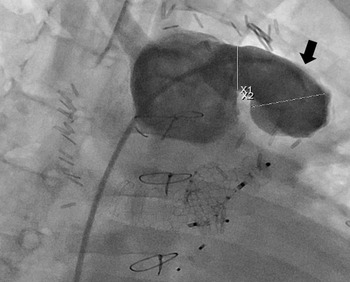
CT chest at age 12 showed slight dilation of the ascending neoaorta. There was no evidence of pseudoaneurysms. At age 14, her parents reported increasing cyanosis, hypoxaemia, and worsening dyspnoea on exertion; thus, she underwent cardiac catheterisation. Angiography demonstrated two aortic pseudoaneurysms at the junction of the patch and native tissue, one measuring 20 x 22 mm and the second 12 x 20 mm arising distal to the left subclavian artery, as well as multiple microscopic and macroscopic left-sided pulmonary arteriovenous malformations with rapid transit of contrast through the left lung (Figure 1). Due to increased risk of an open intervention given multiple previous sternotomies, closure of these pseudoaneurysms was attempted using transcatheter devices.
An angiographic image of the aortic pseudoaneurysm. X1 refers to the neck of the pseudoaneurysm, measuring 13 mm. X2 refers to the diameter of the pseudoaneurysm measuring 21 mm. The black arrow points directly to the pseudoaneurysm.

At age 15, she developed large-volume haematemesis and/or haemoptysis, a generalised tonic-clonic seizure and a witnessed cardiac arrest. Resuscitative efforts resulted in return of spontaneous circulation prior to arrival to an outside hospital. Bronchoscopy on hospital day 2 demonstrated petechiae in the large airways without active bleeding, brown-black secretions, and no abnormal vascular lesions within the airways or pharynx. Esophagogastroduodenoscopy was deferred due to stable haemoglobin and risk of destabilisation. Post-arrest MRI demonstrated diffuse hypoxic-ischemic brain injury and her electroencephalography progressed to diffuse, poorly organised background. Her neurological exam was consistent with a devastating brain injury with minimal chance of recovery. Following family discussions, the decision was made to withdraw life-prolonging therapies. The patient then had large-volume haemoptysis that prevented adequate ventilation, and the decision was made to stop mechanical support. Autopsy revealed extensive acute alveolar haemorrhage, friable gastric polyps, oesophageal varices, and portal vein thrombosis. Additionally, the more proximal and larger pseudoaneurysm arose adjacent to the Carrel patch and the second was just distal to the distal anastomosis. While external thrombus was seen adjacent to the occlusive device within the pseudoaneurysms, there was no communication from either pseudoaneurysm to the lung.
Discussion
Hereditary haemorrhagic telangiectasia, also known as Osler-Weber-Rendu syndrome, is an autosomal dominant disorder affecting 1 in 5,000–8,000 people and is characterised by telangiectasias and arteriovenous malformations. A clinical diagnosis is made via Curacao criteria when a patient has at least three of the following: (1) spontaneous and recurrent epistaxis, (2) multiple mucocutaneous telangiectasias, (3) visceral arteriovenous malformation, and (4) family history of a first degree relative with hereditary haemorrhagic telangiectasia.Reference Shovlin, Guttmacher and Buscarini1 Genetics studies of this disorder have revealed three primary disease-associated genes: Endoglin, activin receptor-like kinase 1 (ALK1,ACVRL1), and SMAD4 (juvenile polyposis/hereditary haemorrhagic telangiectasia syndrome). The products of all three genes modulate transforming growth factor-β signalling. SMAD4 loss-of-function variants represent the small minority < 2% of cases.Reference Heald, Rigelsky and Moran2 To our knowledge, this is the first report of a patient with a pathogenic SMAD4 pathogenic variant, aortopathy, and single ventricle CHD.Reference Heald, Rigelsky and Moran2 The patient in this report met diagnostic criteria for hereditary haemorrhagic telangiectasia as she had epistaxis, telangiectasias, and visceral (pulmonary) arteriovenous malformations. Furthermore, her pathology aligned with her genetic diagnosis. The concurrent presentation of juvenile polyposis syndrome and hereditary haemorrhagic telangiectasia is highly associated with SMAD4 mutation.Reference Teekakirikul, Milewicz and Miller3–Reference Gallione, Repetto and Legius4 Although autopsy did not reveal a definitive cause of haematemesis / homoptysis, it is our belief that it may have been secondary to acute pulmonary haemorrhage from fragile pulmonary arteriovenous malformations in the setting of aorto-pulmonary collaterals associated with her single ventricle heart disease.
While genetic testing for infants with CHD has become more common, there was no definitive protocol for genetic testing in place at the time of this child’s birth. A chromosomal SNP microarray, a commonly employed genetic screen when the patient was born, was ultimately performed when the patient was 12 years of age and did not identify the mutation. The SMAD4 mutation was only identified on a subsequent hereditary high-risk colon cancer genetic panel, performed for cause after the diagnosis of gastric polyps. Although identification of the genetic diagnosis at birth may have helped clinicians to anticipate subsequent complications, it is difficult to know whether an earlier genetic diagnosis would have fundamentally altered care.
A relationship between SMAD4 and hereditary haemorrhagic telangiectasia with aortopathy has been established in case series and reports.Reference Heald, Rigelsky and Moran2–Reference Blatter, Tschupp and Aretz5 Neoaortic dilation following staged palliation of single ventricle heart disease has been demonstrated and is recognised as a source of morbidity, but no direct causation has been determined.Reference Kojima, Kuwata and Kurishima6–Reference Cohen, Marino and McElhinney8 Given this association, the presence of neoaortic aneurysm formation requiring surgical repair in this case did not initially raise clinical suspicion for a genetic aortopathy; however, reports of the SMAD4 phenotype highlighted this possibility in this patient. Once the patient was diagnosed with SMAD4-associated juvenile polyposis syndrome / hereditary haemorrhagic telangiectasia, the presence of aortopathy was consistent with the reported associations.
Fontan physiology is associated with complications, including arteriovenous malformations, but this is the first report of juvenile polyposis syndrome/ hereditary-hemorrhagic telangiectasias in a child with SMAD4 pathologic variant and Fontan physiology. The patient required multiple aortic interventions and ultimately succumbed to haemorrhagic complications of her disease. Although neoaortic dilation and arteriovenous malformations can be seen in patients with Fontan physiology, they may represent additional pathogenic mechanisms with extra-cardiac implications. This case highlights the importance of extra-cardiac evaluation and genetic testing, particularly in children with diagnosed or suspected syndromes, as these patients may be at increased risk of life-threatening complications.
Acknowledgements
None.
Financial support
This research received no specific grant from any funding agency, commercial, or not-for-profit sectors.
Competing interests
None.
IRB/Consent statement
Neither informed consent nor IRB approval was obtained for this case report because neither is required for a case report per institutional guidelines.