Introduction
The Atlantic croaker Micropogonias undulatus Linnaeus 1766 is a demersal sciaenid fish present in the Gulf of Mexico and in the western Atlantic Ocean (Chao & Musick, Reference Chao and Musick1977; Mercer, Reference Mercer1987). Implementation of proper fisheries management for M. undulatus is necessary in the United States due to the commercial and recreational importance of this fish species in this country. It is now understood that Atlantic croaker, referred to as ‘croaker’ in the following text, in the Gulf of Mexico comprise a separate stock from those in the western North Atlantic (Lankford et al., Reference Lankford, Targett and Gaffney1999). However, historical fluctuations in croaker landings from the east coast of the USA have led to an increased concern for the fate of the croaker fishery (Haven, Reference Haven1957; Joseph, Reference Joseph1972; Mercer, Reference Mercer1987; ASMFC, 2005), and thus, the need to understand the Atlantic croaker stock structure in the western North Atlantic Ocean. Numerous studies, using a variety of methods, have been performed over the past 30 years to investigate such stock structure in this area, but a lack of uniformity in the results of these studies left the status of croaker stock structure unresolved. Artificial tag and recapture studies yielded inconclusive results due to low recapture rates (Swartz et al., Reference Swartz, Davidson, Simpson, McAdams, Sandoy, Duncan and Mason1979; Music & Pafford, Reference Music and Pafford1984). Over the years, morphometric and meristic analyses concerning croaker stocks have yielded conflicting results: Initially, White & Chittenden (Reference White and Chittenden1977) noted the possible presence of two stocks of croaker along the eastern coast of the United States, based on the differing life histories of the fish north and south of Cape Hatteras, North Carolina (NC). Although the results of a similar study by Ross (Reference Ross1988) corroborated White & Chittenden's findings, Barbieri et al. (Reference Barbieri, Chittenden and Jones1994) were unable to confirm the presence of two stocks by studying croaker life history within the Mid Atlantic Bight (MAB). Sullivan (Reference Sullivan, Ross, Devries, Hawkins and Sullivan1986) performed a biochemical analysis of a suite of proteins from croaker in the MAB and the South Atlantic Bight (SAB), and though the results were inconclusive, the author could not discount the possible existence of two stocks of croaker. Thorrold et al. (Reference Thorrold, Jones and Campana1997) performed the only study incorporating elemental otolith analysis to the question of croaker stock structure in the western North Atlantic Ocean, the results of which supported the presence of a single stock. However, results remained inconclusive because the sample sites chosen by these authors to represent waters south of Cape Hatteras were located in the Neuse River, which should not be considered south of Cape Hatteras as it is contiguous with all North Carolina sounds. Genetics were applied to the problem of croaker stock structure on two separate occasions. Lankford et al. (Reference Lankford, Targett and Gaffney1999) analysed the mitochondrial DNA (mtDNA) of croaker in the western North Atlantic Ocean and the results supported the presence of a single stock. However, due to the low resolution of mtDNA in distinguishing groups of organisms that have extremely low levels of mixing between them (Lankford et al., Reference Lankford, Targett and Gaffney1999; Cadrin et al., Reference Cadrin, Friedland and Waldman2005), the presence of two croaker stocks was not discounted. Later, Lankford & Targett (Reference Lankford and Targett2001) assessed the inherited physiological tolerances, specifically cold tolerance, of newly recruited juvenile croaker along the east coast of the USA and the results supported the presence of a single croaker stock in the western North Atlantic Ocean.
We decided to use parasites as biological tags in order to complement this array of studies because parasites have been used effectively as biological makers of fish stocks (Lester, Reference Lester1990; Williams et al., Reference Williams, Mackenzie and McCarthy1992; Mackenzie & Abaunza, Reference Mackenzie and Abaunza1998; Lester et al., Reference Lester, Thompson, Moss and Barker2001; Cadrin et al., Reference Cadrin, Friedland and Waldman2005). Our goal was to identify the presence of putative separable croaker stocks and to determine their geographic boundaries along the eastern coast of the United States.
Materials and methods
Fish collection
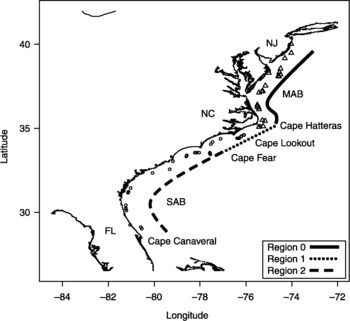
A total of 487 Atlantic croaker were collected in the autumn (September and October) and spring (April) seasons, from autumn 2002 through autumn 2004. Fish were collected via two trawling efforts: with the R/V Albatross IV (National Marine Fisheries Service, Woods Hole) from Atlantic City, New Jersey (NJ) (40°02′68″N, 82°22′91″W) to Cape Hatteras (35°09′61″N, 75°35′69″W), and with the R/V Lady Lisa (Southeastern Atlantic Marine Assessment Program, South Carolina Department of Natural Resources) from Cape Hatteras to Cape Canaveral, Florida (FL) (29°01′22″N, 80°52′51″W) (fig. 1). Collected croaker ranged from 111 to 242 mm standard length (SL) and 0–5 years of age. The targeted size range (125–255 mm SL) was chosen in order to have data comparable with the study by Thoney (Reference Thoney1993), the only previous comprehensive study of the croaker parasite community performed within a portion of the study area (33°50′N–39°00′N). Captured fish were packaged individually in aluminium foil or plastic bags and frozen at − 20°C on board. Upon thawing in the laboratory, the total length (TL) and SL of each fish were measured, the sex of each fish recorded, and the otoliths were collected for croaker age determination. However, due to the temporal and environmental differences in spawning between the MAB and SAB, ages calculated from otolith annuli were, in fact, dissimilar. In the MAB the time of recruitment of the larvae from the coastal waters is approximately 6 months earlier than that in the SAB. In the MAB, Atlantic croaker fail to deposit a well-formed annulus after their first winter, resulting in the laying down of the first annulus 18 months after birth, the midpoint of the spawning season, which in this case is 1 September (Barbieri et al., Reference Barbieri, Chittenden and Jones1994). In the SAB, for most Atlantic croaker, the first annulus is laid down at an age of 14 months, using 1 February as a birth date (Warlen, Reference Warlen1982). For the study herein, croaker ages were estimated based on month and location of capture and on the presence/absence of an otolith annulus. For ‘age 0’ fish (no annulus), age in months was merely the number of months from the birth date to the date of capture. For ‘age 1’, the deposition of the first annulus occurred in the second March after birth for MAB fish and the first April after birth for SAB fish.
Chart of Atlantic coast of USA depicting all sampling sites and the three geographical regions used in the canonical correspondence analysis. Open triangles denote samples made by the R/V Albatross IV, open circles denote samples taken by the R/V Lady Lisa.

Parasite collection
Each fish was thoroughly examined for macroparasites: the skin, eyes, nares, mouth, heart, swimbladder, kidney, mesentery, muscle, liver, gall bladder and gastrointestinal tract from the oesophagus to the rectum. Gonads were not examined because of their small size in the targeted fish. Macroparasites were collected, identified to the lowest possible taxon, enumerated (except for turbellarians, larval nematodes, larval cestodes and metacercariae) and their location documented.
Parasite processing and identification
Parasites were processed, stored, stained and mounted using standard techniques. Parasite identification was carried out following Yamaguti (Reference Yamaguti1958, Reference Yamaguti1959, Reference Yamaguti1961, Reference Yamaguti1963a, Reference Yamagutib), Khalil et al. (Reference Khalil, Jones and Bray1994), Amin (Reference Amin1998), Anderson (Reference Anderson2000), Gibson et al. (Reference Gibson, Jones and Bray2002) and Jones et al. (Reference Jones, Bray and Gibson2005). Primary literature and experts were consulted when necessary.
Tag selection
Due to the paucity of spring samples north of Cape Hatteras, NC, only parasites from fish caught in the autumn seasons from 2002 to 2004 were analysed for tag selection. The 323 fish ranged from 111 to 231 mm SL and 8–25 months old. A canonical correspondence analysis (CCA) (Legendre & Legendre, Reference Legendre and Legendre1998) was performed using all macroparasite species found (or upper level taxa if species could not be identified). The CCA was used to compare the parasite community of Atlantic croaker with respect to geography, based on the various abiotic (temperature, salinity, depth, latitude) and biotic (host SL, sex, and age) variables associated with each site (host fish), and to determine which of the abiotic and biotic variables had the most influence in determining the overall parasite community structure. For the analysis, the area was divided into three regions (fig. 1): ‘Region 0’ corresponded to the MAB and covered the area from Atlantic City, NJ (40°02′68″N), to Cape Hatteras (35°09′20″N). These boundaries were chosen for region 0 because of the consistent life history parameters of Atlantic croaker in this region (White & Chittenden, Reference White and Chittenden1977; Ross, Reference Ross1988) and larval movement according to flow regimes in that area (Grothues et al., Reference Grothues, Cowen, Pietrafesa, Bignami, Weatherly and Flagg2002). Furthermore, the southernmost point of region 0, Cape Hatteras, was used for demarcation due to its status as a biogeographical barrier (Engle & Summers, Reference Engle and Summers1999; Burke et al., Reference Burke, Monaghan and Yokoyama2000). ‘Region 1’ extended from Cape Hatteras to Cape Fear, NC (33°50′01″N), because this region has been referred to as a biogeographical transition zone due its water current patterns (Fornshell et al., Reference Fornshell, Frydenlund and Christensen1984). Further, in winter, young croaker migrate from the MAB to North Carolina waters, moving as far south as Cape Lookout (Haven, Reference Haven1959), which is slightly north of Cape Fear (fig. 1); therefore, some mixing of stocks may occur within this region. ‘Region 2’ constituted the southernmost region of the study area, south of Cape Fear, NC, to Cape Canaveral, FL (29°01′22″N). Also, since previous studies revealed differences in the life history patterns of the Atlantic croaker in the MAB and SAB (White & Chittenden, Reference White and Chittenden1977; Ross, Reference Ross1988), notably that MAB croaker live longer and reach a larger size at a particular age than SAB croaker, and because it is known that there is a tendency for parasite prevalence and/or intensity to increase with host size and/or age (Lester, Reference Lester1990), we analysed only those croaker that were 0 and 1 year old, based on otolith annuli. An analysis of variance (ANOVA) was used to compare the values extracted from the first canonical axis (CCA1) for regions 0, 1 and 2 in order to estimate the significance of latitude to the macroparasite community of the Atlantic croaker. A linear discriminant analysis was performed to assess the classification of regions 0, 1 and 2.
The CCA was followed by the application of classical criteria for selecting parasites that may be reliable tags (Lester, Reference Lester1990; Williams et al., Reference Williams, Mackenzie and McCarthy1992; Mackenzie & Abaunza, Reference Mackenzie and Abaunza1998). Prevalences (P) and intensities (I), whenever appropriate, were calculated for each parasite, as recommended by Bush et al. (Reference Bush, Lafferty, Lotz and Shostak1997), and the differences between the three regions were compared using the G-test and the Kruskal–Wallis test, respectively (Sokal & Rohlf, Reference Sokal and Rohlf1995). All calculations were performed using the R statistical package (R Development Core Team, 2003). Alpha was set to 0.05.
Results
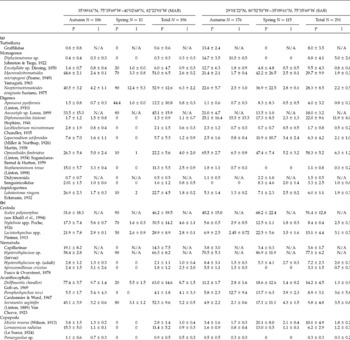
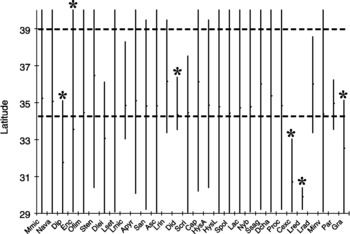
A total of 30 macroparasite species were found during the present study, comprising one turbellarian, four monogeneans, nine digeneans, one aspidogastrean, three cestodes, four nematodes, three acanthocephalans, three copepods and two isopods (table 1a, b). There were a total of 6657 individuals exclusive of turbellarians, larval nematodes, metacercariae and larval cestodes. Mean prevalences and intensities of parasites from croaker collected in the MAB and SAB are reported in tables 1a and 1b. The latitudinal range of each parasite species is reported in fig. 2.
Mean prevalence (P) and mean intensity (I) data for macroparasites of Micropogonias undulatus during the autumn and spring seasons of 2002–2004 in the Mid Atlantic Bight (MAB) and the South Atlantic Bight (SAB). ‘N’ denotes fish sample size. Values are followed by standard error. (a) Turbellarian, monogenean, digenean and aspidogastrean species. (b) Cestode, nematode, acanthocephalan, copepod and isopod species.

Latitudinal ranges of macroparasite species of Micropogonias undulatus: Macrovalvitrematoides micropogoni (Mmic), Neopterinotrematoides avaginata (Nava), Diplectanotrema sp. (Dip), Encotyllabe sp. (Enc), Opecoeloides fimbriatus (Ofim), Stephanostomum tenue (Sten), Diplomonorchis leistomi (Dlei), Lepocreadium setiferoides (Lset), Lecithochirium microstomum (Lmic), Aponurus pyriformis (Apyr), Sanguinicolidae (San), Ascocotyle sp. (Asc), Lobatostoma ringens (Lrin), Didymozoid (Did), Spirocamallanus cricotus (Scri), Capillarid (Cap), Hysterothylacium sp. adult (HysA), Hysterothlacium sp. larvae (HysL), Scolex polymorphus (Spol), Lacistorhynchus spp. (Lac), Nybelinia spp. (Nyb), Serrasentis sagittifer (Ssag), Dollfusentis chandleri (Dcha), Pomphorhynchus rocci (Proc), Cymothoa excisa (Cexc), Livoneca redmanii (Lred), Lernaeenicus radiatus (Lrad), Mixtio inversa (Minv), Paraergasilus sp. (Par), Graffilid (Gra). Dotted horizontal lines represent the limits of the study performed by Thoney (Reference Thoney1993). Solid vertical lines represent the latitudinal range of each individual species. Asterisks denote those species not documented by Thoney (Reference Thoney1993).

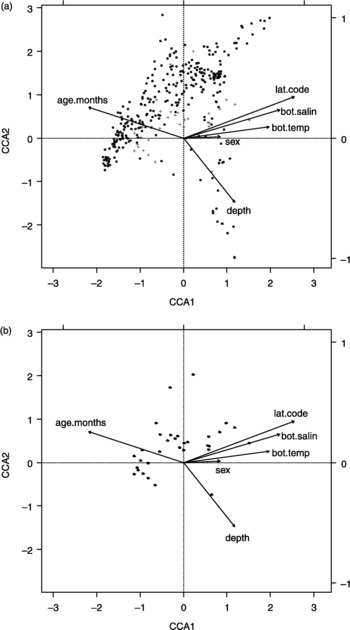
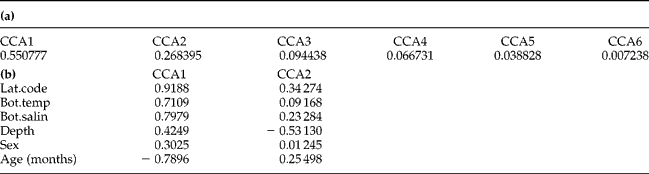
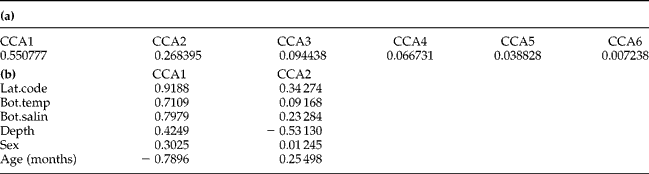
The CCA showed that latitude (categorized as regions 0, 1 and 2) had the highest values of all of the variables tested and had a significant effect on the composition of the macroparasite community of croaker (ANOVA: P < 2.2 × 10− 16). Latitude was followed closely by fish age, expressed in months, and by depth (fig. 3a, b). Due to their nearly perpendicular relationships, each of these three variables was considered independent of each other: fish ages were not different between regions or depths, and trawling depth did not change significantly between geographic regions. Bottom temperatures and salinities followed similar trends to those of latitude, and host gender had a non-significant effect on the macroparasite community of Atlantic croaker. The eigenvalues showed the amount of variance explained by each CCA axis (table 2a). Importantly, axes one and two explained a combined 81.9% of the variance in the species matrix, i.e. elucidating which parasites were found on which fish. The bi-plot scores for constraining variables showed the relationship of each variable to each axis (table 2b). Latitude was highly positively correlated with CCA1 with a value of 0.9188, followed by bottom temperature, bottom salinity, and age, which was negatively correlated with the axis. The other two variables, sex and depth, had much lower correlation coefficients with CCA1. The second axis, CCA2, was best explained by depth, which was negatively correlated to the axis ( − 0.5313). Thus, latitude, divided into regions 0, 1 and 2, was the most important factor involved in shaping the distribution of the parasite species in Atlantic croaker, compared to other variables.
Resultant plot of the canonical correspondence analysis performed using all 30 macroparasites from only those croaker collected during the autumn. (a) Parasites and fish. Individual fish represented by open circles and individual macroparasites represented by crosses. (b) Parasites only; individual parasite species represented by solid black points.

Results of canonical correspondence analysis (CCA) incorporating all 30 macroparasite species found parasitizing Micropogonias undulatus. Lat.code, latitude; Bot.temp, bottom temperature; Bot.salin, bottom salinity; Depth, trawling depth; Sex, sex of fish; Age (months), age of fish in months. CCA refers to an axis. (a) Eigenvalues for constrained axes; (b) biplot scores for constraining variables.
In the linear discriminant analysis, regions were discriminated on the basis of parasite abundance (F 62.578 = 5.63, P < 0.0001). Fourteen of the 30 parasite species representing linear combinations of independent variables showed P values less than 0.05 when analysed using regions 0, 1 and 2 as the grouping variable. The 14 parasites in order from greater to lesser contribution were as follows: the graffilid turbellarian, Dollfusentis chandleri, Ascocotyle sp., Serrasentis sagittifer, Cymothoa excisa, capillarid nematodes, Diplectanotrema sp., Stephanostomum tenue, Macrovalvitrematoides micropogoni, Lernaeenicus radiatus, Opecoeloides fimbriatus, Nybelinia sp., Hysterothylacium sp. larvae and Paraergasilus sp.
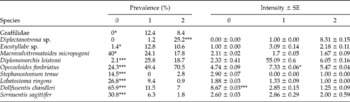
Of the 30 macroparasites found on the croaker, 15 were considered putative tags after qualitative evaluation: the turbellarian; the monogeneans M. micropogoni, N. avaginata, Diplectanotrema sp. and Encotyllabe sp.; the digeneans S. tenue, O. fimbriatus, D. leistomi and L. setiferoides; the aspidogastrean L. ringens; the nematode S. cricotus; the acanthocephalans D. chandleri, S. sagittifer and P. rocci; and the copepod M. inversa. G-tests revealed significant differences in prevalence among 10 out of the 15 parasites cited above with respect to the regions 0, 1 and 2, respectively (table 3). The non-parametric Kruskal–Wallis test revealed significantly different intensities among the three regions for O. fimbriatus and D. chandleri (table 3).
Mean prevalence (P) and mean intensity (I) data for the ten parasite tags in regions 0, 1 and 2.

*P < 0.05; **P < 0.001; ***P < 0.0001.
Discussion
The present study extended the range of the known macroparasite community of offshore Atlantic croaker northward to Atlantic City, NJ, and southward to Cape Canaveral, FL, with a few subtle differences discussed below (fig. 2). In addition, M. undulatus represented a new host record for 5 of the 30 macroparasites found in the present study: one turbellarian, two monogeneans (Encotyllabe sp. and Diplectanotrema sp.), one didymozoid, and one acanthocephalan (Pomphorhynchus rocci). The monogenean Diplectanotrema sp. is new to science and is currently being described (Baker & Euzet, Reference Baker and Euzetin prep.). Differences in the macroparasite community of croaker between the present study and that performed by Thoney (Reference Thoney1993) lie in the level of identification of a few parasites: Thoney reported sanguinicolids from the genus Cardicola, whereas the sanguinicolids we found, although confirmed to belong to one single species yet to be identified, did not belong to the genus Cardicola (S.A. Bullard, USM, personal communication). Further, in the present study only one species of Opecoeloides (O. fimbriatus) was found in the croaker, whereas Thoney reported both O. fimbriatus and O. vitellosus. Additionally, whereas Thoney reported nematodes of the genus Capillaria, we did not identify worms that could have been placed in this genus past the level of subfamily, due to the absence of male specimens, which are considered necessary at such a fine level of identification (F. Moravec, ASCR, personal communication). Finally, adult nematodes of the genus Hysterothylacium were found in the intestine of the croaker as per Thoney, but the rarity of specimens encountered in the present study prohibited identification of these worms to the species level with certainty, whereas Thoney reported H. fortalezae in his study.
The effect of fish age on parasite community structure did not interfere with the CCA analysis because differences in fish age occurred within the geographical regions as opposed to between those regions, i.e. the ages of fish varied more within either region 0, 1 or 2 than between all three regions. Although depth had an effect on croaker parasite community, there was no significant difference in depths trawled between the three designated regions and, as with fish age, the differences in depth occurred within each region. Therefore, neither fish age nor trawling depth were considered to bias the analysis. Additionally, the cloud of points representing the host fish (fig. 3a) closely parallels the latitude vector, thus exhibiting that the sampling regime in this study was appropriate. Changes in temperatures and salinities followed similar trends of the changes in latitudes. This is easily explained since the MAB is known to have lower temperatures than the SAB due to its colder current systems, with the southward flowing Labrador Current bringing cold arctic waters to the MAB. The northward moving Gulf Stream carries warm tropical waters into the SAB from the Caribbean Sea (Siedler et al., Reference Siedler, Church and Gould2001). This warm water is deflected into the northern Atlantic Ocean by the capes of North Carolina, notably Cape Hatteras (Savidge, Reference Savidge2004). However, the fact that latitude was found to be the determining factor in the macroparasite community of the Atlantic croaker in the western North Atlantic Ocean shows that factors likely associated with the life history of the Atlantic croaker are responsible for shaping this community, and thus supports the idea of separable stocks in this area. The use of three regions in classifying the parasites geographically was supported by the linear discriminant analysis that revealed a significant correlation between parasite fauna and geographical regions in the present study.
Using qualitative criteria listed by Lester (Reference Lester1990), Williams et al. (Reference Williams, Mackenzie and McCarthy1992) and Mackenzie & Abaunza (Reference Mackenzie and Abaunza1998), 15 macroparasites were considered putative tags and 15 were discounted because they were considered inappropriate to serve as tags for this study. The 15 parasites discounted were: the digeneans Aponurus pyriformis, Ascocotyle sp., Lecithochirium microstomum, the sanguinicolids, and the didymozoids; the cestodes Scolex polymorphus, Nybelinia sp. and Lacisthorhynchus sp.; the nematodes Hysterothylacium sp. (larval and adult) and the capillarids; the copepods Paraergasilus sp. and L. radiatus; and the isopods C. excisa and L. redmanii. The various reasons for this discount were as follows. Four of these 15 species were rare with prevalences below 5% in each region (two digeneans, L. microstomum and A. pyriformis; one nematode, adult Hysterothylacium sp.; and one copepod, Paraergasilus sp. – see tables 1a and b). The metacercariae of digeneans of the genus Ascocotyle were not identified to species level and, because of the lack of host specificity of individuals belonging to this genus and the possibility of the presence of a complex of species (Sholz et al., Reference Sholz, Vargas-Vázquez, Aguirre-Macedo and Vidal-Martínez1997), they were not considered an appropriate tag. Sanguinicolids were also discounted due to their delicacy and the unreliability in finding specimens. Since these parasites inhabit the blood circulatory system, we had to make the assumptions that only those individuals in the immediate vasculature of major organs were recovered and that others in deeper circulation were likely not recovered from fish that had been frozen. As a result of difficult recovery and identification of specimens, several parasites were discounted: didymozoids were difficult to isolate intact from within the walls of the pyloric caecae and intestines, and are very difficult to identify. Further, it is known that a single host may be infected with more than one species (Nikolaeva, Reference Nikolaeva1985), which precluded them from being appropriate tags in this study. Similarly, the small thread-like nematodes of the subfamily Capillariinae were not considered appropriate tags; according to F. Moravec (ASCR, personal communication), proper identification should not be based on female specimens alone. Since males are small and rare, and females are difficult to detect, these parasites could not be used here as biological tags. The mesentery-dwelling larvae of Hysterothylacium sp. were considered inappropriate tags due to the combination of their consistently high intensity, the difficulty of identification of the worms, and the likely presence of more than one species. The trypanorhynch larvae of the genera Nybelinia and Lacistorhynchus and another larval cestode, Scolex polymorphus, were not considered appropriate tags because specimens were difficult to detect and made fragile by the post-freezing process. The copepod L. radiatus was discounted as a putative tag due to previous documentation of this species altering host behaviour (Voorhees & Schwartz, Reference Voorhees and Schwartz1979). Finally, the two species of isopods were discarded from being putative tags because of the lack of a tight association with their host. It is highly probable that some, and perhaps many, isopods had fallen from their hosts and/or moved from host to host during capture, and thus, prevalence and intensity data were not considered reliable. Furthermore, L. redmanii induced notable destruction of the croaker gills (Lima et al., Reference Lima, Chellappa and Thatcher2005), and obviously pathogenic species should not be considered appropriate tags (Lester, Reference Lester1990; Williams et al., Reference Williams, Mackenzie and McCarthy1992; Mackenzie & Abaunza, Reference Mackenzie and Abaunza1998).
The other 15 macroparasites found in this study were all considered putative tags (see Results). However, only 10 of those 15 parasites exhibited differences in prevalence and/or intensity with latitude, demonstrating the presence of two stocks of Atlantic croaker in the western North Atlantic, one stock in the MAB and another in the SAB (table 3). These 10 tags are: the graffilid turbellarian, three monogeneans, Diplectanotrema sp., Encotyllabe sp. and M. micropogoni; three digeneans, D. leistomi, O. fimbriatus and S. tenue; one aspidogastrean, L. ringens; and two acanthocephalans D. chandleri and S. sagittifer. Of the 14 parasites that, according to the linear discriminant analysis, supported the three-region classification, 7 were among these 10 final parasite tags used to discriminate between croaker stocks.
Turbellarians have rarely been reported as parasites of teleosts (Cannon & Lester, Reference Cannon and Lester1988; Jennings, Reference Jennings1997). Although the life cycle of parasitic turbellarians is poorly understood, the general consensus is that these parasites have direct life cycles requiring a free-living stage (Kent & Olsen, Reference Kent and Olsen1986; Cannon & Lester, Reference Cannon and Lester1988). Although turbellarians may be considered commensal by some authors, histological examination revealed the invasive nature of the worms infecting the Atlantic croaker. Similarly to parasitic turbellarians of the genus Paravortex reported by Cannon & Lester (Reference Cannon and Lester1988), the turbellarians found on the Atlantic croaker were on the gills and in the nares and were identified as members of the family Graffilidae. The species was not identified and could be new to science. The complete absence of this parasite in the MAB (region 0) in both the present study and that by Thoney (Reference Thoney1993) supported the presence of two stocks of croaker in the MAB and SAB.
Three monogeneans infecting M. undulatus also support the existence of two croaker stocks. Macrovalvitrematoides micropogoni inhabit the gills of the croaker, whereas Diplectanotrema sp. and Encotyllabe sp. live in the oesophagus and pharyngeal teeth, respectively. Unlike M. micropogoni, neither Diplectanotrema sp. nor Encotyllabe sp. were reported by Thoney (Reference Thoney1993). Since Thoney's study area was limited to our regions 0 and 1, with the southernmost collections made at Cape Fear, the absence of these two monogeneans in Thoney (Reference Thoney1993) supported our current data. It is possible that the low or non-existent prevalences of specimens of Encotyllabe sp. (1.4%) and Diplectanotrema sp. (0.0%), respectively, north of Cape Hatteras was a reflection of the limits of the environmental tolerances of these two species, since monogeneans are known to be sensitive to temperature (Bychowsky, Reference Bychowsky and Hargis1957). However, the two other gill monogenean species infecting the Atlantic croaker, M. micropogoni and N. avaginata exhibited in the MAB (region 0) prevalences and intensities greater than or equal to those of the SAB (regions 1 and 2), showing that some species of monogeneans can withstand a broad range of temperatures. Further, two specimens of Encotyllabe sp. were found in the MAB, one slightly north of Cape Hatteras (36°12′40″N) and the other at the northernmost limit of this study (40°02′68”N). Thus, it cannot be assumed that the absence of Diplectanotrema sp. and the extremely low prevalence of Encotyllabe sp. north of Cape Hatteras were due to cold intolerance. Alternatively, the unequal prevalences and intensities of M. micropogoni, Diplectanotrema sp. and Encotyllabe sp. between the MAB and SAB may be explained by the sequestration of respective croaker stocks separated at Cape Hatteras. Furthermore, if those fish harbouring the gill monogenean M. micropogoni, had undergone a thorough amount of mixing between the MAB and SAB, one would expect the prevalence of that species to be more homogeneous along the eastern seaboard of the United States.
The three digeneans, Diplomonorchis leistomi, Opecoeloides fimbriatus and Stephanostomum tenue, also demonstrated the presence of two stocks of M. undulatus. Parasites with indirect life cycles, such as digeneans, can be extremely informative as biological tags when the life cycle is as well understood as it is for S. tenue (Martin, Reference Martin1939). Importantly, hosts of different life stages of this species are present throughout the range of the study (Stunkard, Reference Stunkard1961; McGladdery et al., Reference McGladdery, Murphy, Hicks, Wagner, Perkins and Cheng1990; Olivera & Campbell, Reference Olivera and Campbell1998). Unlike D. leistomi and O. fimbriatus, S. tenue was significantly more prevalent in the MAB (region 0) than the SAB (regions 1 and 2) (table 3). However, the opportunity for the completion of the life cycle of this species still exists in both the MAB and SAB, and thus differences in prevalences of this digenean in the croaker in these two regions likely reflect the presence of two stocks in these two areas. The life cycle of D. leistomi is not known and further interpretation of the higher prevalence of this parasite in the SAB (25.8 and 18.7% versus 2.0% in MAB) is not possible, but nevertheless reflects the possibility of two stocks of croaker. Similarly, the complete life cycle of O. fimbriatus is unknown, although various species of second intermediate hosts and definitive hosts have been identified (Kruse, Reference Kruse1959). Therefore it is not possible to entirely understand the lower prevalence of this parasite north of Cape Hatteras and the maintenance of equal intensities in region 0 and region 2 (table 3) However, in similar studies, such unequal prevalences were attributed to differences in host diet between regions, thus indicative of separate host stocks (Moles et al., Reference Moles, Heifetz and Love1998; Timi, Reference Timi2003).
A very commonly reported aspidogastrean (see Hendrix & Overstreet, Reference Hendrix and Overstreet1977), Lobatostoma ringens, was not present throughout the range of this study. Despite its poorly understood life cycle, the absence of L. ringens from the MAB supports the presence of two stocks of M. undulatus. Similarly, the acanthocephalans, D. chandleri and S. sagittifer were very common, and numerous hosts have been recorded along the coast of the USA for each of these species (Amin, Reference Amin1998). The significantly higher prevalence (65.9%) and intensity (8.67 ± 0.03) of adult D. chandleri and the higher prevalence (30.8%) of cystacanths of S. sagittifer in the MAB support the presence of two stocks of croaker, since these numbers would not be significantly different from each other if croaker were undergoing regular migrations between the MAB and SAB (table 3).
Finally, when looking at table 3, one can address the role of Cape Hatteras as a biogeographical boundary to croaker stocks. Diplectanotrema sp. was the only parasite that exhibited significantly different prevalence values in regions 1 and 2, both of which belong to the SAB, and region 1 (the small area between Cape Hatteras and Cape Fear) seemed to act as a transition zone, as shown by the prevalence of three parasites: the monogenean M. micropogoni, the digenean O. fimbriatus, and the aspidogastrean L. ringens. All other parasite tags indicated that Cape Hatteras appeared to serve as a more demonstrable boundary to croaker stocks on the east coast of the USA, since prevalences were significantly higher or lower in the MAB (region 0) than in the SAB (regions 1 and 2). However, it should be noted that this analysis only considered Atlantic croaker collected in the autumn, and that the boundary at Cape Hatteras may not be as well defined in colder seasons, such as spring and winter, due to the southward migration of warm-water-seeking croaker from the MAB, and thus revealing a more transitory role of region 1. If this were the case, then Cape Fear or Cape Lookout could be considered the boundary to croaker stocks, instead of Cape Hatteras.
Acknowledgements
The authors wish to thank Erin Levesque and Gina Perez from the Inshore Fisheries Division of South Carolina Department of Natural Resources (SCDNR) for fish collection aboard the R/V Albatross and otolith processing, respectively; Pearse Webster from SCDNR-Southeastern Marine Assessment Program for fish collection aboard the R/V Lady Lisa; Professors Louis Euzet and Jean-Paul Trilles from the Université de Montpellier II, France for their help with the identification of monogeneans and isopods, respectively; Stephen A. Bullard from the University of Southern Mississippi, Dr Frantisek Moravec from the Academy of Sciences of the Czech Republic (ASCR), and Dr Erik Sotka from the College of Charleston for their advice with the sanguinicolid digenean, nematodes and turbellarian, respectively; Peter Chase and William Kramer from the Fisheries Independent Survey Group at the Northeast Fisheries Science Center NMFS/NOAA for providing croaker samples and environmental data, respectively, from the R/V Albatross IV efforts; The South Carolina Agricultural Society and Joanna Deep Water Fund for funding through the College of Charleston, and the NMFS/NOAA grant #NA17FF2885 for funding of this project.