On a summer evening in 1769, Parma's Teatro Ducale was transported to ancient Greece by the power of song. It happened during the first Italian performance of Gluck and Calzabigi's Orfeo ed Euridice, just as Orfeo was declaiming the recitative preceding the famous aria ‘Che farò senza Euridice?’ Years later, one writer recounted how ‘the singer had managed to colour his voice so well’ that every listener was moved to tears: ‘I realised that here, too, we could achieve the same effects as in Greek music.’Footnote 1 In this story the singer transformed into a real-life Orpheus, evoking with his voice a time and place where music had been a moral force, not to mention a political one.Footnote 2
But the narrator of the anecdote was no mere spectator. The Orfeo he describes was, in fact, himself: the castrato Vito Giuseppe Millico. Millico had long since risen to fame as a castrato of sensibility, thanks to that very Orfeo in Parma and another in London (1773); indeed, after the Parma performance he had become Gluck's go-to primo uomo, creating the male lead in Paride ed Elena (Vienna, 1770) and accompanying the composer to Paris to assist with the French revision of Orfeo ed Euridice (as Orphée et Eurydice, 1773–4).Footnote 3 Without explicitly revealing his own Orphic connection to Parma, Millico told the tale in the preface to the printed score for his opera La pietà d'amore (Naples, 1782), as an intervention in local debates on theatrical reform. Gluck and Calzabigi's operas had been introduced to Naples in the 1770s, beginning with two separate productions of Orfeo ed Euridice in 1774 at the Palazzo Real and San Carlo, and productions of their other works soon followed (albeit with many revisions in light of audience expectations). Calzabigi himself returned in 1779 to Naples, where he and Millico collaborated on several works in the early to mid-1780s. By the time Millico published his preface in 1782, Orfeo ed Euridice functioned as a metonym for progressive operatic aesthetics in Naples. Unsurprisingly, then, in his preface Millico reiterated the major points of Gluck and Calzabigi's reforms – even while proffering an apologia for having contravened them in his music – and borrowed liberally from popular treatises by Neapolitan literati Antonio Planelli (Dell'opera in musica, 1772) and Saverio Mattei (La filosofia della musica, c.1774).Footnote 4
More than just an homage (and mea culpa) to Gluck and Calzabigi, however, Millico's Orphic tale served as the opening gambit for his own theory of voice. The unnamed Orfeo singer seemed an antidote to the virtuosic voices of opera seria, offering the possibility of reforming opera by tethering voice to feeling. Thus his anecdote of the Parmesan Orfeo provided the origin story for a new mode of voice: it established that Orpheus had returned to Italy after the long exile imposed by Metastasian opera seria, bringing with him a mythical voice that could save opera from itself.
Voice was becoming an ever-more-critical nexus of the tensions surrounding ‘serious’ (i.e., non-comic) opera in late eighteenth-century Italy. Such tensions stemmed from deeper concerns about Italy's continued domination by foreign powers, as well as the diminishing authority abroad of Italian cultural products in the realms of poetry and philosophy.Footnote 5 Even the composition of Italian-language operas had long since become a cosmopolitan rather than predominantly Italian endeavour, in that works by foreigners from Hasse to Gluck to Mozart regularly appeared alongside those by Italian composers in Europe's opera houses. The Italian peninsula, especially the musical centres of Naples and Venice, still excelled at producing singers for those houses, churning out astonishing and virtuosic voices. Yet many of those musical centres were also home to vibrant reformist currents, meaning that such virtuosic voices increasingly grated against the Anglo-French-inflected theatrical aesthetics of the Enlightenment. Illuministi such as the Verri brothers and Saverio Bettinelli in the north, and more moderate critics such as Antonio Planelli and Saverio Mattei in the south, articulated a longing not for wonder but for immediacy and feeling.Footnote 6 Some would-be reformers of serious opera in Italy soon recognised that, in order to connect with the growing demand for expressive verisimilitude, they would have to renegotiate the role of voice within the opera house. As Enlightenment epistemologies of feeling converged with Hellenistic neoclassicism, reformist singers and literati looked to rebrand Italy's most famous cultural export as an agent of moral edification.
Among such reimaginings of the operatic voice in the latter half of the Settecento, two disparate yet intertwined approaches emerged. These approaches can be conceptualised as ‘modes’, in the literary sense, in that they are identified better by distinguishing elements of discourse and practice rather than by outright generic convention. I read them here through several different contexts and media, but focus on a few examples that responded directly to the implications of Millico's Orphic turn in 1769. The first of the two modes I call the ‘lyric’ voice, which was rooted in the Orphic self-fashioning and discourses of sensibility laid out by Millico in the preface to La pietà d'amore. The second mode I call the ‘epic’ voice, for its proponents’ focus on the civilising power of foundational myths; many literati were hesitant to relinquish their grip on moral and artistic agency, and so such writers as Carlo Rezzonico and Alessandro Verri repositioned singers as mouthpieces for the poet's (Homeric) voice. These two nascent ideologies of voice were overlapping and yet incompatible. Each offered a way to solve the voice problem: in a musical culture that vigorously criticised the agency of singers within the opera house, how could voice, the primary medium of opera, be redeemed? The lyric mode portrayed voice as the audible expression of an individual feeling subject with claims to political agency, whereas the epic mode required that voice be reined in, sundered from individualised expression, and turned towards a civilising purpose – no longer a tyrant, but a public servant.
The Orfeo act
The 1769 Parma Orfeo ed Euridice provided the perfect backdrop for Millico's vocal theory: it featured a score that Gluck himself had reworked in order to fit Millico's voice.Footnote 7 Presented as L'atto d'Orfeo (the Orfeo act), it closed out an all-Gluck operatic triptych entitled Le feste d'Apollo, organised for the royal wedding of Maria Amalia Habsburg and Duke Ferdinand Bourbon by court secretaries Carlo Innocenzo Frugoni and Carlo Gastone della Torre di Rezzonico. Millico's retelling of the event in 1782 was the culmination of his own decade-plus ‘Orfeo act’: he had been capitalising on his identification with the character ever since Parma, from performing (and publishing) his own harp songs in London and Naples to evangelising across Europe on behalf of Gluck and Calzabigi's reforms. The story is essential to Millico's framing of opera reform, given that his music for La pietà d'amore, as the preface acknowledges, follows only certain reformist tenets. The abundant accompanied recitatives and choral tableaux in La pietà d'amore were undoubtedly inspired by Orfeo, yet Millico did not shy away from using such maligned seria conventions as repeating words in arias and setting them to extensive fioritura.Footnote 8 The preface thus performs a kind of labour that the score could not: the Orphic anecdote enabled Millico to locate opera's moral force not in music itself, but in voice. This key point becomes clear when Millico pivots from well-trod arguments about dramatic music in order to construe Orfeo, with his tear-inducing vocal colours, as a neoclassical figure of sensibility.
Millico aimed his theory of Orphic voice at a Neapolitan public then in the midst of a Greek-tinged antiquarian fervour.Footnote 9 The neoclassical elements are self-evident, given the anecdote cited above, but I would like to draw attention to three key markers of sensibility within Millico's rhetorical technique: communal tears, spectatorial absorption, and an insistence upon ‘naturalness’. Regarding the first, Jerome McGann writes succinctly in The Poetics of Sensibility: ‘As we know, tears are the proper emblem of the literatures of sensibility and sentiment.’Footnote 10 The definitive tableau of sensibility both within a text and in a text's consumption depicts a community of spectators who come together to feel, individually and collectively, along with a suffering subject. Together they relish their humanity through ubiquitous tears and take pleasure in the communal experience of feeling, as Stefano Castelvecchi outlines in his writings on Paisiello's Nina.Footnote 11 In certain cases, communal weeping could signify more than pleasure. In her seminal study of tears in eighteenth-century French culture, Anne Vincent-Buffault notes that in the second half of the century crying at the theatre was theorised as a ‘moral effect’, yielding a ‘social pact of sensibility which turned the theatre into a sort of political assembly'.Footnote 12 Viewed in this light, it seems no small matter when Millico specifies that the ‘all of the listeners’ in Parma wept at Orfeo's voice. As narrator, he needed to dramatise Orfeo's ‘moral effect’ by making recourse to the audience's visible, physical display of otherwise indiscernible feeling. The audience members’ lachrymose fellow-feeling resonated sympathetically with the idea of Greek music as a moral force (hence his remark about achieving ‘the same effects as in Greek music’). Significantly, in Millico's tale it is less Gluck's music than the singer's performance of it that achieved a ‘moral effect’.
Millico's Orfeo accomplished this feat by drawing his auditors into the world of the opera. This point differentiates his anecdote from similar ones about virtuosos such as Farinelli or Marchesi, in that those singers drew attention to their vocal skill (and, consequently, to themselves), thereby precluding listeners’ absorption.Footnote 13 In Millico's preface, by contrast, the nameless singer subsumes himself within the character of Orfeo in order to maintain the audience's immersion in the opera's story (just as Millico, writing in 1782, disappears into his textual role as narrator). As Michael Fried has argued, along with numerous musicologists writing in his wake, absorption into a scene – whether in a painting, novel or opera – facilitated the sympathy which led to tears of sensibility.Footnote 14 Absorption and the ensuing emotional display were understood as proving the immanent moral value of both spectator and object: the former by becoming awakened to feeling, and the latter by awakening those feelings.
Millico was well aware of this. After all, his own voice had served as a litmus test for sensibility in his friend Frances Burney's 1778 novel Evelina (published a few years after she had called him ‘another Orpheus’ during his performance of harp songs in a London drawing-room).Footnote 15 The novel's eponymous heroine attends the opera in London with her ill-behaved relations, who complain incessantly about the exorbitant ticket prices and the Italian singing. Evelina, however, finds herself transfixed by ‘the sweet voice of Signor Millico’, whose rendition of a ‘slow and pathetic’ aria has ‘caught all [her] attention’. Evelina's cousins mock her absorption as ‘affectation’, but for an eighteenth-century novel-reader that absorption marked Evelina as unselfconsciously natural and brimming with genuine sensibility.Footnote 16 Millico's Parma anecdote draws on a similar trope, but his spectators’ absorption is absolute because the singer has no name: he is only Orfeo. By positioning himself as an impartial spectator, Millico concealed the fact that the anecdote was his own textual ‘performance’ – but, as a famous singer of the role, he left it to his readers to insert him back into the narrative.Footnote 17
The movements of nature
Millico further legitimated his new mode of voice by announcing it as intrinsically natural, crediting the anonymous singer's success to his ‘expressing the words with that naturalness which is necessary to the sentiments of the drama'.Footnote 18 Millico's word choice aligns his theory of vocal expression with Gluck's self-proclaimed approach to vocal composition, but the deeper resonances with the vocal philosophy of Rousseau are unmistakable. Authentic vocal expression comes from nature, conveying human passions, and thence derives its power over the emotions.Footnote 19
In identifying voice with sensibility and humanity, Millico may have also sought to naturalise the purportedly unnatural difference projected by castrated singing bodies. Even those writers whose theories had shaped the rest of his preface had attacked such bodies, and the voices they produced, as mercenary perversions of nature and as such complicit in opera's parlous state. Rousseau, ever in thrall to fantasies of nature, had condemned the practice of castration for singing as ‘sacrificing nature to fortune’.Footnote 20 Planelli had written that the ‘feminine voice’ of the castrato ‘moves [a listener…] to laughter’, undercutting operatic representations of masculine political power.Footnote 21 Of course, charges of unnaturalness and inverisimilitude were increasingly levelled not only at castrati but also at opera singers more broadly, in order to attack virtuosity in general.Footnote 22 If Millico could successfully reform vocal practice, especially that of his fellow castrati, perhaps singers’ bodies and voices would no longer be regarded as risible or uncanny – but instead as sites of universally human emotion.
Essential to Millico's project, then, was bridging the perceived gap between operatic singing and nature by casting voice as the audible manifestation of feeling. Therefore sensibility, rather than the voice itself, became the foundation of Millico's programme for vocal education:
[A young singer's] spirit should be cultivated so as to render it sensible to the movements of nature. … [Young singers] should be taught to recognise the beauties of poetry, so that they dress themselves in the sentiments of the authors, and experience in themselves the effects that they will have to produce in their listeners, and when that is done, their natural voice should be trained.Footnote 23
What is so unusual about Millico's prescription for vocal reform is that it goes beyond declamation and gesture (what Planelli called pronunziazione) in order to present the vocal expression of passion as contingent upon individual experience.Footnote 24 The voice of sensibility had to grow from a singer's own interiority: becoming ‘sensible to the movements of nature’ means for Millico learning to feel the passions oneself, instead of approximating them by imitating conventional affective models. The passions, Millico suggested, originate in nature rather than within the human; it is within the human that individual experience transforms nature into feeling. Thus young singers were not to emulate his Orfeo but, through exploring their own interiorities, to recreate it anew. In Millico's theory, the ‘spirit’ stands in for interiority, gradually becoming receptive to nature through a humanistic and sentimental education. He termed this process ‘cultivation’, an appropriately naturalistic metaphor for labour. The condition of sensibility, attained after the spirit has become open to feeling, rendered a singer capable of moving hearts with song. Voice then became a medium through which interiority could be not merely represented, but both literally and metaphorically made sensible.
This direct, causal connection between emotional experience and vocal expression is the foundation of Millico's lyric mode of voice. In archaic Greece, lyric (lirico in Italian) referred to the genre of poetry declaimed or sung to the accompaniment of a lyre, but by the 1780s, if not earlier, a new usage of lirico was coalescing in Italian culture. As exemplified in the first volume of Alessandro Verri's neoclassical novel Le notti romane al sepolcro degli Scipioni (Rome, 1792), lirico no longer meant, simply, poetry that indexed song. Lirico as a literary mode was still bound up with voice, but it now also connoted ‘immediacy of expression’, ‘vivid subjectivity’, ‘poetic intensity’ and ‘passion’ – that is, lyric as the aestheticisation of sensibility.Footnote 25
The political subject
Millico took a radical line in suggesting that the capacity to transmit feeling through voice was potentially universal. His connection between voice and interiority even had subtle political undertones, in that it democratised the notion of natural vocal aptitude:
Some modern singers will perhaps tell me that not all voices are capable of these perfections, and that consequently not all of them can produce the effects of Greek music. I respond to them that if the organs of the throat, the tongue, and the chest of the young singer are well formed, all voices will produce more or less the same effect.Footnote 26
The voice of sensibility could emerge from almost ‘any’ body – not as the deformation of nature, but rather the embracing of it.Footnote 27 Millico's anyone-can-learn-to-sing ideology fits in with broader shifts in thinking about who was entitled to a voice and, consequently, to subjectivity and agency. Already in London and Paris, the burgeoning production of mass-printed vocal manuals advanced the notion that a competent singing voice could be attained by those who bought the right volume, as James Q. Davies has discussed in a nineteenth-century context.Footnote 28 Millico would not go quite that far, as he insisted on the necessity of in-person study with only the ‘most famous singers’ as teachers.Footnote 29 Nonetheless, for Millico most individuals naturally possessed voices with the innate potential to arouse moral effects in those who heard them, so long as the singer had access to a proper education. With this claim, he suggested that his Orphic triumph in Parma was owed not to divinely bestowed gifts but to his own natural sensibility, which had been shaped by education and then transfused to his audiences through the medium of voice. The labour of training the voice had discursively turned into a cultivation of the self. In Millico's lyric ideology, it was the cultivation of a feeling self through moral edification that gave voice its emotional power.Footnote 30 Such voices were at once universal and individual.
Millico insinuated that these aesthetic considerations had very real implications for the political by subtly invoking two emerging concepts of subjectivity. Voice became, first, a metaphor for the expression of a feeling subject, and second, a marker of the agency of that subject within the political sphere. Both concepts resonated with the figure of Orpheus, who had long been associated with the political and social in addition to the strictly musical.Footnote 31 In 1725, the political philosopher Giambattista Vico had emphasised those political and social dimensions, writing in his La scienza nuova that Orpheus ‘tamed the barbarians through their ears’ and ‘taught the Greeks humanity’ with his lyre. The lyre ‘signified law’ because the harmony of its strings had implemented a ‘civil empire’.Footnote 32 Vico's Orpheus civilised the barbarians with the lyre and with poetry, not with song properly so called.Footnote 33 But forty-four years later, in the twilight of the Italian Enlightenment, Orpheus was mythologised first and foremost as a singer. In an aesthetic treatise on immediacy and emotion in the arts, the literary critic and poet Saverio Bettinelli located Orpheus's civilising power in song and, by extension, in voice: ‘Orpheus [became] father and lord of the peoples domesticated by his song, and [founded] the most beautiful empire that has ever been, the empire of humanity and civil life.'Footnote 34
By the late Settecento, Orpheus's song and Greek music were both read as connecting the aesthetic with the political through feeling, along the lines of Vincent-Buffault's ‘moral effect’ of tears in the French theatre. Planelli explained that the moral effects of ancient Greek music were superior to those of contemporary opera because Greek music came from Orphic song and, as such, had as its purpose civil edification:
By Orpheus … [men] had been invited to abandon their life of brutality … and to enjoy, under the protection of law, the sweetness of civil society … With song accompanied by the harmony of a musical instrument [i.e., the lyre] men were taught their duties toward the Supreme Being, the laws of a nascent homeland were promulgated, and the principles of justice, friendship, conjugal love, courtesy, charity, compassion for others, and military courage were instilled.Footnote 35
Millico built upon this myth while maintaining, contra Planelli, that even in modern times (‘anche da noi’) the Orphic voice could shape the personal space of individual interiority and the public space of the political world, thereby revealing a natural and foundational relationship between the individual and the political. The Greeks had known true perfection in music, as Millico put it, but also democracy and civil power, all thanks to Orphic song. Whether Millico's Settecento Orfeo could (and should) accomplish the same proved an increasingly pressing concern for musicians and literati alike.Footnote 36
Too many Orfei
While castrati of sensibility co-opted Orphic symbolism for their own ends, the 1770s Orpheus craze also provided fodder for satirists. Anthony DelDonna has shown how Saverio Mattei, a pro-Metastasian critic and antiquarian, was mocked in Paisiello and Lorenzi's Il Socrate immaginario (Naples, 1775) with a spot-on parody of the Underworld scene from Orfeo, harp and all. The hapless, delusional protagonist, fancying himself both Socrates and Orpheus, was meant to represent the pseudo-musicologist Mattei.Footnote 37 Even more blatant was the popular 1780s opera buffa Li tre Orfei, in which three suitors each dress up as Orpheus and engage in a singing competition in order to rescue their shared paramour from the (faux) Underworld. The Act I finale follows the two buffo characters, Monsù and the Marchese, as they don ostentatious garb and argue over which of them makes a better Orpheus. They are interrupted by the arrival of the mezzo carattere, Don Lavinio, who is decked out in Grecian drapery and carries a lyre; impressed by Lavinio's authentic getup, Monsù exclaims, ‘But this is really Orpheus!’ The requisite harp and Gluckian demonic chorus soon make themselves heard as part of an elaborate scheme to humiliate the aspiring suitors. The finale erupts into an imbroglio as all three Orpheuses sing over one another, replicating the cacophony of singers’ claims to Orphic voice.Footnote 38 Even as Millico was writing the Pietà preface, some Italian intellectuals regarded Orphic posturing as not merely ridiculous, but dangerous, as we shall soon see. If anyone could play Orpheus by successfully engaging listeners’ emotions, how would people distinguish true civilising song from an insidious grab for power?
Perhaps, then, not everyone with a voice could be entrusted with the Orphic lyre. In the spring of 1782, back in Parma, the poet and impresario Carlo Rezzonico dedicated his own ‘noble lyre’ to Maria Amalia Habsburg and Duke Ferdinand Bourbon in celebration of Parma's ‘Greek soul’. The occasion was the visit of the ‘Conti del Nord’, the future Russian tsar Prince Paul Petrowitz and his wife Maria Feodorovna, and the vehicle was Rezzonico's new dramma per musica Alessandro e Timoteo. In the style of a Shakespearean prologue, Rezzonico set the scene for his opera with a narrative poem about the ‘competition’ among a crowd of ‘new Orpheuses’. Printed along with the libretto, the verses introduce the opera's protagonists, but more importantly, they suggest Rezzonico himself as the true victor of the Orphic competition. He positioned himself as the greatest bard of them all, and his poetic genius – represented by the ‘noble lyre’ – as being responsible for transforming Parma into Athens.Footnote 39
Rezzonico had studied under Bettinelli in his youth at the Collegio dei Nobili in Parma (1752–8), and credited his mentor as a strong artistic and intellectual influence.Footnote 40 Rezzonico therefore would have been as familiar with Bettinelli's take on Orpheus's civilising voice as with Millico's Orphic self-fashioning: Rezzonico had overseen the 1769 Le feste d'Apollo, the very same pasticcio in which Millico had performed the ‘Orfeo act’. Like Le feste d'Apollo, Alessandro e Timoteo was produced as a theatrical spectacle for an important international event. It was also the first new ‘serious’ opera given at Parma since Le feste d'Apollo, making Rezzonico's production a high-profile enterprise.Footnote 41 He ensured that the work was sufficiently spectacular by offering four hours of choruses, ballets, elaborate scene changes and special effects, all with music by Giuseppe Sarti, then the maestro di cappella at the Milan cathedral. For the argomento, Rezzonico drew from Dryden's 1697 ode Alexander's Feast and Athenaeus’s Dypnosophistae to craft a shockingly political opera around the ancient Greek poet-singer Timoteo (Timotheus). Seeking vengeance, Timoteo had famously ‘excited the fury of Alessandro [Alexander the Great] with the Phrygian mode, and calmed him with the Lydian mode’, ultimately driving the king to destroy the city of Persepolis in a musically induced rage.Footnote 42
‘A theatre of theatre itself’
By choosing the story of a scheming poet-singer, Rezzonico seized an opportunity to advance his own ideas about the relationship between poetry, music and voice. In an essay on Alessandro e Timoteo written after the opera's premiere, he praised the recently deceased Metastasio, but argued that the other poet's dramas were only musical ‘tragedies’ and not true ‘lyric dramas’ such as Rezzonico's own.Footnote 43 In musical tragedy, he explained, the music was permitted to dominate, while in a genuine lyric drama words and music would be equal, as in ancient Greece. He expressed regret that Metastasio had not read Alessandro e Timoteo, but proclaimed himself certain that he would have approved of this attempt to follow the Greeks and ‘strip away the inverisimilitude of musical and theatrical action’ in opera.Footnote 44 Rezzonico must have been fantasising about how his own contributions could supersede those of the great Metastasio: he would be the one to reclaim ‘lyric’ and liberate serious opera from the clutches of domineering singers and sycophantic composers.
Rezzonico made his aesthetic aspirations political in the libretto by drawing out simmering anxieties about the dual, or duelling, powers of song and sovereignty. Alessandro e Timoteo plays out a veritable nightmare of kingship in the character of the irrational and violent Alessandro, while issuing a warning about singers such as Timoteo who wield their voices to disastrous effect. Throughout his oeuvre Rezzonico insisted upon the civic ramifications of misused voice, drawing on tropes dating to the early Seicento as he borrowed political language in order to vilify singers’ power. After the opera's premiere he explained that he had attempted to link his poetry with Sarti's music to ensure that neither could ‘usurp the rights of the other’, an imbalance threatened by the demands of singers.Footnote 45 He also issued conventional complaints about the ‘laws imposed upon the poet by singers, [who have] now become Pisistratuses of the stage’.Footnote 46 He predictably argued that singers ‘overturn the order of opera’, in that ‘the singer commands the composer, and [together] they command the poet’.Footnote 47 The stereotypical equation of singers with usurpers and tyrants was imbricated with the fraught and flexible identification of castrati with antico regno power, a theme that has been explored extensively by Martha Feldman, and is instantiated in Rezzonico's dyadic title of Alessandro e Timoteo.Footnote 48 The traditional primo castrato role in Metastasian opera was that of prince-in-waiting or usurper of kingship, an association which would have implicitly positioned Timoteo (castrato) as a potential threat to Alessandro (tenor).
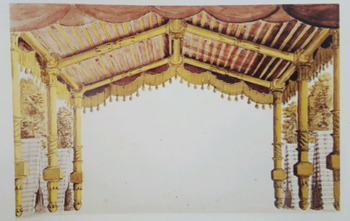
Rezzonico went a step further and wrote his mistrust of singers into the very dramaturgy of the opera. Diverging from his source texts, he portrayed Timoteo's musical effects as (meta-)theatrical rather than supernatural. In so doing, he kept the libretto in line with both the Aristotelian unities and his own mission of verisimilitude, all while subverting myths about the magical power of song over the emotions. In Rezzonico's opera, Timoteo's singing affects Alessandro so strongly because it seems to transport the action to different locations (the Kingdom of Love, the tomb of King Dario and so forth). But crucially, Timoteo's songs are not inherently powerful; they only seem so because they are coordinated with diegetic scene changes masterminded by the singer himself – rendering Parma's Teatro Ducale, in Rezzonico's words, ‘a theatre of theatre itself’.Footnote 49 Behind Alessandro's onstage pavilion, the audience could see various pieces of scenery that were moved around in plain view, a constant reminder that Timoteo's music was only one part of a unified theatrical illusion (Fig. 1). The audience was invited to witness what Alessandro could not: the artificiality of the singer, who seemed to have power only because his songs were supported by a production over which he retained the utmost control. That unified artistic vision and execution make explicit Timoteo's threat to Alessandro by parodying the role of absolutist monarch. When planned and performed by a single agent, stagecraft served as an apt metaphor for the calculated self-projection of absolute power, as historian Joseph Klaits writes of Louis XIV (the absolutist par excellence): ‘As a virtuoso performer in the elaborate piece of baroque stagecraft that was his reign, he wanted Europe to believe that he also had composed the script, built the set, designed the costumes, and directed the action.’Footnote 50 In Rezzonico's libretto, Timoteo has indeed done all of those things, showing he can play the role of king even more convincingly than does Alessandro.
Pietro Gonzaga (scenic designer for Alessandro e Timoteo), illustration of a military pavilion; I-Vgc, inv. 30861. (colour online)

Despite his lofty intentions, Rezzonico soon experienced first-hand the power wielded by singers over opera production. Two virtuosos had been engaged for the title roles: the celebrated tenor Giacomo David with top billing as Alessandro, and the lesser-known soprano castrato Michele Neri as Timoteo. Almost immediately upon arriving in Parma the singers, backed by the composer, prevailed upon the librettist to sacrifice his post-Metastasian vision and accommodate their musical demands.Footnote 51 Rezzonico grudgingly accepted Sarti's modifications, even allowing extensive fioritura in the lead arias, but the conflict left a mark on the poet's ego. Clearly, his post-premiere complaints about tyranny and usurpation had a rather personal impetus. In his own opera, which stages how political order can be undermined by the machinations of a singer-cum-impresario, art was spilling over into life.
Timoteo's counterfeit lyre
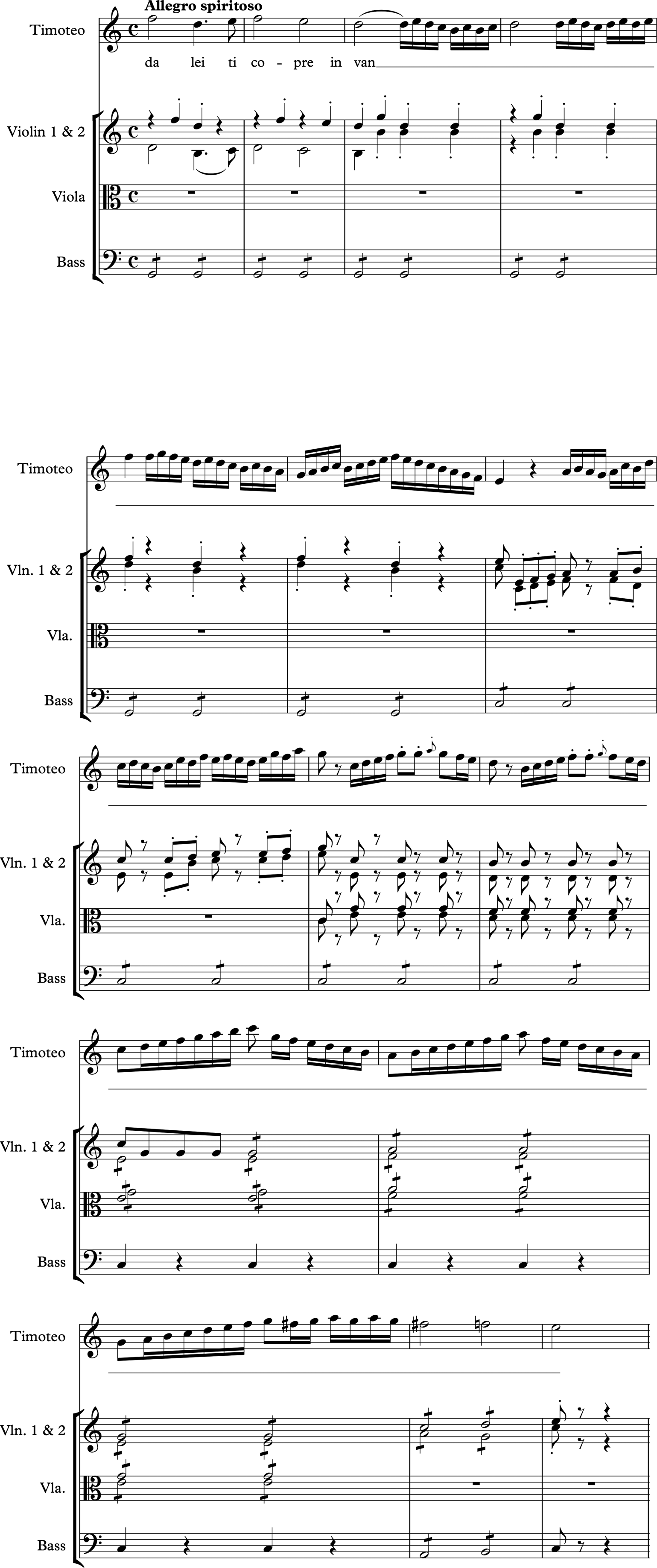
The tyrannical virtuoso was not the only singer-figure castigated by Rezzonico. The Orphic myth of lyric voice was similarly unsettled by the play-within-a-play conceit of Alessandro e Timoteo, as if to show that even a singer of Millico's talents was only as effective as the theatrical whole. Rezzonico suggested this by inserting into Timoteo's role certain recognisable musical and textual references to the ‘Orfeo act’ of thirteen years prior; in so doing, he framed Orphic song as being no more than one of Timoteo's manipulative musical modes. When Alessandro finds out that the Persian king Dario has been murdered (scene 7), Timoteo's recitative invocation and the ensuing ritornello reference Orfeo's diegetic cavatina, ‘Deh! placatevi con me’, from Gluck's opera. Timoteo's call to ‘flatter [Alessandro's] pain, Muses, with song’ (lusinghi il suo duol, Muse, col canto) recalls one of Amore's speeches in which she explains that song is the key to saving Euridice: ‘If you can soothe with song’ (Se placar puoi col canto). Where Orfeo ‘soothes’, however, Timoteo ‘flatters’. In response to Timoteo's call, ‘the orchestra imitates the sound of a plucked lyre’ with repetitive pizzicato arpeggiated triads, much like those in ‘Deh! placatevi’.Footnote 52 Staying in the deceptive Orphic vein, Timoteo's vocal line in the aria consists primarily of dotted rhythms, and is frequently short-breathed owing to the quaver rests that interrupt the textual repetitions. Timoteo even repeats ‘dolor’ (sorrow) as the last word in a tronco poetic line to close the aria, possibly imitating Orfeo's final phrase of ‘Deh! placatevi’ (‘il mio barbaro dolor’).
Timoteo pretends to echo the sincerity of ‘Deh! placatevi’, but this Orfeo is merely a role the singer dons in his ongoing attempt to unhinge Alessandro. For one, he sings what appears to be some of Rezzonico's proclaimed ‘poetry full of feeling and flattery’, in a mix of quinari sdruccioli and piani leading up to the Orphic final line:Footnote 53

The poetic language is strikingly distinct from Calzabigi's simple verses in Orfeo ed Euridice – particularly evident in Rezzonico's use of ‘ite’, which makes the text come across as flagrantly high-flown. The apostrophising of tears and anthropomorphising of pain operate on a similarly elevated rhetorical level, while, significantly, teasing the Orphic metaphor of giving voice to sensibility. Here, Rezzonico twists the relationship between voice and sensibility: Timoteo does not voice genuine feeling, but instead ‘flatters’ Alessandro's ‘sorrow’ by ventriloquising it.
Even as Sarti's score recalls Gluck's, it reveals the inauthenticity of Timoteo's lyre. The composer assigned pizzicati to only the first and third violins and the bass, instructing the second violins and the violas to play col arco (Exx. 1 and 2).Footnote 54 These two different string sounds reinforce the impression that Timoteo's lyre is a trick, especially as compared with the verisimilar harp used by Gluck for ‘Deh! placatevi’. Sarti also undermined the aria's apparent Gluckian simplicity by writing large leaps into the vocal line, both to show off Neri's skill in registration and to add a dash of the histrionic to Timoteo's performance. The last straw is the musical and dramatic irregularity of the aria's close. Instead of repeating the ritornello or at least landing on a clear cadence, the aria ends when a funereal brass sinfonia interrupts Timoteo's final phrases. After some panicked exclamations from Alessandro – still within the same ‘number’ in the score – the sinfonia initiates a diegetic scene change into King Dario's mausoleum. This metatheatrical break, planned and executed by Timoteo, intrudes on the illusion and reminds the audience that Timoteo is only playing Orfeo, another one of his many roles, within a production he is also directing.
‘Deh! placatevi’, bb. 4–6; in Gluck/Calzabigi, L'atto d'Orfeo, score, I-PAc, Corradi Cervi Ms.M.C.C.20, 46R.

‘Pietose lagrime’, bb. 17–22, in Sarti/Rezzonico, Alessandro e Timoteo, score, I-PAc, Borbone Borb.3148/1, 218V–219R.

Both in this scene and throughout the opera, Rezzonico seems to have had in mind his teacher Bettinelli's critique of the power of music over human emotion, particularly the problem of genuine versus artificially inflamed passions. Most musicians, to Bettinelli, were ‘mercenary’, valuing their own gains above genuine art, which was why music had become the ‘mistress, and maybe the tyrant, of drama'.Footnote 55 This uneven distribution of power confused auditors and led them to mistake musical pleasure for genuine feeling: ‘Music lovers feel themselves so moved by pleasure, the sensual pleasure of the ear, [that] they believe themselves impassioned in their soul, and praise the art without knowing it, and the artifice without reason.’Footnote 56 Bettinelli therefore maligned the ancient Timotheus's music as ‘effeminate’ because it had only ‘flattered the ear’. He then launched into a litany of abuses that, he noted, applied just as well to the operas of his own day.Footnote 57 Only a ‘rare’ singer or musician such as Orpheus could make others truly feel what was in his or her soul. For Bettinelli and Rezzonico, feeling alone was insufficient proof of authenticity because it was so easily counterfeited through ‘flattery’. Perhaps the notion of sensibility through voice offered not a moral affirmation of humanity, but a simple exercise in sensuality.
A mouthpiece for political maxims
Yet even ‘mercenary’ singers, however suspect their motivations, were capable of achieving some measure of good. In the scene following his Orfeo act, Timoteo seeks to mitigate Alessandro's bloodlust by reminding him of the transience of earthly glory. ‘Is it then a dream, a shadow, the greatness of kings?’ (È dunque un sogno, un’ ombra / La grandezza de’ Re?) he asks, gesturing to King Dario's tomb.Footnote 58 His question plays upon the inauthenticity of the production he has been staging for Alessandro, as if to suggest that theatre and kingship are equally illusory. He first reveals the mortal limits of kingly power by transporting Alessandro to Dario's tomb through the scene change after ‘Pietose lagrime’, foreshadowing Alessandro's own eventual and ineluctable transition into the grave. Timoteo then performs the challenge with his voice: he delivers an unusually long obbligato recitative, followed by a fiery aria di bravura (‘Nel seno il cor mi palpita’) in which he reminds the king that his days are numbered and he ought to ‘think about it, o King’ (‘Pensaci, o Re’). Aided by the wonder of his flexible larynx, the castrato intimates that the king will one day be supplanted. Timoteo alone checks the sovereign's tyrannical behaviour, because he can do so safely from within his production; Alessandro does not realise that his surroundings – the cave, Dario's tomb, the mourners – are merely the artifices of ‘theatre’, and not truly conjured up by Timoteo's vocal magic (Ex. 3). Now Timoteo's vocal virtuosity becomes not simply self-serving but also politically beneficial: it civilises the raging king and (albeit temporarily) prevents war. In Parma in 1782, this would have been a significant statement. Before the French Revolution erupted, and a decade before Italian operas staging sovereigns’ deaths became thinkable, let alone popular, Timoteo's direct challenge to Alessandro's absolutist authority would have been quite astonishing indeed.
‘Nel seno il cor mi palpita’, bb. 115–29, in Sarti/Rezzonico, I, 267V–269R.

Curiously, the most acclaimed moment in the opera was neither Timoteo's Orfeo act nor his virtuosic aria but his recitative line: ‘Is it then a dream, a shadow, the greatness of kings?’ One widely disseminated French review of the opera, soon reprinted in Italian, described a discussion ignited by Timoteo's provocative question:
The author [of this review] was sitting in the royal box, close to the Count of the North, when that line was sung. … [Prince Paul Petrowitz] showed the most vivid emotion; he said to the poet: ‘Count Rezzonico, you should engrave that in golden letters.’ … He then shared some quotes from Antoninus or Marcus Aurelius about vanity and the nothingness of human greatness. The Duke of Parma testified to the poet that it had touched him as well. Rezzonico replied, ‘There is another one that I believe is even better for a prince like you to learn by heart: … “If the land is happy, I am a god.”’Footnote 59
Timoteo had inspired the audience, and royalty both real and operatic, with a voice tuned to a political mode. In the royal box, Prince Petrowitz and Duke Ferdinand resonated with Timoteo's ruminations on the mortal limits of kingship, while in the opera, Alessandro breaks his sword. Timoteo lends Rezzonico his voice in order to endorse the ‘good’ princes (those in the audience) by cautioning the ‘bad’ one (the onstage Alessandro), simultaneously condoning and critiquing absolutism. For the poet it was the voice that transmitted those political maxims that established and protected civil harmony, however mercenary the singer.
As expected in a work about the tyranny of singers, Timoteo's vocal power turns destructive by the opera's finale. In order to distract Alessandro from his romantic pursuit of Taide, Timoteo's betrothed, the singer pretends to raise the ghosts of the Greeks left unburied after the Persian wars. Driven by Timoteo's coordinated song and stagecraft, Alessandro falls victim to his misguided sensibility and sets the onstage city of Persepolis on fire – leading critic Stefano Arteaga, for one, to call Alessandro a ‘raving madman’ in his ambivalent 1783 review.Footnote 60 In this period, ending an opera with such violence – and without so much as a licenza – had disturbing implications. Until the finale, the entire action of the opera has taken place within the palace gardens, but Alessandro's destruction of Timoteo's scenery moves from the play-within-a-play into the opera's ‘real world’ beyond. With this ending, Rezzonico's ‘theatre of theatre’ warns that theatrical illusions might shatter the fourth wall and incite violence in the world outside the opera house. Timoteo the mercenary singer augurs the downfall of civilisations should voice and misplaced sensibility be allowed to run amok. When he sings of political truths, he fights tyranny and serves the greater good; when he sings of counterfeit emotion, he endangers society.
The tale of the charlatan and the citaredo
In Rezzonico's view, voice was most salutary when separated from the singer's individuality and treated as a mouthpiece for political edification. Yet if theatrical performance enacted and perpetuated tyranny, how else might that vocal power be reined in, harnessed and redirected for the good of civilisation? One such possibility for redirection emerges from a constellation of texts by the writer Alessandro Verri. By the 1780s Verri was solidly enmeshed in conservative Roman neoclassicism, but he had a northern Italian Illuminismo pedigree: along with his elder brother Pietro, the more famous of the two, he had founded the progressive literary journal Il Caffè in Milan in the early 1760s, and it was thanks to Pietro's efforts that Bettinelli's Dell'entusiasmo delle belle arti was first published.Footnote 61 Alessandro Verri had travelled to London and Paris in the later 1760s, where he met many of the thinkers idealised in Il Caffè, before ultimately settling in Rome and publishing several novels there in the 1780s and 1790s. His writings reveal another contemporary Italian fantasy of voice, a compromise that drew upon Millico's Orfeo act while diverting it to a new – or, rather, ancient – purpose. The voice Verri wished to hear was that of the ancient Greek rhapsode (in Italian, rapsodo or citaredo), a singer who declaimed epic verses to his own invented musical accompaniment. The rhapsode, in the words of twenty-first-century philosopher of voice Adriana Cavarero, was ‘the poet who sings the glories of the past and educates the present generations’ – that is to say, an agent of public, cultural and civic edification.Footnote 62 This figure re-entered the cultural imaginary in the second half of the eighteenth century when classicists began debating the authenticity of ‘Homer’.Footnote 63 If the rhapsode could lend his voice to educating modern Italians about their immediate literary past, he just might lead them to a more civilised future.
Alessandro Verri's fascination with the figure of the citaredo or rhapsode as a civilising force is perhaps most evident in a scene from his 1782 novel Le avventure di Saffo, poetessa di Mitilene (The adventures of Sappho, poet of Mytilene). In Book II, the philosopher Eutichio throws a dinner party during which his citaredo Melanzio begins to sing,
lightening the mood with his melodious voice mixed with the sound of the lyre. He first unfolded the song with moderate breath like a voice heard from far away that gradually gets closer; and then, crescendoing with full melody, agitated the rapid notes of the lyre, abundantly spilling out the song, such that all with drooping eyelids had turned to watch in silence. Melanzio sang some verses from the Iliad, animating with harmony that divine meter and those celestial ideas, so that with double delight it descended upon attentive ears to possess the heart.Footnote 64
Melanzio's song has a very real public utility in Saffo. That is, his singing of the epic past proves more beneficial than agonising over the realities of life (and death): when a nearby volcano erupts, Eutichio keeps his guests from panicking by distracting them with the citaredo’s performance. Eutichio then remarks,
See how marvellous is the magnanimity of the Trojan and Greek heroes, and, no less, the beauty of the verses of Homer in singing their praises, and also the skill of my citaredo in animating with the allurements of music such excellent ideas; yet neither heroes, nor poets, nor musicians are shaped by the scholastic disciplines.Footnote 65
Verri, via Eutichio, drew a lineage from the epic heroes through Homer to the citaredo. In his idealised civil society, these three central figures would contribute to the social good by (respectively) generating, transcribing and propagating foundational myths, together preventing the masses from revolting. Verri's philosophical contemporaries had the opposite effect, becoming the downfall of society by focusing on what Eutichio calls ‘useless truths’ instead of ‘nobler and healthier persuasions’.Footnote 66 By this point, Verri had become disenchanted with the ideology of his youth, turning against the philosophes he had revered while working on Il Caffè. He even called Rousseau a ‘charlatan’ for purporting to fix society yet hiding from it.Footnote 67 Looking back on his time in the Parisian salons of the late 1760s, Verri judged his erstwhile companions harshly: ‘The only fruit of the pride with which the sophists of that time had attempted the reform of mankind was a rapid and continuous destruction.’Footnote 68
Yet the civilising potential lacking in philosophers and academicians could be found, for Verri, in a singer's voice. He had written admiringly of Millico as not only an Orpheus, but also a modern-day citaredo. In the same 1777 letter to Pietro in which he denigrated Rousseau, sent shortly before he began working on Saffo, Alessandro described the Genevan philosopher's amazement at hearing Millico sing ottave from Torquato Tasso's Italian vernacular epic Gerusalemme liberata (1581). ‘Rousseau told [Millico] that, if Tasso had heard him, he would have made a new epic poem for him.’Footnote 69 Rousseau may have been a charlatan, but at least he had recognised Millico as the singer-composer who could reanimate Tasso (Tasso being for Verri modern Italy's answer to Homer).Footnote 70 Woven into Verri's retelling of the Millico–Rousseau encounter is his belief in the power of voice to displace self-important intellectualism as the primary edifying force. In such a worldview, people were still little better than Orpheus's barbarians: they had to be continuously re-civilised through tales of heroic deeds, as recorded in epic poetry and animated by the citaredo’s voice. Perhaps the imminent destruction of society might be halted, if only such singers as Millico would trade Orfeo for Tasso and give voice to Italian literary glory.