I. INTRODUCTION AND MOTIVATION FOR COMBINATORIAL SYNTHESIS OF HIGH-ENTROPY ALLOYS
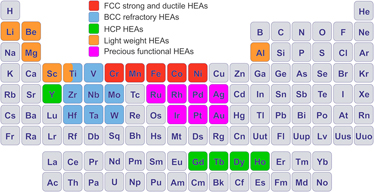
High-entropy alloys (HEAs) are multicomponent metallic materials consisting of four or more elements in high or even equimolar fractions.Reference Yeh, Chen, Lin, Gan, Chin, Shun, Tsau and Chang1–Reference Luo, Li and Raabe10 This design principle originally aimed at the stabilization of single phase massive solid solutions through high configurational entropy.Reference Yeh, Chen, Lin, Gan, Chin, Shun, Tsau and Chang1 Also, it shifts the search space for new alloys from the corners toward the centers of phase diagrams. Beyond the original concept of single phase solid solutions, several variants of this new design approach have been suggested including nonequiatomic, multiphase, interstitial, duplex, precipitate containing, and metastable HEAs.Reference Li, Pradeep, Deng, Raabe and Tasan4,Reference Li, Tasan, Pradeep and Raabe11–Reference Basu, Li, Pradeep and Raabe16 As shown in Fig. 1, several typical HEA systems have been developed, including face-centered cubic (FCC) structure-based strong and ductile HEAs, body-centered cubic (BCC) structure-based refractory HEAs, hexagonal-close packed (HCP) structure-based HEAs, light-weight HEAs, and precious-metal functional HEAs. The number of HEA compositions explored is increasing rapidly due to the growing research efforts in this field, driven by promising properties which have been observed for some of these materials such as for instance good cryogenic toughness and high strain hardening.Reference Zhang, Zuo, Tang, Gao, Dahmen, Liaw and Lu3–Reference Miracle and Senkov6,Reference Seol, Bae, Li, Chan Han, Kim, Raabe and Kim17
Element groupings highlighting the main ingredients used to synthesize alloys pertaining to the five most typical HEA families, i.e., FCC-based strong and ductile HEAs, BCC-based refractory HEAs, HCP structured HEAs, light weight HEAs, and precious functional HEAs. For simplicity, other HEA systems or variants of the alloy classes mentioned above including other substitutional elements or interstitial ones such as B, C, N, O, etc. are not color-coded here.

The main challenge that HEA research is facing is how to explore the huge compositional and microstructural spaces, with the aim to efficiently identify novel materials with promising property profiles or even so far undiscovered features. Therefore, we review several approaches which have been used for the efficient, combinatorial, and high-throughput metallurgical synthesis and processing of such alloys.
Four main directions are presented and discussed. The first one is rapid alloy prototyping (RAP) which basically consists in an efficient coupling of casting, hot rolling, homogenization, cold rolling, and recrystallization annealing in conjunction with subsequent characterization of microstructure and properties.Reference Springer and Raabe18,Reference Springer, Belde and Raabe19 The second one utilizes diffusion couples which can serve for alloy synthesis through systematic intermixing among blocks of pre-alloyed composition.Reference Zhao, Zheng and Cahill20–Reference Wilson, Field and Kaufman22 The third one is combinatorial laser additive manufacturing (LAM) methods that enable synthesis of compositionally graded materials which allows many variants to be probed efficiently for instance by using established micromechanical testing methods.Reference Borkar, Gwalani, Choudhuri, Mikler, Yannetta, Chen, Ramanujan, Styles, Gibson and Banerjee23 The fourth one consists in combinatorial synthesis of multinary thin-film materials libraries, i.e., well-defined and large thin-film composition gradients across a substrate wafer fabricated in a single experiment.Reference Ludwig, Zarnetta, Hamann, Savan and Thienhaus24
In the following, we present these methods and provide examples of their use in the field of HEA development. Also, we critically discuss them regarding aspects such as compositional homogeneity, microstructure effects, and size dependence. The related characterization methods for samples produced by different combinatorial synthesis techniques are briefly introduced. Additionally, we reflect the advantages and disadvantages of the different combinatorial synthesis techniques and compare them with each other to provide guidance for identifying the appropriate methods for specific combinatorial HEA studies.
II. RAP OF BULK HEAs
The recently developed bulk combinatorial metallurgical screening method, referred to as RAP,Reference Springer and Raabe18 is a semicontinuous high-throughput bulk casting, rolling, heat treatment and sample preparation approach and has been successfully applied to screening weight-reduced steels with twinning induced plasticity (TWIP),Reference Springer and Raabe18,Reference Raabe, Tasan, Springer and Bausch25 high strength martensitic steels,Reference Springer, Belde and Raabe19 and HEAs.Reference Li, Pradeep, Deng, Raabe and Tasan4,Reference Pradeep, Tasan, Yao, Deng, Springer and Raabe12 Since this approach involves synthesizing bulk samples of specific compositions, it is particularly appropriate for screening structural alloys, where the strength, toughness, and ductility are strongly dependent on the entire thermomechanical history and microstructural evolution with strong effects associated with internal length scales such as grain size and phase dispersion.
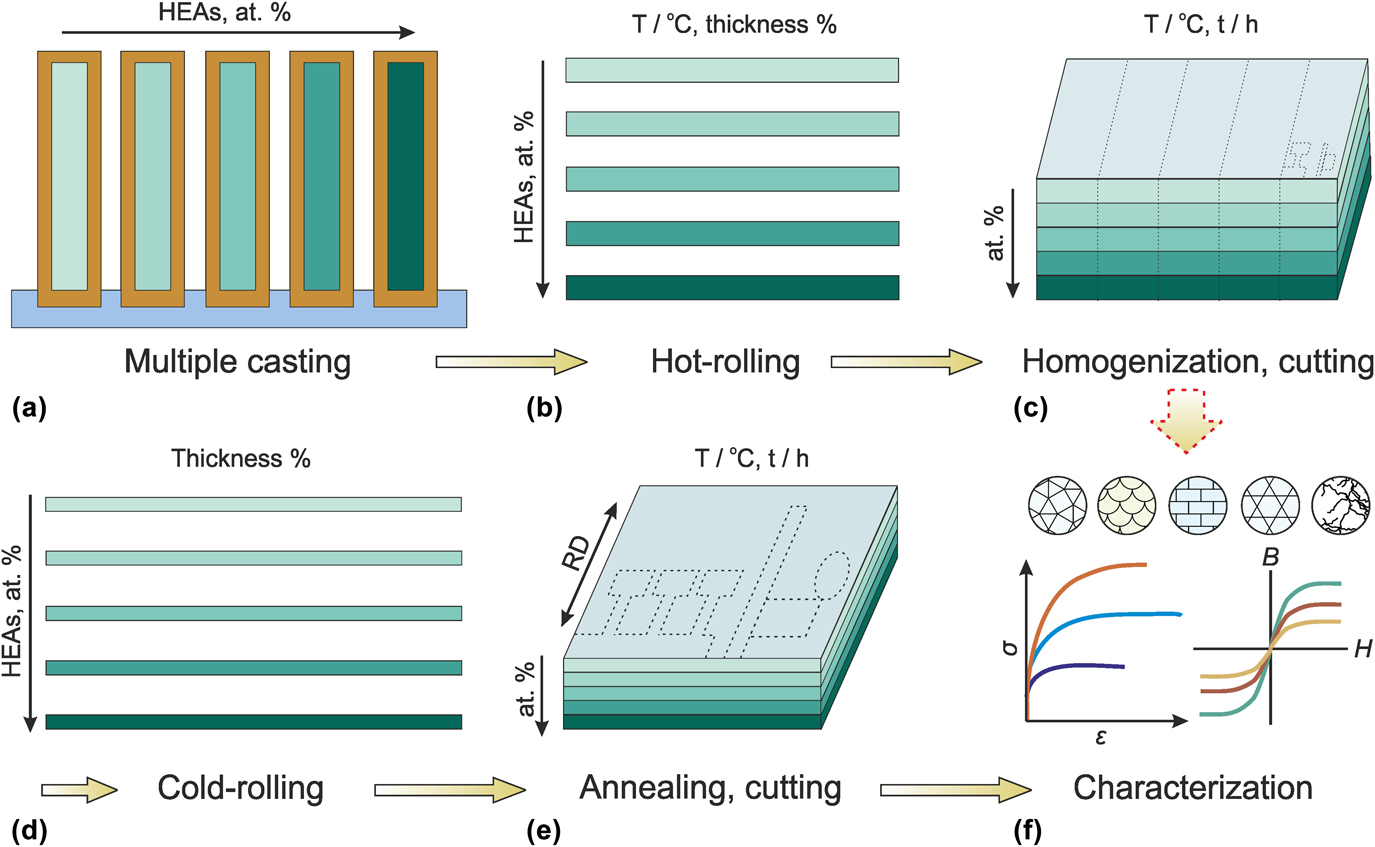
For the 3d transition metal HEAs, well-established bulk metallurgical processes are capable of synthesizing high-quality sheets by controlling the thermomechanical processing parameters properly. The RAP technique has been used for rapid trend screening of suited alloy compositions. As schematically illustrated in Fig. 2(a), the RAP approach enables casting of five different alloys with tuned compositions of an alloy system in one operation. This is achieved by using a set of five copper molds which can be moved stepwise inside the furnace.Reference Springer and Raabe18 Although the solidification rate in the RAP casting setup is deliberately high to avoid macrosegregations, in as-cast condition, the distributions of multiple principal elements are typically not fully homogeneous in the bulk HEAs with their coarse dendritic microstructure owing to classical Scheil segregation.Reference Li and Raabe26 Following casting, the alloy blocks with a thickness of 10 mm and varying compositions are subsequently hot-rolled in air [Fig. 2(b)]. This step is required for removing the dendritic microstructure and possible inherited casting porosity. The hot-rolling temperature can be adjusted for the specific HEA compositions and the rolling reduction is generally above 50%. Sometimes, even the hot-rolled HEAs still carry some inherited compositional inhomogeneity. Therefore, after the last hot-rolling pass, the HEA plates are homogenized at high temperatures (e.g., 1200 °C) for several hours (e.g., 2 h) under Ar atmosphere, followed by water quenching [Fig. 2(c)]. For HEAs, appropriate homogenization is critically important for achieving uniform distributions of the multiple principal elements in the solid solution structure owing to the sometimes low substitutional diffusion constants in these materials. Hence the homogenization time should consider the diffusion kinetics and the dimensions of the alloys sheets—generally, the larger (or thicker) the alloy sheets, the longer the required homogenization time. The homogenized HEA plates are cut perpendicular to the hot-rolling direction to obtain some segments with smaller size for the subsequent processes and characterization [Fig. 2(c)]. The homogenized HEAs generally show homogeneous distribution of the multiple principal elements and are devoid of cracks or pores. HEAs with higher amounts of Mn (e.g., >10 at.%), however, may contain inclusions enriched in Mn which are often hard to remove even when imposing with long-term homogenization.
Schematic sketches illustrating the RAP approach for combinatorial synthesis and processing of HEAs. (a) Multiple casting; (b) hot-rolling; (c) homogenization and cutting; (d) cold-rolling; (e) annealing and cutting; (f) characterization. The RAP approach can also be applied to many other material systems including advanced high-strength steels.Reference Springer and Raabe18
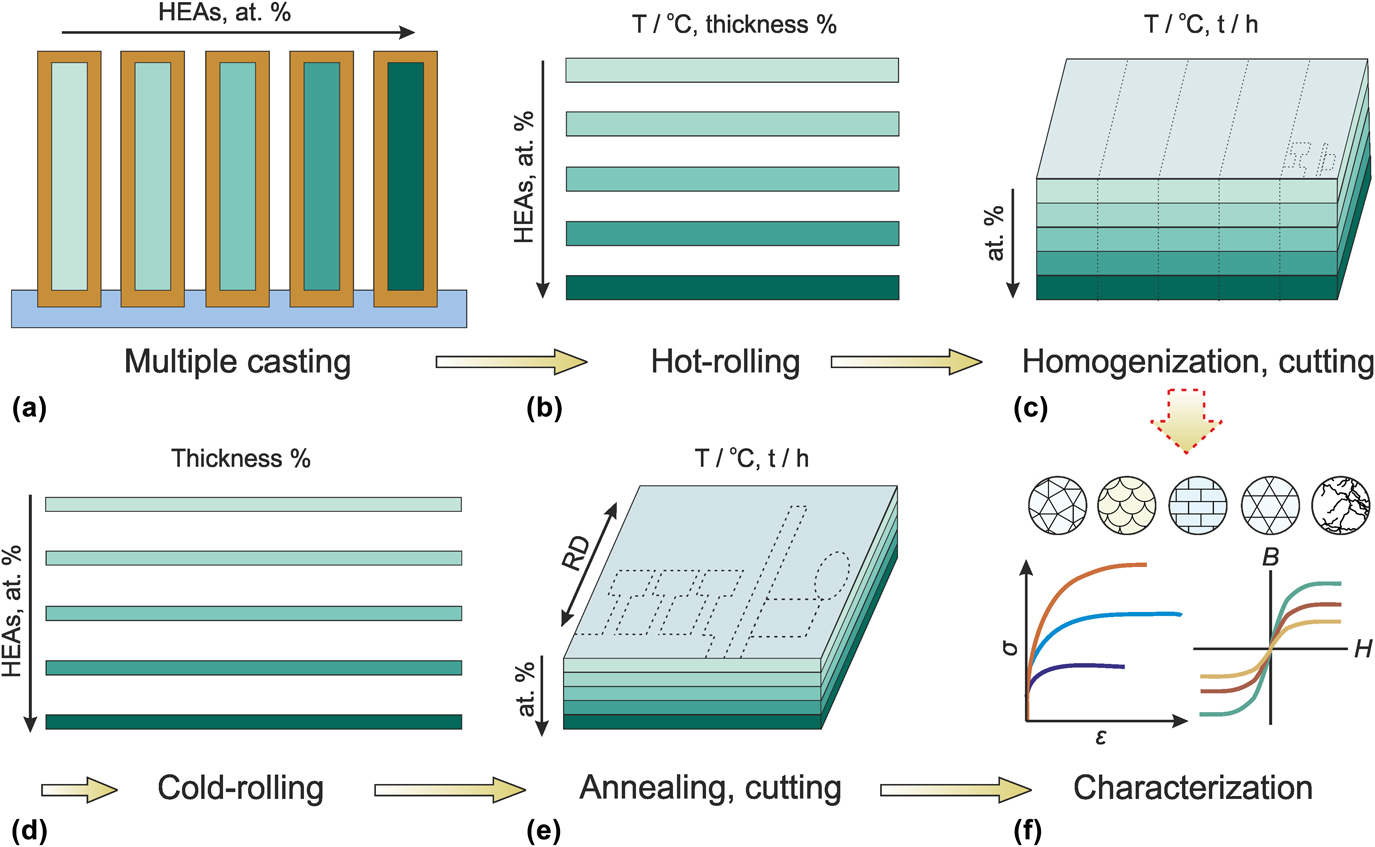
Since the homogenized HEA plates generally exhibit a large grain size, cold-rolling [Fig. 2(d)] and annealing [Fig. 2(e)] processes are required to refine the microstructure toward better mechanical properties. The thickness reduction during cold-rolling is generally higher than 50% to obtain a fully deformed microstructure and sufficient stored strain energy in the alloys. Annealing is conducted for recrystallization of the microstructure and for the control of the grain sizes; hence, times and temperatures are in each case adjusted according to the targeted grain sizes and crystallographic textures. After these microstructure-tuning processing steps, samples for microstructure investigation and performance testing are machined from the alloy segments by spark erosion. For accelerated alloy development, high efficiency of this cutting process is realized by clamping the five alloy segments on top of each other for simultaneous machining [Fig. 2(e)]. For this purpose, proper marks should be placed on the alloy sheets with varying compositions and processing parameters. Following the sample preparation, various characterizations [Fig. 2(f)] can be efficiently performed to probe the composition–microstructure–property relationships in the HEA systems.
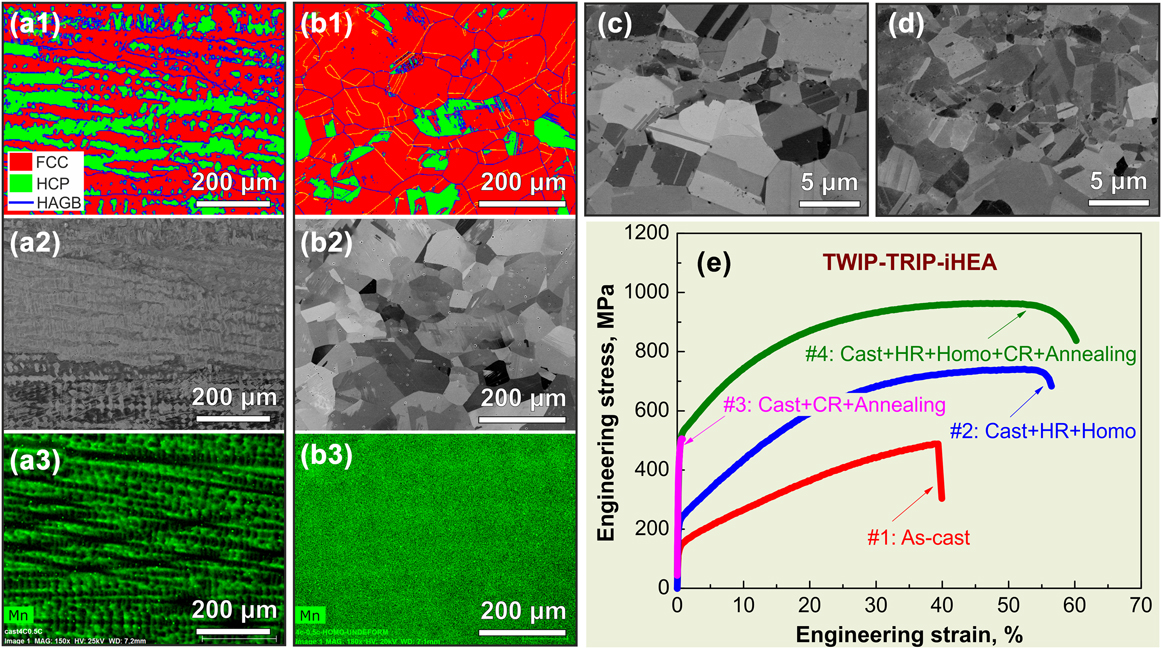
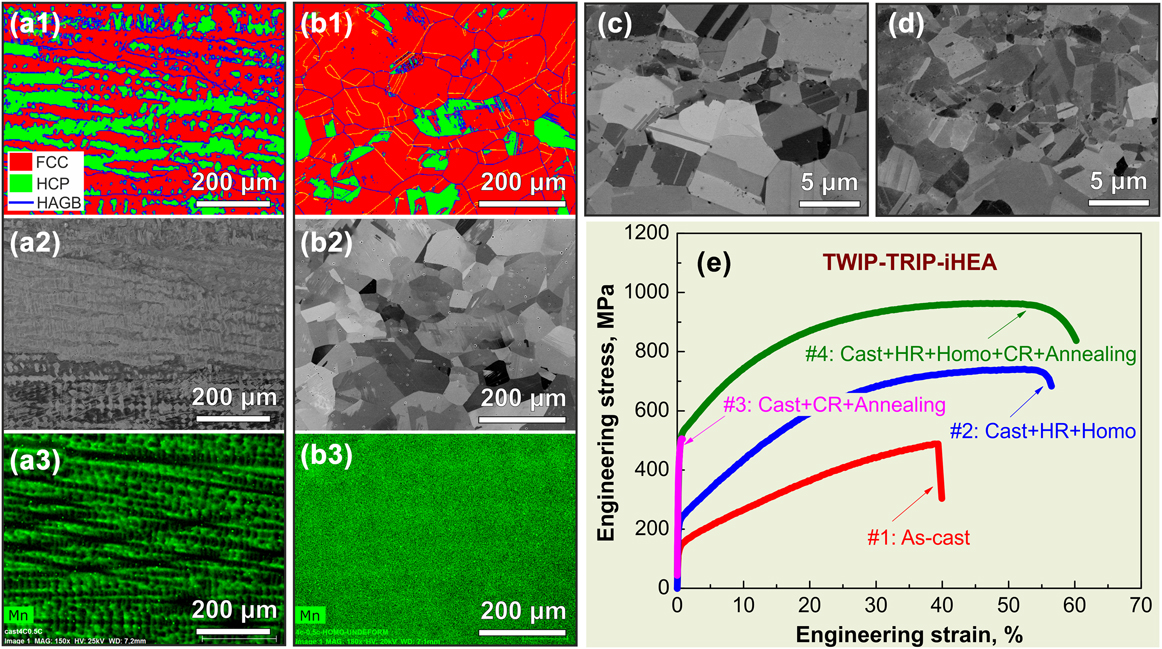
As mentioned above, alloys with an identical bulk composition but in different processing conditions may have significantly different compositional homogeneity state, microstructure, and properties. This is a general scenario for all alloys including RAP-processed HEAs. As a typical example, Fig. 3 shows the microstructure, compositional homogeneity state, and tensile properties of a recently developed interstitially carbon alloyed HEA at various conditions during the RAP process. The nominal composition of the interstitial HEA is Fe49.5Mn30Co10Cr10C0.5 (at.%) and it shows joint activation of mechanical twinning and phase transformation from the FCC to the HCP phase upon strain loading. The novel material is thus referred to as “TWIP-TRIP-iHEA” (TWIP: twinning-induced plasticity; TRIP: transformation-induced plasticity; iHEA: interstitial high-entropy alloy).Reference Li and Raabe26–Reference Wang, Li and Raabe28 The microstructure of the as-cast iHEA shows a coarse-grained FCC matrix (∼300 μm) containing a number of HCP islands [Fig. 3(a)1–2]. The BSE image [Fig. 3(a)2] and energy dispersive X-ray spectroscopy (EDS) map of Mn [Fig. 3(a)3] probed on an identical sample region reveal the cast dendrites with inhomogeneous elemental distribution. Basically, the HCP islands locate at the regions depleted in Mn and enriched in Fe.Reference Li and Raabe26 This can be explained by the fact that regions depleted in Mn and enriched in Fe have lower stacking fault energy, hence, promoting formation of the HCP phase compared to the regions enriched in Mn and depleted in Fe.Reference Li and Raabe29 By contrast, the microstructure of the homogenized iHEA shows a dual-phase (FCC & HCP) microstructure with equiaxed FCC grains [Fig. 3(b)1–2] and uniformly distributed elements [Fig. 3(b)3].Reference Li, Tasan, Springer, Gault and Raabe27 These differences in microstructure and compositional homogeneity clearly influence the mechanical properties, i.e., the as-cast coarse-grained iHEA shows significantly reduced ductility and strain-hardening compared to the homogenized counterpart [Fig. 3(e)]. The detrimental effect of compositional inhomogeneity on mechanical properties of the coarse-grained iHEA was attributed to the preferred deformation-driven phase transformation occurring in the Mn depleted regions with lower stacking fault energy, promoting early stress–strain localization.Reference Li and Raabe26 After grain refinement, although the iHEAs with and without compositional homogeneity show similar recrystallized microstructure with identical average grain size, as presented in Figs. 3(c) and 3(d), respectively, the alloy without compositional homogeneity (directly cold-rolled and annealed after casting) was characterized by almost total loss in work-hardening [Fig. 3(e)]. This was attributed to the large local shear strains caused by the inhomogeneous planar slip in the compositionally inhomogeneous iHEA.Reference Li and Raabe26 These observations clearly suggest the importance of appropriate processing for the development of advanced HEAs.
Microstructure, compositional homogeneity state, and tensile properties of an iHEA with nominal composition of Fe49.5Mn30Co10Cr10C0.5 (at.%) in various processing conditions obtained after specific steps of RAP. (a1), (a2), and (a3) are the EBSD phase map, BSE image, and Mn EDS map of an identical region in the as-cast sample, respectively. (b1), (b2), and (b3) are the EBSD phase map, BSE image, and Mn EDS map of an identical region in the homogenized sample, respectively. (c) BSE image of the sample processed by homogenization, cold-rolling, and annealing. (d) BSE image of the directly cold-rolled and annealed sample after casting. (e) Tensile stress–strain curves of the iHEA samples in various processing conditions. “FCC”, “HCP”, and “HAGB” refer to FCC phase, hexagonal close-packed phase, and high angle grain boundaries with misorientation larger than 15°. “HR”, “Homo”, and “CR” refer to hot-rolling, homogenization, and cold-rolling, respectively. “EDS” and “EBSD” refer to EDS and EBSD, respectively. Tensile data are mainly taken from Ref. Reference Li and Raabe26.
Since bulk samples can be produced by the RAP technique, all characterization methods used in conventional one-alloy-at-a-time practice, such as X-ray diffraction (XRD), electron backscatter diffraction (EBSD), EDS, tensile testing, etc., can also be applied to explore the composition–microstructure–property relationships in the combinatorial RAP-processed HEAs. However, the number of alloy compositions that can be probed in one RAP practice is relatively limited (generally 5) compared to other combinatorial synthesis techniques discussed later.
To promote the efficient combinatorial development of HEAs, theoretical guidance is critically important, capable of suggesting suited mechanical, stability, corrosion or magnetic trends for the design of alloy compositions.Reference Miracle and Senkov6,Reference Oh, Ma, Leyson, Grabowski, Park, Körmann and Raabe30–Reference Friák, Hickel, Grabowski, Lymperakis, Udyansky, Dick, Ma, Roters, Zhu and Schlieter32 For instance, to design strong and ductile HEAs with the assistance of simulations and the RAP technique, we found that the phase (meta)stability of the HEAs is a key feature to tune the compositions of certain HEA systems to introduce activation of multiple deformation mechanisms, thereby improving the range of accessible strength–ductility combinations.Reference Li and Raabe29 More specifically, for FCC-structured HEA systems, the phase (meta)stability can be represented by the intrinsic stacking fault energy which is mainly determined by the free energy difference between the FCC and HCP phases. Accordingly, parameter-free ab initio simulations and thermodynamic calculations are powerful to obtain stacking fault energies and/or free energy differences between phases to assist the combinatorial HEA development.Reference Li and Raabe29,Reference Li, Körmann, Grabowski, Neugebauer and Raabe33
III. DIFFUSION-MULTIPLE PROBING OF HEAs
As an extension of diffusion-couples, diffusion-multiples allow three or more metal blocks to be placed in diffusional contact, which enables the probing of ternary and higher-order alloy systems. Generally, such diffusion-multiple setups are subjected to a high temperature to induce thermal interdiffusion to form continuously compositionally graded solid solutions and/or intermetallic compounds.Reference Zhao, Zheng and Cahill20,Reference Zhao21 The primary investigations on the combinatorial design of alloys by diffusion-multiples have been conducted by Zhao et al. during the past years.Reference Zhao, Zheng and Cahill20,Reference Zhao21,Reference Zhao, Jackson, Peluso and Brewer34,Reference Zhao35 They demonstrated that for binary and ternary systems, complete composition libraries of all single-phase regions (including intermetallic compounds) can be achieved by using diffusion multiples.Reference Zhao, Zheng and Cahill20,Reference Zhao21,Reference Zhao, Jackson, Peluso and Brewer34,Reference Zhao35 Currently, this technique is also being extended to the high-throughput development of multicomponent HEAs.Reference Wilson, Field and Kaufman22
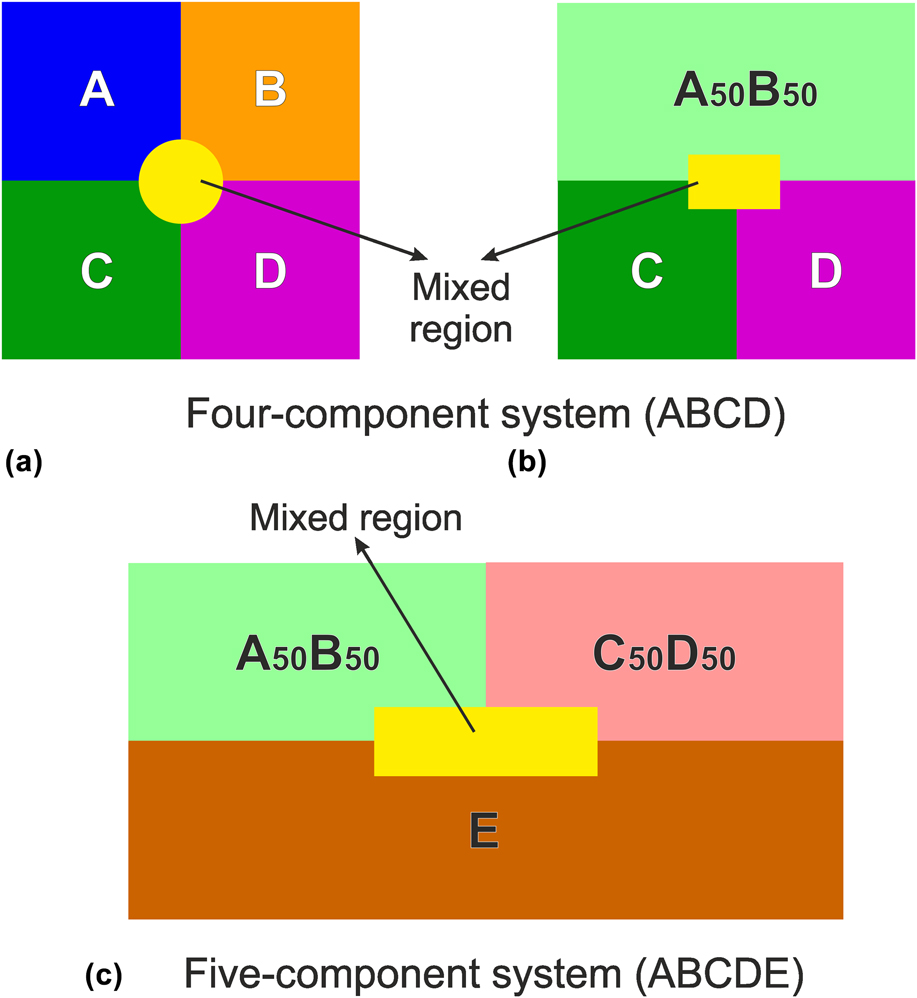
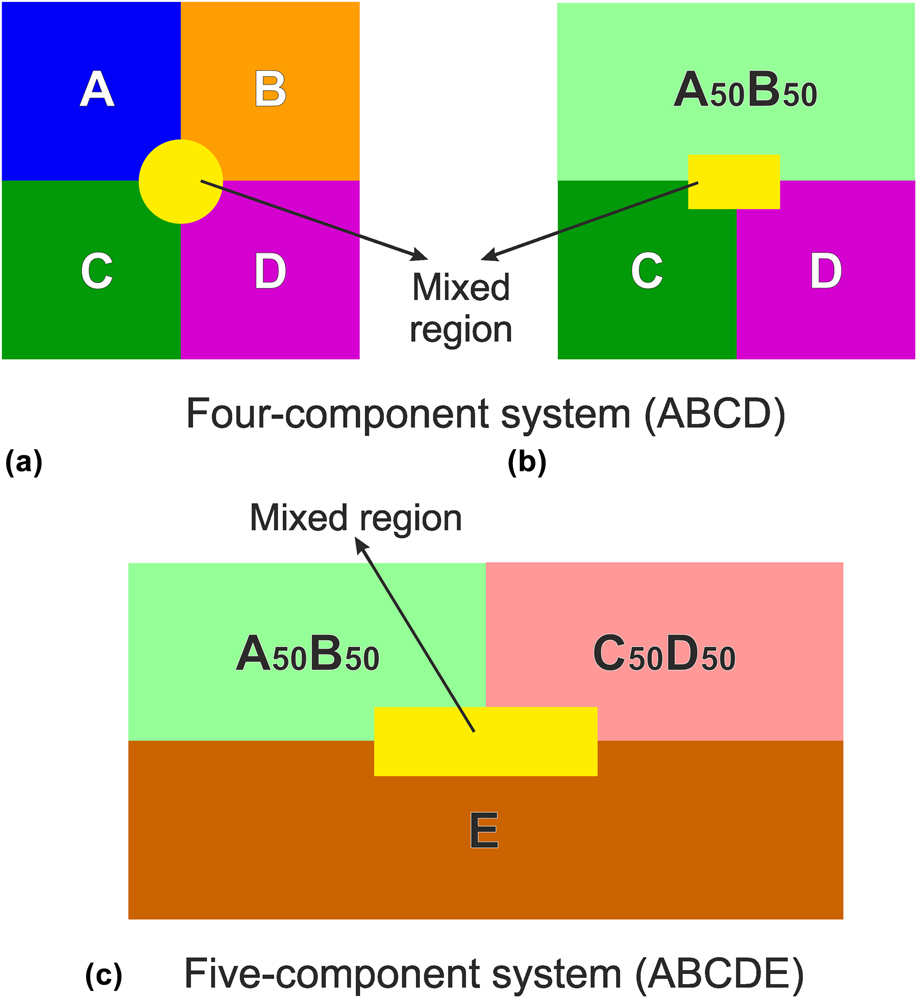
Figure 4 presents some typical examples of diffusion-multiple setups for combinatorial HEA research and discovery. For four-component systems (ABCD), four pure metal blocks can be used to build the assembly, and the quaternary mixed region is located at the center of the whole assembly [Fig. 4(a)]. Also, setup made by one block of an equiatomic binary alloy (e.g., A50B50) and two pure metal blocks (e.g., C and D, respectively) can be used to investigate the four-component systems [Fig. 4(b)]. For five-component systems (ABCDE), two different binary alloy blocks (e.g., A50B50 and C50D50, respectively) together with one pure metal block (e.g., E) are suitable for building a diffusion-multiple assembly [Fig. 4(c)].
Schematic sketches showing some examples of diffusion-multiple setups for combinational HEA research. (a and b) Two typical setups for four-component alloy systems. (c) A typical setup for five-component HEA systems.Reference Zhao21,Reference Wilson, Field and Kaufman22
In a diffusion-multiple assembly, the contacted surfaces of different metal blocks are required to be polished and cleaned without contamination. Generally, to avoid contamination from the environment, the assembly needs to be evacuated and welded in vacuum along the peripheral junction using methods such as electron beam welding.Reference Zhao35 The whole assembly is then treated in a hot isostatic pressing condition at a high temperature (e.g., 1200 °C) for several hours to achieve intimate interfacial contacts of all constituent blocks. Subsequently, the diffusion multiple is heat-treated at a high temperature (e.g., 1200 °C) for a long period (generally above 24 h). The total time of heat treatment at high-temperature is determined for achieving diffusion profiles with sufficiently large extension so that the solid-solution phases and/or intermetallic compounds formed in the diffusion multiple are large enough to be subsequently characterized without interference from neighboring phases.
Besides the sample-making process, the diffusion-multiple technique also involves the localized property measurements using multiple microscale probing methods. Since the phases formed in a diffusion-multiple have a very small length scale, many of the commonly used characterization techniques in conventional one-alloy-at-a-time practice cannot be directly applied, and therefore the characterization of different phases is conducted at the microscale.
After the high-temperature heat-treatment, the diffusion-multiple can be cut, ground, and polished for various local measurements. This enables efficient probing of corresponding composition–structure–property relationships for the various solid-solution phases and/or intermetallic compounds, which is significantly more effective than the conventional one-composition-at-a-time approach. There are a number of probing methods applicable to the localized measurements for diffusion multiples, including electron probe micro-analysis, EBSD, instrumented nanoindentation, and microscale thermal conductivity evaluation. With the capability of detecting elements covering most of the periodic table (from Be to U), EMPAReference Misell and Stolinski36 can provide accurate compositional information of the diffusion regions. EBSDReference Schwartz, Kumar, Adams and Field37,Reference Dingley38 can be used to identify the crystal structure of the solid-solution phases and/or intermetallic compounds formed in the diffusion multiples. In an experimental EBSD pattern, since phase identification is conducted by a direct match of the diffraction bands with simulated patterns generated using known structures and lattice parameters, all known crystal structures in the sample are required to be considered by EBSD probing. Therefore, EBSD is not applicable to readily identify unknown phases or those with closely related space group relationships (e.g., an ordered phase from its disordered parent) in the diffusion-multiple sample, which can frequently happen in HEA development. In this regard, the combination of focused ion beam (FIB) and transmission electron microscopy (TEM) is an applicable approach to overcome this limitation of EBSD characterization. The FIB technique enables the preparation of site-specific thin foil samples from the interested regions in the diffusion-multiple, and TEM allows the precise determination of crystal structures and even some physical and chemical properties of the targeted region of interest.Reference Williams and Carter39,Reference Fultz and Howe40 Therefore, by using EBSD to identify known phases and FIB-TEM combination to investigate the unknown phases, most structures in diffusion multiples can be revealed effectively.
Mechanical, physical, and chemical properties of various solid-solution phases and/or intermetallic compounds in the diffusion couples can also be probed by microscale techniques such as instrumented nanoindentation, dynamic force modulation atomic force microscopy (AFM), or the time-domain thermoreflectance technique. NanoindentationReference Fischer-Cripps41–Reference Oliver and Pharr43 enables efficient hardness measurements of microscale phases. The composition–structure–hardness relationships obtained for various phases in the diffusion couples reflect the solution hardening/strengthening behavior and thus are very useful for the design of novel high-strength HEAs. Nanoindentation is also suited to measure the reduced elastic modulus of the materials,Reference Fischer-Cripps41,Reference Vlassak and Nix44 where “reduced” refers to the fact that a mixed measure of the intrinsic elastic modulus normalized by the Poisson ratio is retrieved by indentation. Dynamic force modulation AFM using a nanoindenter tip and a suited sensing system is applicable for micro- and nanoscale measurements of the Young’s modulus with rather high accuracy.Reference Asif, Wahl, Colton and Warren45 Thermal conductivity measurements at the microscale for the phases in such diffusion couples can be conducted by using a time-domain thermoreflectance technique.Reference Zhao, Zheng and Cahill20,Reference Huxtable, Cahill, Fauconnier, White and Zhao46 The obtained thermal conductivity data of metallic phases and/or intermetallic compounds are strongly associated with elemental substitution, point defects, and ordering and can be used to guide the alloy design. Additionally, by using the FIB technique mentioned above, micro- and nanopillars can be prepared and tested under scanning electron microscopy (SEM) to obtain compressive strength and roughly estimate ductility of the solid-solution phases and/or intermetallic compounds in the diffusion couples, although this is generally not very efficient compared to that using bulk samples with the RAP technique discussed above.
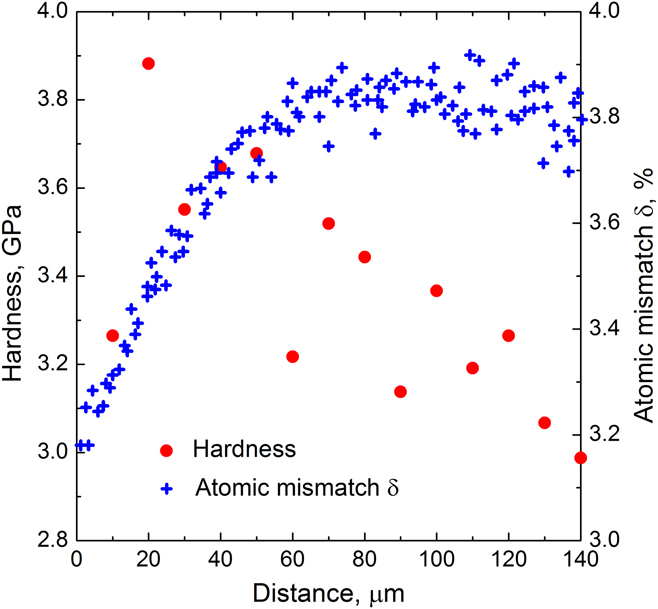
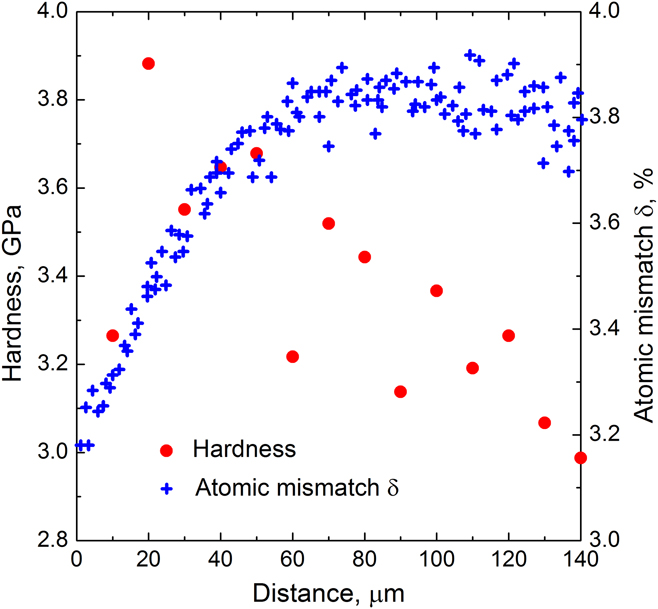
The diffusion-multiple technique has been proven to be powerful for the combinatorial research and development of multicomponent HEAs. For instance, Wilson et al.Reference Wilson, Field and Kaufman22 used the Co–Cr–Fe–Mn–Ni quinary diffusion multiples with a setup shown in Fig. 4(c) to accelerate alloy development in this HEA system. They confirmed that a disordered quinary region with FCC structure can be formed in the diffusion multiple, and the disordered quinary region was examined by using EDS and nanoindentation. The results of nanoindentation hardness and atomic mismatchReference Yang and Zhang47 (calculated from the EDS results) are plotted in Fig. 5 and reveal that the highest hardness did not correlate well with the maximum in atomic mismatch, suggesting that the severe lattice distortion hypothesis is not a predominant factor for the strengthening of the single phase solid solution in the Co–Cr–Fe–Mn–Ni HEA system.Reference Wilson, Field and Kaufman22
Direct comparison of microhardness and atomic mismatch δ (the mean square deviation of the atomic size of elementsReference Yang and Zhang47) in a section of a diffusion region in a Co–Cr–Fe–Mn–Ni quinary diffusion multiple made of Fe50Mn50, Co50Ni50, and Ni. Data points are mainly taken from Ref. Reference Wilson, Field and Kaufman22.
In principle, all possible compositional variants (i.e., complete composition libraries) of single-phase regions of a given HEA system could be produced in a properly constructed diffusion-multiple, although the size of a certain compositional variant might be too small to be efficiently characterized. Also, the sample-making process of a diffusion multiple is associated with relatively low costs compared to other combinatorial techniques discussed in this review. Therefore, the diffusion-multiple technique has its unique advantages and could be applied extensively for future HEA development when screening wider ranges of phase states and properties that can be probed without the necessity of using larger samples.
IV. COMBINATORIAL LAM OF HEAs
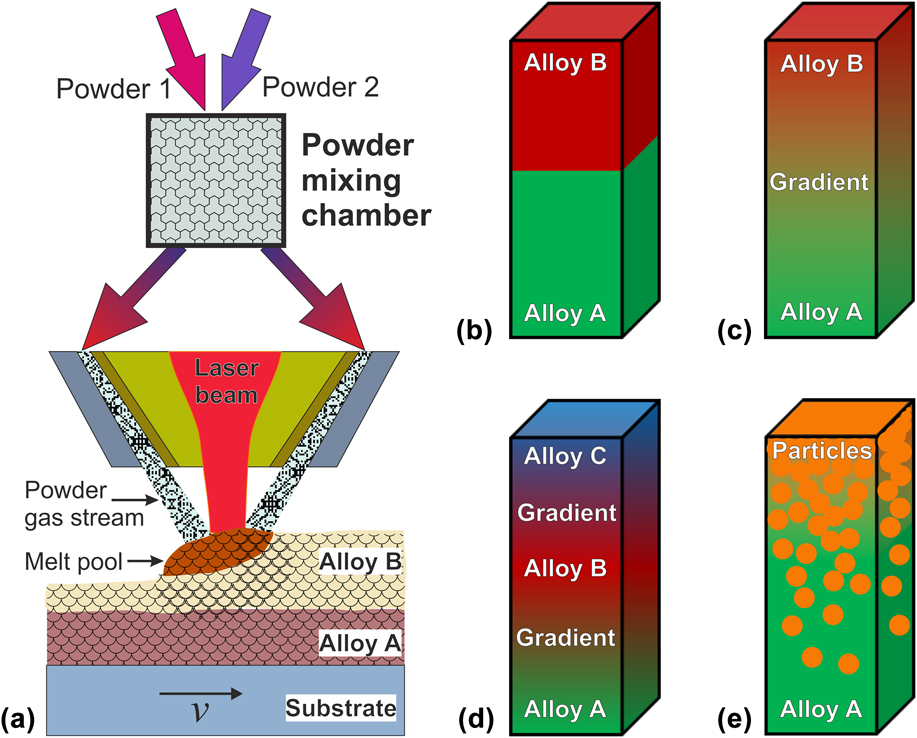
LAM has been used as an efficient rapid solidification technique for synthesizing bulk HEAs.Reference Ocelík, Janssen, Smith and De Hosson48–Reference Brif, Thomas and Todd51 An important advantage of LAM is that it also provides the possibility to explore materials that cannot be cast conventionally, e.g., alloys containing solute ingredients above the solubility limit or elements that are metallurgically hard to blend for instance due to vapor pressure limits. This inherent advantage of LAM is due to its rapid melting and solidification kinetics applied to confined volume regions of the melt pool exposed to the laser.Reference Ocelík, Janssen, Smith and De Hosson48–Reference Hofmann, Kolodziejska, Roberts, Otis, Dillon, Suh, Liu and Borgonia52 There are mainly two types of LAM approaches that can be used in that context, i.e., laser metal deposition (LMD) and selective laser melting (SLM).Reference Rombouts, Kruth, Froyen and Mercelis53 The LMD process has also been referred to as laser engineered net shaping (LENS). During LMD [Fig. 6(a)], the alloy or premixed powder blends are transferred into the interaction zone of the laser beam and onto the substrate by injecting them through nozzles with a carrier gas (e.g., Ar). In the SLM process,Reference Brif, Thomas and Todd51,Reference Knoll, Ocylok, Weisheit, Springer, Jägle and Raabe54 a laser beam is scanning over a powder layer, melting it locally. A fresh powder layer bed is applied after each areal laser scan and the process is then repeated after the respective 2D layered portion of the shape of the part has been built stepwise in the preceding layers. Both the various types of LMD and SLM methods have been used to produce bulk HEAs.Reference Joseph, Jarvis, Wu, Stanford, Hodgson and Fabijanic49,Reference Brif, Thomas and Todd51 For instance, Joseph et al.Reference Joseph, Jarvis, Wu, Stanford, Hodgson and Fabijanic49 fabricated bulk AlxCoCrFeNi (x = 0.3, 0.6, and 0.85 M fraction) HEAs by utilizing an LMD process, in this case referred to as direct laser fabrication in Ref. Reference Joseph, Jarvis, Wu, Stanford, Hodgson and Fabijanic49, from simple elemental powder blends. The resultant alloys showed indeed similar mechanical properties as the reference specimens that had been prepared via conventional arc-melting and solidification. Brif et al.Reference Brif, Thomas and Todd51 investigated the four-component equiatomic FeCoCrNi HEA prepared by SLM from a pre-alloyed and gas-atomized powder. The so-produced alloy showed significantly enhanced yield and ultimate tensile strengths compared to reference material that had been produced by conventional casting. This effect was attributed to the fine microstructure of the single-phase FCC solid solution obtained by laser melting and the associated rapid solidification.
(a) Schematic sketch showing the LMD process and its capability for producing multilayered bulk alloys. During the LMD process, the premixed powders are transferred into the interaction zone of the laser beam and onto the substrate by injecting them through nozzles with a carrier plasma gas. All blends can be obtained by fractionized contribution from the different feeding powders with different compositions. Powders are mixed in a separate chamber prior to injection. (b–e) Schematic sketches showing some examples of the different compositionally graded alloys including HEAs that can be achieved by the LMD process. The colors in (b)–(e) refer to alloys of different compositions and blended colors represent that a transition is introduced from one composition to another.
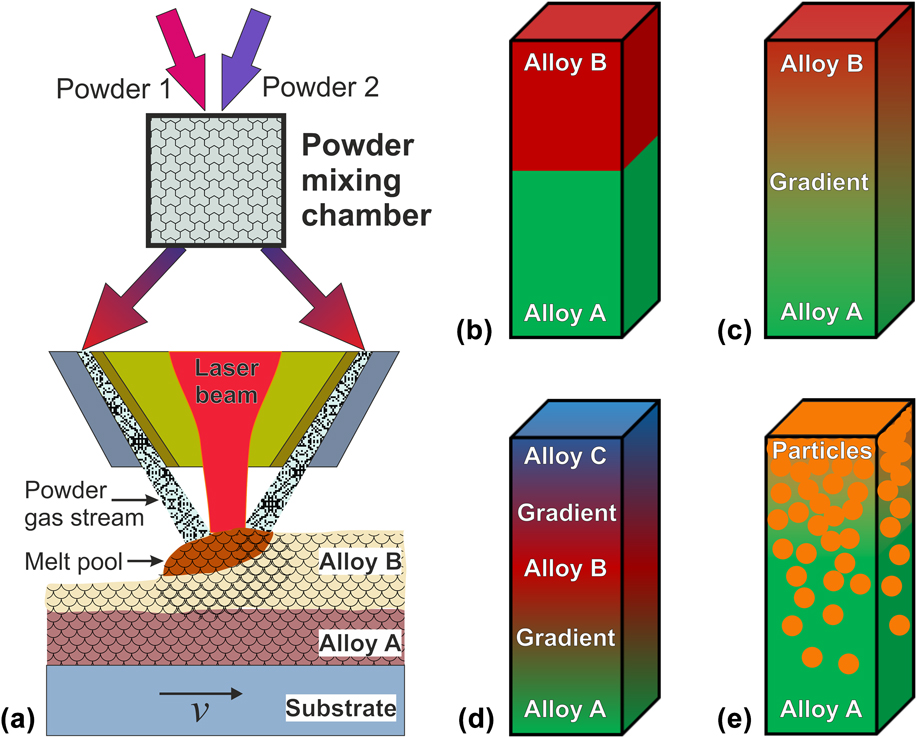
Other than the ability of efficiently synthesizing bulk HEAs with a uniform composition across a single part as discussed above, LAM can also be used to produce compositionally graded metal alloys, which renders it a powerful combinatorial approach for rapid alloy development.Reference Borkar, Gwalani, Choudhuri, Mikler, Yannetta, Chen, Ramanujan, Styles, Gibson and Banerjee23,Reference Hofmann, Kolodziejska, Roberts, Otis, Dillon, Suh, Liu and Borgonia52,Reference Knoll, Ocylok, Weisheit, Springer, Jägle and Raabe54,Reference Welk, Gibson and Fraser55 In regard to the above-introduced two types of LAM methods, LMD is an ideal technique for building up compositionally graded materials and in situ synthesis of new materials, while the SLM is generally less suited to fabricate samples with compositional gradients as the process requires a homogeneous powder bed.Reference Hofmann, Kolodziejska, Roberts, Otis, Dillon, Suh, Liu and Borgonia52,Reference Knoll, Ocylok, Weisheit, Springer, Jägle and Raabe54 The current commercial LMD systems can be installed with four or more different feedstock nozzles to deliver powders with varying compositions to the laser, which allows for a nearly infinite combination of compositional gradients.Reference Hofmann, Kolodziejska, Roberts, Otis, Dillon, Suh, Liu and Borgonia52 Figures 6(b)–6(e) show the schematic sketches of four different compositionally graded alloys including HEAs that can be efficiently synthesized by the aid of the LMD process. The compositionally gradient part can be designed to include have large compositional steps [Fig. 6(b)], and it can also proceed with a smoothly graded transition from one composition to another [Figs. 6(c) and 6(d)].Reference Hofmann, Kolodziejska, Roberts, Otis, Dillon, Suh, Liu and Borgonia52 Also, metal-matrix composites, e.g., nanoparticle-reinforced HEA-based materials, graded with a matrix can be fabricated by LMD, as schematically illustrated in Fig. 6(e). This can be realized when one of the powders being transferred into the laser has a significantly higher melting temperature than the others, thereby those particles would not readily pre-alloy with powders of lower melting point.Reference Hofmann, Kolodziejska, Roberts, Otis, Dillon, Suh, Liu and Borgonia52
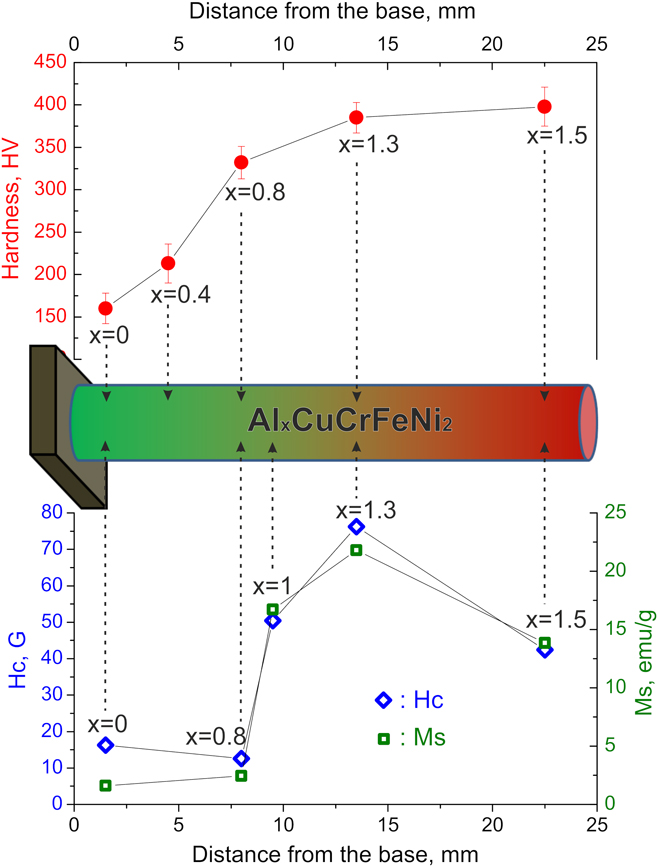
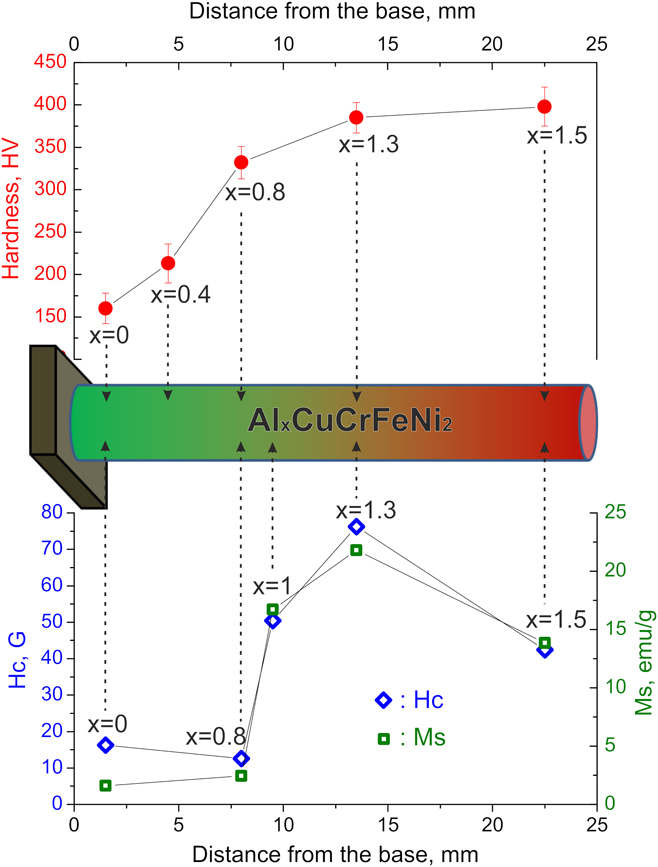
Fabricating compositionally graded parts via laser deposition has been shown as an attractive approach to systematically screen the influence of compositional changes on microstructural evolution and associated physical and mechanical properties of HEAs. For instance, Borkar et al.Reference Borkar, Gwalani, Choudhuri, Mikler, Yannetta, Chen, Ramanujan, Styles, Gibson and Banerjee23 studied the compositionally graded AlxCrCuFeNi2 (0 < x < 1.5) HEAs (referred to as complex concentrated alloys in Ref. Reference Borkar, Gwalani, Choudhuri, Mikler, Yannetta, Chen, Ramanujan, Styles, Gibson and Banerjee23) produced by laser deposition (referred to as LENS process in Ref. Reference Borkar, Gwalani, Choudhuri, Mikler, Yannetta, Chen, Ramanujan, Styles, Gibson and Banerjee23) from elemental powder blends. They found that the microstructure of the HEAs gradually changes from an FCC matrix containing an ordered L12 phase to a BCC matrix containing an ordered B2 phase.Reference Borkar, Gwalani, Choudhuri, Mikler, Yannetta, Chen, Ramanujan, Styles, Gibson and Banerjee23 Moreover, as shown in Fig. 7, the microhardness gradually increases with the increase of Al content, while the saturation magnetization and coercivity increase and reach a maximum value when x = 1.3.Reference Borkar, Gwalani, Choudhuri, Mikler, Yannetta, Chen, Ramanujan, Styles, Gibson and Banerjee23 These findings demonstrated that compositional gradients prepared by laser deposition provide a powerful combinational approach for probing composition–microstructure–property relationship in HEAs.
Microhardness values and magnetic properties along the length direction of the compositionally graded AlxCrCuFeNi2 (0 < x < 1.5) HEAs produced by laser deposition. The compositional gradient has a length of ∼25 mm. Ms and Hc refer to saturation magnetization and coercivity, respectively. Data points are mainly taken from Ref. Reference Borkar, Gwalani, Choudhuri, Mikler, Yannetta, Chen, Ramanujan, Styles, Gibson and Banerjee23.
The number of compositional variants that is accessible in compositionally graded HEA samples produced by combinatorial laser deposition process is huge, although the process is associated with relatively high costs, particularly due to the requirement of feeding large amounts of powders, many of which need to be carefully and cleanly pre-alloyed and produced by established powder metallurgical methods. Basically, the characterization techniques applicable to the diffusion-multiple samples discussed above can also be used for laser deposited graded samples. Also, the combinatorial laser deposition process can be used to tap novel HEAs that cannot be cast conventionally, e.g., those containing solute contents above the solubility limit, as the laser process involves rapid solidification. This is particularly relevant to HEAs since rapid solidification reduces segregations in such multiple principal element systems.
V. COMBINATORIAL THIN-FILM SYNTHESIS OF HEAs
Alloy design can be accelerated by combinatorial thin-film synthesis for the efficient exploration of special compositional ranges, which, e.g., show crystal structures suitable for functional applications, e.g., for the development of functional materials such as shape memory alloys.Reference Cui, Chu, Famodu, Furuya, Hattrick-Simpers, James, Ludwig, Thienhaus, Wuttig, Zhang and Takeuchi56 This results from the fact that for many functional materials, the intrinsic material characteristics such as reversibility of phase transformationsReference Cui, Chu, Famodu, Furuya, Hattrick-Simpers, James, Ludwig, Thienhaus, Wuttig, Zhang and Takeuchi56 are essentially dependent on the chemical composition and are more critical than structural properties that are strongly dependent on microstructure and sample dimensions. Whereas the exploration of compositional and crystal structure phase space is well addressed by the thin-film combinatorial approach, it is currently investigated how this approach can be extended to include also effects of the microstructure, e.g., by using step heaters for the systematic variation of thin-film microstructures.Reference Stein, Naujoks, Grochla, Khare, Gutkowski, Grützke, Schuhmann and Ludwig57
The combinatorial methodology applied to thin film growth consists of forming controlled composition gradients from multiple physical deposition sources, most frequently magnetron sputter sources, due to their broad applicability.Reference Ludwig, Zarnetta, Hamann, Savan and Thienhaus24,Reference Yan, Li, Zhang and Zhang58 The result is a materials library comprised of smoothly changing mixtures of the source materials which are characterized by high-throughput methods to identify the optimum composition or range of compositions for one or multiple properties of interest. Because all compositions in a library have been formed at the same time, with the same conditions, and can be further processed together (e.g., annealing, environmental exposure), many sources of sample-to-sample variability can be eliminated, clarifying investigations of cause and effect. Additionally, properties that may reach a narrow maximum or only occur at all in a very restricted composition range can be revealed.
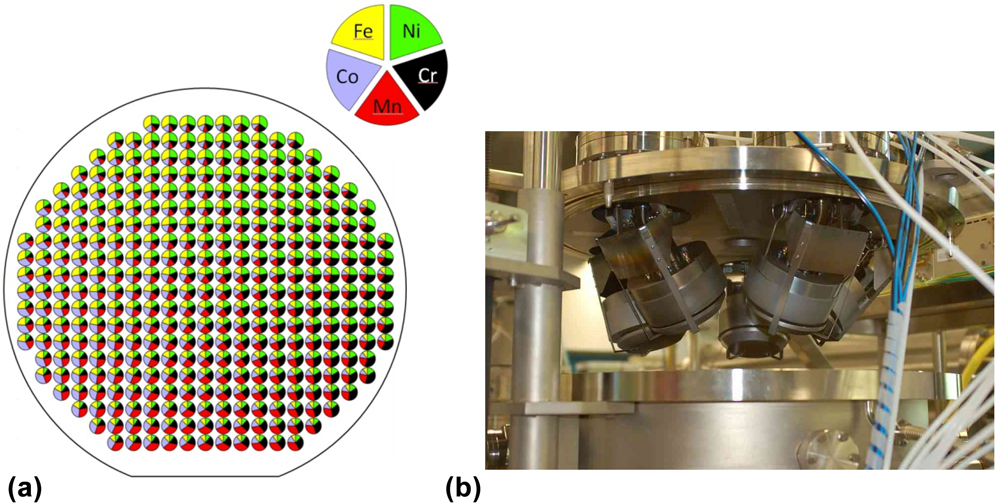
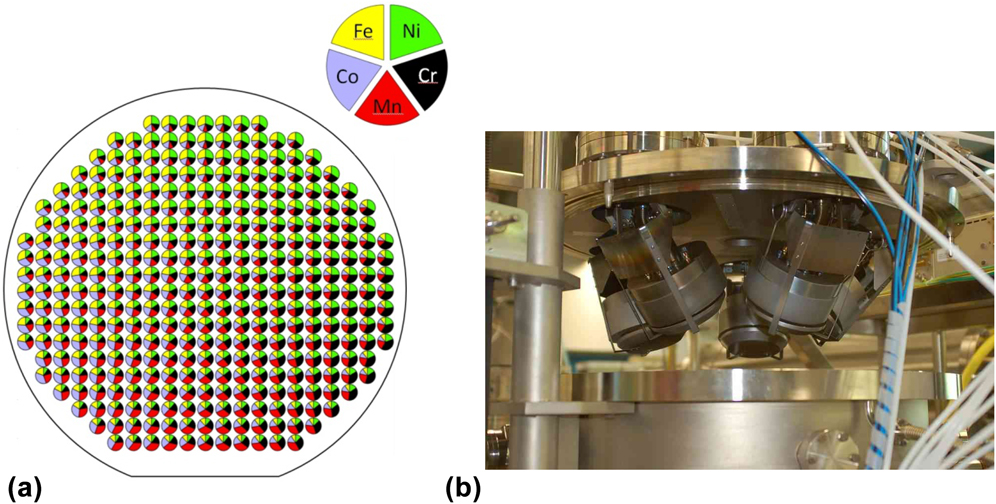
Several approaches to achieve designed combinatorial libraries by independently varying the individual constituent elements can be used, all based on magnetron sputtering. (i) Co-deposition from cathodes that are tilted with respect to the substrate plane results in wedge-shaped nanoscale thin films that are thickest from the geometrically closest edge of the substrate to thinnest at the farthest edge.Reference Li, Jensen, Liu, Liu, Gong, Scanley, Broadbridge and Schroers59 Multiple cathodes evenly distributed around the center of a substrate (3 cathodes: 120° separation, 4 cathodes: 90° separation, 5 cathodes: 72° separation) each produce such a wedge, with the resulting composition at any point on the substrate being the sum of the material arriving from each cathode (see Fig. 8). Co-sputtered films are atom-scale mixtures of the materials that are often subsequently annealed to form thermodynamically stable phases and reduce defects. (ii) When the sputtering cathode is directly opposite to the substrate, a blade shutter positioned parallel to the substrate surface can be moved during the deposition to produce a thickness wedge. By next rotating the substrate and moving a different target material into position, a controlled series of wedges can be grown. The wedges are typically 10 or 20 nm at the thickest end, and the complete multilayer stack can be repeated many times. With suitable subsequent annealing, the multilayers can be compositionally mixed to produce a combinatorial library. (iii) A hybrid of these two approaches can be made when the substrate is rotated past several opposed targets, with additional 90° substrate rotation steps in combination with deposition profile-shaping apertures.Reference Chevrier and Dahn60 With typical deposition rates, the net result is a film built up of multilayer gradients that are individually generally less than 1 nm thick through much of their length. Thus, while material is not being co-sputtered, neither is the material deposited by a single rotation past a single target truly a well-defined layer, resulting in a hybrid between the co-sputtered and multilayer approaches.
(a) Visualization of the quinary compositions contained in an exemplary thin-film library of Cr–Mn–Fe–Co–Ni co-sputtered from individual single-element targets, indicating the relative concentrations at each of 342 EDS measurement points. Legend identifies the elements and respective cathode positions. (b) Opened co-sputter chamber showing 5 confocal, 100 mm diameter magnetron sputter cathodes.
For HEAs with multiple principal elements, it eventually happens that the number of constituent elements desired exceeds the number of cathodes available. Increasing the number of confocal cathodes requires increasing the diameter of the circle on which they are situated and increasing the cathode center to substrate center distance, with the consequent problems of larger vacuum chamber sizes and longer target to substrate distances. Alternatively, decreasing the individual cathode’s diameter leads to physically smaller combinatorial libraries having steeper composition gradients in turn making it often difficult to measure and characterize distinct, individual alloy compositions. These issues can be addressed by using homogeneously mixed, multiple-element targets which are confocally co-sputtered with other mixed or elemental targets. Or, a single target can be made of separate material segments,Reference Kauffmann, Stüber, Leiste, Ulrich, Schlabach, Szabó, Seils, Gorr, Chen and Seifert61 yielding a combinatorial library after sputtering. However, to deposit different composition-spread ranges, custom targets of the appropriate composition need to be fabricated. Since the as-deposited element compositions are in general not identical to the target composition and can change as the target is used, the added complexity limits the versatility of this approach.
The combinatorial thin-film materials library approach is not only dependent upon subsequent high-throughput measurement and characterization of individual composition points but also highly conducive to this by having regular, designed gradients organized on a common substrate. As long as the library is kept together on this substrate, all sample areas experience the same environments during post-deposition handling as they similarly did during any pretreatments and during the thin film growth itself. Additionally, characterization instruments need only similar-sized programmable x–y translation tables and a common measurement grid to yield data sets that can be directly compared, combined, and archived. Physical properties such as thickness measurement by scanning needle profilometry or confocal laser microscopy, elemental composition mapping by EDS, phase mapping by XRD, surface structures characterization by SEM and scanning probe microscopy are all automated for data collection. More recently, thin film chemical properties can be measured by automated scanning X-ray photoelectron spectroscopy (XPS)Reference Brundle, Conti and Mack62 and (photo)electrochermical scanning droplet cell techniques.Reference Stein, Gutkowski, Siegel, Schuhmann and Ludwig63 Further examples are mechanical property screening by automated nanoindentation,Reference Warren and Wyrobek64 magnetic properties by magneto-optic Kerr effect,Reference Fackler, Alexandrakis, König, Kusne, Gao, Kramer, Stasak, Lopez, Zayac and Mehta65 and optical properties by photostand.Reference Thienhaus, Naujoks, Pfetzing-Micklich, Konig and Ludwig66
A recently introduced combinatorial investigation approach consists in depositing an alloy thin film on a nanoscale-tip array which can then be further processed, e.g., by annealing or oxidation at various temperatures and times.Reference Li, Savan, Kostka, Stein and Ludwig67 The nanoscale volumes at each tip can be quickly analyzed by atom probe tomography and a range of TEM measurements at the atomic scale, without further preparation steps such as FIB cutting. These nanoscale volumes facilitate rapid phase evolution and decomposition avoiding the need for long annealing of bulk materialsReference Saal, Berglund, Sebastian, Liaw and Olson68 or need for the introduction of high defect densities for acceleration. As an example, the temperature stability of the equiatomic CoCrFeMnNi single-phase solid solution was investigated.
Combinatorial libraries are particularly useful in refining and verifying predictions made by theoretical calculations and applied to design of novel HEAs.Reference Lederer, Toher, Vecchio and Curtarolo69 Sputtered thin films, particularly when co-deposited from elemental sources with the arriving elements being mixed on the atomic scale, provide a time- and effort-efficient alternative to the homogenization steps needed for bulk HEA manufacture such as by arc-melting.Reference Gurao and Biswas70
Along with the advantages of high materials purity, excellent cross-sectional compositional uniformity and atomic-scale mixing of the arriving elements, the fabrication of combinatorial libraries in the form of thin films also has potential complications that must be kept in mind. Magnetron sputtered thin films tend to be highly textured and have substantial internal stress, and as-deposited may have metastable phases that are not easy to anneal to the thermodynamically stable form(s). They often grow with columnar microstructures which tilt toward the highest particle arrival rate direction. This in turn can result in the development of intercolumnar cracks and voids. Alternatively, libraries grown using the repeating multilayer approach may be difficult to homogenize by annealing (for slowly diffusing elements) and show additional effects from the stacking sequence of the layers. These issues can frequently be mitigated by applying various deposition options, such as sputtering power generation with radio frequency (RF), direct current (DC), bipolar pulsed DC, and high power impulse magnetron sputtering (HIPIMS). The substrate can be held at high (or low) temperature during deposition, and a bias (RF, DC, and HIPIMS) can be simultaneously applied during growth. Finally, since they are inherently thin films with a thickness scale of nanometers to a few microns, morphologies that can appear in bulk materials on much larger scales may be unable to form.
VI. SUMMARY AND OUTLOOK
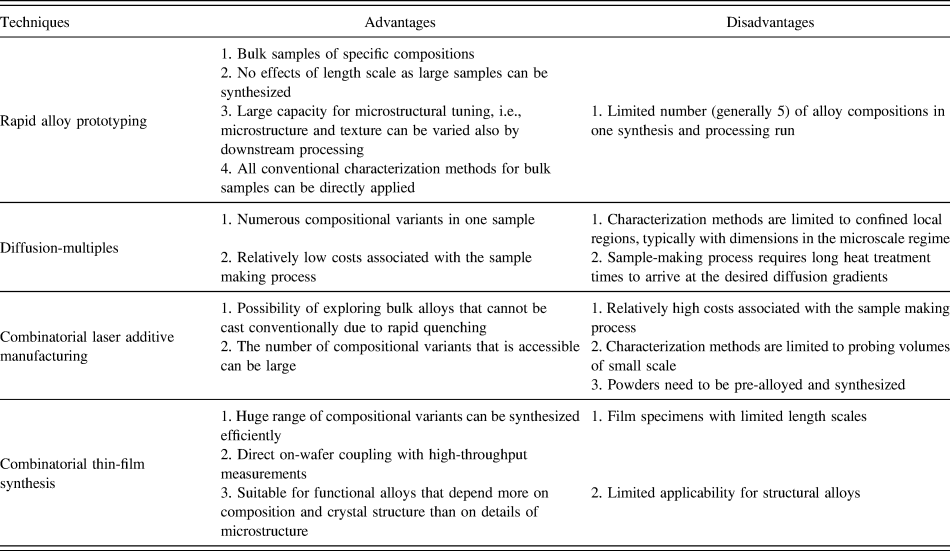
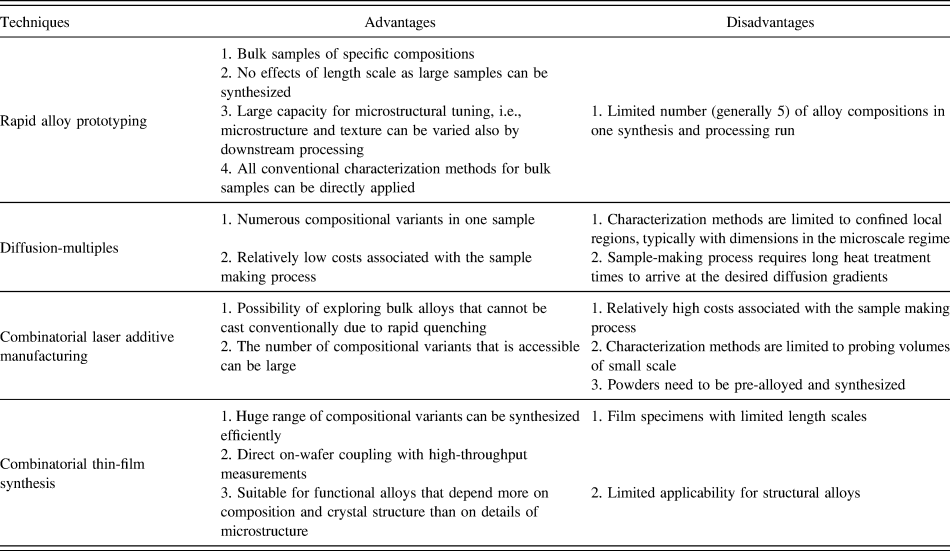
We present a brief overview for the four different combinatorial experimental methods that have been used to synthesize novel HEAs, namely, RAP, diffusion-multiples, combinatorial LAM, and combinatorial co-deposition of thin-film materials libraries. The RAP enables synthesis and processing of bulk samples with specific compositions, and thus all characterization methods used in conventional one-alloy-at-a-time practice can be directly applied to obtain reliable composition–microstructure–property relationships. The diffusion-couple technique produces all possible compositional variants (i.e., complete composition libraries) of single-phase regions of a given HEA system, although the size of a certain compositional variant might be too small to be efficiently characterized. The combinatorial LAM method enables synthesis of compositionally graded samples with many compositional variants, although the process is associated with relatively high costs. Also, it allows for exploring novel HEAs that cannot be cast conventionally due to the laser process involving rapid melting and solidification. The combinatorial thin-film synthesis technique involves probing well-defined and large range thin-film composition gradients across a substrate wafer fabricated in a single experiment and is accessible to the associated high-throughput measurements of thin-film specimens. A comparison of the advantages and disadvantages of the four different combinatorial experimental techniques is shown in Table I to provide guidance for selecting appropriate methods for conducting combinatorial HEA studies.
Comparison of the advantages and disadvantages pertaining to the four different combinatorial and high-throughput synthesis techniques for HEA development.
These combinatorial techniques are essentially required for the development of novel HEAs over the practically infinite compositional space. Yet, even these accelerated synthesis methods are not capable of entirely screening the composition and microstructure space of HEAs so that coupling with theoretical guidance regarding specific target features is an important approach of screening novel HEAs with beneficial property profiles. For instance, our efforts on the development of TRIP and/or TWIP-assisted HEAs using RAP technique confirmed that phase (meta)stability is a key feature to tune the compositions of certain HEA systems to introduce multiple deformation mechanisms, thereby improving the range of accessible strength–ductility combinations.Reference Li and Raabe29,Reference Li, Körmann, Grabowski, Neugebauer and Raabe33 For future HEA development, it is thus expected that more extensive combinations of combinatorial experimental methods with theoretical assistances both from large scale screening of phase diagramsReference Miracle and Senkov6 and ab initio guided phase-property treasure mapsReference Li, Körmann, Grabowski, Neugebauer and Raabe33 will help to more efficiently identify and realize promising materials design routes with novel property profiles or even so far undiscovered features.
ACKNOWLEDGMENTS
This work is financially supported by the European Research Council under the EU’s 7th Framework Program (FP7/2007-2013)/ERC grant agreement 290998. H. Soren-Stein and S. Thienhaus are gratefully acknowledged for development and realization, respectively, of multidimensional graphing for high-entropy alloy data visualizations.