



INTRODUCTION
Free-living amoebae of medical relevance include the genera/species Acanthamoeba spp., Balamuthia mandrillaris and Naegleria fowleri which are causative agents of lethal encephalitis and other diseases in humans and animals [Reference Marciano-Cabral and Cabral1–Reference Lorenzo-Morales4]. Regarding B. mandrillaris, this amoebae is the causative agent of Balamuthia amoebic encephalitis (BAE), which has been reported in more than 200 cases worldwide [Reference Lorenzo-Morales4, Reference Cabello-Vílchez5]. The United States and Latin America have reported the highest number of cases, with the southwest United States and Peru being the most affected regions [Reference Matin3, Reference Lorenzo-Morales4, Reference Maciver6, Reference Bravo and Seas7–Reference Lares-Jiménez10].
The pathogenicity mechanisms of this amoeba have not been established so far; however, it is suspected that the amoeba is able to enter the host through the olfactory neuroepithelium, the respiratory tract or a skin lesion. The amoeba is then able to reach the central nervous system by haematogenous spread [Reference Lorenzo-Morales4, Reference Perez and Bush11, Reference Siddiqui and Khan12].
There is an urgent need for the development of reliable diagnostic and therapeutic measures for BAE. In the case of diagnosis, it is often carried out post-mortem since the disease is lethal in more than 98% of cases [Reference Lorenzo-Morales4, Reference Schuster13, Reference Todd14].
Although the environmental niches of B. mandrillaris seem to be associated with soil-related habitats, the pathogen has only been isolated from the environment on nine previous occasions: dust and soil sources in the United States [Reference Schuster15, Reference Dunnebacke16] and Iran [Reference Niyyati17, Reference Niyyati18], mud in Jamaica [Reference Todd14], soil and water in Mexico [Reference Lares-Jiménez10], soil in Peru [Reference Cabello-Vílchez5], dust in Costa Rica [Reference Retana-Moreira19] and water in Guinea–Bissau [Reference Baquero20].
In Iran, previous studies have reported the isolation of B. mandrillaris from dust collected in the city of Tehran [Reference Niyyati17] and it was also recently isolated from soil samples in northwestern Iran [Reference Niyyati18]. Nevertheless, even though the pathogen appears to be present in the environment, no clinical cases have been reported so far in Iran [Reference Niyyati18].
A recent study by Todd et al. [Reference Todd14], reported the presence of B. mandrillaris in a local mud spa in Jamaica. Therefore, since we have previously detected B. mandrillaris in dust and soil in Iran, in this study we checked water samples for the presence of this amoebic pathogen from hot springs widely visited by locals and tourists in Iran.
To the best of our knowledge, this is the first report on the isolation of B. mandrillaris from water sources in Iran related to human activity and the third time that this pathogen has been isolated from the environment in this country. Moreover, this is the first time that B. mandrillaris has been isolated from hot springs worldwide.
MATERIALS AND METHODS
Geographical study area
This study was conducted in Mazandaran province, northern Iran. Mazandaran province is located on the southern coast of the Caspian Sea. The province enjoys a moderate, subtropical climate with an average temperature of 25 °C in summer and about 8 °C in winter. The region has many therapeutic and recreational mineral springs and geothermal streams, thus many locals and tourists travel to this region to use the facilities (mostly those located in the capital of Mazandran province, Ramsar), which are used to treat skin diseases, rheumatism, neuralgia and muscular pains (Fig. 1).
Map of the Caspian Sea showing outline of Caspian Sea coast and country boundaries, Mazandaran province, northern Iran. The 22 sampling points are indicated by solid circles (•). Ramsar city, where Balamuthia mandrillaris isolates were detected, is indicated by a star (⋆)

Sample collection and processing
Water samples were collected from the 22 most popular hot springs of Mazandaran province, northern Iran using 1-l sterile bottles in triplicate, thus a total of 66 samples were processed in this study. Each sample was filtered using nitrocellulose membrane (0·22 μm pore size, 45 mm diameter) and cultured using the enrichment cultivation method. Briefly, 1·5% non-nutrient agar were obtained using Bacto agar (Difco, USA), filters were then placed on the surface of the medium and incubated at room temperature. Plates were monitored for outgrowth of Balamuthia-like amoebae every 24 h [Reference Retana-Moreira19, Reference Baquero20].
DNA extraction, PCR analysis, and sequencing
A modified phenol–chloroform method for DNA extraction from cysts and trophozoites on positive plates was used based on our previous work [Reference Niyyati17]. For the molecular identification of B. mandrillaris, the 16S rDNA gene was targeted and sequenced as described previously [Reference Niyyati17, Reference Booton21], using the Balspec16S primer pair (5′-Balspec16S: 5′-CGCATGTATGAAGAAGACCA-3′ and 3′-Balspec16S: 5′-TTACCTATATAATTGTCGATACCA-3′).
PCR was performed using the Ampliqone kit (Taq DNA Polymerase Master Mix RED, Denmark) which is a pre-made mixture. According to the manufacturer's instructions, 15 µl Ampliqone was mixed with 3 µl suspicious DNA, 1·3 µl primers and 10·7 µl distilled water. The thermal cycling conditions were an initial denaturing step at 94 °C for 1 min and 35 repetitions at 94 °C for 35 s, annealing steps were at 56 °C for 1 min, and 72 °C for 1 min.
PCR products were purified and sequenced in both directions. Obtained sequences were edited using Chromas software (Informer Technologies Inc.) and aligned using the Mega 5.0 program (http://mega.software.informer.com/5.0/). Homology analysis was then performed against all available genes in the Genbank database. The obtained sequences for the new isolates have been deposited in Genbank (accession nos. KU184268–KU184269).
RESULTS AND DISCUSSION
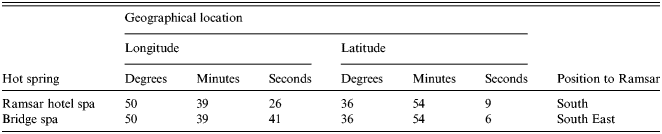
From the 66 water samples collected from the 22 mineral and hot springs of Mazandaran province included in this study, two plates showed suspected Balamuthia growth in the non-nutrient agar plates. Balamuthia trophozoites were approximately 30–120 µm in diameter with dendritic pseudopodia and most of the time their trophozoites appeared stretched out and branched (Fig. 2). Subsequent cultures revealed the elimination of unwanted amoebae, bacteria and fungi and the suspected amoebae were cloned successfully. Both positive plates belonged to popular hot springs in the city of Ramsar (Tables 1 and 2). One of the isolated strains, designated LN-HSR5-Balamuthia, exhibited very slow growth rates and was not fully grown until 20 days. This strain was isolated from an acidic and sulphurous hot spring with a temperature of 32 °C. The other strain, designated LN-HSR1-Balamuthia, was isolated from a hot spring with a temperature of 42 °C. Furthermore, PCR of the 16S rDNA mitochondrial gene of B. mandrillaris confirmed the morphological observations in both cases. The PCR products of these strains showed sequence homologies between 96% and 99% compared to the B. mandrillaris sequences available in GenBank [KT175741·1 and EU934073·1 (Iranian isolate: ID19 strain), respectively]. Furthermore, the isolated strains showed high homology with the previously reported Balamuthia strains in Iran (accession nos. KR908788–KR908792). The 96% homology was shown with the mitochondrial genome of B. mandrillaris (V039 strain).
Balamuthia mandrillaris trophozoites and cysts (a, b, magnification ×100). B. mandrillaris trophozoites (c, d, magnification ×400) in non-nutrient agar plates, during the early stages of isolation.

Geographical location of two positive hot springs in northern Iran
Positive isolates and contaminated hot-spring data

This is the first report regarding the isolation of B. mandrillaris from water sources in Iran and the first to report regarding the occurrence of this amoeba in hot springs worldwide. Moreover, therapeutic springs in northern Iran are very popular and thus awareness should be raised regarding contact and likelihood of infection with B. mandrillaris. A previous study conducted by Todd et al. also revealed the presence of B. mandrillaris in therapeutic mud used by locals and tourists in Jamaica [Reference Todd14]. In accordance with previous studies, the present study again confirmed that the occurrence of B. mandrillaris in environmental sources is very low (2/66 collected water samples) [Reference Cabello-Vílchez5, Reference Lares-Jiménez10, Reference Niyyati17, Reference Niyyati18]. Moreover, the isolation of the amoebae from various regions of the world also showed low rates, e.g. Iran (5/55, 9% [Reference Niyyati17]), Costa Rica (1/36, 2·7% [Reference Retana-Moreira19]), Jamaica (1/72, 1·38% [Reference Todd14]), Guinea–Bissau (1/22, 4·5% [Reference Baquero20]) and Peru (4/21, 19% [Reference Cabello-Vílchez5]). These data reveal the low rates of occurrence of Balamuthia in environmental niches. It should be noted that the low rates of this amoeba can be explained by the fact that it is very rare in nature compared to other free-living amoebae such as Acanthamoeba. On the other hand, this could also be due to lack of reliable culture methods for this amoeba and the high contamination of environmental sources with fungi and bacteria that confer the outgrowth of the amoebae [Reference Lares-Jiménez10]. According to a previous study the ‘sandwich agar technique’ and a new axenic culture could be a way of decreasing fungal contamination [Reference Lares-Jiménez10, Reference Lares-Jiménez, Gámez-Gutiérrez and Lares-Villa22].
In the present study both positive strains (LN1 and LN5) were isolated from hot springs with acidic pH and relatively high temperature (32–42 °C). The ability of Balamuthia to tolerate hostile conditions is not surprising as evidenced by a previous study [Reference Siddiqui and Khan12], which showed amoeba viability could not be affected by high temperatures (up to 60 °C for 1 h). Moreover, the cysts could even survive at up to 70 °C for 1 h and they can transfer to proliferating amoebae [Reference Siddiqui and Khan12, Reference Siddiqui and Khan23].
The present study is in accord with a report by Lares-Jiménez et al. regarding the aquatic environment as a potential source for B. mandrillaris [Reference Lares-Jiménez10]. Our study further confirms that the potential risk is not limited to soil and dust samples [Reference Niyyati17, Reference Niyyati18]. Previous studies in Iran have shown the occurrence of B. mandrillaris in soil and dust sources of public places including parks and school campuses. It should be also mentioned that most cases of Balamuthia infection in Peru, the most affected country, occurred in dusty places and in places with a soil environment [Reference Cabello-Vílchez5, Reference Niyyati18]. There are studies in the literature demonstrating a direct relationship between the presence of Balamuthia in water sources and cases of encephalitis [Reference Lares-Jiménez10, Reference Baquero20, Reference Pindyck24].
Overall, the present study reports the contamination of hot springs in Iran due to B. mandrillaris, which is also the first time that this pathogen has been isolated from this type of habitat. Therefore, this organism should be considered in cases of encephalitis following immersion in hot springs worldwide.
ACKNOWLEDGEMENTS
J.L.M. was supported by the Ramón y Cajal Subprogramme from the Spanish Ministry of Economy and Competivity RYC-2011–08863. This study was funded by Shahid Beheshti University of Medical Sciences, Tehran, Iran. The authors thank Dr Niloofar Taghipour for her kind comments and Dr Eznolah Azargashb for his kind and helpful comments.
DECLARATION OF INTEREST
None.



