Background
Cancer of the oropharynx accounts for about 18,000 new cases annually in India (worldwide 93,000 cases).Reference Bray, Ferlay, Soerjomataram, Siegel, Torre and Jemal 1 Radiation therapy (RT) in combination with chemotherapy is the mainstay in the treatment for locally advanced oropharyngeal cancer, as radical surgery is associated with high morbidity and functional compromise. In the past two decades, the trend in radiation therapy had been to increase the number of fractions or in other words to reduce the dose per fractions in order to decrease the severity of late effects by exploiting the difference in the shape of the dose–response relationship between early and late responding tissues. But recent studies, focused on alternative fractionation, are showing a renewed interest in dose fractions much larger than 2 Gy for curative radiotherapy.
Several landmark studies including the continuous hyperfractionated accelerated radiotherapy (CHART) trial had demonstrated the advantage of acceleration, that is, reducing the overall treatment time to improve local control.Reference Dische, Saunders and Barrett 2 But as the repair half-times of late reacting normal tissues are long, this strategy of using multiple treatments per day to maintain a large number of treatments in a short overall time has its own limitation. Reference Bentzen, Saunders and Dische3–Reference Landuyt, Fowler, Ruifrokb, Stiiben, van der Kogeld and van der Schuerena5 The probable solution instead seems to be the use of a smaller number of once daily larger dose fractions.
Accelerated RT, that is, increasing the dose more than the standard 10 Gy per week, has been shown in many randomised controlled trialsReference Overgaard, Hansen and Specht 6 , Reference Bourhis, Lapeyre and Tortochaux 7 to be associated with an improved efficacy/toxicity ratio relative to standard fractionation if a careful balance between total dose, dose per fraction and overall treatment time is chosen.
Fractionation studies have shown that local control is lost when the overall treatment time is prolonged. For head and neck cancers, the local control is reduced by 0·4–2·5% for each day that the overall treatment time is prolonged.Reference Fowler and Harari 8 , Reference Withers and Peters 9 As a result, after the first 4 weeks of a fractionated schedule, the first 0·61 Gy of each day’s dose fraction is required to overcome proliferation from the previous day.Reference Hall 10
Additionally, it is a well-accepted fact that chemotherapy given concurrently with RT as a definitive treatment enhances loco-regional control and overall survival in head and neck cancer as compared with RT alone.Reference Denis, Garaud and Bardet 11 – Reference Pignon, le Maître, Maillard and Bourhis 17 Chemotherapy-induced radiosensitisation can, therefore, be considered as a method of biologic dose escalation,Reference Kasibhatla, Kirkpatrick and Brizel 18 and to be precise, there is an average gain of 3·6 fractions of 2 Gy for the effect of chemotherapy in head-and-neck radiation therapy.Reference Fowler 19
In comparison to a dose fractionation schedule of 70 Gy in 35 fractions, a schedule delivering 55 Gy in 20 fractions will have a similar log 10tumourcell kill and a lower biologically effective dose (BED) to late effect tissues of 105·4 Gy 3 versus 116·6 Gy 3, using the formula
 $BED = N \times d \times [1 + {d \over {{\raise0.7ex\hbox{$\alpha $} \!\mathord{\left/ {\vphantom {\alpha \beta }}\right. } \!\lower0.7ex\hbox{$\beta $}}}}] - {{0.693} \over {a \times Tp}} \times [T - {T_k}]$
, assuming Tp [cell population doubling time during treatment]= 3 days, Tk [the time taken from the start of radiotherapy to commencement of accelerated repopulation] = 21 days, α/β = 10 Gy for tumour, α/β = 3 Gy for late-responding tissue. It also predicts for tolerable acute mucosal reaction with a BED of 55·9 (assuming Tp = 2·5 days, Tk = 7 days, α = 0·35 lnGy−1, α/β = 10 Gy).Reference Fowler, Levitt, Purdy, Perez and Poortmans
20
Similarly, the doses for the intermediate and low risk nodal levels can be adjusted to 50 Gy in 20 fractions and 46 Gy in 20 fractions, respectively, which have comparable BED to conventionally fractionated doses.
The reduction in number of fractions and overall treatment time allows more efficient use of resources, which can help avoid long waiting times, and treatment regimens involving fewer fractions would also clearly be more convenient for patients. At the same time the department can increase the number of treated patients with the same workload but implementation of this altered fractionation schedule as a routine practice is yet to be established.
The development of intensity-modulated radiation therapy (IMRT) has resulted in greatly improved dose distributions, with smaller volumes of normal tissues receiving high doses. Thus, this provides the opportunity of increasing the dose per fraction, where the need to spare late responding normal tissues by fractionation is reduced because of the lower dose to these tissues.
We have practiced a similar hypofractionated radiation therapy, as mentioned above, for locally advanced head and neck cancers at our hospital, exploiting the radiobiological efficacy and as a resource-sparing alternative for a high-volume centre. In this study, we analysed the tumour response and the toxicity profiles in patients having locally advanced oropharyngeal cancers treated with hypofractionated IMRT and concurrent chemotherapy with Cisplatin.
The aim was to assess the feasibility and efficacy of hypofractionated IMRT with concurrent Cisplatin in the treatment of locally advanced oropharyngeal cancer (Stage III and IVA) patients in Indian scenario in a high-volume centre with specific objectives being:
1. Evaluation of loco-regional response.
2. Assessment of toxicity (acute and late).
Material and Methods
This retrospective, observational, single arm study was completed at the Department of Radiation Oncology, Chittaranjan National Cancer Institute (CNCI), Kolkata—which is a Regional Cancer Center of Eastern India located in the state of West Bengal. The treatment records of 41 eligible patients with histopathology proven, locally advanced squamous cell carcinoma of oropharynx, Stage III (T3N0-1 M0or T1-2N1M0) and IVA (T4aN0-2a-cM0, T1-3N2a-cM0) according to American Joint Committee on Cancer (AJCC) 7th Edition, 2010, 21 registered at the hospital from September 2015 to April 2017, treated with hypo-fractionated IMRT with concurrent 3-weekly Cisplatin and had completed treatment, were analysed from the hospital database. Patients received concurrent chemoradiation with 2 cycles of 3-weekly cisplatin on day 1 and day 22 along with hypofractionated radiation therapy (IMRT) 55 Gy delivered in 20 fractions over 4 weeks. All patients who had received this regimen had Eastern Cooperative Oncology Group (ECOG) performance status 22 1 or 2, normal renal function, liver function and blood counts and baseline audiometry limited to mild sensory neural deficits. Patients who had received prior chemotherapy or had received radiation therapy with conventional fractionation were excluded from the analysis. Due approval of the institutional ethical committee was obtained and informed consent was taken from all the eligible patients before analysing their data (IEC Ref: A-4.311/77).
Radiation therapy was delivered with IMRT technique with image guidance using cone beam computed tomography (CBCT) on Elekta Synergy Linear Accelerator (Elekta, Stockholm, Sweden) with treatment planning on Monaco 3-D Treatment Planning System (Elekta, Stockholm, Sweden).
The gross tumour volume (GTV) included all gross primary tumour and also the involved lymph node(s) as determined by physical examination, pathological examination and imaging. The clinical target volume (CTV) was divided into three groups:
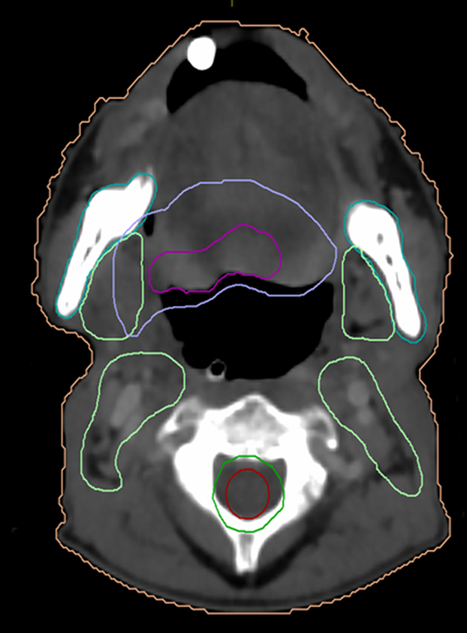
CTV55: (GTV + 1·0 cm){thesubscript55denotestheradiationdose delivered} (Figure 1)
CTV50: Remaining area at high or intermediate risk of involvement which included the adjacent nodal levels.
CTV46: Low risk nodal levels.
Axial view showing contoured CTV55 (primary tumour and nodal disease). Dark pink-GTV55 (primary tumour), Sky blue-CTV55 (primary tumour). Green-CTV55 (nodal contouring including level IB and II).

The planning target volume (PTV) of additional 5 mm was added to the CTV.
The critical normal structures delineated included parotid gland (right and left), spinal cord, spinal cord Planning organ at risk volume (PRV) (around the contoured spinal cord, 3 mm margin was applied to create planning organ at risk volume), mandible, cervical esophagus, brain stem, optic nerve (right and left), optic chiasm, cochlea (right and left), larynx, eye ball (right and left) and lens (right and left).
IMRT Dose Prescriptions
PTV 55 ‒55 Gy in 20 fractions(2·75 Gy/fraction)
PTV 50 ‒50 Gy in 20 fractions(2·50 Gy/fraction)
PTV 46 ‒46 Gy in 20 fractions(2·30 Gy/fraction)
Organs at risk (OARs) were delineated and the dose constraints were modified considering higher dose per fraction as per LQ model and BED.
Brainstem D max ≤ 38 Gy
Spinal cord D max ≤ 38 Gy
Spinal cord Planning risk volume (PRV) D max ≤ 40 Gy
Eyeball (right and left) D max ≤ 35 Gy
Lens (right and left) D max ≤ 4 Gy
Optic nerve (right and left) D max ≤ 40 Gy
Optic chiasm D max ≤ 40 Gy
Cochlea (right and left)D max ≤ 35 Gy
Parotid (right and left) mean ≤ 18 Gy
Mandible D max ≤ 60 Gy
Larynx D max ≤ 38 Gy/mean ≤ 57 Gy
Esophagus mean ≤ 30 Gy
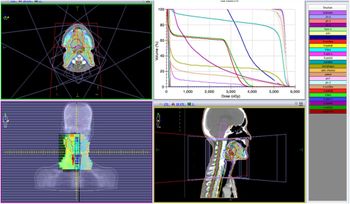
All plans were completed by using 7–9 coplanar beams (6 MV photon) (Figure 2).
Beam arrangement with dose painting and DVH.

A particular plan was approved if the prescribed dose covered 95% of PTV with maximum target dose less than 108%. Normal tissue dose volume was maintained within 5% of the constraints prescribed. Step and shoot IMRT technique was used to deliver the radiation therapy.
Patients also received two cycles of concurrent chemotherapy with Cisplatin (100 mg/m2) by intravenous infusion, on day 1 and day 22, respectively. Standard anti-emetic prophylaxis consisting of 16 mg of Ondansetron and 16 mg of dexamethasone was given as intravenous bolus as pre-medication 30 minutes prior to chemotherapy. Routine hydration with 500 ml normal saline was given 30–45 minutes before chemotherapy and 1,000 ml of normal saline was given over 2 hours immediately after chemotherapy. Anti-emetic prophylaxis was continued with oral Ondansetron and Domperidone for 3–5 days after chemotherapy.
Data Collection Technique and Tools
Data collection from patient follow-up was completed up to December 2017. Patients were observed for any radiation reaction or chemotherapy toxicity at least once a week during the course of radiation therapy and they were managed accordingly. Blood Investigations (complete blood counts and assessment of renal function and serum electrolytes) were completed at least once in a week. First three follow-up visits were at 2 weeks, 4 weeks and 6 weeks of completion of treatment, respectively. Thereafter, the clinical follow-up continued monthly once for the first 6 months and thereafter at 3-month intervals. In each follow-up, the patient had a complete head and neck examination and was assessed clinically for response and toxicities. Contrast-enhanced computed tomography (CECT) neck was completed 3 months post-treatment to assess the tumour response and was correlated clinically. The response was assessed using evaluation criteria in solid tumours (Response Evaluation Criteria In Solid Tumors version 1.1). 23 Acute and late toxicities were assessed and graded as per common terminology criteria for adverse events version 4.03 (Common Terminology Criteria for Adverse Events 4.03). 24 After collecting all the data from hospital records and database, it was computed in Microsoft Excel Workbook.
Statistical analysis was performed with aid of Epi Info (TM) 3.5.3. Descriptive statistical analysis was performed to prepare the tables with corresponding percentages. Test of proportion was used to find the Standard normal deviate (Z) to compare the difference in proportions. p ≤ 0·05 was taken to be statistically significant.
Results
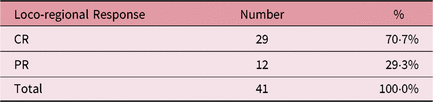
All 41 patients for analysis had received the full course of treatment. 29 patients (70·7%) achieved complete response, while the remaining 12 showed partial response (Table 1). Proportion of patients with complete response (70·7%) was significantly higher than that of partial response (29·3%) (Z = 5·93; p < 0·001).
Response to treatment

Till the last follow-up data (December 2017), none of those 29 patients who achieved complete response had any evidence of local or distant recurrence. At 6 months follow-up, among the 12 patients who were partial responders, none had distant spread. Patients with partial response were referred back to multidisciplinary tumour board for discussion regarding further treatment options.
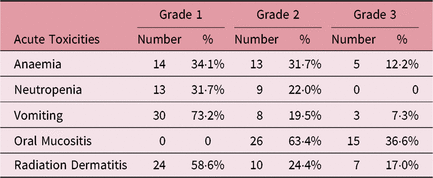
Distribution of Acute Toxicities (Table 2)
All the acute toxicities related to IMRT plus concurrent chemotherapy were within expected limits, and overall, the whole course of treatment was tolerated well by most of the patients. Acute grade 3 toxicity was observed mostly in the form of oral mucositis and radiation dermatitis. Grade 3 oral mucositis and radiation dermatitis were seen in 15 patients (36·6%) and 7 patients (17%), respectively. Incidence of acute grade 3 anaemia was observed in 5 patients (12·2%) and grade 3 vomiting in 3 patients (7·3%). No patient had grade 3 neutropenia. No acute grade 4 toxicities were observed.
Distribution of acute toxicities

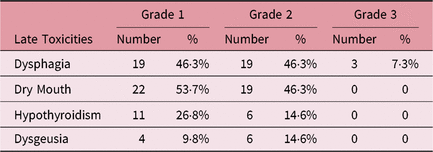
Distribution of Late Toxicities (Table 3)
Till the date of last follow-up, the most common late toxicities were those of dysphagia and dry mouth. Incidence of grade 2 and grade 3 dysphagia were observed in 19 patients (46·3%) and 3 patients (7·3%) respectively; grade 2 dry mouth observed in 19 patients (46·3%).
Distribution of late toxicities

Distribution of Total Duration of Interruption of Treatment (Table 4)
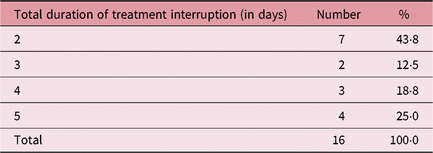
Twenty-five patients (61%) completed the overall treatment within 4 weeks’ duration. Sixteen patients (39%) needed a treatment break, and of these, 7 patients (43·75%) has a treatment interruption of more than 3 days. Oral mucositis followed by hematological toxicities and radiation dermatitis were most common causes of treatment interruption.
Number of patients who suffered treatment interruption (in days)

The mean total duration of interruption (mean ± SD) of the patients was 3·25 ± 1·29 days with range 2–5 days and the median was 3·0 days. Among the 16 patients who had treatment interruption, 43·8% patients had treatment interruption of 2 days.
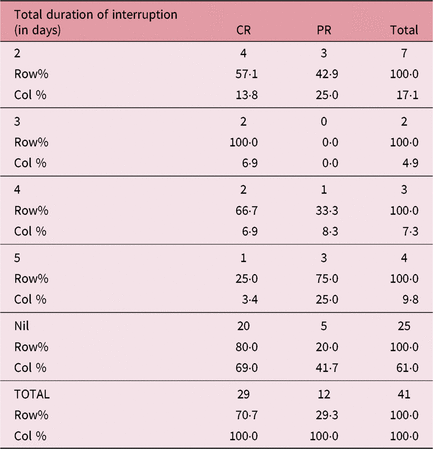
Distribution of Number of Days of Treatment Interruption and Tumour Response (Table 5)
Corrected Chi-square (χ2) test showed that there was no significant association between number of days of treatment interruption and tumour response of the patients (p = 0·16). However, the proportion of patients with CR was lower for the patients with a greater number of days of treatment interruption. χ2 = 6·55; p = 0·16 (Not Significant).
Number of days of treatment interruption and tumour response respectively

Discussion
Evidence is strong for increased local control using accelerated radiation therapy schedules. A Danish Head and Neck Cancer Study Group 6 and 7 (DAHANCA 6 and 7) randomised control trials demonstrated that reducing the overall treatment time by 1 week, while maintaining the same dose and fractionation schedules, improved the 5-year local control by 10% (p-0·0005).Reference Overgaard, Hansen and Specht 25
Benghiat et al. in 2014 measured the outcome of 4-week hypofractionated IMRT (55 Gy in 20 fractions) and synchronous Carboplatin in 85 stage II-IV oropharyngeal cancer patients. The 2-year LR-RFS was 68% for the cohort. Grade 3 mucositis was experienced by all patients who completed the planned 4 weeks of radiation therapy. There was no grade 4 mucositis seen, similar to ours study. Grade 3 skin reaction was observed in 36 patients (48%), higher in proportion as compared to our patient population. Patients receiving concurrent cetuximab were significantly more likely to experience grade 3 skin reactions versus those receiving carboplatin chemotherapy (p = 0·002).Reference Benghiat, Sanghera, Cashmore, Hodson, Mehanna and Simmons 26
In another study, Chan et al. at the University of Warwick measured the outcome of hypofractionated radiation therapy with concurrent carboplatin for locally advanced Head and Neck Squamous Cell Carcinoma (HNSCC). One hundred and fifty consecutive patients with squamous cell carcinoma of the larynx, oropharynx, oral cavity and hypopharynx (stage II–IV) were treated with 55 Gy in 20 fractions over 25 days with concurrent carboplatin. There were 135 patients with stage III and IV disease. For these patients, the local control and 2-year disease-free survival were 79·1 and 67·6%, respectively, which is comparable with our results.Reference Chan, Sanghera and Choo 27
D’Angelo et al. between July 2009 and February 2014 analysed 59 consecutive patients with locally advanced oropharyngeal cancers (LAOC) who received accelerated hypofractionated radiation therapy (66 Gy at 2·2 Gy/fraction) with tomotherapy and concurrent chemotherapy. With median follow-up of 38 months (range 14–70), the estimated 3-years local disease-free survival (DFS) rate and complete response rate were 88% ± 0·04SE and 88%, respectively, better than what we had achieved with conventional fractionation. No grade 4 acute toxicity was observed, maximal acute toxicities were of G3 mucositis 31%, dermatitis 15%, almost similar with ours observations. Maximal late toxicities were xerostomia G2 36%, dysphagia G2 14%.Reference Meduri, D’Angelo and Barbieri 28
Sanghera et al. analysed 81 patients with squamous cell cancer of the larynx, oropharynx, oral cavity, and hypopharynx (Stages II–IV), who received hypofractionated radiation therapy with dose of 55 Gy in 20 fractions with concurrent chemotherapy. The 2-year local control rate was 75·4% and the 2-year DFS rate was 68·6%. Acute toxicity was mostly in the form of Grade 3 mucositis, experienced by 60 patients (74%) and 5% patients suffered Grade 4 mucositis.Reference Sanghera, McConkey, Ho, Glaholm and Hartley 29
The dose of 55 Gy in 20 fractions is based on sound radiobiological basis as it has a similar log10 tumour cell kill as a schedule of 70 Gy in 35 fractions with the additional advantage of lower BED to late effect tissues (105·4 Gy3 versus 116·6 Gy3) and a tolerable acute mucosal BED, as supported by the above discussed clinical trials and our study results. The IMRT seems to have added to this advantage by delivering more conformal dose distribution and better sparing of organ at risk.
Conclusion
The reduction in number of fractions and overall treatment time allows more efficient use of resources, which can help avoid long waiting times to maximise service productivity, especially in resource-constrained countries like India with heavy population burden. This hypofractionated regimen is feasible and was associated with tolerable acute and late morbidity and satisfactory locoregional response. This single arm retrospective analysis found acceptable response and toxicity rates. Based on the available literature, IMRT is now a standard recommendation for locally advanced oropharyngeal cancers. Moderately hypofractionated radiation therapy based on sound radiobiological basis needs to be evaluated, especially in combination with IMRT. Concurrent chemoradiation, which is the standard of care with conventionally fractionated radiation therapy, needs further evaluation with altered fractionation, especially hypofractionated treatment in conjunction with IMRT. Larger prospective, randomised, preferably multi-institutional studies examining hypofractionated accelerated schedules may be undertaken in the near future to establish this altered fractionation schedule as a standard practice, especially in resource-constrained areas with high-volume centres.
Author ORCIDs
Debarshi Lahiri 0000-0002-6343-0361
Acknowledgment
The authors thank all the patients, resident doctors, medical physicists, radiotherapists and nursing officers of Department of Radiation Oncology, Chittaranjan National Cancer Institute, Kolkata, India.