One of the mental disorders that most concern has arisen in recent years within the psychological and psychiatric community is depression. The World Health Organization (WHO, 2001a), in their "World Health Report, 2001", supported the launch and development of global campaigns targeting the treatment of depression and suicide prevention. The report stated that severe depression was the leading cause of disability worldwide and the fourth of the ten leading causes of the overall global burden of disease. Nowadays, data have hardly changed and it is estimated that depression affects over 350 million people worldwide (WHO, 2015) and that it has consequences in all areas of the patient’s life: relationships with family, friends, and co-workers; productivity at work, etc... It is estimated that, throughout 2010, depression cost the European economy 92 billion Euros (Olesen, Gustavsson, Svensson, Wittchen, & Jönsson, Reference Olesen, Gustavsson, Svensson, Wittchen and Jönsson2012).
Many studies have warned about the high prevalence of depression at early ages (Katz, Conway, Hammen, Brennan, & Najman, Reference Katz, Conway, Hammen, Brennan and Najman2011; Kovacs & López-Durán, Reference Kovacs and López-Durán2010). Those studies based on the diagnostic criteria of the Diagnostic and Statistical Manual of Mental Disorders (DSM-IV-TR; APA, 2002) have reported prevalence rates for major depressive disorder ranging between 1% and 2.8% (Angold et al., Reference Angold, Erkanli, Farmer, Fairbank, Burns, Keeler and Costello2002; Cohen et al., Reference Cohen, Cohen, Kasen, Velez, Hartmark, Johnson and Streuning1993; Costello, Erkanli, & Anglod, Reference Costello, Erkanli and Anglod2006; Fleming & Offord, Reference Fleming and Offord1990; Polaino-Lorente & Domenech, Reference Polaino-Lorente and Domènech1993), whereas for the dysthymic disorder, currently known in the DSM-5 as the persistent depressive disorder (APA, 2014), the percentages ranged between 0.3% and 6.4% (Angold et al., Reference Angold, Erkanli, Farmer, Fairbank, Burns, Keeler and Costello2002; Polaino-Lorente & Domenech, Reference Polaino-Lorente and Domènech1993). More specifically, studies with child populations from schools that use self-reports -especially the Children’s Depression Inventory (CDI, Kovacs, Reference Kovacs1992) and the Children’s Depression Scale (CDS, Lang & Tisher, Reference Lang and Tisher1978)- to assess severe depression have reported prevalence rates close to 4% in Spain (Bernaras, Jaureguizar, Soroa, Ibabe, & de las Cuevas, Reference Bernaras, Jaureguizar, Soroa, Ibabe and de las Cuevas2013) or in Turkey (Demir, Karacetin, Demir, & Uysal, Reference Demir, Karacetin, Demir and Uysal2011), 6% in Finland (Puura et al., Reference Puura, Tamminen, Almgvist, Kresanov, Kumpulainen, Koivisto and Moilanen1997), 8% in Greece (Kleftaras & Didaskalou, Reference Kleftaras and Didaskalou2006), 10% in Australia (McCabe, Ricciardelli, & Banfield, Reference McCabe, Ricciardelli and Banfield2011) or even of 25% in Colombia (Vinaccia et al., Reference Vinaccia, Gaviria, Atehortúa, Martínez, Trujillo and Quiceno2006).
The probability of onset of depressive disorders increases significantly during puberty, but can occur at any age (APA, 2014). Moreover, some studies show that the onset of depressive symptoms is observed at the age of 7 or 8 years (Bernaras et al., Reference Bernaras, Jaureguizar, Soroa, Ibabe and de las Cuevas2013; Whalen et al., Reference Whalen, Luby, Tilman, Mike, Barch and Belden2016). Regarding the differences in terms of age and gender, studies show a higher prevalence of depressive symptoms in boys than in girls aged between 6 and 12 years (Bernaras et al., Reference Bernaras, Jaureguizar, Soroa, Ibabe and de las Cuevas2013; Vinaccia et al., Reference Vinaccia, Gaviria, Atehortúa, Martínez, Trujillo and Quiceno2006; Whalen et al., Reference Whalen, Luby, Tilman, Mike, Barch and Belden2016). However, from 12 years onwards, the incidence is higher among girls (Jaureguizar, Bernaras, Soroa, Sarasa, & Garaigordobil, Reference Jaureguizar, Bernaras, Soroa, Sarasa and Garaigordobil2015; Ružić & Matešić, Reference Ružić and Matešić2015). Furthermore, it is important to take into account the risk of suicide that depression entails (APA, 2014). According to WHO (2012), suicide rates among young people have been increasing and nowadays, suicide is the second leading cause of death among 10 to 24 year-olds.
Viñas, Canals, Gras, Ros, and Domènech-Llaberia (Reference Viñas, Canals, Gras, Ros and Domènech-Llaberia2002) found that students with suicidal ideation presented greater depressive symptomatology. Studies indicate that suicidal ideation varies with age, with percentages of up to 16% in students aged between 6 and 12 years (Kovess-Masfety et al., Reference Kovess-Masfety, Pilowsky, Goelitz, Kuijpers, Otten, Moro and Carta2015), 13% in adolescent students aged between 15 and 17 years (Sánchez, Cáceres, & Gómez, Reference Sánchez, Cáceres and Gómez2002), and with the percentage varying between 3% (Calvo, Sánchez, & Tejada, Reference Calvo, Sánchez and Tejada2003) and 31% (Sánchez, Muela, & García, Reference Sánchez, Muela and García2014; Siabato & Salamanca, Reference Siabato and Salamanca2015) among the adult population. According to the National Institute of Statistics (Instituto Nacional de Estadística, INE) in Spain, in 2014, a total of 319 young people aged between 15 and 29 years committed suicide, of which 239 were men and 80 were women. Among children under the age of 15, 10 suicides were registered, of which 6 were girls and 4 were boys. The WHO (2001b) states that suicidal thoughts become abnormal in children and adolescents when the realization of such thoughts seems to be the only solution to the difficulties they must face and it is then when there is a high risk of suicide or attempted suicide. It is necessary to note that destructive behaviors derived from a depression or other conditions should not be construed as mere calls for attention or manipulation attempts and should not be ignored.
This situation requires depressive symptoms to be identified as early as possible in order to carry out preventive programs for emotional disorders in the first years of life. These programs could, among other things, teach children and adolescents more adaptive ways to face problems and discomfort, so as to avoid both, irreversible behaviors (such as suicide) and the economic costs arising from their psychiatric and psychological treatment.
The highest concentration of children aged between 6 and 12 years is found within the school environment. Therefore, the teacher figure becomes particularly relevant in identifying any type of emotional disorder. Within the school, teachers can observe students, perceiving interpersonal differences and identifying those behaviors that differ from the standard parameters. Herman, Reinke, Parkin, Traylor, and Agarwal (Reference Herman, Reinke, Parkin, Traylor and Agarwal2009) emphasize the role of the school in the lives of children, outside the family, becoming a place where depression can be developed, prevented and even treated. However, children with emotional disorders are one of the populations whose identification and treatment presents most deficits (Reddy & Richardson, Reference Reddy and Richardson2006). The reason for this is because teachers do not have enough training to detect depressive symptoms in their students (Kleftaras & Didaskalou, Reference Kleftaras and Didaskalou2006). Usually, the teacher detects poor performance or behavior problems, but rarely identifies students with depressive symptomatology (Kleftaras & Didaskalou, Reference Kleftaras and Didaskalou2006; McCabe et al., Reference McCabe, Ricciardelli and Banfield2011).
Achenbach, McConaughy, and Howell (Reference Achenbach, McConaughy and Howell1987) analyzed the depressive symptomatology taking into account the perceptions of several informants (parents, teachers, mental health workers, observers, peers and the individuals themselves) and found that the correlations between all types of informants were statistically significant, moderate and alike. In contrast, other studies showed differences between the evaluated groups (Kleftaras & Didaskalou, Reference Kleftaras and Didaskalou2006; Sternberg, Lamb, Guterman, & Abbott, Reference Sternberg, Lamb, Guterman and Abbott2006). When assessing the identification of internalizing and externalizing variables and the level of agreement of such variables between parents and teachers, little overlap has been reported, especially in the identification of internalizing variables (Deng, Liu, & Roosa, Reference Deng, Liu and Roosa2004; Grietens et al., Reference Grietens, Onghena, Prinzie, Gadeyne, Van Assche, Ghesquière and Hellinckx2004). Overall, comparative assessments of parents and teachers show that the correlation between informants is low (Bernaras, Jaureguizar, Soroa, & Garaigordobil, Reference Bernaras, Jaureguizar, Soroa, Garaigordobil and Columbus2015; Cicchetti, Rogosch, Gunnar, & Toth, Reference Cicchetti, Rogosch, Gunnar and Toth2010). Clay, Surgenor, and Frampton (Reference Clay, Surgenor and Frampton2008) argued that this inconsistency may be due to the lack of agreement among informants and to the different characteristics of the informants, or even to the situational variability of children’s behavior. Thus, Verhulst, Koot, and Van der Ende (Reference Verhulst, Koot and Van der Ende1994) found that parents mostly observed disruptive behaviors; teachers mostly reported cognitive manifestations and children centered on their own socialization problems.
One of the aspects that perhaps teachers pay more attention to in order to assess the adequate adaptation of their students is their academic performance. The WHO states that depression and anxiety have a negative and significant effect on educational performance in the short and long term (Suhrcke & de Paz Nieves, Reference Suhrcke and de Paz Nieves2011). Several studies support that depressive symptomatology is associated with poor academic performance (Orgilés, Gómez, Piqueras, & Espada, Reference Orgilés, Gómez, Piqueras and Espada2014; Wu & Kuo, Reference Wu and Kuo2015). Moreover, depressive symptomatology has been identified as a predictor of poor academic performance (Marsh & Hau, Reference Marsh and Hau2003). Other studies have found significant negative, although low relationships between academic performance and depressive symptomatology (Bernaras et al., Reference Bernaras, Jaureguizar, Soroa, Ibabe and de las Cuevas2013; Bernaras et al., Reference Bernaras, Jaureguizar, Soroa, Garaigordobil and Columbus2015; Moyeda, Velasco, & Ojeda, Reference Moyeda, Velasco and Ojeda2009).
Taking into account the review of the studies previously mentioned, the present study has three main objectives: (1) to identify the prevalence of depressive symptomatology among students aged between 7 and 10 years, exploring the differences based on gender and age; (2) to analyze the correlation between student self-reports and teacher reports; and (3) to explore the relationship between depressive symptomatology and academic performance. Based on these objectives, three hypotheses are proposed: (1) a percentage of clinically significant depression of about 4% (taking into account Bernaras et al.’s results in 2013, with a similar sample) is expected to be found, with higher depression scores for boys and incrementing with age (taking into account Bernaras et al.’s, Reference Bernaras, Jaureguizar, Soroa, Ibabe and de las Cuevas2013 and Vinaccia et al.’s, Reference Vinaccia, Gaviria, Atehortúa, Martínez, Trujillo and Quiceno2006 studies with similar samples); (2) the correlation between student self-reports and teacher reports is expected to be low, in line with Grietens et al.’s (Reference Grietens, Onghena, Prinzie, Gadeyne, Van Assche, Ghesquière and Hellinckx2004) and Kleftaras and Didaskalou’s (Reference Kleftaras and Didaskalou2006) studies; and (3) that significant negative or inverse relationships will be found between depression and academic performance (Orgilés et al., Reference Orgilés, Gómez, Piqueras and Espada2014; Wu & Kuo, Reference Wu and Kuo2015), assessed through the perception of academic success that the teacher has of his/her students.
Method
Participants
The sample was composed of 420 participants aged between 7 and 10 years, with 59.5% of them aged between 7 and 8 years (n = 250) and 40.5% of them aged between 9 and 10 years (n = 170), with a total of 224 boys (53.3%) and 196 girls (46.7%). Participants were enrolled in schools in the Basque Country, 53.6% in public schools (n = 225) and 46.4% in private schools (n = 195), in which they were attending 3rd (n = 221, 52.6%) and 4th (n = 199, 47.4%) year of primary education. A total of 81.9% (n = 344) students were born in Gipuzkoa, 1.9% (n = 8) of students were born in other provinces of Spain, 5.2% were born abroad (n = 22) and an 11% (n = 46) did not answer this question. The sample was intentionally selected from within schools of Gipuzkoa, taking into account the balance between public / private schooling.
Assessment instruments
To measure the variables under study, four assessment instruments with psychometric guarantees of reliability and validity were administered.
Children’s Depression Scale, CDS. (Lang & Tisher, Reference Lang and Tisher1978; Spanish adaptation by Seisdedos, Reference Seisdedos2003)
This instrument assesses depression in children aged between 8 and 16 years. It contains 66 elements, 48 of depressive type and 18 of the positive type. These two sets of items are grouped into two separate independent general subscales: Total Depressive (TD, e.g., "I often think that no one cares about me") and Total Positive (TP, e.g., "I enjoy the things I do"). The TD consists of six subscales: Affective Response, Social Problems, Self Esteem, Preoccupation with Sickness or Death, Guilt and Depressive miscellaneous. The TP contains two subscales: Pleasure/Enjoyment and Positive miscellaneous. Each item is scored on a scale of 1 to 5 depending on the degree of agreement (1 = strongly disagree to 5 = strongly agree). The internal consistency of the test in its Spanish adaptation was analyzed by the Kuder-Richardson (K-R 20) formula, yielding indices for the TD and TP scores of .91 and .69 respectively, which indicate a good level of internal consistency. The Cronbach’s alpha obtained with the sample of this study for the whole test confirms its internal consistency (α = .88).
Behavior Assessment for Children, BASC. (Reynolds & Kamphaus, Reference Reynolds and Kamphaus1992; Behavior Assessment of Children and Adolescents, Spanish adaptation by González, Fernández, Pérez, & Santamaría, Reference González, Fernández, Pérez and Santamaría2004)
The BASC is a multidimensional assessment tool designed to assess both the positive (adaptive scales) and negative (clinical scales) dimensions of behavior and personality of the child or adolescent. In the present study, the S2 personality self-report and specifically, the clinical depression scale for children aged between 8 and 12 years were used. This consists of 15 statements exploring depression (common symptoms of depression, including feelings of loneliness and sadness and an inability to enjoy life, e.g., "I prefer to be alone most of the time"). The self-report version of the test shows good internal consistency (Cronbach’s α) for the depression scale (α = .83), similarly to that of the sample of this study (α = .74).
Children’s Depression Scale-Teacher, CDS-T. (Lang & Tisher, Reference Lang and Tisher2004; Tisher, Reference Tisher1995)
The depression questionnaire for teachers consists of 10 items extracted from the original CDS scale (e.g., “This child achieves most of his/her goals”; “This child almost always feels that he/she is not as good as he/she would like to be”). Teachers must assess the degree of agreement with the statements presented across a Likert scale ranging from 1 to 5 (1 = strongly disagree to 5 = strongly agree). The questionnaire yields two scores: depressive and positive. The instrument shows an adequate internal consistency with the original sample (α = .72 for both scales), and an even higher internal consistency (α = .70 positive, negative α = .93) for the sample of this study. In addition, the questionnaire asks teachers to assess the academic performance of their students using a 5 to 1 Likert scale (5 = well above average, 4 = above average, 3 = average, 2 = below average and 1 = well below average). Therefore, the perception of academic success that the teacher has of his/her student is also assessed, as this assessment is not obtained through the student’s average results in academic performance.
SPECI. Screening for Children’s Emotional and Behavioural Problems (Garaigordobil & Maganto, Reference Garaigordobil and Maganto2012)
It identifies emotional and behavioral problems (EBP) in children aged between 5 and 12 years through their teacher’s reports. A total of 10 EBP or diagnostic categories are evaluated through a series of illustrative examples of the problem (e.g., “Seclusion: The child seems withdrawn and inhibited, he/she prefers to be alone and seems isolated, he/she is not very active and quite reserved in his/her relationships with others”), which are scored on a Likert scale ranging from 0 to 2 (0 = not at all, 1 = quite a bit, 2 = a lot). To measure each diagnostic category, a single item is used, accompanied by a description of said item. For example, depression (the child seems apathetic or sad, he/she is often bored and easily cries), academic performance (the child does not work in class or study, he/she lacks motivation and seems uninterested), etc. In addition to an overall EBP score, two other factors are obtained: (1) internalizing problems, which consist of behaviors of an emotional content, behaviors that indicate an inadequate way to resolve conflicts as they are expressed internally (withdrawal, somatization, anxiety, child-dependent, thought problems, depression); and (2) externalizing problems, more related to an outward expression of conflict (attention-hyperactivity, disruptive behavior, academic performance, and violent behavior). The internal consistency obtained with the original sample was adequate (α = .82), in the same direction as that obtained with the sample of the present study (α = .74).
Procedure
The study used a descriptive, comparative and correlational cross-sectional design. Firstly, a letter was sent to the selected schools explaining the research project. Those schools who agreed to participate were informed in more detail through a personal interview, where informed consent forms for parents and/or guardians were given. Members of the research team visited the schools and administered 2 assessment tools to the participants during a 40-minute evaluation session. In addition, the teacher fulfilled another 2 instruments in relation to each child. The study met the ethical values required to carry out research with humans and received a favorable report from the Research Ethics Commission of the University of the Basque Country (CEISH/266MR/2014).
Data analyses
Data analyses were performed using the IBM-SPSS Statistics 22 statistical package.
Firstly, the percentiles for the raw scores of the “Total Depressive” scale of the CDS self-report were calculated, establishing as moderate depressive symptomatology those situated above the 90th percentile and up to the 95th percentile (from 90 to 95; raw scores between 141 and 157) and establishing as clinically significant depressive symptomatology that above the 95th percentile (96 to 100; raw scores > 157). Similarly, the percentiles for the raw score of the “Depression” scale of BASC-S2 self-repot were calculated, categorizing as moderate depressive symptomatology those situated above the 90th percentile and up to the 95th percentile (90 to 95; raw scores between 4 and 5) and as clinically significant depressive symptomatology those situated above the 95th percentile (from 96 to 100; raw scores > 5). The same procedure was followed to establish the scales of the CDS-T, those raw scores of 21 (90th to 95th percentile) indicated a moderate depressive symptomatology, and those scores > 21 (96th to 100th percentile) were considered as clinically significant symptomatology. In the SPECI, the “fairly / quite a bit” assessment was used as the evaluation criterion for moderate depression and “a lot” for clinically significant depression.
Secondly, in order to estimate the prevalence of depressive symptomatology, the percentage of participants who suffered depressive symptoms according to the CDS, BASC-S2, CDS-T and SPECI was calculated. Afterwards, mean comparison analyses were performed using the Student t test to compare the mean scores of depressive symptomatology for each of the tests according to sex and age of the participants, also calculating the effect size (Cohen’s d). Thirdly, Pearson correlation analyses were conducted to check the relationship between student self-reports (CDS and BASC-S2), teacher reports (CDS-T and SPECI) and children’s academic performance. Finally, contingency tables were obtained by crossing self-reports and teacher reports.
Results
Prevalence of child depression
According to the results of the CDS self-report, a 5% of the sample (n = 21) obtained scores classified as moderate depressive symptomatology, while a 4.6% of the sample (n = 19) showed clinically significant symptomatology. If the results of the depression scale of the BASC-S2 self-report are taken into account, it is observed that 4.3% of the sample (n = 18) obtained scores of moderate depressive symptomatology and 4.8% (n = 20) of the sample showed clinically significant symptomatology. Regarding the prevalence observed by teachers, according to the results of the CDS-T, a 7.7% of the sample (n = 32) exhibited a moderate depressive symptomatology, while a 3.6% (n = 15) showed clinically significant depressive symptomatology. According to the results of the SPECI teacher reports, a 4.6% of the sample (n = 19) showed a fair amount of depressive symptomatology, and a 0.2% (n = 1) exhibited a lot of symptomatology. In short, the percentages found fluctuate between 4.3% and 7.7% with moderate depression, and between 0.2% and 4.8% with clinical depression.
Prevalence of child depression according to gender and age of the children
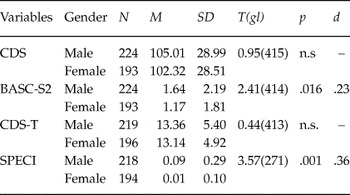
Table 1 shows that both the BASC-S2 self-report and the SPECI teacher report detected differences in depressive symptomatology according to the gender of the participants, finding higher levels in boys than in girls, although the effect size is small. In contrast, the CDS self-report and the CDS-T teacher report did not show differences in depressive symptomatology between boys and girls.
Student t test analysis using means comparison between self-reported depression (CDS and BASC-S2) and depression observed by teachers (CDS-T and SPECI) according to gender of the student

Notes: CDS = Children’s Depression Scale; BASC-S2 = Behavior Assessment for Children; CDS-T = Children’s Depression Scale-Teacher; SPECI = Screening de Problemas Emocionales y de Conducta Infantil [Screening for children’s emotional and behavioral problems]
The results of the Student t test according to age (7–8 and 9–10 years), showed no statistically significant differences for any of the depression measures used, CDS (M7–8 = 102.53, DT = 29.49, M9–10 = 105.59, DT = 27.65, t(415) = –1.06, p = . 287), BASC (M7–8 = 1.34, DT = 2.03, M9–10 = 1.54, DT = 2.04, t(415) = –0.95, p = . 340), CDS-T(M7–8 = 13.12, DT = 5.01, M9–10 = 13.45, DT = 5.41, t(345) = –0.63, p = . 529), SPECI (M7–8 = 0.05, DT = 0.23, M9–10 = 0.05, DT = 0.22, t(410) = –0.14, p = .885).
Relationship between self-reports, teacher reports and academic performance
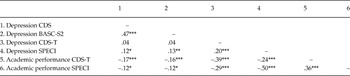
Table 2 shows the correlations between children’s self-reports, teacher reports and academic performance. As can be observed, the correlation between CDS-T and the self-reports (CDS and BASC-S2) was not significant. In contrast, the correlation between SPECI and students’ self-reports (r = .12 for the CDS and r = .13 for the BASC-S2), and between teacher reports (r = .20 for the CDS-T) were significant, although the effect sizes were low.
Correlations between student self-reports (CDS and BASC-S2), teacher reports (CDS-T and SPECI) and academic performance

Notes: ***p < .001; **p < .01; *p < .05; CDS = Children’s Depression Scale; BASC-S2 = Behavior Assessment for Children; CDS-T = Children’s Depression Scale-Teacher; SPECI = Screening de Problemas Emocionales y de Conducta Infantil. [Screening for children’s emotional and behavioral problems]
As for the correlations between the depressive symptomatology of the self-reports, the teacher reports and academic performance, it should be noted that all depressive measures, both self-assessed and evaluated by teachers, negatively correlated with academic performance. Thus, children with high scores in depression showed low scores in academic performance. Furthermore, it is observed that the correlations between the depressive symptomatology observed by teachers and academic performance (CDS-T r = –.24, SPECI r = –.50) were greater than the correlations between depressive symptomatology reported by students and their academic performance assessed by their teachers (CDS-T r = –.12, SPECI r = –.17).
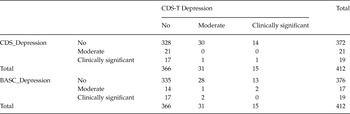
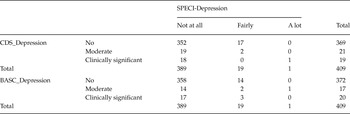
In order to further research the relationships between the two types of tests (self-reports and teacher reports), contingency analyses were performed. The results of such analyses are shown in Tables 3 and 4. As can be observed in these tables, the cases where self-reports revealed severe depressive symptomatology and were detected by the teacher were very scarce. For example, Table 3 shows that the relationship of the CDS and the BASC with the CDS-T was not statistically significant. Therefore, 19 students scored high (clinically significant depression) in the CDS and the BASC, but out of these, only one case was detected by teachers using the CDS-T as being a clinically significant depression. The other cases identified by the teachers as clinically significant belong to the moderate depression category and primarily to the category without depression, if the student self-reports are considered. As for the SPECI, teachers only evaluated one student within the “a lot” category (which, according to the CDS, would obtain a clinically significant score, yet, according to the BASC, it would be moderate). The rest of the students with clinically significant scores in their self-reports remained undetected by teachers when assessing them through the SPECI.
Contingency Table between the CDS and BASC-S2 self-reports and the CDS-T teacher reports

Notes: CDS_Depression*CDS-T Depression: χ2(4) = 3.08, p > .05; BASC_Depression* CDS-T Depression: χ2(4) = 4.18, p > .05; CDS = Children’s Depression Scale; BASC-S2 = Behavior Assessment for Children; CDS-T = Children’s Depression Scale-Teacher
Contingency Table between the CDS and BASC-S2 self-reports and the SPECI teacher reports

Notes: CDS_Depression*SPECI-Depression: χ2(4) = 22.53, p ≤ .001; BASC_Depression*SPECI-Depression: χ2(4) = 30.71, p ≤ .001; CDS = Children’s Depression Scale; BASC-S2 = Behavior Assessment for Children; SPECI = Screening de Problemas Emocionales y de Conducta Infantil. [Screening for children’s emotional and behavioral problems]
Discussion
The state of mental health of society in general is being threatened in recent years, with depression becoming one of the most observed mental disorders in all areas of society, including education. In order to explore this issue, this research has analyzed the prevalence of depressive symptomatology in schoolchildren aged between 7 and 10 years, the differences according to gender and age, the correlation between children self-reports and teacher reports and the relationship between depression and academic performance.
Firstly, the results have shown differences between self-reports and teacher reports, in relation to the prevalence of depression. The results of self-reports ranged between 4.8% (BASC-S2) and 4.6% (CDS) for clinically significant depression; and between 4.3% (CDS) and 5% (BASC-S2) for moderate depression. However, the prevalence obtained with the teacher reports fluctuated between 0.2% (SPECI) and 3.6% (CDS-T) for clinically significant depression and 4.6% (SPECI) and 7.7% (CDS-T) for moderate depression. Therefore, teachers perceive clinically significant depression to a lesser extent. These data are consistent with those obtained in other studies (Bernaras et al., Reference Bernaras, Jaureguizar, Soroa, Ibabe and de las Cuevas2013; Forti-Buratti, Saikia, Wilkinson, & Ramchandani, Reference Forti-Buratti, Saikia, Wilkinson and Ramchandani2016; Polanczyk, Salum, Sugaya, Caye, & Rohde, Reference Polanczyk, Salum, Sugaya, Caye and Rohde2015), although they differ from other studies that have found higher percentages (McCabe et al., Reference McCabe, Ricciardelli and Banfield2011; Vinaccia et al., Reference Vinaccia, Gaviria, Atehortúa, Martínez, Trujillo and Quiceno2006). The results found in this study may have important implications, as the teacher is a key figure to detect the students’ symptomatology, given the time they share together. The lower rate of detection of depression by teachers may have very diverse explanations: ranging from the stress and heavy workload of teachers, to the lack of more specific or wider training (e.g., emotional intelligence) in this type of emotional symptoms (Pena, Rey, & Extremera, Reference Pena, Rey and Extremera2012).
As for the differences based on gender, in the BASC-S2 and the SPECI, higher levels of depressive symptomatology have been observed for boys. These results are consistent with those observed by other authors (Bernaras et al., Reference Bernaras, Jaureguizar, Soroa, Ibabe and de las Cuevas2013; Vinaccia et al., Reference Vinaccia, Gaviria, Atehortúa, Martínez, Trujillo and Quiceno2006; Whalen et al., Reference Whalen, Luby, Tilman, Mike, Barch and Belden2016) and with the data provided by studies with clinical samples, which demonstrate an overall superiority of boys with both internalizing and externalizing clinical problems (López Soler, Alcántara, Fernández, Castro, & López Pina, Reference López Soler, Alcántara, Fernández, Castro and López Pina2010). However, the results obtained in the CDS and the CDS-T do not show any differences between sexes. None of the assessment tests used have reflected differences in terms of age, results which are in line with other studies (Bernaras et al., Reference Bernaras, Jaureguizar, Soroa, Ibabe and de las Cuevas2013).
Therefore, the first hypothesis is partially confirmed, since a rate of clinically significant depression of approximately 4% in self-reports (4.6% – 4.8%) was obtained, although the prevalence identified by teachers was lower (0.2% – 3.6%). In addition, boys showed greater depressive symptomatology (although the effect size was very small), but it was not confirmed that depression increased in these age group. These results demonstrate that it is necessary to carry out preventive policies and early interventions in order to reduce the percentage of students with clinically significant and moderate symptomatology, because if these children are not treated early, they run the risk of suffering from serious disorders in adolescence and adulthood.
Secondly, the results relating to the correlation between self-reports and teacher reports are somewhat contradictory, as low significant correlations between the self-reports (CDS, BAS-S2) and the SPECI have been found, but no significant correlations with the CDS-T have been found. Therefore, it can be considered that Hypothesis 2 is largely confirmed, as correlations with one of the instruments (SPECI) were significant and low, and with the other (CDS-T) there were no significant correlations. That is, teachers rarely detected students with depressive symptomatology or even detected “false positives”. These findings are similar to those found in other studies (Bernaras et al., Reference Bernaras, Jaureguizar, Soroa, Garaigordobil and Columbus2015; Cicchetti et al., Reference Cicchetti, Rogosch, Gunnar and Toth2010; Kleftaras & Didaskalou, Reference Kleftaras and Didaskalou2006; Sternberg et al., Reference Sternberg, Lamb, Guterman and Abbott2006), although they differ from the results found by Achenbach et al. (Reference Achenbach, McConaughy and Howell1987), who found a moderate overlap between different informants. The results obtained in the present study confirm teachers’ low capacity to identify child depression, which emphasizes the importance of training teachers in matters related to mental health and particularly, in depressive symptomatology. Furthermore, the discrepancies in the obtained prevalence may be due, in part, to the characteristics of the instruments used. On the one hand, self-reports (CDS) and hetero-reports (CDS-T) of depression were included which showed different results, and on the other hand, some instruments were one-dimensional or specific (CDS), delving further into the construct, and others were multidimensional (SPECI, BASC), which analyze various constructs and in some cases measure the variable with a single item (SPECI). The findings especially emphasize the importance of self-report and of hetero-reports with one-dimensional or specific instruments that explore the construct with a wide range of items (CDS and CDS-T), which have shown to be valid and reliable tools.
Thirdly, the results have shown that students with depressive symptomatology presented low academic performance scores (assessed through the perception of academic success that the teacher had of his/her student), thus confirming the posed hypothesis, in line with the conclusions obtained in other studies (Bernaras et al., Reference Bernaras, Jaureguizar, Soroa, Ibabe and de las Cuevas2013, Reference Bernaras, Jaureguizar, Soroa, Garaigordobil and Columbus2015; Moyeda et al., Reference Moyeda, Velasco and Ojeda2009; Orgilés et al., Reference Orgilés, Gómez, Piqueras and Espada2014; Suhrcke & de Paz Nieves, Reference Suhrcke and de Paz Nieves2011; Wu & Kuo, Reference Wu and Kuo2015). However, it also should be noted that teachers perceive a greater relationship between performance and depression than that indicated by the results when taking into account the students’ self-reports on their depressive symptomatology. This may be because teachers place greater emphasis on cognitive problems that may accompany depression (Verhulst et al., Reference Verhulst, Koot and Van der Ende1994), which sometimes could magnify the relationship between depression and academic performance.
These results also emphasize an important issue. When students exhibit a poor academic performance, it is often thought that it is because he/she makes no effort or doesn’t have the ability to do better. But that apathy towards studies can sometimes be caused by negative emotional situations being suffered by the students.
Teachers often experience student behaviors that are out of the norm (children with behavior disorders, children who do not stay still, who do not concentrate, etc.), but the depressive symptomatology draws less attention. In addition, feelings, experiences, emotions, etc. are rarely talked about in the classroom, and hence, for this reason, with so many children in a class, it is normal that teachers may not notice the emotional situation of every child.
It is therefore necessary to train teachers to identify emotional disorders, and more specifically, to identify depressive symptomatology. Teachers should know what factors can cause its appearance, and the consequences of such depression. This knowledge would help make an early and accurate detection of the depressive symptomatology, and to intervene as soon as possible to prevent these children from suffering depression through adolescence and adulthood.
The findings of this study regarding the prevalence of depression have significant practical implications and suggest the importance of carrying out psycho-educational prevention programs for child depression. Moreover, it would be desirable to form teachers in these matters, in order for them to properly and promptly identify students at risk of suffering from emotional disorders. Regarding the limitations of this study, these include: (1) the sample is not representative, it has been chosen by convenience; (2) parents have not been included as informants; and (3) students’ scores for each school subject should be used as a measure of academic performance. Future studies could alleviate these limitations by using representative samples and supplementing the information with parents as informants.
In conclusion, the existence of depressive symptomatology at an early age, its relationship with academic underachievement and the need to train teachers so that they can identify students who present such symptoms and to take early action can be confirmed.
The alarm being raised globally around mental illness implies that all sectors (including education) should ensure prevention and early identification in order to alleviate the human, economic and social consequences of depression.
The present study has been financed by the ALICIA KOPLOWITZ foundation (OTRI code: FP15/62).