Policy context
The idea of welfare consumerism is one that has been growing in significance throughout the post-war period. It has been influenced historically by a number of factors, such as feminist discourses that challenged professionals and policy makers to improve the quality of public services and growing affluence that enabled some to buy themselves private welfare services, either directly or through their employers (Greener, Reference Greener2008). From 1979, the pressure on professionals was increased by political factors: the Conservative governments’ neo-liberal policies included cutting public expenditure (Driver and Martell, Reference Driver and Martell2006) and subjecting the public sector to the same disciplines as the private sector through a new public management (Driver and Martell, Reference Driver and Martell2006). Linked to this agenda was a stated concern to lessen the power of state and give it back to the citizen (Greener and Powell, Reference Greener and Powell2008). Conservative references to the recipients of public services as ‘customers’ and ‘consumers’ rather than ‘clients’ were intended to emphasise the responsibility of public services to be accountable for the large sums of money that they managed and to be more responsive to the needs of people receiving services (Cowden and Singh, Reference Cowden and Singh2007).
The Labour Party had historically held a strong attachment to public services and those who worked in them, with state institutions seen as central to the achievement of social democratic goals. However, by the 1990s many in the New Labour movement were beginning to accept some of the criticisms of the Conservatives that the state had grown distant from the citizen, with the result that service users faced limited choices and were little involved in policy making. There was a desire to see the public more involved in the policy process (Driver and Martell, Reference Driver and Martell2006).
Central to notions of welfare consumerism is a belief that consumers should have a choice of providers of public services. This was a key characteristic of Conservative social policy of the 1980s and 1990s (Bagley, Reference Bagley2006). Following Labour's second election victory in 2001, Tony Blair indicated that choice would also be a major feature of his government's agenda (Dowding and John, Reference Dowding and John2009).
The provision of choice to users of public services has, in some cases, been a pre-requisite for the creation of quasi-markets. Although quasi-markets are widely assumed to have been introduced in a number of areas of social policy in the 1980s and 1990s, their definition is both unclear and disputed (Powell, Reference Powell2003). Helpful to the discussion of this article is the definition of Bradley et al. (Reference Bradley, Draca and Green2004), that is the introduction of market mechanisms into the provision of publicly funded services rather than full privatisation. Policy on schools, to take one example, has been driven by the assumption that consumers (that is, parents) will reward the best providers by choosing them (Greener, Reference Greener2008). The creation of league tables, together with a pupil based funding formula, was one of the essential elements of creating a quasi-market (Bradley et al., Reference Bradley, Draca and Green2004).
It seems likely that the emphasis on quasi-market principles and choice of public services will remain under the current Coalition government. Although the 2010 Liberal Democrat general election manifesto did not refer to this issue, the Conservative manifesto promised choice across a range of public services and a reform of school league tables for the better exercise of choice.
There are a number of perceived advantages of offering choices of public service providers. Competition is assumed to lead to improvements in quality and efficiency and a greater sensitivity to the needs of individuals (Shaw, Reference Shaw, Simmons, Powell and Greener2009) – a view articulated by Prime Minister David Cameron:
We want to give people the power to improve our country and public services, through transparency, local democratic control, competition and choice. To give you just one example: instead of teachers thinking they have to impress the Department of Education, they have to impress local parents as they have a real choice over where to send their child. (Cameron, Reference Cameron2010)
Choice is also believed to be desired by the public, who are seen as ‘waiting for the opportunity to choose’ (Brown and King, Reference Brown and King2005: 62). Providing choice in public services is thought to bring about a re-distribution of power from producers to consumers of services and so to make public service providers more accountable (Clarke et al., Reference Clarke, Newman and Westmarland2007).
This final assumption about a re-distribution of power is one that has been particularly criticised; Cowden and Singh (Reference Cowden and Singh2007) argue that the majority of service users in reality have little choice over the manner in which services are run. It is further argued that, where there are benefits from choice, these are enjoyed most by those with access to social and cultural capital: for example, middle-class parents have been best able to understand information and manipulate systems to ensure that their children gain places in the best schools (Clarke et al., Reference Clarke, Newman and Westmarland2007; Greener, Reference Greener2008). The New Labour response to criticisms that choice did not tackle power inequalities, articulated by Tony Blair, was to argue that choice in public services would be extended to ‘the many, not the few’ (Clarke et al., Reference Clarke, Newman and Westmarland2007: 249). David Cameron has dismissed arguments that the poorest lose out when choice is increased: ‘In a system where people have no choice, it's the richest who can opt out while the poorest have to take what they're given’ (Cameron, Reference Cameron2010).
Any discussion of choice in public services needs to consider the basis on which decisions are made. The provision of evaluative information has been seen as central to the public sector choice agenda, enabling citizens to switch between suppliers of services (Jordan, Reference Jordan2005). Julian Le Grand (Reference Le Grand2007), policy advisor to Tony Blair, identified the provision of poor user information as a barrier to effective choice in both health and education. Under New Labour, client satisfaction became an important element of the assessment of a range of programmes (Peters, Reference Peters, Ellison and Pierson2003). One consumer evaluation, the National Student Survey, has played a major part in higher education policy; its role is discussed below.
Higher education policy
There are three substantial areas of continuity between the higher education policies of the current Coalition government and its Labour predecessors. These are transferring the costs of tuition from the state to the student, seeking to increase participation by under-represented groups and encouraging students to choose universities on the basis of information about the quality of provision, in accordance with quasi-market principles.
In common with countries across the world, the UK has funded greater participation in higher education by the transfer of costs from the state to the student through loan based support schemes (Opheim, Reference Opheim2005). Tuition fees for students were introduced at a flat rate by the 1998 Teaching and Higher Education Act, with the 2004 Higher Education Act giving universities the opportunity to charge ‘top up’ fees, but setting a maximum level of £3,000 per year (Callender and Jackson, Reference Callender and Jackson2008). The Coalition government has initiated a much greater transfer of costs, as public spending on universities is substantially reduced. While not accepting the recommendation of the Browne review (Reference Browne2010) that there should be no cap on the level of fees that an institution could charge, students will be expected to pay to a threshold of £9,000 per annum (Garner and Morris, Reference Garner and Morris2010).
It was originally intended that universities would only be able to charge fees above £6,000 per annum in exceptional circumstances. However, the government subsequently indicated that the requirement for charging fees above this level was to set out an access agreement, which received approval from the Office for Fair Access, to widen participation beyond white, middle-class teenagers without disabilities (Shepherd, Reference Shepherd2011). This demonstrates continuity with the policies of the Labour governments, whose attempts to increase the numbers entering higher education focused particularly on those from under-represented groups, such as disabled students and those in lower socio-economic positions (Kenyon, Reference Kenyon2010).
The Labour governments specifically linked the increase in the cost to the individual of higher education to the need for consumer attitudes, with then Business Secretary Lord Mandelson saying in 2009:
As students who go into Higher Education pay more, they will expect more . . . I hope they will be more picky, demanding and choosy as customers of the Higher Education experience. (Quoted in Shepherd, Reference Shepherd2009)
In order to facilitate students becoming more ‘choosy’, Labour introduced the National Student Survey in 2005. Conducted annually, the survey asks final-year undergraduates about their level of satisfaction with a number of aspects of the education provided. Students can view the results by institution and programme, in addition to reading external examiners’ reports and institutional statistics (Richardson et al., Reference Richardson, Slater and Wilson2007).
In 2004, when making the case for the National Student Survey, then Education Secretary Charles Clarke (Reference Clarke2004: para. 9) drew on principles of welfare consumerism by arguing that the survey would enable students to make well-informed choices of university. When in opposition, David Willetts (Reference Willetts2007) similarly embraced the quasi-market principles underlying the introduction of the survey:
The introduction of the National Student Survey . . . was a step in the right direction. There are already signs that vice chancellors are reacting to poor scores in areas such as feedback and assessment and striving to drive up their standards in a competitive market.
As Higher Education Minister, Willetts (Reference Willetts2010), has argued that the rise in tuition fees will be accompanied by a transfer of power to students and parents as they make choices of university based on increasing amounts of publicly available information. The full list of the information that universities will be required to publish is the subject of a government consultation (HEFCE, 2010).
Welfare consumerism and higher education
The enthusiasm of successive governments for applying principles of welfare consumerism to higher education is perhaps unsurprising. This is an area of social policy where quasi-market principles have been in existence for longer than elsewhere (Middleton, Reference Middleton2000): students have historically, at least in theory, been able to choose between different institutions. As with other public sector organisations, universities have been subjected to new public sector management in recent decades (Deem and Brehony, Reference Deem and Brehony2005); they must undergo external evaluations of their research and teaching (Davies and Thomas, Reference Davies and Thomas2002). University league tables are regularly published in national newspapers, despite a lack of research to establish their validity (Gunn and Hill, Reference Gunn and Hill2008).
There are a number of reasons for thinking that people applying to universities would be particularly likely to make informed choices of service provider. This group are intelligent, will be paying for the services they receive and are predominantly made up of young people, whose lifestyles and identities are often centred around consumption (Jones, Reference Jones2009).
However, research and academic debate has also advanced a number of reasons to question the assumption that potential students will act as informed consumers. McCulloch (Reference McCulloch2009) argues that university programmes are designed to develop the capacity to make informed choices so, almost by definition, such choices cannot be made prior to enrolment. Gunn and Hill (Reference Gunn and Hill2008) suggest that, while some universities struggle to avoid a shortfall of students, others choose from a surplus of applicants, so it is they – rather than their potential customers – who make the selection. Jongbloed (Reference Jongbloed, Teixeira, Johnstone, Rosa and Vossensteyn2006) argues that student choices are complex and not simply made on the rational basis of which institution will deliver best value for their money. The complexity of decision making in the USA is illustrated by studies which identify twenty or more factors influencing student choice; research in the UK, while not so extensive, has also demonstrated that choices are influenced by a large number of factors and that the weighting given to these factors varies substantially between individuals (Briggs, Reference Briggs2006). People who may have an influence on the decisions of potential students include parents, friends, teachers and careers advisors (Connor et al., Reference Connor, Burton, Pearson, Pollard and Regan1999; Briggs, Reference Briggs2006).
In addition, there is a substantial body of research suggesting that there are differences between social groups in the method of choosing universities and the extent to which they use evaluative information. Connor et al. (Reference Connor, Burton, Pearson, Pollard and Regan1999) found that, although few potential students made use of external measures of quality in deciding where to apply, those who did tended to be of higher social class and to have higher academic ability. Similarly, Ball et al. (Reference Ball, Davies, David and Reay2002) found that students from families or schools where there was a strong history of higher education participation were most likely to use university rankings as a basis for decision making.
Ball et al. (Reference Ball, Davies, David and Reay2002) also found that the choices of middle-class students were often restrained by their own desire, or that of their families, to maintain their social position. However, Brooks’ (Reference Brooks2003) study of lower-middle-class students found that status was not the only factor that influenced decision making: other issues that had an impact included the choices of peers, the status of the subject area and vocational considerations, such as graduate employment (Brooks, Reference Brooks2003).
Studies of the decision making of working-class students have suggested that choices are more limited and based on very different factors. Pugsley (Reference Pugsley1998) found that working-class parents could contribute little to their children's choice of university. Reay et al. (Reference Reay, Davies, David and Ball2001) demonstrated that location was a factor that restricted the choices of university that working-class students could make due to limited finances, while Brooks (Reference Brooks2008) indicated that a desire to be close to their working-class roots increased the tendency to choose local institutions.
Both Reay et al. (Reference Reay, Davies, David and Ball2001) and McCulloch (Reference McCulloch2009) found that a concern as to whether they could ‘fit in’ was another factor limiting the choices of potential working-class students.
The case study
So research and academic debate has questioned the assumption of successive governments that measures of quality are a key factor affecting the choices of potential students. These assumptions were examined further through case study research undertaken with two cohorts of first-year social science students at a post-1992, city centre university in the North of England. In 2005–06, 183 first-year students completed a questionnaire which covered a wide range of subjects, including demographic information, financial circumstances, previous education and approach to studying.
The purpose of the research was originally to examine the influences of all these factors on students’ academic performance. However, a striking feature that emerged from the first cohort data was the very limited extent to which students were acting as the informed consumers of higher education advocated by politicians. To examine this issue further, a smaller cohort of eighty-four first-year social science students completed a questionnaire in 2009–10. This questionnaire repeated some of the original questions linked to consumer behaviour and added new ones arising from policy developments, such as the publication of National Student Survey results.
As with any case study, there are questions as to how far the findings can be generalised. It should be remembered that the data were collected only from students in one subject area in one post-1992 case study university, and that previous research (Briggs, Reference Briggs2006) has suggested that the process of decision making tends to be different for students applying to pre-1992 institutions. The case study university had a high number of applicants for several of its social science programmes so, to some extent, fitted the categorisation of Gunn and Hill (Reference Gunn and Hill2008) of universities who choose from a surplus of candidates, rather than struggling to avoid a shortfall against target student numbers. However, despite its limitations, the case study makes an important contribution to the very limited evidence available to evaluate some of the assumptions about welfare consumerism that underlie higher education policy.
Characteristics of the cohorts
In both cohorts, approximately two-thirds of the students were female, the large majority were aged eighteen or nineteen and approximately 90 per cent classified their ethnic origin as ‘White: British’. Fourteen (8 per cent) of the first cohort reported that they had one or more disabilities, compared to only two (2 per cent) of the second cohort.
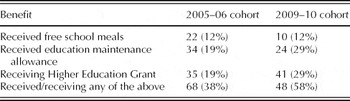
A majority of students in both cohorts – 56 per cent in the first and 69 per cent in the second – said that neither of their parents had studied at university. A weakness of the questionnaire used with the first cohort was that it included no direct measure of social class. However, a proxy measure was devised to identify those students who were from disadvantaged backgrounds. Students were asked whether they had ever received free school meals or education maintenance allowance or were currently receiving the Higher Education Grant – all indicators that they had been part of a low-income household at some point in their lives. These questions were repeated in the second questionnaire, by which time the Higher Education Grant covered a greater scope of parental incomes so was received by more students. Not all students answered the relevant questions, but the responses of those who did are shown in Table 1.
Benefits received by students

Students who had received, or were receiving, any of the benefits listed above are hereafter referred to as ‘less affluent students’; the others are referred to as ‘more affluent students’.
Students in the second cohort were asked to classify their own social class or to provide information about their own or their parents' occupation which would make such a classification possible. Half of the students (forty-two) were from either professional or managerial and technical backgrounds. Only twelve (14 per cent) were from manual backgrounds and only one came from a background of not working.
The case study data and assumptions of government policy
Fundamental to discussions of quasi-markets and welfare consumerism is an assumption that, where the opportunity exists, the public make choices between different providers of services. By definition, this means that alternatives must be considered. A large majority of students in both cohorts – 78 per cent of those who answered the question in the first questionnaire and 85 per cent in the second – said that they had considered attending other universities. However, the percentage who had visited other universities was smaller, only 52 per cent and 69 per cent respectively, which suggests that there was a sizeable minority who made no real choice between institutions.
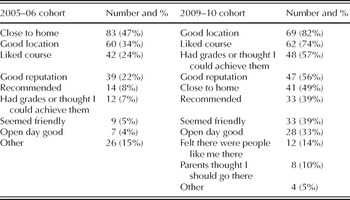
Despite the effective lack of alternatives in some cases, almost all respondents were able to identify reasons for choosing the case study university. First cohort students were asked their reasons in an open question. The question was changed to a closed format for the second cohort, with students invited to choose up to five reasons from a list. The list included the eight most popular answers from the first questionnaire, plus two extra ones and an ‘other’ option. One of the extra options was ‘parents thought I should go there’, which reflected ideas expressed by David Willets (2010) that parents are part of the process of consumer choice. The other extra option was ‘felt there were people like me there’, which was based on some of the research evidence discussed previously (Reay et al., Reference Reay, Davies, David and Ball2001; McCulloch, Reference McCulloch2009). The frequency with which each answer was given (as a percentage of the 176 first cohort students who gave reasons and the eighty-four second cohort students) is shown in Table 2.
Reasons for choosing the case study university

There are two difficulties in seeking to find common patterns between the responses of the cohorts. The first is that the change to a closed question appeared to increase the number of reasons each student gave. It may also explain the sharp increase in the number of respondents choosing ‘Had grades or thought I could achieve them’ as this may not have been a reason that students thought of unless prompted. Secondly, a larger percentage of students who completed the second questionnaire were from outside the region where the case study university is located, which had an impact on the options chosen – most obviously the numbers selecting ‘close to home’.
However, whatever the limitations of this data, one conclusion that can be drawn is that few students were influenced by the views of their parents or professionals as to which university they should attend: where students specified who had recommended the university, the source of information was almost always friends and/or current students. More importantly, Table 2 suggests that geographical factors played a major part in choosing the case study university: these factors were considerably more important than those relating to the quality of provision among the first cohort and of approximately equal importance among the second. Where quality factors were considered, it tended to be the perceived value of a specific course, rather than the university as a whole, that was important to respondents. So the assumption of students making choices on the basis of the quality of the institution finds little support here.
Given the apparent lack of choice exercised by some students, and the limited importance of factors relating to quality, it is perhaps unsurprising that few had made use of ‘external’ evaluations of universities, such as the National Student Survey, that successive governments have attached so much importance to.
Indeed, only 19 of the second cohort (23 per cent) had heard of the National Student Survey and an even smaller number – six (7 per cent) – had examined the results before applying to the case study university. There were also few examples of students using other externally devised evaluations: four had consulted The Times Good University Guide or The Times online, two had looked at UCAS information and there were four other sources consulted that could be regarded as providing objective information. Students were more likely to have consulted information produced by the university itself. The most popular sources of written information discussed by second questionnaire respondents were the prospectus (in ten cases), the university website (eight) and the course specification or course information (five). The apparent preference of students for sources of information such as the prospectus meant that the supplier of services was also often the supplier of information, a situation identified by Le Grand as a barrier to the effective exercise of choice in public services (Greener and Powell, Reference Greener and Powell2009).
An even more striking finding was that a majority of second cohort students – forty-eight of the eighty-three who answered the relevant questions (58 per cent) – had chosen the case study university without reference to any written information at all. Students who had read information about the university were more likely to choose good reputation as one of the reasons for their choice (chi-square, p = 0.047). However, twenty-one students selected good reputation despite not having consulted any written information; in nine of these cases, the university had also not been recommended. So, in addition to supporting McCulloch's (Reference McCulloch2009) assertion that potential students are not in a position to make the types of informed choices that are expected of them, the findings also supported those of Ball et al. (Reference Ball, Davies, David and Reay2002) that notions of quality can be conveyed in an indirect manner. The process by which a university acquires a ‘good reputation’ appears not to be as simple as might be assumed.
It was noted above that both Tony Blair and David Cameron rejected arguments that providing more choice in the provision of public services would discriminate against groups who were already socially and economically disadvantaged. However, this study suggested that members of such groups are less likely than others to make real choices between universities.
Across the two cohorts, only eight of fifteen students who considered themselves to have a disability had considered attending other universities (53 per cent), compared to 82 per cent of those who did not have disabilities (chi-square, p = 0.014). This finding is consistent with a broader set of concerns that young disabled people are less mobile and less able to act as consumers than their peers (Hughes et al., 2005). In addition, 69 per cent of more affluent students had visited other universities, compared to 56 per cent of less affluent students. This difference fell just short of being statistically significant (chi-square, p = 0.057). However, when considering only the first cohort of students, where the Higher Education Grant covered a much narrower range of parental incomes, there was a significant difference between more and less affluent students for both considering attending (chi-square, p = 0.039) and visiting (chi-square, p = 0.018) other universities.
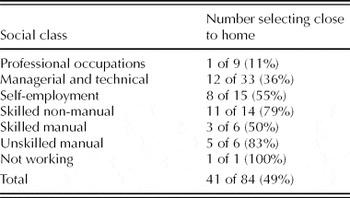
The findings supported those of Callender and Jackson (Reference Callender and Jackson2008) that working-class students’ choices of institution are likely to be limited by a need or desire to be close to home. Where neither parent had studied at university, 54 per cent of students across the two cohorts gave ‘being close to home’ as one of their reasons for choosing the case study university, compared to 37 per cent of students where one or both parents had studied at university (chi-square, p = 0.01). Turning to a direct measure of social class, second cohort data demonstrated that the wish to be near home was more common among students from manual backgrounds, as is shown by Table 3 (chi-square, p = 0.007).
Whether selected close to home as a reason for choosing the case study university by social class

Conclusion
The data in relation to differences between groups suggest that, at least in this policy area, the New Labour aspiration to provide choice to ‘the many, not the few’ was not delivered. It also highlights a conflict in the policies of successive governments: the under-represented groups who are being particularly encouraged to apply to universities are those who are least likely to act like consumers when choosing which institutions to apply to.
Other findings also cast doubt on government assumptions that the transfer of tuition costs to students is accompanied by a greater use of their purchasing power to choose on the basis of quality of provision by universities. The research highlighted a sharp contrast between, on the one hand, the concern of politicians and professionals with measures of quality and, on the other, the experiences of students for whom such measures are often irrelevant. Where decision making was based on quality factors, it often seemed to incorporate an idea of good reputation, the origins of which were difficult to identify and which need further investigation. However, many of the reasons for student choices were completely unrelated to ideas of quality: the findings suggest that strict application of quasi-market principles would favour institutions that produce effective marketing materials, have large numbers of potential working-class students within daily travelling distance and are situated in locations attractive to students. The striking findings in relation to the limited use of written information, particularly National Student Survey scores, highlight the gulf between principles of welfare consumerism and reality.
For a more realistic evaluation of the potential impact of the National Student Survey and the extra information that the government is likely to publish about universities, it is helpful to refer to Le Grand's view that the provision of evaluative information is not used by consumers to make appropriate judgments about public services, but will still lead to improvements as a matter of pride on the part of the provider (Greener and Powell, Reference Greener and Powell2009). If politicians were to adjust their rhetoric to suggest that the publication of National Student Survey scores and other information should bring about improvements in quality by encouraging universities to reflect on their practice, and to respond to students’ views, this would seem a realistic goal. However, this study strongly suggests that potential students are resisting the role of informed consumers that successive governments have advocated for users of public services.
Acknowledgements
The author gratefully acknowledges the invaluable support of Mark Cieslik, Laura Gower, Irene Hardhill, Darryl Humble, Ruth Lewis, Adel Pasztor and the students who took part in the research.