INTRODUCTION
Wave-swept habitats are prone to physical disturbance, resulting in major changes of community diversity and structure (Denny, Reference Denny2006). Among other parameters, wave exposure can determine the relative biomass of dominant functional groups in intertidal areas (McQuaid & Branch, Reference McQuaid and Branch1984), allowing composition estimates from measures of wave intensity (Burrows et al., Reference Burrows, Harvey and Robb2008; Blamey & Branch, Reference Blamey and Branch2009). Higher abundance of filter-feeding invertebrates such as mussels and barnacles at exposed areas contrasts with the predominance of macroalgae on more protected environments (Blockley & Chapman, Reference Blockley and Chapman2008; Christofoletti et al., Reference Christofoletti, Takahashi, Oliveira and Flores2011). Direct effects of wave impact include mortality owing to dislodgement or damage (e.g. Dayton, Reference Dayton1971; Paine & Levin, Reference Paine and Levin1981), while indirect effects may be related to responses to enhanced flow, such as increased larval settlement (Hunt & Scheibling, Reference Hunt and Scheibling1996) and reduced sediment deposition (Kennelly, Reference Kennelly1989).
Interstitial spaces within biogenic habitats, such as mussel beds (O'Donnell, Reference O'Donnell2008), provide shelter from wave action due to drag and water retention, and are often colonized by diverse invertebrate assemblages. Coralline algae can also provide suitable topographic complexity for the establishment of a wide array of invertebrates. Their hard calcareous branches and potential for sediment accumulation result in mechanical protection and water retention, lowering the impact of wave splash on the associated fauna. Calcium carbonate layers over cell walls, visible as a pink coating (Joly, Reference Joly1967; Johansen, Reference Johansen1974), provide high resistance to both herbivory and hydrodynamism (Littler & Littler, Reference Littler and Littler1980). As wave exposure increases, turfs tend to be more compact, thus enclosing smaller interstitial spaces and different invertebrate assemblages (Dommasnes, Reference Dommasnes1968). The upper limit of coralline habitats usually delimit the lower shore level in tropical rocky shores (Stephenson & Stephenson, Reference Stephenson and Stephenson1972) and usually host diverse invertebrate assemblages including molluscs, polychaetes and crustaceans (e.g. Bussell et al., Reference Bussell, Lucas and Seed2007).
Among crustaceans, peracarids are the most common coralline dwellers (e.g. Izquierdo & Guerra-García, Reference Izquierdo and Guerra-García2011). They undergo direct development, with the eggs being laid into the female marsupium, where they hatch and juveniles develop. Therefore, species may settle and find stable populations regardless of immigration from distant turf habitats. Also, algal turfs may be colonized by many different peracarids, because they exhibit a variety of lifestyles, even among closely related species. Within free-living and tube-building species, peracarids can be herbivorous, detritivorous, carnivorous or omnivorous (for review, see Guerra-García et al., Reference Guerra-García, Tierno de Figueroa, Navarro-Barranco, Ros, Sánchez-Moyano and Moreira2014). Frequent predation of peracarids by nearshore fish (Nelson, Reference Nelson1979) may constitute an important trophic link between the benthic and pelagic environments.
Investigating the interactive effects of physical and biological factors on peracarid assemblages may help in understanding the functioning of turf habitats. In this study, we focused on gammaridean amphipods and tanaidaceans, the most abundant peracarids in our study region. We specifically investigated the effect of hydrodynamics on abundance and assemblage structure by sampling natural habitat patches exposed to different degrees of wave action. We expected that effects of wave exposure on the physical structure of coralline habitats would result in important changes in the associated peracarid assemblages.
MATERIALS AND METHODS
Study area and sampling
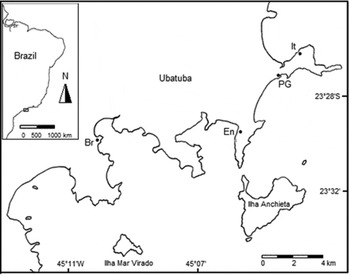
In this study we focused on the structure of peracarid assemblages in the intertidal zone, where wave exposure and sedimentation are likely to be particularly relevant. Four rocky shores at Ubatuba, São Paulo, Brazil were chosen to provide spatial replication of habitats of varying wave exposure, along a 20 km coastline (Figure 1). Enseada and Itaguá are relatively protected shores formed by small boulders, while Bravinha and Praia Grande are moderately exposed areas where larger boulders and platforms make the most of the rocky habitat. Exposure categories were based on the indices reported by Bueno & Flores (Reference Bueno and Flores2010), using the method described in Palumbi (Reference Palumbi1984). Dense coralline algal patches were found at low-shore heights on all these localities and were sampled during emersion periods. On protected sites, coralline algae form homogeneous mat-like habitats, whereas patches are sparser and turf-like on exposed shores. The most abundant algal species were Corallina officinalis Linnaeus, Jania rubens (Linnaeus) J. V. Lamouroux and Amphiroa beauvoisii J. V. Lamouroux (Joly, Reference Joly1967). Since they usually co-occur at any given patch, and form an overall common turf habitat (although of variable height and structure), we did not identify algal species in each sample. We occasionally observed sponges Hymeniacidon heliophila growing among coralline fronds, especially at sheltered shores, which may affect amphipod species composition.
Map of the study area. Rocky shores are indicated by black dots. It, Itaguá; Pg, Praia Grande; En, Enseada; Br, Bravinha.

Fieldwork was conducted from September to November 2010, thus minimizing the influence of seasonal trends. We sampled each shore by haphazardly taking three samples, separated by an approximate distance of 20 m along shorelines, during three sampling events (22 September, 22 October and 7 November). We tested for variation among sampling events and did not find any. Therefore, we pooled samples obtained at these different times and used a sample size of nine replicates. Samples were taken at 100% coralline cover areas during diurnal low-tide periods, using a 10 cm diameter corer. Turfs were frozen and later analysed under a dissecting microscope to sort out amphipods and tanaidaceans, which were counted and identified to species level. Abundance was calculated as individuals per plot. After removing the vagile fauna and trapped sediment, habitat complexity was estimated as coralline biomass (dry weight) per plot for the two last events. For that, samples were dried at 60°C for 48 h and weighed on a precision weighing scale.
Statistical analyses
We first investigated the co-occurrence of amphipods and tanaidaceans in the coralline algae through correlation analyses using the Statistica software (Stat Soft Inc., 2005). A positive correlation would suggest these groups require similar environmental conditions, clustering at favourable spots, while a negative correlation would indicate exclusion through competition or preference for different environmental conditions. No relation was expected if their occurrence is independent at the sampled local scale. Correlational trends were then tested between habitat complexity and peracarid abundance, to evaluate whether habitat size may be a limiting factor.
We applied a nested ANOVA design to test the effect of wave exposure on habitat complexity and abundance of both amphipods and tanaidaceans using the WinGMAV5 software (Underwood & Chapman, Reference Underwood and Chapman2002). The nested design included the factors exposure (fixed, two levels: moderately exposed and sheltered) and shore (random, nested in exposure, two levels: Praia Grande and Bravinha; Enseada and Itaguá). Nesting shores within exposure levels allowed us to test the consistency of wave exposure effects. Amphipod and tanaidacean abundance data were transformed to ln(x + 1) to achieve homoscedasticity when needed. Dominant amphipod species were analysed according to the degree of exposure through a one-way ANOVA.
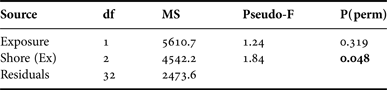
The same nested design was used to examine changes in the assemblage structure of amphipods. In this case, PERMANOVA (Clarke & Gorley, Reference Clarke and Gorley2006) analyses were run, using Bray–Curtis distances after 999 permutations. Singletons were removed. The SIMPER test was used to detect the main species underlying the formation of clusters. Only two tanaidacean species were found, precluding any statistical procedures. However, patterns of occurrence of these two species were strikingly different and simple numerical trends sufficed.
RESULTS
Habitat complexity was similar between moderately exposed and sheltered shores (F = 0.01; df = 1; P = 0.936). Also, we observed no variation between shores of the same exposure level (F = 0.55; df = 2; P = 0.587), suggesting a homogeneous turf at the local scale. No correlation was found between amphipod and tanaidacean abundances (r = −0.0690; P = 0.690), indicating their independent occurrence on coralline algae. Peracarid abundance, as a whole, did not show any correlation with habitat complexity (r = 0.1074; P = 0.617). Separately, we found a positive correlation between amphipod abundance and coralline complexity (r = 0.4720; P = 0.020) but no correlation for tanaidaceans (r = 0.1119; P = 0.603).
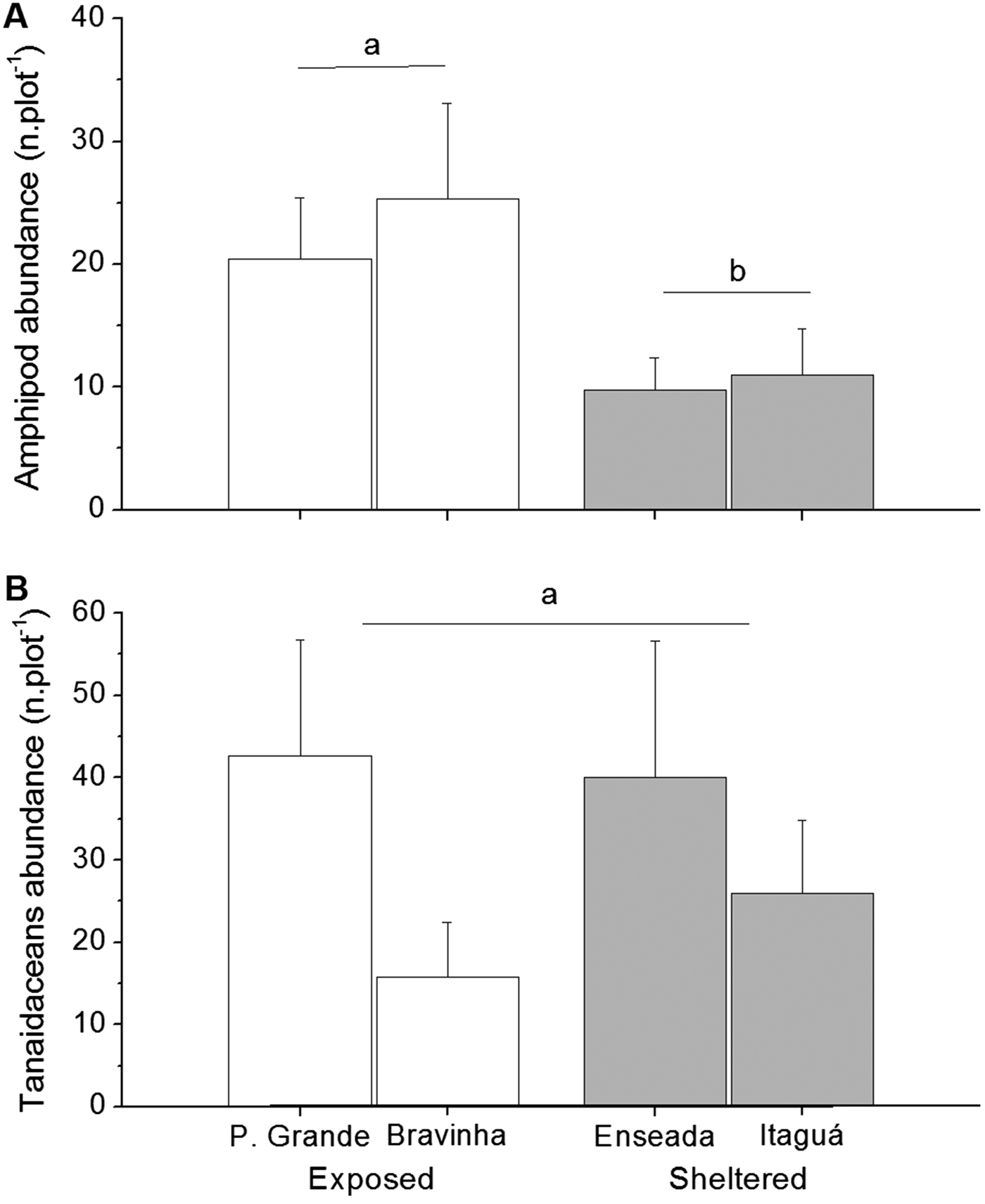
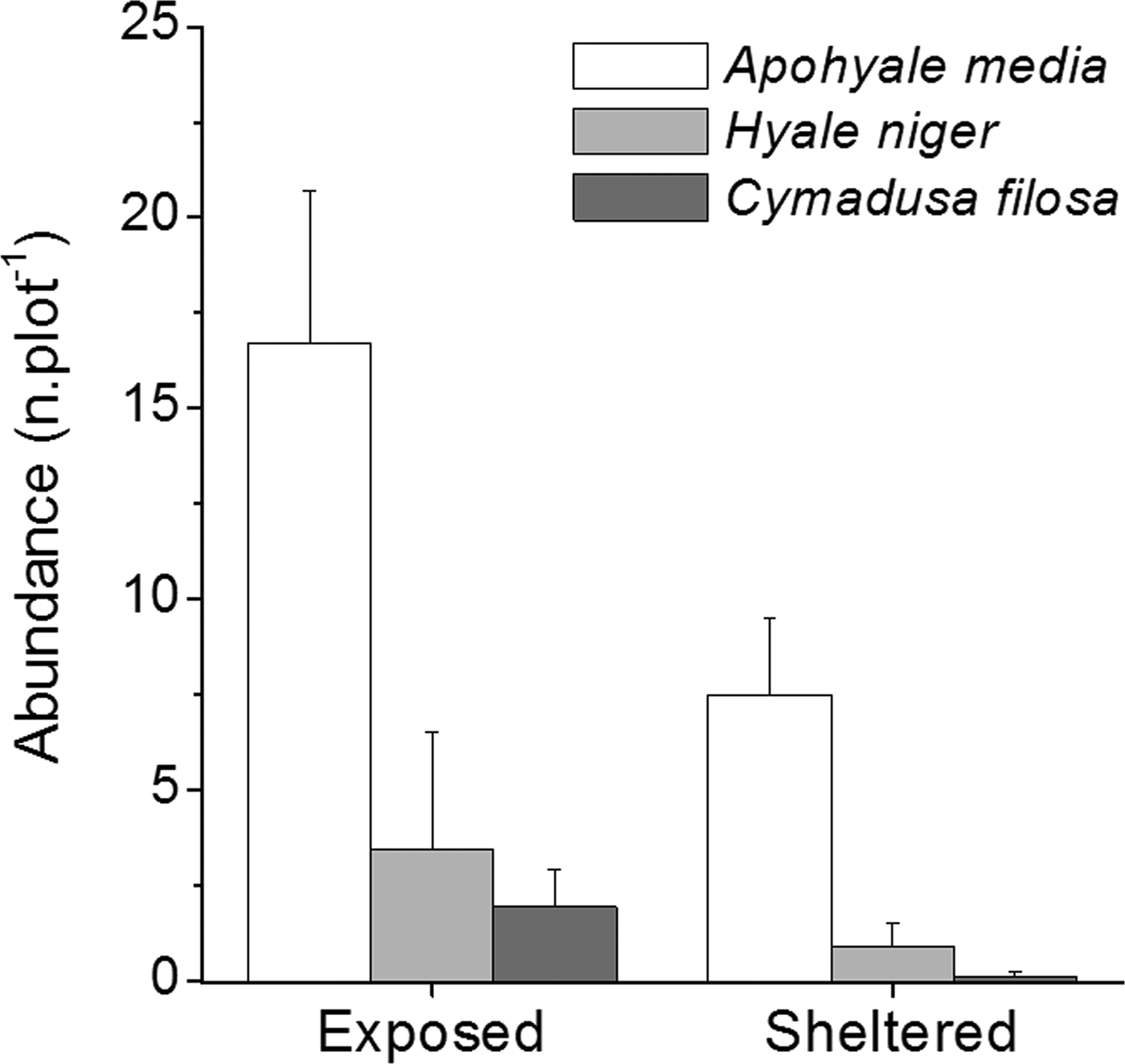
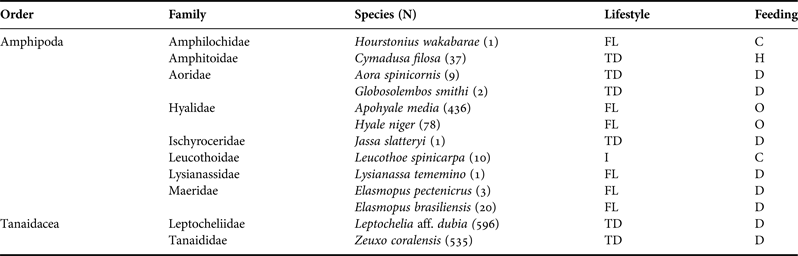
We found 589 amphipods distributed on 11 species. Details on life, feeding habits and counts for all species are shown in Table 1. Higher overall amphipod abundance was observed on moderately exposed sites (Table 2, Figure 2A). We did not observe differences between shores, within each category of exposure, further suggesting that amphipod abundance is consistently higher at more exposed areas, as observed for the most abundant species Apohyale media, Hyale niger and Cymadusa filosa (Figure 3). Apohyale media dominated both exposed and sheltered shores, while H. niger and C. filosa occurred at lower numbers. However, differences between degrees of exposure were not significant for all three species (A. media: F = 2.21; df = 1; P = 0.147; H. niger: F = 0.15; df = 1; P = 0.703; C. filosa: F = 4.03; df = 1; P = 0.053). We did not find an effect of wave exposure on the structure of amphipod species assemblages, but we did find differences between shores (Table 3). Pair-wise post-hoc tests showed that between-shore contrasts were significant for more exposed assemblages at Praia Grande and Bravinha (t = 1.63, P = 0.048), but not for Enseada and Itaguá (t = 1.0492, P = 0.365). Main contributors to these results were identified through SIMPER analysis and included A. media (60.5%), C. filosa (20.8%) and H. niger (13.1%).
Abundances at moderately exposed (Praia Grande and Bravinha) and protected sites (Enseada and Itaguá). A: amphipods. B: tanaidaceans. Bars indicate standard errors. Different letters indicate P < 0.05. For tanaidaceans, all individuals at exposed shores were Zeuxo coralensis, and all individuals at sheltered shores were Leptochelia aff. dubia, except for two Leptochelia individuals found at Praia Grande.

Abundance of dominant species Apohyale media, Hyale niger and Cymadusa filosa at exposed and sheltered rocky shores. Bars indicate standard errors.

Lifestyle and feeding habits of peracarids occurring at Praia Grande, Bravinha, Enseada and Itaguá.

N, number of individuals; FL, free-living; TD, tube-dwelling; C, carnivorous; H, herbivorous; O, omnivorous; D, detritivorous; I, inquiline; C, commensal. From Leite et al. (Reference Leite, Güth and Jacobucci2000); Guerra-García et al. (Reference Guerra-García, Tierno de Figueroa, Navarro-Barranco, Ros, Sánchez-Moyano and Moreira2014).
ANOVA results for peracarid abundance at moderately exposed (Praia Grande and Bravinha) and protected sites (Enseada and Itaguá).

PERMANOVA results for amphipod species composition at moderately exposed (Praia Grande and Bravinha) and protected sites (Enseada and Itaguá).

Tanaidaceans occurred at higher numbers, summing up 1131 animals belonging to two species, Leptochelia aff. dubia (after Bamber, Reference Bamber2010) and Zeuxo coralensis (Table 1). Segregation of these two species according to levels of wave exposure was virtually absolute. Leptochelia was restricted to sheltered areas (Enseada and Itaguá), except for two animals recorded at Praia Grande, while Zeuxo was only found at exposed shores (Figure 2B). These two species apparently fulfil the tanaidacean niche, since whole tanaidacean abundance did not vary according to exposure levels, nor between shores within the same level (Table 2).
DISCUSSION
The occurrence of amphipods and tanaidaceans at a very local scale, within turf samples of less than 80 cm2, was unrelated, suggesting no substantial interactions between these two major groups, neither positive or negative, nor any meaningful similarity (or divergence) of habitat preferences. Despite no apparent differences of habitat complexity between the tested exposure levels, and our rather restricted sampling effort (two shores in each exposure level), the peracarid community in our study region is clearly affected by wave action, suggesting that other factors than habitat structure may affect these assemblages. Because we found mostly changes in abundance for amphipods and species composition for tanaidaceans, effects of wave exposure are apparently complex and group-specific.
Amphipods were far less abundant than tanaidaceans but much more diverse, as observed for Masunari (Reference Masunari1982) for turfs dominated by the coralline alga Amphiroa beauvoisii. We found 11 amphipod species with different lifestyles and feeding modes, suggesting they may exploit a wide array of resources within the turf habitat. Habitat complexity, which did not differ between turfs exposed to different wave action, but did vary considerably within any given shore (52%), positively affected overall amphipod abundance. Habitat features can influence hydrodynamics at small scales (Madsen et al., Reference Madsen, Chambers, James, Koch and Westlake2001) and more physically complex patches may supply several different microhabitats. It would allow resource partitioning, as observed for Corallina officinalis, where six species of copepods are specialized on the use of different resources, probably mitigating interspecific competition (Hicks, Reference Hicks1977).
Higher overall abundance of amphipods on more exposed shores could be related to more frequent water renewal. This could enhance oxygen saturation, a factor correlated to higher abundance of several Eastern Atlantic caprellid and gammarid species (Izquierdo & Guerra-García, Reference Izquierdo and Guerra-García2011), and supply of suspended food particles (Fenwick, Reference Fenwick1976), which could be used by the prevailing omnivore species (Apohyale media). Also, amphipods are highly mobile species which may rapidly return to their algal hosts after being dislodged (Fenwick, Reference Fenwick1976; Norderhaug et al., Reference Norderhaug, Christie, Andersen and Bekkby2012), thus possibly overcompeting more sedentary invertebrates. Wave exposure would likely benefit in a similar manner all amphipod species since it did not affect assemblage composition, in contrast to the results obtained by Lancellotti & Trucco (Reference Lancellotti and Trucco1993) for Chilean rocky shores. It should be noted, however, that a greater gradient of wave exposure was sampled by these latter authors. Shores within similar conditions of exposure to wave action may however host distinct amphipod assemblages, as noted here for the communities sampled at Bravinha and Praia Grande. Therefore, any processes operating at spatial scales of a few km may drive substantial environmental change and alter the composition of the turf-dwelling amphipod fauna. Among many possible factors, the identity of accompanying epiphytic algae (e.g. Schmidt & Scheibling, Reference Schmidt and Scheibling2006; Jacobucci & Leite, Reference Jacobucci and Leite2014), and patterns of sedimentation (Whorff et al., Reference Whorff, Whorff and Sweet1995; Boström & Bonsdorff, Reference Boström and Bonsdorff2000) may play important roles. The effects of these and other possible factors cannot be advanced here and should be addressed in future experimental work.
We found both free-living and tube-dwelling amphipods. Among the free-living species, hyalids prevailed, especially Apohyale media. Hyalids are omnivorous and resistant to desiccation, thus capable of colonizing intertidal habitats spanning a considerable vertical height on rocky shores (Wieser, Reference Wieser1952; Tararam et al., Reference Tararam, Wakabara and Leite1986; Chavanich & Wilson, Reference Chavanich and Wilson2000). Tube-building species are usually more patchily distributed than free-living animals (Tanaka & Leite, Reference Tanaka and Leite2003). They are more sedentary, and juveniles build their tubes near their parents, resulting in aggregated patterns, as observed for Cymadusa filosa (Appadoo & Myers, Reference Appadoo and Myers2003). This species was the most abundant tube-dwelling amphipod in this study. It occurred mostly at the exposed shore Bravinha, with no animals found at Praia Grande. Distribution of C. filosa was clearly patchy, since we found samples containing 10 and 14 animals, which together make up 65% of the whole sample. We also found Leucothoe spinicarpa, a species frequently associated with sponges and ascidians (Thiel, Reference Thiel2000). Although at low numbers (N = 10), its presence was probably related to the co-occurring sponge Hymeniacidon heliophila, a structuring organism associated with coralline algae mainly at sheltered shores.
Tanaidaceans were far more abundant than amphipods, but much less diverse (only two species recorded). Overall densities were similar in exposed and sheltered shores, but species were segregated in these two environmental conditions, with turf habitat being colonized by Leptochelia aff. dubia at sheltered shores and Zeuxo coralensis at moderately exposed sites. Spatial segregation of intertidal tanaidaceans according to water motion was also reported by Kitsos & Koukouras (Reference Kitsos and Koukouras2003) in the Greek coast. Although the authors measured water flux, not wave exposure, they observed Leptochelia savignyi and Pseudoleptochelia anomala at lower hydrodynamism, and two species of Tanais, belonging to the same family of Zeuxo (Tanaididae), at sites where higher hydrodynamism prevailed. However, substrates varied from coralline algal turfs to mussel beds, as sites varied from low to high hydrodynamic intensity (Kitsos & Koukouras, Reference Kitsos and Koukouras2003), making it hard to separate the effects of hydrodynamism and habitat type. Unlike amphipods, the abundance of tanaidaceans was not related to habitat complexity. The distribution of tanaidaceans may be more directly linked to sediment trapping in coralline algal turfs, since they use grains to build their housing tubes and feeding. Krasnow & Taghon (Reference Krasnow and Taghon1997) observed the behaviour of L. aff. dubia and noted that this species manipulates sediment particles using their mouth parts and pereopods. Individuals may thus obtain food from biofilms adhered to sand grains as they build up their tubes. Our ongoing research is investigating the role of trapped sediment in the distribution of tanaidaceans, and preliminary data suggest that coralline algal turfs in sheltered areas contain higher organic contents due to sediment retention. It is thus possible that the functional morphology of mouth and thoracic appendages will determine the habitat type and niche breadth in these abundant peracarids.
Wave exposure is an important environmental variable affecting the distribution of animals and plants on rocky shorelines. Regarding wave exposure and peracarid lifestyles, our results challenged the general notion that tube-building provides protection against dislodgement (Dommasnes, Reference Dommasnes1968; Fenwick, Reference Fenwick1976). In spite of a diverse amphipod assemblage, constituted of both free-living and tube-dwelling species, we found no differences in composition structure suggesting a higher occurrence of the latter group in more exposed shores. Accordingly, both tanaidacean species build tubes using mucus and sand grains, and, if this was the single most important trait determining distribution patterns, we would expect L. aff. dubia and Z. coralensis to be equally distributed in sheltered and exposed habitats. Clearly, further observational and experimental studies should advance alternative hypotheses underlying distribution patterns of peracarids in intertidal algal habitats.
ACKNOWLEDGEMENTS
We are grateful to many colleagues for their help during fieldwork.
FINANCIAL SUPPORT
Funding was provided by the Fundação de Amparo à Pesquisa do Estado de São Paulo as a PhD fellowship awarded to MB (#2009/53937-4) and undergraduate fellowship awarded to SADS (#2011/11927-2).