Introduction
Sleep-disordered breathing (SDB), which includes habitual snoring and recurrent obstructive sleep apnoea (OSA), affects 6–17 per cent of children.Reference Redline, Cook, RD, Ishman, CM and RB1 This condition poses significant long-term risks, such as daytime sleepiness, neurodevelopmental impairment and cognitive dysfunction.Reference Isaiah, Ernst, Cloak, Clark and Chang2, Reference PK, Radcliffe, Gerry, RS, CM and Boswick3 Adenotonsillar hypertrophy (AH) is a well-known primary risk factor for pediatric SDB, and adenotonsillectomy achieves 70 per cent success rates in non-obese children.Reference Gileles-Hillel, Bhattacharjee, Gorelik and Narang4 To be noted, children frequently present with AH, allergic rhinitis (AR), and sinusitis, which not only serve as primary etiological factors for SDB but may also significantly increase their susceptibility to developing Eustachian tube dysfunction (ETD).Reference Alper, Teixeira, Richert and Douglas Swarts5–Reference Juszczak and Loftus7 The clinical manifestations of ETD range from ear fullness, hearing loss, and tinnitus to more severe complications, including otitis media with effusion (OME), tympanic membrane retraction and cholesteatoma formation. Critically, the cognitive and behavioral impairments resulting from ETD, such as decreased concentration, may clinically overlap with those of SDB, potentially explaining persistent symptoms in some post-adenotonsillectomy children. However, the co-prevalence of SDB and ETD in children remains uninvestigated. Moreover, although SDB and ETD share common risk factors (e.g., adenoid hypertrophy), their interplay remains poorly characterized. This study aims to investigate the prevalence of ETD and to identify associated risk factors in children with SDB who are scheduled for adenotonsillectomy.
Methods
We conducted a retrospective study of children who underwent adenotonsillectomy between January 2019 and November 2023 at two tertiary referral centres in Southern China: Sun Yat-Sen Memorial Hospital and Guangdong Provincial People’s Hospital. Eligible children were aged 3–14 years old, had persistent SDB (≥ three months duration) refractory to conservative management, conservative management included at least six weeks of intranasal corticosteroidsReference Baker, Grobler, Davies, Griffiths, Hiscock and Kubba8 (e.g., mometasone furoate) and/or oral antihistamines for those with allergic symptoms and environmental control measures (e.g., allergen avoidance). Patients who showed no significant improvement in snoring or obstructive symptoms after this period were referred for surgical evaluation. Complete pre-operative evaluation, including standardized polysomnography (PSG) and tympanometry, and absence of chronic middle ear pathology (including suppurative otitis media, adhesive otitis media, or cholesteatoma). Exclusion criteria included incomplete pre-operative assessments (missing PSG or tympanometry data), history of middle ear disease (excluding transient otitis media), previous otologic surgery, the results of PSG indicated central problems, and craniofacial anomalies or syndromic conditions.
Clinical data were extracted from medical records, including demographic characteristics, disease duration, tonsil and adenoid size, body mass index (BMI), polysomnographic findings (Apnea-Hypopnea Index [AHI], minimum oxygen saturation), and co-morbid conditions (AR and sinusitis). Type A bilaterally was considered normal. Unilateral or bilateral type B/C tympanograms were classified as abnormal, and considered ETD. Tonsillar hypertrophy was evaluated using a standardized four-point scaleReference Bokov, Boujemla, Matrot, Spruyt, Gallego and Delclaux9: Grade I, contained within tonsillar fossa; Grade II, extending past anterior pillars; Grade III, beyond posterior pillars (non-contacting); Grade IV, midline contact (near-complete obstruction). Grades III–IV met criteria for pathological hypertrophy.Reference RB, SM, SL, RM, Coles and SA10 Adenoid obstruction was quantified by nasopharyngeal space occupancy: Grade I, less than or equal to 25 per cent obstruction; Grade II, 26–50 per cent obstruction; Grade III, 51–75 per cent obstruction; Grade IV, greater than 75 per cent obstruction. Grades III–IV constituted pathological hypertrophy.Reference Acharya, Bhusal and Guragain11 Obesity was defined as BMI greater than or equal to the 95th percentile for age and sex. OSA diagnosis required an AHI greater than or equal to 1.Reference Sateia12 The degree of OSA was classified according to AHI score: mild, 1 to 5; moderate, more than 5 to 10; severe, greater than 10. Hypoxemia was identified by a minimum oxygen saturation of less than 92 per cent during polysomnography. AR was diagnosed based on typical symptoms (sneezing, rhinorrhea, nasal itching, and congestion)Reference Barr, Al-Reefy, Fox and Hopkins13 and anterior rhinoscopy was performed, whereas normal mucosa was pink, the nasal mucosa in allergic rhinitis was typically swollen and greyish, and clinical signs (pale and edematous nasal mucosa, allergic salute) documented in the medical records, with or without allergen testing. Chronic rhinosinusitis in children was defined as at least 90 continuous days of two or more symptoms of purulent rhinorrhea, nasal obstruction, facial pressure/pain or cough and either endoscopic signs of mucosal edema, purulent drainageReference SE, JJ, Choi, JT, SR and Pena14 or nasal polyposis in our patients. In our cases, all the patients underwent fiberoptic nasopharyngoscope.
Continuous variables were dichotomized according to clinically meaningful thresholds: age (≤ six vs > six years) and symptom duration (< 12 vs ≥ 12 months). Categorical data are reported as counts and percentages. Univariate analyses employed χ2 tests, with variables demonstrating significant associations (p < 0.05) subsequently entered into multivariable logistic regression models. Results are presented as adjusted odds ratios (aORs) with 95 per cent confidence intervals. Statistical significance was set at α = 0.05 (two-tailed). All analyses were performed using SPSS (version 25.0, IBM Corp).
The study protocol was approved by the Institutional Review Board of Sun Yat-Sen Memorial Hospital, Sun Yat-Sen University (Approval No. SYSKY-2024-839-01).
Results
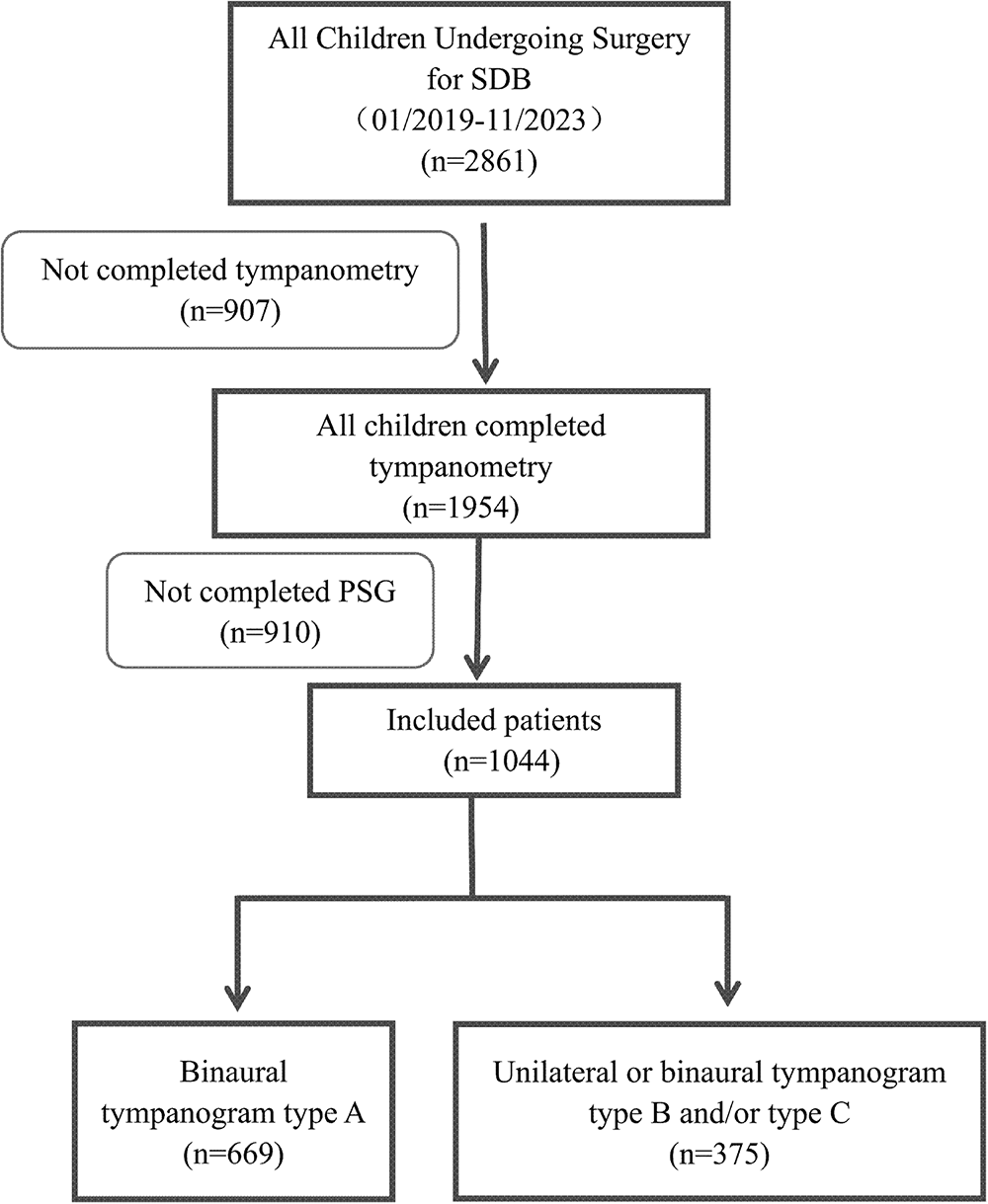
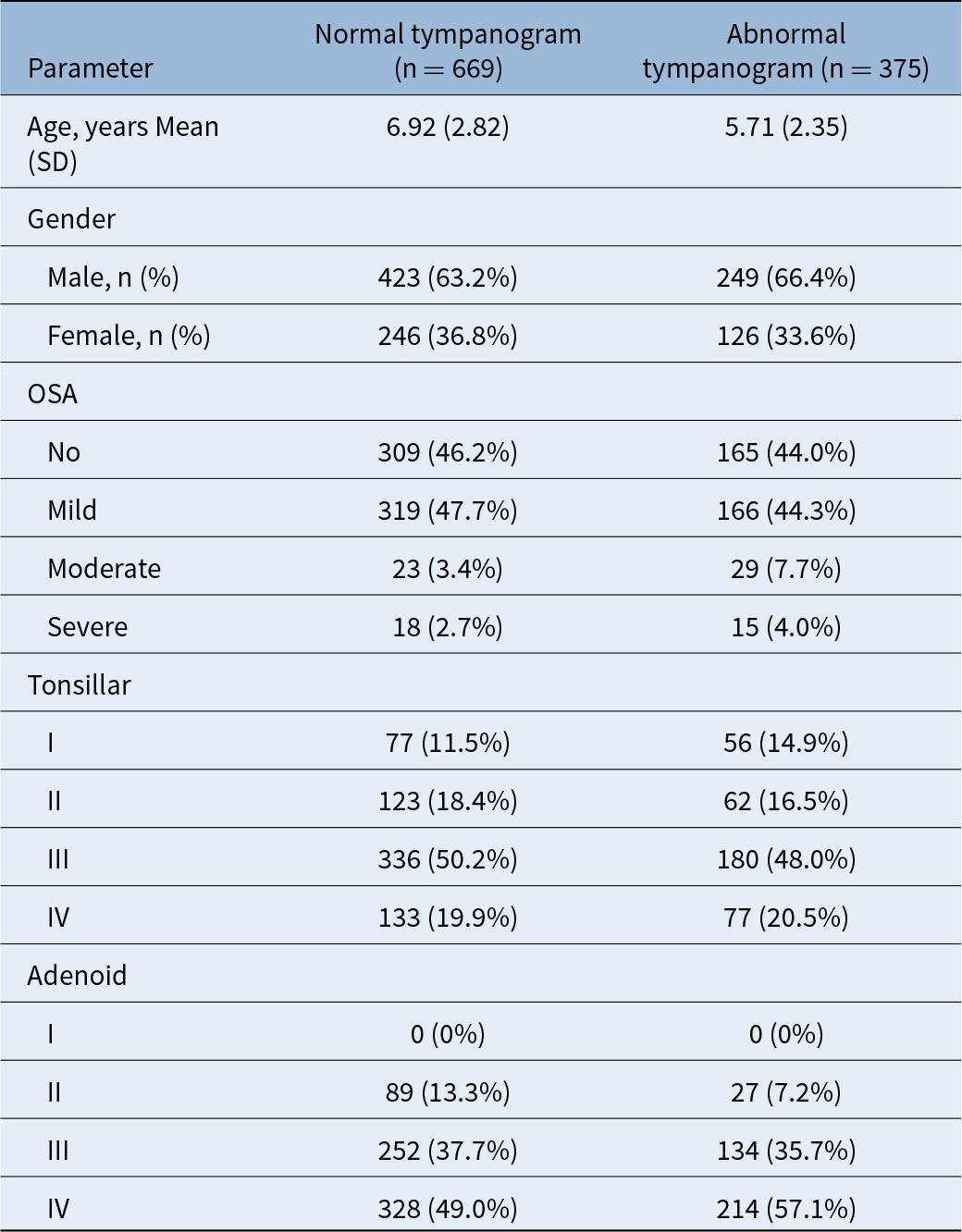
From January 2019 to November 2023, a total of 2,861 consecutive SDB children scheduled for adenotonsillectomy were admitted to the two hospitals. Finally, 1,044 patients (672 males and 372 females, mean age of 6.49 ± 2.72 years) meeting the inclusion criteria were included (Figure 1). There were 375 (35.9%) cases of abnormal tympanometry, of which 66.6 per cent were boys, with an average age of 5.71 ± 2.35 years. There were 669 (64.1%) cases of normal tympanometry. Of those, 63.2 per cent were boys, with the average age of 6.92 ± 2.82 years. The age of the normal tympanogram group was older than the abnormal tympanogram group (p < 0.001), while there was no statistically significant difference in gender (p = 0.21). The demographic and tympanogram data are in Table 1.
Patient flowchart.

Demographic and tympanogram data in SDB children undergoing adenotonsillectomy

OSA = obstructive sleep apnoea; SD = standard deviation; SDB = sleep-disordered breathing.
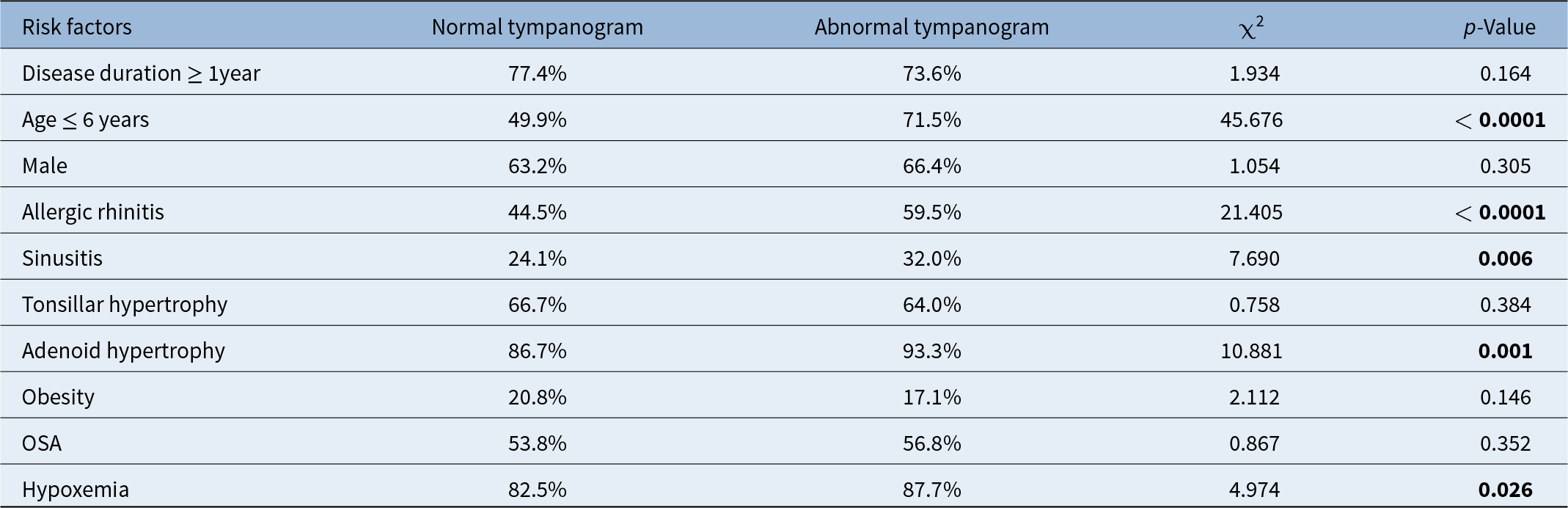
Univariate analysis of risk factors for ETD in SDB children undergoing adenotonsillectomy was shown in Table 2. Compared with patients showing normal tympanometry, those with abnormal tympanograms demonstrated significantly higher rates of: younger age (≤ six years; p < 0.001), AR (p < 0.001), sinusitis (p = 0.006), AH (p = 0.001) and hypoxemia (p = 0.026). No significant associations were observed for sex, disease duration, tonsillar hypertrophy, obesity or OSA (all p > 0.05).
Univariate analysis of potential risk factors for ETD in SDB children undergoing adenotonsillectomy

ETD = Eustachian tube dysfunction; OSA = obstructive sleep apnoea; SDB = sleep-disordered breathing
Table 3 shows the multifactorial analysis of potential risk factors for ETD in SDB children undergoing adenotonsillectomy, age less than or equal to six years, AR, sinusitis, AH and hypoxemia was significantly associated with ETD.
Multifactorial analysis of risk factors for ETD in SDB children undergoing adenotonsillectomy

Note: Values in boldface type are statistically significant.
ETD = Eustachian tube dysfunction; OR = odds ratio; SDB = sleep-disordered breathing.
Discussion
In this study, we for the first time reveal the prevalence and risk factors of ETD in children undergoing adenotonsillectomy for SDB in South China. The prevalence of ETD was 35.92 per cent, and age less than or equal to six years, AR, sinusitis and hypoxemia were risk factors for ETD in this population of children.
Many parents of children with SDB primarily focus on snoring and AH, often neglecting potential ETD. Although adenotonsillectomy can alleviate snoring in some children with SDB, symptoms like poor concentration and academic performance may persist. This highlights the importance of identifying ETD risk factors in SDB children to enhance screening and clinical management.
Robison et al. reported a prevalence of ETD in 31.9 per cent of pediatric OSA patients,Reference Robison, Wilson, Otteson, Chakravorty and Mehta15 which is similar to our results. Liu et al. reported a 17.43 per cent prevalence of OME among Chinese children with OSA,16 a significantly lower rate than ours. Their study focused solely on OME patients, whereas our cohort included ETD cases with and without effusion, as indicated by Type C tympanograms.
In our study, age less than or equal to six years is a notable risk factor for ETD in children with SDB. This association is rooted in the age-dependent anatomical development of the Eustachian tube (ET). Specifically, the ET in infants and young children exhibits a short, flat, and wide configuration, only attaining adult-like dimensions around age seven. This anatomical immaturity explains the higher prevalence of OME in children compared to adults.Reference Gürtler, Husner and Flurin17
Our study demonstrates a close relationship between allergy and ETD, aligning with previous literature.Reference Juszczak and Loftus7, Reference Lazo-Sáenz, Galván-Aguilera, Martínez-Ordaz, Velasco-Rodríguez, Nieves-Rentería and Rincón-Castañeda18 Based on Tubomanometry (TMM) test data, 33.1 per cent of patients with AR suffered ETD, rising to 44.6 per cent in severe AR cases.Reference Ma, Liang, Tian, Liu, Dang and Chen19 The mechanisms linking allergy to ETD likely involve mechanical obstruction from mucous membrane inflammation, reduced ET surface area due to inflammatory mediators, impaired ET opening function and disrupted mucociliary clearance.Reference Yu, Zhang, Zong and Xiao20, Reference Hardy, Heavner, White, McQueen, Prazma and Pillsbury21 Poorly controlled AR over time can lead to chronic ETD, potentially requiring therapeutic interventions or balloon dilatation of the Eustachian tube (BDET).Reference Kaderbay, Karkas, Schmitt, Mura, Lavieille and Venail22 The prevalence of ETD in patients with sinusitis ranges from 33 per cent to 48.5 per cent,Reference Tangbumrungtham, VS, Thamboo, ZM, JV and Ma23, Reference Chen, Dang, Chen, Chen, Ma and Liu24 while our research found 31.8 per cent of ETD patients also had sinusitis. The nasal congestion and mucosal inflammation characteristic of sinusitis can cause ETD by directing purulent secretions towards the ET nasopharyngeal orifice, inducing mucosal inflammation and edema and obstructing the ET.Reference Stoikes and Dutton25, Reference Grimmer and Poe26
AH and ETD are significant contributing factors to OME.Reference GP, Tamashiro, JL, TH, Prates and TB27 Skoloudik et al. found that the degree of compression between the adenoid and the ET orifice is related to OME.Reference Skoloudik, Kalfert, Valenta and Chrobok28 In addition to the static lymphoid tissue surrounding the ET orifice, AH may directly impede the rotation of the posterior bony plate of the ET,Reference Alper, Teixeira, Mandel and Swarts29 when the adenoid tissue is larger, elevation of the soft palate pushes the lymphatic tissue into the ET orifice, further obstructing the ET orifice, which may contribute to ETD.
Our study also found that the presence of hypoxemia correlated with ETD; however, there was no significant correlation between tonsillar hypertrophy and OSA with ETD. It has been suggested that increased severity of OSA correlates with negative middle ear pressure (MEP).Reference Ahmed, Lin, Moskowitz and Stupak30 Cayir et al. found that mild and moderate OSA had no significant effect on middle ear pressure MEP, and that severe OSA could cause MEP to become elevated. Long-term continuous positive airway pressure (CPAP) can improve the quality of life in severe OSA patients while restoring ET function.Reference Cayir, Hizli, Kayabasi and Yildirim31 Alshukry et al. suggested that MEP regulation was based on sensory nerve reflex pathways to maintain the pressure balance between the middle ear and the surrounding environment, and hypoxia inhibited mechanoreceptors and caused an increase in the open latency of the ET manometry index, suggesting that hypoxia inhibits the opening of the ET.Reference Alshukry, Lagier, Della Vedova, Salburgo, Lavieille and Montava32 However, whether long-term intermittent hypoxia of OSA affects the neural reflex mechanism of ET opening needs further investigation. Additionally, tonsillectomy may not have a direct effect on the improvement of ETD. However, it could improve ET function by alleviating the hypoxic state associated with OSA.
Previous studies had shown that overweight and obesity were risk factors for OMEReference Kaya, Selimoğlu, Cureoğlu and Selimoğlu33–Reference Shin, Park, Kwon and Yeo35; however, our study found that obesity was not a risk factor for ETD in children with SDB undergoing adenotonsillectomy. There was also a study in agreement with ours that suggested that obesity or overweight is not a risk factor for OME in children with adenoid hypertrophy.Reference Yang, Jv, Zhang, Hu, Mi and Hong36 The relationship between overweight or obesity and ETD is complex and deserves further study. In addition, our study also found that gender was not a possible risk factor for ETD in children with SDB.
The present study has certain limitations. First, we only used tympanogram to assess ET function, without combining other ET function measures such as TMM, Eustachian Tube Dysfunction Questionnaire (ETDQ-7), and Eustachian Tube Score (ETS), although it was considered that there might be poor cooperation of the children. Second, our study was retrospective. For these children, whether ET function recovered after the release of mechanical obstruction, and whether concomitant surgical intervention is necessary, is something that we are currently working on in a multicentre prospective study (ClinicalTrials.gov Identifier: NCT05600595).
• This double-centre, retrospective study investigated the prevalence and risk factors of Eustachian tube dysfunction (ETD) in 1,044 children with sleep-disordered breathing (SDB) scheduled for adenotonsillectomy
• The prevalence of ETD, defined by abnormal tympanogram results (Type B or C), was 35.9 per cent in the studied cohort
• Significant risk factors associated with ETD included younger age (≤ six years), allergic rhinitis, sinusitis, adenoid hypertrophy and the presence of hypoxemia during sleep
• No significant associations were found between ETD and gender, disease duration, tonsillar hypertrophy, obesity, or the presence of obstructive sleep apnoea (OSA)
• The study highlights the high co-morbidity of ETD in children with SDB and suggests that ETD may contribute to persistent neurocognitive symptoms even after adenotonsillectomy
• We recommend routine tympanometry screening for ETD in children with SDB, especially in younger children with allergic rhinitis or sinusitis, to allow for early diagnosis and intervention
Conclusion
ETD is highly prevalent in children undergoing adenotonsillectomy for SDB. ETD in such children is affected by a variety of factors, and independent risk factors for ETD in children include age less than or equal to six years, AR, sinusitis, AH and hypoxemia. Routine acoustic impedance testing should be performed for children with SDB who are candidates for adenotonsillectomy to actively screen for ETD, especially in young children (age ≤ six years) with AR and sinusitis, which is essential for early diagnosis and timely intervention of ETD.
Funding statement
This work was supported by the Natural Science Foundation of Guangdong Province (Grant No. 2023A1515010465).
Ethical approval
Ethical approval was obtained from the Ethics Committee of Sun Yat-Sen Memorial Hospital, Sun Yat-Sen University (Approval No. SYSKY-2024-839-01).
Competing interests
The authors have no funding, financial relationships or conflicts of interest to disclose.