Lexical stress is used in languages such as English and Italian to contrast strong and weak syllables within polysyllabic words. In both of these languages lexical stress is a critical linguistic feature required for meaning. For example, in English, butterfly must be produced with a strong initial syllable, but a word like potato must be produced with an initial weak syllable followed by a strong syllable. An English word like incense has a different meaning when produced with a strong initial syllable versus production with a weak initial syllable followed by a strong syllable. Similarly, in Italian, gomito ‘elbow’ must be produced with a strong initial syllable (antepenultimate stress) but a word like matita ‘pencil’ must be produced with an initial weak syllable followed by a strong syllable (penultimate stress). If speakers do not conform to these stress patterns during their speech production they are likely to be misunderstood.
There is some research suggesting that children with autism spectrum disorders (ASD) exhibit atypical production of lexical stress (as reviewed by Arciuli, Reference Arciuli, Arciuli and Brock2014) which may, at least in part, be due to speech motor control issues (Paul, Bianchi, Augustyn, Klin, & Volkmar, Reference Paul, Bianchi, Augustyn, Klin and Volkmar2008). This kind of atypical speech can impede social inclusion (e.g., Paul, Shriberg, McSweeney, Cicchetti, Klin, & Volkmar, Reference Paul, Shriberg, McSweeny, Cicchetti, Klin and Volkmar2005). One limitation of this body of research is that it has focused primarily on English. There is a pressing need to extend research endeavours to languages other than English in order to investigate language-specific versus physiological issues in speech production by children with ASD. As far as we are aware, the current study is the first acoustic investigation of stress contrastivity in Italian-speaking children with and without ASD.
Cross-linguistic research on stress contrastivity in typically developing children
One way to learn more about the production of lexical stress is to undertake fine-grained acoustic measures of the magnitude of stress contrastivity in children's naming of polysyllabic targets. Recent studies of typically developing (TD) English-speaking children (Arciuli & Ballard, Reference Arciuli and Ballard2017; Ballard, Djaja, Arciuli, James, & van Doorn, Reference Ballard, Djaja, Arciuli, James and van Doorn2012) and typically developing Italian-speaking children have done just this (Arciuli & Colombo, Reference Arciuli and Colombo2016). Italian is appropriate for cross-linguistic comparison with English when it comes to lexical stress production. While acknowledging differences in the size of the phonemic inventories of these languages, and other differences concerning the contrast between long and short vowels as well as the presence of geminate consonants and use of vowel reduction, English and Italian present similar phonetic challenges for children (Keren-Portnoy, Majorano, & Vihman, Reference Keren-Portnoy, Majorano and Vihman2009). Of particular relevance here, neither English nor Italian have fixed patterns of lexical stress whereby every word exhibits a uniform stress pattern, so it is possible to compare the magnitude of stress contrastivity in words with different patterns of lexical stress.
All three aforementioned studies (Arciuli & Ballard, Reference Arciuli and Ballard2017; Arciuli & Colombo, Reference Arciuli and Colombo2016; Ballard et al., Reference Ballard, Djaja, Arciuli, James and van Doorn2012) elicited production via picture naming and utilised a relative measure of stress change or stress contrastivity known as the normalised Pairwise Variability Index (PVI; Low, Grabe, & Nolan, Reference Low, Grabe and Nolan2000). The PVI can be used to ascertain the degree of contrast over adjacent syllables in terms of vowel duration, intensity, and fundamental frequency. Many studies, across a variety of ages and special populations, have used the PVI to measure stress change or stress contrastivity in this way (e.g., Arciuli & Bailey, Reference Arciuli and Bailey2019; Arciuli & Ballard, Reference Arciuli and Ballard2017; Arciuli & Colombo, Reference Arciuli and Colombo2016; Arciuli, Simpson, Vogel, & Ballard, Reference Arciuli, Simpson, Vogel and Ballard2014; Ballard et al., Reference Ballard, Djaja, Arciuli, James and van Doorn2012; Ballard, Savage, Leyton, Vogel, & Hodges, Reference Ballard, Savage, Leyton, Vogel and Hodges2014; Kopera & Grigos, Reference Kopera and Grigos2019; Vergis et al., Reference Vergis, Ballard, Duffy, McNeil, Scholl and Layfield2014, among others). Some cross-linguistic differences have emerged from recent studies of lexical stress in the speech of typically developing children.
Typically developing English-speaking children appear to take longer to reach adult-like production of stress contrastivity in their production of words beginning with a weak–strong (WS) pattern of lexical stress (e.g., tomato), by comparison with production of stress contrastivity in words beginning with a strong–weak (SW) pattern of lexical stress (e.g., butterfly). Ballard et al. (Reference Ballard, Djaja, Arciuli, James and van Doorn2012) who examined two- to seven-year-olds, and Arciuli and Ballard (Reference Arciuli and Ballard2017), who examined eight- to eleven-years-olds, hypothesised that this might be because the WS pattern is the non-dominant pattern in English and children have less practice producing it. They also noted that some previous research has suggested that words beginning with a weak vowel may present challenges for children more generally because of issues relating to controlling a rising contour (Sundberg, Reference Sundberg1979) and/or issues relating to controlling the production of brief vowels in initial weak syllables (e.g., Allen & Hawkins, Reference Allen, Hawkins, Yeni-Komshian, Kavanagh and Ferguson1980, but see Vihman, DePaolis, & Davis, Reference Vihman, DePaolis and Davis1998).
Unlike English, most trisyllabic words in Italian begin with a weak syllable (81% according to Monaghan, Arciuli, & Seva, Reference Monaghan, Arciuli, Seva, Thomson and Jarmulowicz2016). Thus, trisyllabic words beginning with a WS pattern (e.g., matita), described as having penultimate stress, are in fact dominant in Italian, while trisyllabic words beginning with a SW pattern (e.g., gomito), described as having antepenultimate stress, are non-dominant. Arciuli and Colombo (Reference Arciuli and Colombo2016) examined lexical stress production in young typically developing Italian-speaking children aged three to five years. Productions were elicited via picture naming, and stress contrastivity across the initial two syllables was measured via the PVI methodology as in recent studies of English (Arciuli & Ballard, Reference Arciuli and Ballard2017; Ballard et al., Reference Ballard, Djaja, Arciuli, James and van Doorn2012). Results showed that Italian children exhibited adult-like stress contrastivity both in their productions of trisyllabic words beginning with a SW pattern (e.g., gomito) and in their productions of trisyllabic words beginning with a WS pattern (e.g., matita). This suggests that practice (regarding the WS pattern being dominant for trisyllabic Italian words) and physiological issues (possibly relating to production of WS words, more generally) may interact in Italian to allow children to master trisyllabic words beginning with a WS pattern earlier than English-speaking children.
It is noteworthy that previous studies that have examined lexical stress in Italian children have been concerned with phenomena such as weak syllable duration (e.g., Bortolini & Leonard, Reference Bortolini and Leonard1991, Reference Bortolini and Leonard2000; Bortolini et al., Reference Bortolini, Arfe, Caselli, Degasperi, Deevy and Leonard2006; Majorano & D'Odorico, Reference Majorano and D'Odorico2011) or determining how lexical stress affects the reading aloud of polysyllables and its developmental trajectory (e.g., Colombo, Deguchi, & Boureux, Reference Colombo, Deguchi and Boureux2014; Sulpizio & Colombo, Reference Sulpizio and Colombo2013). These studies did not include acoustic analyses of speech production. Thus, the study by Arciuli and Colombo (Reference Arciuli and Colombo2016) and the current study represent initial acoustic explorations of the magnitude of stress contrastivity in Italian children's speech.
Acoustic studies of stress contrastivity in children with autism spectrum disorders
Expressive prosody in individuals with ASD is highly variable, having been described as “monotonic, sing-song-like, robotic, parroted, machine-like, odd, over-exaggerated, and/or stilted” (Järvinen-Pasley, Peppé, King-Smith, & Heaton, Reference Järvinen-Pasley, Peppé, King-Smith and Heaton2008, p. 1328). As noted in the review by Arciuli (Reference Arciuli, Arciuli and Brock2014), not all individuals with ASD exhibit atypical prosody but atypicalities have been reported across the spectrum including both low- and high-functioning individuals (Peppé, McCann, Gibbon, O'Hare, & Rutherford, Reference Peppé, McCann, Gibbon, O'Hare and Rutherford2007; Shriberg et al., Reference Shriberg, Paul, McSweeny, Klin, Cohen and Volkmar2001). Lexical stress is just one type of expressive prosody. With regard to the production of lexical stress, specifically, some previous studies have reported atypical production in ASD (Kargas, López, Morris, & Reddy, Reference Kargas, López, Morris and Reddy2016; McAlpine, Plexico, Plumb, & Cleary, Reference McAlpine, Plexico, Plumb and Cleary2014; Paul, Augustyn, Klin, & Volkmar, Reference Paul, Augustyn, Klin and Volkmar2005) while others have not (Shriberg et al., Reference Shriberg, Paul, McSweeny, Klin, Cohen and Volkmar2001).
We know of only two studies of individuals with ASD that have focused on measuring the magnitude of stress contrastivity via acoustic analyses (Paul et al., Reference Paul, Bianchi, Augustyn, Klin and Volkmar2008; Van Santen, Prud'Hommeaux, Black, & Mitchell, Reference Van Santen, Prud'Hommeaux, Black and Mitchell2010). Paul et al. (Reference Paul, Bianchi, Augustyn, Klin and Volkmar2008) elicited speech via imitation using the Tennessee Test of Rhythm and Intonation Patterns (T-TRIP; Koike & Asp, Reference Koike and Asp1981) which is described as “25 items prerecorded on audiotape that vary in rhythm and intonation using the same nonsense syllable /ma/” (Paul et al., Reference Paul, Bianchi, Augustyn, Klin and Volkmar2008, p. 115). Their analyses revealed that strong syllables were longer than weak syllables in all participants, but that this difference was greater in the TD group than the ASD group (i.e., less stress contrastivity in the productions of the ASD group). Like Paul et al. (Reference Paul, Bianchi, Augustyn, Klin and Volkmar2008), Van Santen et al. (Reference Sundberg2010) utilised an imitation task where participants repeated nonsense utterances. Unlike Paul et al. (Reference Paul, Bianchi, Augustyn, Klin and Volkmar2008), Van Santen et al. (Reference Van Santen, Prud'Hommeaux, Black and Mitchell2010) examined a conglomerate of acoustic measures, revealing some group differences suggesting that individuals with ASD exhibit an atypical balance of acoustic features associated with stress contrastivity by comparison with TD peers.
Recently, Arciuli and Bailey (Reference Arciuli and Bailey2019) reported on the production of polysyllabic words beginning with a WS or SW pattern of lexical stress in a group of English-speaking school-aged children with ASD and a group of TD peers. Productions were elicited via picture naming, and stress contrastivity across the initial two syllables was measured via the PVI methodology as in earlier studies (Arciuli & Ballard, Reference Arciuli and Ballard2017; Arciuli & Colombo, Reference Arciuli and Colombo2016; Ballard et al., Reference Ballard, Djaja, Arciuli, James and van Doorn2012). Results revealed that children with ASD tended to produce less contrastivity in their production of WS words by comparison with typical peers in terms of the relative change in intensity across the initial two syllables. Arciuli and Bailey (Reference Arciuli and Bailey2019) speculated that (some) English-speaking children with ASD might exhibit atypical production of lexical stress in WS words because there is less opportunity to practise the WS pattern which is non-dominant in English, a pattern which may present unique physiological challenges for all children (as noted earlier, referencing Sundberg, Reference Sundberg1979, and also Allen & Hawkins, Reference Allen, Hawkins, Yeni-Komshian, Kavanagh and Ferguson1980, but see Vihman et al., Reference Vihman, DePaolis and Davis1998).
Thus, for English-speaking children, WS word production may be more vulnerable to speech motor control/practice issues than the production of SW words. This possibility can be further explored by examining WS vs. SW word productions in Italian-speaking children with and without ASD. As mentioned earlier, by contrast with English, an initial weak syllable is the dominant pattern of lexical stress for trisyllabic Italian words. As such, Italian-speaking children have more practice producing this prosodic pattern than English-speaking children. We know of no research on production of stress contrastivity in children with ASD who speak languages other than English, and understand ours to be the first study to explore this.
The current study
We used the same targets and methods of acoustic analyses as Arciuli and Colombo (Reference Arciuli and Colombo2016) in order to investigate stress contrastivity in Italian-speaking children with and without ASD. We hypothesised that if Italian-speaking children with ASD struggle with stress contrastivity more than their TD peers we might see evidence of this in acoustic data. Potentially, Italian-speaking children with ASD might exhibit the reverse pattern that we see in the English data and show atypical stress contrastivity in their production of the non-dominant SW stress pattern for trisyllabic words. Then again, the WS pattern of lexical stress may be more physiologically challenging than the SW pattern (regardless of the language in question). Yet another consideration is that opportunities for practice of the dominant WS pattern might enable Italian children to overcome any physiological challenges with that particular prosodic pattern, rendering the challenges of producing SW and WS trisyllabic relatively comparable. As there are competing possibilities, and due to the fact that this is exploratory research, we did not have directional hypotheses.
Method
We used the stimuli, elicitation task, acoustic measures, and data analysis methods used by Arciuli and Colombo (Reference Arciuli and Colombo2016). The data we report here were collected in larger studies.
Participants
We report data from 32 Italian-speaking children. Sixteen children had received a diagnosis of ASD (3 females), and 16 children comprised the TD group (13 females). The children with ASD were recruited from hospitals in the same region and had all received an independent clinical diagnosis based on the Diagnostic and Statistical Manual of Mental Disorders – 4th edition (American Psychiatric Association, Reference Andreoli, Cassano and Rossi1997 [1994]) or the Diagnostic and Statistical Manual of Mental Disorders – 5th edition (American Psychiatric Association, Reference Cortina2014 [2013]), and Autism Diagnostic Observation Schedule – 2nd edition (Lord et al., Reference Lord, Rutter, DiLavore, Risi, Gotham, Bishop, Colombi, Tancredi, Persico and Faggioli2013 [2012]). For the 16 children with an ASD diagnosis, the following descriptor terms applied: 8 ‘moderato’ (moderate), 4 ‘basso’ (low), 2 ‘moderato-alto’ (moderate-high), 1 ‘moderato-basso’ (moderate-low), and 1 ‘alto’ (high). Unfortunately, we do not have information regarding potential concomitant diagnoses (e.g., intellectual disability, ADHD, hearing loss). The data on TD children are a subset of the data reported by Arciuli and Colombo (Reference Arciuli and Colombo2016) from the Veneto region in northern Italy, chosen as the children with the lowest receptive vocabulary scores within that sample.
Descriptive statistics relating to age and receptive vocabulary as measured by the Italian version of the Peabody Picture Vocabulary Test (PPVT; Dunn & Dunn, Reference Dunn and Dunn1997) for each of these groups are provided in Table 1. Notwithstanding the points made by commentators such as Sassenhagen and Alday (Reference Sassenhagen and Alday2016), who question the appropriateness of comparing groups on these kinds of variables, this is common practice in the literature and so we provide the information here. None of our participants had noticeable articulation problems, although we did not verify this using a formal assessment.
Descriptive statistics for age and PPVT scores for ASD and TD groups

Note. Data in parentheses are standard deviations.
Stimuli and procedure
As reported by Arciuli and Colombo (Reference Arciuli and Colombo2016), highly familiar targets that enabled easy identification of vowel onsets and offsets for measuring vowel durations were selected. Of the 10 trisyllabic targets presented during a picture-naming task, 5 have a WS pattern of stress across the initial 2 syllables, also known as penultimate stress: patata ‘potato’, matita ‘pencil’, cucina ‘kitchen’, banana ‘banana’, tacchino ‘turkey’. The other 5 have a SW pattern of stress across the initial 2 syllables, also known as antepenultimate stress: pattino ‘skate’, macchina ‘car’, gomito ‘elbow’, sedano ‘celery’, pettine ‘comb’. The naming task was performed twice while the child wore a headset microphone at a 10 cm mouth–microphone distance. Speech was recorded on a laptop (44 kHz sampling rate, 16 bit). Testing was conducted individually and in a quiet room.
Perceptual and acoustic measures
As per the methodology adopted by Ballard et al. (Reference Ballard, Djaja, Arciuli, James and van Doorn2012), Arciuli and Ballard (Reference Arciuli and Ballard2017), and Arciuli and Colombo (Reference Arciuli and Colombo2016), our focus was fine-grained acoustic analyses of correct productions. As such, correct versus incorrect productions of targets were identified via perceptual judgements. Correct productions were then analysed acoustically with PRAAT (V5.2.0.1; Boersma & Weenink, Reference Boersma and Weenink2010). Acoustic measurements for the first two vowels of each target were: (1) vowel duration (msec) as measured from onset to offset for V1 and V2; as well as (2) peak vocal intensity (dB); and (3) peak f 0 (Hz) for V1 and V2. These measurements were used in the calculation of PVI values for duration, intensity, and f 0 for each word production. The PVI is the normalised difference between the first 2 vowels within a word: PVI_a = 100 x {(a1-a2)/[(a1+a2)/2]} where a 1and a2 are measures of duration, peak intensity, or peak f0 of the first and second vowels, respectively. A positive PVI indicates a SW pattern while a negative PVI indicates a WS pattern. The larger the numerical PVI value, either positive or negative, the greater the magnitude of stress contrastivity.
PVI values were averaged across the two productions of each target in order to create 6 grand PVI values for each participant: PVI_SW_duration, PVI_SW_intensity, and PVI_SW_f 0, and PVI_WS_duration, PVI_WS_intensity, and PVI_WS_f 0.
Test of vocabulary
The Italian version of the Peabody Picture Vocabulary Test (PPVT; Dunn & Dunn, Reference Dunn and Dunn1997) was used to assess vocabulary. Participants were asked to select one of four images that corresponded with a target spoken by the experimenter.
Results
In view of our sample size we decided to try to retain as much data as possible by applying fairly liberal criteria when judging productions as correct or not. Out of a possible total of 640 word productions (32 participants × 10 targets × 2 repetitions of each target) there were 49 errors (7.66% of the data) leaving a total of 591 word productions that could be analysed acoustically. Children with ASD made 34 errors while TD children made 15 errors (examples of errors include word substitutions and productions containing phonemic errors). As noted earlier, our focus here is fine-grained acoustic analyses of correct productions so no further analyses of errors was undertaken. To maximise datapoints for reliability analysis, of the children who produced fewest errors, data from 6 children (18.75% of participants) were analysed by a second person for reliability of acoustic measurements. Average reliability was high for all measures (vowel duration, r = .927; vowel f 0,r = .909; vowel intensity, r = .976).
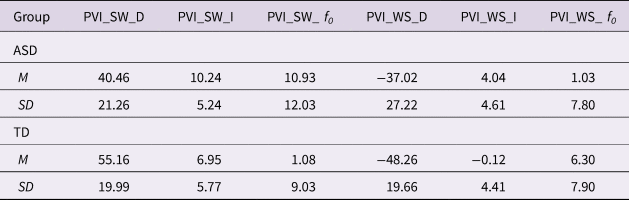
Table 2 displays the mean PVI values for SW and WS productions. As expected, the mean PVI_duration was negative for trisyllabic words beginning with a WS pattern (indicating strong stress on the second syllable) and positive for trisyllabic words beginning with a SW pattern (indicating strong stress on the first syllable).
Mean PVIs and standard deviation for SW words and WS words for both groups

Notes. PVI = pairwise variability index; SW = strong–weak pattern across initial syllables; WS = weak–strong pattern across initial syllables; D = duration; I = intensity; f 0 = fundamental frequency.
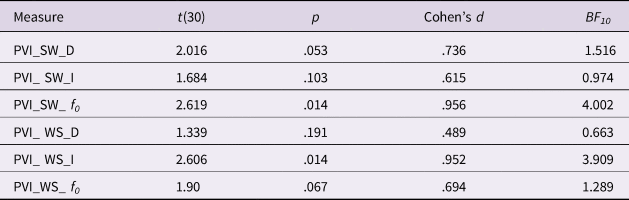
A series of six independent t-tests were conducted with a Bonferroni-corrected alpha of .008 (DVs: PVI_ SW_duration, PVI_ SW_intensity, and PVI_ SW_ f 0 and PVI_WS_duration, PVI_ WS_intensity, and PVI_ WS_ f 0). Although there were some deviations from normality for some variables, assumption of equal variances was met for all of these tests. Table 3 shows the descriptive statistics and t-test results with effect sizes. While there were some numerical differences in group means, these differences were not statistically significant. Bayesian analyses using JASP with default priors (JASP Team, 2018) were in line with our frequentist analyses in revealing a lack of strong support for differences between the groups across these variables.
Results of independent samples t-tests and Bayesian equivalents for all dependent variables

Note. In view of deviation from normality, for some dependent variables we did a logarithmic transformation of the absolute values of all datapoints and the subsequent t-test results revealed p values between .010 and .877.
As reported in Table 1, there were statistically significant differences between our TD and ASD groups in terms of age and vocabulary. Group means indicate that the TD group had greater vocabulary skill and were younger than the ASD group. However, none of the dependent variables were significantly correlated with age or PPVT score so we did not pursue covariate analyses.
Discussion
We utilised acoustic analyses to investigate stress contrastivity in the word productions in Italian-speaking children with and without ASD. Following recent acoustic studies of typically developing individuals in English (Arciuli & Ballard, Reference Arciuli and Ballard2017; Ballard et al., Reference Ballard, Djaja, Arciuli, James and van Doorn2012) and in Italian (Arciuli & Colombo, Reference Arciuli and Colombo2016), and a study comparing English-speaking children with and without ASD (Arciuli & Bailey, Reference Arciuli and Bailey2019), we examined stress contrastivity in the production of Italian words that exhibit different patterns of lexical stress. Our stimuli included trisyllabic words beginning with a SW pattern (the non-dominant antepenultimate pattern of stress) and trisyllabic words beginning with a WS pattern (the dominant penultimate pattern of stress). We thought that if children with ASD have more difficulties with stress contrastivity by comparison with TD peers we might see evidence of this in our acoustic measurements of stress contrastivity using the normalised PVI. We did not have any directional hypotheses regarding whether we might expect group differences to emerge in the production of SW or WS patterns of lexical stress.
Our acoustic data did reveal some subtle differences in the way that Italian-speaking children with and without ASD realised stress contrastivity; however, these numerical differences were not statistically significant when we applied a Bonferoni-corrected alpha level of p < .008. Even with a less conservative correction of alpha to p < .01 there were no statistically significant group differences. Bayesian analyses were in line with the results of our frequentist analyses in showing a lack of strong support for differences between the groups. Some of the effect sizes we found could be described as medium–large but these should be interpreted with caution because Cohen's d is thought to be a positively biased estimate of effect size when the sample size is modest (e.g., Durlak, Reference Durlak2009).
These findings may seem contrary to previous acoustic studies of stress contrastivity in English-speaking children with and without ASD. Although there is not a large body of research to draw on, previous studies have found acoustic differences in the way lexical stress is produced in English-speaking children with and without ASD (Arciuli & Bailey, Reference Arciuli and Bailey2019; Paul et al., Reference Paul, Bianchi, Augustyn, Klin and Volkmar2008; Van Santen et al., Reference Van Santen, Prud'Hommeaux, Black and Mitchell2010). The findings of these studies of English-speaking children with ASD align with other research indicating that some children with ASD have motor difficulties that affect gross, fine, and speech motor control (e.g., Adams, Reference Adams1998; Belmonte et al., Reference Belmonte, Saxena-Chandhok, Cherian, Muneer, George and Karanth2013; Gernsbacher, Sauer, Geye, Schweigert, & Hill Goldsmith, Reference Gernsbacher, Sauer, Geye, Schweigert and Hill Goldsmith2008). We propose that such issues may be exacerbated when producing words that contain a non-dominant pattern of lexical stress versus the dominant pattern of lexical stress, especially in a language such as English where the non-dominant pattern is a WS pattern which might present physiological challenges for all children. By contrast, in Italian, it might be that such physiological challenges associated with the WS pattern are overcome because trisyllabic words beginning with a WS pattern over the initial syllables exhibit the dominant pattern of lexical stress, thereby providing greater opportunities for practice. We can only speculate that this might be the case. Another point to consider is that some previous studies have used imitation tasks (e.g., Paul et al., Reference Paul, Bianchi, Augustyn, Klin and Volkmar2008; Van Santen et al., Reference Van Santen, Prud'Hommeaux, Black and Mitchell2010) while others, including the current study, have used picture-naming tasks (Arciuli & Bailey, Reference Arciuli and Bailey2019). It is possible that at least some children with ASD might imitate speech in a way that is different from typically developing children. We can only speculate about all of these possibilities, which could be pursued in future studies.
We observed that some of the children with ASD had to be reminded to make a response to each picture. Moreover, although this is speculative and based only on perceptual judgements of the recordings, it seemed as though some children with ASD sporadically spoke faster/slower, more loudly/softly, or with greater/lesser pitch – giving the impression of unusual expressive prosody (in the broader sense of expressive prosody rather than the narrow sense of stress contrastivity). This variability was not evident in the speech samples of our TD group. Our study was not designed to capture or measure these broader characteristics of speech production, but this could be pursued in future research.
With regard to the limitations of our exploratory study, it is possible that statistically significant differences in stress contrastivity in the dependent variables we examined would emerge in Italian-speaking children with and without ASD with larger samples from these populations. Additionally, larger samples would enable more sophisticated statistical analyses that could incorporate a range of cognitive/linguistic/motor variables as covariates (e.g., Sassenhagen & Alday, Reference Sassenhagen and Alday2016). Another advantage of testing a larger sample of autistic Italian children is in capturing the great variability in this population – it is likely that atypical stress contrastivity is present in only some children with ASD. As ours is the first study to examine this issue in Italian, it was not possible to undertake a power analysis prior to recruiting participants. However, future studies could recruit larger samples and compare their results with the results we report in the current study to investigate this possibility. That said, it is useful to remember that acoustic studies often include modest sample sizes because manual acoustic measurements are time-consuming. Indeed, the current study included almost 4000 acoustic measurements that were undertaken manually. Automatic methods of acoustic analyses will improve the feasibility of larger sample sizes in future studies. Another limitation is that our groups differed significantly in age and vocabulary skill, with group means indicating that the TD group were younger than the ASD group but had greater vocabulary skill. In addressing this limitation it is important to reiterate that our correlational analyses showed that neither age nor vocabulary skill was related to any of our dependent variables. As such, we think it unlikely that age or vocabulary skill can explain our pattern of results. Finally, it is possible that an alternative acoustic measure of stress contrastivity might reveal differences in the balance of different suprasegmental features that are used to mark stress contrastivity in Italian-speaking children with ASD compared to TD peers (e.g., the conglomerate acoustic measure of stress contrastivity used to analyse English-speaking children with and without ASD reported by Van Santen et al., Reference Van Santen, Prud'Hommeaux, Black and Mitchell2010). We think this would be a worthwhile avenue for future research.
We hope that our study will inspire more cross-linguistic research on speech production in children with and without ASD. Our sample sizes were modest and we observed greater variability in the way that our Italian children with ASD approached the picture-naming task by comparison with their typical peers in terms of broader aspects of speech production. Thus, we do not wish to draw firm conclusions about speech differences in Italian children with and without ASD. While the stimuli and task we used are appropriate for acoustic analysis of stress contrastivity using the PVI methodology, cross-linguistic research using a broader range of speech production measures in larger samples of children would be valuable in future research endeavours.
Conclusion
This study examined how stress contrastivity is realised by Italian-speaking children with and without ASD via acoustic analyses using the PVI methodology. Although there were some fine-grained acoustic differences in the way that children with and without ASD produced stress contrastivity, there was little evidence of statistically significant group differences in our frequentist and Bayesian analyses. It is our hope that this exploratory study will encourage additional research.
Acknowledgement
This work was supported by a Future Fellowship awarded to Joanne Arciuli by the Australian Research Council (FT130101570).