Introduction
In March 2013, a judge in Steubenville, Ohio convicted two teenage boys of rape for digitally penetrating and molesting a drunk, unconscious teenage girl (and videotaping and distributing the video). Multiple high school students watched the sexual assault and never intervened. When prosecutors asked one of the witnesses, Evan Westlake, why he did not stop the incident, he said, “It wasn't violent. I didn't know exactly what rape was. I pictured it as forcing yourself on someone” (Carter and Harlow Reference Carter and Harlow2013). Whether we believe Westlake's explanation to be earnest, his response has important implications. First, Westlake implies that he believes rape is wrong, and warrants intervention. Second, he implies that not all nonconsensual sexual contact is wrong or warrants intervention, and third, it is Westlake's understanding of what constitutes violence that informs the line he draws between acceptable and unacceptable nonconsensual sex. Using data from young peoples' narrative accounts of their experiences with violence and aggression in public drinking settings, this article situates Westlake's reported confusion about the morality of what he witnessed within a larger cultural context. We show that Westlake's response should not be dismissed as an anomalous instance of poor socialization, but instead, understood as revealing of a wider cultural uncertainty about what constitutes sexual aggression and violence, and what constitutes an appropriate response.
Although there is a strong legal and social consensus in the United States that the physically injurious rape of a stranger is wrong (Estrich Reference Estrich1986; Hoffman and Hardyman Reference Hoffman and Hardyman1986), and that unwelcome touching, grabbing, and kissing should be illegal in the workplace (Tinkler Reference Tinkler2008), many nonconsensual, sexually aggressive behaviors are largely tolerated and are a part of normal social interaction in specific settings. For example, sexually offensive public speech is commonplace and infrequently punished by law (Nielsen Reference Nielsen2000). In addition, the majority of young men and women who patronize nightclubs and bars have witnessed or been involved in incidents of nonconsensual sexual contact, and perceive such incidents as so ubiquitous to be an inevitable—albeit sometimes unpleasant—part of going out (Parks and Miller Reference Parks and Miller1997; Graham et al. Reference Graham, Wells, Bernards and Dennison2010; Kavanaugh Reference Kavanaugh2013; Graham et al. Reference Graham, Bernards, Osgood, Abbey, Parks, Flynn, Dumas and Wells2014; Becker and Tinkler Reference Becker and Tinkler2015). While states have laws on the books that punish nonconsensual sexual touching and groping in public places, in practice the law rarely punishes perpetrators in public drinking settings.
The contingency in the law's response means that people routinely negotiate the moral boundaries of nonconsensual sexual contact. Using in-depth interviews with 197 men and women between the ages of 21 and 25, the present study examines how young people think about aggression, nonconsensual sexual contact, and the role of law in regulating sexual boundaries in bars and clubs.Footnote 1 In this article, we integrate insights from sociological theories of gender (Connell Reference Connell1995; Glick and Fiske Reference Glick and Fiske1996; Ridgeway Reference Ridgeway2011) and sociolegal theories of legal consciousness (Ewick and Silbey Reference Ewick and Silbey1998; Merry Reference Merry1990; Nielsen Reference Nielsen2000; Silbey Reference Silbey2005) to show how young people's discursive strategies for negotiating the moral boundaries of sexual aggression reveal the cognitive, often unconscious link between culture and action. In so doing, we contribute to broader debates about how best to study culture (Swidler Reference Swidler1986; Eliasoph and Lichterman Reference Eliasoph and Lichterman2003; Vaisey Reference Vaisey2009; Pugh Reference Pugh2013; Jerolmack and Khan Reference Jerolmack and Khan2014; Vaisey Reference Vaisey2014).
Law and In/Tolerance of Sexual Aggression
Laws influence the extent to which people perceive injuries, as well as the extent to which people attribute fault to others for their injuries (Felstiner, Abel, and Sarat Reference Felstiner, Abel and Sarat1980). Thus, both the presence and absence of law shape people's understandings of sexual aggression. Nonconsensual sexual contact is legally punished most often through the enforcement of criminal laws against rape/sexual assault and civil laws against workplace sexual harassment. Though these laws tend not to cover the routine nonconsensual groping and grinding that occur in bars, they are arguably the most culturally available frameworks to shape moral understandings of sexual aggression. As such, views about the role law should play in handling nonconsensual sexual contact in barrooms are likely to be shaped by understandings of rape and workplace sexual harassment law.
In the United States, serious legal sanctions for rape (Corrigan Reference Corrigan2006; Decker and Baroni Reference Decker and Baroni2011; Beichner and Spohn Reference Beichner and Spohn2012) and sexual harassment in the workplace (Dobbin and Kelly Reference Dobbin and Kelly2007; Tinkler Reference Tinkler2008) suggest a strong cultural consensus exists against particular forms of nonconsensual sexual contact. In some states, the maximum punishment for rape is life imprisonment and it was not until 2008 that the Supreme Court ruled against rape being a capital offense. In addition, Megan's Laws oftentimes permanently mark convicted sex offenders as dangerous deviants by requiring that they register on a public database (Bell Reference Bell2007; Kleinfeld Reference Kleinfeld2013). Likewise, over 90 percent of large employing organizations have adopted sexual harassment policies (Dobbin and Kelly Reference Dobbin and Kelly2007) that hold all forms of nonconsensual sexual attention to be unacceptable in the workplace (Equal Employment Opportunity Commission 2013).
If laws operate as symbols of society's morals (Gusfield Reference Gusfield1967), then the punishments for convicted sex offenders and the widespread diffusion of workplace sexual harassment policies (Dobbin and Kelly Reference Dobbin and Kelly2007) suggest a strong cultural intolerance for sexual misconduct. However, not all sexual aggression is seen as wrong and/or legally actionable. Contextual factors condition how nonconsensual sexual behavior is punished. Laws tend to punish sexual misconduct when it is (1) physically/financially injurious, (2) uncommon, or (3) perpetrated against women who are perceived as chaste. Importantly, beliefs about gender normative behavior influence how each of these contextual factors operates to influence the way law handles nonconsensual sexual contact.
First, law enforcement treats forcible stranger rape more seriously than other forms of sexual violence (Corrigan Reference Corrigan2006; Decker and Baroni Reference Decker and Baroni2011; Beichner and Spohn Reference Beichner and Spohn2012). Similarly, workplace sexual harassment only rises to legally actionable levels when it is perceived to be severe and pervasive and when it interferes with a person's ability to work (Gutek, Morasch, and Cohen Reference Gutek, Morasch and Cohen1983; Greenlaw and Kohl Reference Greenlaw and Kohl1992; Cummings and Armenta Reference Cummings and Armenta2002). In addition, sexual misconduct that is perpetrated by men against women is more harshly punished than are same-sex and women-perpetrated acts (Embry and Lyons Reference Embry and Lyons2012). The consequence of these enforcement patterns is to more harshly punish offenders when women's vulnerability and men's power are more visible. As a result, gender stereotypes (that emphasize men's strength and women's weakness) are reified in the law's enforcement patterns, obscuring the injuriousness of forms of sexual aggression that do not involve physical injury or that occur in settings where men and women go to make consensual romantic or sexual connections.
Second, the least common forms of sexual misconduct are regulated more stringently. Despite being far less common than sexual assaults perpetrated by acquaintances without the use of a weapon (Bureau of Justice Statistics 2013), sexual assault by strangers, with physical injuries, and/or where a weapon is used are more likely to be reported and to result in jail time (Scully and Marolla Reference Scully, Marolla and Cromwell1999; Clay-Warner and Burt Reference Clay‐Warner and Burt2005). In addition, the least common forms of workplace sexual harassment are perceived to be more serious (United States Merit Systems Protection Board 1995), and are most likely to be legally actionable (Terpstra and Baker Reference Terpstra and Baker1992). The absence of law enforcement in the regulation of more ubiquitous forms of nonconsensual sexual conduct normalizes male aggression and gives the impression that injurious behavior is only committed by poorly socialized deviants at the margins of society.
Finally, traditional gender norms also shape the law's treatment of sexual predators and victims more directly. For example, norms that proscribe women's sexual promiscuity have historically advantaged women victims who are seen as sexually chaste and disadvantaged those who are not—even after the widespread adoption of rape shield laws that limit lawyers' use of a victim's past sexual history as evidence (Anderson Reference Anderson2010; Tuerkheimer Reference Tuerkheimer2012; Capers Reference Capers2013). Likewise, when victims of workplace sexual harassment can be characterized as sexually virtuous, courts are more likely to rule in their favor (Schultz Reference Schultz1998). The privileging of chaste victims sends the message that so long as women demonstrate sexual purity, it is the state's job to protect women from insatiable men. However, when women violate these stereotypic expectations, it becomes their responsibility to do the gatekeeping.
The fact that workplace sexual harassment laws punish the same behaviors that go unpunished in barrooms suggests that in settings where heterosexual connections are sought, there is greater cultural and legal tolerance for nonconsensual sexual contact. Indeed, young men and women routinely interact with each other in ways that normalize male dominance and female submission (Armstrong, Hamilton, and Sweeney Reference Armstrong, Hamilton and Sweeney2006; Grazian Reference Grazian2007; Pascoe Reference Pascoe2007; Thompson and Cracco Reference Thompson and Cracco2008; Hamilton and Armstrong Reference Hamilton and Armstrong2009; Ronen Reference Ronen2010; Hlavka Reference Hlavka2014). Moreover, public drinking venues frequented by young people are social locations where alcohol encourages (by reducing inhibitions) and justifies (by diffusing responsibility for deviant behavior) men's sexually aggressive behavior (West Reference West2001; Connell Reference Connell2002; Buddie and Parks Reference Buddie and Parks2003; Thompson and Cracco Reference Thompson and Cracco2008; Weiss Reference Weiss2013; Becker and Tinkler Reference Becker and Tinkler2015). Likewise, gender stereotypes that prescribe women to be polite in their filtering of unwanted attention expose women to greater risk of sexual harassment and assault (Armstrong, Hamilton, and Sweeney Reference Armstrong, Hamilton and Sweeney2006). Thus, masculinity and femininity stereotypes encourage men's sexual aggression in the pursuit of women's affections in the college bar and party scene.
These patterns reveal that people widely perceive rape and workplace sexual harassment to be wrong and punishable by law, but those beliefs operate in a broader cultural setting where law enforcement is bound up in gender stereotypes that frame men's sexual aggression as natural and inevitable and women as in need of protection (Estrich Reference Estrich1986; Corrigan Reference Corrigan2006). Sexual aggression in barroom settings rarely results in serious physical injury, frequently involves men engaging in what is perceived as the normative pursuit of women's affections (Grazian Reference Grazian2007; Thompson and Cracco Reference Thompson and Cracco2008; Ronen Reference Ronen2010), and can include conduct by women that is perceived as unchaste (e.g., wearing sexually revealing clothing, alcohol consumption, suggestive dancing). In other words, typical acts of nonconsensual sexual contact in public drinking settings resemble forms of sexual aggression that the law punishes less harshly (Mitchell et al. Reference Mitchell, Angelone, Kohlberger and Hirschman2009; Basow and Minieri Reference Basow and Minieri2011; Sizemore Reference Sizemore2013; Graham et al. Reference Graham, Bernards, Osgood, Abbey, Parks, Flynn, Dumas and Wells2014). The absence of law in these settings likely contributes to people normalizing this type of sexual aggression and perceiving intervention by law as inappropriate.
Nonetheless, a tension exists between injunctions against nonconsensual sexual contact and gendered social scripts that normalize men's domination of women's bodies. In short, young people have access to contradictory cultural scripts about sexual misconduct in public drinking settings. Men's sexual aggressiveness can be perceived as either a normal part of male–female interaction or an act of deviance that should be regulated by law. Consistent with the evidence that law both reflects and shapes norms (Merry Reference Merry1990; Silbey Reference Silbey2005), our data show that when people navigate the moral boundaries of uninvited sexual behavior, both law's tolerance and intolerance for male aggression influence beliefs about its injuriousness. Thus, we find that people simultaneously minimize and condemn nonconsensual sexual contact in public drinking settings, and invoke laws against sexual misconduct to justify their views. In what follows, we draw on recent insights from the sociology of culture to argue that people's moral understandings of nonconsensual sexual contact require attention to both conscious and unconscious processes.
Dual-Process Model of Culture and Legal Consciousness
Recent debates in the sociology of culture have focused on culture's role in motivating action. The cultural toolkit/repertoire perspective holds that cultural values and beliefs cannot be the primary motivators of action given the contradictory narratives from which people draw meaning (Swidler Reference Swidler1986). The implication is that we would see more consistency between people's understandings and their actions if cultural values were a primary force in motives. An important and recent insight that has emerged out of critiques of the toolkit perspective is that individual action is often motivated by automatic, unconscious processes. The dual-process model of culture, as articulated by Stephen Vaisey (Reference Vaisey2009), contends that culture often motivates action at the unconscious level of human thought while people more consciously use culture (often in contradictory ways) to justify their behavior. From this perspective, understanding the role of culture in action requires attention to the often unconscious cultural logics that underlie attitudes and behavior. Here, we see an affinity between the dual-process model of culture and theoretical insights from both the legal consciousness and social psychology of gender traditions.
Theories of legal consciousness build on the cultural toolkit perspective by emphasizing how law structures the thoughts and actions of everyday citizens (Saguy and Stuart Reference Saguy and Stuart2008). In this conception, law is culture, providing citizens with categories for thinking about the world at the same time that it obscures alternative schemas for meaning making. For example, when a woman interprets her male boss's uninvited shoulder rub as an instance of sexual harassment rather than as sexual violence or innocent friendliness, she demonstrates a particular form of legal consciousness—one that is accessible to her by virtue of her location in a modern American workplace where civil law can be mobilized to punish nonconsensual sexual attention (Uggen and Blackstone Reference Uggen and Blackstone2004; McLaughlin, Uggen, and Blackstone Reference McLaughlin, Uggen and Blackstone2012). From the legal consciousness perspective, people interpret and react to events within a framework of rules about what constitutes normal or moral behavior, the conditions under which wrongdoing warrants action, and the appropriateness of remedies (Silbey Reference Silbey2005).
Legal consciousness researchers have long recognized the primary role of unconscious processes in their emphasis on the taken-for-granted, hegemonic power of law to structure both thought and action (Merry Reference Merry1990; Nielsen Reference Nielsen2000; Silbey Reference Silbey2005; Ryo Reference Ryo2013). Ewick and Silbey (Reference Ewick and Silbey1998) demonstrate, in their ethnographic study of ordinary citizens, that although people talk about the law as an abstraction that exists separate and apart from their daily lives, they interact with legality all of the time. People rarely notice the presence of law, for example, when they pay their bills, drive on the right side of the road, or download computer software. People take for granted the way things are and cannot imagine alternative ways of living because law obscures the alternatives. As a consequence, legal consciousness “may be so much a part of an individual's worldview that … the body of assumptions people have about the law are difficult to articulate” (Nielsen Reference Nielsen2000, 1059). In this way, law shapes morality and in turn action, often unconsciously.
Likewise, gender scholars emphasize hegemonic beliefs that guide expectations, norms, and behavior–oftentimes without people's conscious awareness. Research in social psychology has shown that people unconsciously rely on widely held cultural beliefs about men and women (i.e., gender stereotypes) to guide behavior and smooth interactions (Ridgeway et al. Reference Ridgeway, Backor, Li, Tinkler and Erickson2009; Ridgeway Reference Ridgeway2011). In fact, even when men and women consciously challenge traditional gender stereotypes, they behave according to them in many situations (Ridgeway and Correll Reference Ridgeway and Correll2004; Lamont Reference Lamont2014). Cultural beliefs about both law and gender are hegemonic in the sense that much of their force in shaping social behavior goes unnoticed and/or unarticulated.
Given the ways law obscures its impact, legal consciousness researchers have developed interviewing methods for identifying unconscious processes. This methodological approach involves “decentering law” or asking people to talk about their ordinary experiences and then looking for law as it emerges (or not) in their narratives (Ewick and Silbey Reference Ewick and Silbey1998). By decentering law, researchers in the legal consciousness tradition have focused as much on the presence as they have on the absence of law in people's narratives, and in so doing have advanced knowledge about how law shapes conscious and unconscious processes. In this article, we report on data collected using a decentering strategy in which we asked young people to tell stories about aggression in public drinking settings and coded the narrative data for the presence and absence of nonconsensual sexual contact and law. We explore how people draw on contradictory cultural discourses to make sense of sexual aggression, by focusing in our analysis on how what is hidden—gender stereotypes embedded in legality—emerges through the process of meaning making.
Data and Methods
Our data come from 197 in-depth interviews conducted with young men and women residing in two college towns in the Southeastern United States. Young people's rates and patterns of alcohol consumption, participation in college party scene(s), and the frequency with which they patronize bars, clubs, and other public drinking venues make them ideal candidates for interviews soliciting memories of recent experiences with aggression in such settings (Jackson, Sher, and Park Reference Jackson, Sher, Park and Galanter2005; Hingson, Zha, and Weitzman Reference Hingson, Zha and Weitzman2009; Vander Ven Reference Vander Ven2011). Our sample includes 105 women and 92 men, all of whom range in age between 21 and 25 years old (Mean = 22; SD = 1.28). Ninety-two percent were undergraduate students. The racial/ethnic diversity of the sample is similar to that of the universities most of the interviewees attend with seventy-three percent self-identifying as white, twenty-one percent as black, and six percent as other (e.g., Asian, Latino, American Indian, etc.). All of the interviewees were American citizens. Only two of the interviewees self-identified as gay; the other interviewees either implied over the course of the interview that they were attracted to the other sex or did not reference their sexual orientation.
In partial fulfillment of a research practicum course requirement, undergraduate students enrolled in Sociology of Law, Gender and Crime, and Introduction to Women and Gender Studies courses conducted and transcribed audiotaped interviews.Footnote 2 Each student recruited one friend via a script that invited participants to be interviewed about their experiences with aggression or violence in public drinking settings. Before conducting the interviews, student interviewers completed the institutional review board (IRB) training on research with human subjects in the social and behavioral sciences and attended a ninety-minute training session on successful interviewing techniques. The training covered strategies for recruiting interviewees, obtaining consent, maintaining confidentiality, establishing rapport, upholding neutrality, facilitating responses (including prefatory statements and probing), and maintaining control of the interview.Footnote 3 In addition, because of the sensitive nature of the subject, we provided course materials on sexual assault before and during training, warned students about the possibility of interviewees' sexual victimization disclosure and/or stress related to the interview, and provided contact information for local counseling services for sexual assault survivors and/or victims of intimate partner violence.Footnote 4 Students were provided with a document summarizing interviewing tips and were graded on their use of these interviewing strategies. This method of data collection allowed us to collect a large number of in-depth interviews and, since students were thoroughly trained and their interview transcripts graded,Footnote 5 data quality was relatively high.
All participants in an interview contribute to the production of meaning (Holstein and Gubrium Reference Holstein and Gubrium1995). For sensitive topics that deal with issues of sexuality, peer-facilitated interviews have an advantage in establishing rapport (Price and Hawkins Reference Price and Hawkins2002; Tinkler Reference Tinkler2012), have been shown to result in more open disclosure than interviews conducted by older strangers (Sennott and Mollborn Reference Sennott and Mollborn2011), and produce data comparable to interviews conducted by trained graduate students with no prior relationship to the interviewee (England, Shafer, and Fogarty Reference England, Shafer, Fogarty, Kimmel and Aronson2008). Our analysis of postinterview questionnaire data revealed that students who interviewed close friends often reported the most success getting rich narrative detail as compared to students who interviewed less intimate acquaintances. Rapport gained through peer interviewing is therefore a strength of this study. Nonetheless, it is important to acknowledge that while self-presentation shapes people's responses in all interviewer–interviewee relationships, the stakes may be higher for admitting morally questionable/embarrassing behaviors when the interviewer is a friend. We suspect this could have led to an underrepresentation in our data of narratives in which young people admitted to being perpetrators of unwanted sexual contact and narratives in which men labeled themselves as victims of unwanted sexual contact.Footnote 6 The data we report below should not be interpreted as an accurate count of the prevalence of nonconsensual sexual contact in public drinking settings (since it is likely underestimated), but instead as revealing of the ways in which young people interpret the moral boundaries of such incidents.
The thirty-to-ninety minute interviews were semi-structured, and students were required to follow an interview guide.Footnote 7 To guide the student interviewers, the interview template included prefatory statements, transition statements, probes, and follow-up questions.Footnote 8 Since legal consciousness emerges out of everyday experiences that are shaped by law in ways that are often unconscious and taken for granted (Ewick and Silbey Reference Ewick and Silbey1998; Nielsen Reference Nielsen2000), we adopted the methodological approach of “decentering” sexual aggression by asking people to talk about their experiences with aggression in bars and clubs generally, and then looking for experiences with nonconsensual sexual contact as they emerged (or did not emerge) from their narratives. By decentering law and gender in our initial inquiries, we uncovered both the presence and the absence of sexual aggression, and in so doing, gained access to conscious and unconscious processes.
Interviewees were first asked whether they had witnessed or been involved in any incidents of aggression or violence in public drinking venues. If asked for further clarification, the interviewer defined an incident as “an assault or a conflict that seemed like it could have led to an assault” and a public drinking venue as a “bar, club, or public tailgate—just not private parties.” Following Graham and Wells's approach (Reference Graham and Wells2003), interviewers asked the interviewee to describe the incident in detail—what happened before the incident, how much the interviewee had been drinking, who was involved, who witnessed it, what happened during the incident, what happened after the incident, and how they attributed responsibility. After describing one incident in detail, interviewees were asked to list any other incidents of violence or aggression they had witnessed or been involved in. We capitalized here on the fact that question wording activates particular constructs and obscures others. These narratives give us access to the stories people most strongly associate with aggression/violence. Our goal in the first part of the interview was to identify the incidents that people recall when they are not asked specifically about sexual aggression, that is, when gender is decentered.
Once the interviewee had catalogued all incidents that they could recall, if no incidents of nonconsensual sexual contact had been described we asked if he/she had been involved in or witnessed an incident in a bar, club, or other public drinking venue that involved unwanted or uninvited sexual kissing, touching, or grabbing. Interviewees were then probed about all of the details with the same questions as those asked after their initial narrative of violence and aggression. When gender is salient, widely held cultural beliefs about men and women shape behavior (Ridgeway Reference Ridgeway2011). Here, we made gender salient, and thus “centered” gender, by asking about experiences with unwanted sexual contact. However, since we “decentered” law by not invoking legal concepts like sexual harassment or assault, analyses of these narratives allowed us to look for law when it emerged and when it did not.
In the latter part of the interview, we “centered” law (and gender beliefs), and asked people to reflect on the injuriousness of unwanted sexual contact and their beliefs about the role of law in regulating such conduct. Interviewers asked those who had been involved in incidents of unwanted sexual contact but had not originally mentioned the incident to reflect on why (e.g., Why didn't you mention this incident when we first asked you to describe your experiences with aggression in public drinking settings? Do you think others would think of unwanted sexual contact as aggression? Why?). Finally, drawing on Laura Beth Nielsen's research on law and street harassment (2000; Reference Nielsen2006), we asked whether interviewees supported or opposed laws (e.g., a fine, right of the victim to sue in civil court, and/or jail time for perpetrators) against unwanted sexual contact in public drinking settings. In the final part of the interview, interviewees reported their drinking behavior and provided their demographic information.
Analysis
For the present analysis, we applied a coding scheme that we developed based on prior literature and modified as patterns and themes emerged from the data. The first two authors and two research assistants collaborated to build the database. Trained research assistants entered demographic data, interviewer information, and full-text responses to questions into a spreadsheet. Coding was a recursive, iterative process in which the first two authors developed an initial coding scheme and then met routinely to refine codes and resolve disagreements. We began the coding process by reading through all of the interviews and coding incidents by type (nonconsensual sexual contact, fistfight/brawl, or verbal conflict) and for whether respondents originally categorized an incident of nonconsensual sexual contact as an act of aggression. We differentiate in our coding between attention that was unwanted, but politely and non-aggressively pursued (e.g., a man attempting to dance with a woman and stopping the pursuit when the woman signals a lack of interest) and attention that was unwanted and aggressively pursued. We borrow from the perspective adopted in the interpersonal aggression literature, and define aggression as an action taken in pursuit of one's aims and interests that has the effect of imposing harm on another person or forcing his/her compliance (O'Leary-Kelly, Paetzold, and Griffin Reference O'Leary‐Kelly, Paetzold and Griffin2000).
We used an open coding strategy to classify interviewee's explanations for why they did or did not classify incident(s) of unwanted sexual contact as acts of aggression. Finally, we coded responses to questions about support for the legal regulation of unwanted sexual contact. We coded responses (yes/no) for whether or not interviewees said they would support legal regulation generally and/or specific forms of regulation like a ticket/fine and arrest/jail time. We then used an open coding strategy to classify their justifications for supporting legal regulations or not. At this stage, we engaged in axial coding (Strauss and Corbin Reference Strauss and Corbin1998), wherein we examined the relationships between concepts and began to construct a theoretical explanation for the conditions under which people perceive unwanted sexual attention as an act of aggression, and as an injury to be regulated by law.
Findings: Summary Statistics
Experiences with Aggression—Law and Gender Decentered
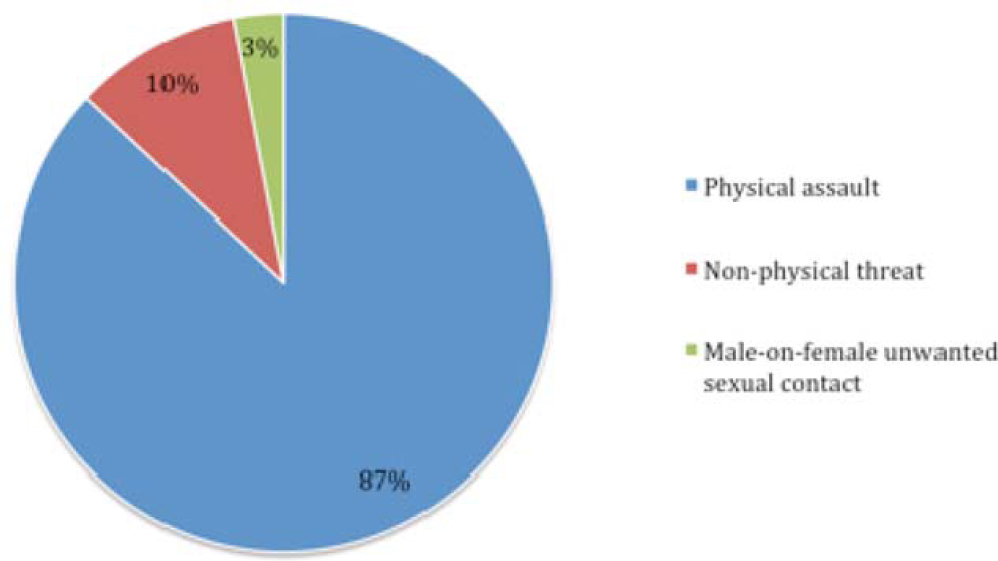
Figure 1 reports the types of incidents interviewees reported when asked about their experiences with violence or aggression in public drinking settings. We examined whether there were race or gender differences in all of the findings we report below. Unless noted, the findings do not differ according to the race or gender of the interviewee. The results make clear that, when law and gender are decentered, that is, when we do not ask about sexual harassment or assault, very few respondents call to mind nonconsensual sexual contact. Out of the 270 incidents of aggression reported, only 9 of the narratives involved respondents (7 women and 2 men) categorizing their experience with nonconsensual sexual contact as an incident of violence or aggression.Footnote 9 Six of the nine incidents shared by these interviewees involved a man physically forcing himself on a woman (e.g., restraining her arms and pushing her against the wall, climbing on top of her). In the remaining three cases, women respondents called to mind nonconsensual sexual contact when asked about aggression and violence, but also used rhetorical strategies to minimize and distinguish it from more serious incidents. As a twenty-one-year-old woman reported: “Um, several times either me or some of my friends will get … like a guy will touch or put their hands all over you. But it hasn't ever been anything more than that.”
Types of Aggressive Incidents Reported (N = 270). [Color figure can be viewed at wileyonlinelibrary.com]
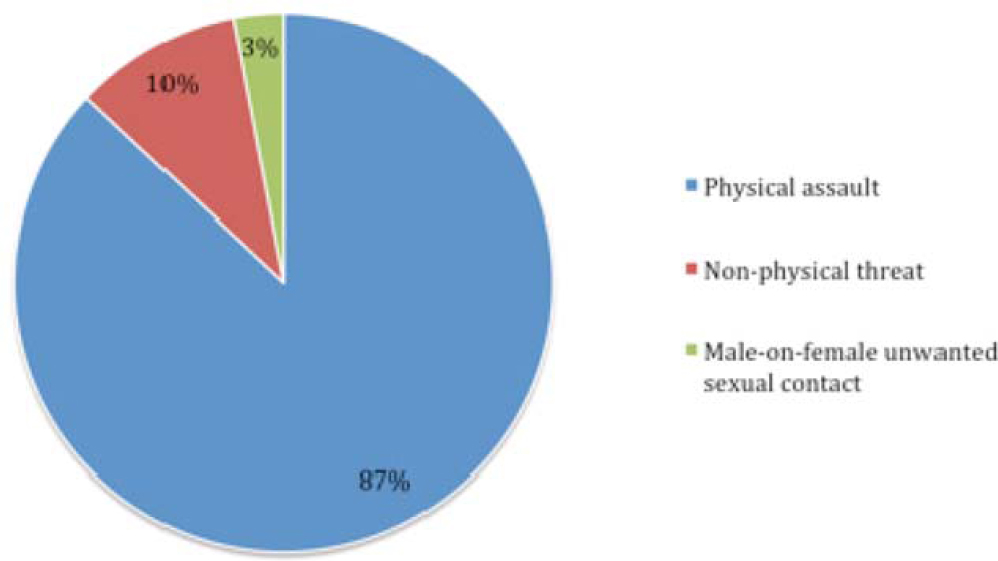
For most interviewees, aggression and violence in public drinking settings means fistfights. Eighty-seven percent of interviewees told a story that involved a physical assault like a fistfight or brawl. Male-on-male fistfights comprise seventy-four percent of the total incidents reported. There were twenty-six (thirteen percent of sample) incidents that did not involve any physical contact but involved verbal threats or altercations.Footnote 10
Experiences with Nonconsensual Sexual Contact—Law Decentered, Gender Centered
As Figure 2 indicates, though very few men and women recalled nonconsensual sexual attention when asked to describe incidents of aggression, sixty-four percent of women and sixty-five percent of men reported witnessing or experiencing it when they were asked directly (this number reflects incidents that we coded as aggressively pursued unwanted sexual attention). Here, the question likely made gender beliefs salient, but did not invoke legal concepts such as sexual harassment or assault. A majority of men described incidents in which they had been witnesses (only six men reported being victims) and a majority of women (sixty-seven percent) described incidents in which they had been victims. Most interviewees reported interactions that began as consensual and then became nonconsensual (e.g., a woman dancing with a man whose attention became unwelcome when he kissed too aggressively, or grinded, touched, or hugged too much). A large proportion also described an incident of opportunistic predation, where an unknown man groped (including grabbing a woman's buttocks, breasts, or genitals), tried to undress (e.g., lift a woman's skirt or pull down her top), or forced a kiss on a woman. It is important to emphasize that we asked interviewees to describe one incident they witnessed or experienced. Thus, the descriptive statistics do not necessarily include all incidents experienced by students nor should the proportion of victims vs. witnesses by gender be interpreted as an accurate proportion of the total incidents. The primary takeaway is that most men and women report involvement in at least one incident, but men rarely report incidents in which they are victims. This is likely due to women's higher risk of victimization but also to men's reluctance to see themselves as victims (Tinkler Reference Tinkler2012).
Percentage of Interviewees Who Reported Experiences with Unwanted Sexual Attention by Question Type and Gender (N = 197).
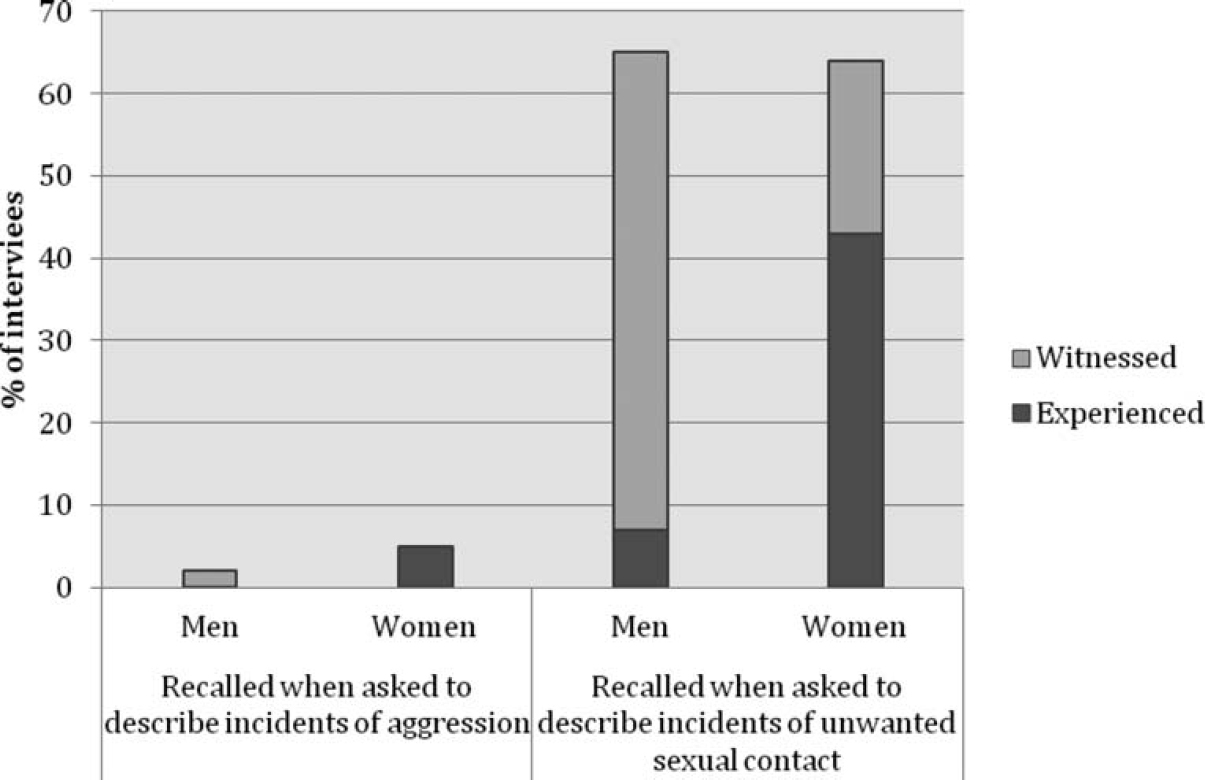
In summary, we found that virtually none of the interviewees who had experiences (either as witnesses or as victims) with nonconsensual sexual contact in public drinking settings associated them—at least consciously—with aggression or violence. Rather, the overwhelming majority of the experiences people associated with “real” aggression were conflicts between men. The near unanimity of this reaction is revealing of the extent to which people fail to see men grabbing, groping, and forcing their bodies onto women as aggression when it occurs in barrooms. The absence of law enforcement in the regulation of nonconsensual sexual contact in public drinking settings likely contributes to this pattern.
The Role of Law—Law and Gender Centered
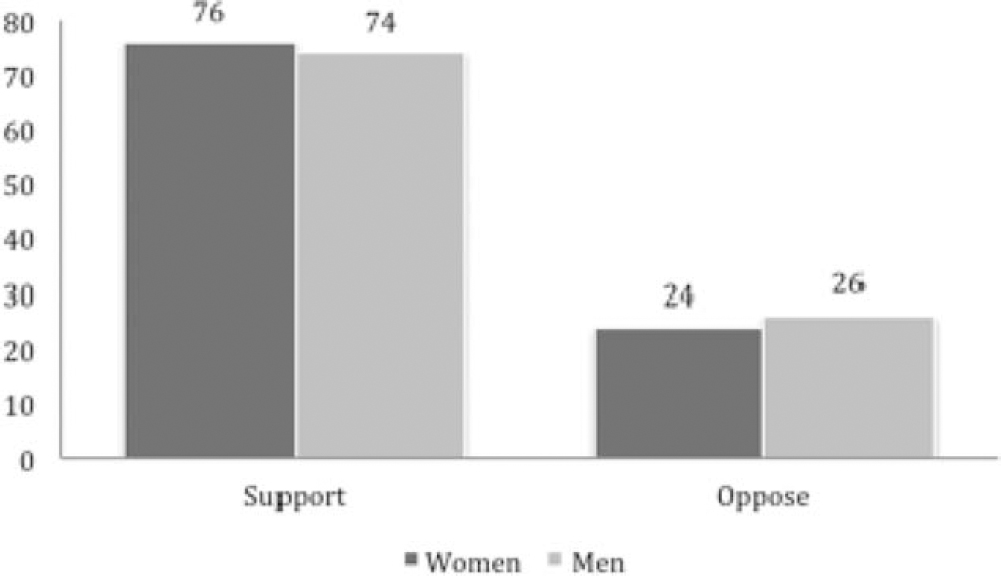
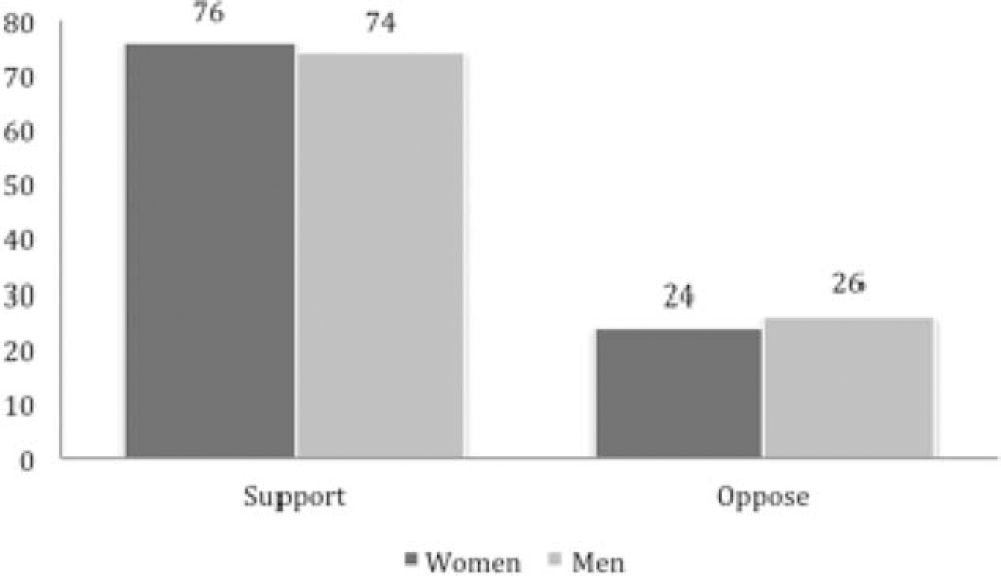
Despite a widespread tendency to minimize the link between aggression and nonconsensual sexual contact, as Figure 3 shows seventy-five percent of our sample asserted that the law should do more to regulate it in bars and clubs. When we centered law and gender by asking directly about whether law should punish perpetrators of unwanted sexual contact, the majority of interviewees believed that a ticket or fine for offenders was appropriate, and a significant minority believed that jail time or a victim's right to sue in civil court were appropriate legal remedies. In other words, when we asked directly about whether the law should punish such behavior and thus moved it into people's conscious awareness, they demonstrated a legal consciousness that was intolerant of nonconsensual sexual contact. We found no gender or race differences in the call for more law enforcement. This widespread call for increased law enforcement appears to contradict our finding (reported above) that most people disassociate nonconsensual sexual contact from aggression and minimize its injuriousness. To understand this contradiction, we turn below to our qualitative analysis of the discursive strategies people use to both minimize nonconsensual sexual attention and call for greater punishments. By analyzing the contradictions, we show how legal consciousness and gender stereotypes underlie and unify both tolerance and intolerance for nonconsensual sexual contact.
Percentage Who Support/Oppose Stronger Legal Restrictions against Unwanted Sexual Contact in Bars and Nightclubs (N = 197).
Findings: Qualitative Analysis
Tolerance of Nonconsensual Sexual Contact
As Figures 1 and 2 indicate, at the less conscious, more automatic level, young people categorize violence and aggression as distinct from nonconsensual sexual attention. In the following analysis, we focus on the explanatory data from respondents who experienced nonconsensual sexual contact that was aggressively pursued but did not recall it when asked about their experiences with aggression or violence (N = 123). We did not find any race or gender differences in the findings we report below. When respondents were asked to articulate why they did not associate aggression with unwanted sexual contact, their responses revealed an understanding of violence and aggression that conforms to the way the law reacts to sexual assault and harassment. In particular, respondents revealed a legal consciousness that minimizes sexual aggression when the victim suffers no physical injuries, the type of aggression is routine, and the offender/offense conforms to traditional heterosexual interaction norms.
“It Doesn't Cause Physical Injury”
The most common explanation people gave for why they did not call unwanted sexual attention to mind when asked about aggression was that it was different than “actual” aggression, like fistfights. As a twenty-three-year-old white woman said, “when I hear violence, I think of actual fighting and throwing punches and stuff like that.” When further explicating what distinguished sexual aggression from other aggression, respondents argued that true aggression is “more related to inflicting pain.” For example, one twenty-two-year-old white man said,
Umm, it probably has to do with just the definition of violence that I've worked with. Which is generally, [pause] physical harm is usually what you associate with the term violence, whereas like a girl getting groped, I would certainly say it's harmful however … but I would not …, the harm it is doing is not largely physical.
Many of the interviewees described sexually harassing incidents that were serious and upsetting, and acknowledged they caused harm, but like this man, interpreted their (likely) unconscious disassociation of these experiences with aggression by drawing on definitions of violence that exclude nonphysical injuries. For example, a twenty-three-year-old white waitress who had finished her shift described the following incident:
That same guy who had been up there all day came up and grabbed me. I turned around and said something to him and he just kept making these godawful comments about my ass and boobs and stuff and he touched me, like tried putting his hands up my skirt that's part of the uniform there you know, and I freaked out on him. … I should have hit him cuz he was nasty.
When asked why she did not recall the incident when asked about experiences with aggression, she replied, “I don't know, I guess because I didn't physically fight that guy I didn't classify it as violence when you first asked.”
The emphasis on physical injury as the primary differentiating feature of “real” aggression narrows understandings of aggression, and is instructive for situating Evan Westlake's failure to see rape in his witnessing of the (nonforceful) sexual penetration of an unconscious girl in Steubenville, Ohio. It is also consistent with the law's tendency to more harshly punish sexual misconduct when physical force is involved. Moreover, by only linking unwanted sexual contact to aggression when physical pain is felt, interviewees mark the moral boundary in a way that emphasizes women's physical vulnerability. This emphasis on physical vulnerability is also evidenced in students' contrasting of their experiences with unwanted sexual contact to those that more closely match rape scripts associated with public drinking settings—specifically, those involving perpetrators who slip “roofies” into drinks (Littleton et al. Reference Littleton, Tabernik, Canales and Backstrom2009). For example, when asked about unwanted sexual contact, a twenty-one-year-old white woman shared the story of a “random drunk man” who “thought it would be a good idea to smack [her] butt.” To explain why she did not bring that up when first questioned about aggression, she argued it was not violence because “I know a lot of people around [the college] get slipped roofies all the time and that's aggressive and violent, but what happened to me personally wasn't violent.” Here, the boundary she draws around real violence is a legal one. By contrasting her experience of being smacked on the butt (where law normally does not intervene) to a form of nonconsensual sexual contact where law is more likely to intervene (drug-facilitated sexual assault), she reveals the hidden role of law in constructing the relative injuriousness of nonconsensual sexual contact. In addition, like the other students who insist on physical injury as the defining feature of aggression, her definition of sexual violence requires extreme vulnerability (in this case, incapacitation) on the part of victims.
It is also relevant that the type of nonconsensual contact that the woman labeled as aggressive—using drugs to secure sexual contact—is, contrary to her assertion that it happens “all the time,” very rare (Weiss and Colyer Reference Weiss and Colyer2010). In addition, while interviewees argued that they omitted unwanted sexual contact from their narratives of aggression because there was no physical injury, many classified conflicts without injury (e.g., verbal threats, chases) as aggression. Closer analysis of this contradiction revealed that it is not so much physical injury (or the perceived threat thereof) as it is uncommonness that triggers people's labeling of an incident of nonconsensual sexual contact as aggression. Highlighting this tendency to associate the nonroutine with greater severity, one woman described her experiences with aggression in the following way:
I mean I've definitely like had my ass grabbed in a bar before by drunk guys that are walkin' behind you. Then they're gone before you turn around so, you know, there's nothing you can really do about it. But nothing too serious, like I've never had anyone throw a drink in my face or anything like that.
Here, nonconsensual sexual attention is characterized as routine and different than more serious, less common (but nonetheless physically harmless) incidents. As we discuss below, much of the aggression in unwelcome sexual contact is obscured by the frequency with which it occurs.
“It Is Ubiquitous”
As theorized by Durkheim ([1895] Reference Durkheim1964) and empirically supported in analyses of crime data (Cooney and Burt Reference Cooney and Burt2008), acts of deviance that are prevalent tend to be punished less. Our data suggest that one mechanism underlying this pattern is related to the normative acceptance of more prevalent behaviors. Many respondents emphasized the ubiquity of nonconsensual sexual contact in explaining why they did not recall it when first asked about aggression. As one twenty-three-year-old white man said,
I would say that because it occurs so frequently, that … when it happens it's not something, I mean you almost take it for granted, it's not something like a fight or you know something that you're going to remember.
As another white man put it (he did not bring up unwanted sexual contact), “I guess because I just kind of thought it was normal. It didn't really stand out to me.” These remarks suggest that the ubiquity of nonconsensual sexual contact in these venues renders it nearly invisible to some or that its commonplace nature makes it unremarkable and difficult to remember. However, many of the respondents who made this argument recalled incidents of unwanted sexual contact when asked about it directly. People remember these incidents, but do not recall them in the same context as they do other incidents of aggression. As a twenty-one-year-old black woman said,
I guess it depends whether you're thinking of something that would commonly occur or something in the extremes. When I think of unwanted sexual contact being aggressive or violent, I think extreme. Then I would think rape or something like that. But something that would happen in a bar in front of everyone, I wouldn't think of it being necessarily aggressive or violent, because that would be uncharacteristic.
Here, the legal category of rape is invoked in contrast to the unwanted sexual attention she does not categorize as violent, and it is the infrequency (that it would be “uncharacteristic”) with which it happens that informs the moral line she draws. Again, the absence of law in the punishment of routine acts of sexual aggression combined with the severe sanctions that accompany the least common forms of rape (e.g., stranger-perpetrated, use of a weapon) contribute to the sense that nonconsensual sexual contact is not aggressive.
Just as the infrequency of rape heightens the perceived wrongness of it, the ubiquity of unwanted touching and groping lessens its perceived immorality. In reflecting on her own recent experience with “some guy … like trying to dance with me and I didn't want his attention because he was being like too touchy and he was like grabbing me in places that I just wanted him to get away,” a twenty-one-year-old white woman told the interviewer when asked why she did not describe the incident when asked about aggression, “I feel like it was a very normal thing to happen, it happens a lot, like it was probably happening to one hundred other people at the time at the venue.” The ubiquity not only minimizes the perceived harm of nonconsensual sexual contact in drinking settings, but also positions perpetrators as normal drunk guys. For example, as a twenty-one-year-old black woman replied, “When guys get pretty drunk they're known to like try to hike up your skirt or like grab your crotch or something.” Here, she emphasizes how typical the behavior is by describing a pattern of behavior rather than a particular incident. Later in the interview, when she was asked why she did not mention any of her experiences with unwanted grabbing and touching at the beginning of the interview, she replied, “Umm, I guess I don't think of unwanted sexual contact as aggression unless, you know, it's rape.”
Events like fondling and groping, which law enforcement rarely regulates in public drinking settings, are seen as “normal.” Rape, on the other hand (where law enforcement is more likely to intervene), serves as a contrast point for tolerance of these more ubiquitous incidents. Just as law enforcement patterns reify stereotypes about men's aggressiveness by tolerating routine acts and harshly punishing the acts in which men exert the most power (Estrich Reference Estrich1986; Corrigan Reference Corrigan2006), the logic our interviewees deployed about sexual aggression not being “real” aggression also reveals the perceived inevitability of men's aggressive (and/or sexually aggressive) behavior. This same assumption undergirds young people's beliefs that sexual aggression is something that “people go out to do” in public drinking settings.
“That's What People Go Out to Do”
Part of the reason that sexual harassment is so ubiquitous in bars is because traditional gender norms encourage male aggression in the pursuit of women's affections (Connell Reference Connell1995; Pascoe Reference Pascoe2007). Thus, hegemonic beliefs about gender promote sexual harassment and obscure the aggression that oftentimes accompanies interactions between young men and women in drinking settings. For example, at college parties, a “synergistic intersection of” context-specific partying expectations that normalize sexual aggression and gender norms that prescribe women's deference to men encourage nonconsensual sexual contact (Armstrong, Hamilton, and Sweeney Reference Armstrong, Hamilton and Sweeney2006). Young people who are invested in the scene because it also produces fun, consensual social interactions often justify and normalize aggressive sexual conduct (Armstrong, Hamilton, and Sweeney Reference Armstrong, Hamilton and Sweeney2006). In addition, fairly widespread acceptance of a “hook-up culture” (Hamilton and Armstrong Reference Hamilton and Armstrong2009; Armstrong, England, and Fogarty Reference Armstrong, England and Fogarty2012; Currier Reference Currier2013) among college students, where women occupy a position of limited sexual agency (i.e., comfort with saying no or shaping/directing sexual encounters) compared to men serves to obscure and normalize men's sexual violence against women (Heldman and Wade Reference Heldman and Wade2010).
A similar pattern of justification and normalization emerged among our interviewees. Sexual harassment laws punish less serious and more common forms of nonconsensual sexual contact, but only in the workplace. The absence of sexual harassment laws in settings where men and women go to pursue each other sexually sends the symbolic message that nonconsensual sexual contact is not always wrong. Reflecting adherence to traditional gender norms and demonstrating the hegemonic impact of (the absence of) law, many interviewees characterized unwanted sexual contact as a consensual part of participating in the college bar/club scene. As one young white man asserted, people “might not want to be sexually harassed by the wrong person, but they certainly do want to be sexually harassed by someone … but, you know, by the right person.” In referring to consensual sexual contact as sexual harassment that people “certainly do want,” this man blurs the meaning of consent. Moreover, by invoking the language of sexual harassment, he subverts its power as a legal category of punishable behavior.
While most young people did not claim so brazenly that victims enjoy sexual harassment in bars, many suggested that they encourage it. Consider the story one twenty-two-year-old black woman told:
A friend and I went out to a nightclub and as we walked through the crowd, she was grabbed by a guy who picked her up while the other guy fondled her under her skirt. I didn't know what to do until she asked me to pull her away but the outfit that she had on was very inviting to the activity, not saying she deserved it but what she had on looked as though she wanted it.
This narrative highlights the dilemma young people face in moralizing about sexual aggression, and reveals how victims are held culpable for the nonconsensual sexual contact they experience. On the one hand, she is quick to emphasize that her friend did not deserve to be picked up and fondled (i.e., the behavior is wrong), but on the other hand she suggests that her friend's clothing invited it. The implication is that appearing sexually attractive encourages male aggression because men's sexual appetites are beyond their control. This rationale is indicative of broader patterns in victim-blaming for sexual assault (Grubb and Harrower Reference Grubb and Harrower2008; Suarez and Gadalla Reference Suarez and Gadalla2010) and of hostile sexism in our culture, which frames women as duplicitous or manipulative in how they use sexuality to tease men (Glick and Fiske Reference Glick and Fiske1996; Cohn, Dupuis, and Brown Reference Cohn, Dupuis and Brown2009) and men as insatiable and morally bankrupt in how they pursue sex (Glick et al. Reference Glick, Lameiras, Fiske, Eckes, Masser, Volpato, Manganelli, Pek, Huang, Sakalli‐Ugurlu, Castro, D'Avila Pereira, Willemsen, Brunner, Six‐Materna and Wells2004).
Many respondents were more direct in using essentialized arguments about male–female interactions to draw conclusions about the morality of sex and violence. A twenty-three-year-old man tried to explain why he did not think of unwanted sexual contact as violence by referring to nature:
Sexual contact, sex in general, is kind of a natural thing. The unwanted sexual contact is not so much, but violence, hurting another person, that's something unnatural, something that's avoided by most people at extreme costs, while sexual encounters are usually sought after.
Here the man reveals a genuine confusion about where to situate unwanted sexual contact in a context where violence is wrong and sexual encounters are sought after. This confusion makes sense given the absence of law in settings where heterosexual interaction norms prescribe male sexual aggression and female politeness in their filtering of wanted from unwanted attention (Thompson and Cracco Reference Thompson and Cracco2008). Men and women make sense of their tolerance for “kind of natural, kind of wrong” unwanted attention by pointing out that many people go to bars to make sexual connections. In equivocating about the morality of sexual harassment in this way, they blur the line between mutually consensual contact and harassment and reinforce beliefs about men's aggressive and women's passive nature.
Intolerance of Nonconsensual Sexual Contact
Given the infrequency with which interviewees perceived their experiences with nonconsensual sexual contact as aggressive and the extent to which respondents normalized and minimized the harm, the fact that more than seventy-five percent of men and women favored stronger legal restrictions (as shown in Figure 3) appears paradoxical. In the analysis below, we focus on the sample of interviewees who minimized their experiences with nonconsensual sexual contact in the first part of the interview and then called for more law in the latter part (N = 102). As detailed above, when young men and women are asked to explain why unwanted sexual touching, groping, and kissing in public drinking settings is not aggression, they draw on the same cultural logics that produce variation in the legal response to sexual offenders/offenses: physical injuriousness, uncommonness, and gender normativity of victims and offenders. When the same people explain their support for more laws against nonconsensual sexual behavior, most draw on the cultural logics that underlie laws against rape and workplace sexual harassment to justify their responses. In response to questions about whether offenders should be legally punished, interviewees punctuated their affirmations with statements like, “it is sexual harassment,” “it is illegal,” and “it is sexual assault,” and referred to the harsh penalties for rape like sex offender registries and prison terms. As a twenty-four-year-old white woman said in response to whether offenders should serve jail time,
I think so yes, I think it should be a crime to, I mean in some sense it's like committing rape. Maybe it's not that far, but at least some level of probation. Although maybe a registered sex offender is sufficient enough to deter people from taking on such activities, but I think it would be acceptable in some cases.
When law operates unconsciously, its absence in public drinking settings contributes to the sense that nonconsensual sexual contact is not rape and not sexual harassment, but when people grapple more consciously with legality, they recognize the law's intolerance for nonconsensual sexual behavior.
Among the respondents who favor harsher punishments for offenders, most justified their desire for more law in terms of its potential to deter offenders and possibly prevent more serious forms of sexual assault. For example, a twenty-two-year-old white woman argued that legal restrictions “might help prevent further [offenses]—like people might say, ‘Oh well, you know, I might get fined, if I go creep on that girl over there. Maybe I should be a little more careful.'” Another white woman compared potential legal restrictions to drinking and driving crackdowns:
I feel that, like I said, with more repercussions people would think more. Umm … people think more about drinking and driving now because the laws are becoming stricter. So I feel that if you place those same laws on sexual activity unwanted while you're drinking, people will think about it before they do it, but as of right now there is no repercussions.
The implication is that repercussions could change the cost/benefit analysis sexual harassers would make. Other interviewees suggested that fines would not only raise the costs of harassing women, but even change what men think is socially acceptable. As a twenty-one-year-old white man expressed, “I think definitely fines would be a huge deterrent for [unwanted sexual contact]. A lot of people think they can just go into bars and hit on girls and, you know, dance up on them, grabbing their hips.” Others suggested that a fine would discourage more serious sexual offenses. As a twenty-two-year-old white woman replied, “Umm … yeah a ticket or fine because I think that it could lead to worse things such as rape so they need to be … it needs to be stopped immediately before it gets worse.”
Implicit in deterrence arguments is a belief in the legitimacy of law as a tool for punishing wrongdoers and maintaining social control. This “majestic” orientation toward law exists as a cultural schema in the United States (Ewick and Silbey Reference Ewick and Silbey1998), but was only articulated when interviewees were asked directly about whether legal enforcement was an appropriate remedy for unwanted sexual contact in bars. By calling attention to law, interviewers invoked cultural schemas that were cognitively inaccessible to interviewees in the first part of the interview. This time, instead of contrasting their experiences with rape as a strategy for minimizing harm, they drew on instances of legal intolerance for rape and sexual harassment to rationalize the need for more law enforcement.
In calling for more legal regulations, young people emphasized morality, stating that they “don't think it's okay,” “it's wrong,” “it's not right,” or people “do not have the right” to commit acts of unwanted sexual contact. As one twenty-one-year-old white man said when asked if he would support legal restrictions, “definitely … once they cross the line with ignoring somebody's beliefs or wants, they tell you they don't want to be touched, then you continue to touch them? That should not be accepted.” When asked how law enforcement should handle unwanted sexual contact, a twenty-two-year-old white woman gave a similar answer: “Well, I think that people need to understand that it's not okay. And I think that there should be jail time.”
While respondents drew on different cultural discourses to justify their tolerance (when explaining why “actual” aggression is different) and intolerance (when explaining why law should be a remedy) for nonconsensual sexual contact in bars, stereotypes about men's aggression/strength and women's relative weakness underlie both logics. For example, in justifying their desire for legal punishments, young people revealed a heteronormative morality that only recognized the harm of nonconsensual sexual contact when women are victims. As one twenty-four-year old white man put it, “I mean, it should be—people should be reprimanded from a guy standpoint. I mean if a girl does it to a guy, it's kind of whatever. But if a guy does it to a girl, I don't think it's acceptable.” Masculinity standards and heterosexual sex scripts that embrace men's aggressiveness make it difficult for people to imagine male victims (Pascoe Reference Pascoe2007; Weiss Reference Weiss2010). In addition, gender norms support women's passivity, gatekeeping, and reciprocation in sexual/romantic encounters (Strouse Reference Strouse1987; Bogle Reference Bogle2008). They also frame women as vulnerable and worthy of protection (Hollander Reference Hollander2001). For many, it is women's vulnerability and men's insatiable sexual appetite that makes a legal response seem necessary.
For example, one twenty-one-year-old black man said, “I would favor a ticket because you're in public—you should know how to act in public. You shouldn't be doing things unwanted on females.” A twenty-one-year-old white woman said,
I think that it should not be accepted. A female's parts are private—they are called private parts for a reason. If someone is touching her inappropriately and she expressed that she doesn't want to be, then I think that if that male, if he continues to try to touch that female inappropriately then I think that he should have a law enforcement officer take him to jail or in the back of the car and talk to him. Let him know what he is doing isn't right.
Respondents take for granted that women's private parts are more vulnerable than men's, and perceive law as a tool for controlling men when other forms of social control are absent. Their justifications for more law often do not challenge the gender hierarchy, and sometimes reify it. As one twenty-one-year-old white man implied, more law enforcement could further protect men's rights over women's bodies: “Yeah, I mean I have a girlfriend and if some guy just ran up and grabbed her ass then, then yeah—and I wasn't there then I would definitely want something to be a punishment for him.” Here, the man recognizes the potential for a law against nonconsensual sexual contact to benefit him not because it could protect him from victimization, but because in his absence it can supplant his role as protector of his girlfriend's body.
Calls for law that rely on stereotypes about men's protector role and women's vulnerability are indicative of benevolent sexism in our culture, which frames men and women in terms of positive stereotypes: women as good and pure and men as protectors and providers (Glick et al. Reference Glick, Fiske, Mladinic, Saiz, Abrams, Masser, Adetoun, Osagie, Akande, Alao, Brunner, Willemsen, Chipeta, Dardenne, Dijksterhuis, Wigboldus, Eckes, Six‐Materna, Exposito and Moya2000). While this might seem to contradict the stereotypes respondents used to justify and normalize sexual aggression (i.e., that women “ask for it” or men are uncontrollable), ambivalent sexism theory and research suggests that in societies characterized by male dominance and heterosexual interdependence, people tend to simultaneously endorse both positive and negative stereotypes about men and women (Glick et al. Reference Glick, Fiske, Mladinic, Saiz, Abrams, Masser, Adetoun, Osagie, Akande, Alao, Brunner, Willemsen, Chipeta, Dardenne, Dijksterhuis, Wigboldus, Eckes, Six‐Materna, Exposito and Moya2000; Glick et al. Reference Glick, Lameiras, Fiske, Eckes, Masser, Volpato, Manganelli, Pek, Huang, Sakalli‐Ugurlu, Castro, D'Avila Pereira, Willemsen, Brunner, Six‐Materna and Wells2004). While these stereotypes appear to conflict, they are, in fact, complementary; ambivalent stereotypes naturalize a system of gender relations in which men and women are intimately interdependent and male dominance is justified by the need for “good” men to protect “good” women from “bad” men. Benevolent sexism incentivizes women's chastity and men's protective paternalism while hostile sexism punishes women for violating chastity expectations and men for sexually harassing and assaulting women. It is within this cultural context that men and women negotiate the role of law in regulating sexual aggression.
While our interviews reveal that many people move between contradictory narratives, respondents were often aware of these contradictions. Interviewees advocated for more law with a discursive style that reflects the tension between their understanding of current laws against nonconsensual sexual conduct and their participation in a party scene that allows so much of it. As a twenty-three-year-old white woman said,
I think, I think a ticket and fine … that's nothing to people. If someone is really that creepy, I would say something harsher like if he's really that creepy. But then people get drunk and get creepy so maybe he's not really a bad person. This is hard, I don't know. These are hard questions (laughs).
Here, she starts to answer the question by imagining offenders as creepy deviants that deserve harsh punishments, but then backtracks when she is reminded that good people can act creepy when they are drunk. Similarly, another twenty-four-year-old white woman replied to the same question by differentiating the creeps from the normal drunk guys in the following way:
Yes, I'm okay with them making these guys or girls registered sex offenders so a ticket is definitely acceptable in my mind. I mean I don't know about someone who kisses someone; an example being a drunk guy walks up thinks he is grabbing his girlfriend grabs some other girl and makes out with her. I mean he doesn't deserve to become a registered sex offender or you know go to jail or get a fine because he was just making a drunken mistake. Now someone who sticks his hand up some girls skirt intentionally, yeah, I think he deserves the highest level of punishment.
These quotes reveal a sense that the law is not for punishing normal behavior, but for stopping deviants. Interviewees called the questions “tricky” and “hard,” acknowledging the uncertainty inherent in determining whether sexual harassers are “creepers” or “just drunk guys.” The implication is that if perpetrators of nonconsensual sexual contact are good people or “just drunk guys,” then the law seems like an inappropriate solution. This distinction between “creepers” and “normal drunk guys” highlights Durkheim's insight that prevalence is inversely related to perceptions of deviance. It also reinforces the perception that it is natural for men to be sexually aggressive, and dovetails with the sense students have that the ubiquity of nonconsensual sexual contact is evidence of its inevitability.
Discussion and Conclusion
We find that young people normalize and minimize nonconsensual sexual contact as not being “real” aggression while at the same time arguing that it is serious, wrong, and should be better regulated. Drawing on insights from legal consciousness scholarship and social psychology, which provide evidence that law and gender stereotypes structure our thoughts and interactions often unconsciously, we used an interviewing strategy that decentered (and then centered) law and gender to explore people's sense making strategies. Like Eliasoph and Lichterman (Reference Eliasoph and Lichterman2003), our work illustrates that people can draw on contradictory narratives without contradiction. Our case suggests that this can happen if/when an underlying (and perhaps even understated) cultural logic unifies the two. Here, gender beliefs, enshrined in law, about men's aggressive nature and women's passive nature are at the base of respondents' narratives about unwanted sexual contact both when they are normalizing and when they are condemning it. Deeply held beliefs about men and women's roles in romantic pursuits structure both the assertion that unwanted sexual contact is normative, to be expected, or not “real” aggression and the assertion that it is serious and should be handled more stringently by law enforcement. Young people can draw on these two contradictory discourses in part because they are both tied to gender stereotypes that frame men as naturally more aggressive and stronger than women. These stereotypes make it seem natural and inevitable that men will be sexually aggressive toward women while also working to justify the need for restraints on men's aggression in order to protect vulnerable women from victimization.
This study has implications for recent debates in the sociology of culture about how best to study the link between culture and action (Swidler Reference Swidler2008; Vaisey Reference Vaisey2009; Pugh Reference Pugh2013; Jerolmack and Khan Reference Jerolmack and Khan2014; Vaisey Reference Vaisey2014). In particular, Vaisey argues that the “semistructured interview puts us in direct contact with discursive consciousness but gives us little leverage on unconscious cognitive processes” (Vaisey Reference Vaisey2009, 1688). Our study provides evidence in support of a dual-process model in which culture motivates action often unconsciously, but challenges the notion that the in-depth interview cannot provide access to unconscious processes. We show how an interviewing strategy that “decenters” and then “centers” cultural forces that are often hegemonic in their impact (in this case, law and gender stereotypes) can provide researchers access to the underlying, often unconscious logics that allow people to embrace competing narratives with so little trouble. Research designs that anticipate cultural incoherence by incorporating this feature may enrich self-report data, and provide greater understanding of the ways in which culture shapes conscious and unconscious behavior.
These findings contribute to the literature on sexual violence by spatially and socially contextualizing people's beliefs about sexual aggression. By examining how people's feelings about nonconsensual sexual contact are tied to specific social settings like barrooms, this work adds another dimension to existing research. Our findings illuminate how myths about sexual assault (e.g., victim-blaming and stereotypical impressions of “real” rape), gendered sexual scripts that prescribe male aggressiveness, and support for laws against sexual misconduct—though seemingly at odds with one another—work together in the context of public drinking settings to produce ambivalence and confusion about what constitutes sexual aggression and how it should be handled by the law. It is also noteworthy that we find no substantial race or gender differences in the findings we report above. While women more often experience nonconsensual sexual contact and nonwhites have more reasons to be skeptical of law enforcement (Brunson and Miller Reference Brunson and Miller2006), the gender stereotypes and legal constructs that people harnessed (both consciously and unconsciously) to make sense of the injuriousness of nonconsensual sexual contact were accessible to all of our interviewees.
Our study also has important implications for research on aggression. Only nine of the 270 narratives of aggressive incidents involved nonconsensual sexual contact despite 65 percent of interviewees reporting—when asked directly—that they had witnessed or experienced aggressive forms of it. One implication of this finding is that even studies that operationalize aggression broadly (Faris and Felmlee Reference Faris and Felmlee2011) will not capture forms of nonconsensual sexual contact that go largely unrecognized as aggressive. In addition, the near unanimity in people's unconscious disassociation of nonconsensual sexual contact with aggression has implications for understanding high rates of unacknowledged and/or unreported sexual assault (Clay-Warner and Burt Reference Clay‐Warner and Burt2005; Orchowski, Untied, and Gidycz Reference Orchowski, Untied and Gidycz2013), why bystanders to sexual assault often fail to intervene (Becker and Tinkler n.d.), and the ways in which negotiations in the early stages of sexual activity set the stage for nonconsensual sexual assault later. To the extent that men's domination over women's bodies is naturalized (Hlavka Reference Hlavka2014), uninvited and nonconsensual sexual contact may often be interpreted by onlookers as consensual.
Finally, the results of our study raise interesting questions about how more common and less physically injurious forms of nonconsensual sexual contact should be punished. In the wake of growing concern over the frequency of campus sexual assault, many colleges and universities have recently updated their sexual misconduct policies to require some type of affirmative consent at each stage of sexual activity (New Reference New2014). This shift in law and policy toward intolerance for nonconsensual sexual contact could be good news to the college students in our study who favor greater legal sanctions against perpetrators of nonconsensual sexual contact. At the same time, our findings (and the growing backlash that has accompanied the adoption of affirmative consent policies at universities; e.g., see Bartholet et al. Reference Bartholet2014; Rubenfeld Reference Rubenfeld2014) highlight the risky nature of such law enforcement efforts because it is clear that people are vested (albeit unequally) in a social scene in which nonconsensual sexual contact—particularly when accompanied by alcohol—is very much a part of heterosexual interaction. We know that workplace sexual harassment laws have significantly changed behavior (Gruber Reference Gruber1998), but there is less evidence that the laws have changed gender attitudes (Bisom-Rapp Reference Bisom‐Rapp2001; Tinkler, Li, and Mollborn Reference Tinkler, Li and Mollborn2007; Tinkler Reference Tinkler2012). Moreover, the research shows that when workplace sexual harassment laws are perceived to threaten gender interaction norms, people often respond by reifying gender stereotypes (Tinkler Reference Tinkler2008, Reference Tinkler2013). Since people enjoy the bar scene and tend to normalize nonconsensual sexual contact, laws against such contact run this risk of inciting the type of resistance that sets gender equalizing beliefs back. Future research should examine the conditions under which people might support legal interventions. This study suggests that directly addressing norms that endorse or encourage sexual aggression by men against women needs to be addressed and should be a crucial part of any efforts to change how these offenses are handled by law enforcement, college campuses, bars, or any other institutional authority.
While the general patterns in our data reveal no substantial group-level differences in how young people negotiate the moral boundaries of what constitutes sexual aggression, our sample is predominantly white and largely composed of undergraduate students. Future research should further examine how race and class influence attitudes about the legal regulation of sexual aggression. Men who are lower class (Small Reference Small2015) and men of color are disproportionately punished for sexual harassment (Giuffre and Williams Reference Giuffre and Williams1994) and rape (LaFree Reference LaFree1980). Women of color are less likely to see their reports of sexual assault result in arrests and convictions (LaFree Reference LaFree1980; Crenshaw Reference Crenshaw1991). With respect to age, teenagers drink and interact sexually in more private settings, even further removed from the influence of social control. Future research, then, should examine how one's age, race, and class influence perceptions and experiences with sexual aggression in drinking settings.
We are also unable to examine regional differences across the United States or in other countries where the intersections of law and gender differ (Saguy Reference Saguy2003). Given that research has documented small but significant differences in the gender role attitudes of Americans in the southeastern United States as compared to other regions (Suitor and Carter Reference Suitor and Carter1999; Powers et al. Reference Powers, Suitor, Guerra, Shackelford, Mecom and Gusman2003; Carter and Borch Reference Carter and Borch2005), future research would do well to examine whether regional differences exist in the ways that young people think about aggression, nonconsensual sexual contact, and law. A comparative study of aggression in public drinking settings in different countries could also shed light on the exceptionality and/or typicality of the US context. Finally, our study focuses on heterosexual interaction, a limitation because gender is performed in less traditional ways in gay and lesbian bars and nightclubs (Johnson Reference Johnson2005). Studies might look to see whether different patterns emerge in straight, gay, or lesbian bars or whether patterns differ by type of public drinking setting (bars, clubs, tailgates, or parades, for example). As previous studies utilizing the methodology (Graham et al. Reference Graham, Wells, Bernards and Dennison2010) reveal, observational data could also potentially add insight into how incidents of sexual aggression unfold and are handled in specific settings as well.