US support for these multilateral programs helps foster open, fair, and functioning markets in which American businesses can compete and win.
—Timothy GeithnerFootnote 1How do national economic interests affect donor countries' decision to allocate aid to international organizations (IOs)? Aid giving has been generally examined through the prism of decision making by donor countries conceptualized as unitary actors: donor countries use aid as a foreign policy instrument to achieve their geopolitical, military, or economic goals.Footnote 2 Even when the research focus is on the economic objectives that motivate aid allocations, studies avoid relaxing the unitary state assumption and instead refer to donor countries' commercial considerations that lead donors to allocate more aid to their important trading partners.Footnote 3
Although this simplifying assumption is useful in identifying and explaining general aid allocation patterns, it also accounts for the fact that the domestic politics of aid allocation remains a largely overlooked area of research. In particular, few studies have analyzed the effect of aid allocation on the interests of donor countries' economic groups and the influence of these domestic groups on aid giving.Footnote 4 The result is that donors' economic interests are inferred indirectly by examining aid distribution among recipient countries, instead of identifying relevant domestic groups and their preferences over aid allocation policies. Yet research in other areas of international political economy has demonstrated that domestic groups often experience distributive effects of economic policies and pressure their governments for policies favorable to their interests.Footnote 5 I depart from the unitary state assumption and examine how domestic economic groups affect donor countries' policy-making in the area of foreign aid.
I focus on donors' allocation of aid through multilateral channels because the influence of domestic groups on these aid flows is particularly easy to underestimate and, hence, the implicit consensus has emerged in the aid literature that no domestic constituency in donor countries could benefit from this type of aid. Individual donor governments have much less control over aid distribution by IOs than over bilateral aid; therefore, multilateral aid appears to be a policy instrument that donor governments are unlikely to use to promote the interests of their domestic groups. I reject this conclusion and argue that, despite donor governments' lack of complete control over multilateral disbursements, and consequently, limited opportunities for securing deals favorable to domestic economic groups, these groups can receive significant benefits from aid programs financed by IOs. Such programs generate contracts, which often benefit suppliers of goods and services from donor countries; therefore, donor countries' companies that serve as suppliers for international aid projects have an interest in maintaining and increasing their governments' support for the multilateral agencies generating the projects. Domestic demand for aid allocations to these preferred IOs provides donor governments with incentives to disburse more aid to the IOs. I argue and show empirically that the positive influence of one key domestic group—that is, donor exporters—on multilateral allocations will occur when the exporters are competitive internationally, and benefit from contracts awarded by IOs through competitive bidding.
Note that, although the main argument of this article is that donor countries whose domestic groups benefit from programs funded by IOs will contribute more aid to these IOs, other motivations may also shape donors' multilateral aid giving. In particular, donor governments receive benefits from using multilateral agencies and from the public goods produced by the agencies' programs. Because domestic interests exert an independent and significant influence on donor governments' aid decisions, I consider multilateral aid flows as an instrument to maintain and expand the IOs' activities and aid programs that generate income for donors' domestic economic groups. Donor governments' contributions also serve as a tool of influence over IOs' decision making, and insurance that the IOs' rules regarding competitive contract allocation will be enforced, thereby giving an advantage to the donors' exporters. In sum, internationally competitive exporters that benefit from IOs' programs are expected to serve as an important determinant of multilateral aid flows.
The rest of the article proceeds as follows. I begin by briefly reviewing existing research on multilateral aid giving. I then focus on domestic economic implications of multilateral aid and develop a theoretical argument to explain variation in aid allocations to different IOs. I argue that economic groups' preferences over multilateral allocations depend on their level of competitiveness. Internationally competitive domestic companies that can supply goods and services in the sectors relevant to IO-funded programs are significant beneficiaries of multilateral aid, and they incentivize their governments to extend more aid to these IOs. To conduct empirical tests of my argument, I use Organisation for Economic Cooperation and Development (OECD) data on twenty-four donors' aid allocations to two environmental IOs: the Global Environment Facility (GEF) and the Multilateral Fund for the Implementation of the Montreal Protocol (Multilateral Fund), over the period between 1994 and 2001, and create measures of donor countries' revealed comparative advantage to gauge donor exporters' competitiveness. The cross-national empirical scope of this study is an important contribution to the existing research, which tends to focus on a single, albeit the largest, donor—the United States. My analyses provide strong empirical support for the theoretical expectations: when donor exporters enjoy comparative advantage in machinery and transport equipment, the sector that receives contracts through projects in climate change and ozone-depleting substances, their governments allocate more aid to the GEF and Multilateral Fund—IOs financing these projects. I find a similar positive relationship between competitiveness in the chemicals sector and allocations to the Multilateral Fund—the main funding mechanism for ozone projects in less developed countries. I also demonstrate that competitive sectors have a more general impact on multilateral aid—they increase the share of multilateral aid in donor governments' overall foreign assistance.
Why Give Aid Multilaterally?
Existing studies of foreign aid have long emphasized differences between multilateral and bilateral aid giving: the two types of aid often appear to pursue divergent goals and hence have different allocation patterns.Footnote 6 Bilateral disbursements are consistent with donors' foreign policy preferences,Footnote 7 whereas multilateral disbursements reflect collective decision making by members of a given IO, as well as some autonomous influence of the IO's bureaucracy, and biases of the most influential donor countries.Footnote 8 Since in most cases bilateral and multilateral aid policies will diverge to some degree, donor countries are expected to prefer disbursing aid bilaterally rather than multilaterally. Yet, on average, donors allocate approximately 30 percent of their official development assistance (ODA) to IOs.
Another potential cost of allocating aid to IOs is that it limits donor governments' abilities to use multilateral aid to reach quid pro quo deals with recipient governments. In contrast, donor countries often use bilateral aid to influence recipients' policies or extract concessions.Footnote 9 Carter and Stone provide one example of such quid pro quo expectations in donor-recipient interactions: donor governments use their aid to secure recipients' votes in the UN.Footnote 10 Such aid-for-policy exchanges should, therefore, make donors reluctant to give up control over this foreign policy instrument by allocating aid to multilateral agencies, since it is usually much harder, if not impossible, for a donor country to create a link between multilateral aid disbursements and recipients' concessions benefiting the donor country. Even when their key interests are at stake, donors that can sway IOs' policy-making to reflect their own policy preferences cannot always expect to get their preferred outcomes when it comes to multilateral aid. For instance, Kuziemko and Werker find evidence of US efforts to buy votes on the UN Security Council by disbursing additional bilateral aid to nonpermanent members.Footnote 11 Although the study reports a similar finding for UN aid, the increase in aid is much smaller in scale and is driven by just one branch of the UN (UNICEF), in which the United States has significant influence. If multilateral aid giving makes exchanges of concessions for aid disbursements more difficult, why do donor countries choose to allocate some aid to IOs?
The answer in the aid literature is that it must be the case that, even when costs of decreased control over aid allocations are taken into account, multilateral aid giving generates significant benefits that outweigh the costs. Multilateral aid agencies help countries to realize benefits from cooperation by pooling resources and facilitating burden-sharing, verifying recipients' compliance, enhancing donors' credibility, providing specialized expertise, reducing costs of joint decision making, as well as administrative costs.Footnote 12 A related line of aid research points out that donor countries use their formal and informal influence either alone or through coalition building to shape policy-making within IOs, and thus bring IOs' policies closer to donors' own preferences and minimize costs of delegation to IOs.Footnote 13 Other studies suggest that donor countries can reduce costs from multilateral aid giving by choosing to distribute more aid through IOs, whose policies are in line with the donors' policy preferences.Footnote 14 The latter strategy may be particularly attractive for countries that are unable to influence policy-making within IOs.
Although existing research offers important insights into donor governments' strategies of aligning IOs' aid allocation policies with donors' foreign policy interests, the literature has largely overlooked domestic distributional effects of multilateral aid allocations and domestic aid-giving preferences. The oversight is a result of the literature's implicit assumption that governments that receive aid, on the one hand, and governments that obtain desired policy outcomes in exchange for their aid, on the other hand, are the only aid beneficiaries. Even when researchers find that foreign aid is often allocated through quid pro quo arrangements promoting donors' commercial interests,Footnote 15 these interests remain a “black box.”
When they seek to promote commercial ties with recipient countries, donor governments usually act in the interest of their domestic constituents. Donors often use aid to promote their exports to the recipient countries, and hence donor exporters are a key domestic group that affects donor-recipient interactions. When aid allocations are used with the goal of export promotion, the conventional wisdom suggests that the donor government must experience significant domestic pressure in favor of bilateral aid, whereas allocations of resources through multilateral agencies should not find any domestic support. The reason for exporters' preference in favor of bilateral aid is straightforward: bilateral disbursements can be tied implicitly or explicitly to purchases from the donor country's exporters.Footnote 16 This is particularly attractive when recipient countries adopt and implement protectionist policies, thereby limiting access to their markets to other countries' exporters, or when the donor government seeks to help its domestic exporters in retaining or increasing their market share relative to other countries' exporters supported by their own governments through promises of aid.
Does this imply that exporters will never have reasons to support multilateral aid allocations? This article rejects such a conclusion and considers domestic economic groups in donor countries as another important beneficiary of multilateral aid flows (in addition to donor and recipient governments). The next section identifies the conditions, under which these groups benefit from multilateral aid. I then investigate the role that domestic economic groups play in their governments' aid allocation decisions.
Domestic Economic Interests and Multilateral Aid
In analyzing the domestic political economy of multilateral aid, this article departs from the unitary state assumption made implicitly or explicitly in most foreign aid studies. Rather than studying aid as a foreign policy instrument of a unitary donor country, I view aid allocations as financial transfers that have important domestic implications, in addition to desired and/or actual foreign policy outcomes. The economic implications for domestic groups will then create incentives for the government to maintain or adjust its policy. This approach is consistent with a growing body of research in international political economy that recognizes the importance of the “unitary society” assumption and questions its implications: various domestic actors often have divergent economic preferences, and governments' economic policies usually have different distributional effects on these actors' interests. That is, although some groups may primarily benefit from a given policy, its costs may be imposed on other groups.Footnote 17
Distributional implications of aid flows are particularly salient for one domestic group in donor countries—exporters. Previous research demonstrates the existence of a strong relationship between bilateral aid allocations and donor-recipient trade levels,Footnote 18 and suggests that donors use their aid disbursements to strengthen their trade relations more generally, and export flows more specifically. The most explicit form of export promotion is aid tying—when a donor disburses aid bilaterally, the donor requires recipient countries to spend this aid on purchases of goods and/or services in the donor country. According to OECD data, on average, 65 percent of bilateral ODA committed during the 1990s was either tied or unreported—35 percent of bilateral ODA was fully untied. In 2009, aid reported as untied constituted, on average, 60 percent of bilateral ODA, with country values ranging from approximately 90 percent for Sweden, Luxembourg, and Ireland to 15 percent for Portugal and 14 percent for Greece.
Donor exporters' preferences over types of aid (multilateral, tied bilateral, or untied bilateral aid) depend on their level of international competitiveness. Less competitive companies, that is, companies that are less efficient in their sector of production than companies in other countries, are likely to seek their governments' assistance in entering the recipient's market or remaining there. Although tied bilateral aid can be linked to purchases from any donor companies, tied aid is particularly attractive for noncompetitive sectors as a form of protectionist policy. This type of aid giving should, then, receive more support from noncompetitive exporters than either untied bilateral aid or multilateral aid. Untied bilateral aid is less preferable because recipients can choose suppliers of goods or services without any restrictions. The formally unrestricted ability to use aid may be somewhat mitigated by the “goodwill” effect—recipients may purchase goods or services from their donors' noncompetitive exporters to generate goodwill to sustain aid flows in the future. However, export opportunities are much less certain than in the case of tied bilateral aid. Multilateral aid giving represents the worst possible aid allocation approach from the perspective of noncompetitive exporters: when donors allocate aid to IOs, export promotion, implicit or explicit, is generally not possible. As Milner notes, “By and large, aid given through multilateral fora cannot be ‘tied’ to purchases from a country's firms, hence undermining the pursuit of donor economic interests.”Footnote 19 Such aid, therefore, is not consistent with the interests of noncompetitive industries in donor countries.
Although competitive exporters in donor countries may also receive benefits from tied bilateral aid, such benefits are significantly lower than those of noncompetitive exporters. Tied aid does not lead to substantial increases in exports of donor countries with competitive industries because of substitution effects: recipients often use disbursements of tied aid to purchase services or goods that they would have purchased from donors' competitive exporters without such aid.Footnote 20 Hence, the main benefit is the exporters' ability to retain their market shares, rather than expand them. The primary motivation for competitive exporters to seek tied aid is to counter other donor countries' aid allocation strategies. Competitive exporters may not be able to capture opportunities in the recipient's market because companies from other donor countries benefit from tied aid extended by their governments. In this case, tied aid helps to alleviate the market-distorting effect of other donors' tied aid and capture the share of the recipient's market that competitive industries could have controlled under conditions of free and fair competition. Competitive industries may also seek tied aid to address restrictions on market access: if a developing country does not allow fair competition and limits export opportunities for foreign companies, the donor's competitive companies cannot export to this country's market and, hence, will seek their government's assistance in the form of aid disbursements tied to purchases from the donor's companies.
Given that multilateral aid cannot be tied to purchases from donors' competitive companies, does this mean that these companies are similar to their noncompetitive counterparts in opposing this form of aid giving? The key to answering this question lies in the process of contract allocation structured by IOs' rules and the distribution of benefits that these rules produce. Despite the absence of implicit or explicit conditions promoting donor exports, allocating aid through IOs benefits competitive sectors in donor countries because IOs can alleviate problems of unfair competition and restricted access and create new export opportunities. IOs meet these goals by pooling resources, which generates new projects and greater demand for goods and services supplied by competitive sectors, and distributing the resources in accordance with IOs' rules and procedures that are generally based on the principle of fair market competition among suppliers.
Consider the effect of IOs' procurement rules and procedures: they generally aim at creating a level playing field for companies from different countries. In particular, many IOs, including large and influential organizations such as the World Bank, use procurement procedures that rely on competitive bidding—these procedures allow the most competitive companies to receive contracts for providing services and goods to the recipient country to make project implementation possible. The World Bank, for instance, requires the use of the International Competitive Bidding (ICB) process in most cases. ICB is a set of conditions that aid recipients must satisfy to make the procurement process more open and transparent. To achieve this goal, ICB requires recipient governments to allow companies from all countries to bid on recipients' orders of goods, works, and services, and to advertise available contract opportunities both nationally and internationally.Footnote 21 One of the main results of these requirements is a predictable set of procurement expectations and reduced transaction costs—conditions that are advantageous to a donor country's exporters that are highly competitive in the areas of a given IO's activities because these exporters can rely on the process of competitive bidding to learn about recipients' procurement needs and secure contracts financed by project funding.
In addition to the advantages of formal rules that create a level playing field for companies from different countries (aid untying and unrestricted access to recipients' markets), giving aid through multilateral channels opens new business opportunities for donors' competitive exporters. When a number of countries contribute aid to an IO, the result is a pool of resources that can significantly exceed aid allocations of a donor government.Footnote 22 Besides pooling government funding, IOs can attract substantial amounts in additional project contributions from various public and private donors, thereby further increasing the value of multilateral aid. A study of aid disbursed by the GEF demonstrates that the IO attracts $4.4 in cofinancing for every grant dollar committed by the IO to its approved projects.Footnote 23 Therefore, competitive sectors' benefits from multilateral aid can be far greater than the resources allocated to IOs by individual donor governments and are largely free from substitution effects associated with tied aid.Footnote 24
Multilateral aid allocations also enable donor governments to rely on informal influence within IOs. Donor countries' allocations endow the donors with the power and legitimacy to shape IOs' policies when significant interests are at stake for donor countries.Footnote 25 For instance, even though competitive bidding rules seek to promote fair competition for financial resources provided by IOs, recipient countries retain a certain level of control over the final decision allocating a contract to a given company: the most competitive bid may not necessarily win if the recipient government exercises its right to place constraints of a qualitative nature. In this case, donor governments can influence contract allocation informally, through the IO, and the donors' financial contributions provide them with the ability to do so. Similarly, the IO determines the threshold, above which a contract must go through ICB, and donor governments may seek to influence this threshold informally to maximize business opportunities for their exporters. Donor governments' multilateral allocations may therefore serve to enhance donors' informal influence within IOs, which can help to protect donor exporters' ability to gain from IO-funded programs.
Finally, some amount of aid has to be distributed multilaterally. Currently, twenty-nine IOs serve as primary multilateral aid channels,Footnote 26 and each developed country is a member of many of these organizations, which means that donor countries have to fulfill their international commitments by allocating resources to the IOs. In 2012 the United States, for instance, disbursed aid to various UN funds and programs, as well as fourteen other IOs, including the World Bank Group and regional development banks.Footnote 27 In addition, donors seek to promote their interests in IOs—this objective also requires some aid to be channeled through multilateral agencies because the size of contributions determines donor influence over IO decision making. Competitive exporters can take advantage of their governments' multilateral commitments by supporting aid allocations to their preferred multilateral agencies.
Given these considerations, exporters that expect to benefit from programs financed by IOs provide their governments with strong incentives to allocate aid to these IOs. Previous research suggests that domestic groups can influence their governments' decision making through two mechanisms.Footnote 28 The first is organized pressure through lobbying and campaign contributions: for instance, Broz and Hawes identify how the banking sector pressures US legislators in favor of International Monetary Fund (IMF) contribution increases.Footnote 29 Another mechanism operates through government decision makers' understanding of domestic distributional consequences of aid allocations and does not require any organized activity on the part of affected domestic groups.Footnote 30 Regardless of which mechanism dominates, donor governments are expected to take their domestic groups' interests into account when determining multilateral aid allocations. My argument leads to the following sector-specific testable hypothesis:
H1:
As donor exporters become more competitive in a given economic sector, donor governments will allocate more aid to IOs that finance contracts in this economic sector.
Besides the benefits that multilateral aid giving can generate for domestic economic groups in the short run, donor governments are likely to consider long-term implications of their multilateral contributions. From the long-term perspective, countries' support for IOs is similar to countries' support for international trade liberalization and fair competition: both are upheld by advanced, highly competitive economies because they expect to win in global competition.Footnote 31 IOs that advance fair competition for contract funding available through recipient countries' aid programs should be most likely to attract the support of donor countries whose companies expect to win contracts under rules of predictable and nondiscriminatory competition in a given economic sector because such support contributes to these IOs' proper functioning and survival in the long run. Therefore, I expect that collectively, these sectoral patterns in multilateral allocations will result in broader shifts in donors' aid giving. Uncompetitive companies' preferences are likely to remain unaffected by opportunities available through multilateral agencies: these companies will continue to seek tied bilateral aid because of substantial direct benefits accrued by uncompetitive sectors. When, on the other hand, the donor country's exporters are internationally competitive, and multilateral channels offer increasingly attractive business opportunities, these sectors will have less interest in bilateral aid and a stronger preference for multilateral allocations. The expected outcome of these changes should be a growing share of multilateral aid in donors' foreign assistance budgets, as summarized in the following hypothesis:
H2:
As donor exporters become more competitive internationally, the donor country is expected to distribute a larger share of its aid through multilateral channels.
Similarly, competitive sectors' preference for free and fair competition is expected to lead donor governments to reduce the use of aid tying. Because tied aid does not produce significant benefits for donors' exporting industries when they are highly competitive as a result of substitution effects, such exporters would be better off if donor countries could collectively reduce their reliance on tied aid. In fact, not only does tied aid fail to increase donor countries' exports by any significant amount, it is also inefficient. Goods and services that recipients purchase with this type of assistance are overpriced by 15 to 30 percent or even more.Footnote 32 Donor governments demonstrate their recognition of exporters' preference for untying aid and their interest in reducing aid inefficiency by adopting international agreements that coordinate joint efforts to untie bilateral aid. In 2001 members of the Development Assistance Committee (DAC), a subcommittee of the OECD, adopted a recommendation to untie most categories of aid to less-developed countries. The 2005 Paris Declaration and the 2008 Accra Agenda for Action reflect attempts to reduce the use of tied aid even further: “donors will extend coverage of the 2001 DAC Recommendation on Untying Aid to non-LDC HIPCs [Heavily Indebted Poor Countries].”Footnote 33 Although the agreements do not impose any clear limits on the scale of aid tying, donors commit to developing plans to further untie their aid as much as possible, and to following more stringent reporting standards for tied aid, which makes it harder for individual donors to continue disbursing tied aid undetected. These international agreements have produced noticeable reductions in the share of fully tied aid: the share of untied aid in donors' bilateral aid allocations has increased from the average of 30 percent in 2000, the year prior to the adoption of aid untying recommendations, to 60 percent in 2009, according to OECD data. This substantial decline in the share of tied aid is a direct consequence of the overlap between competitive exporters' aid allocation preferences and donor governments' efforts to increase aid efficiency. This testable implication is presented in the following hypothesis:
H3:
As donor exporters become more competitive internationally, the donor country is expected to distribute more aid without formal tying requirements.
Data and Measurement
To test the hypotheses linking competitiveness of a donor country's exporters with the donor's multilateral aid allocations, I rely on a data set with observations on twenty-four OECD donor countriesFootnote 34 and their aid allocations to two environmental organizations: the GEF and the Multilateral Fund, from 1994 to 2001. The focus on one specific issue area makes the process of matching IOs' activities and procurement needs with donor countries' competitive sectors more tractable.Footnote 35 Although both the Multilateral Fund and GEF address global environmental issues, the Multilateral Fund supports only programs that aim to reverse the depletion of the Earth's ozone layer. The GEF provides funding for ozone projects as well, but the GEF's activities extend to six additional areas: climate change, biodiversity, international waters, forest management, land degradation, and persistent organic pollutants. Both IOs were established in 1991, are funded through regular replenishments, and rely on implementing agencies to carry out work in recipient countries.Footnote 36
Dependent Variables
To evaluate how domestic economic interests affect donor governments' willingness to allocate aid to the IOs, I use measures of donors' contributions to the Multilateral Fund and GEF. The two aid allocation measures, net disbursements to gef (log) and net disbursements to multilateral fund (log), represent the theoretical concept of multilateral aid giving. Each dependent variable is the log of a donor's net ODA disbursements to a given IO (in constant 2010 US dollars). The GEF receives more funding from donors than the Multilateral Fund because of the broader scope of the GEF's activities: an average contribution to the GEF is $26 million, while an average contribution to the Multilateral Fund is just $5 million.
To capture a general shift to multilateral aid giving and to gauge levels of aid untying, I create two additional measures. The first variable, multilateral aid, is constructed as a ratio of a given donor's net disbursements of multilateral ODA to total ODA, whereas the untied aid measure, untied aid, represents the (logged) share of a donor's bilateral ODA that is disbursed without tying requirements. The source of all aid data is the OECD's International Development Statistics.
Main Independent Variables
To examine the effect of exporters' competitiveness on their governments' willingness to allocate aid to IOs, I construct measures of revealed comparative advantage (RCA) in goods categories that are relevant for the environmental IOs' procurement needs. I rely on the widely used Balassa measure of comparative advantage: the RCA of country j in the trade of product i is represented by the product's share in the country's exports relative to the product's share in world exports.Footnote 37 In other words, if X ij is the value of country j's exports of product i and X tj is the country's total exports, then its RCA index is:
 $$RCA_{ij} = \displaystyle{{X_{ij} /X_{tj} } \over {X_{iw} /X_{tw} }},$$
where subscript w denotes export values for the world.
Identifying goods relevant for contracts awarded by the Multilateral Fund and GEF is not a trivial task. Financing provided by the Multilateral Fund is limited to activities leading to the phase-out of production and consumption of ozone-depleting substances. In practice, this means that recipients purchase new ozone-friendly technology and equipment used in refrigeration, industrial cleaning, foam blowing, soil fumigation, fire extinguishing, as well as the production of cosmetic and pharmaceutical goods. I rely on the National Bureau of Economic Research–United Nations (NBER-UN) world trade data to identify corresponding economic sectors and obtain information on export values for these sectors.Footnote 38 Two economic sectors correspond to the Multilateral Fund's main procurement areas: the machinery and transport sector (M&TE)Footnote 39 and the chemicals and related products sector (C&RP).Footnote 40
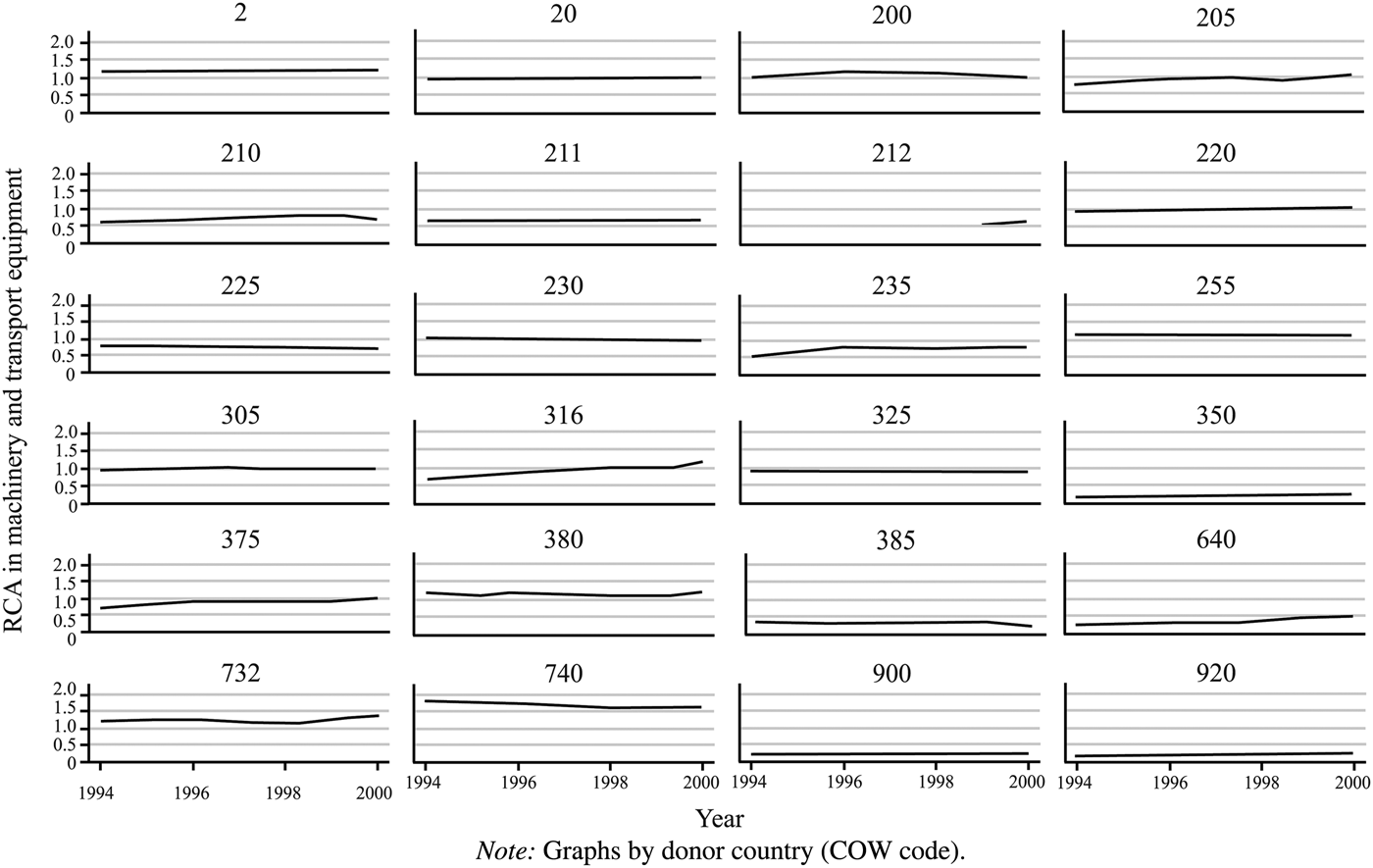
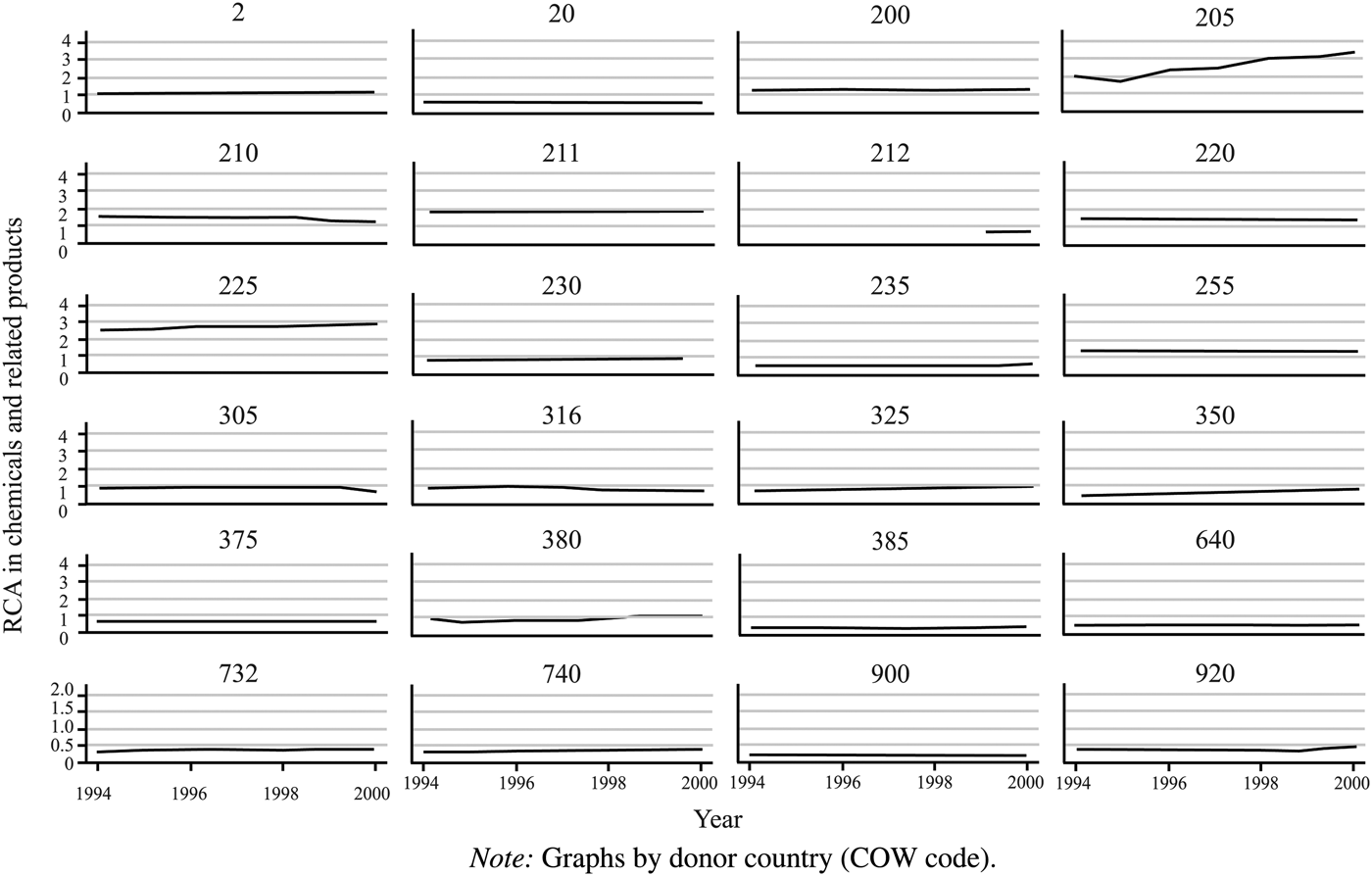
In addition to the RCA measures based on these general categories (m&te rca and c&rp rca), I create RCA measures for subcategories to be able to conduct robustness checks with more nuanced indicators of competitiveness. In the machinery and transport sector, two additional variables (gim&e rca and h&ce rca) capture donor exporters' competitiveness in the sectors that stand to benefit from the Multilateral Fund's contracts: RCA in general industrial machinery and equipment (GIM&E),Footnote 41 and RCA in heating and cooling equipment (H&CE).Footnote 42 Japan's exporters have the highest RCA index in the machinery and transport sector among OECD countries during the period under study: the index values range from 1.7 to 1.9. In the chemicals sector, I create a measure for the subcategory of organic chemicals (oc rca)Footnote 43 because the Montreal Protocol seeks to eliminate chlorofluorocarbons (CFCs), a subset of organic chemicals found to harm the ozone layer, and the implementation of the Protocol has led to the replacement of CFCs with hydrochlorofluorocarbons (HCFCs) and hydrofluorocarbons (HFCs), different subsets of organic chemicals. Producers of the organic compounds are expected to benefit from recipients' need to switch to new chemical products to comply with the terms of the Montreal Protocol. In my data set, Irish exporters have the highest RCA index in the organic chemicals subsector among donor countries during the period under study: the values of the index range from 5.2 to 11.5. Note that the RCA measures do not vary much over time: the within variance of these key explanatory variables is low in absolute terms, as well as relative to the between variance. Figures 1 and 2 plot changes in the main competitiveness measures over time by donor country.
RCA in machinery and related products

RCA in chemicals and related products

The GEF's aid goes to seven broad areas of environmental work, listed earlier. One area—the ozone sector—overlaps with the focus of the Multilateral Fund. In other areas, in particular the climate change sector, which accounts for approximately one-third of the GEF's budget, recipients usually use GEF financing to acquire new technology and equipment that reduces environmental pollution. Climate change projects, for instance, support recipients' efforts to cut greenhouse gas emissions by turning to renewable energy, increasing energy efficiency, and converting to sustainable transport—all of which require purchases in the SITC category of machinery and transport. Therefore, I use the RCA variable for this category (m&te rca), as well as the measures for two subcategories in the machinery and transport sector (gim&e rca and h&ce rca), to analyze aid allocations to the GEF.
Control Variables
In addition to the main explanatory variables (that is, the RCA measures), I include a set of regressors controlling for the factors discussed in the existing research on foreign aid as important determinants of donors' aid allocation decisions. One limitation of using these control variables is that most existing studies of multilateral aid deal with donor countries' decision to give aid multilaterally in aggregate terms; however, the determinants of aggregate multilateral flows identified in these studies may not apply to donors' allocations to individual organizations.Footnote 44
First, I include two trade variables: exports of goods and services (% of gdp), and imports of goods and services (% of gdp). These measures reflect the extent to which donors depend on trade with other countries.Footnote 45 Previous research suggests that, in general, higher levels of trade exchanges make countries more reluctant to rely on multilateral aid giving because bilateral aid is an instrument that can be used to influence trading partners with the goal of maintaining or increasing trade flows.Footnote 46 Therefore, donors' trade dependence is expected to have a negative association with aid allocations to IOs.
Second, I control for the level of economic development. I include gdp per capita (constant 2000 US dollars; log) as a measure of a donor's wealth. Existing studies indicate that more developed countries may be more willing to contribute to multilateral organizations.Footnote 47 Another economic measure is general government final consumption expenditure (% of gdp). Milner suggests that a donor government's spending levels should be positively associated with multilateral aid allocations.Footnote 48 Therefore, I include the government expenditure variable to control for the donor's general ability and willingness to tax and spend.Footnote 49
Third, previous research identifies two political factors as important influences on donor governments' decision making in their interactions with IOs. The first is democracy, represented by the Polity score, and its inclusion is based on the idea that more democratic countries may be more willing to honor their international commitments,Footnote 50 and hence more willing to allocate aid to multilateral organizations.Footnote 51 The second is affinity with system leader. This measure is based on a donor's s-score with the United States and captures the effect of donor countries' strategic relationship with the United States on their decision to give aid to the IOs, in which the United States is the largest donor and exercises substantial influence over policy-making.Footnote 52 Previous research suggests that donor countries allocate more aid to organizations that pursue policies in line with the donors' foreign policy preferences.Footnote 53 Given the ability of the system leader to exert informal control over policy-making within the two IOs, countries that share the leader's preferences should be more willing to contribute to these organizations.
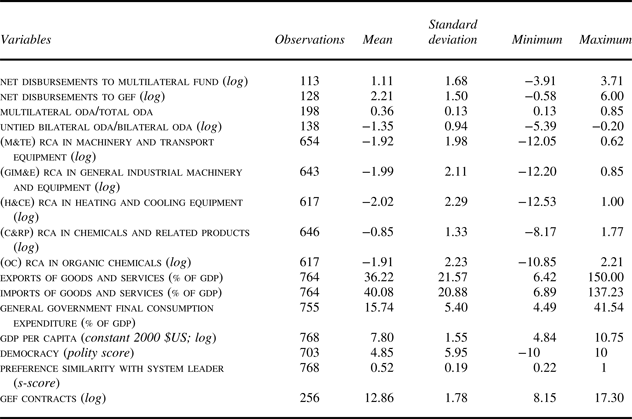
Finally, I include a linear time trend to control for any common shifts in multilateral aid giving over time.Footnote 54 Because changes in independent variables are likely to take some time to influence aid disbursements, all regressors, except the time variable, are lagged by one year. Table 1 provides summary statistics for the variables used in the empirical tests.
Summary statistics

Empirical Analysis and Discussion
Tables 2 to 4 report estimation results for individual IOs, whereas the models in Table 5 test aggregate level hypotheses. To account for heteroskedasticity in the error processes, I employ panel-corrected standard errors. I do not include a lagged dependent variable because there is no theoretical reason to do so.Footnote 55 Given that the theoretically important variables (that is, competitiveness measures) do not vary much over time, I estimate aid allocation models without donor fixed effects. In this case, the use of fixed effects would yield unnecessarily large standard errors, which makes inferences on their statistical significance difficult. Moreover, inefficiency in estimating the effect of the regressor with a low level of within-variance is likely to result in highly unreliable point estimates and, consequently, lead to wrong inferences, just as a biased estimator would.Footnote 56
Effect of competitiveness in machinery and transport category on aid allocations to Multilateral Fund

Notes: Linear regression with panel-corrected standard errors in parentheses. Dependent variable: Log of financial contributions to Multilateral Fund. *p < .10.
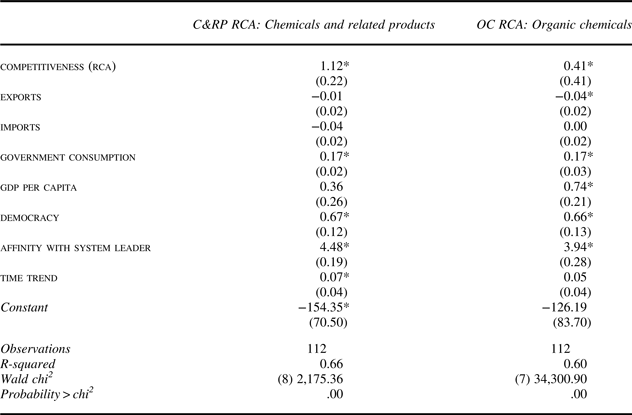
Effect of competitiveness in chemicals category on aid allocations to Multilateral Fund

Notes: Linear regression with panel-corrected standard errors in parentheses. Dependent variable: Log of financial contributions to Multilateral Fund. *p < .10.
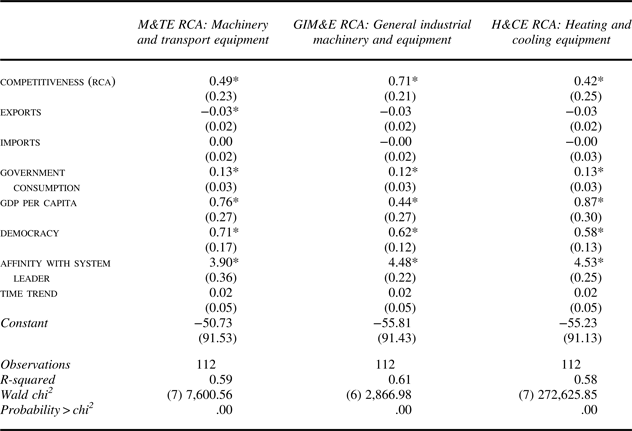
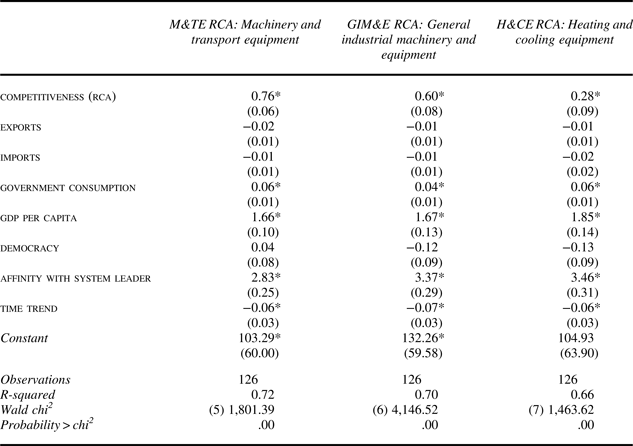
Effect of competitiveness in machinery and transport category on aid allocations to GEF

Notes: Linear regression with panel-corrected standard errors in parentheses. Dependent variable: Log of financial contributions to GEF. *p < .10.
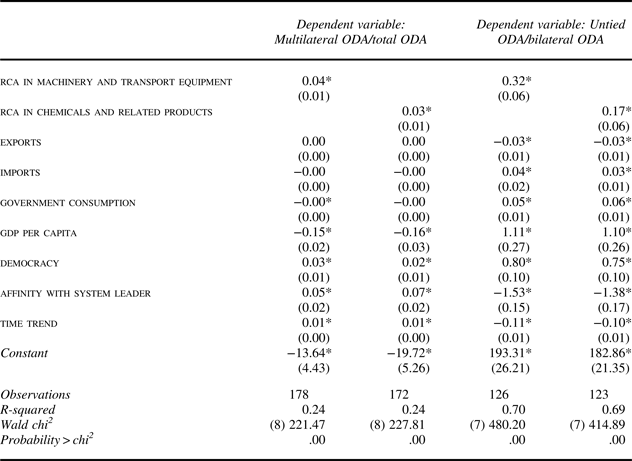
Effect of donor exporters' competitiveness on multilateral and untied aid allocations

Notes: Linear regression with panel-corrected standard errors in parentheses. *p < .10.
To summarize the main findings briefly, the estimates in each of the tables show consistent support for the hypothesized positive effect of exporters' competitiveness on their countries' aid flows to IOs. The RCA measures have a substantively and statistically significant positive effect on aid contributions to both environmental organizations—the Multilateral Fund and the GEF. Therefore, the results provide robust empirical evidence that exporters' competitiveness creates incentives for their governments to allocate more aid to international environmental organizations whose programs benefit internationally competitive economic groups in donor countries. I also find evidence of aggregate aid shifts in favor of multilateral allocations, as well as evidence of aid untying, associated with increasing levels of exporters' competitiveness.
In Table 2, I examine the effect of donor exporters' competitiveness in the machinery and transport equipment sector on donor governments' allocations to the Multilateral Fund. The RCA measures for the sector as a whole—as well as for the subsectors of general industrial machinery and equipment, and heating and cooling equipment—have a statistically significant positive effect on aid flows to the Multilateral Fund. When developing countries seek to replace equipment that does not comply with the requirements of the Montreal Protocol, and draw on the Multilateral Fund's resources, donor countries' exporters that are internationally competitive in this economic sector expect to win contracts financed by the Multilateral Fund. Interests of donor exporters benefiting from this financing increase their governments' willingness to continue and expand their support for the IO—in essence, exporters' interests provide donor governments with selective incentives to contribute to the provision of a public good, that is, the Multilateral Fund's programs that help to reduce the production and use of ozone-depleting substances.
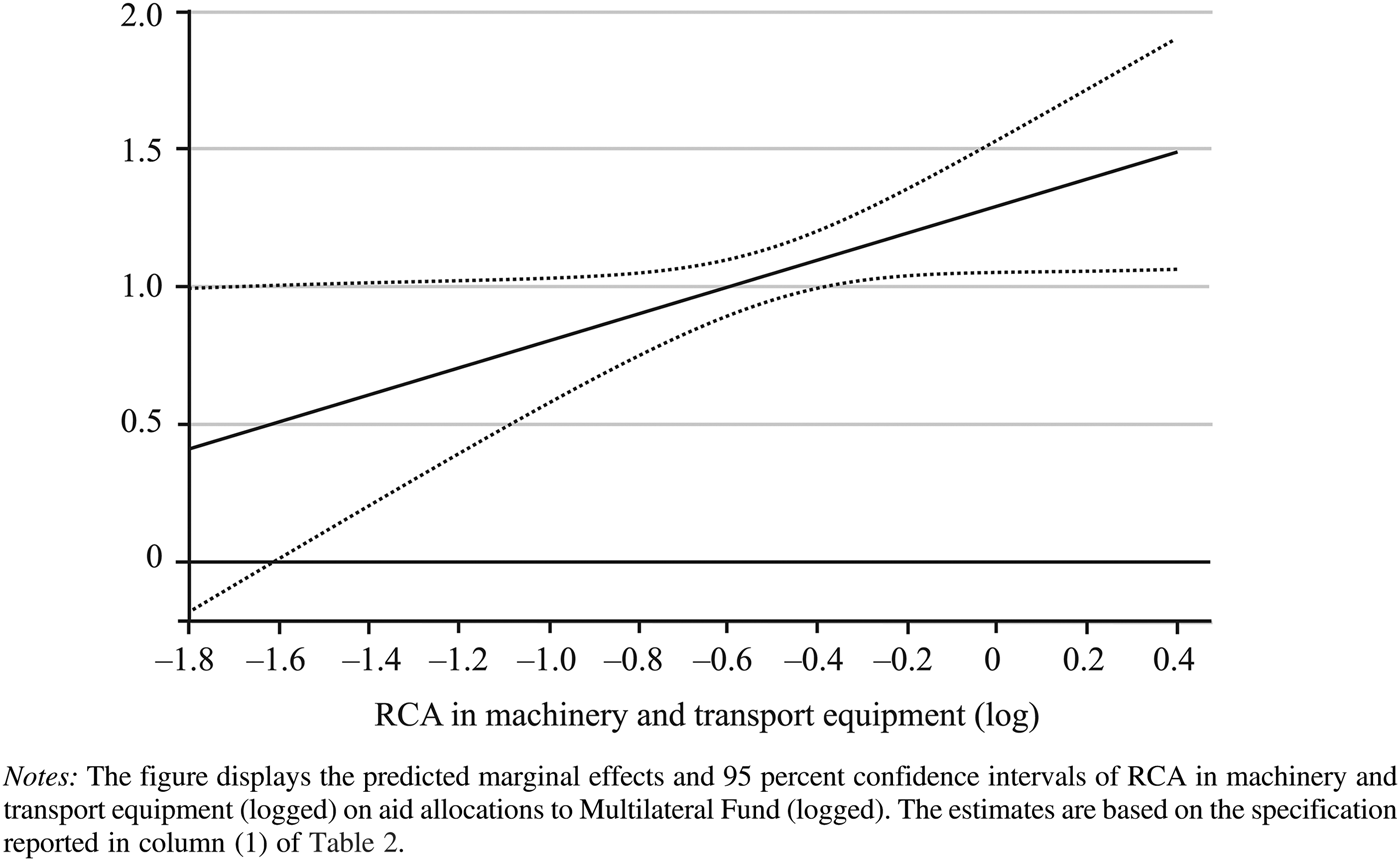
The substantive effect of changes in competitiveness is illustrated in Figure 3. The figure shows predicted multilateral aid allocations at varying levels of competitiveness in the machinery sector, when other regressors are fixed at their mean values. Note that the predicted values are calculated for the specification reported in the first column of Table 2. When donor exporters' competitiveness in the machinery and transport equipment sector increases from its mean by one standard deviation, the donor country's predicted aid allocation goes up by 26 percent.
Marginal effects of competitiveness in machinery and transport category on aid allocations to Multilateral Fund

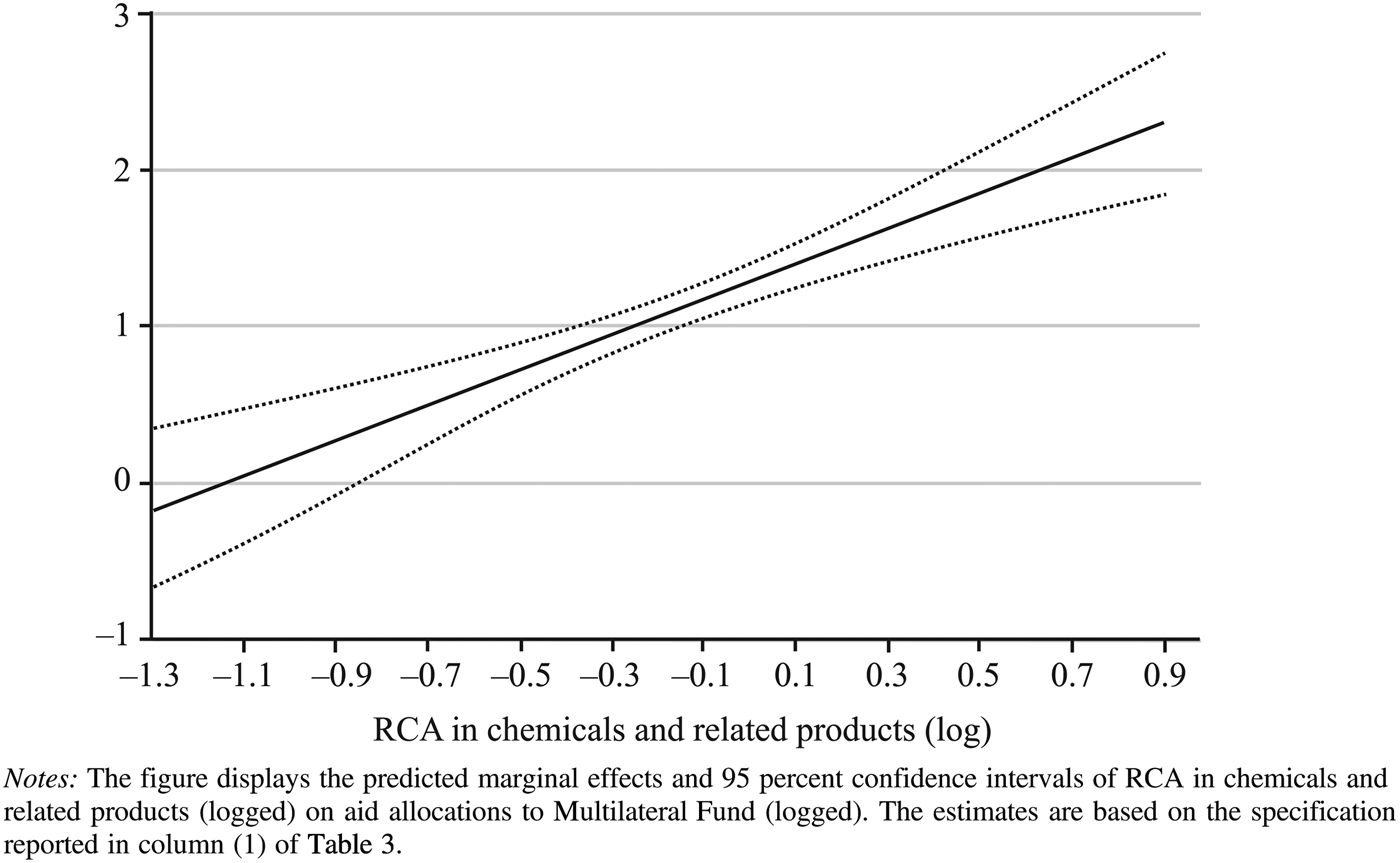
In Table 3, I report results testing the relationship between exporters' competitiveness in the chemicals sector on aid allocations to the Multilateral Fund. I find that RCA measures for the chemicals and related products sector and the organic chemicals subsector have a positive effect on aid allocations to the Multilateral Fund, and the findings are statistically significant at conventional levels. These results suggest that donors' domestic interest groups that are likely to receive contracts to replace ozone-depleting substances with other types of chemicals increase their governments' willingness to allocate aid to the Multilateral Fund, which finances ozone projects in the developing world. The effect is substantively nontrivial, as Figure 4 demonstrates. A standard deviation increase in competitiveness in the chemicals sector from the mean value results in a 58 percent increase in the predicted aid allocation to the Multilateral Fund, when all the other regressors are held at their mean values.
Marginal effects of competitiveness in chemical category on aid allocations to Multilateral Fund

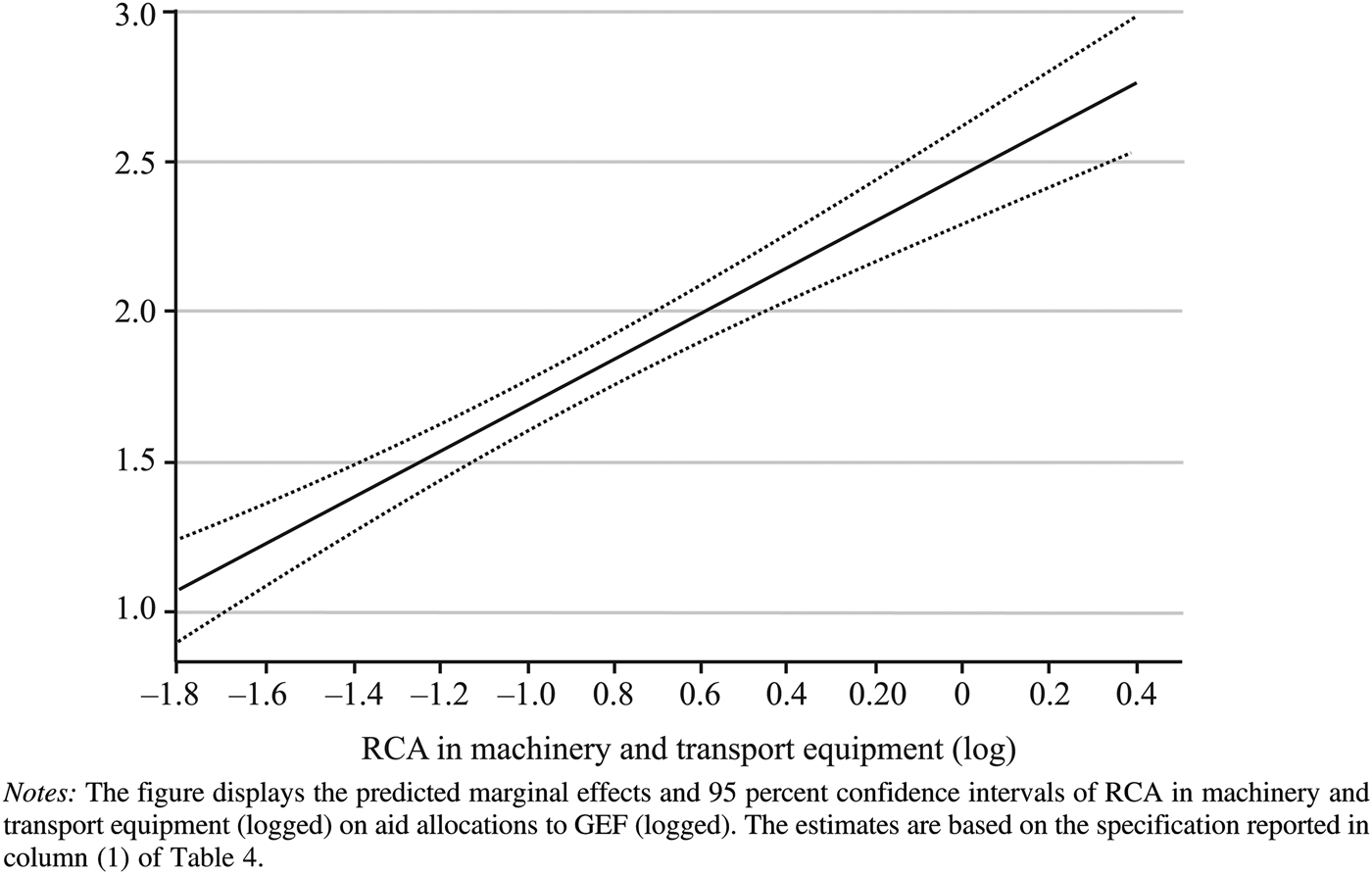
In Table 4, I turn to a different environmental organization—the GEF—and evaluate the effect of exporters' competitiveness in the machinery and transport equipment sector on aid allocations to this organization. The competitiveness measures for the sector in general, as well as for the subsectors of general industrial machinery and equipment, and heating and cooling equipment, are positively associated with aid flows to the GEF, and the results reach statistical significance at conventional levels. Note that ozone-depleting projects are not the GEF's major area of work—it receives just 2.1 percent of total GEF funding. However, the GEF disburses substantial amounts of aid for projects in other environmental areas that benefit exporters in the machinery and transport equipment sector. Climate change is one such area of the GEF's work, and from its inception through 2009, the GEF has given $2.7 billion in funding for climate change projects.Footnote 57 Figure 5 shows that the substantive impact of the RCA measure in this sector is significant: when the level of competitiveness rises by one standard deviation over the mean value of this variable, the resulting increase in the predicted aid allocation to the GEF is 21 percent, given that all the other independent variables are fixed at their means.
Marginal effects of competitiveness in machinery and transport category on aid allocations to Global Environment Facility (GEF)

Annual budget requests for international program funding that the US president's administration submits to Congress provide illustrations of politicians' awareness of distributive effects that multilateral aid programs have for American exporting sectors. The fiscal year 2013 request, for instance, emphasizes not just the global and domestic environmental benefits of aid allocations to environmental IOs—they assist recipient countries to “reduce their pollution, curbing the damage that they inflict on our shared spaces, such as the atmosphere and the oceans” and mitigate “threats to our domestic environment that increasingly originate beyond our borders”—but also benefits that domestic economic groups can realize through environmental IOs' programs, which provide “opportunities for US businesses, particularly in clean energy.”Footnote 58 One of the benefits that exporters receive from the existence of multilateral aid agencies and that policy-makers commonly refer to is the multiplier effect. The magnitude of this effect varies from one IO to another, but it exerts an important influence on decisions to allocate aid through multilateral channels: “The US contribution leverages significant funding from other donors, developing country governments, development institutions, and the private sector. Each US dollar contributed to the GEF [Clean Technology Fund], and [Strategic Climate Funds] leverages four to five additional dollars from other donors and six to ten times that from other funding sources.”Footnote 59 The multiplier effect increases funding available for environmental programs and business opportunities for highly competitive exporters in this sector.
The key mechanism that enables US exporters to access these resources is the procurement process that allocates contracts to the most competitive suppliers. A 2011 hearing before the Subcommittee on International Monetary Policy and Trade of the Committee on Financial Services of the US House of Representatives provides a telling illustration of companies' lobbying efforts in favor of multilateral aid giving—and their emphasis on the importance of IOs' rules and procedures in enabling the most competitive companies to win contracts. This hearing focused on reviewing the Obama administration's request for funding for multilateral organizations, including multilateral development banks, and sought to establish what impact a reduction in funding for the IOs might have on US economic interests. Representatives of American companies attended the hearing as witnesses and expressed their support for multilateral development aid: “The direct benefits to US firms are quite significant. Over the last decade, from just one of the MDBs [Multilateral Development Banks], the World Bank, directly sourced contract awards, total about $1.6 billion … In terms of the procurement, I think if you look at the MDBs, there is a very clear, profound benefit in the fact that their procurement standards are world-class—transparent, open to all [companies] that are from countries of their MDB members, and very fair … there were a number of markets where we would not even try to go after the contracts at all because it was so nontransparent, unless they were an MDB contract.”Footnote 60 Therefore, exporters recognize that transparent, open procurement procedures serve as the mechanism that enables the exporters to realize business opportunities generated by multilateral aid, which is consistent with my theoretical argument.
Competitive exporters' interests do not only result in a growing volume of aid channeled through their preferred IOs but they also produce an overall redistribution of donors' aid flows in favor of multilateral channels and a reduction in the practice of aid tying, as the results reported in Table 5 suggest. Exporters' competitiveness, regardless of the sector, has a positive and statistically significant effect on the share of donors' total ODA disbursed through multilateral organizations, and reduces the proportion of bilateral ODA tied to purchases from donor countries' companies. These findings are also substantively significant: for instance, a standard deviation increase in the chemicals competitiveness measure results in the predicted multilateral aid share of 38.2 percent, compared with 36.2 percent when the RCA variable is fixed at its mean, and 41.1 percent at the maximum level of competitiveness. Similarly, in the case of untied aid, when all other regressors are held at their means, the predicted value of untied aid increases by 6.7 percent as a result of a standard deviation increase in the chemicals competitiveness variable from its mean, and by 20.4 percent when the RCA variable takes its highest value. These results, in sum, lend support to H2 and H3 that link donor exporters' competitiveness with general shifts in donors' aid-giving patterns.
The empirical analyses reported in Tables 2 to 5 generate interesting findings for other independent variables as well. Consistent with the expectation of a negative relationship between the donor country's trade dependence and multilateral aid allocations, as existing studies of multilateral aid demonstrate, I find some empirical evidence of a statistically significant relationship between one trade variable (exports) and aid flows to the Multilateral Fund and the GEF. However, the result is not particularly robust: the coefficient on exports is negative and statistically significant in two out of eight specifications in Tables 2 to 4, and is not significant in the models of multilateral aid giving in Table 5. Import flows, on the other hand, do not have a statistically significant effect on allocations to individual IOs or multilateral aid giving in general.
The results also show that, as expected, allocations to the Multilateral Fund and the GEF increase as donor governments' spending levels increase, as their per capita income grows, and as their foreign policy preferences become more closely aligned with those of the United States—the IOs' largest donor, whose formal power and informal influence are likely to shape policy-making within both of these environmental IOs. Finally, democratic donors are willing to contribute more aid to the Multilateral Fund but do not show a similar pattern with their GEF allocations. This difference in democracies' allocation patterns may be attributed to the politics of the IOs' replenishment processes. The Multilateral Fund calculates developed countries' contributions based on the UN scale of assessment. Given such clear contribution expectations, democratic countries choose to respect their international obligations, as previous research suggests. In the case of the GEF, on the other hand, funds are replenished through negotiation sessions, where participants discuss and come to an agreement over the IO's policies and funding issues. Hence, no clear up-front funding targets are set for all donor countries, which may leave room for negotiated changes in aid allocations and thus reduce the pressure on democratic donors to act consistently with their international environmental commitments.
The positive effect of democracy on multilateral aid giving holds at the aggregate level as well: Table 5 shows that democratic countries allocate more of their aid through multilateral channels. Democracies are also more willing to disburse their bilateral aid without formal tying requirements, as are donors with higher levels of government spending and per capita income. Yet GDP per capita and government spending have a negative and significant effect on multilateral aid giving, contrary to the expectation of a positive relationship between these two explanatory variables and donors' willingness to shift aid distribution to multilateral channels. The affinity variable produces interesting results that highlight the influence of the world's largest economic power and one of the top donors in many IOs on other donors' decision making: donors that share US foreign policy preferences disburse more of their aid through IOs, but give less untied aid. The former result implies that donors expect US preferences to shape multilateral aid policies and allocate more to IOs when donors share these preferences. The latter finding reflects the fact that the United States lags behind a number of other donors in aid untying: in 2007, for instance, the United States reported 60.7 percent of its bilateral aid as fully untied, whereas for the median donor, the share of untied aid was 61.9 percent. Hence, greater affinity with the United States is associated with the adoption of similar foreign aid policies.
Robustness Checks
To evaluate the robustness of my empirical results, I conducted a number of additional tests. The main results remained largely unaffected in these analyses. First, I used different techniques for modeling time effects: I replaced the linear year trend with cubic polynomial approximation, natural cubic splines, lagged dependent variables, and biannual time dummies. I then estimated three sets of models, in which I included measures controlling for donor influence in the GEF and Multilateral Fund. The first measure was a donor's share of each IO's total contributions; the second was the US dummy; and finally, three dummy variables were used to control for the influence of the largest donors in each of the IOs. Third, I reran the analyses using commitment data, instead of disbursement data. Another modification was to use averaged data within each of the IO's replenishment cycles (the GEF has four-year replenishment cycles, while replenishments of the Multilateral Fund take place once every three years). Next I included tied aid as a control variable in all eight models. Finally, I collected aid allocation data for a different IO—the World Food Programme (WFP)—and replicated all the analyses with the original competitiveness measures, as well as with new competitiveness measures based on food and agricultural sectors. The new competitiveness variables, as expected, had a positive and significant effect on allocations to the WFP. Exporters' competitiveness in the machinery and chemicals sectors, on the other hand, was negatively associated with aid flows to the WFP at conventional levels of statistical significance, indicating a strong redistributive effect within donors' multilateral aid budgets resulting from domestic economic interests. These robustness checks are not reported here because of space constraints, but I provide them in the online appendix.
IO Contract Allocation
Although a comprehensive analysis of contract allocation by IOs is beyond the scope of this study, it is important to examine whether competitive exporters indeed benefit from programs funded by environmental IOs. Such benefits constitute a critical part of the causal mechanism underpinning my theoretical argument. Therefore, I check to see whether the IOs' procurement results reflect expectations of fair competition, that is, whether they benefit internationally competitive companies.
Anecdotal evidence indicates that environmental programs financed by the GEF and Multilateral Fund indeed provide donor exporters with business opportunities when the exporters are in a position to win contracts generated by these programs. Activities of the Multilateral Fund, for instance, have benefitted US exporters that specialize in ozone-friendly technology: “Since 1991, when the Fund was created, Fund projects have provided excellent opportunities for US industries to export technologies and for US technical experts to provide consulting services. The United States is a leader in ozone protection technologies and has captured a significant portion of the sales/technology transfer opportunities created by Multilateral Fund projects.”Footnote 61 Available contract data for the Multilateral Fund illustrate the magnitude of these business opportunities for US companies: US exporters received 26 percent of the total number of contracts, which amounted to 13.2 percent of contract financing, when the sample is restricted to donor countries. Even when the sample is expanded to include all countries eligible for competitive bidding,Footnote 62 US exporters' benefits remain substantial: 7.7 percent of awarded contracts, and 5.6 percent of total contract financing.
Turning to the empirical analysis of contract allocation, the main question is: Does a country's competitiveness in areas relevant to environmental programs have a positive association with contracts awarded to this country by environmental IOs? Although systematic and comprehensive contract award data for the Multilateral Fund and GEF are unfortunately unavailable, the World Bank's Contract Awards DatabaseFootnote 63 provides some contract information for these two environmental IOs. The World Bank is the largest implementing agency for both the Multilateral Fund and GEF; however, data coverage is better for the GEF. The number of country-year observations equals 414 in the case of the GEF (seventy-one when restricted to donor countries and the period of my main data set), whereas the number of observations is just sixty-five for the Multilateral Fund (nineteen when restricted to donor countries and the period of my main data set). Therefore, I report results for only one organization—the GEF.
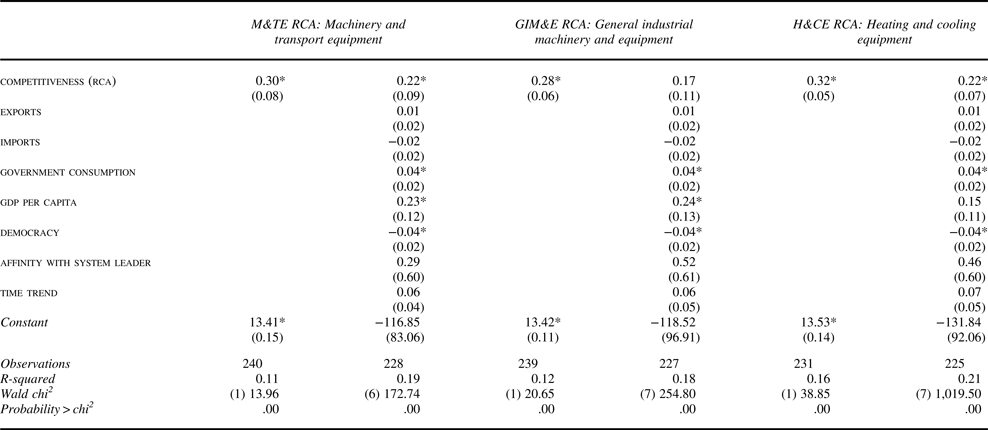
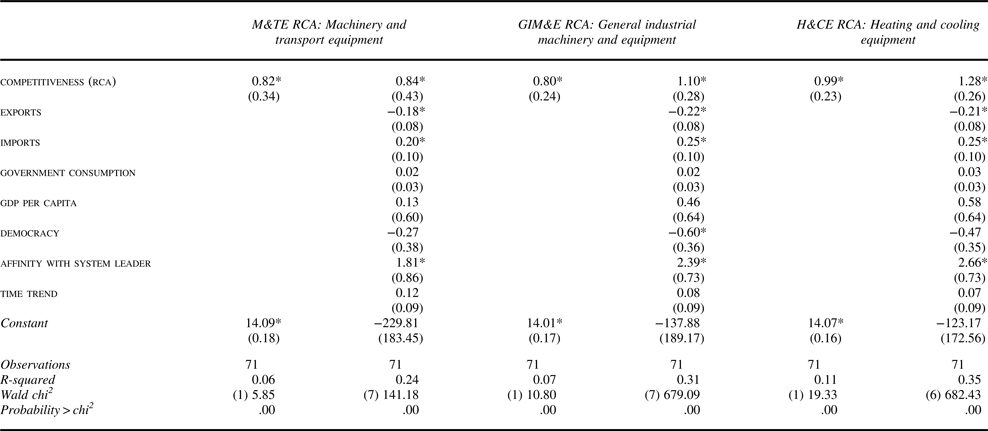
Tables 6 and 7 report results of empirical analyses testing whether a positive relationship exists between RCA measures for the machinery and transport sector (m&te rca), as well as two subsectors (gim&e rca and h&ce rca), and the total amount of contracts awarded to companies from a given country (measured in US dollars and logged). Findings presented in Table 6 are based on the full sample of countries that received GEF contracts, regardless of their donor status, whereas Table 7 restricts the sample to donor countries. The results reported in columns (1), (3), and (5) of both tables are derived from bivariate regressions with panel-corrected standard errors; columns (2), (4), and (6) include additional regressors—control variables previously used in the aid allocation models (Tables 2 to 4). The inclusion of the controls has minimal effect on the main findings: in all but one specification, there is a statistically significant, positive relationship between exporters' competitiveness and contract awards. The evidence of a robust positive relationship is consistent with my argument: IOs' programs do in fact create greater business opportunities for donor exporters that are internationally competitive in relevant sectors.
Effect of competitiveness in machinery and transport category on GEF contract awards (full sample)

Notes: Linear regression with panel-corrected standard errors in parentheses. Dependent variable: Log of GEF contract awards. *p < .10.
Effect of competitiveness in machinery and transport category on GEF contract awards (donor sample)

Notes: Linear regression with panel-corrected standard errors in parentheses. Dependent variable: Log of GEF contract awards. *p < .10.
Conclusion
This article has developed a theoretical framework for analyzing the influence of domestic economic interests in donor countries on these countries' multilateral aid giving. I have argued that internationally competitive exporters in donor countries benefit from multilateral aid programs that generate contracts in the sector of the exporters' comparative advantage. In this case, the exporters have an interest in higher levels of donor contributions to the international organizations. As a result, the benefits that domestic economic groups receive from aid programs serve as an incentive for donor governments to provide more support for these international organizations. The empirical analyses based on aid data for two environmental organizations (the Multilateral Fund and the GEF), as well as data on aggregate-level aid allocations, and exporters' competitiveness in two relevant sectors (the machinery and chemicals sectors) provide robust support for my argument. Internationally competitive exporters positively influence their governments' aid-allocation decisions both for individual multilateral agencies and multilateral aid giving more generally.
Although the empirical tests in this study focus on aid allocations to environmental organizations, my theoretical argument applies to other international organizations as well. In particular, the argument extends to all aid agencies that disburse project funding that is subsequently spent by recipients on purchases of goods and/or services. On the other hand, multilateral organizations that provide financing to address balance of payments problems, as in the case of the IMF or the Arab Monetary Fund, do not generate contract opportunities; therefore, donor exporters will have no interest in influencing their governments' support for these international agencies. These organizations nevertheless benefit other domestic constituencies in donor countries, namely the financial sector.Footnote 64
Another important part of the argument that defines the scope of its applicability is IOs' use of transparent and fair bidding procedures for the procurement of goods and services. Although an overwhelming majority of global and regional aid organizations rely on ICB to structure their procurement procedures, organizations vary in their levels of transparency, which usually affects all aspects of their work, including procurement. A recent study by the UK Department for International Development highlights significant differences in transparency between aid organizations: the report concludes that “like other UN institutions UN-HABITAT is weak on transparency,”Footnote 65 whereas branches of the World Bank Group receive much more positive evaluations, illustrated by the strong review of the International Finance Corporation's performance in this area: “Financial management, independent audit and transparency are very strong.”Footnote 66 Given that transparency in procurement procedures is critical for companies' ability to identify and take advantage of contract opportunities, more transparent agencies are likely to receive more support from domestic economic groups in donor countries and, as a result, more funding.
The emphasis on the role that domestic political economy plays in aid allocation is a key contribution of this study to our understanding of donors' motivations to give aid multilaterally. Domestic economic groups do not lose their influence when aid is allocated through multilateral channels: in fact, donor governments may have a significant interest in strengthening these multilateral channels in part because they generate benefits for donors' exporters. Recent international relations studies demonstrate donor governments' ability to adjust their aid allocations to different IOs. This ability helps donors to provide more support to IOs that share the donor governments' allocation preferences—and to IOs that generate more substantial benefits to domestic economic groups. Therefore, the results presented in this study suggest that multilateral aid giving is not only shaped by donor governments' foreign policy goals. Donor governments consider distributive effects of their aid-allocation decisions on domestic interest groups, and hence domestic considerations are an important determinant of multilateral aid flows.
This has important implications for foreign aid efficiency and effectiveness. Existing aid studies suggest that donors' pursuit of their commercial interests has a negative impact on both of these dimensions when aid is disbursed bilaterally.Footnote 67 Efficiency decreases because of distortions in the allocation and use of scarce aid resources. As a consequence, the aid's value for recipient countries declines when donors aim to promote their exports through aid disbursements. Similarly, aid becomes less effective in reaching its development objectives when donors utilize it to achieve other goals, such as geopolitical or economic interests: when donors' interests are at stake, donors cannot credibly threaten to withdraw aid if recipients fail to implement reforms necessary for economic development and growth. Multilateral aid, on the other hand, is more efficient and effective in promoting development.Footnote 68 Therefore, the extant research on aid effectiveness concludes that donors must choose between the pursuit of their interests and development goals. In fact, aid can serve as a two-pronged policy instrument addressing domestic and international objectives: by disbursing more aid through multilateral channels that are favored by donors' competitive exporters, donor governments can avoid making their foreign aid more inefficient and less effective while supporting the interests of domestic economic groups.
Supplementary material
Supplementary material for this article is available at http://dx.doi.org/10.1017/S0020818314000289