Introduction
Considerable evidence suggests that offspring of depressed mothers show higher depression rates than offspring of never-depressed women, and that this vulnerability also extends to other psychiatric disorders (Hammen et al. Reference Hammen, Burge, Burney and Adrian1990, Reference Hammen, Brennan and Keenan-Miller2008; Lieb et al. Reference Lieb, Isensee, Hofler, Pfister and Wittchen2002; Klein et al. Reference Klein, Lewinsohn, Rohde, Seeley and Olino2005; Weissman et al. Reference Weissman, Wickramaratne, Nomura, Warner, Pilowsky and Verdeli2006; Halligan et al. Reference Halligan, Murray, Martins and Cooper2007; for a review, see Goodman et al. Reference Goodman, Rouse, Connell, Broth, Hall and Heyward2011). Similarly, although much research has exclusively focused on effects of depression, several studies indicate that other maternal disorders, including anxiety disorders, also confer risk for a broad range of psychiatric outcomes among offspring (Weissman et al. Reference Weissman, Leckman, Merikangas, Gammon and Prusoff1984; Last et al. Reference Last, Hersen, Kazdin, Francis and Grubb1987; Turner et al. Reference Turner, Beidel and Costello1987; McClure et al. Reference McClure, Brennan, Hammen and Le Brocque2001). However, the great majority of these studies have not accounted for co-morbidity, potentially misrepresenting associations between parental disorders and youth outcomes and leaving it unclear whether familial vulnerability can be more accurately understood as transmission of a non-specific liability to internalizing problems from parents to offspring.
The present study seeks to improve existing models of intergenerational transmission of internalizing disorders by accounting for co-morbidity among individual disorders in both mothers and offspring, specifically by incorporating recent advances in the understanding of the latent structure of psychopathology. Recent research has supported a hierarchical-spectrum model of mental disorders (HSM; Krueger et al. Reference Krueger, Caspi, Moffitt and Silva1998; Krueger & Markon, Reference Krueger and Markon2006), which assumes that internalizing disorders are manifestations of a transdiagnostic, continuously distributed internalizing spectrum representing a common vulnerability trait for depressive and anxiety disorders. Several studies applying the HSM framework have suggested the existence of a general internalizing factor (and a separate externalizing factor) accounting for the shared variance of individual disorders, converging with numerous studies finding evidence for a shared substrate to anxiety and depressive disorders varyingly labeled neuroticism, general distress and negative affect/affectivity (e.g. Watson et al. Reference Watson, Clark, Weber, Assenheimer, Strauss and McCormick1995; Brown & Barlow, Reference Brown, Barlow and Barlow2002; Griffith et al. Reference Griffith, Zinbarg, Craske, Mineka, Rose, Waters and Sutton2010). The HSM framework has been supported in adult (Krueger, Reference Krueger1999; Vollebergh et al. Reference Vollebergh, Iedema, Bijl, de Graaf, Smit and Ormel2001; Krueger & Markon, Reference Krueger and Markon2006; Eaton et al. Reference Eaton, Kann, Kinchen, Shanklin, Flint, Hawkins, Harris, Lowry, McManus, Chyen, Whittle, Lim and Wechsler2012) and adolescent samples (Fergusson et al. Reference Fergusson, Horwood and Boden2006; Walton et al. Reference Walton, Ormel and Krueger2011), and offers the ability to discriminate between the common (or transdiagnostic) and unique features of disorders. In turn, HSM-informed methods can differentiate between an external construct's associations with these shared and specific elements. As such, applications of HSM have begun to yield insights into how key psychopathological processes map onto unique components of individual disorders versus shared pathology (South et al. Reference South, Krueger and Iacono2011; Conway et al. Reference Conway, Hammen and Brennan2012).
The HSM method may prove useful in modeling the intergenerational transmission of internalizing disorders. First, it can address whether a transdiagnostic internalizing trait, representing vulnerability to all internalizing disorders, is transmitted from mothers to offspring. Second, it can pinpoint the degree to which diagnosis-specific pathology (represented by residual variances associated with each individual disorder) is also transmitted across generations. Thus, HSM can distinguish between general versus specific modes of intergenerational transmission.
To our knowledge, only two studies to date have used latent variable modeling techniques to disentangle the general and specific pathways of intergenerational transmission of psychopathology. Using data from the National Comorbidity Survey, Kendler et al. (Reference Kendler, Davis and Kessler1997) modeled internalizing and externalizing diagnoses as indicators of distinct latent factors among probands and their parents, and examined associations between parent and proband latent factors. Parental internalizing and externalizing factors each affected offspring standing on both internalizing and externalizing dimensions. Although this study did not directly model residual covariation, specificity of transmission was tested by controlling for the presence of all other disorders when computing associations between particular parent and offspring diagnoses. For major depressive disorder (MDD), generalized anxiety disorder (GAD) and alcohol use disorders, substantial intergenerational transmission effects remained, suggesting that some unique risk for these disorders is intergenerationally transmitted, independent of the transmission of general vulnerability. However, this study had two major limitations: first, parental psychopathology was assessed via offspring report, a clear potential source of bias (Milne et al. Reference Milne, Caspi, Crump, Poulton, Rutter, Sears and Moffitt2009). Second, only two internalizing disorders (GAD and MDD) were included, limiting the scope of the latent factor. Hicks et al. (Reference Hicks, Krueger, Iacono, McGue and Patrick2004) used the HSM framework to investigate heritability and familial transmission of a latent externalizing trait in the Minnesota Twin Family Study. Results indicated that parent standing on the externalizing factor was significantly related to offspring externalizing levels. Unlike the findings of Kendler et al. (Reference Kendler, Davis and Kessler1997), no significant residual correlations between parent and child diagnoses were detected after controlling for the general transmission effect, indicating an absence of disorder-specific transmission among externalizing disorders.
The present study approaches the generality versus specificity question with respect to internalizing disorders. Although ample evidence demonstrates that offspring of depressed and anxious mothers are vulnerable to a variety of disorders, no study has used the HSM framework to examine transgenerational effects of a broad range of internalizing disorders, directly assessed from mothers and offspring. The current study does so, modeling intergenerational transmission in a longitudinal, community sample of mothers and their adolescent offspring. Maternal psychopathology was assessed over the first 15 years of the youth's lifetime (as evidence suggests that maternal depression during this developmental period exerts stronger effects; Hammen et al. Reference Hammen, Brennan and Keenan-Miller2008), and offspring psychopathology was assessed up to the age of 20 years. This allowed for greater representation of disorders that increase in prevalence during later adolescence (Lewinsohn et al. Reference Lewinsohn, Rohde and Seely1998; Merikangas et al. Reference Merikangas, He, Burstein, Swanson, Avenevoli, Cui, Benjet, Georgiades and Swendsen2010). The staggered timing of the maternal and offspring diagnoses is justifable as the impact of maternal depression often persists after the depressive episode remits (Billings & Moos, Reference Billings and Moos1985; Cox et al. Reference Cox, Puckering, Pound and Mills1987). Although HSM research has often examined externalizing as well as internalizing spectra (Krueger et al. Reference Krueger, Caspi, Moffitt and Silva1998; South et al. Reference South, Krueger and Iacono2011), the present study only tested depressive and anxiety disorders due to infrequent externalizing diagnoses among mothers. Although prior studies are limited, based on existing evidence we anticipated that the pathway between the maternal and offspring broad internalizing factors would account for a substantial proportion of the intergenerational transmission of internalizing disorders. We also tested pathways between the residual variance for individual maternal disorders and corresponding offspring disorders (e.g. maternal MDD predicting offspring MDD) but made no a priori hypotheses regarding these diagnosis-specific associations.
Previous research has exclusively utilized unidimensional models to examine intergenerational transmission of psychopathology (Kendler et al. Reference Kendler, Davis and Kessler1997; Hicks et al. Reference Hicks, Krueger, Iacono, McGue and Patrick2004), but recent research suggests that more complex models may better describe the latent structure of internalizing disorders (Krueger, Reference Krueger1999; Watson, Reference Watson2005; Krueger & Markon, Reference Krueger and Markon2006; Simms et al. Reference Simms, Grös, Watson and O'Hara2008, Reference Simms, Prisciandaro, Krueger and Goldberg2012). These include two-factor models, in which internalizing disorders bifurcate into fear versus distress factors (Krueger, Reference Krueger1999) or anxiety versus depression factors [i.e. the model implicitly endorsed by the Diagnostic and Statistical Manual, 4th edition (DSM-IV); APA, 1994], as well as hierarchical (including a superordinate internalizing factor and additional lower-order factors) and bifactor (with all disorders loading onto both an internalizing factor and a lower-order factor) models (Simms et al. Reference Simms, Grös, Watson and O'Hara2008, Reference Simms, Prisciandaro, Krueger and Goldberg2012; Prenoveau et al. Reference Prenoveau, Zinbarg, Craske, Mineka, Griffith and Epstein2010). As a preliminary step, the current study tested alternative factor structures to determine which models are best suited to examine intergenerational transmission of internalizing disorders in this sample.
Method
Participants
A total of 815 Australian mother–offspring pairs participated as part of a large, longitudinal project. Participants were selected from a large birth cohort study conducted at the Mater Misericordiae Mothers’ Hospital in Brisbane, Queensland, Australia (n = 7775; Keeping et al. Reference Keeping, Najman, Morrison, Western, Anderson and Williams1989), which tracked mothers and children born between 1981 and 1984. Mothers provided data, including self-reported depressive symptoms [assessed using the Delusions-Symptoms-States Inventory (DSSI); Bedford & Foulds, Reference Bedford and Foulds1978], during pregnancy, postpartum, and at the child ages of 6 months and 5 years. A subset of the initial sample was targeted for participation in a follow-up 15 years after birth, selected on the basis of maternal DSSI scores over the four data points, with mothers with elevated depression scores selectively oversampled. (The DSSI was used only for sample selection purposes. Maternal depression as reported in the current analyses reflects clinical interview data.) A total of 991 families were identified for participation in the age 15 years follow-up and 815 provided data. Mean maternal age was 40.4 years. Hammen & Brennan (2001) provide further detail on sample recruitment and characteristics. At the offspring age of 20 years, families were invited to participate in an additional follow-up, and 705 participated (363 offspring were female, 342 were male). Non-participating families could not be contacted (n = 58), declined to participate (n = 52), or were deceased (n = 2). Youth depression history did not predict attrition, but non-participating families reported lower income (t 783 = –2.11, p = 0.04) and offspring were more likely to be male (χ 2 1 = 8.63, p = 0.003). Mothers participating at the offspring age of 20 years were marginally more likely to have a depression history (χ 2 1 = 3.56, p = 0.06).
Procedure
Pregnant women were recruited into the Mater Misericordiae Mothers’ Hospital–University of Queensland Study of Pregnancy (MUSP) during their first prenatal visit and continued to provide questionnaire data until the child reached the age of 5 years. For further details about MUSP procedures, see Keeping et al. (Reference Keeping, Najman, Morrison, Western, Anderson and Williams1989). At both the age 15 and 20 years follow-ups, after providing consent/assent, mothers and offspring were individually interviewed in private locations by separate interviewers blind to maternal psychiatric history. Interviewers were advanced graduate students in clinical psychology, supervised by a licensed clinical psychologist, and were highly trained in administration of diagnostic interviews and required to meet high reliability standards. The institutional review boards of UCLA (University of California, Los Angeles), Emory University and University of Queensland approved this research.
Measures
Maternal psychiatric diagnoses were assessed using the Structured Clinical Interview for DSM-IV (SCID; Spitzer et al. Reference Spitzer, Williams, Gibbon and First1995), a widely used semi-structured interview designed to generate clinical diagnoses. For the current analyses, maternal diagnoses were assessed at the offspring age of 15 years and reflect lifetime psychopathology until that point. Inter-rater reliability was very good (κ's based on ratings of independent judges ranged between 0.87 for current and 0.84 for past depressive disorders, and between 0.82 and 0.85 for current and past anxiety disorders). Relevant to the current study, mothers were assessed for the following categorically defined mood and anxiety disorders: MDD, dysthymia (DYS), social phobia (SOC), obsessive–compulsive disorder (OCD), GAD, specific phobia (SPEC), post-traumatic stress disorder (PTSD), panic disorder and agoraphobia [panic disorder and agoraphobia were subsequently aggregated into a single disorder category (PAN)].
At the age of 15 years, youth were assessed using the Schedule for Affective Disorders and Schizophrenia – Child-Revised (Epidemiological Version) for the DSM-IV (K-SADS-E; Kaufman et al. Reference Kaufman, Birmaher, Brent and Rao1997), a widely used semi-structured interview designed for use with children and adolescents. Offspring were assessed for lifetime psychopathology up to that point. Following standard procedures, the K-SADS-E was administered to both mother and child, with final diagnostic decisions made by a clinical team using all available information. Inter-rater reliability based on independent ratings was good (κ's for current and past depressive disorder were 0.82 and 0.73 respectively; for anxiety disorders, κ = 0.79 for both current and past). At the age of 20 years, offspring disorders occurring between the ages of 15 and 20 years were assessed using the SCID, with excellent inter-rater reliability (for current and past depressive disorders, κ ranged from 0.83 to 0.89; for current/past anxiety disorders, κ ranged from 0.89 to 0.94). At both data points, offspring and mothers were assessed for the same mood and anxiety disorder diagnoses. For the current analyses, offspring current and past diagnoses assessed at the ages of 15 and 20 years were aggregated to reflect categorical cumulative lifetime diagnoses through to the age of 20 years.
Data analytic plan
All analyses used structural equation modeling. Observed internalizing diagnoses were treated as indicators of a latent internalizing dimension for both mothers and offspring. Only diagnoses with frequencies above 5% of the sample were included as indicators to avoid model convergence problems and ensure acceptable reliability of diagnosis-specific variance terms. For mothers, diagnoses meeting that threshold were MDD, DYS, PAN, SOC, SPEC and PTSD, with GAD (n = 26, 3%) and OCD (n = 8, 1%) excluded. For offspring, MDD, DYS, SOC, SPEC, PTSD and GAD defined the corresponding offspring internalizing factor, with PAN (n = 24, 3%) and OCD (n = 21, 3%) excluded. Model fit was evaluated on the basis of the likelihood ratio χ 2 test, the comparative fit index (CFI; Bentler, Reference Bentler1990), the root-mean-square error of approximation (RMSEA; Browne & Cudeck, Reference Browne, Cudeck, Bollen and Long1993) and the weighted root-mean-square residual.
As a preliminary step, we compared several different factor structures for the internalizing spectrum; comparative model fit was assessed using the Bayesian information criterion (BIC), CFI and RMSEA. Next, we regressed the offspring internalizing factor(s) on the maternal internalizing factor(s) to examine intergenerational transmission of non-specific internalizing pathology. Finally, we estimated the correlations between the residuals of maternal diagnoses and corresponding residuals of offspring diagnoses (no residual correlations were estimated for PAN and GAD because they were excluded from the offspring and maternal spectra, respectively, for low frequency). As an additional test, we compared model fit using BIC indices for models including versus excluding each residual pathway. We did not test cross-disorder associations to prevent an excessive number of tests.
Analyses were conducted in Mplus using the WLSMV estimator (Muthén & Muthén, 1998–2011); ML estimation was used to generate BIC reports. Mplus employs full information maximum likelihood procedures for missing data (there were no missing data except for 110 families lost to attrition at the age of 20 years).
Results
Descriptive statistics
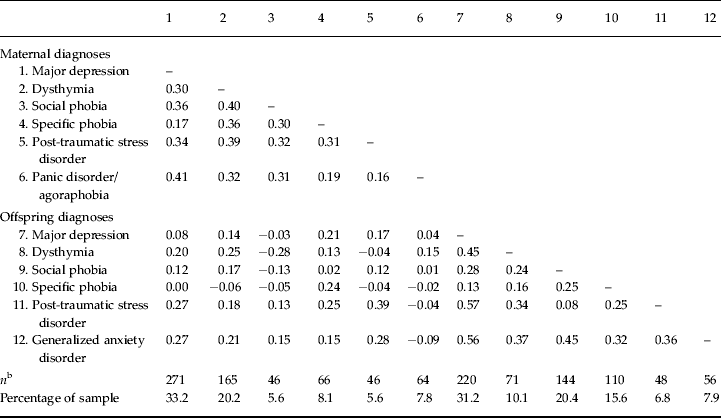
Frequencies of maternal and offspring diagnoses, and tetrachoric correlations among them, are presented in Table 1. All maternal diagnoses were significantly correlated with multiple offspring diagnoses. Notably, maternal diagnoses did not always exhibit the highest correlations with corresponding offspring diagnoses. For instance, the correlation between maternal and offspring MDD was roughly one-third the magnitude of the correlation between maternal MDD and offspring PTSD.
Tetrachoric correlations between maternal and offspring internalizing diagnoses a

a All correlations are tetrachoric correlations. Correlations greater than |0.07| are significant at the 0.05 level; correlations greater than |0.10| are significant at the 0.01 level.
b Number of participants qualifying for a diagnosis.
Model fit
To determine optimal latent structure of internalizing spectra within this dataset, we tested several competing models, including: (a) a single factor representing internalizing distress (INT); (b) a two-factor model featuring correlated distress (MDD, DYS, GAD, PTSD) and fear (PAN, SPEC, SOC) based on Krueger's (Reference Krueger1999) conceptualization; (c) an oblique two-factor model reflecting the DSM-IV organization of depression (MDD, DYS) and anxiety (SOC, PAN, GAD, SPEC, PTSD); (d) a hierarchical model in which a superordinate internalizing factor is marked by subordinate fear and distress factors; and (e) a bifactor model in which all disorders load on a general internalizing factor as well as either the fear or distress unique factor (e.g. Simms et al. Reference Simms, Prisciandaro, Krueger and Goldberg2012).
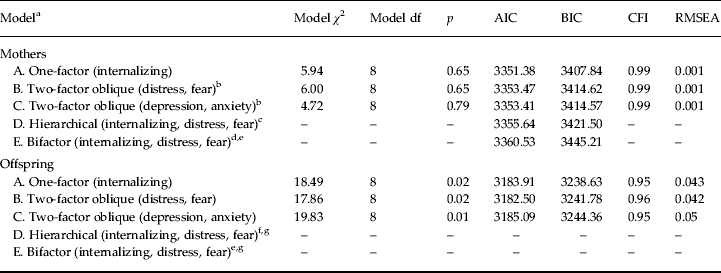
Fit data are presented in Table 2. Models for mothers and offspring were run separately, but both yielded the same conclusions; for simplicity, we focus here on mothers. For both two-factor models (i.e. correlated distress and fear; correlated depression and anxiety), BIC favored the one-factor model; more importantly, the estimated factor correlation in both two-factor models exceeded 1.0, suggesting that the factors could not be reliably differentiated in this sample. The hierarchical model could not be estimated because it was under-identified. The bifactor model converged, but the factor loadings on the unique (distress and fear) factors were non-significant. Therefore, we concluded that the unique factors would not be useful in testing structural relations between mothers’ and offspring's internalizing factors. Remaining analyses utilize a one-factor model.
Fit data for competing structural models of internalizing disorders for mothers and offspring

df, Degrees of freedom; AIC, Akaike information criterion; BIC, Bayesian information criterion; CFI, comparative fit index; RMSEA, root-mean-square error of approximation; MDD, major depressive disorder; DYS, dysthymia; PTSD, post-traumatic stress disorder; GAD, generalized anxiety disorder; SOC, social phobia; SPEC, specific phobia; PAN, panic disorder or agoraphobia.
a Model A = single internalizing factor (MDD, DYS, PTSD, GAD, SOC, SPEC, PAN); model B = oblique two-factor with distress (MDD, DYS, PTSD, GAD) and fear (SOC, SPEC, PAN); model C = oblique two-factor model with depression (MDD, DYS) and anxiety (PTSD, GAD, SOC, SPEC, PAN); model D = hierarchical model with superordinate internalizing factor and subordinate fear (SOC, SPEC, PAN) and distress (MDD, DYS, PTSD, GAD) factors; model E = bifactor model with all disorders loading on internalizing factor as well as either fear (SOC, SPEC, PAN) or distress (MDD, DYS, PTSD, GAD). Because of low frequency in this sample, GAD was excluded from mother models and PAN from offspring models. AIC and BIC were estimated using the ML estimator; CFI and RMSEA and χ 2 were estimated using WLSMV. Model A was used in all subsequent analyses.
b Factor correlation was greater than or equal to 1.
c Using the ML estimator, the factor loadings of subfactors on internalizing were = 0.99. Using WLSMV, model fit could not be computed, due to the fact that all factor correlations were greater than or equal to 1.
d None of the factor loadings on the fear and distress unique factors was statistically significant.
e Using the WLSMV estimator, fit indices were not computed due to negative variances of unique factors.
f Using WLSMV, model fit indices could not be computed. Factor loading of fear subfactor on internalizing = 0.92.
g Using ML, model fit indices could not be computed due to a non-positive definite information matrix.
As indicated in Table 2, fit statistics for the factor model for mothers and offspring indicated that the unidimensional latent variable models provided an excellent fit to the data. All factor loadings on both factors were significant at an α level of 0.01, as displayed in Fig. 1.
A hierarchical-spectrum model of the intergenerational transmission of internalizing psychopathology. Coefficients are standardized/unstandardized. For clarity of presentation, the correlations between residual variances – representing intergenerational transmission of diagnosis-specific pathology – are not depicted (see Table 3). MDD, Major depressive disorder; DYS, dysthymia; SOC, social phobia; SPEC, specific phobia; PTSD, post-traumatic stress disorder; PAN, panic disorder or agoraphobia; INT-M, maternal internalizing factor (all observed variables loading on this latent factor reflect maternal diagnoses); INT-O, offspring internalizing factor (all observed variables loading on this factor reflect offspring diagnoses); GAD, generalized anxiety disorder.

Intergenerational transmission of internalizing disorders
The regression of the offspring internalizing factor on the maternal internalizing factor was significant with a moderate effect size (b = 0.51, s.e. = 0.12, p < 0.0001, β = 0.38), as illustrated in Fig. 1. Gender moderation was tested using the DIFFTEST option in Mplus to examine whether constraining the path linking the maternal and offspring latent variables to equality across genders significantly reduced fit. The change in fit was not significant (χ 2 1 = 2.58, p > 0.05), suggesting no differences in intergenerational associations by gender. Additionally, controlling for gender produced equivalent results.
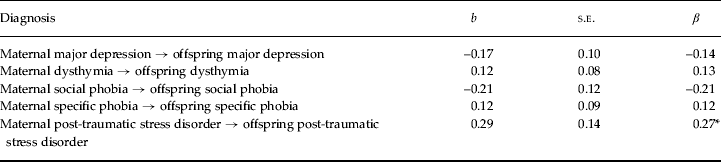
To test residual correlations, we individually added pathways between residual terms for each disorder (an identical significance pattern was obtained when all residual correlations were entered simultaneously). As displayed in Table 3, none of the residual correlations among internalizing diagnoses was significant, with the exception of PTSD, which showed a significant residual association between mother and offspring disorder-specific components (β = 0.27, p < 0.05). As an additional test of disorder-specific associations, we examined whether model fit was improved by adding residual correlations. Compared with a model with no residual correlations (χ 2 53 = 82.11, p = 0.01, BIC = 6711.43, CFI = 0.94, RMSEA = 0.26), adding the PTSD correlation did not improve the BIC (6714.02) but did improve the CFI (0.95) and RMSEA (0.24), providing mixed evidence of model improvement (note that BIC penalizes increased model complexity). Residual pathways for other disorders did not improve fit. Taken together, findings offer tentative support for PTSD-specific effects, but not for other disorders. We used χ 2 difference testing comparing nested models to evaluate the equivalence of residual correlations across gender, and found no significant gender differences in disorder-specific intergenerational transmission (p's > 0.05).
Associations between diagnosis-specific components of maternal and offspring internalizing disorders

s.e., Standard error.
* p < 0.05.
Similar results were obtained when both offspring and maternal factors were limited to the same diagnoses (i.e. those meeting the 5% frequency threshold in both groups, with OCD, GAD and PAN excluded), with comparable fit (χ 2 34 = 55.70, p = 0.01, CFI = 0.93, RMSEA = 0.028) and correlation between latent INT factors (β = 0.40), and unchanged pattern of residual correlations.
Discussion
A large body of research persuasively links maternal depression with negative outcomes among offspring (Goodman & Gotlib, Reference Goodman and Gotlib1999; Goodman et al. Reference Goodman, Rouse, Connell, Broth, Hall and Heyward2011), but most studies do not account for the co-occurrence among internalizing disorders, leaving it unclear if maternal depression exerts a unique influence on offspring psychopathology, or examine if effects are related to its co-morbidity with other internalizing diagnoses. Likewise, most previous studies examine individual offspring psychological disorders in isolation as outcomes, without controlling for their shared features. The current study applied latent variable modeling to clarify the extent to which intergenerational transmission occurs via disorder-specific versus transdiagnostic pathways.
As a preliminary step, we tested alternative structural models of internalizing disorders, and found that a unidimensional model (with a single latent factor representing shared variance across all internalizing disorders) provided the best fit to diagnostic correlations in the current sample. We then showed that transmission of internalizing disorders from mother to offspring is largely explained by the influence of this maternal internalizing factor on the corresponding offspring factor. In contrast, with the exception of PTSD, mothers’ standing on diagnosis-specific forms of pathology (including MDD) was unrelated to offspring standing on these same constructs. This implies that, in large part, transmission of internalizing disorders is non-specific, with depression predicting risk for anxiety disorders and vice versa (fitting with other data; McLaughlin et al. 2012). Stated differently, mothers seem to pass down a general propensity to develop internalizing disorders, rather than risk for one particular disorder.
These findings carry several important implications. First, they suggest that bivariate associations between specific maternal and offspring diagnoses largely reflect the effects of a more general concordance of transdiagnostic pathology across generations, and should thus be interpreted with this in mind. Second, they suggest that mechanisms linking maternal and offspring anxiety and depression may operate predominantly via the overarching internalizing trait. The current study was not designed to adjudicate between genetic and behavioral models of intergenerational transmission, and it is virtually certain that both factors contribute. That said, results may help inform future work on genetic and psychosocial models of transmission, as they suggest that that (a) genetic vulnerabilities (and other biological mechanisms, such as in utero conditions) may be more likely to predispose to standing on the broad internalizing factor, rather than specific aspects of individual disorders (see Corley et al. Reference Corley, Zeiger, Crowley, Ehringer, Hewitt, Hopfer, Lessem, McQueen, Rhee, Smolen, Stallings, Young and Krauter2008; Dick et al. Reference Dick, Aliev, Wang, Grucza, Schuckit, Kuperman, Kramer, Hinrichs, Bertelsen and Budde2008), and (b) psychosocial mechanisms of intergenerational transmission may be most influenced by shared internalizing features. Researchers point to a range of psychosocial mediators for the intergenerational transmission of depression, including parenting style, attachment, familial environment, interpersonal chronic stress, and disruptions in social competence (Goodman & Gotlib, Reference Goodman and Gotlib1999; Elgar et al. Reference Elgar, McGrath, Waschbusch, Stewart and Curtis2004; Hammen et al. Reference Hammen, Shih and Brennan2004; Burt et al. Reference Burt, Van Dulmen, Carlivati, Egeland, Alan Sroufe, Forman, Appleyard and Carlson2005), and similarly, several factors (e.g. income and social resources) may jointly influence both maternal and offspring depression (Elgar et al. Reference Elgar, McGrath, Waschbusch, Stewart and Curtis2004). Current findings raise the possibility that these factors are most closely linked to common features of internalizing disorders, rather than unique components of depression.
In an important exception, PTSD showed evidence of disorder-specific transmission, although findings are tentative and require replication. Yehuda et al. (Reference Yehuda, Halligan and Bierer2001a ) similarly found that parental PTSD specifically predicted offspring PTSD controlling for other anxiety disorders and depression in a sample of children of Holocaust survivors. Shared exposure to traumatic events (or shared contexts that promote likelihood of trauma exposure, such as poverty or chaotic environments) may explain the unique correspondence of diagnosis-specific aspects of PTSD between mother and child. Offspring of parents with PTSD also show greater exposure to traumas perpetrated by the PTSD-affected parent, such as neglect or emotional abuse (Yehuda et al. Reference Yehuda, Halligan and Grossman2001b ) and generally higher stress levels (Brand et al. Reference Brand, Schechter, Hammen, Brocque and Brennan2011). Studies also suggest that offspring of mothers with PTSD show reduced salivary cortisol levels starting in infancy (Yehuda et al. Reference Yehuda, Engel, Brand, Seckl, Marcus and Berkowitz2005, Reference Yehuda, Teicher, Seckl, Grossman, Morris and Bierer2007), and this in turn may elevate risk for PTSD in response to traumatic events (Delahanty et al. Reference Delahanty, Raimonde, Spoonster and Cullado2003; Raison & Miller, Reference Raison and Miller2003). Interpreted in conjunction with the current results, PTSD may be one case where intergenerational transmission does not exclusively occur via transdiagnostic processes.
With the exception of PTSD, there was little evidence for specific transmission of individual disorders. On one hand, this could be interpreted as supporting the ‘lumper’ position that the unique components of internalizing disorders are relatively unimportant, at least in terms of intergenerational transmission of internalizing problems. Although more research is decidedly needed to determine whether diagnostic boundaries are fundamentally meaningful, we caution against blunt interpretations of the current results given certain study limitations. First, we excluded disorders with low frequencies in this sample, and as maternal and offspring disorders exhibited different frequencies, different disorders were included on mother and child internalizing factors. This contributed to dissimilarity between offspring and maternal latent internalizing factors, which may have influenced intergenerational associations (although comparable results were produced when restricting both latent variables to diagnoses meeting the 5% threshold for both mothers and offspring). It is also possible that some of the excluded diagnoses (such as GAD) would show specific transmission. There may also be developmental differences in the structure of psychopathology, producing differences in latent and residual variables between mothers and offspring.
Further, our sample was overselected for maternal depression, and while this allowed for sufficient representation of clinically significant symptoms, results may differ in unselected samples. Also, cross-diagnostic associations (e.g. maternal depression predicting offspring SOC) were not tested in the current study. Moreover, there has been limited research on the construct validity of the diagnosis-specific components of disorders in the HSM framework. Although researchers have speculated about what the disorder-specific components represent (e.g. anhedonia in MDD; Watson et al. Reference Watson, Clark, Weber, Assenheimer, Strauss and McCormick1995), further work is needed to evaluate whether these diagnosis-specific variances are related to external constructs in theoretically plausible ways (Krueger & Markon, Reference Krueger and Markon2011; Simms et al. Reference Simms, Prisciandaro, Krueger and Goldberg2012; Eaton et al. Reference Eaton, Krueger, Markon, Keyes, Skodol, Wall, Hasin and Grant2013). In addition, diagnosis-specific effects may be underestimated because of imperfect measurement reliability of individual diagnoses.
Finally, the lack of disorder-specific effects may be related to the age of the offspring in our sample. For example, some evidence suggests that the majority of the depressive effects of maternal depression manifests by the age of 15 years (Hammen et al. Reference Hammen, Brennan and Keenan-Miller2008). First onsets of depression between the ages of 15 and 20 years (when youth in the current study were assessed) may reflect transient episodes with other etiological roots; thus, examining transmission at an earlier age may reveal a stronger specific effect for depressionFootnote 1 Footnote †. On the other hand, while most depressive effects of maternal depression emerge by mid-adolescence, depression-specific effects (as opposed to a general diathesis toward internalizing disorders) could potentially emerge later, as depression tends to have later onset than anxiety disorders (Kessler et al. Reference Kessler, Berglund, Demler, Jin and Walters2005). If so, older samples may demonstrate depression-specific transmission.
Several additional limitations should also be considered. Our model included only maternal psychopathology, and several studies have suggested the importance of paternal or even grandparental effects (e.g. Warner et al. Reference Warner, Weissman, Mufson and Wickramaratne1999; Brennan et al. Reference Brennan, Hammen, Katz and Le Brocque2002; Hammen et al. Reference Hammen, Shih and Brennan2004; Pettit et al. Reference Pettit, Olino, Roberts, Seeley and Lewinsohn2008), although Tully et al. (Reference Tully, Iacono and McGue2008) demonstrated that paternal depression has negligible impact on internalizing psychopathology. In addition, we could not evaluate transmission of the externalizing spectrum because these diagnoses were not well represented among the mothers in our sample. Using similar methods, Hicks et al. (Reference Hicks, Krueger, Iacono, McGue and Patrick2004) found support for general transmission of externalizing disorders.
Finally, we used categorically defined diagnoses as indicators of the latent internalizing spectra, which excluded potentially important subthreshold symptoms. Dimensional indicators would be statistically preferable (Fergusson et al. Reference Fergusson, Horwood and Boden2006; Markon, Reference Markon2010; Wright et al. Reference Wright, Krueger, Hobbs, Markon, Eaton and Slade2013), although note that numerous prominent studies examining the latent structure of psychopathology have also used categorical indicators (Krueger et al. Reference Krueger, Caspi, Moffitt and Silva1998; Krueger, Reference Krueger1999; Krueger & Finger, Reference Krueger and Finger2001; Vollebergh et al. Reference Vollebergh, Iedema, Bijl, de Graaf, Smit and Ormel2001; Cox et al. Reference Cox, Clara and Enns2002; Slade & Watson, Reference Slade and Watson2006; Eaton et al. Reference Eaton, Krueger, Markon, Keyes, Skodol, Wall, Hasin and Grant2013). Our study is perhaps best interpreted as examining how internalizing disorders strictly as defined by the DSM-IV are transmitted from mothers to offspring. As mounting evidence suggests that few diagnostic constructs are truly taxonic (Haslam et al. Reference Haslam, Holland and Kuppens2012), it is possible that measuring the constructs using methods more in line with their natural psychometric properties (e.g. dimensional; Prisciandaro & Robert, Reference Prisciandaro and Robert2009) would yield greater disorder-specific effects.
Although our data were most consistent with a single-factor model of internalizing pathology, different structural models may be more appropriate in other datasets. For example, our use of binary data may have limited our ability to fit more complex models. Future research should explore whether lower-order internalizing factors identified in prior studies (e.g. fear versus distress/anxious misery; Krueger, Reference Krueger1999; Prenoveau et al. Reference Prenoveau, Zinbarg, Craske, Mineka, Griffith and Epstein2010) are transmitted specifically from parents to offspring.
These limitations notwithstanding, the current study supplies new evidence that transdiagnostic processes may substantially account for intergenerational transmission of internalizing problems, challenging the assumption that maternal depression exerts a unique effect on offspring depression. This raises an interesting question: to the extent that children inherit (genetically or psychosocially) vulnerability to a general internalizing propensity rather than specific disorders, what factors then determine which specific internalizing disorders ultimately manifest, and where do these factors originate (if not from parental sources)? Researchers have begun to identify specific risk factors that predict anxiety versus depression, controlling for shared features (e.g. Craske et al. Reference Craske, Wolitzky-Taylor, Mineka, Zinbarg, Waters, Vrshek-Schalihorn, Epstein, Naliboff and Ornitz2012), but more work is needed to better understand the unique etiologies of separate internalizing disorders. Ultimately, the current study suggests that, although a considerable volume of research has treated depression as a special class of disorder with unique effects, it may be better understood as a manifestation of a broader internalizing trait, with causes and consequences that cut across diagnostic boundaries. As such, adopting a transdiagnostic perspective may facilitate exploration of key psychopathological processes.
Acknowledgements
This research was supported by National Institute of Mental Health (NIMH) R01MH052239 and NIMH T32MH082719. We are grateful to the MUSP, M900 and M20 Research Teams, and to the parents and youth in the Mater Cohort for their participation in this study. We extend particular thanks to Robyne LeBrocque, Cheri Dalton Comber and Sascha Hardwicke (project coordinators). The cooperation of Professor Jake Najman of the University of Queensland and head of the MUSP program is gratefully acknowledged.
Declaration of Interest
None.