Introduction
The practice of architecture is the most delightful of all pursuits. Also, next to agriculture, it is the most necessary to man. One must eat, one must have shelter.
(Johnson Reference Johnson1979)Sedentary architecture flourished in the Neolithic as more than a simple expedient for shelter and protection; it was a new representation of society's changing relationship between itself and the natural environment. The transition from dwellings to domestic structures was a manifestation of the socio-cultural changes that characterized societies at the passage between the Mesolithic/Epipaleolithic and the Neolithic (Banning & Chazan Reference Banning and Chazan2006; Hodder Reference Hodder1990; Watkins Reference Watkins2004). In turn, sedentarization also impacted the social organization of early societies, creating a complex and multi-faceted phenomenon in ways that have been extensively addressed by post-processualists, structuralists and social theorists alike (Carsten & Hugh-Jones Reference Carsten, Hugh-Jones, Carsten and Hugh-Jones1995; Hodder Reference Hodder1990; Lévi-Strauss Reference Lévi-Strauss1962; Rapoport Reference Rapoport1969; Samson Reference Samson1990; Watkins Reference Watkins2004; Wilson Reference Wilson1988). Neolithic ‘house-forms’ and their possible significance within contemporary social parameters have been the subject of lively debates, although only a limited number of scholars have focused on architectural materiality and its symbolism in Neolithic societies (Akkermans Reference Akkermans, Bolger and Maguire2010; Aurenche Reference Aurenche, Frangipane and Hauptman1993; Boivin Reference Boivin, Boivin and Owoc2004; Kotsakis Reference Kotsakis, Ivanova, Athanassov, Petrova, Takorova and Stockhammer2018, 33; Wilk Reference Wilk and Kent1990). This discussion often tends to identify Neolithic societies’ choice of building materials as only deterministic, or disregards its potential cultural significance for the community, merely focusing on the functionality of building choices. Consequently, it overlooks a key aspect of material culture—building materials—that intrinsically depends on the sharing of knowledge and possible existence of ‘communities of practice’ in architecture (Lave & Wenger Reference Lave and Wenger1991; Marchand Reference Marchand, Rainer, Gandreau and Rivera2011; van Vuuren Reference van Vuuren2015). The concept of ‘communities of practice’ implies a common interest by communities in gaining knowledge in a specific field or directing it to a problem-solving activity (Lave & Wenger Reference Lave and Wenger1991; Rogoff Reference Rogoff, Wertsch, del Rio and Alvarez1995; Wenger Reference Wenger1998; Reference Wenger and Blackmore2010).
Models developed by anthropologists investigating the transmission of knowledge indicate that learning spans a range of scales and modes (Bauer & Agbe-Davies Reference Bauer, Agbe-Davies, Bauer and Agbe-Davies2010; Kardulias & Hall Reference Kardulias and Hall2008; Knappett & van der Leeuw Reference Knappett and van der Leeuw2014). Our understanding of learning practices is clearly complicated by the diachronic nature of learning itself at both the individual and the community level. The ‘communities of practice’ approach considers an intermediate level of learning, showcasing how technological learning is linked to social context, motor-skill development and other forms of non-declarative learning (Gosselain Reference Gosselain, Stark, Bowser and Horne2008; Knappett & van der Leeuw Reference Knappett and van der Leeuw2014; Lemonnier Reference Lemonnier1993; Warnier Reference Warnier2007). The integration of multiple types of knowledge can be a long process, but one that is reflected in material culture and often in the kinaesthetic movements people perform during these processes (Roux & Corbetta Reference Roux and Corbetta1989; Wendrich Reference Wendrich and Wendrich2012a). Thus, a ‘communities of practice’ approach allows us to investigate skill transfer at the synchronic and diachronic level within the same community and between multiple sites (Abell Reference Abell2020; Knappett & van der Leeuw Reference Knappett and van der Leeuw2014, 82).
By sharing their knowledge, members of a community can increase the general social-based knowledge and develop motor skills essential for craft specialization (Cutler Reference Cutler2019; Lave & Packer Reference Lave and Packer2011; Lave & Wenger Reference Lave and Wenger1991). In their assertion that ‘a community of practice is a set of relations among persons, activity and world over time and in relation to other tangential and overlapping communities of practice’, Lave and Wenger (Reference Lave and Wenger1991, 115) propounded how the learning process is not just a top-down approach but often also works horizontally within communities. In archaeology, the concept of community of practice was introduced to understand better the relationship between apprentice and master in material culture production. This concept also considers the relationship between different craft specialists and the diachronic transfer of knowledge between kin and/or different social groups within a community, creating new lenses through which material culture and the chaînes opératoires behind its production can be examined (Cutler Reference Cutler2019; Lave Reference Lave2012; Miller Reference Miller and Wendrich2013, 227–33; Minar & Crown Reference Minar and Crown2001; Wendrich Reference Wendrich and Wendrich2012b, 257–60). In turn, the chaîne opératoire can be understood as the totality of operational steps required to move from raw materials to a complete form of material culture, involving both materiality and movements (Leroi-Gourhan Reference Leroi-Gourhan1964, 323; von Rüden Reference von Rüden, Gauss, Klebinder-Gauss and von Rüden2015, 36–7). Technological processes cannot be known just by the mere description of technical steps, but it is the experience of the people creating them, the ‘tacit knowledge’ embedded in objects, that gives them value in our debate (Lindblom et al. Reference Lindblom, Gauss, Kiriatzi, Gauss, Klebinder-Gauss and von Rüden2015; von Rüden Reference von Rüden, Gauss, Klebinder-Gauss and von Rüden2015).
Earthen building materials are a human production and symbol of the community effort to use natural resources to create a man-made built environment. The manufacture of these materials undergoes a complex chaîne opératoire in which we assist in a complete transformation of the raw sources, such as soil, water and temper, to enable the creation of original material culture embedded with environmental and social data (Lorenzon Reference Lorenzon2021; Lorenzon et al. Reference Lorenzon, Nitschke, Littman and Silverstein2020; Love Reference Love2013a; Sadalla & Sheets Reference Sadalla and Sheets1993; Warnier Reference Warnier2009).
Building upon these approaches, this contribution aims to draw attention to the materiality and social process of constructing with earth. I argue that inferences about economic and social organization and the varying social importance of buildings are based on the degree of effort and the quality of raw material sources used in the construction process. The prominence of earth as a construction material in the eastern Mediterranean during the Neolithic period can also be connected with the increased exploitation of clay in various other forms of material culture (e.g. pottery, figurines, personal items), elevating this material to new socio-cultural status connected with the development of agriculture and identity (Catapoti & Relaki Reference Catapoti and Relaki2020; Mina Reference Mina2008). Therefore, any analysis of prehistoric architecture needs to overcome the attitude that building materials are not an essential part of material culture, but rather chosen for opportunistic or functional reasons (Lévi-Strauss Reference Lévi-Strauss1962; Love Reference Love2013b; Rapoport Reference Rapoport1969).
In the Levant and Mesopotamia, earthen building materials are typically associated with the earliest identified sedentary architecture (Kurapkat Reference Kurapkat, Renn, Osthues and Schlimme2014; Love Reference Love2013b; Rosen Reference Rosen1986; Stordeur Reference Stordeur, Becker, Hempelmann and Rehm2010). In reality, the use of earth to create permanent and semi-permanent dwellings is already attested in Mesolithic Europe (e.g. the Balkans; see Stevanović Reference Stevanović1997) and during the Epipaleolithic in Asia (e.g. Mesopotamia, Anatolia; see Biçakçi Reference Biçakçi, Özdoğan, Hauptmann and Başgelen2003; Goring-Morris & Belfer-Cohen Reference Goring-Morris, Belfer-Cohen, Bocquet-Appel and Bar-Yosef2008), but it is only in the Neolithic that we have evidence of a multi-scalar transformation from simple, seasonal dwellings to a more stable form of built environment (Hodder Reference Hodder1990; Kotsakis Reference Kotsakis, Ivanova, Athanassov, Petrova, Takorova and Stockhammer2018; Watkins Reference Watkins2004).
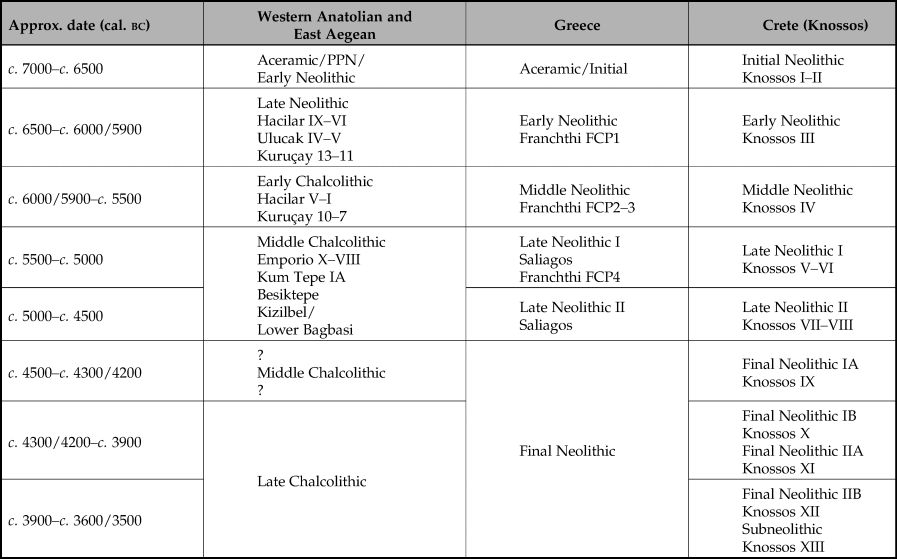
Aurenche (Reference Aurenche1981; Reference Aurenche, Frangipane and Hauptman1993) has discussed the development of earthen architecture in southeast Anatolia, Mesopotamia and the Levant from the eighth to the fourth millennium bc, featuring the main techniques employed in earthen construction in Pre-Pottery Neolithic A (PPNA), Pre-Pottery Neolithic B (PPNB) and other Neolithic sites. In the last two decades, further research conducted on Neolithic earthen architecture in southeast Anatolia, Mesopotamia and the Levant highlighted the lack of comparative studies of earthen architecture in western Anatolia, Greece and the Aegean region (Andreou et al. Reference Andreou, Fotiadis and Kotsakis1996; Akkermans Reference Akkermans, Bolger and Maguire2010; Banning Reference Banning2010; Białowarczuk Reference Białowarczuk, Pieńkowska, Szeląg and Zych2019; Finlayson et al. Reference Finlayson, Kuijt, Mithen and Smith2011; Goring-Morris & Belfer-Cohen Reference Goring-Morris, Belfer-Cohen, Bocquet-Appel and Bar-Yosef2008; Kinzel Reference Kinzel2015; Love Reference Love2013a; Prévost–Dermarkar Reference Prévost–Dermarkar2019). This is partially due to a long-standing division in the study of Neolithic archaeology between these regions in which western Anatolia has been bundled together with the rest of western Asia (i.e. Mesopotamia, the Levant, southeast Anatolia). Only recently have researchers called into question this arbitrary classification (Table 1). The connection of western Anatolia with the Aegean and Greece creates a broad, extremely stimulating archaeological context in which architecture is characterized by various influences coming from central Anatolia, the Balkans and the Levant (Demoule & Perlès Reference Demoule and Perlès1993, 370–75; Horejs et al. Reference Horejs, Milic, Ostmann, Thanheiser, Weninger and Galik2015; Özdoğan Reference Özdoğan2014; Perlès Reference Perlès2003). Recent investigations have begun to bridge this gap, by offering a more comprehensive picture of Neolithization in the Eastern Mediterranean as an interconnected region (Broodbank Reference Broodbank2013, 173–96; Horejs Reference Horejs2019; Perlès Reference Perlès and Demoule2010; Reingruber Reference Reingruber2011).
Comparative chronological table (after Tomkins Reference Tomkins and Momigliano2007; Reference Tomkins, Isaakidou and Tomkins2008; Reference Tomkins2018; pers. comm.)

This paper builds on these new approaches by exploring the creation of communities of practice in Neolithic earthen architecture in the eastern Mediterranean. The difficulties of preservation and the geographical separation of Anatolia from Greece and the Aegean in the scholarship have resulted in a significant gap in the study of this material in the region. Consequently, earthen building materials in this geographical area have received little attention. This contribution aims to bring this understudied resource to the forefront for a more comprehensive examination of the process of Neolithization in the eastern Mediterranean (Guest-Papamanoli Reference Guest-Papamanoli1978; Horejs Reference Horejs2019; Love Reference Love2013a).
The paper first considers the implementation of different earthen techniques and provides a clearer picture of the location in which these are documented, by evaluating their use in structural architectural elements (i.e. wall elevations) over time. For this, I record the regular use of earthen architecture in the eastern Mediterranean, to be precise, western Anatolia, the Aegean islands and mainland Greece. Second, I analyse the complex chaîne opératoire process of these earthen building materials to gain a better understanding of Neolithic societies’ relationship with earth. Finally, a focused case study at Knossos aims to ascertain evidence of synchronic and diachronic learning processes.
Archaeological evidence in the eastern Mediterranean
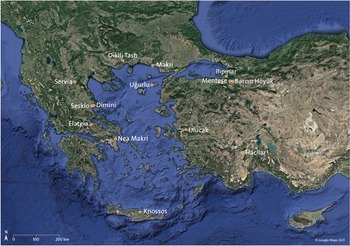
The use of earth as a building material is attested for over three millennia in most western Anatolian, mainland Greek, Cretan and other Aegean Neolithic villages (Fig. 1). Within this landscape, Stevanović (Reference Stevanović1997) conducted one of the earliest comprehensive studies of Neolithic architecture in southeast Europe, demonstrating that an anthropological approach applied to building techniques can offer comprehensive insights into the social processes of human settlements. Her research successfully extracted social information from a technological analysis of Neolithic architecture (Stevanović Reference Stevanović1997; Reference Stevanović, Stevanović and Tringham2012), raising questions about the importance of clay for Neolithic cultures and the selection of clay as a key building material.
Sites mentioned in the text. (Image: Google Map, 2021; drawing: Maija Holappa.)

The Aegean landscape, with its heterogeneous assemblage of architecture, could be considered a melting-pot of creative Neolithic earthen practices. Numerous earthen techniques have been documented in wall structures, ceilings and foundations, thanks to the ubiquitous nature of earth, which makes it easy to employ as a binder (i.e. mud mortar), as a cover (i.e. plastic earthen materials,Footnote 1 plaster in all plaster or ceiling elements) and a structural element (i.e. wall structures in tauf [cob in British vernacular tradition] or mudbrick) (Aurenche Reference Aurenche1981, 45–72; Wright Reference Wright2005, 75–144).
Although recent excavations have provided more material for the analysis of construction techniques, clear limitations are posed by the re-use of building materials over time, the natural decay of buildings after abandonment, the depositional and post-depositional processes that affect earthen materials, and the instability of these materials once exposed during excavation. All these factors contribute to the fragmentary nature of the information recorded, conditioning the analysis of earthen architecture (Friesem et al. Reference Friesem, Karkanas, Tsartsidou and Shahack-Gross2014; Stevanović Reference Stevanović1997; Reference Stevanović, Stevanović and Tringham2012; Wardle Reference Wardle1996).
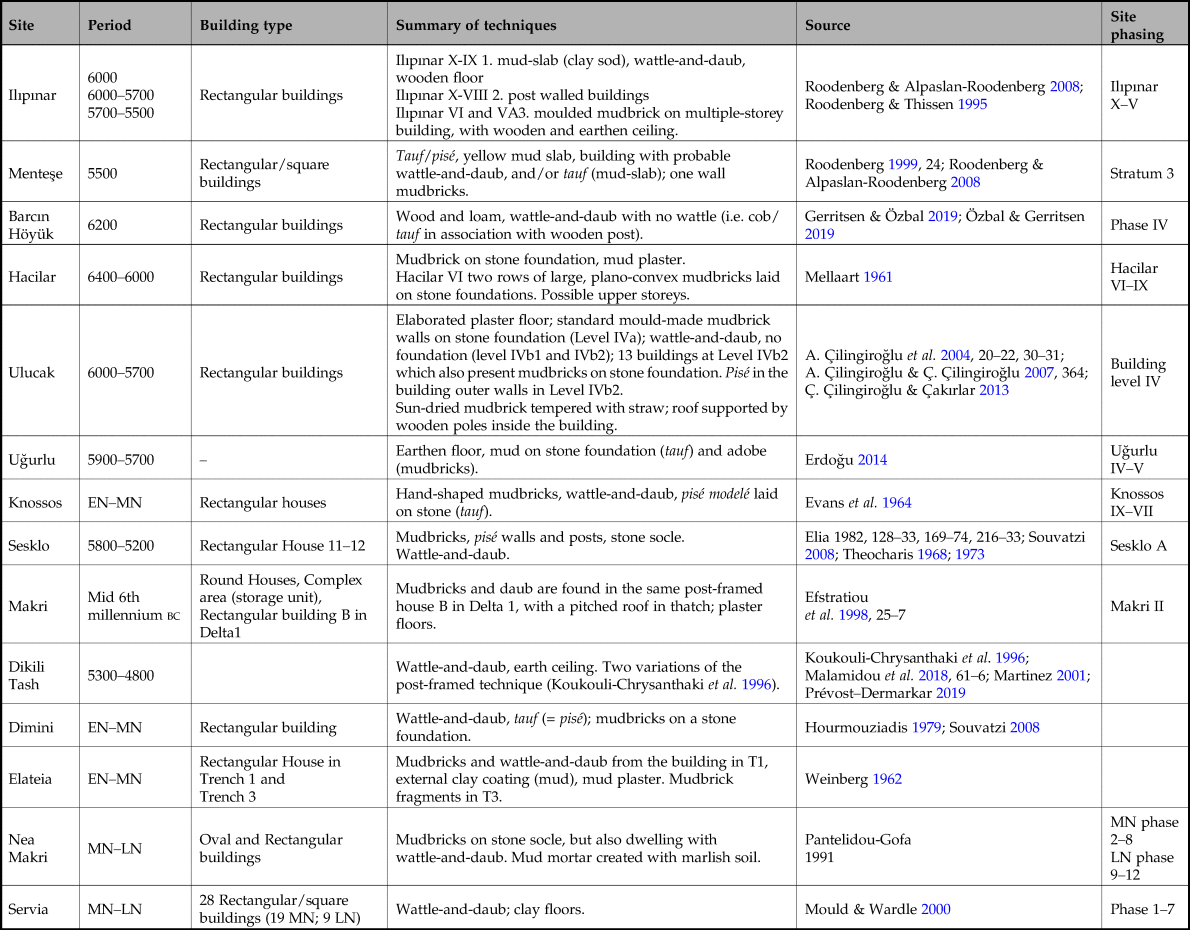
Table 2 presents a comprehensive summary of the techniques documented at Neolithic sites in the eastern Mediterranean with long occupational histories. Most of the buildings considered are forms built above ground, while pit-dwellings also provide essential information. I have privileged the former due to the available archaeological record and informative reports describing earthen techniques (Bailey Reference Bailey2000, 263–5; Kloukinas Reference Kloukinas, Sarris, Kalogiropoulou, Kalayci and Karimali2017, 169; Kotsakis Reference Kotsakis, Ivanova, Athanassov, Petrova, Takorova and Stockhammer2018, 36).
Examples of the variety of techniques in the Eastern Mediterranean. EN = Early Neolithic; MN = Middle Neolithic; LN = Late Neolithic; FN = Final Neolithic.

At first glance, the data collected from these 14 archaeological sites exhibit a heterogeneous picture characterized by synchronic and diachronic variability of techniques both within a single site and between sites; however, as discussed in further detail, clear patterns of skill transfer between techniques become evident when the data are compared.
Archaeological work carried out at coastal sites in western Anatolia has also brought to light more evidence of Neolithic earthen architectural practices (Biçakçi Reference Biçakçi, Özdoğan, Hauptmann and Başgelen2003; Ç. Çilingiroğlu Reference Çilingiroğlu2005; Horejs Reference Horejs2019). Four techniques are documented at these five selected sites (Ilıpınar, Barcın Höyük, Menteşe, Hacilar and Ulucak): wattle-and-daub, tauf, mudbrick—both handmade and mould-made—and earthen ceilings as structural elements in rectangular buildings. The presence of mud mortar and mud plaster was not attested but inferred (A. Çilingiroğlu et al. Reference Çilingiroğlu, Derin, Abay, Kayan and Saglamtimur2004, 20–39; Gerritsen & Özbal Reference Gerritsen and Özbal2019; Mellaart Reference Mellaart1961; Özbal & Gerritsen Reference Özbal, Gerritsen and Marciniak2019, 290–93; Roodenberg Reference Roodenberg1999, 24; Roodenberg & Alpaslan-Roodenberg Reference Roodenberg, Alpaslan-Roodenberg, Bailey, Whittle and Hofmann2008; Roodenberg & Thissen Reference Roodenberg and Thissen1995; Thissen Reference Thissen2010).
While the north Aegean site of Uğurlu provides some detailed evidence of Neolithic occupation, few architectural remains have been documented, making the site of Knossos, the best-known Neolithic settlement in Crete, the best source of information on earthen architectural practices (Erdoğu Reference Erdoğu2014; Evans Reference Evans1971; Evans et al. Reference Evans, Cann, Renfrew, Cornwall and Western1964). The analysis of materials from Knossos indicated the presence of three distinctive construction techniques that, although implemented diachronically, had significant temporal overlap: wattle-and-daub, mudbrick, and what is described as pisé.
In mainland Greece, much of the evidence regarding Neolithic construction comes from excavations in the northern and central part of the country (including Thrace and western, central and eastern Macedonia). More than 50 sites from this region have provided basic information on construction techniques and materials. The evidence shows the use of earthen building materials either on their own or in combination with wood (Kloukinas Reference Kloukinas2014; Reference Kloukinas, Sarris, Kalogiropoulou, Kalayci and Karimali2017; Reingruber Reference Reingruber and Lichter2005). In this region, we see a high variability of techniques, both synchronically and diachronically. The adoption of a specific technique and its implementation depended on a combination of factors, including available resources and social considerations. For instance, during the middle of the sixth millennium bc, Makri presents both wattle-and-daub and mudbrick constructions (Efstratiou et al. Reference Efstratiou, Fumanal and Ferrer1998), while a fortuitous conflagration event at Dikili Tash allowed excavators to recognize the presence of wattle-and-daub as the only technique implemented at the site during the same period (Koukouli-Chrysanthaki et al. Reference Koukouli-Chrysanthaki, Treuil and Malamidou1996; Malamidou et al. Reference Malamidou, Ntinou, Valamoti, Tsirtsoni, Koukouli-Chryssantakhi, Darcque, Sarris, Kalogiropoulou, Kalayci and Karimali2018, 61–6; Martinez Reference Martinez2001; Prévost–Dermarkar Reference Prévost–Dermarkar2019). Moving south towards central Greece, Dimini, Nea Makri and Sesklo are well-known Neolithic sites that provide evidence of mudbrick architecture on top of a stone socle. This is true at least in the later phase of the Neolithic, although earlier constructions indicate the extensive use of wattle-and-daub (Elia Reference Elia1983; Hourmouziadis Reference Hourmouziadis1979; Pantelidou-Gofa Reference Pantelidou-Gofa1991; Souvatzi Reference Souvatzi2008, 81; Theocharis Reference Theocharis1968; Reference Theocharis1973; Wijnen Reference Wijnen1981; Reference Wijnen1992). At other sites, such as Elateia, we have evidence for the synchronic use of wattle-and-daub and handmade mudbrick, while Servia indicates a consistent use of the wattle-and-daub practice from the Middle Neolithic to the Early Bronze Age (henceforth EBA) (Mould & Wardle Reference Mould, Wardle, Ridley, Wardle and Mould2000, 71–105; Weinberg Reference Weinberg1962).
A review of earthen archaeological materials identified at these sites demonstrates the use of four main building techniques and structural elements in the Aegean: 1) wattle-and-daub; 2) mud-slab; 3) pisé or tauf; 4) mudbricks. Ancillary earthen techniques such as mud plaster, mud mortar and earthen floors are also attested.
Earthen chaîne opératoire in the eastern Mediterranean
Earth became a major signifier in Neolithic societies. Its transformation from an agricultural by-product to building material and finally to use in architecture occurred not only as a technological process, but as a socio-cultural practice through which people created meaning communicated through a non-verbal medium, such as kinaesthetic motor movements (Lévi-Strauss Reference Lévi-Strauss1962; van Vuuren Reference van Vuuren2015). Recent ethnoarchaeological studies showed how repetitive actions stemming from the manufacture of earthen building materials result in a multi-sensory experience that conditions the mind and help to develop kinaesthetic motor skills and tactile sensibility (Jerome et al. Reference Jerome, Chiari and Borelli1999; Marchand Reference Marchand, Rainer, Gandreau and Rivera2011). Similar studies on ceramic production have emphasized the importance of non-declarative knowledge often expressed through motor skills and implicit learning (Abell Reference Abell2020; Cutler Reference Cutler2019; Gosselain et al. Reference Gosselain, Zeebroek Decroly and Decroly2009; Squire Reference Squire2004; Warnier Reference Warnier2007).
Studies focusing on the behavioural chain help us consider the meticulous choices that people had to make (i.e. What type of sediment? What type of temper? How much? Should the soil be sieved? How long to mix? Are the mudbricks hand-moulded? How? Mould-formed? Are they regular?). An analysis of these choices guides us through the manufacturing process, providing evidence for identifying issues in implicit learning within the same community. Implicit learning or tacit knowledge is linked to motor skills, and the continuous repetition of kinaesthetic movements during manufacturing is reflected in the created material. Furthermore, eventual differences in the chaîne opératoire of contemporary materials are relevant for pinpointing the presence of multiple communities of practice within the same settlement.
The attestation of multiple earthen techniques in the Eastern Mediterranean indicates the presence of different steps in the chaîne opératoire linked to the creation of different architectural elements (i.e. daub, plaster and mudbrick), often requiring diverse kinaesthetic movements. An analysis of these different behavioural chains provides us with primary information to assess the presence of communities of practice (Abell Reference Abell2020; Chazan Reference Chazan, Shea and Lieberman2009; Roux Reference Roux and Hunt2016; Skibo & Schiffer Reference Skibo and Schiffer2008; Walls Reference Walls2016).
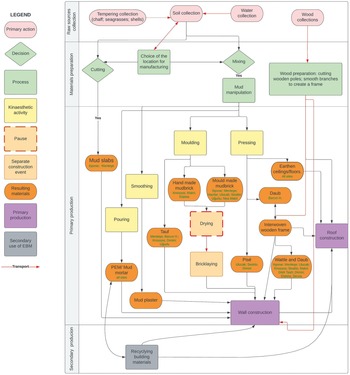
All the earthen methods documented and presented in the chaîne opératoire involved a direct, tactile manipulation of earth during the mixing process and/or during its application, highlighting the multi-sensorial facet of earth work (Catapoti & Relaki Reference Catapoti and Relaki2020; Herva et al. Reference Herva, Nordqvist, Lahelma and Ikäheimo2014, 36; Lévi-Strauss Reference Lévi-Strauss1962). There are several overlaps in the manufacture of earthen building-material chaîne opératoire: 1) the collection of raw sources; 2) the transport of materials; 3) the preparation of the soil, in which the soil is made suitable for manufacturing by removing large inclusions such as branches and big stones that are detrimental to manipulation and manufacturing; 4) the addition of organic and/or inorganic temper as well as water; and 5) the tactile manipulation by hands or feet of the mud mixture over a span of a few hours or days, highly dependent on the materials to be produced (Fig. 2). In this latter step, the chaîne opératoire diverged depending on the technique:
a. Daub: the mud mixture was directly applied to a wattle skeleton (Mould & Wardle Reference Mould, Wardle, Ridley, Wardle and Mould2000; Pantelidou-Gofa Reference Pantelidou-Gofa1991).
b. Tauf (or pisé modelé): the wall was shaped by hand-positioning a chunk of mud mixture still wet on top of a stone socle, foundation, or directly on the ground. This technique could also be used with wooden poles, creating a basic skeleton to be filled with mud (Gerritsen & Özbal Reference Gerritsen and Özbal2019). This type of vertical structure could be created by an individual or a limited number of people (Kurapkat Reference Kurapkat, Renn, Osthues and Schlimme2014, 73–4).
c. Mud plaster: it was smoothed on top of mudbrick and wooden walls, but also on the floor for protection (Weinberg Reference Weinberg1962).
d. Mudbrick: the mud mixture was worked for a few days to increase plasticity and allowed the fibres to ferment. Then, it was moulded by hand to create loaf-shaped bricks or pressed into a wooden mould to manufacture size-standardized bricks (Mellaart Reference Mellaart1961; Roodenberg & Alpaslan-Roodenberg Reference Roodenberg, Alpaslan-Roodenberg, Bailey, Whittle and Hofmann2008). The bricks were then sun-dried for multiple days or weeks depending on the climate. In addition, this technique usually required the participation of more than one individual, since a team of a minimum of three to four peoples was required to assist in the different steps of production, including: mud working, transporting the mud and moulding the bricks.
e. Earth ceiling: the mix presented a higher clay concentration and was spread on top of the ceiling structure to cover it and make it impermeable (Malamidou et al. Reference Malamidou, Ntinou, Valamoti, Tsirtsoni, Koukouli-Chryssantakhi, Darcque, Sarris, Kalogiropoulou, Kalayci and Karimali2018, 61–6; Prévost–Dermarkar Reference Prévost–Dermarkar2019).
f. Mud mortar: a mix of clay and water with minimal organic matter was used as a binder between stones or bricks.
Chart of earthen architecture chaîne opératoire.

From a chaîne opératoire perspective, common steps include the selection of earth/soil, its excavation, the addition of human-induced tempering (i.e. vegetal temper, sand, shells) and the plastic manipulation of the mud mixture created with the addition of water. Usually, the location of earthen building-material manufacture depends on the typology. Plastic materials such as mortar and plaster are usually created in proximity to the structure, as they require immediate use. Mudbrick required not only space for the mud mixing carried out over multiple days, but once moulded, also needed an extensive area to dry (Devolder & Lorenzon Reference Devolder and Lorenzon2019). Thus, their manufacture usually occurs outside the settlements and closer to the sources of raw material. The transport of raw material or finished building materials also varies between techniques.
The use of agricultural by-products such as cereal chaff or straw is well evidenced in the Aegean Neolithic alongside other organic and inorganic tempering, such as dung, crushed shells and sand (Ç. Çilingiroğlu & Çakırlar Reference Cilingiroğlu and Çakırlar2013; Guest-Papamanouli Reference Guest-Papamanoli1978; Mould & Wardle Reference Mould, Wardle, Ridley, Wardle and Mould2000, 80; Prévost–Dermarkar Reference Prévost–Dermarkar2019). Small changes in quantity and tempering determined the earthen building material to be produced; for instance, mud plaster required a higher quantity of vegetal temper than mudbrick, while pisé needed a smaller amount of organic material than either bricks or tauf (Doat et al. Reference Doat, Hays, Houben, Matuk and Vitoux1991; Minke Reference Minke2000).
The distinctive kinaesthetic movements linked to the production of various earthen building materials bring about significant differences in the chaîne opératoire. Each earthen building material relates to individual motor skills and repetitive movements, which may indicate the change of specific know-how within a community in a diachronic analysis.
The problematic nature of mud-slab, a building material that was mostly used untreated causing continuous spalling and decay, may be the reason for the abandonment of this technique in the post-walled building of Ilıpınar X–VIII (Roodenberg & Alpaslan-Roodenberg Reference Roodenberg, Alpaslan-Roodenberg, Bailey, Whittle and Hofmann2008). Mudbricks seem to have appeared not only as a result of hand-moulded production, as recorded at Knossos and Hacilar (Evans et al. Reference Evans, Cann, Renfrew, Cornwall and Western1964; Mellaart Reference Mellaart1961), but also as mould-made modular units at Ilıpınar VI–VA (Roodenberg & Alpaslan-Roodenberg Reference Roodenberg, Alpaslan-Roodenberg, Bailey, Whittle and Hofmann2008).
The overlapping of two techniques, tauf and pisé, in the description of archaeological walls remains a problem in the analysis of recorded data. In the tauf technique, the wall is shaped by hand-positioning a chunk of mud mixture still wet on top of a stone socle, a foundation, or directly on the ground. This technique can also be used with wooden poles, creating a basic skeleton to be filled with mud such as in the structures at Barcin Höyük and Knossos (Gerritsen & Özbal Reference Gerritsen and Özbal2019). This type of wall elevation can be created by an individual or a small number of people (Kurapkat Reference Kurapkat, Renn, Osthues and Schlimme2014, 73–4). On the other hand, pisé (i.e. pisé moulé), while often mentioned in the literature of the Aegean Neolithic, was not really an implemented technique. So far, studies do not provide any concrete evidence for the use of wooden formworks in this period. Consequently, a mention of pisé in archaeological reports often refers to pisé modelé (i.e. hand-shaped loam clods) and overlaps with the tauf technique (or ‘cob’ in the British vernacular tradition).
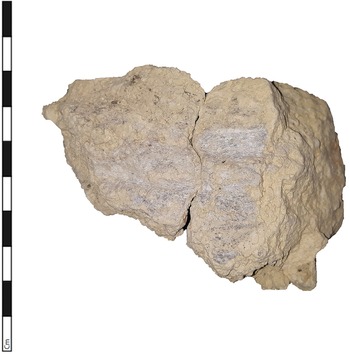
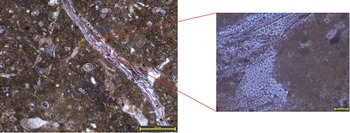
Pisé and tauf are differentiated by the amount and quality of vegetal temper as indicated by the analysis of the Knossian material (Fig. 3). At Knossos, the material initially described as pisé presents characteristics better associated with tauf, such as the presence of high amounts of vegetal temper, the use of long grasses and straw in the mix alongside chaff, and a small percentage of sand (Fig. 4).
Tauf fragment from Neolithic Knossos (Middle Neolithic).

Micrograph of Knossos tauf (Middle Neolithic) in which phytoliths associated with long grasses are visible within the silty matrix.

The qualitative and quantitative prominence of earthen material production in the Neolithic highlights a communal effort to transform the surrounding natural environment. Earth becomes a crucial common resource that is deliberately sought, excavated and shaped to create a man-made product, shared by the whole community. But technological choices are also representative of ‘social constraints’ and the agency of builders to pursue culturally significant building forms (Love Reference Love2013b, 751). Thus, the preference for one building technique over another is never only practical but may reveal the existence of practices that are meaningful to the social groups who were implementing them (Abell Reference Abell2020; Knappett & van der Leeuw Reference Knappett and van der Leeuw2014).
A community of knowledge: Neolithic practices at Knossos
The relevant role of earth in Neolithic construction advances the hypothesis that earth work could also play a role in creating social identities. Thus, community members that have acquired a skill related to the manipulation of earth may also have acquired a distinct social status within their own communities (Fredriksen Reference Fredriksen2011; Love Reference Love2013a; Marchand Reference Marchand, Rainer, Gandreau and Rivera2011). The presence of more experienced builders in the Late and Final Neolithic Aegean is evidenced by the technological improvements in construction, such as a wider roof span, multiple storeys and standardization of mudbrick recipes and techniques (A. Çilingiroğlu et al. Reference Çilingiroğlu, Derin, Abay, Kayan and Saglamtimur2004, 30–33; Evans et al. Reference Evans, Cann, Renfrew, Cornwall and Western1964: 144–8; Nodarou et al. Reference Nodarou, Frederick and Hein2008; Roodenberg & Alpaslan-Roodenberg Reference Roodenberg, Alpaslan-Roodenberg, Özdoğan, Başgelen and Kuniholm2013). Knossos is a central case study in this research, as the site presents not only continuous levels of occupation but also a variety of earthen techniques implemented over time.
Looking at the transformation of techniques between the Early Neolithic/Middle Neolithic and the introduction of new techniques in the Middle Neolithic/Final Neolithic at Knossos suggests a change from simple task-sharing activities between members of the same community to a knowledge-sharing endeavour, especially in the Late Neolithic period (Hole Reference Hole and Kuijt2000, 205–6; Kurapkat Reference Kurapkat, Renn, Osthues and Schlimme2014, 107–8; Love Reference Love2013a; Perlès & Vitelli Reference Perlès, Vitelli and Halstead1999; for discussion on craft specialization, see Clark Reference Clark1995; Costin Reference Costin1991; Flad & Hruby Reference Flad and Hruby2007). The know-how of earthen techniques may have been part of a general communal knowledge—especially in relation to techniques such as mud-slab, tauf and mud mortar—acquired through observation, participation and constant connection to other earth-related activities such as agriculture and pottery production (Catapoti & Relaki Reference Catapoti and Relaki2020; Kurapkat Reference Kurapkat, Renn, Osthues and Schlimme2014, 114–15). On the other hand, the expertise and effort required in more labour-intensive earthen techniques such as mud plaster, which requires numerous replastering events and maintenance, and standardized mudbrick production indicates: 1) the presence of multiple people engaged in these activities; 2) the commitment of societal resources from agricultural and husbandry by-products such as chaff and animal dung used for tempering; and 3) an increased knowledge-base for the selection of the soil and the collection of consistent quantities for manufacture (Aurenche Reference Aurenche1981; Guest-Papamanoli Reference Guest-Papamanoli1978; Jerome et al. Reference Jerome, Chiari and Borelli1999; Kurapkat Reference Kurapkat, Renn, Osthues and Schlimme2014, 114; Marchand Reference Marchand, Rainer, Gandreau and Rivera2011).
At Knossos, the analysis indicates a heterogeneous landscape in which we have different techniques that shared the initial steps of the chaîne opératoire but required different degrees of builder proficiency. They also present a splitting of the behavioural chain regarding earth manipulation. More importantly, these techniques do not follow one another in a deterministic fashion. For instance, wattle-and-daub (Initial Neolithic/Early Neolithic) overlapped with mudbrick architecture (Early Neolithic), followed by a phase of tauf construction (Middle Neolithic). Increased architectural sophistication is often the product of a slow learning process that is characterized by trial and error; thus, techniques may have overlapped for long periods while experimentation took place (Kurapkat Reference Kurapkat, Renn, Osthues and Schlimme2014; Leroi-Gourhan Reference Leroi-Gourhan1964, 26–7; Love Reference Love2013b).
Considering the kinaesthetic movements, the chaîne opératoire points to a progressive development from a simple sod-cut to a more plastic working of the earth; from the creation to non-modular types of building materials (i.e. daub and tauf) to the manufacture of modular earthen materials (i.e. mudbricks). I agree with Kurapkat (Reference Kurapkat, Renn, Osthues and Schlimme2014, note 51) that often the lack of well-preserved remains or specificity in the twentieth-century excavation reports regarding mud or clay slabs makes it impossible to determine if in those cases we are discussing proto-mudbricks that received some kind of treatment or just mud slabs, directly cut from the earth and placed on top of a wall.
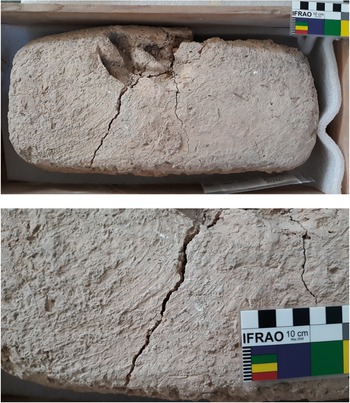
At Knossos, mudbricks made their appearance in the Initial Neolithic alongside other earthen techniques such as wattle-and-daub, and from Middle Neolithic tauf (recorded as pisé) (Evans Reference Evans1971; Reference Evans, Evely, Hughes-Brock and Momigliano1994). Early Neolithic mudbricks showed evidence of circular polishing on the surface, probably carried out with a wet cloth or wet leaves after moulding and before the bricks were laid out to dry. This kinaesthetic movement can be associated with a smilar step in other earthen techniques. The repetitive circular polishing of freshly elevated surfaces is typical of mud plastering and wattle-and-daub. In a period in which both techniques were in use at Knossos, this movement seems to have been transferred between the two branches of the chaîne opératoire. This provides preliminary evidence of motor-skill transfer between different earthen techniques, suggesting the presence of communities of practice, or better perhaps, of communities of knowledge (Fig. 5).
Knossos mudbrick, House E, Areas AC, Stratum IX, evidencing possible kinaesthetic movements.

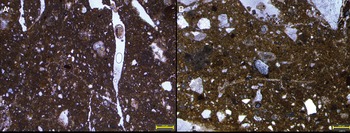
A community of knowledge may actually be the more appropriate definition for a social group that shared knowledge of production but for which we cannot assess the level of craftmanship and specialization due to the limited nature of our archaeological materials. Evidence of skill transfer between mudbrick and daub techniques in the Early Neolithic can be proposed from the similarity of raw-source procurement and sediment preparation. This silty matrix with few, angular and very poorly sorted inclusions that characterized both earthen processes suggests the limited mixing of the mud and similar processing techniques (Fig. 6).
Thin section of (A) mudbrick and (B) daub (plain polarized light) in which are visible the similar matrix with microfossils and limited inclusions such as rounded clay-rich granules.

On the other hand, the diversity of vegetal temper used in the Middle Neolithic tauf seems to indicate a technological development in the knowledge of earthen building materials. The use of long bendable grasses is only featured in this technique, emphasizing a more marked separation between different earthen chaînes opératoires in this period.
When mudbricks reappeared at Knossos during the Final Neolithic/Subneolithic and Early Bronze Age, they did not present the same semi-circular striations, indicating that over time this step of the chaîne opératoire was progressively abandoned. Was it abandoned because it was not functional for mudbrick manufacture? Or because of the increased standardization of mudbrick architecture in the Final Neolithic/Early Bronze Age? The lack of extensive materials from multiple contexts does not permit the formulation of a more precise answer. We can, however, debate whether the introduction of additional steps (i.e. mould-moulding in EBA) in the manufacture of modular units and the long-term communal effort required incentivized a progressive standardization in production. The presence of a passive step in the mudbrick chaîne opératoire, the drying phase, took at least a couple of weeks. Aside from turning the drying mudbricks, this step does not require the active participation of the mudbrick maker. It is possible that this created a separation of the two key phases of mudbrick production: manufacture and construction. As the two phases could only occur at a temporal distance, they might not always have been conducted by the same people (Kurapkat Reference Kurapkat, Renn, Osthues and Schlimme2014, 85).
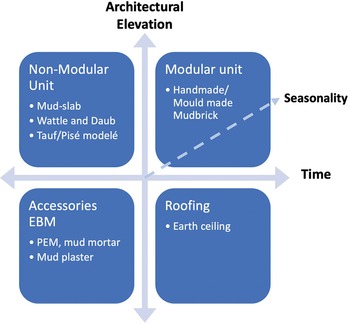
The temporal element is often missing in the reconstruction of the chaîne opératoire for earthen building materials. The sourcing of these materials and their production may occur at different times throughout the year, still creating perfectly functional materials. For mudbrick manufacturing, this was not always the case, since the need for mudbrick to dry before construction introduced an important step that is quantifiable. For example, chaff, the main vegetal temper used, was collected after threshing and mudbrick needed a moderately dry/warm season to dry properly (Devolder & Lorenzon Reference Devolder and Lorenzon2019). Temporality and seasonality are therefore two other variables that we can introduce into our analysis of the chaîne opératoire. Thus, when considering differences between non-modular building materials and modular units, it also becomes necessary in addition to account for the length of the manufacturing and construction processes, and their seasonality (Fig. 7).
Graph of modular units and time.

Concluding reflections
Cognitive anthropology has explored the creation and development of communities of practice in architecture as moving beyond language-cognitive skills, but operating through motor cognition, in which the mode of learning is based on kinaesthetic representation and simulations (Cutler Reference Cutler2019; Marchand Reference Marchand and Harris2007, 193–95; Minar & Crown Reference Minar and Crown2001, 375). Ethnographic studies that focus on earthen architecture have analysed the structuration of social relations during the learning process, and shown the primary importance, in the learning process, of the relationship established between an apprentice and a master; a skilled labourer and top-down relations are the backbone of this type of learning process (Fodde Reference Fodde2009; Jerome et al. Reference Jerome, Chiari and Borelli1999; Marchand Reference Marchand, Rainer, Gandreau and Rivera2011). At the same time, there is evidence for the establishment of horizontal connections between different communities of practice, for instance between skilled and semi-skilled labourers who share their knowledge of earthen architecture among themselves, specifically when a skilled workman is not present within the community (Fodde Reference Fodde2009, 152–3; Lorenzon & Sadozaï Reference Lorenzon, Sadozaï, Joffroy, Guillaud and Sadozaï2018).
While the limited material preserved provides preliminary evidence for the presence of communities of practices in the eastern Mediterranean from the Middle Neolithic onward, the data demonstrate a general synchronic consistency of earthen practices within each site. The heterogeneous nature of techniques among different sites supports the hypothesis that knowledge and practice were shared within Neolithic communities through the creation of a social learning context in which members of the same community participated (Minar & Crown Reference Minar and Crown2001, 372; Rogoff Reference Rogoff1990; Reference Rogoff, Wertsch, del Rio and Alvarez1995; Wendrich Reference Wendrich and Wendrich2012a, 11–16). While we cannot always assess the characteristics, organization, or nature of these communities of practice, we nevertheless recognize their presence.
We may then define these as ‘communities of knowledge’, a shared know-how based on motor skills and tacit learning such as choice of raw sources over time. If the motor skills were not efficient, they were abandoned, as in the case of Knossos. For instance, the variability in wattle-and-daub techniques between Neolithic sites exemplified by diverse daub composition, fibres used and wall thickness indicates diverse manufacturing and construction traditions that reflect the variety of knowledge present in each community, which was shaped by unique environmental and social contexts (Mould & Wardle Reference Mould, Wardle, Ridley, Wardle and Mould2000; Pantelidou-Gofa Reference Pantelidou-Gofa1991). Conversely, at Ilıpınar and Makri, the coexistence of different earthen architectural techniques within a single building can be linked to the presence of more than one community of knowledge within each site.
The creation of a communities of knowledge is also visible in the endurance of specific earthen techniques within the same site (i.e. Dikili Tash; Servia), proving that knowledge and expertise were being shared between members of the community over time (Koukouli-Chrysanthaki et al. Reference Koukouli-Chrysanthaki, Treuil and Malamidou1996; Malamidou et al. Reference Malamidou, Ntinou, Valamoti, Tsirtsoni, Koukouli-Chryssantakhi, Darcque, Sarris, Kalogiropoulou, Kalayci and Karimali2018, 61–6; Martinez Reference Martinez2001; Mould & Wardle Reference Mould, Wardle, Ridley, Wardle and Mould2000; Prévost–Dermarkar Reference Prévost–Dermarkar2019).
Earthen building-material manufacture is intrinsically linked to kinaesthetic movements. The repetition of specific motor activities learned over time leaves traces on these materials. Through comparisons, these traces can help us determine the characteristics of each community of knowledge. At Knossos, for instance, the few surviving mudbrick examples retained evidence of wet-polishing after hand-moulding. This is associated with a specific kind of know-how in the Early Neolithic earthen building process. Already in the Middle Neolithic the differentiation in the choice of vegetal temper indicates a clear separation between different techniques. This separation might also demonstrate the diminishing of the household-based organization of labour in favour of a community-based architectural production. Engaging in communities of knowledge—the predecessor of communities of practice—redefines earthen building production both diachronically and synchronically. Diachronically, it enables us to study skill transfer between generations; synchronically it allows us to compare production techniques between members of the same community (Abell Reference Abell2020; Lave & Wenger Reference Lave and Wenger1991).
To grasp fully the socio-cultural impact of architecture on the building practices of past communities, investigations should consider more precisely the modalities of learning processes, their technological and social aspects and their diachronic transformation. While diverse earthen architectural practices may be the result of environmental conditions, each Neolithic community created and sustained local traditions that were clearly meaningful to them. For a more holistic understanding, I argue we need to go beyond ecological determinism and reflect upon the Sitz im Leben of these practices in order to make inferences about the economic, socio-cultural importance of buildings and building materials in this period.
Acknowledgements
This research was conducted with the financial support of the Deutsches Archäologisches Institut (DAI) and PM Warren Visiting Fellowship, Institute of Greece, Rome, and the Classical Tradition, University of Bristol. Special thanks are also due to my colleagues Moritz Kinzel, Nicoletta Momigliano, Paula Gheorghiade and Caroline Wallis for fruitful discussions on Neolithic architecture and preliminary comments on an early draft of this manuscript. I would also like to thank Peter Tomkins and Valasia Isaakidou as PIs of the Neolithic Knossos project for their insightful comments, continuous support, and encouragement to investigate Knossos earthen materials. A special thanks to Joanne Cutler, who is no longer with us, but was an inspiration and often a sounding-board for the discussion of Neolithic materials. I am also really grateful to the British School at Athens for granting me access to the earthen building materials preserved at the Knossos Stratigraphic Museum, the Knossos Research Centre, and Dr Kostis S. Christakis, the Knossos Curator. Sampling permits were provided by the Ephorate of Antiquities of Heraklion and the Greek Ministry of Culture.