Introduction
The widespread evolution of herbicide resistance in weeds (Heap Reference Heap2014), the lack of recent herbicide discovery (Duke Reference Duke2012), and the risk of regulatory withdrawal of some herbicides (Chauvel et al. Reference Chauvel, Guillemin, Gasquez and Gauvrit2012) have catalyzed the development of nonchemical weed control practices. One postcrop maturity practice that could potentially be used in an integrated weed management system is harvest weed seed control (HWSC). These systems have been developed in Australia to collect and destroy weed seeds during grain harvest, thus minimizing weed seedbank inputs by seed rain (Walsh et al. Reference Walsh, Harrington and Powles2012, Reference Walsh, Broster, Schwartz-Lazaro, Norsworthy, Davis, Tidemann, Beckie, Lyon, Soni, Neve and Bagavathiannan2018b; Walsh and Powles Reference Walsh and Powles2007). Weed seedbanks are the soilborne reserves of viable seeds that act as a primary source of annual weed infestations (Buhler et al. Reference Buhler, Hartzler and Forcella1997; Gill and Holmes Reference Gill and Holmes1997). The prolific seed production potential of annual weeds and the formation of persistent seedbanks suggest that management strategies should focus on reducing weed seed inputs rather than solely controlling weed density (Gallandt Reference Gallandt2006).
Most annual weeds retain on the plants at maturity a high proportion of the total weed seed produced, which enables its collection and processing at grain crop harvest (Gill and Holmes Reference Gill and Holmes1997; Walsh et al. Reference Walsh, Broster, Schwartz-Lazaro, Norsworthy, Davis, Tidemann, Beckie, Lyon, Soni, Neve and Bagavathiannan2018b). During a typical grain crop harvest, a high proportion of the total weed seed produced is retained above the harvesting height for many annual weeds, enabling its collection, threshing, and separation from grain to exit the harvester in the chaff fraction, which is evenly redistributed across the field by the harvester’s residue-spreading system (Broster et al. Reference Broster, Walsh and Chambers2016; Walsh et al. Reference Walsh, Newman and Powles2013). This process creates the opportunity to intercept weed seeds by targeting the chaff fraction as it exits the harvester (Broster et al. Reference Broster, Walsh and Chambers2016). Currently, there are multiple HWSC systems in use in Australia that include chaff carts, narrow windrow burning, bale direct system, chaff tramlining, chaff lining, and mechanical weed seed destruction by “impact mills” such as the Harrington Seed Destructor (HSD), Seed Terminator, and Redekop system. Although, HWSC systems have been shown to be equally effective, in the case of rigid ryegrass (Lolium rigidum Gaudin) (Walsh et al. Reference Walsh, Aves and Powles2017), the impact mill has received greater global interest due to its efficacy in weed seed destruction, its ability to retain all crop harvest residues for moisture conservation and nutrient cycling, and its elimination of the need for additional postharvest chaff management practices (Tidemann et al. Reference Tidemann, Hall, Harker and Beckie2017; Walsh et al. Reference Walsh, Harrington and Powles2012, Reference Walsh, Newman and Powles2013).
The impact mills have been rigorously tested in Australia and can destroy >90% of seeds of wild oat (Avena fatua L.), brome grass (Bromus spp.), L. rigidum, and wild radish (Raphanus raphanistrum L.) during a wheat (Triticum aestivum L.) harvest (Walsh et al. Reference Walsh, Harrington and Powles2012). Tidemann et al. (Reference Tidemann, Hall, Harker and Beckie2017) also reported high levels of weed seed destruction (>98%) and concluded that impact mills such as the HSD will be highly effective in many cropping systems in western Canada and the U.S. Great Plains. In 2016, a modified version of the HSD was commercialized, known as the “Integrated HSD” (iHSD), which integrated the HSD at the rear of a combine harvester and was powered by the combine harvester rather than a separate diesel engine, as in the original HSD (Anonymous 2019). The iHSD impact mill system was introduced to eliminate the need for a tow-behind system and to reduce costs by using the engine of the combine (Walsh et al. Reference Walsh, Broster and Powles2018a). The iHSD impact mill system was tested on weeds of soybean [Glycine max (L.) Merr.] and rice (Oryza sativa L.) in the southern United States (Schwartz-Lazaro et al. Reference Schwartz-Lazaro, Norsworthy, Walsh and Bagavathiannan2017b) and was found to destroy >99% of seeds of 11 tested weed species.
Although impact mills provide a high level of weed seed destruction, a small fraction of weed seeds are damaged less lethally. All of the studies conducted so far have evaluated weed seed destruction efficacy of the impact mills, but none of them have studied the fate of weed seeds in the seedbank that remain viable after impact mill processing. Furthermore, the efficacy of the impact mills in destroying seeds of weeds common to the soybean production systems in the midwestern and mid-Atlantic United States is unknown. Therefore, the objective of this study was to (1) determine the efficacy of impact mill to target weed seeds of common weeds in the midwestern and mid-Atlantic regions and (2) determine the fate of weed seeds in the seedbank that remain viable after impact mill processing. The HSD, (De Bruin Engineering Pty Ltd, Mount Gambier, Australia) a trailer-mounted impact mill–based processing unit that destroys weed seeds in seed-bearing chaff material during grain crop harvest was used to conduct this study.
Materials and Methods
Plant Material
Seeds of seven problematic weed species in the Midwest during 2015 and five in the mid-Atlantic United States during 2017 with a range of seed sizes were selected for stationary impact mill testing. The seven midwestern weed species were waterhemp [Amaranthus tuberculatus (Moq.) J. D. Sauer], common lambsquarters (Chenopodium album L.), giant foxtail (Setaria faberi Herrm.), velvetleaf (Abutilon theophrasti Medik.), ivyleaf morningglory (Ipomoea hederacea Jacq.), giant ragweed (Ambrosia trifida L.), and common cocklebur (Xanthium strumarium L.). The five mid-Atlantic weed species were smooth pigweed (Amaranthus hybridus L.), common ragweed (Ambrosia artemisiifolia L.), jimsonweed (Datura stramonium L.), C. album, and A. theophrasti. Chaff and weed seed for impact mill testing were collected from the agricultural fields in Urbana, IL, and the Beltsville Agricultural Research Center (BARC), MD, in late summer and early fall of 2015 and 2017, respectively. Chaff was collected directly from a combine from a soybean field with no visible weed presence. The collected chaff and weed seeds were then placed separately in cloth bags to enable air drying and stored in a laboratory at room temperature until used for impact mill testing. Before the impact mill testing, all seeds were cleaned using a STS-WM3 air-column seed cleaner (U.S. Global Resources, Seattle, WA). The viability of the weed seed lot was estimated by testing a separate subsample of 20 seeds per species in four replicates using the tetrazolium chloride test per the procedure described by Elias and Garay (Reference Elias and Garay2004). The estimated viability percentages were then used to adjust the number of viable seeds tested with the impact mill. Eight replicates of 500 viable seeds were manually counted and placed in paper envelopes to be used for impact mill testing later. Due to its larger seed size, X. strumarium was limited to 100 viable seeds per replicate for stationary testing. From the same seed lot of each weed species, four replicates of 30 seeds per species were counted and placed in paper envelopes to be used as a control for winter burial study. Similarly, four replicates of 300 seeds per species were also counted and bagged to be used as a control for a weed seed germination assay. For each species, the 100-seed weight was also recorded for each replicate.
Stationary Impact Mill Testing
Impact mill testing was conducted at the University of Illinois at Urbana–Champaign, IL, in 2015 and BARC in 2017. For impact mill testing, eight replicates for each sample per species containing 6 L of soybean chaff mixed with 500 seeds per species were used, except for X. strumarium, which had 100 seeds per replicate. The volume of the soybean chaff used was based on harvest index and the operational capacity of a Class 9 combine during soybean harvest as described by Schwartz-Lazaro et al. (Reference Schwartz-Lazaro, Norsworthy, Walsh and Bagavathiannan2017b). To ensure homozygosity of the samples and prevent seed settling, the chaff and weed seeds were manually mixed just before impact mill processing. The mixed seeds and chaff went through impact mill in order of largest to smallest seeds. The samples were introduced into the impact mill once the mill was running at maximum speed of 1,400 rpm. A cloth bag was mounted on the back of the impact mill to collect the processed sample. The impact mill was allowed to run for an additional minute to ensure that the entire sample was processed and expelled. To avoid weed seed contamination between species, a sample of 6 L of chaff only was run between test samples.
The impact mill–processed samples were passed through multiple hand sieves to separate seed material and chaff. For each species, the sieve sizes were selected to retain the seeds between original seed size and 50% of their original size. The separated seed material was visually assessed using a magnifying glass; seeds of original size or at least 50% of their original size that withstood the forceps crush test (Sawma and Mohler Reference Sawma and Mohler2002) were separated and labeled as potentially viable seed (PVS). All the remaining chaff was further tested in a greenhouse for potentially missed seeds.
Weed Seed Germination Testing
After extracting seed material, the separated chaff was further assessed during the next growing season for weed seed emergence to estimate potential missed seeds. In April 2016 and 2018, each sample was spread in a thin layer on a 55 cm by 28 cm greenhouse flat filled with a potting medium (Pro-Mix® PGX, Hummert International, Earth City, MO). The chaff was lightly mixed with the top layer of the potting mix to ensure germination. Additionally, 300 seeds per species were seeded into flats and covered over with potting medium and used as a control. Weed emergence was recorded weekly by counting and removing weeds from the trays beginning at 7 d after sowing. The trays were maintained in a greenhouse for 6 wk until no further emergence was noted in consecutive assessments. The trays were watered twice a week for the duration of the experiment.
Winter Burial
The fate of weed seeds in the field during winter after impact mill processing was analyzed by burying the impact mill–processed and nonprocessed weed seeds in the field overwinter at Urbana–Champaign, IL (40.08°N, 88.21°W), in 2015 to 2016, and BARC (39.03°N, 76.92°W) in 2017 to 2018. For each species, the PVS separated from the processed sample from two replicates were combined and mixed with a small amount of unmilled weed-free chaff and placed in a wire-mesh bag (76 cm by 38 cm), referred to as one replicate for the purposes of this study. The remaining impact mill–processed samples were combined similarly, resulting in four replicates for each species. The chaff was mixed with the samples to mimic the natural exposure of weed seeds in the field. In addition to the impact mill–processed PVS, 30 unprocessed control seeds per species per replicate were buried overwinter following the above procedure. By replicate, the PVS (impact mill–processed) samples and unprocessed controls were put together in a 10 cm by 8 cm wire envelope (SKU: 698621, Hobby Lobby, Laurel, MD), buried at a 5-cm depth in the field in December 2015 and 2017 to mimic the seed burial due to fall cultivation and/or soil freeze–thaw cycles in this region. All the replicates were buried at the same time. At 90 d after burial (DAB), in spring 2016 and 2018, wire envelopes were removed from the field. Seeds recovered in mesh bags were recorded for both impact mill–processed PVS and nonprocessed control samples. The recovered seeds that survived overwinter were tested for viability using a forceps crush test (Sawma and Mohler Reference Sawma and Mohler2002). The following criteria were followed to classify seeds: (1) any seed that resisted crushing, flattening, or disintegrating was considered viable; (2) seed that appeared intact but collapsed under pressure was considered nonviable; and (3) seed that disintegrated and could not be recovered after burial was considered decayed.
Statistical Analysis
The percent weed seed destruction by the impact mill was calculated using Equation 1. The initial viability percent of the weed seed lot was used to adjust the number of viable seeds tested with the impact mill.
 $$\eqalign{\% \ {\rm{seed}}\ {\rm{destruction}}\ {\rm{by}}\ {\rm{HSD}} \hskip -94pt\cr={{{\rm{no}}.\ {\rm{of}}\ {\rm{viable}}\ {\rm{seeds}}\ {\rm{in}}\ {\rm{the }}\ {\rm{sample}} - {\rm{PVS}}} \over {{\rm{no}}.\ {\rm{of}}\ {\rm{viable}}\ {\rm{seeds}}\ {\rm{in}}\ {\rm{the}}\ {\rm{sample}}}}\!\, \times \! 100}$$
The Pearson’s correlation coefficient (r) between percent seed destruction by impact mill and 100-seed weight (g) was estimated using PROC CORR in SAS® v. 9.4 (SAS Institute, Cary, NC). The linear regression model (Equation 2) was fit to the data using Origin® v. 2019 (OriginLab Corporation, Northampton, MA).
 $$Y = a + bx$$
where Y is the percent seed destruction by impact mill, x is 100-seed weight, a is the intercept, and b is the slope of the line. The % seed viability after winter burial was calculated using Equation 3, while % seed decay after winter burial was calculated using Equation 4.
 $$\% \ {\rm{seed}}\ {\rm{viability}} = {{{\rm{no}}.\ {\rm{of}}\ {\rm{recovered}}\ {\rm{viable}}\ {\rm{seeds}}} \over {{\rm{no}}.\ {\rm{of}}\ {\rm{seeds}}\ {\rm{buried}}}}\, \times \, 100$$
 $$\% \ {\rm{seed}}\ {\rm{decay}}\,\! = \!\hskip 1pt 100\!\, -\!\! \ \% \ {\rm{total}}\ {\rm{seed}}\ {\rm{recovered}}$$
All the data were subjected to ANOVA using PROC GLIMMIX in SAS. Data for each site-year were analyzed separately. Weed species and impact mill were analyzed as fixed effects, while replications were considered a random effect in the model. Residual analysis was performed using PROC UNIVARIATE in SAS, and data for seed destruction by impact mill followed a gaussian distribution. However, the data for seed viability, nonviability, and decay were arcsine square-root transformed before analysis to improve the normality of residuals and homogeneity of variance. Means are presented on the basis of the interpretation from the transformed data. Means were separated using Fisher’s protected LSD (α = 0.05).
Results and Discussion
Stationary Impact Mill Testing
The impact mill was highly effective in destroying small-seeded weed species such as A. tuberculatus and C. album as well as large-seeded species such as X. strumarium and A. trifida (Table 1). However, the greatest effect of the impact mill was on A. theophrasti seeds, with 99% seed destruction; slightly lower seed destruction (92%) was incurred by A. hybridus seeds. During 2015, the impact mill destroyed, on average, 98% of weed seed with a range of 93.5% to 99.8% (Figure 1). However, during 2017, weed seed destruction averaged 96.1% with a range of 85.6% to 100%. These results are consistent with previous studies testing impact mill efficacy in Australia, Canada, and the southern United States (Schwartz-Lazaro et al. Reference Schwartz-Lazaro, Norsworthy, Walsh and Bagavathiannan2017b; Tidemann et al. Reference Tidemann, Hall, Harker and Beckie2017; Walsh et al. Reference Walsh, Harrington and Powles2012). In pioneering studies to evaluate the cage mill capacity to destroy weed seeds in crop chaff in Australia, Walsh et al. (Reference Walsh, Harrington and Powles2012) found that >94% of L. rigidum seeds were destroyed at the fastest mill speed of 1,300 rpm. Subsequently, high levels (>97%) of weed seed destruction by impact mills were reported in Canada and the southern United States, respectively (Schwartz-Lazaro et al. Reference Schwartz-Lazaro, Norsworthy, Walsh and Bagavathiannan2017b; Tidemann et al. Reference Tidemann, Hall, Harker and Beckie2017).
Estimates of mean ± SE 100-seed weight (g) and weed seed destruction (%) efficacy of the impact mill for various weed species during 2015 and 2017.

a Means followed by the same letter are not different at P ≥ 0.05. A dash indicates that a weed was not processed in that year.
Box-and-whiskers plot of weed seed destruction by impact mill during 2015 and 2017.

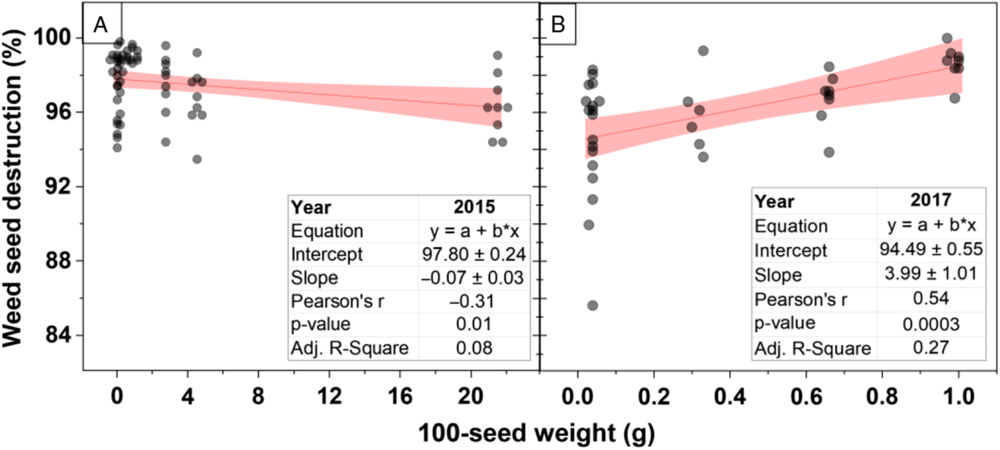
The weed species used for stationary impact mill testing, based on a 100-seed weight, ranged from 0.02 to 21.5 g. We hypothesized that weed seed destruction by the impact mill would be positively correlated with seed size. However, in 2015, seed destruction by impact mill (%) showed a very weak negative correlation with 100-seed weight (r = −0.31, P = 0.01); the linear model explained 8% of the variability in seed destruction by impact mill (Figure 2A). In 2017, a weak positive correlation between seed destruction by impact mill (%) and 100-seed weight was observed (r = 0.54, P = 0.0003); the linear model explained 27% of the variability in seed destruction by impact mill (Figure 2B). Although, the effect of seed size is significant (P < 0.05), the model only explained a small proportion of the variability in seed destruction by the impact mill. Tidemann et al. (Reference Tidemann, Hall, Harker and Beckie2017) observed a positive linear relationship between volunteer canola (Brassica napus L.) seed control by the impact mill at seed weight. However, the authors concluded that seed size might not significantly influence control from a practical standpoint, as >98% control was achieved across all tested weights. Similarly, Schwartz-Lazaro et al. (Reference Schwartz-Lazaro, Norsworthy, Walsh and Bagavathiannan2017b) also reported that the efficacy of the impact mill was independent of weed seed size, as it effectively destroyed small-seeded weed species such as Palmer amaranth (Amaranthus palmeri S. Watson) and large-seeded weed species such as I. hederacea and X. strumarium. The weak relationships (positive or negative) between seed size and seed destruction by the impact mill and the high percentage of weed seed destruction by the impact mill across all seed sizes in this study indicate that the biological or practical effect of seed size is limited.
The correlation and regression plot of weed seed size (100-seed weight) and percent weed seed destruction by impact mill in (A) Year 2015, and (B) Year 2017. The solid red line (─) shows the fit of the linear model, and the area shaded in red around the line is the 95% confidence interval.

Weed Seed Germination and Winter Burial
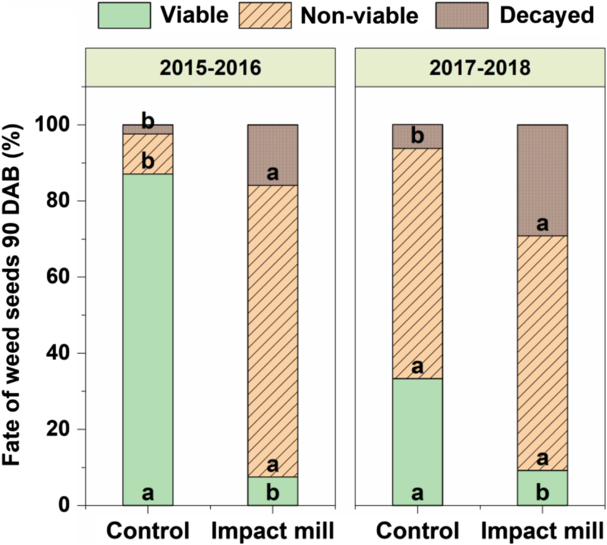
During weed seed germination testing, except control, no weed seed germination was observed in the chaff portion separated from the impact mill–processed sample, indicating that no viable seeds were missed during the sieving process. The recovered PVS seeds that survived overwinter were tested for viability and classified as viable, nonviable, or decayed (Figure 3). The percentage of viable and nonviable seed between unprocessed control treatments differed significantly between years, with a greater percentage of viable seed recorded in 2015 to 2016 and nonviable seeds in 2017 to 2018. The difference in seed viability between the 2 yr was likely due to the difference in weed species tested, environmental conditions, and agricultural management histories at both sites. Crops and crop management systems substantially influence weed seed decay rates (Chee-Sanford et al. Reference Chee-Sanford, Williams, Davis and Sims2006; Davis et al. Reference Davis, Anderson, Hallett and Renner2006). Different cropping systems affect soil physical and chemical characteristics differently (Chee-Sanford et al. Reference Chee-Sanford, Williams, Davis and Sims2006), ultimately affecting the distribution of soil microbial population that can potentially influence the colonization and decay of weed seeds (Gómez et al. Reference Gómez, Liebman and Munkvold2014). During both years, the data showed that the impact mill significantly reduced seed viability and promoted seed mortality compared with the unprocessed control. Damage to weed seeds by the impact mill that did not destroy the seed likely physically scarified the PVS and promoted seed mortality via microbial decomposition. Mechanical damage to the seed coat has been previously shown to increase seed mortality during burial (Davis et al. Reference Davis, Schutte, Iannuzzi and Renner2008). The physical integrity of the seed coat is essential for persistence of seeds in the soil (Mirsky et al. Reference Mirsky, Wallace, Curran and Crockett2015; Mohamed-Yasseen et al. Reference Mohamed-Yasseen, Barringer, Splittstoesser and Costanza1994; Rodgerson Reference Rodgerson1998), as mechanical damage helps fungi or bacteria to overwhelm seed chemical defenses (Davis et al. Reference Davis, Schutte, Iannuzzi and Renner2008). The similar level of viability reduction by the impact mill during both years also suggests that the seed-destruction effect of the impact mill is independent of the weed species processed. The fate of weed seeds after impact mill processing and overwintering in fields is summarized and shown in Figure 4. The majority (97.5% in 2015 to 2016; 96.1% in 2017 to 2018) of weed seeds processed by the impact mill were instantly destroyed; only a small fraction (0.2% in 2015 to 2016; 0.4% in 2017 to 2018) of the total weed seed processed by the impact mill remained viable after winter burial. Most of the PVS recovered after impact mill processing either decayed (0.4% in 2015 to 2016; 1.2% in 2017 to 2018) or were rated as nonviable at 90 DAB (1.9% in 2015 to 2016; 2.4% in 2017 to 2018).
The fate of weed seeds in the seedbank that remain intact after impact mill processing at 90 d after burial (DAB) during 2015 to 2016 and 2017 to 2018. Means within the same data set followed by the same letter are not different at P ≥ 0.05.

Pie charts summarizing the fate of weed seeds after impact mill processing and overwintering in fields for 90 d at (A) Urbana–Champaign, IL, in 2015 to 2016, and (B) at Beltsville Agricultural Research Center, Beltsville, MD in 2017 to 2018. PVS, potentially viable seed.

Management Implications
The results presented here demonstrate that the impact mill is highly effective in increasing seed mortality. Even seeds that appeared to be intact or potentially viable after passing through the impact mill were prone to rapid decay due to mechanical damage incurred during processing. However, the potential of the impact mill to effectively target weed seed production during a harvest depends upon the biological attribute of seed retention at maturity, which facilitates weed seed capture at crop harvest. Amaranthus palmeri, A. trifida, A. tuberculatus, I. hederacea, and S. faberi are the most problematic weeds in corn (Zea mays L.) and soybean crop production systems in the United States (Wychen Reference Wychen2015, Reference Wychen2016). Several studies have shown evidence of high proportions (>50%) of seed retention at maturity in these weed species, concurrent with the crop harvest window (Davis Reference Davis2008; Goplen et al. Reference Goplen, Sheaffer, Becker, Coulter, Breitenbach, Behnken, Johnson and Gunsolus2016; Schwartz et al. Reference Schwartz, Norsworthy, Young, Bradley, Kruger, Davis, Steckel and Walsh2016; Schwartz-Lazaro et al. Reference Schwartz-Lazaro, Green and Norsworthy2017a). The high weed seed retention rate at crop harvest and destructive potential of the impact mill suggest that it can play a vital role in managing weed populations in U.S. cropping systems. Although the weed seedbank will be marginally replenished by seeds shattered before harvest, the impact mill aids in destroying the majority of the weed seeds at harvest, subsequently decreasing the seedbank over time. Each year, the soil seedbank is the primary source of new annual weed infestations. Preventing seeds from contributing to the seedbank is critical for long-term weed management (Buhler et al. Reference Buhler, Hartzler and Forcella1997; Davis Reference Davis2006, Reference Davis2008). Targeting weed seed rain in addition to controlling weeds at the seedling stage could aid in further optimization of integrated weed management systems (Davis Reference Davis2006). The impact mill is one way to target weed escapes from early-season weed management tactics that set seed at the end of the growing season. Weeds that escape early-season control measures are highly likely to harbor traits for herbicide resistance and, if allowed to set seed, would contribute to the development of herbicide resistance in subsequent seasons (Jasieniuk et al. Reference Jasieniuk, Brule-Babel and Morrison1996). Diversifying management selection pressures that complement and/or improve chemical weed control will help to control existing resistant populations and decrease the incidence of new cases of herbicide resistance. Thus, there is a great potential to use the impact mills as an HWSC tactic for integrated weed management in the United States. However, further research is required to evaluate weed control efficacy of the impact mills across various cropping systems and environments in the United States.
Acknowledgments
The authors acknowledge area-wide financial support from USDA-ARS (project no. 8042-22000-166-20-S). We also express our gratitude to Victoria Ackroyd (Research Scientist, Sustainable Agricultural Systems Laboratory, USDA-ARS) for reviewing the early draft of this paper. We also acknowledge the technical assistance provided by Allen Burke, Ethan Sweep, Cara Peterson, Jennifer Showalter, Nicholas Hausman, and several undergraduate and graduate students.