After the notable editions of Suetonius by Roth,Footnote 1 Preud'homme,Footnote 2 IhmFootnote 3 and Ailloud,Footnote 4 the De uita Caesarum edited by R.A. KasterFootnote 5 in the Oxford Classical Texts has made available to scholars a critical text which rests on the firm foundations of a thorough exploration of the tradition and the scholarship on the subject. The relationship of the eighteen medieval manuscripts, placed in a time-frame between the ninth century, the age of the oldest copy, Par. Lat. 6115, and the beginning of the thirteenth century, has been extensively and carefully examined and schematized in a complex stemma codicum, which illustrates the network of copying and contamination. Moreover, the editor has revised the dating of the manuscripts, in the light of the most recent studies, and brought order to the sigla assigned to them by previous editors.
Suetonius, as is well known, incorporated Greek words and phrases in the Caesars: we find them in all the Lives Footnote 6 save that of Titus. As a whole, their placement is uniform throughout the work, although they are more concentrated in some passages (Aug. 98.4–99.1, Tib. 21.4–6, Claud. 4.2, Nero 38.1–40.2). In many cases, they are literary quotations, mainly drawn from the Iliad. Among them there appear the longest sentences, such as Il. 10.246–7 at Tib. 21.6 and the epigram by Euenus from Anth. Gr. 9.75 at Dom. 14.2. Lines 524–5 of Euripides’ Phoenissae at Caes. 30.5 are a clear ancient interpolation.
In the medieval transmission, Greek passages in Latin works, losing their stable form, underwent a gradual alteration. Their restoration was one of the most challenging tasks for humanist philology, when Greek began to be studied again in the West and linguistic competence could be applied to recovering the corrupt Graeca, a process that handed on a reliable textual basis to modern scholarship. From that point, generations of scholars were able to improve on the results previously achieved. However, even in the Middle Ages the need was felt to work out the meaning of the Greek passages; some witnesses to attempts at interpretation, severely conditioned by limited linguistic knowledge, survive in Carolingian and Ottonian manuscripts. The first evidence of a determination to interpret—and restore—the Greek in Suetonius’ work probably dates back to this period, when an anonymous scholar set about recognizing the words in segments of Greek written in scriptio continua and translating them into Latin: this translation is situated between the lines of some manuscripts, the oldest of which is Vat. Lat. 1904, dating back to the first half of the eleventh century.
However, the turning point in the history of Suetonius’ Graeca is the restoration carried out by Manuel Chrysoloras in Florence at the end of the fourteenth century. Greek passages transcribed in Chrysoloras's hand are preserved in two manuscripts, Vallic. B 26 and Laur. 20 sin. 3.Footnote 7 The text that he established allowed a good understanding of the Greek in the De uita Caesarum; nevertheless, the scant attention paid by scholars to the humanistic transmission of Suetonius’ work, and more precisely of its Graeca, led to the absence of Chrysoloras's name from the apparatus criticus of any modern edition, although the authorship of the vulgate text belongs to him. Not even Kaster's edition, though well informed, has filled this gap.
The peculiar circumstances in which Greek was transcribed in Latin works, by copyists who reproduced the letters by imitation or from a simple knowledge of the Greek alphabet, granted autonomy to Greek passages in the process of transmission. This autonomy, which makes them what can be called ‘a text within a text’, affords an invaluable resource for philological analysis. This has nothing to do with occasionally including this or that reading in the data assembled from examination of the Latin text; rather it means that we need to study the Graeca for their own sake. A proper evaluation will lead to philological conclusions to which results achieved on the Latin text can be compared. This is an investigation which has so far never been made in a systematic way, and Suetonius’ historical work, which has been the object of sundry studies and has been published many times, is one of those that have suffered. A contribution which I am preparing will be devoted to such an investigation: I shall illustrate the methodological and philological features of a comprehensive analysis of the Graeca in the De uita Caesarum carried out on the basis of their own textual character.
I present here some proposals arising from this research and referring to the constitutio textus of the Greek passages: they are the outcome of the convergence of palaeographical, historical and linguistic reflections which allow us to sift through the traditional textual data and offer a different perspective.Footnote 8
1) Tib. 21.4 ἐμοὶ καὶ ταῖς Μούσαις στρατηγῶν
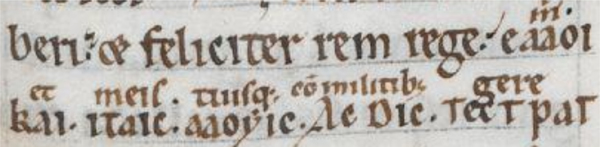
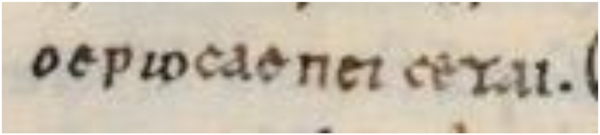
The sentence is contained in a letter from Augustus to Tiberius; its meaning has been explained in an article by J.G.F. Powell,Footnote 9 who recalls Cic. Brut. 87, where the music-teacher Antigenidas addresses his pupil using a similar expression: mihi cane et Musis. Kaster accepts Chrysoloras's reading—which is for him just the reading of the first editions and of one of the fifteenth-century manuscripts, Oxon. Canon. Class. Lat. 180—rejecting the cruces of Preud'homme († μου ισα σαιστε)Footnote 10 and Ihm († μουισασαιστ), and the numerous conjectures of earlier scholars (which he does not report in his apparatus criticus; they are recorded by Preud'homme and Ihm).Footnote 11 All the conjectures tried to make better use of the letters not considered in Chrysoloras's plain reconstruction. Kaster indicates in the apparatus ΜΟΥΙCΑCΑΙCΤ as the reading of the archetype; however, the sequence of letters in the archetype must have been ΜΟΥΙCΑCΔΙCΤ, the delta being clearly distinguishable from alpha and lambda, as shown by the well-defined outline of this letter in Vat. Lat. 1904 and Par. Lat. 6115 (Fig. 1). A clear delta can also be seen in Par. Lat. 5801 (Fig. 2), while it is converted into a capital Latin D in Montepess. H 117 (Fig. 3) and in Laur. 68.7Footnote 12 (Fig. 4). None of these elements has been taken into account in the scholarly discussion.
Par. Lat. 6115.

Par. Lat. 5801.

Montepess. H 117.

Laur. 68.7.

A different conjecture can be proposed on the basis of the actually transmitted shapes of the Greek letters: in order to emphasize Tiberius’ double militancy, Augustus might have resorted to the joking neologism διστρατηγῶν (cf. διλογέω); alternatively, the sentence has to be read as ἐμοὶ καὶ ταῖς Μούσαις δὶς στρατηγῶν.Footnote 13 Chrysoloras used the letters ΔΙC after ΜΟΥΙCΑC, which he probably read in Laur. 68.7 as DΙC, to recover the word Μούσαις;Footnote 14 so Δ or D came to be equivalent to Α, and the letters ΑC in ΜΟΥΙCΑC, in which the dative ending was hidden, were considered a dittography.
2) Claud. 42.1 ἄνδρ᾿ ἐπαμύνασθαι ὅτε τις πρότερος χαλεπήνῃ
Claudius would always take any chance to show his preference for Greek and after rendering judgement against an enemy or a traitor gave, as usually, the signal to the guard (excubitori tribuno signum de more poscenti) by quoting this Homeric verse (from Il. 24.369 = Od. 16.72 = 21.133). Most of Suetonius’ codices offer the reading ΧΑΛΕΠΗΑΙΝΕΙ, which is likely to date back to the archetype. Kaster, like all editors since Roth, adopts the reading of the Homeric manuscripts, χαλεπήνῃ; the majority of earlier editors preferred the present subjunctive χαλεπαίνῃ, attested since the fifteenth century in the De uita Caesarum published both in Venice in 1490 per Baptistam de Tortis, along with the commentary by Sabellicus, and in Bologna in 1493, by Benedictus Hectoris Bononiensis, with the commentary by Beroaldus. Chrysoloras had restored the reading χαλεπαίνει, which remained stable right through the fifteenth century; Poliziano chose the form χαλεπήνῃ of the Homeric manuscripts, as we find from the notes that a pupil of his wrote down in the margins of a copy of the 1470 editio princeps by Giovanni Antonio Campano, now B.R. 92 in the Florence National Library;Footnote 15 but in B.R. 91 of the same Library—a copy owned by Angelo Poliziano of the 1475 Milan edition by Bonus Accursius of the Vitae and of the Scriptores Historiae Augustae, in which spaces reserved for Greek were left emptyFootnote 16—he transcribed the verse with the reading χαλεπαίνοι. A reader of Mutin. γ.R.6.19—who recorded at the end of the manuscript the date MCCCCLXXXI pridie nonas Iunias—filled up the space left empty by the copyist with ἄνδρ᾿ ἐπαμύνεσθαι ὅτε τις πρότερος χαλεπήνῃ: the reading χαλεπήνῃ very likely originates from Poliziano, for in the Mutinensis, at Dom. 14.2, the same hand inserted the Greek epigram by Euenus, which Poliziano himself had recovered by connecting Suetonius’ passage with Ovid's Fast. 1.353–8.Footnote 17 In the reading ΧΑΛΕΠΗΑΙΝΕΙ the sound [ε] of ΑΙ—already stabilized in the second century a.d.—is duplicated through Η (cf. ΕΗΙΩΘΟCΙΝ at Claud. 4.2); alternatively, one can suppose that Η had been noted as a variant between the lines or in the margin of one of the copies previous to the archetype, and thereafter it had slipped into the word (the same might have occurred in the case of the first letter of ΕΗΙΩΘΟCΙΝ). The reading of Par. Lat. 6115 (ΧΑΛΕΠΕΑΙΝΕΙ) could be a result of confusion between Η and Ε, both vowels being transmitted to the Middle Ages with the same sound, which became a peculiar feature of Greek pronunciation in the West.Footnote 18 It is likely that the archetype received a dittography that might have caused the duplication of ΑΙ through Η or vice versa, or that a variant intruded into the word. Given the above, it is plausible that the original reading was ΧΑΛΕΠΑΙ-, not -ΠΗ-, because the ending -ΕΙ, pronounced like [i], could not have replaced an eta, which was phonetically equivalent, as I said before, to epsilon both in Late Antiquity and in the Western Middle Ages; consequently, the authentic reading should not be the subjunctive χαλεπήνῃ but the indicative χαλεπαίνει, which Suetonius cited either by committing a lapsus memoriae (a trivialization owing to ὅτε being construed in prose with the indicative) or by taking it directly from his source.
3) Claud. 43.1 ὁ τρώσας ἰάσεται
Claudius, repenting of his marriage to Agrippina and the adoption of Nero, spoke these words to his son Britannicus: ‘he who has injured you will heal you’. This is the oracle's answer to Telephus, king of Mysia, who healed the wound inflicted by Achilles’ spear by touching it with the same spear. The manuscripts show the last word in two corrupt forms, ΠΕΙCΑΤΑΙ and ΠΕΙCΕΤΑΙ; the archetype will have had ΟΤΡΩCΑCΠΕΙCΕΤΑΙ. Chrysoloras had drawn from it the sentence ὁ ἔρως δ᾿ ἐπείγεται, exploiting the further adulterated reading of one of the ancient copies used for restoring the Greek passages, probably Laur. 68.7, with the sequence ΟΕΡΩCΑΕΠΕΙCΕΤΑΙ (Τ of ΤΡΩ- → Θ → Ε and the final C of -CΑC → Ε) (Fig. 5).
Laur. 68.7.

In this case too the anonymous medieval interpreter tried to identify the Greek words: like Chrysoloras, he resorted to a copy of branch α, with the reading ΟΘΡΩCΑCΠΕΙCΕΤΑΙ, and restored Greek in the form ΟΡΘΑC ΠΟΙΕΙΤΕ, obtaining rectas facite. This translation slipped into the text before the Greek letters: the interpolation is attested by Par. Lat. 5801, Laur. 66.39 and 68.7, Montepess. H 117, Vat. Reg. Lat. 833.Footnote 19
In the margin of the incunable B.R. 91 Poliziano noted the reading of Laur. 68.7 and the Greek passage in the vulgate form, which derives from Chrysoloras's restoration (ὁ ἔρως δ᾿ ἐπείγεται); immediately below he transcribed another traditional reading, ὀρθῶς δὲ ποιεῖτε,Footnote 20 a sort of compromise between the Greek that could be read in the codices and the medieval translation rectas facite.Footnote 21 Further down he copied the reading of Laur. 64.8, on the basis of which he advanced the conjecture ὁ τρώσας καὶ ἰάσεται. This conjecture was very likely improved on, as Vincenzo Fera points out,Footnote 22 through the omission of καί, according to the evidence of the reportata from the lectures on De uita Caesarum contained in Neap. V D 43, dating to 1490–1.Footnote 23 Poliziano's restoration of the Greek was made known by Pier Vettori, who, covertly exploiting Poliziano's materials, proposed amending ὁ ἔρως δ᾿ ἐπείγεται to ὁ τρώσας καὶ ἰάσεται;Footnote 24 none the less, Chrysoloras's reading survived in later editions. Kaster, like Ihm, prefers ὁ τρώσας ἰάσεται, omitting καί and thus supposing that the letters ΙΑ were altered to ΠΕΙ. The deformation is not easy to explain and, in the end, I do not consider it inappropriate to revive ὁ τρώσας καὶ ἰάσεται, postulating an early confusion between the homophones ΑΙ and Ε, the loss of Α following Ι, fostered by the sequence of three vowels (ΕΙΑ) and the unusual transformation, however it came about, of Κ into Π.Footnote 25
The passages we have discussed above were certainly in Greek from the beginning. Elsewhere the whole manuscript tradition features Greek terms in the Latin alphabet, and there is no evidence to establish whether or not it was the original form (so at Aug. 71.2 geronticos). In one case, for sure, someone transliterated into Greek a word that had been transmitted in Latin.
4) Dom. 13.2 ianos arcusque […] tantos ac tot instruxit ut cuidam graece inscriptum sit ΑΡΚΙ
An anonymous ‘graffiti artist’, to use Kaster's term, inscribed on one of the many triumphal arches built by Domitian a word meant to poke fun at this passion of the emperor's: it has been handed down as ‘arci’ (that is, ἀρκεῖ = satis est).Footnote 26
ΑΡΚΙ is the reading adopted by Kaster, who accepts a conjecture of Gustav Becker,Footnote 27 but the medieval manuscripts transmit arci, arti, arcui. In Oxon. Lat. class. d. 39 (C) and British Library, Royal 15 C IV (H) this word is in Greek characters, ΑΡΘΙ; since both codices are positioned on a branch of the stemma in which the reading arti appears, it is evident that a scholar—most probably to be identified with the author of many other textual interventions, William of Malmesbury (about 1085–143)Footnote 28—was induced by the text itself (graece inscriptum sit) to make the transliteration, in the common ancestor of CH; so he reconstructed the Greek word on the basis of the form ‘arti’ by employing such a typical Greek letter as theta. As for ΑΡΚΙ, the line of reasoning that led Becker to conjecture this form is the following: ‘ein Witz wäre es nur, wenn mit griechischen Buchstaben ΑΡΚΙ geschrieben wäre, was sowohl nach der damaligen Aussprache ἀρκεῖ sein könnte, als auch lateinisch geschrieben arci, ein allerdings ungewöhnlicher Nominativus plur. von arcus.’ However, I do not think that an orthographically incorrect form such as ΑΡΚΙ is needed for creating a double entendre: the boutade lies in the phonetic correspondence, while, from a merely graphic point of view, ΑΡΚΙ would not refer clearly to either ἀρκεῖ or ‘arci’. Suetonius points out that the word had been written graece, but this might also imply that he is referring to the transposition of a term that was not a Grecism and could be therefore defined as Greek even if converted into Latin letters; its transposition into Latin would offer the advantage of recalling more directly ‘arcus’, though with an unusual ending. ‘arci’ would immediately have conveyed ἀρκεῖ, just as the numeral ‘bini’ could equivocally have been understood as βινεῖ, according to Cicero (Fam. 9.22.3). Anyway, it seems unlikely to me that an incorrect form such as ΑΡΚΙ could have been used to make a clearer allusion to the Latin term ‘arcus’: should it have been written in Greek letters, ΑΡΚΕΙ could indeed have referred to the Latin word in its sound, without any orthographical aberration. Therefore, if we acknowledge that the transposition into the Latin arci (from which arcui by conjecture and arti by mistake) is not original, it must have replaced the Greek form at an early date, when Greek was still studied and spoken in the West and living pronunciation could cause ει to turn into ‘i’.
5) We have reserved the last place to discuss ‘the most troubled passage of Greek in the Caesars’.Footnote 29 At Aug. 99.1 (ἐπεὶ δὲ †ΤΙΑΧΟΙ† καλῶς τὸ παίγνιον, | δότε κρότον καὶ πάντες ἡμᾶς μετὰ χαρᾶς προπέμψατε) Chrysoloras was not able to find a solution to the problem presented by the sequence of Greek letters he read in manuscripts.
Suetonius reports the emperor's departure from life and says that he recited on his deathbed the clausula with which mime-actors addressed the audience at the end of the performance asking them to applaud. Since Roth this text has been recognized as two iambic trimeters, while previously, from Erasmus on, it had been reconstructed as trochaic tetrameters: this is the path Kaster has followed. The medieval forerunner of Chrysoloras was able to interpret the second part in his own way; for in MSS Vat. Lat. 1904 (V), Montpellier, Bibl. Univ. de Médecine, H 117 (S, with its apograph British Library, Egerton 3055), Laur. 68.7 (L), Vat. Reg. Lat. 833 (N), we can read the following interlinear translation: postulet autem date plausum et omnes (om. V) uos cum gaudio aliquid facite. The Greek text in the archetype must have been: ΕΤΙCΙΔΕΤΙΑΧΟΙΚΑΩCΤΟΤΙ [alternatively: ΟΠ] ΑΙCΝΙΟΔΟΤΕΚΡΟΤΟΝΚΑΠΙΑΝΤΕCΗΜΑCΜΕΤΑΧΑΡΑCΤΙΠΟΠΑΙΨΑΤΕ; an idea of how it actually appeared can be given by the shape of the letters in this passage in Par. Lat. 6115, in which, however, we find the peculiar reading ΕΤCΙ (Fig. 6).
Par. Lat. 6115.

It seems that the medieval scholar—a Westerner who might have been helped by a Byzantine—identified the verb αἰτήσῃFootnote 30 in the first group of letters, clearly by resorting to itacistic pronunciation, and, recklessly, the form ποιεῖτε (or ποιήσατε) in the last one; he could not recognize, after ΔΟΤΕΚΡΟΤΟΝ, the words hidden in the intermediate letters ΤΙΑΧΟΙΚΑΩCΤΟΤΙΑΙCΝΙΟ. In the course of the fifteenth century, someone devised the phrase δότε (or more rarely δίδοτε) κρότον καὶ πάντες ὑμεῖς μετὰ χαρᾶς τί ποιεῖτε (so, for example, in Berol. Lat. fol. 28 or in Bonon. 2810) by means of a back version of the medieval translation, dropping the meaningless phrase postulet autem.Footnote 31 This is the text—with the reading ἅπαντες—transcribed into the corresponding blank in the incunable B.R. 91 of the National Library of Florence by a hand which added in the margin the corresponding translation date plausum et omnes uos cum gaudio aliquid facite. Above it, Poliziano made a note of the correct reference to a passage of Dio Cassius (56.30.4) clearly connected to the Greek sentence quoted by Suetonius: in excerptis ex Dione hoc: ὅτι Αὔγουστος θνήσκων, κρότον δή τινα παρὰ τῶν ἑταίρων ὁμοίως τοῖς γελωτοποιοῖς ὡς καὶ ἐπὶ μίμου τελευτῇ τινος αἰτήσας, καὶ πάνυ πάντα τὸν τῶν ἀνθρώπων βίον διέσκωψεν. In the lower margin trimming has left traces of the reading of an old manuscript, identifiable with Laur. 64.8, from which Poliziano accurately drew the Greek majuscule letters in their corrupt form. The phrase δότε κρότον καὶ πάντες ὑμεῖς μετὰ χαρᾶς τί ποιεῖτε was inherited, with occasional erroneous formsFootnote 32, by all the editions up to the 1518 Basel edition, in which Erasmus turned τι ποιεῖτε into κτυπήσατε; Turnebus would later propose ποππύσατε, and Bentley eventually προπέμψατε.
In all the editions the text originating from the anonymous back version—that is, ultimately, from the medieval translation—kept its status; however, the consultation of codices allowed scholars to speculate on the first part of the passage, where Erasmus gave up (page 55 of the Basel edition: praecesserunt hunc versum aliquot verba graeca sed non quivimus e vestigiis quicquam certi divinare). Kaster lists in the apparatus criticus ad loc. and in his discussion of this passage in his Studies (129–31) the numerous attempts to restore the opening words from the Basel edition on. In particular, Turnebus conjectured εἰ δὲ πᾶν ἔχει, Jakob Gronov ἐπειδή τι ἔχει, Bentley ἐπεὶ δ᾿ ἔχει vel δὲ σχοῖ, Roth εἰ δέ τι | ἔχοι (with the word inversion κρότον δότε), Bücheler ἐπεὶ δὲ πάνυ, Crusius ἐπεὶ δ᾿ ἐπαίχθη μοι. None of these conjectures sufficiently takes into account the ductus litterarum of the manuscripts; for this reason, Kaster has cautiously accepted Kassel and Austin's decisionFootnote 33 to put cruces round ΤΙΑΧΟΙ.
One can doubt whether the words before and after the cruces have been restored correctly, whether no serious gap occurred within the letters between the cruces, and even whether the first part, as a quotation from a mime,Footnote 34 needs to be in verse; an acceptable restoration therefore is a very hard task. ΤΙΑΧΟΙ—but probably all the first part of the passage—seems to be a locus likely to remain desperatus. I would be tempted to read ΤΙΑΧΟΙ as πάγχυ: in the corruption process Π might have broken up into ΤΙ, Γ might have disappeared, and Υ might have been mixed up with the homophone ΟΙ (ΠΑΓΧΥ → ΠΑΓΧΟΙ / ΤΙΑΓΧΟΙ → ΤΙΑΧΟΙ), evidently earlier than the archetype, when Greek was still studied in the West with the sounds of living pronunciation.Footnote 35 But this word is of limited use in classical Greek and furthermore, while well explaining the corruption process from a graphic point of view, does not seem to fit the context, at least as it has been reconstructed.