Bookmaking by amateurs is enjoying a revival as a means of artistic expression and satisfies a desire to create and connect to the traditional book in new ways. As an activity, bookmaking fits within the broader do-it-yourself (DIY) and do-it-together (DIT) culture that is flourishing in many communities. Currently, many libraries, museums, and galleries are incorporating makerspaces and supporting activities that encourage people, independently and communally, to discover and use both new and traditional tools and technologies.Footnote 1 Students preparing for careers in information, preservation and curation will need knowledge and skills to plan, implement and manage these creative spaces.
Since 2013, students enrolled at the Faculty of Information at the University of Toronto have participated in an innovative 6-week workshop that fosters a deep engagement with the book in its material form from traditional codex books to artists’ books using the collections of the Thomas Fisher Rare Book Library to discover the physical book and its boundaries.Footnote 2 The workshop successfully integrates knowledge, bookmaking and the book. By making books, students experience new connections between the work of their hands, the work of their minds, and the book as text, object and art. This experience combined with other competencies can be carried forward in their future careers in planning and organizing makerspaces in libraries and museums and in pursuing lifelong learning opportunities in the book arts.
Outline of the Workshop: De/Constructing the Book
Approximately 175 students have completed this workshop since 2013. The following discussion regarding the course structure and the description of books created by the students is gleaned from digital images taken of the books, text that accompanied the books in three separate exhibitions (2013–2015), and by consent from the students who are identified in this article.
Students enrolled in De/Constructing the Book have convenient access to the Thomas Fisher Rare Book Library (one of the University of Toronto libraries), which boasts a collection of over 700,000 volumes and 4,000 linear metres of manuscript holdings. It has a sizable collection of artists’ books and small press and fine press books representative of artists, printers and publishers from several countries, and currently concentrates primarily on collecting books with a Canadian context.Footnote 3 Two visits to the library are arranged and students subsequently use the reading room to closely examine one book selected by them from the books viewed in class to write a brief descriptive essay that includes their reflective response to it.
The objective of the first visit is to examine scrolls, manuscripts, incunabula and printed books that highlight changes in format, materials and structure through the centuries. For many students this is their first visit to the rare book library and their first encounter with the structural and technical terms associated with books (i.e. distinguishing between a book sewn on raised cords versus recessed cords or a book with false raised bands). The survey of the codex includes books from ca. 1153 to 2014, concluding with a fine press book, Viewfinder, by Michael Crummey and Alan Stein, published in Parry Sound, ON. The manuscripts include ordinary manuscript notebooks with contemporary bindings, palm leaf books, Hebrew scrolls and Quranic texts, as well as highly embellished and very large antiphonaries. Early printed books include those that mimic manuscripts in layout and design or those with replicable binding structures. Exemplars include a 1479 copy of Quadragesimale printed by Anton Koberger with evidence of its time in a chained library and a 1610 Italian play, Givstina Reina di Padoua, printed in a duodecimo format and bound in stiff paper with a long stitch and vellum tackets that the students can examine closely as they complete the first assignment.
The second visit focuses on artists’ books, and small press and fine press books. The students engage with the books directly, as many require some form of manipulation to be read. The books are selected to showcase varieties of forms and structures. The Half-Year Letters: An Alphabet Book by Roy Fisher and designed by Ron King, has inspired accordion books that spell out words. Poetry in the Landscape: The Robert Frost Trail by Montreal book artist Ewa Monika Zebrowski inspired a student to use a poem by Canadian poet E. J. Pratt as text for her book. Abracadabra: An Homage to N. H. Werkman: A Set of Typographic Explorations by Werner Pfeiffer was the catalyst for a student to explore parallels between cross-stitch and bookmaking by focussing on the letter x. The library has two books in its collection that never fail to be admired; they are River Worn and Chinese Zodiac by Canadian book artist Dea Fischer. River Worn is an accordion book constructed of handmade marbled paper and collaged pages of close-up images of rocks and phrases of the song “Peace I ask of thee, O River” meandering throughout the book. The collaged pages are sewn to the accordion using various threads and wires, with found objects attached to them, extending over the head of the book to embellish the spine. The boards are covered with marbled paper embellished with gold and an irregular, flattened piece of rusted metal placed underneath three small stones attached to the upper board with fine copper wire. This book has prompted many students to reflect on the natural world in their constructed books. The Chinese Zodiac is a star book that celebrates the Chinese New Year and contains pockets with international postage stamps issued to commemorate the 12 animals associated with a year in the cycle. Students are captivated by its structure and the inclusions. Paul Johnson's colourful pop-up books and accordion books in the collection are viewed with delight. Finally, A Book Arts Mosaic: A Portfolio Collection of Work by Book Artists From Across Canada never fails to delight the students as it is contained in a large box with the books and papers wrapped as treasures. One book in this collection, Robert Wu's miniature book Poems & Drawings, directly inspired An Exploration of Beer by Nathan Reeves. Several fine press books are included in this tour of artists’ books such as Through Closed Doors: 7 Paraclausithyra … . by Susan Alix, Taith Arall: An Other Journey by Shirley Jones and Execution Poems: The Black Acadian Tragedy of “George and Rue” by George Elliot Clarke and published by Gaspereau Press.
Two classes are devoted to bookmaking in which students construct several book structures: 3-hole pamphlet, Japanese stab binding, accordion, flag, meander, pop-up, multiple signatures, dos-à-dos and Coptic stitch bindings. The bookmaking sessions are for groups of 15 (or fewer) students, with basic supplies provided (bone folder, slitting knife, awl, pencil, scissors, templates for hole placement, glue sticks, needle and thread). Paper and cardstock covers are prepared in advance, and needles are pre-threaded to save time. The bookmaking is conducted in a regular classroom setting, necessitating the use of minimal equipment and small formats for the sample books. This provides the students with enough skill to construct a book or book object for the final assignment. There is an optional drop-in open studio session (a pop-up makerspace in the iSchool) held on a weekend where students can obtain materials and assistance and begin their final project.
Students present their books created for the final assignment in class as a ‘show-and-tell’ event and select one book to receive the Students’ Choice Award. They also submit an essay describing their artistic vision, the construction process and materials used, and the challenges encountered in completing the assignment. The best books are curated into an exhibit showcased in the main library at the University of Toronto over the summer months.
The students are fortunate in that many people involved in the book arts live and work in Toronto and the surrounding metropolitan area. In order to make connections between academe and the wider book arts community, students (in small groups) conduct interviews with local papermakers, calligraphers, printmakers, printers, publishers, bookbinders, conservators, antiquarian booksellers and curators of special library collections to discover their stories and business models, how their spaces are organized, and how these entities fit into the wider community. Students also have the option to identify and review a website or blog that features a person, publisher, or organization devoted to the book arts. They present their findings to the class resulting in an increased awareness of artisans, studios and other resources within the greater Toronto community and beyond. Inviting members of the book arts community to participate in interviews and a panel discussion bridges the gap between the academy and the community. Several members of the book arts community attend the final class, vote on a book to receive the Book Arts Community Award and participate in a panel in which they discuss their work in the book arts or a book that has influenced them.
Themes of Books Constructed by Students
The constructed book submitted by the students for the final assignment must have text and/or image and a colophon. The books can be made from new materials or recycled and altered materials. The assignment to construct a book can be quite a challenge for many students. A few students have experience in the world of crafting and amateur art and others have experience in design and publishing and can bring these skills to the book project. Many students use the structures learned in the workshop to construct their book, however a few students attempt more complicated structures such as cased bindings, tunnel books and star books based on artists’ books viewed at the Thomas Fisher Rare Book Library and their own investigations in reference books and online. During open studio, students often discuss their ideas among themselves generating new approaches and ideas for the final book. In 2015, several students integrated laser cutting and 3D printing skills learned in the iSchool's critical making lab to construct books they created for their final projects.
The book as object and personal archive
In attempting to define the boundaries of the book, it is evident that the book is larger than its physical embodiment. Heidi Hayward created a box-format book with each side of the box answering the question: What is a book? For Hayward, a book can be a vessel that contains thoughts, ideas and stories; a building block that transmits sociocultural values; a Pandora's box that can influence readers in positive and negative ways; and a time machine that transports readers to a different time and space. Another student explored the book as a self-reflexive object, set the type and printed ‘The Curse on Book Thieves’ as the bookplate and integrated blurbs, title page, synopsis, barcode, ISBN, price and marks made by readers to highlight all that readers take for granted in the book as object.
A constructed book can evoke memories and magic through its use of personal memorabilia. Susan Beazley created a book using saved objects from her childhood ‘memory box’ and beloved childhood books to create The Formative Years. She used a structure ‘X Book with Pockets’ described by Alisa Golden in Making Handmade Books.
Several students reflect on the book form and its uses over the centuries to create their own commonplace books. In most instances blank pages are left to encourage an ongoing engagement with the books. Julia King created Florilegium, to pay homage to the medieval commonplace book using paper she made at a local papermaking studio. She used washi tape to reinforce the stitching of her pamphlet book in reference to medieval bindings that used manuscript waste tackets to add strength to the book's structure.
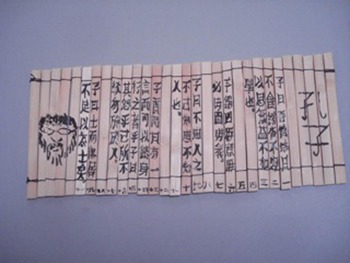
Other students reflect on the surfaces of writing used in the past before parchment and paper were used. Chris Harry constructed his Bamboo tablet book to explore an Eastern book structure. He acquired the bamboo slats from a basket purchased in Toronto's Chinatown. He disassembled the basket and created the tablet/scroll with text in Chinese characters of Confucian teachings. He included a self-portrait as the colophon (See Figure 1). Xiaowei Yin wrote a poem in Chinese characters on a silk handkerchief reflective of Chinese tradition. Her text was inserted into a book constructed with Japanese paper with layered, cut-out sections that allow subsequent lines of text to be visible as the reader turns the pages. The book functions as a bookcase for the text written on silk.
Bamboo tablet book by Chris Harry. Photo © Greta Golick

Kendall Kiddie's book Haiku Narrative Song | Book purposely lacked the robustness and immediacy that the reader expects when engaging with its visuals depicting the performance and flow of an original tune, “Haiku Narrative,” and imagery from the lyrics. The reader expects a hyperlink embedded in the songbook to transport the reader seamlessly to a recording of the music. It exists as a printed URL, which the reader can only access through the digital realm.
Reading and remediation of the digital word
According to Andrew Piper, we are in a world where ‘books and screens are now bound up with one another.’Footnote 4 That was the starting point for Alexandra Kordoski's book that explored the differences and similarities of paper and electronic books. Her book, printed on opaque paper, highlighted traditional bookmaking practices while its content featured the frame, screen and other elements of digital books. Annmarie Uleryk asked fellow students to contribute to her book with notes and drawings on various papers producing a book that is unique and engages readers to consider the future of personalized handwritten notes and doodles in the digital age. The irregular pages were loosely rolled in a cloth napkin and bound together in a bejewelled napkin ring to create Scrolling through Text(s).
Several students have submitted books that translate conversations from the digital realm into a physical book playing with the concepts of brevity and permanence. Lucia Gambetti-Bracco painstakingly translated pop songs into watercolour emojis on large folio pages and then bound the pages into a cased binding. Kay Jorgensen created Things Kay Hates/ Things Kay Likes, a dos-à-dos book with watercolour images and handwritten text selected from a list on her phone. Portia Dodds created a ‘little black book’ with a subset of five years of online dating messages. Sally Butterfield created Food Thoughtz, a zine of poems related to food to accompany her blog posts about food that she is willing or unwilling to eat. She used a typewriter to create the text, and cut and pasted the text before photocopying, stapling and trimming the zine. Jenna Moyer reflected on how our interaction with travel pictures has changed. Although the pictures can be shared through social media platforms, it is difficult to include other ephemera such as postcards, ticket stubs, and other items in this way. She constructed a travel journal that combined pictures and memorabilia affecting how that journey will be remembered and shared.
Interpretations of published works
Many students construct their books centred on favourite books or poems. James Roussain made an accordion book using the text of “The Land God Forgot” by Robert Service about the rugged terrain of the Yukon Territory. Traditionally presented as four quatrains, Roussain wrote one line per page on paper that he had painted with deep blues, yellows, greens and reds, to evoke the Yukon landscape. Kelly Turner used the text “In Flanders Fields” by John McCrae to create Remembrance. The book is a double accordion with poppies and white crosses. She fashioned the finished book into a pin by attaching a button to a stick pin closure that goes through the pages, creating a book that can either be worn or opened out with the text, poppies and white crosses in a poignant interpretation of a beloved poem. Caitlin Marshall created a book using an excerpt from Khalil Gibran's Sand and Foam to explore how language mediates our relationship to the world. She incorporated her own analog photographs of trees as endpapers and bound the book with boards constructed of mahogany and teak veneer and embellished with fabric.
Alice's Adventures in Wonderland is a popular choice for reinterpretation as an artist's book. In The Oyster, the Walrus, and the Carpenter, Nicole Kuiper represents the poem “The Walrus and the Carpenter” with a papier-mâché oyster, a meander book printed in reverse for the ‘pearl’ text with a small mirror labelled ‘Use me’ attached to aid the reader in decoding the text. Another student deconstructed the novel into 12 separate books and used various structures with reference to the text. For example, “Down the Rabbit Hole” is constructed in a circular meandering style and “Alice's Evidence” is an accordion book with two playing cards as the covers to represent the royal guards.
Melissa Munro created five small books within a book for A Collection of Fairy Tales. She printed and bound the five small books, each a separate fairy tale, which were set into a secret compartment cut out of a larger book. Just as children in a fairy tale might discover a secret fairy door tucked away in their garden, one might open this book expecting the expected, and instead discover another world contained in five tiny parcels.
Showcasing original texts
Students also submit books with original rhymes, poems and stories as the textual element. Hannah Saunders's Teddy Bear's Closet combined her original singsong rhyming text, a teddy bear with origami clothes and a star book structure. Her book invites exploration and interaction for both children and adult readers.
In Chess: A Love Story/ Chess: A Murder Mystery, Wendy Banks used text from Lie with Me by Tamara Faith Berger and The Simple Art of Murder by Raymond Chandler to form the squares on her chessboard. The chess pieces open up to reveal phrases composed by Banks, which taken together in a certain sequence present two different narratives – one for each player. The book is ‘read’ through the course of a game: as each player wins the opponent's pieces, he or she will slowly piece together the other player's story. However, the phrases concealed within the pieces may be deceptive in their intent; and each story contains a twist – a final word or phrase that changes the meaning of what has gone before – hidden within the King. So only the winner of the game will know the whole truth about the other player's story.
Building bridges and cementing memories
Many students construct books that reflect their current life experiences and milestones. Two students explored their reactions and experiences coping with serious medical diagnoses. Others use their books to capture a moment of a child's development. Rebecca Frerotte constructed a scroll attached to two foam carrots with a poem documenting a baby's development from bean to avocado to watermelon and a welcome embrace from his extended family for her nephew. Another student with a young son constructed a picture book with an innovative folding structure for a child to connect with his extended, distant family members. A student who was getting married contrasted the sentiments of excitement and anticipation with the tedious work involved in planning a wedding. The Wedding Cake was constructed in three tiers using cardstock, rose-patterned paper, and reception reply cards bound into several pamphlets as the cake topper and text to be used in the ceremony decorating the tiers.
Living in a culturally diverse city and country, many Canadians experience a daily immersion in two diverse cultures. Students reflect their cultural heritage in their books through their choices of colour, text and image. One student created a modern version of a Middle Eastern manuscript with calligraphic Arabic quotes that are both religious and philosophical and have deep personal meaning. English translations of the quotes make the book accessible to English readers too.
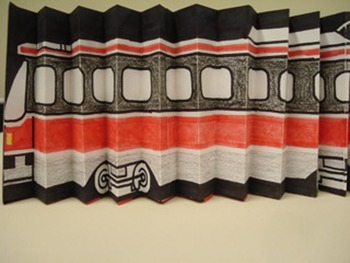
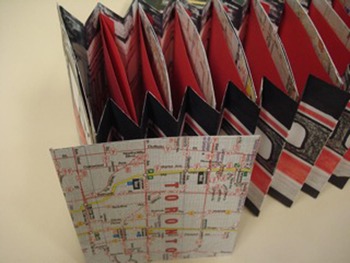
Ride the Rocket by Lily Gu. Photo © Greta Golick

Ride the Rocket by Lily Gu. Photo © Greta Golick

As a newcomer to Toronto in 2008, Lily Gu and her family negotiated the city by streetcar and a Toronto Transit Commission (TTC) map. Gu created a tunnel book, Ride the Rocket that reflects her engagement with public transit and her interaction with the city. Her book is a streetcar (tram) that contains the TTC map in nine segments. A reader can begin anywhere. The map segment may be pleasingly familiar or inspire exploration of unfamiliar territory (See Figures 2 and 3).
Travel and exploration: real and imaginary
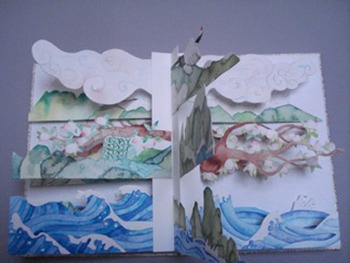
Constructed books often incorporate images, ephemera, and text from personal journals, and time-travel to imagined places and eras. My Travels in Time combines some well-known poems about time with fictional diary entries inspired by ephemera, historical events, and places that the student had traveled to in the past. The paper for the book was handmade by the student. Fonts from several typewriters, ink pens, charcoal, pastel pencils, watercolour, vintage photographs and stamps were used to create the text. Junoh Kim used a flag book structure for Visiting Shangri-La. Kim placed different but complementary images on each side of the mountain folds, creating a multi-dimensional panoramic image of this imagined utopia (See Figure 4).
Visiting Shangri-La by Junoh Kim. Photo © Greta Golick

Books about travel can incorporate novel shapes and structures. One student constructed a meander book to relate four narratives of non-linear travelling. This allows the reader to begin anywhere. The narratives and images from children's books, maps, and photographs experiment with the book form and the reader's expectations of a book through a mixture of textual and visual stories. Curtis Frederick constructed a shaped book that is a personalized travelogue listing the places he has travelled, organized in word clouds, and printed on paper cut to resemble the shape of the countries he visited. Each country in his book is a map of a separate location, but not the one represented. The mismatch of map and country outline represents Frederick's love of simply wandering and deliberately getting lost when travelling. The book is bound in two half circles covered with maps.
Materials and Structures of Constructed Books
Students constructed their books using various tools and equipment. A few students with InDesign or TEX skill used this software to print a text properly imposed for folding into a quarto signature. Students recycle packaging material, binder boards, and dis-bind cased books and use handmade paper, bookcloth, new and reused fabric scraps, ribbons and buttons to make book covers. The class create a variety of book structures, from the simple pamphlet or Japanese stab binding to a book constructed of acrylic ‘pages’ positioned in a 3D printed spine. In some instances, the book structures created are hybrid structures, such as an accordion book that can be closed resembling a codex, or opened and hung as an extended scroll, or a book that combines elements of the accordion book and the lotus fold. Many students combine other hobbies and skills to create their books, such as constructing books with knitted covers or embroidered pages.
Cynthia Dempster created a book using paper masks, which she painted and filled with face-shaped pages to produce The Actor and the Sea, that contained an original poem and surreal images of the human face. Dawn Walker repurposed a book belonging to her mother, On Becoming a Woman, published in 1958 by Dell Publishing Co. Inc. The book discusses new roles and responsibilities that come with passing through puberty that felt constrained and restrictive to Walker, reading the text in 2015. In reassembling this text, Walker experienced a tension between her desire to create a beautiful book and acknowledging its unsettling content. Walker dis-bound the book and attached paper hinges to form folios and reassemble it into signatures of 16 pages. She used a laser etcher to cut silhouettes of the illustrations out of gauzy fabric adding them to the text to create a partial obstruction between text and image. She rebound the book using an aqua-and-white houndstooth-patterned cotton bookcloth over recycled binder boards for the cover. Katie Wilson constructed an edible book complete with gingerbread covers, rice paper pages with favourite food quotes written in food colouring and licorice ties to bind it together.
This is a small sample of the variety of books submitted by the students over the past few years. While the books are often reflective of their creators, many students in the workshop use this opportunity to explore and play with books and expand their ideas of the book and its boundaries.
Evaluation of the workshop
Now in its fourth year, this workshop is well established and a joy to teach. The instructor, book arts community, rare book librarians and library personnel who manage the collection and place the books on display are familiar with all its aspects and participate with enthusiasm.
Overwhelmingly, students respond positively to this course.Footnote 5 ‘Make it a full course,’ they write. They thoroughly enjoy the ‘direct engagement with books and artists’ books.’ The students appreciate ‘discussing books beyond their intellectual form, as an object and as art.’ They value the ‘opportunity to explore the bookmaking process.’ One student declared ‘these are the only things I've ever shown to family and friends that I've done at school!’ The optional open studio, where students can select paper, thread, buttons, ribbon, stickers, stamps and embellishments, use tools and supplies, and request assistance for their final projects also generates enthusiastic comments.
In addition, the workshop enables the students to view the potential for incorporating what they have learned into their own creative practice in journaling or zine making and to consider offering similar programming in local libraries and other locations. One student commented that the workshop ‘exposed me to a whole new set of manual skills that I really love.’ Several students mentioned that they have discovered a new passion for making and creating books and have expressed a desire to continue making books and taking courses through the local bookbinding guild in the future. By conducting interviews in the greater Toronto region, many students become aware of individuals and businesses and other resources that they may consult in the future. A few students commented that this workshop was the best course that they had taken during their program.
Conclusion
Providing public spaces where citizens can explore, create, and learn new skills is a recent focus for public cultural institutions as the distinctions among libraries, archives, museums and galleries converge. Librarians, archivists and curators will require skills and experience in developing public spaces where DIY and DIT can thrive. Students planning for careers in these fields can benefit from participating as makers and by forging connections with artisans and makers in their communities during their educational preparation. Participating in the De/Constructing the Book workshop, students have engaged with the book as a material object and gained understanding of the traditional structure of the book and new directions for the book as an art object. In creating their own books, students acquire new skills in manipulating materials and build on latent knowledge and skills. Each year during the final ‘show-and-tell’ class, the students, instructor, and guests are amazed to be in the presence of such stunning creativity and expression of the book form. As a result, students will confidently continue to explore new skills and to seek new connections within and beyond the book arts community.
The ‘booxs’ in the title of this article was coined during a ‘show-and-tell’ event of student work in 2015. Christopher Hogendoorn described his book constructed of a dis-bound, discarded 1937 edition of Sir Hilary Jenkinson's A Manual of Archive Administration placed into file folders, which were sewn into a Hollinger box, creating a ‘booxs’. The book maintains its readability, but as a ‘booxs’ it is also a visual work to be observed and appreciated in its new incarnation.
The author gratefully acknowledges the excellent work the students in the workshops have submitted each year. Names of students identified in the article are used with their permission.
A version of this article was presented as a paper at the “Livres d'Artistes: The Artist's Book in Theory and Practice” conference held at Cardiff University, Cardiff, UK, 4–6 December 2015.