I. INTRODUCTION
Sodium sulfur battery (NAS) is one of the most promising candidates for energy storage applications because of its high power and energy densities.Reference Wen, Gu, Xu, Cao, Zhang and Lin1,Reference Dunn, Kamath and Tarascon2 In the battery, Na-β″/β-Al2O3 (Na-β″-Al2O3 and/or Na-β-Al2O3, both are aluminates with two-dimensional layer structures) is used as both the sodium ion conductor and separator between the sodium anode and sulfur cathode. The methods available for the preparation of Na-β″/β-Al2O3 powder include solid state reaction (SSR) process, slurry spray drying (SSD), alkoxide hydrolysis, co-precipitation, solution combustion technique, sol–gel process, and so on.Reference Virkar, Miller, Cutler and Gordon3–Reference Li, Wen, Wu, Zhang and Liu5 However, most of the above methods require calcination temperatures >1200 °C, at which a substantial amount of Na2O may be lost during the heat treatment process, resulting in a final product with poor chemical homogeneity and subsequently result in a nonuniform microstructure. Moreover, loss of sodium would also be deleterious to the densification of the ceramics during the sintering process and thus degrades the mechanical and electrical properties of the ceramic electrolyte.Reference Francis, Phelps and Maczura6,Reference River and Pelton7
Room temperature ionic liquids (abbreviated as RTILs or simply ILs), a series of room-temperature molten salts composed of organic ions that may undergo almost unlimited structural variations,Reference Armand, Endres, MacFarlane, Ohno and Scrosati8 have received much attention as functional materials in a wide range of applications such as solvents, catalysis, electrochemistry, separation, etc.Reference Parvulescu and Hardacre9–Reference Welton14 In recent years, a variety of new IL systems have been developed by combining anion and cation components, which make it possible for them to be used as a reaction medium.Reference Zhu, Huang, Pan and Dai15 In addition to the potential applications of ILs as solvents, they can also be used as soft templates to fabricate materials with controlled morphologies.Reference Cao16
In this paper, lithium stabilized Na-β″/β-Al2O3 nanorods were synthesized for the first time by using ILs as the solvent and the template. The fabrication process was fast, seedless, and environmentally benign. High purity Na-β″/β-Al2O3 phase was obtained by heating to 1100 °C. The obtained powder exhibited good homogeneity and high specific surface area, which can result in improved sintering behavior. Moreover, the special rod morphology of the particles could act well to strengthen the Na-β″/β-Al2O3 ceramics.
II. EXPERIMENTAL
A. Preparation
All chemical agents were of analytical grade and used without further purification. In a typical synthesis, 0.157 g 1-hexadecyl-3-methylimidazolium bromide ([C16mim]Br) was mixed with 4 mL propanol and 0.309 mL deionized water (the concentration M = 0.094 mol/L), then aluminum isopropoxide, LiNO3, and NaNO3 with stoichiometric ratios and 0.3 mL aqueous solution of 0.01 M HCl were added to the mixture drop by drop with stirring. The resultant mixture was further stirred at 60 °C for 120 min, followed by aging at 60 °C for 1 day. The mixture was then heated for 2 days at 120 °C at ambient pressure to complete gelation, and then the gel was calcined at 450 °C for 2 h to decompose the organic residuals. Lithium-stabilized Na-β″/β-Al2O3 was finally fabricated after the obtained gel precursor was sintered at 1100 °C for 3 h.
B. Characterization
Thermal analysis (TG/DSC, NETZSCH STA409PC) of the precursor was carried out to define the formation temperature of Na-β″/β-Al2O3. The sample was heated from 50 to 1200 °C at a rate of 5 °C/min in air.
X-ray diffraction (XRD) data were collected on a Rigaku RAD-C diffractometer (Tokyo, Japan; 18 kW) at room temperature by using Cu Kα radiation and in the 2θ range from 5 to 80°. The microstructure was observed by transmission electron microscopy (TEM, JEOL, JEM-2100F, Tokyo, Japan).
Dilatometric property was performed on a Netzsch DIL 402C (Selb, Germany) using a square rod to evaluate the sinterability of the synthesized powder. The as-pressed green quadrangular bars (10 mm in length and 4 mm2) were directly put in the sample holder for the sintering shrinkage test from room temperature to 1500 °C. For comparison, similar tests were carried out with powders synthesized by SSR process (1 μm in particle diameter) and a sol–gel method (100 nm in particle diameter).Reference Lu, Xia, Lemmon and Yang4
The N2 sorption measurement was performed using Micromeritics Tristar 3000 (Norcross, GA) at 77 K, and the specific surface area was calculated using the Brunauer–Emmett–Teller (BET) equation.
Contents of the components in the final synthesized powder were tested by an inductively coupled plasma optical emission spectrometer (ICP-OES, Vista AX, Varian, Palo Alto, CA) for lithium and sodium elements and by chemical titration for aluminum element. By doing this, the chemical formula of the final powders was determined.
III. RESULTS AND DISCUSSION
A. Thermal behavior of the gel precursor
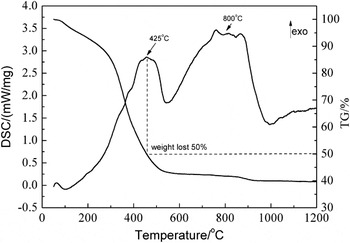
Figure 1 shows the thermal behavior of the [C16mim]Br-based dry gel in the temperature range of room temperature to 1200 °C. Two major exothermic peaks were observed at 425 and 800 °C in the DSC curve. The peak at 425 °C is related to the decomposition of the metal nitrates and the metal-ionic liquids, a corresponding 50% weight loss was obtained at the same temperature from the TG curve. The peak at 800 °C with no weight loss was attributed to exothermic crystallization of Na2Al2xO3x+1 (JCPDS-291164). Based on the results, the calcination route was set as follows: the precursor was heated to 450 °C for 2 h for decomposition and then 800–1100 °C for 3 h for the phase formation.
TG-DSC curves of the dry gel prepared with [C16mim]Br.

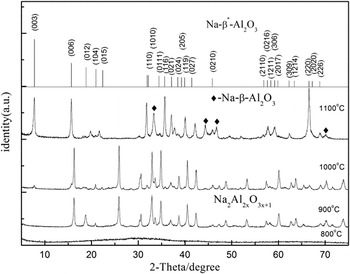
We can see in Fig. 2 that the product obtained was primarily amorphous at the temperature below 800 °C. While at 900 °C, an intermediate phase, Na2Al2xO3x+1 (JCPDS 29–1164),Reference Li, Wen, Wu, Zhang and Liu5 formed. At temperatures >1000 °C, a phase transition occurs. It is indicated by the XRD results that the final powder is a mixture of Na-β″-Al2O3 and some Na-β-Al2O3 (JCPDS No. of 48-1258 and 19-1173, respectively, simply described as Na-β″/β-Al2O3). As seen, Na-β″/β-Al2O3 powder with good crystallinity was obtained after the precursor was further heated at 1100 °C. This synthesis temperature for Na-β″/β-Al2O3 was 150 °C lower than that of the conventional solid-state reaction method or most wet chemical methods reported.Reference Virkar, Miller, Cutler and Gordon3,Reference Eddy and Rhodes17,Reference Virkar18 According to Scherrer equation, the crystallite size was estimated to be about 50 nm. The chemical formula of the final synthesized powder was determined to be Na1.61Li0.29Al10.70O17 according to chemical composition analysis results.
XRD patterns of the [C16mim]Br-based dry gel and the powders calcined at different temperatures.

B. FTIR analysis of the precursor
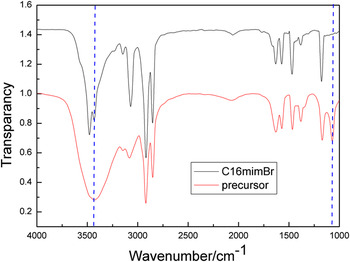
Fourier transform infrared spectroscopy (FTIR) was used to qualitatively illustrate the interaction between [C16mim]Br and metal ions. Figure 3 shows the FTIR profile of the dried gel heated at 120 °C for 2 days at ambient pressure. The pure [C16mim]Br was also tested for comparison. The characteristic bands at 3450 and 1180 cm−1 were distinguished in the spectrum of [C16mim]Br with metal ions, which were not observed in the spectrum of the pure [C16mim]Br sample. According to the standard spectrum,Reference Zhao, Hu, Zhang, Guan and Yu19 the adsorption band at 3450 cm−1 could be attributed to the hydrogen bond in C position of the imidazolium ring. The characteristic band at 1180 cm−1 indicated the stretching vibration of the imidazolium ring. Both bands revealed the combination of [C16mim]Br with the metal ions.
FTIR patterns of the dry gel and [C16mim]Br.

C. Morphology of the powders
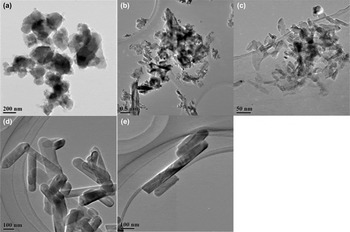
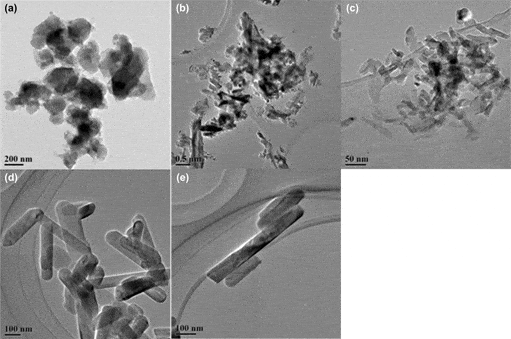
Morphologies of the powders prepared in different solvents were observed by TEM. Typically, as seen in Fig. 4(d), the particles prepared with [C16mim]Br solvent were nano-sized and highly dispersed. A regular nanorod shape of about 50 nm in diameter and 200–300 nm in length was observed. The diameter was uniform for almost all particles. However, some abnormally long nanorods were found as shown in Fig. 4(e).
TEM photographs of the powders prepared with different ionic liquid templates, (a) pure water, (b) [C4mim]Br, (c) [C12mim]Br, (d and e) [C16mim]Br.

Powders were prepared in different ILs. The results showed that the ILs play an important role in controlling the particle shape of the calcined product. As shown in Fig. 4(a), in the absence of ILs, the particles showed typical hexagonal plate type morphology of Na-β″/β-Al2O3 with the size in the range of tens to 300 nm. Figures 4(b) and (c) show the morphologies of the particles fabricated by changing the ILs to [C4mim]Br and [C12mim]Br, respectively. In particular, the former product was composed of nanoparticles with a shape greatly different from that of the powder prepared in [C16mim]Br. Anyway, the final products exhibited the tendency to form rod-type particles, although it was highly agglomerated when a short alkyl chain IL was used. As seen, the sample prepared with [C12mim]Br solvent displayed nanorod shape with the size much smaller than those fabricated using [C16mim]Br, but the particles were aggregated. These results indicate that the morphology of Na-β″/β-Al2O3 powders is strongly dependent on the type of IL or the length of the alkyl chain in this work.
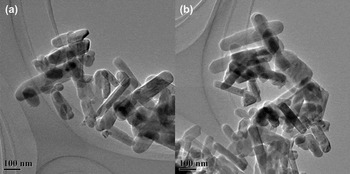
The influence of the amount of ionic liquid on the synthesis was also investigated. Figures 5(a) and (b) show the morphology of the powders obtained with 10 and 100-fold amount of [C16mim]Br as designed in the preparation procedure (i.e., M = 0.94 and 9.4 mol/L, respectively). It was found that excessive ILs did not affect the average particle size of the final calcined powder, indicating no obvious effect of ionic liquid on the morphology of the products at higher IL concentration.
TEM photographs of the powders prepared with different concentrations of [C16mim]Br ionic liquid in the reaction systems, (a) 10-fold and (b) 100-fold.

D. Mechanism for the formation of Na-β″/β-Al2O3 nanorods
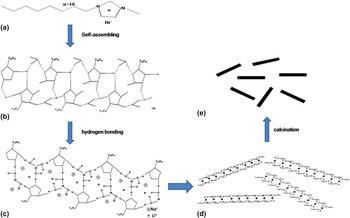
Till now, it is still difficult to fully understand the mechanism of the nanorod-formation process, though some work has been reported in the literature.Reference Schmidt, Ellison, Holliday, Kubin and Trujillo20–Reference Rautaray, Banpurkar, Sainkar, Limaye, Pavaskar, Ogale and Sastry22 Based on the results obtained in our work and previous work, it is believed that the ILs acted as the templates, which can form different structures by self-assembly under different conditions. The proposed principle for the formation of the Na-β″/β-Al2O3 nanorods is schematically illustrated in Fig. 6. Figure 6(a) shows the structure of [C16mim]Br,Reference Guerra-Abreu, Pinoa, Anderson and Afonso23 which consists of one [C16mim]+ cation and one Br− anion. While dissolved in water, the ILs can be connected by weak interactions of C–H···O and O–H···Br, then a 1D chain was formed with the long alkyl groups on two sidesReference Virkar18 [Fig. 6(b)]. The added aluminum isopropoxide hydrolyzed, and Al(OH)3 (Ref. Reference Zeng and Yang24) was produced, which was connected with the [C16mim]+ cations by weak interactions originating from the hydrogen bond formed between H atom at C in the imidazolium ring and O atom in the hydroxyl of Al(OH)3 along the 1D chain, as shown in Fig. 6(c). Then a one-dimensional precursor containing the components of Na-β″/β-Al2O3 would be formed, as shown in Figs. 6(d) and (e).
Proposed growth mechanism of Na-β″/β-Al2O3 nanorods with ionic liquid as the template, (a) structural illustration of ILs, (b) proposed hydrogen bond in ILs, (c) aggregation of the hydrogen bond connected ILs, (d) precursor rods formed in the gel, (e) Na-β″/β-Al2O3 nanorods after calcination.

According to the Wulff facet theorem, the shape of a crystal is determined by the relative specific surface energies associated with the facets of the crystal.Reference Zhu, Wang, Qi and Hu25 This theorem implied that one could control the final shape of a crystal by changing the free energies of the various crystallographic surfaces and thus to alter their growth rates. For the obtained precursor, the facet perpendicular to the bar means that the Na-β″/β-Al2O3 precursor attaches more easily to this facet and this facet has the largest relative specific surface energies, indicating that grain growth along the bars is preferred to other directions. It was suggested that in the precursor, the cations were preferred to bind to the facets that were not perpendicular to the bars, resulting in the largest relative specific surface energies of the facets perpendicular to the bars. In a typical grain growth process, Na-β″/β-Al2O3 nanocrystals rapidly grew primarily along the bar axis and coalesced to form nano-bars.
Why did the morphologies of the products differ when different ILs were used? It would be related to the morphology of the IL aggregates shown in Fig. 6(b), which favorably increases their interactions and minimizes unfavorable interactions with water.Reference Bhargava and Klein26 Based on the results from Wang’s group,Reference Wang, Wang, Zhang, Zhang and Zhao27,Reference Zhang, Liang, Wang and Li28 the aggregation of ionic liquids depends on the alkyl chain length of their cations, that is, the aggregation of [C16mim]Br was stronger than that of [C4mim]Br and [C12mim]Br. So the length of the lines in Fig.6(c) is longer. While the amount of ILs increased, less Al(OH)3 was connected with one [C16mim]+ cation, which is directly correlated to the generation of the nucleation centers for Na-β″/β-Al2O3. Therefore, the increase in the amount of ILs influences the morphology of Na-β″/β-Al2O3 to some extent.
E. Performance of Na-β″/β-Al2O3 nanorods
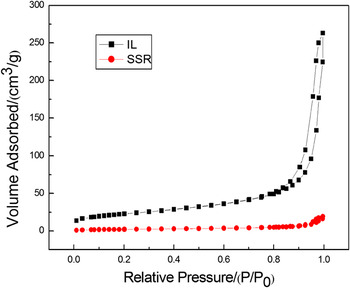
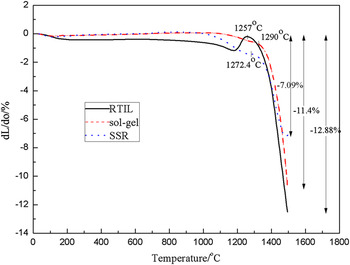
Figure 7 shows the N2 adsorption–desorption isotherms of the nanorod Na-β″/β-Al2O3 powders. The BET surface area was 81.3 m2/g compared with 8.1 m2/g obtained by the SSR process. Figure 8 compares the shrinkage behavior among the green bars prepared by SSR, sol–gel process, and the IL-assisted method. As seen, there was no obvious difference for the on-set temperature for sintering as a result of the formation process. But the total shrinkage from room temperature to 1500 °C was 12.9% and 11.4%, respectively, for the IL-based and sol-gel based samples and only 7.1 % for the SSR sample. The slopes at the end of the curves for both IL-assisted and sol–gel samples were steep, indicating their shrinkages were far from ending at 1500 °C. The end part of the curve for the SSR sample had an inflection point, meaning that the shrinkage is finished. For determining the formula of the powder, we did the ICP-OES analysis, and the molar ratio of 1.61:0.29:10.70:17 for Na:Li:Al:O was obtained.
Nitrogen adsorption–desorption isotherms of powders by SSR and IL processes.

Temperature dependence of linear shrinkage of different powders.

IV. CONCLUSIONS
The [CXmim]Br series ionic liquids were used as templates to synthesize Na-β″/β-Al2O3 nanorods at the calcining temperature as low as 1100 °C. It was demonstrated that the morphology of the powders was significantly influenced by the chain length of the ionic liquid. The specific surface area of the obtained powder was as high as 81.3 m2/g, which is more than one order of magnitude higher than that of the powder obtained by the SSR process. The powder exhibited much better shrinkage behavior than traditionally prepared powders, indicating its good sintering activities.
ACKNOWLEDGMENTS
We gratefully acknowledge financial support from the National Natural Science Foundation of China (Grant No. 50730001) and Chinese Science and Technology Ministry (Grant No. 2007 CB 209700).