We now know that the Sino-Vietnamese dispute over China's aid to the Democratic Republic of Vietnam (DRV) began to deteriorate well before 1975. Since 1965, Chinese aid had been predicated on Hanoi's political and ideological concessions. At stake in such concessions was Hanoi's acceptance of Beijing's counselling on foreign affairs and control over Soviet aid, and acquiescence to China's revolutionary leadership in Indochina, which included an emulation of Mao Zedong 毛泽东's revolutionary experiences and ideology of armed struggle.Footnote 1 This complicated Vietnamese war efforts, fomenting a lingering bitterness about Chinese obstructionism that strained the Beijing–Hanoi relationship.Footnote 2 Reflecting these trends, Chinese sources highlight shifts in support, expressly: China's support to Vietnam decreased in 1968–1970; it increased in 1971–72; and it then decreased again in 1973 after the signing of the Paris accord in January.Footnote 3 As Vietnamese sources reveal, the friction between Hanoi and Beijing over aid to the DRV gave rise to a serious 1972–75 dispute.Footnote 4 Moreover, since 1968 Hanoi had outgrown its early to mid-20th century role as a “student” or “younger brother” and insisted on China's recognition of its lead position in Indochina and its greater role in the world revolution enterprise.Footnote 5 In Hanoi's view, Vietnam had fought a heroic war while China had sunk into the self-induced chaos of the Cultural Revolution. Nevertheless, Beijing's leaders perceived Hanoi's burgeoning relationship with Moscow as indicating a rising hostile Indochinese competitor and not a grateful past aid recipient.Footnote 6 To Beijing's leaders, Hanoi was aiming for a role beyond what it considered to be Vietnam's limited place in South-East Asia and the world revolutionary movement.Footnote 7 Indeed, the Vietnamese post-1975 self-centeredness and national pride spawned Chinese fears and threatened a Chinese sense of moral superiority.
The subject of China's economic sanctions against Vietnam has been understudied due to the lack of archival access.Footnote 8 I use the concept of “economic sanctions” here as what David Baldwin refers to as economic techniques of statecraft or means of achieving intended foreign policy goals.Footnote 9 The prevailing view in the existing studies is that after 1975 Hanoi decidedly sided with Moscow and the Soviet Union because of more sophisticated aid, and that what followed was merely the spiralling escalation of the Sino-Vietnamese conflict into the border war in February 1979.Footnote 10 Notably, Robert Ross argues that “Chinese aid to Vietnam could not greatly affect the state of the Vietnamese economy. Moscow, on the other hand, possessed such capability, because it could either grant or withhold significant amounts of aid and advanced technology.”Footnote 11 Drawing on new Vietnamese archival sources, this article provides new insight into this subject, and answers two interrelated questions: Why did Beijing escalate economic sanctions against Hanoi in 1975–78? And what impact did the sanctions have on Vietnam's socialist transformation and economic reconstruction efforts?
I argue that Beijing's economic sanctions against Vietnam in 1975–78 were motivated by its desire to punish Vietnam for its anti-China nationalistic policies that seemingly forgot China's past assistance and publicly contested its claim over the territorial boundary between the two nations. Hanoi's audacious defiance of Beijing's demands in defence of its national sovereignty and its closer cooperation with Moscow further fuelled Beijing's desire to escalate economic sanctions against Vietnam.Footnote 12 Contrary to the dominant view that China had little influence over Hanoi after 1975, Beijing still had economic leverage. Furthermore, Hanoi's leaders overwhelmingly recognized the importance of China's remaining aid and economic potential (such as its big internal market) to their Five-Year Plan (1976–1980) and they were reluctant to openly side with the faraway Soviet Union against their powerful neighbour. On the contrary, nationalistic policies to solidify Vietnamese national identity and recover territorial loss from China's opportunistic expansionism collided with Beijing's insistence on Hanoi's deference. Vietnam's anti-China policies wounded Chinese leaders' self-perception of superiority and confirmed their perception of Vietnamese ingratitude, compelling them to escalate economic sanctions against Vietnam.
This article is divided into three sections. The first section discusses Hanoi's contradictory policies towards China after 1974 – that while Hanoi's leaders emphasized the importance of securing China's continued aid and improving economic relations with China, they turned an all-out challenge to China's territorial claims into a national cause and then adopted a provocative policy of forced assimilation of Chinese residents in Vietnam. The second section evaluates the importance of China's aid and economic potential to Vietnam's Five-Year Plan of 1976–80 and Beijing's motivation behind its punitive reduction of aid. The third section assesses the impact of China's economic sanctions on Vietnam and the course of Sino-Vietnamese relations in 1977–78.
Hanoi's Contradictory Policies toward China, 1975–78
With Vietnamese reunification and the post-conflict absence of an American threat, the context in which Sino-Vietnamese relations developed changed radically. Domestically, the two countries went through opposite experiences. A unified and stronger Vietnam embarked on an ambitious plan of socialist transformation of the entire country with a neo-Stalinist economic model. Concomitantly, a politically unstable, economically weakened China struggled to shift its path towards economic reform and opening. The Vietnamese leadership's attitude at the time of unification (1975–76) was filled with “illusions of victory,” to use Womack's term, with a strong sense of national pride, entitlement and heroism in the world, while the Chinese leadership expected the Vietnamese to remain deferential to China for its past assistance.Footnote 13 At that time, Vietnamese leaders believed that an independent and unified Vietnam with the fourth largest population in the socialist bloc was an important economy, and therefore they expected other countries to desire economic cooperation with their country. They indulged themselves by seriously imagining that Vietnam could become an industrialized country by the turn of the 21st century, although in reality Vietnam in 1975 was a “weak state” with an inefficient and ineffective neo-Stalinist economic model.Footnote 14 As Womack contends, this was a dangerous transition in the asymmetrical relations between the two neighbouring countries which generated systemic misperception.Footnote 15
Vietnam's domestic and foreign policies after 1975 were mainly concentrated on socialist transformation, economic reconstruction and the resolution of territorial boundary disputes with its neighbours. Correspondingly, Hanoi mounted concerted economic diplomacy with China, the Soviet Union, six other socialist countries in Eastern Europe and some Western countries. It simultaneously initiated border negotiations with Laos, Cambodia and China. While its territorial boundary demarcation with Laos was smoothly completed by the end of 1976 and a border agreement was eventually signed on 18 July 1977, Vietnam's territorial disputes with China and its ally Cambodia worsened and threatened to spin into potential armed conflicts after 1975. Based on a Beijing report which Hanoi does not refute, the number of Sino-Vietnamese border clashes rose from 100 cases in 1974 to 400 in 1975 and up to 900 in 1976.Footnote 16 At the core of this dispute was both sides' attempt to change the territorial status quo in their respective favour. Worse, Hanoi's overt repudiation of its 14 September 1958 declarative recognition of China's claims over the Xisha 西沙 (Paracel) Islands and Nansha 南沙 (Spratly) Islands caused Beijing to fear a Vietnamese attempt to challenge the land boundary status quo.Footnote 17 In February 1974, the Saigon government seized six islands in the Spratly group and Hanoi gave tacit support to Saigon's action by saying nothing. In April 1975, before the fall of Saigon to North Vietnam, Hanoi dispatched troops to occupy the six islands, explicitly departing from its previous recognition of China's claim over the Paracel and the Spratly Islands. On 10 June 1977, Chinese Vice-Premier Li Xiannian 李先念 protested Hanoi's occupation of six islands of the Spratly group to Vietnamese Prime Minister Pham Van Dong; he asserted that, “In response to our demand for the return of the islands, Vietnam cooked it up and made efforts to stir up public opinion domestically and internationally in order to spread propaganda that these islands belong to Vietnam. Before 1975, the Soviets recognized China's possession of these two islands. After the Vietnamese comrades created this dispute, the Soviets immediately changed their attitude and exploited our differences to undermine our fraternal relations. We hope the Vietnamese comrades will uphold your previous position.”Footnote 18
From Beijing's perspective, Vietnam's post-1975 misbehaviour towards China, emblematized by the territorial boundary dispute (after it gained closer cooperation with the Soviet Union), betrayed a fundamental principle of Sino-Vietnamese fraternal relations.
In 1976, Hanoi's leaders struggled to formulate a consistent China policy, although Moscow was enthusiastic about its potential role as the main provider of aid to Vietnam. China's remaining aid and economic potential were vital to Vietnam's post-war economic reconstruction, but its territorial irredentism posed an imminent threat to Vietnam's territorial sovereignty by mid-1976. In July, the Vietnamese ministry of foreign affairs' internal report raised pressing concern about China's encroachment on Vietnam's territory and its increased mobilization of Chinese people to reside in the disputed territory along the border; it also spoke of a greater number of Chinese fishing boats entering deeper into Vietnam's maritime territory surrounding Hoang Sa (Paracel) and Truong Sa (Spratly) Islands.Footnote 19 In mid-1976, Hanoi introduced a Chinese assimilationist policy in Vietnam and also set about nationalizing “businesses” owned by the capitalist bourgeoisie in southern Vietnam – the majority of whom were Hoa (ethnic Chinese) – because it saw them as reactionaries to its socialist transformation.Footnote 20 In northern Vietnam, as Sino-Vietnamese border clashes increased, the Chinese community in Vietnamese provinces along the Sino-Vietnamese border became a strategic concern in the eyes of Hanoi's leaders. Because of fear of Vietnamese persecution, 265,000 Chinese residents crossed borders into China in 1978 – 95 per cent of them resided in Quang Ninh province, only 130 kilometres from China by sea.Footnote 21
What explains Hanoi's belligerent behaviour toward Beijing while it was seeking the latter's economic assistance after 1975? The answer lies in Vietnam's strong sense of entitlement to Chinese aid in return for its past sacrifice in warding off the American threat, its function as a security buffer for China, and its confidence (reinforced by Soviet support) in recovering territorial losses to China. From Beijing's view, the post-1975 curtailment of economic and military aid to Hanoi was reasonable because it had provided massive non-refundable economic and military aid for 25 years from 1950 to 1975. The aid had greatly drained Chinese resources, even considering the size of country.Footnote 22 On the other hand, throughout the 1970s, Hanoi felt that it had contributed greatly to the defence of the socialist camp and that it had paid a very high price in spearheading the socialist revolutionary enterprise against the world's number one imperialist (the US).Footnote 23 Hanoi believed that it had singlehandedly weakened Washington in international relations, which substantiated a constant litany of demands for aid from other socialist countries, even after 1975. Even close allies like the Soviet Union and East Germany became exasperated at endless demands for aid.Footnote 24
With hasty unification and transplantation of the Northern model of “socialist transformation” into the South, Hanoi's leaders soon found themselves trapped in an economic crisis that threatened their legitimacy even in the eyes of the Vietnamese peasants and workers they had mobilized to support the socialist transformation plan.Footnote 25 In Beijing, the political struggle between the pragmatist faction led by Deng Xiaoping 邓小平 and the ultra-Leftist Gang of Four resulted in a decision-making crisis in 1975–76. Following the death of Mao Zedong in September 1976 and the subsequent fall of the Gang of Four, the Tenth CCP Congress put Deng Xiaoping in charge in 1977.Footnote 26 Deng spearheaded an economic “reform and opening” to accelerate the socialist, modernized construction of China in 1977–78, with the establishment of the Leading Group on the Introduction of New Technology and the China Economic Investigation Group under the leadership of Vice-Premier Gu Mu 谷牧 in the State Council in mid-1977.Footnote 27 In addition to reducing China's burden of aiding Vietnam, Deng took punitive actions against Vietnam for its “ingratitude” for Chinese aid, its widespread use of anti-China historical references, and its reversal of its 1958 recognition of China's claims over the Paracel and Spratly Islands. The effects of such drastic change on Sino-Vietnamese relations were four-fold: 1) they hardened irredentist nationalism on both sides, 2) they fomented an exodus of ethnic Chinese from northern Vietnam, which Beijing read as outright anti-China, 3) they led to a less responsive Chinese leadership vis-à-vis Vietnam's economic needs, which was worsened by a loss of political allegiances following the deaths of Zhou Enlai 周恩来 and Mao Zedong and 4) they made visible an array of domestic politics that influenced Hanoi's and Beijing's foreign policies.
China's Economic Influence over Vietnam after 1975
From the Vietnamese perspective, China was very important to Vietnam's post-war economic reconstruction for three reasons. First, China had been the most generous aid donor over the previous 20 years (1955–75). Second, its huge market had an enormous potential for Vietnam to boost its export and economic efficiency. Third, given the geographical proximity and the existing transportation links between southern China and northern Vietnam, it provided favourable conditions to boost bilateral trade. According to the Vietnamese ministry of foreign trade's internal report, from 1955 to 1975, Vietnam imported from China general consumption goods worth 2.515 billion rubles (roughly US$2 billion when calculated at an average exchange rate of 1 ruble = 0.8 USD during this period), out of which 2.14 billion rubles was given as non-refundable aid, equal to over 90 per cent of the total non-refundable aid for this category.Footnote 28 The report added that “from 1955 to 1975, China has provided us with the largest amount of aid for our import of both general consumption goods and complete sets of industrial equipment. Chinese aid for the consumption goods import accounted for 51.59 per cent of the total aid for this category while the Soviet aid amounted to 29.09 per cent. And China's aid for our import of complete sets of equipment accounted for 46 per cent while the Soviet aid accounted for 35.92 per cent.”Footnote 29 Underlying this report was the importance Vietnamese leaders attached to the role of China's aid in its post-war reconstruction. In terms of bilateral trade, Vietnam's sharp decline in exports to China from 1966 to 1975 to an insignificant level (equivalent to just 3 per cent of its total import from China during this period) was viewed by Hanoi's leaders as a big opportunity to boost Vietnam's post-war export to China.Footnote 30
In 1975–76, Vietnam was reluctant to openly side with the Soviet Union, even putting off a Soviet request for military access to the Cam Ranh Bay in October 1975; Soviet military aid to Vietnam reached its lowest level in 1976.Footnote 31 Until late 1977, amid Sino-Soviet rivalry, Hanoi preferred a balanced position and at least maintained cooperative relations with China. While the military wing of the Vietnamese government secretly built closer military cooperation with the Soviet Union, economics-minded leaders made concerted efforts to persuade Beijing to commit to its past aid pledges and long-term bilateral trade to complement Soviet aid. In Hanoi's evaluation, the remaining Chinese aid and its economic potential were essential to Vietnam's economic reconstruction, and Chinese engineering, parts and equipment for constructing some 430 industrial projects during the period 1955–75 could not be easily replaced by those from the Soviet Union. Additionally, Chinese aid remained far more important than Western aid, as China had largely supported Vietnam's light-industrial sector and had also directly supplied consumer goods.Footnote 32 Hanoi clearly realized that China's cut in aid was bound to inflict a significant toll on its post-war economic reconstruction.
Between August and November 1975, Deputy Prime Minister Le Thanh Nghi and Vice-Minister of Foreign Trade Ly Ban made frequent visits to Beijing to persuade Chinese leaders to resume economic assistance and long-term bilateral trade to propel its first Five-Year Plan (1976–80). From 21 August to 20 September, a series of bilateral economic negotiations took place in Beijing to prepare the ground for General Secretary Le Duan's visit to Beijing from 22 to 29 September.Footnote 33 However, the negotiations dragged on for a month and the result greatly disappointed Hanoi. Before Le Thanh Nghi flew to Beijing for economic negotiations on 20 August, Chinese Vice-Premier Li Xiannian told Vietnamese Ambassador Nguyen Trong Vinh in Beijing that “Comrade Le Thanh Nghi will be disappointed this time” because the amount of China's aid would be substantially reduced.Footnote 34
In 1975, a total of 120 China-aided projects remained unfinished – 40 projects were under construction and 80 more worth 2.6 billion yuan had yet to be built – and over 300 other China-aided projects were in need of Chinese parts, equipment and engineering for maintenance. In his report to the Politburo on 30 August, Le Thanh Nghi noted that the remaining 80 projects were the most important and costly ones to build, and that Beijing proposed to delay the completion of the most important ones from 1976–77 (Hanoi's proposal) to 1978–80.Footnote 35 In fact, Beijing began to construct only four projects in 1976, falling far short of Hanoi's request.Footnote 36
On 15 November 1976, Prime Minister Pham Van Dong sent an official letter to Chinese Premier Hua Guofeng 华国锋, while Deputy Prime Minister Le Thanh Nghi sent another letter to his counterpart, Vice-Premier Li Xiannian, to propose a bilateral economic negotiation for the next four years 1977–80 with four main requests: 1) that China supply raw materials worth 1.1 billion yuan to Vietnam; 2) that China provide a long-term loan of 800 million yuan because Vietnam's export to China could only reach a total value of 300 million yuan; 3) that of the remaining 120 China-aided projects, Beijing prioritize the construction of big and important projects first and then complete the rest before 1980; 4) that both sides established a joint “Economic and Scientific Co-operation Committee” to improve bilateral economic cooperation between the two nations.Footnote 37 After three nonresponsive weeks, on 5 December 1976, the Politburo dispatched Do Muoi, Deputy Prime Minister in charge of state construction, to visit Beijing on his way to Moscow to follow up on Pham Van Dong's and Le Thanh Nghi's letters. In Beijing, Do Muoi reiterated Pham Van Dong's four-point proposal, yet Beijing's response was once again disappointing to Hanoi. On 6 December, Chinese Vice-Premier Gu Mu turned down Hanoi's request, reasoning that “three crises hit China in a single year [1976], namely the death of our three great leaders [Zhou Enlai, Mao Zedong and Zhu De 朱德], the destructive campaign by the Gang of Four, and the adverse effects of natural disasters on China's agriculture.”Footnote 38 Notably, Do Muoi reported back to his Politburo with a note stressing that “China's economic hardship is not the main reason for cutting aid to us.”Footnote 39 Underlying this was Hanoi's perception that Beijing found every reason to weaken Vietnam, while proving more enthusiastic about increasing aid to the anti-Vietnam Khmer Rouge in Cambodia.
In 1977, Vietnam was an insecure state, fearing domestic challenges to its communist party's rule and the encirclement by China and its ally the Khmer Rouge. Incontrovertibly, the gathering storm of tension over Chinese aid and bilateral economic relations, the territorial dispute and the question of Chinese residents in Vietnam threatened to burst out of control. Internally, Vietnam faced a serious economic crisis that threatened the regime's goal of integrating the South into its socialist system. As Alexander Woodside observed in Reference Woodside1979, “the majority of the Vietnamese peasants felt that they were asked to shoulder undue burden; they were moved from urban areas to New Economic Zones to do agricultural work and yet still suffered enormous hardship after the war.”Footnote 40 By mid-1977, sixth months after 4th Party Congress's ambitious resolution to bring the entire country toward socialism, Vietnam suffered yet another huge natural disaster (a prolonged central Vietnam drought), which prompted a severe food crisis. Hanoi devoted most of its diplomatic efforts in early 1977 to solving this crisis.Footnote 41
On 5 February 1977, following another Vietnamese aid request, Chinese Vice-Minister of Foreign Economic Relations and Trade Chen Jie 陈洁 met a Vietnamese delegation led by Vice-Minister of Foreign Trade Nguyen Chanh. Chen again raised China's economic hardship as the primary reason for limiting its delivery of raw materials to Vietnam on credit.Footnote 42 On 10 February, during the second round of negotiations, the Chinese side ruled against Hanoi's request for loan, stating that “our leadership would like to officially inform Vietnamese comrades that we will only discuss bilateral trade for 1977.”Footnote 43 Without Beijing's pledge of a loan of 800 million yuan, Vietnam could only import less than 30 per cent of its projected import volume from China for 1977–80. On 24 February, Vice-Premier Li Xiannian reiterated to the Vietnamese delegation that “China is facing economic difficulty, and therefore cannot provide additional loan to Vietnam. The remaining 120 projects worth over two billion yuan have already put us in a situation of enormous economic hardship. That is why we cannot complete [them] in a few years.”Footnote 44
On 31 March 1977, Le Thanh Nghi gave a bleak assessment of China's aid commitment by noting that “during the period 1955–75, China provided non-refundable economic aid worth 12 billion yuan. In the period 1965–75 alone, China's economic assistance amounted to 11.2 billion yuan. After 1975, China not only categorically rejected our request for non-refundable aid (except a long-term loan of 100 million yuan in 1975), but also delayed the delivery of the existing aid pledges.”Footnote 45 Worse, in a span of two years Vietnam's import of raw materials from China drastically dropped to an insignificant level. In 1975, Vietnam's import of raw materials from China amounted to 750 million yuan, then decreased to 100 million yuan in 1976, and again fell to 43 million yuan in 1977.Footnote 46 Similarly, Moscow was not forthcoming with its aid delivery because it wanted to pressure Hanoi to cut ties with Beijing. Hanoi also resented Moscow's reduction of its aid to the lowest level in 1976 in response to the former's rejection of the Soviet proposal for naval access to the Cam Ranh Bay and refusal to join the Soviet-led Council for Mutual Economic Assistance (COMECON).Footnote 47 Apparently, Beijing's economic mercantilism was interpreted by Hanoi as direct punishment against Vietnam while Moscow's similar actions were merely inducement.
To reduce the pressure from both Moscow and Beijing, Hanoi boldly established economic relations with a few Western European countries in the spring of 1977. From 25 to 29 of April, Prime Minister Pham Van Dong made a milestone official visit to France. Indicatively, the ministry of foreign affairs' July 1977 report wrote: “This visit is very important politically and economically because it demonstrated our political strength and independence. The world has once more paid close attention to Vietnam and some Western newspapers praised our high spirit of independence, realistic mind-set, and proactive and flexible foreign policy. Yet, we must closely observe reactions from the socialist bloc toward our Prime Minister's trip.”Footnote 48 Underlying this statement is Hanoi's frustration with Beijing's aid curtailment and Moscow's half-hearted commitment to Vietnam.
At a meeting on 10 June 1977, Pham Van Dong made a last-ditch effort to urge Beijing to honour its past aid pledges. According to minutes, Pham reminded Li Xiannian that Premier Zhou had promised to provide aid to Vietnam at the 1973 level for the next five years, which was quite substantial. Pham asked Li to help build a number of important projects Beijing had promised to build, namely the Thang Long bridge, the Ha Bac hydro power plant, the But Son cement factory, and the Thay Nguyen steel factory.Footnote 49 Li replied:
Concerning China's assistance [to Vietnam], on 15 November last year [1976], Premier Pham sent us an official letter. We could not meet your request. On 24 February [1977], on behalf of the Central Party and Government of China, I myself spoke to Comrade Nguyen Chanh [Vietnamese Vice-Minister of Foreign Trade], and clearly affirmed that ‘the destruction by the Gang of Four against our party and the severe natural disasters last year [1976] inflicted a heavy toll on our economy, and that at the same time, the remaining amount of China's assistance to build more than 100 projects for Vietnam is over 2 billion yuan. In the near future, we will have to try very hard to fulfil this obligation and we cannot provide additional assistance to you. In February, we asked Comrade Nguyen Chanh to report to Premier Pham. On 17 March 1977, he conveyed Premier Pham's message to us that you understood our difficulty. So, I do not have anything else to say.Footnote 50
In Le Thanh Nghi's meeting with Vice-Premier Li, also in June, his efforts to secure some Chinese economic assistance for 1978–80 were to no avail. In May and June 1977, in response to the Khmer Rouge military offensives against Vietnam, a series of unpublicized high-level meetings between Soviet and Vietnamese leaders in Moscow convinced the Soviet leadership to increase military aid to Vietnam, and Soviet–Vietnamese relations entered a new phase of “all-round” cooperation.Footnote 51 Economically, Hanoi remained disappointed in Moscow's half-hearted support and insistence on Vietnam's joining the Soviet-led COMECON. Indeed, the Vietnamese ministry of foreign affairs in July 1977 reported:
Our relations with the Soviet Union, Eastern European countries and Cuba are generally favourable. Recently, these countries have expressed their interests in promoting economic cooperation with us and have proposed some specific fields of cooperation with us. However, we are still facing a few big problems in our relations with them—i.e. many important projects for our five year plan which the Soviets have agreed to construct have progressed very slowly. The Soviets have refused to allow us to purchase on credit 20,000 tons of supplementary fuel and gas for 1977 and 200 million rubles [nearly US$ 150 million at that time] to purchase consumption goods. The GDR (East Germany) has raised the reason of their economic difficulty to cancel, curtail or postpone certain important projects until the next five year plan, 1981–85. Their economic difficulty is only part of the problem, but the main reason is their policy toward us.Footnote 52
Worse, Hanoi's most anticipated change – that the victory of the reformist leader Deng Xiaoping in mid-1977 would lead to a Sino-Soviet rapprochement and an improvement in Sino-Vietnamese relations – did not occur. The foreign affairs ministry's July 1977 report confirmed Steven Morris's account of Hanoi's expectation that Deng, when in power, would change Chinese foreign policy because he would certainly depart from Mao Zedong's path, hoping to restore international solidarity among all the socialist countries.Footnote 53 In the fall of 1977, Deng reopened the Overseas Chinese Affairs office and entrusted it with broad powers to integrate overseas Chinese into his new economic rejuvenation plan. Vietnam's continued mistreatment of ethnic Chinese in Vietnam predictably provoked a strong reaction in Beijing.Footnote 54
Moreover, Deng was eager to use his “get tough with Vietnam” policy to consolidate power. Accordingly, Deng did not appear at Beijing airport to receive Le Duan's delegation when they visited Beijing on their way back from Moscow on 20 November. During his stay in Beijing from 20 to 23 of November, Le Duan reportedly resented a cold reception from the Chinese leadership and Beijing's unusually low publicity about his visit. A close aide to Le Duan observed: “Compared with Tito's and Pol Pot's visits, the Chinese leadership this time received us with a much lower profile. When Tito visited, Hua Guofeng, Deng Xiaoping, Li Xiannian, and Zhu De welcomed him at the airport. When Pol Pot visited, Hua Guofeng, Deng Xiaoping, Li Xiannian, Ji Dengkui 纪登奎, Zhu De, Geng Biao 耿飚, Fang Yi 方毅, Chen Muhua 陈慕华, all members of the CCP Politburo, welcomed him at the airport. But, only Hua Guofeng and Li Xiannian will come to the airport to welcome our delegation.”Footnote 55 To put it in a proper historical-political context, Tito's visit to Beijing in September symbolized the rapprochement between Yugoslavia and China after two decades of cold relations since 1957 when Beijing openly supported Moscow's anti-Tito line. Le Duan's visits, in comparison, happened on an annual basis, if not more often. Hanoi's self-perception of Beijing's apparent differential treatment of Le Duan's delegation, compared to Tito's visit just before, reflected the Vietnamese perception of entitlement and an inflated sense of status in the world, and pointed to the wounded pride of the Vietnamese above everything else.
In December 1977, addressing the Third Plenum of the Sixth National Assembly, Deputy Prime Minister and Foreign Affairs Minister Nguyen Duy Trinh reiterated the importance of “international socialist unity” and upheld “Vietnam's independent foreign policy.”Footnote 56 He stressed that Vietnam needed a foreign loan of 35 billion Vietnamese dongs (roughly US$14 billion), equal to 18 per cent of our gross domestic product (GDP) of the Five Year Plan, to import general equipment, raw materials, and consumption goods: 53 per cent of the loan was expected to come from the socialist bloc, 37.9 per cent from the capitalist bloc, and 8.5 per cent from other nationalist countries.Footnote 57 Underlying this report was Hanoi's remaining doubt about Moscow's actual commitment to fill the void left by China. This perception is the most plausible explanation as to why Hanoi continued to be reluctant to sign an official military alliance with Moscow, an outright hostile act against China, until June 1978.
Beijing's Escalation of Economic Sanctions against Vietnam, Late 1977–78
As Hanoi refused to make any concession on territorial issues or the question of ethnic Chinese in Vietnam, and continued to treat China as a hostile neighbour, Beijing decidedly escalated a series of punitive economic sanctions by late 1977. After much delay, Beijing and Hanoi commenced a serious bilateral land border negotiation between October 1977 and March 1978. However, the preparation and negotiations themselves drew both sides’ local authorities and people into a tit-for-tat land grab rather than solving the territorial conflict. Beijing consistently accused the Vietnamese side of using the negotiations to buy time for local authorities and border defence forces to grab as much land as they possibly could from the disputed territory along the border provinces of Yunnan and Guangxi.Footnote 58 Likewise, in Hanoi's interpretation, China's rhetoric about its eagerness to solve the border issue through peaceful negotiations masked its practice of territorial expansion into Vietnamese territory. Hence, such negotiation efforts not only failed but also considerably contributed to increased militarization of the border dispute in 1977–78.
It is in the context of Hanoi's anti-China policy and rhetoric regarding the territorial boundary dispute that the flight of Chinese residents in northern Vietnam to China took place, which impelled Beijing to escalate economic sanctions against Vietnam in 1977–78. Hanoi's intensification of forced Chinese assimilation during this period was largely driven by fear and insecurity – a resurfacing emotional remnant of Chinese residents' propagation of Maoist ideology during the Cultural Revolution proper 1966–68 – that they were loyal to their motherland China.Footnote 59 As Chinese residents resisted Hanoi's forced assimilation policy, Hanoi's suspicion of Chinese loyalty was confirmed and tough measures were then adopted: Chinese residents along the border were either forced to migrate to China or relocated to New Economic Zones against their will.Footnote 60 In early 1977, Hanoi began to clear ethnic Chinese residents away from its northern border area to create a security buffer zone, while simultaneously mobilizing its local authorities and frontier defence forces to counter China's territorial expansion along the Sino-Vietnamese border.Footnote 61 Amid this chaotic atmosphere, local Vietnamese authorities were given broad powers to defend their border against China's further expansion.Footnote 62 Consequently, the harassment of ethnic Chinese residents along the border and their alleged expulsions continued unabated. On 12 May 1978, Beijing protested in an official letter that “Since early 1977, along the border provinces in the North, the Vietnamese side has begun to expel Chinese immigrants in the provinces along the (Sino-Vietnamese) border, who migrated from China to live in Vietnam for many years. In November 1977, the Vietnamese side has begun to expel overseas Chinese residing in three Vietnamese border provinces, Hoang Lien Son, Lai Chau, and Son La. Especially, since early 1978, the Vietnamese side has intensified its expulsion of Chinese overseas and enlarged the scale to Hanoi, Hai Phong, Nam Dinh, Thanh Hoa etc..”Footnote 63 Significantly, Hanoi has never officially admitted to issuing orders to expel Chinese residents. Nonetheless, they admitted to restricting the occupations that ethnic Chinese could engage in the years 1977–78, and creating a buffer zone along the border, moving people including ethnic Chinese away from the border.Footnote 64 In Beijing's view, Hanoi's increased mistreatment of Chinese residents and anti-Chinese rhetoric in 1977–78 indicated a more solid alliance with Moscow.Footnote 65 Worse, Beijing's leaders perceived that Moscow instigated the anti-Chinese persecution and encouraged Hanoi's refusal to bow to China's demands.Footnote 66
Such a perception was obviously overblown, because the flight of ethnic Chinese residents from Vietnam, as Ungar and Godley have pointed out, was partly attributed to China's changing policy towards overseas Chinese in South-East Asia from late 1977 to early 1978.Footnote 67 The timing of Vietnam's expulsion of ethnic Chinese could not have been worse for China. In the fall of 1977, after Beijing's prolonged indifference toward overseas Chinese in South-East Asia, Deng Xiaoping launched a new policy of economic modernization; the overseas Chinese affairs office was reorganized and granted broad powers to attract overseas Chinese capital and talent to rejuvenate its economic development.Footnote 68
In the first half of 1978, Beijing expressed its irritation with Hanoi's rigidity by further reducing its aid delivery. In January 1978, Beijing sent a group of ministry of foreign trade representatives to Hanoi to discuss China-aided projects. Hanoi requested Beijing to build 15 projects in addition to the 46 projects already under construction, totalling 61 projects for 1978. According to Deputy Prime Minister Do Muoi's report to the Politburo on 7 May, Beijing agreed to construct only seven projects for 1978 and again raised China's economic hardship as the main reason for delaying the construction of the remaining projects which were the most important and urgent ones.Footnote 69 Even so, details of Beijing's economic measures in the first six months of 1978 indisputably illuminate Beijing's desire to exact punishment for Hanoi's misbehaviour towards China.
By early 1978, Hanoi's missteps were read by Beijing as serious hostilities toward China that warranted further economic sanctions. Indicative of that was Beijing's reaction to Hanoi's handling of the death of a Chinese expert, Xie Wei Zhang, in late April 1978 at Vinh Phuc garment factory. On 4 May, the Chinese charged that Vietnam “disrespectfully handled” the case of the Chinese expert's death. As a result, Beijing withdrew all Chinese experts at the factory back to China and cancelled 21 China-aided projects including vital economic and defence ones. Hanoi protested that “this was Beijing's baseless pretext to cut aid to Vietnam and would severely damage the spirit of fraternal relations between the two nations.”Footnote 70 In another move, Beijing reduced the total delivery of Chinese goods in the first quarter of 1978 by 50 per cent of its original plan. In an internal report to the prime minister's office, Do Muoi summarized: “In May, we received China's delivery of 1,406 tons compared with the delivery plan of 2,861 tons, accounting for only 49.14 per cent of the plan. Since early 1978, they have not completed any project except the printing house in January. Chinese experts who enthusiastically wanted to help us were hard pressed to return home.”Footnote 71 At the Vinh Phuc garment factory, China pulled out all nine Chinese experts at the end of March 1978, reasoning that the Vietnamese mistreated Chinese experts. At the Thang Long bridge, there were 294 Chinese experts on the official list but more than half refused to work, complaining that Vietnamese workers and people in the area misbehaved toward them.Footnote 72 By May 1978, Beijing's determination to find every reason to cut aid, limit trade volume and delay the delivery of goods to Vietnam was very clear to Hanoi's leaders. China also threatened to pull out Chinese experts from Vietnam for trivial reasons and refused to accept Vietnamese officials for training in China.Footnote 73
In mid-1978, Hanoi's leaders were appalled by what they viewed as yet another of Beijing's punitive measures designed to raise the cost of Vietnam's transportation of goods and people across China. On 15 May, the Chinese delegation arrived in Hanoi to discuss their initiatives to modify the existing financial settlement procedures for bilateral trade and non-trade related activities between the two countries.Footnote 74 On 17 May, the Chinese side revoked the 1963 Prague Agreement (a set of preferential trade policies within the socialist bloc), which provided lower prices for Vietnam's import of goods from China, and in its place laid out three new measures: 1) an independent currency as the medium for financial settlement of all non-trade related activities; 2) hard currency for financial settlement of bilateral trade; 3) international exchange rate for currency exchange.Footnote 75 The Chinese side explained their action based on two rationales: China's entrance into the global market (price inflation and floating currency exchange), and the practicality of the procedures for both sides.Footnote 76
Since the mid-1960s, railroad transportation through China to other socialist countries had been the most inexpensive and efficient route for Vietnam. Believing that China would soon unilaterally apply the three measures, Hanoi instructed all concerned authorities to conduct research on sea travel from Hai Phong (Vietnam's port in the North) to Vladivostok (the Soviet Union), to assist Vietnamese students, trainees and staff – nearly 10,000 per year – who up to this point had travelled across China.Footnote 77 In 1977 alone, the number of Vietnamese passengers who crossed the Sino-Vietnamese border by train was 9,517, and 11,093 people crossed the border to Vietnam from other countries. For 1977 alone, the total quantity of exported goods that passed through China to the Soviet Union and other countries was 44,028 tons, and 403,431 tonnes of imported goods from the Soviet Union and other countries to Vietnam passed through China.Footnote 78
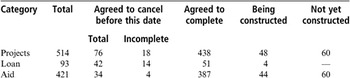
On 30 May, the Chinese government sent another letter complaining about Vietnamese mistreatment of Chinese experts.Footnote 79 Beijing then cancelled the remaining China-aided projects to Vietnam. With China's two letters of 12 and 30 May, China unilaterally cancelled 74 important projects (52 economic and 22 defence projects), and only 34 projects remained (see Table 1).
Summary of the Quantity and Value of All Projects that China Cancelled after May 1978

Source: A report from the Vietnamese Ministry of Foreign Trade to the Prime Minister's Office on 15 June 1978 entitled: “A Summary of the Quantity & Value of All Projects China Cancelled after May 1978,” CPMO, Folder 10778 (8), 71–78.
On 26 May and 9 June 1978, the Chinese ministry of foreign affairs informed the Vietnamese government of its decision to send ships to Hai Phong and Ho Chi Minh City to rescue ethnic Chinese residents.Footnote 80 The return of the empty Chinese ships that had been sent to repatriate “persecuted Chinese residents” in late July 1978, as Ramses Amer correctly observed, was tantamount to a loss of face for the Chinese government.Footnote 81 In June 1978, the Vietnamese state planning committee proposed to join the Soviet-led COMECON to convince Moscow to speed up the delivery of aid and complete all the projects left behind by China.Footnote 82 On 3 July 1978, Beijing stated: “The Chinese government was compelled to decide to cut off all economic and technical assistance to Vietnam and bring back home all Chinese experts who are currently working in Vietnam.”Footnote 83 Based on Vietnamese Deputy Prime Minister Do Muoi's report on 5 July 1978 to the Vietnamese leadership, “from 1955 up to 3 July 1978, China pledged to help build 438 projects with Chinese equipment in aid worth 3.874 billion yuan [see Table 2]. Up to 3 July, China had completed 331 projects worth 1.877 billion yuan, and cancelled 99 major projects with the value of 1.997 billion yuan [roughly 1 US$ billion when calculated at 1.86 yuan to 1 USD at that time].”Footnote 84 Do Muoi emphasized in his report to the Vietnamese leadership that the remaining 99 projects that China had cancelled were the most important and costly ones, and valued more than the combined price tag of the 331 projects completed before 3 July 1978.
Number of Projects Based on the Agreements Regarding Industrial Equipment before May 1978

Source: A report from the Vietnamese Ministry of Foreign Trade to the Prime Minister's Office on 15 June 1978 entitled “A Summary of the Quantity & Value of All Projects China Cancelled after May 1978,” CPMO, Folder 10778 (8), 71–78.
Conclusion
China was prolific in utilizing both positive and negative economic sanctions as techniques to punish Vietnamese misbehaviour, as well as to defend its vital interests. To be sure, China's economic sanctions were political acts designed to extract Vietnamese concessions on the territorial issue and the question of Chinese residents in Vietnam, even if they were apparently seen by Beijing as less effective means of pulling Vietnam from the Soviet orbit. China's use of trade sanctions on Vietnam ranged from the suspension of its preferential trade agreements, imposition of import and export quotas (quantitative restrictions on particular imports and exports of strategic goods) and subsidies for exports and imports, to the denial of low-cost trans-shipment via China. Additionally, China used aid suspension to reduce, delay or terminate its aid pledges and delivery to Vietnam in parallel with Vietnam's misbehaviour toward China. It ranged from the significant curtailment of its past aid pledges and non-refundable aid programs, denial of new loans and withdrawal of Chinese experts, to the slow-down of aid transfers to Vietnam. Yet, China's failed attempt to coerce Vietnam, a perceived disloyal ally, into making any concession to its demands could best be explained by Vietnam's strong sense of entitlement to China's aid generosity in the past, compounded by its enormous sacrifice during the war against the US, and the extreme sensitivity of the main issues in dispute – namely the territorial dispute and the question of Chinese residents in Vietnam. Both lay at the core of modern Chinese and Vietnamese national identity and nationalism, and were far less amenable to mutual compromise in the post-war context.
In retrospect, both sides' unwillingness to be seen as weak on these questions in the eyes of their domestic audiences derailed diplomatic efforts and left no room for moderation and accommodation. Beijing was determined to punish Hanoi for its misbehaviour toward China after 1975 and its economic sanctions marked the first step toward China's punitive war against Vietnam in February 1979. If any lesson can be drawn from this, it is that the emotional factors such as mutual trust/distrust and nationalistic zeal remain a potential force that influences the dynamics of Sino-Vietnamese relations today.