The importance of salt (NaCl) addition during cheese making has been well established (Guinee, Reference Guinee2004a). NaCl is traditionally used as a preservative to control the growth of undesirable microorganisms. In addition, NaCl affects water activity, enzyme activity and starter culture growth (Sutherland, Reference Sutherland, Roginski, Fuquay and Fox2003). A relationship between NaCl addition and the texture profile and microstructure in cheeses has been reported by Guinee & Fox (Reference Guinee, Fox, Fox, McSweeney, Cogan and Guinee2004). An increase in NaCl concentration in cheese moisture reduced free water in cheeses thus increasing hardness (Kaya, Reference Kaya2002; Madadlou et al. Reference Madadlou, Khosrowshahi, Mousavi and Farmani2007). However, hardness decreased when proteolysis increased during cheese ripening (Ayyash et al. Reference Ayyash, Sherkat, Francis, Williams and Shah2011). Microstructure of cheese is also affected by NaCl addition. Salted cheeses have more homogeneous and smaller fissures compared with unsalted cheeses (McMahon & Oberg, Reference McMahon and Oberg1998; Madadlou et al. Reference Madadlou, Khosrowshahi, Mousavi and Farmani2007). The importance of NaCl during manufacture of LMMC has been reported by several researchers (Fox, Reference Fox1987; Guinee, Reference Guinee2004a; Guinee & Fox, Reference Guinee, Fox, Fox, McSweeney, Cogan and Guinee2004; Kindstedt et al. Reference Kindstedt, Caric, Milanovic, Fox, McSweeney, Cogan and Guinee2004). However; the health risks associated with increased NaCl consumption is a serious issue for the cheese industry. A positive correlation between excessive NaCl consumption and hypertension (Buemi et al. Reference Buemi, Senatore, Corica, Aloisi, Romeo, Tramontana and Frisina2002; Kotchen, Reference Kotchen2005), kidney stones, and osteoporosis (Heaney, Reference Heaney2006) has been reported. In the USA, approximately 27% of the population in 2004 suffered from hypertension, in addition to 25 000 deaths because of circumstances related to hypertension (Centers for Disease Control and Prevention, 2007). Fifteen thousand people in Canada are said to die every year because of excessive sodium intake (Cassels, Reference Cassels2008). In order to reduce the daily NaCl intake by consumers, the World Health Organization has recommended that food manufacturers decrease NaCl in their products (World Health Organization, 2007). Cheeses contribute to about 20% of the total daily intake of sodium in the western countries (Guinee, Reference Guinee2004b). Therefore, there is a high demand for NaCl-reduced cheeses. Several issues (unpleasant flavour, high proteolytic activity, poor texture, and growth of pathogenic bacteria) have been reported with a simple reduction of NaCl in cheeses (McMahon, Reference McMahon2010). Hence, partial substitution of NaCl with other salts is suggested to be an alternative method to reduce salt in cheese without adverse effects on cheese quality. Potassium chloride (KCl) was successfully used to partially substitute NaCl in cheeses (Guinee, Reference Guinee2004b; Guinee & Fox, Reference Guinee, Fox, Fox, McSweeney, Cogan and Guinee2004; Ayyash et al. Reference Ayyash, Sherkat, Francis, Williams and Shah2011). Several studies have been carried out to investigate the effect of partial substitution of NaCl with KCl on chemical composition, proteolysis, and texture profile of various type of cheeses (Zorrilla & Rubiolo, Reference Zorrilla and Rubiolo1994; Katsiari et al. Reference Katsiari, Voutsinas, Alichanidis and Roussis1997, Reference Katsiari, Voutsinas, Alichanidis and Roussis2000, Reference Katsiari, Voutsinas, Alichanidis and Roussis2001; Ayyash & Shah, Reference Ayyash and Shah2010, Reference Ayyash and Shah2011a). Ayyash & Shah (Reference Ayyash and Shah2011b) and Ayyash et al. (Reference Ayyash, Sherkat, Francis, Williams and Shah2011) reported that the effect of partial substitution of NaCl with KCl was insignificant on texture profile analysis (TPA) of Nabulsi and Halloumi cheeses. Katsiari et al. (Reference Katsiari, Voutsinas, Alichanidis and Roussis1997, Reference Katsiari, Voutsinas, Alichanidis and Roussis1998) reported that texture profile of kefalograviera and Feta cheeses salted with NaCl/KCl mixture differed insignificantly compared with control (salted with only NaCl). The effects salt substitutions on chemical composition and functionality of Mozzarella cheese (Ayyash & Shah, Reference Ayyash and Shah2011c) and proteolysis (Ayyash & Shah, Reference Ayyash and Shah2011d) have been reported elsewhere. This study investigated the effects of partial substitution of NaCl with KCl on the texture profile, microstructure, and sensory evaluation of LMMC and to examine the relationship between soluble Ca and texture profile as affected by NaCl substitution.
Materials and Methods
LMMC making
Homogenized and pasteurized milk (protein 3·5%, fat 3%) was purchased from a local dairy plant (Melbourne, VIC, Australia). LMMC was manufactured according to Feeney et al. (Reference Feeney, Fox and Guinee2001) with some modifications. Forty litres of milk were tempered to 40 °C and inoculated with TCC-4 direct-in-vat starter culture (15 g per 100 litres of milk; Chr. Hansen, Bayswater, Victoria, Australia) consisting of Streptococcus thermophilus and Lactobacillus delbrueckii ssp. bulgaricus which was added according to the manufacturer`s instructions. After 40 min, double-strength chymosin (CHY-MAX; Chr. Hansen) diluted (1:20) with distilled water was added according to manufacturer's instructions and milk coagulated in 35 min. Curd was cut into 1-cm cubes and cooked at 40 °C with continuous agitation for 15 min. Whey was drained and the curd was manually pressed to remove additional whey. The curd was cheddared and milled when the pH of the slabs reached to 5·3 to 5·2. The milled curd was dry-salted with 4 different NaCl/KCl combinations; only NaCl (A; control); 3:1 NaCl:KCl (B); 1:1 NaCl:KCl (C); and 1:3 NaCl:KCl (D), (each at a level of 46 g/kg of cheese curd) and allowed to mellow for 20 min. The salted curd was plasticsed in 4% brine solutions in the ratio as in A, B, C, and D at 80 °C for 5 min. The plasticsed curd was moulded in circular moulds (about 2·5 kg per block) and the resulting cheese blocks were kept in cold room at 4 °C until the temperature reached to 15 °C followed by cutting into smaller blocks of 500 g, vacuum-packaged in food grade barrier bags (Food Industry Products, Altona, VIC, Australia) using a Multivac A300/16 machine (Multivac Sepp Haggenmuller KG, Wolfertschwenden, Germany) and stored at 4 °C for 27 d. Experimental cheeses were made in triplicate, and sampled at 0, 9, 18, and 27 d of storage. The cheese samples were shredded and then sub-sampled for the following analysis.
Texture profile analysis
The texture profile analysis (TPA; hardness, cohesiveness, adhesiveness, and gumminess) was measured according to Zisu & Shah (Reference Zisu and Shah2005) with some modifications. Briefly, cheese cylinders of 25 × 25 mm were cut from the centre of the LMMC blocks. Specimens were kept in a refrigerator at 4 °C in plastic containers overnight followed by TPA. TPA analysis was carried out using an Instron universal testing machine (Model 5564; Instron Ltd, London, England) based on the principle described by Pons & Fiszman (Reference Pons and Fiszman1996). The LMMC samples were compressed to 30% of the height using a 100-N load cell with a flat plunger and the crosshead movement was adjusted to 50 mm/min. A 2-cycle compression was achieved and the data were collected using Merline software. Analyses were carried out in duplicate.
Microstructure by environmental scanning electron microscopy (ESEM)
LMMC specimens were imaged by FEI Quanta® ESEM (Philips Electron Optics, Eindhoven, The Netherlands) using ESEM mode. Images were taken at accelerating voltage at 30 kV under 47 Pa pressure and were magnified by 1000 times at 4 °C. Specimens were not conductivity-coated or defatted before imaging. A horizontal cut of the cheese was carried out by hand, not with a cheese knife and trimmed edges were placed in ESEM and images were visually examined in order to determine differences among batches.
Soluble Ca, P, Na, and K
The soluble Ca expressed as percentage of total Ca in experimental LMMC was analysed according to Metzger et al. (Reference Metzger, Barbano and Kindstedt2001) with some modifications. Briefly, grated cheese sample (10 g) was taken from the shredded cheese lot was homogenized with 90 ml MilliQ water (Millex, Millipore, Bedford, Mass., USA) using an Ultraturrax homogenizer (Jonke & Kunkel K.G., Staufen i. Breisgau, Germany) at 10 000 rpm for 3 min and the cheese slurry was centrifuged at 4000 g for 20 min and then the supernatant was filtered using Whatman # 41 (Whatman International Ltd., Maidstone, England). The filtrate was filtered with a 0·45 μm filter (Millipore) and then soluble Ca and P was determined using the ICPE method mentioned above. The Ca, Na, K, and P percentages were calculated as follows:
 $${\rm Percent}\;{\rm of}\;{\rm soluble}\;{\rm Ca},\;{\rm P},\;{\rm Na},\;{\rm or}\;{\rm K} = {\rm} \displaystyle{{{\rm Soluble}\;{\rm Ca,}\;{\rm P,}\;{\rm Na,}\;{\rm or}\;{\rm K}\displaystyle{{{\rm mg}} \over {100\;{\rm g}}}} \over {{\rm Total}\;{\rm Ca,}\;{\rm P,}\;{\rm Na,}\;{\rm or}\;{\rm K}\displaystyle{{{\rm mg}} \over {100\;{\rm g}}}}}$$
Total Ca, P, Na and K (mg/100 g) results have been presented in Ayyash & Shah (Reference Ayyash and Shah2011c).
Sensory evaluation
Ten well trained panellists were recruited for sensory analysis for a series of scoring test for specific attributes. The panellists were again trained for their ability to detect creaminess, bitterness, saltiness, sour-acid, and vinegary taste; however, the panellists were familiar with basic sensory evaluation techniques for cheeses. Prior to sensory evaluation, they also participated in a briefing session. All panellists signed a consent form and the project was approved by the Human Ethics Committee of Victoria University. Sensory evaluation was conducted for LMMC cheeses at D9, D18, and D27 of storage. Cheese samples were tempered at room temperature for 1 h and cut into pieces and placed on white plates coded with a random numbers. The panellists evaluated 12 cheese samples and water was provided between each sample. The panellists ranked attributes using a 10-point scale as follows: creaminess, 1 = absent and 10 = extremely creamy; bitterness, 1 = absent and 10 = extremely bitter; saltiness, 1 = absent and 10 = extremely salty; sour- acid, 1 = not acidic and 10 = extremely acidic; vinegary, 1 = not detected and 10 = high intensity.
Statistical analysis
One-way ANOVA was performed to investigate significant differences at level 0·05 between experimental cheeses at the same storage period. Fisher's test was carried out to examine differences between means of experimental cheeses at same storage period (least significant difference; LSD). The significance of storage period was examined at the same salt treatment using LSD. Pearson's correlation was carried out to investigate a correlation between the four measured minerals and TPA variables at the same salt treatment. Two-way ANOVA was performed to investigate significant effects of salt treatment and storage period interaction on cheese attributes.
Results and Discussion
Texture profile analysis
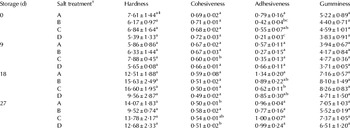
The chemical composition results of LMMC have been presented in Ayyash & Shah (Reference Ayyash and Shah2011c). Hardness, cohesiveness, adhesiveness, and gumminess of experimental LMMC salted with 4 different salt treatments and stored at 4 °C for 27 d are presented in Table 1. There were no significant (P > 0·05) differences in texture profile of the experimental LMMC at same storage period. Nonetheless, hardness of LMMC salted with only NaCl (A) was higher (P > 0·05) compared with other treatments. This means that salting with only NaCl was the cause of an increase in hardness during storage. This finding is in agreement with the results of Ayyash et al. (Reference Ayyash, Sherkat, Francis, Williams and Shah2011) and Katsiari et al. (Reference Katsiari, Voutsinas, Alichanidis and Roussis1997) who showed increase (P > 0·05) hardness of Halloumi, Nabulsi, and feta cheeses, respectively, salted with NaCl only compared with those made using partial replacement of NaCl with KCl. Softness in cheese with partial substitution of NaCl with KCl was probably due to proteolytic enzymes. We anticipated that proteolytic enzymes were inactivated or activated in presence of KCl. Armenteros et al. (Reference Armenteros, Aristoy, Barat and Toldrá2009) found that some proteolytic enzymes in the meat product were inhibited and/or activated in the presence of KCl. Also, we have reported that ACE-inhibitory activity of LMMC salted with high KCl concentrations (C and D) was higher compared with the control (A) (Ayyash & Shah, Reference Ayyash and Shah2011d). A direct effect of proteolysis on the texture of cheeses has been reported (Fox & McSweeney, Reference Fox and McSweeney1996; Upadhyay et al. Reference Upadhyay, McSweeney, Magboul, Fox, Fox, McSweeney, Cogan and Guinee2004). The effects of partial substitution of NaCl with KCl on proteolytic activity and on texture profile need further investigation. Analysis of variance showed that hardness and gumminess slightly increased (P > 0·05) during storage at the same salt treatment. This may be due to increase in medium and small peptides as a results of proteolysis, that increased water holding which in turn increased hardness and gumminess (Lawrence et al. Reference Lawrence, Creamer and Gilles1987). This result is in agreement with that of Ayyash et al. (Reference Ayyash, Sherkat, Francis, Williams and Shah2011) who reported a significant increase in hardness in Halloumi cheese during the first 2 weeks of storage at 4 °C. Two-way ANOVA showed that salt treatment and storage time interaction had no significant effect on TPA profile of LMMC.
Hardness, cohesiveness, adhesiveness and gumminess of experimental LMMC salted with only NaCl and 3 different salt mixtures of NaCl and KCl during storage at 4 °C for 27 d

a–cMeans in each column and at the same storage period with same letter did not differ significantly (P > 0·05)
† Salt treatment: A = NaCl only (control); B = 3:1 NaCl:KCl (w/w); C = 1:1 NaCl:KCl (w/w); D = 1:3 NaCl:KCl (w/w)
‡ Mean values±se of 3 trials
Soluble Ca, P, Na, and K
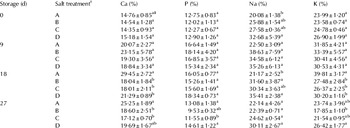
The total concentrations of Ca, P, Na and K (mg/100 g cheese) of experimental LMMC cheeses at D0 and stored at 4 °C were presented in Ayyash & Shah (Reference Ayyash and Shah2011c). Table 2 presents the percent of soluble Ca, P, Na, and K of experimental LMMC salted with 4 different salt treatments during storage. Soluble Ca and P showed almost similar patterns; both elements showed no significant (P > 0·05) differences between experimental LMMC batches at 0 and 9 d storage, while the differences were significant (P < 0·05) for the rest of the storage period. On the other hand, cheese salted with only NaCl (A) had a higher (P < 0·05) soluble Ca than other treatments towards the end of storage period (18 and 27 d). This may suggest that Na possessed more ability to exchange with Ca in the casein network than K. In general, there were no significant differences (P > 0·05) in the percentage of soluble Na and K between experimental LMMC at the same storage period. The percentage of soluble Ca and P increased (P > 0·05) as a result of ripening at same salt treatment. This may be due to the conversion of insoluble Ca and P to their soluble state during storage (Hassan et al. Reference Hassan, Johnson and Lucey2004). Two-way ANOVA showed that salt treatment and storage time interaction had no significant effect on the 4 soluble elements of LMMC.
Percentages of soluble Ca, P, Na, and K of experimental LMMC salted with only NaCl and 3 different salt mixtures of NaCl and KCl during storage at 4 °C for 27 d

a–bMeans in each column and at the same storage period with same letter did not differ significantly (P > 0·05)
† Salt treatment: A = NaCl only (control); B = 3:1 NaCl:KCl (w/w); C = 1:1 NaCl:KCl (w/w); D = 1:3 NaCl:KCl (w/w)
‡ Mean values±se of 3 trials
Correlations and microstructure
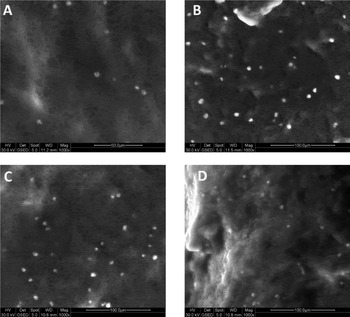
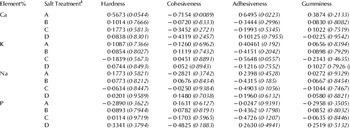
Hardness and gumminess correlated positively with the percentage of soluble Ca at the same salt treatment, especially in LMMC salted with only NaCl (treatment A) (Table 3). There were no observable correlations between texture profile attributes and the percentage of soluble K, Na, and P at any salt treatments. The microstructure images of experimental LMMC taken at the end of the storage period are shown in Fig. 1. ESEM micrographs of A, B, C, and D treatments showed a uniform casein matrix, small voids, and a homogeneous LMMC structure at day 27 of storage. White spots were evenly distributed in cheese matrix in all salt treatments. As seen in Fig. 1, there was no obvious difference in microstructure between experimental LMMC at day 27 of storage. This suggests that NaCl and KCl had similar effects on the microstructure of LMMC. This finding is in accordance with the result of Ayyash et al. (Reference Ayyash, Sherkat, Francis, Williams and Shah2011) who found similar results.
The ESEM images of 4 experimental LMMC samples; A = NaCl only (control); B = 3NaCl:1KCl (w/w); C = 1NaCl:1KCl (w/w); D = 1NaCl:3KCl (w/w) at day 27 of storage.

Pearson correlations of percentages of soluble Ca, K, Na, and P and texture profile of LMMC at same salt treatment†

† Results are expressed as correlation coefficients P-values are in (italic)
‡ Salt treatment: A = NaCl only (control); B = 3:1 NaCl:KCl (w/w); C = 1:1 NaCl:KCl (w/w); D = 1:3 NaCl:KCl (w/w)
Sensory evaluation
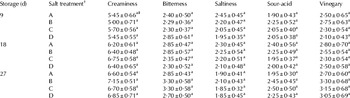
Table 4 presents sensory evaluation scores of LMMC during storage. The analysis of variance showed no significant difference (P > 0·05) in creaminess, bitterness, saltiness, sour-acid, and vinegary taste among the experimental LMMC at the same storage time. These results are in accordance with those of Katsiari et al. (Reference Katsiari, Voutsinas, Alichanidis and Roussis1997, Reference Katsiari, Voutsinas, Alichanidis and Roussis1998). Numerically, treatments C and D received lower saltiness scores compared with other treatments at the same storage period. This suggested that substitution of NaCl with KCl may decrease saltiness taste. Vinegary taste score increased (P > 0·05) during storage at the same salt treatment. This may be attributed to the increase in organic acids content occurred during storage.
Sensory properties of experimental LMMC salted with only NaCl and 3 different salt mixtures of NaCl and KCl during storage at 4 °C for 27 d

a–bMeans in each column and at the same storage period with same letter did not differ significantly (P > 0·05)
† Salt treatment: A = NaCl only (control); B = 3:1 NaCl:KCl (w/w); C = 1:1 NaCl:KCl (w/w); D = 1:3 NaCl:KCl (w/w)
‡ Mean values±se of 3 trials
Conclusion
In general, the use of NaCl or NaCl/KCl mixtures in the salt of cheeses had similar effects on texture profile and microstructure of LMMC at the same storage period. Hence, KCl may be used as an alternative salt to substitute NaCl to produce LMMC. Further investigation is required to understand the effect of NaCl substitution on the conversion of insoluble Ca to soluble Ca in LMMC during storage.