Introduction
Worldwide, 45.7 million people were forcibly displaced due to conflict at the end of 2019 (the most recent global estimate), and half of these ‘internally displaced people’ (IDPs) were women (IDMC, 2020). In sub-Saharan Africa, about 16.5 million were living in displacement at the end of 2018 (IDMC (Internal Displacement Monitoring Centre), 2019). Nigeria has an estimated 2,583,000 million IDPs (IDMC, 2020) and is ranked as having one of the largest numbers of IDPs among sub-Saharan African countries (IDMC, 2016; Nigeria Health Watch, 2016). According to the United Nations office for the coordination of Humanitarian Affairs (OCHA), 80% of IDPs in Nigeria are women and children (OCHA, 2019); 92.4% live with host families and 7.6% live in camps (UNICEF, 2016).
Displacement in Nigeria is mainly due to armed conflicts – for example, Islamist Boko Haram insurgency, communal and international boundary disputes, to mention but a few. Akwa Ibom State, located in the southern part of Nigeria, is home to an estimated 10,000 people displaced due to a boundary dispute between Nigeria and Cameroon. Following the International Court of Justice (ICJ) ruling and the ceding of the Bakassi Peninsula to Cameroon in 2002, the indigenes were displaced from their ancestral homes and resettled in different states of Nigeria. Those who returned to Akwa Ibom State resettled in makeshift camps located at Ibiono Ibom and Ibesikpo. This displacement and re-location was associated with untold hardships and increased health care challenges for IDPs because of the forceful removal from their traditional fishing settlement to a landlocked area. In addition, the re-location led to the loss of their riverine-related occupations resulting in unemployment, coupled with malnutrition and poor access to health care services. Furthermore, most of the women were exposed to the risk of rape and unwanted pregnancy, without adequate access to family planning services (Usoro, Reference Usoro2016).
The rate of contraceptive use in Nigeria is low. An estimated 12% of married women in the country used modern contraceptives in 2019, while the prevalence rate for any method was 17%, with 19% of currently married women reporting an unmet need for contraception (NPC & ICF, 2019; Ononokpono et al., Reference Ononokpono, Odimegwu and Usoro2020). Among the vulnerable displaced population in Nigeria, over a million women of reproductive age require life-saving reproductive health services, including family planning. Notably, several global agencies and organizations have made concerted efforts to finance actions promoting family planning and contraceptive usage, especially in developing countries (Moreira et al., Reference Moreira, Ewerling, Barros and Silveir2019). However, despite these efforts, many women, particularly those in humanitarian settings, still face various barriers to contraceptive use.
During humanitarian crises, the reproductive health needs of women and girls are compromised. In addition, displacement can increase the demand for reproductive health services since access, information and supplies are greatly disrupted. The lack of contraceptive services and life-saving obstetric care for internally displaced women and girls results in increased unplanned pregnancies, unsafe abortions or complicated deliveries and consequently death and permanent disability (Foreman, Reference Foreman2013).
Generally, women and girls are the most vulnerable segments of displaced populations (Brookings Institution, 2014). In humanitarian settings, women are cut off from a regular source of reproductive health services, especially contraceptives, and live in conditions hostile to pregnancy and childbearing (Foreman, Reference Foreman2013). As a result, most displaced women do not use contraceptives and tend to engage in unsafe abortion when faced with the challenges of an unplanned pregnancy. The United Nations Population Fund (UNFPA) have estimated that between 25% and 50% of maternal deaths in refugee settings are due to the complications of unsafe abortion related to non-use of contraceptives, and these deaths could probably have been prevented if life-saving reproductive health services had been available (Foreman, Reference Foreman2013). In some places, ongoing conflicts have destroyed the few reproductive health services, leaving millions of women and girls without access to these essential services (Lafta et al., Reference Lafta, Aflouk, Dhiaa, Lyles and Burnham2016).
Furthermore, internally displaced women across the globe have specific reproductive health care needs that are not known and often go unmet. In eastern Burma, for example, decades of conflict have led to a limited health system with very few trained health professionals and an insufficient and inconsistent supply of contraceptives, leading to high rates of non-use, unsafe abortion and maternal mortality (Hobstetter et al., Reference Hobstetter, Walsh, Leigh, Lee, Sietstra and Foster2012). A study in Iraq indicated that family planning was a significant maternal health care need for internally displaced women (Lafta et al., Reference Lafta, Aflouk, Dhiaa, Lyles and Burnham2016). Osotimehin (Reference Osotimehin2015) noted that the survival of women of reproductive age in crisis contexts in Nigeria depends mainly on their access to essential sexual and reproductive health services, particularly contraception. Casey and Tshipamba (Reference Casey and Tshipamba2017) argued that implementing comprehensive contraceptive services in humanitarian contexts reduces maternal deaths; however, this is difficult, particularly in countries with low contraceptive prevalence.
Reproductive health care services such as family planning are non-existent in most IDP camps in Nigeria, and this may have led to high rates of non-use of contraception. For instance, in one of the IDP camps in Abuja Federal Capital Territory, it has been reported that most women do not have access to, or use, contraceptives (Nigeria Health Watch, 2016). Evidence from the existing literature has shown that contraceptive use is relatively poor among IDPs. Most extant studies have attributed the low or non-use of contraceptives in humanitarian contexts to health care system factors, such as lack of access, unavailability of contraceptive services and disruption of the health care system (Creel, Reference Creel2002; Daniel, Reference Daniel2017; UNFPA, 2017). However, little evidence on the social and cultural factors contributing to the non-use of contraceptives in humanitarian settings is available.
Several studies have focused on the social cost of displacement, challenges of resettlement and reintegration of IDPs (Chi et al., Reference Chi, Bulage, Urdal and Sundby2015; Lassi et al., Reference Lassi, Aftab, Ariff, Kumar, Hussain and Musavi2015; Usoro, Reference Usoro2016). Others have examined the specific health problems of IDPs, such as depression, malnutrition and infectious disease (Kim et al., Reference Kim, Torbay and Lawry2007; Olwedo et al., Reference Olwedo, Mworozi, Bachou and Orach2008; Hamid & Musa Reference Hamid and Musa2010; Gbakima et al., Reference Gbakima, Richard, Namisa and Foday2012; Owoaje et al., Reference Owoaje, Uchendu, Ajayi and Cadmus2016); but there is a paucity of research on the contraceptive behaviour of women in conflict settings. Notably, some studies on reproductive health services have focused on the reproductive health needs of women displaced by the Boko Haram insurgency in northern Nigeria (for example, Odo et al., Reference Odo, Musa and Oladugba2020; Amodu, Reference Amodu2020). To the best of the authors’ knowledge, few studies on reproductive health services exist in southern Nigeria, where several thousands of women and girls have been displaced by communal and international boundary conflicts (Ononokpono et al., Reference Ononokpono, Odimegwu, Imasiku and Adedini2014; Usoro, Reference Usoro2016).
Okanlawon et al. (Reference Okanlawon, Reeves, Opeyemi and Agbaje2010), in a study of IDPs in eastern Nigeria, established that low use of contraceptives was associated with women having little correct information about contraceptives, misperceptions about their safety, believing that contraceptives are dangerous and that chemicals in contraceptives can damage the reproductive system. Creel (Reference Creel2002) highlighted the lack of available data to guide reproductive health programme implementation and the need to improve contraceptive usage in crisis-affected populations. This lack of data points to the need for evidence-based data on critical factors contributing to the non-use of contraceptives in crisis contexts, particularly in Nigeria, where contraceptive prevalence and unmet need for contraception are low. Against this backdrop, this study used a qualitative approach to explore the reasons for the non-use of contraceptive services among displaced Bakassi women in Akwa Ibom State, Nigeria, to unpack the factors mitigating contraceptive usage in humanitarian settings.
Theoretically, this study was anchored on Andersen’s behavioural model of health care service use (Andersen Reference Andersen1995). Following the principles of this model, predisposing factors include a person’s ability to cope with, and command, the resources to use health care services, healthy or unhealthy physical environment, beliefs, attitudes, norms and values, and the knowledge that people have about health and health care services, including contraceptive services, which in turn could influence their perceptions of need, use or non-use. Enabling resources such as income, health personnel, distance to a health facility and transportation could enable or deter individuals from accessing and using health services. The utilization of health services, including contraceptive services, could also be determined by individuals’ views of their experiences and perceptions. Based on the tenets of this model, the predisposing factors of the religious belief that contraception is ‘interference with God’s divine plan’, the cultural norm of large family size and knowledge regarding contraception could determine the use or non-use of contraceptive services. Also, the non-use of modern contraceptives by internally displaced women could also depend on enabling resources such as income or the cost of family planning services, the availability of contraceptive services in the camps, the distance to health facilities that provide quality family planning services and transportation costs. Misconceptions, and perceived or real experiences of side-effects of contraception, could also influence women’s perception of need and consequently non-use of contraceptive services.
Methods
Study area
Akwa Ibom is one of the 36 states of Nigeria, located in the South-South geopolitical zone. It is bordered on the south by the Atlantic Ocean and is currently the home of many IDPs from the Bakassi Peninsula in Cameroon. The sovereign government of Nigeria over the Bakassi Peninsula dates back to the1960s when Nigeria’s Green-White-Green flag was hoisted in the Peninsula. The trouble started in 1994 when the Cameroonian government claimed the oil-rich Bakassi Peninsula (Usoro, Reference Usoro2016). This resulted in a long-drawn legal tussle between Nigeria and Cameroon, which had recorded bloody skirmishes, claimed 34 lives, and almost resulted in a full-blown war (Dafe, Reference Dafe2008). This hostility provoked the Cameroonian government to take Nigeria to the ICJ in 1996. The ICJ gave its verdict in favour of Cameroon on 10th October 2002. As a means of dousing tension between the two countries, Nigeria entered into the Greentree Agreement (GTA) with Cameroon (Usoro, Reference Usoro2016). This agreement documented the processes or procedures for possible implementation of the ICJ ruling on the ownership of the disputed Bakassi Peninsula by the two countries (Federal Republic of Nigeria, 1999).
Following the ceding of Bakassi Penisula to Cameroon, Nigerians residing in the peninsula were given the option to either remain as tenants in their traditional homeland or relocate to Nigeria. Subsequently, some of the displaced persons who traced their origin to Akwa Ibom State were assisted by the Akwa Ibom State Government under Akwa Ibom State Emergency Management Agency’s (AKSEMA) auspices to return to Akwa Ibom State. On 5th September 2008, about 10,000 displaced persons from Bakassi Peninsula returned to Akwa Ibom State (Usoro, Reference Usoro2016); and those IDPs who could not trace their families were relocated to makeshift camps in Ikot Adaidem and Ikot Ediom in Ibiono Ibom and Ibesikpo Asutan Local Government Areas, respectively. There are no health facilities providing reproductive health services in these camps; however, the internally displaced women obtain family planning services and antenatal care from hospitals and health centres located several kilometres away from the camps.
Study design
This study was conducted between 4th January and 7th February 2021 in two purposively selected IDP resettlement camps: Ikot Adaidem and Ikot Ediom temporary camps in Ibiono Ibom and Ibesikpo Asutan Local Government Areas, Akwa Ibom State, southern Nigeria. These two camps were located about 143 km from the coastal city of Port Harcourt and were chosen because they were the most populated government-established transit camps for all the internally displaced persons from the Bakassi Peninsula. Before the commencement of the research, several meetings were held with camp heads to discuss the purpose of the study and obtain permission to implement it in the camps. The camp heads also helped identify and recruit women participants in the camps who met the study’s specific reproductive and demographic criteria – currently married, ever married and never married women of reproductive age (15–49 years).
Study participants and data collection
The study participants included a convenience sample of 40 women of reproductive age (15–49 years). Data were collected using focus group discussions (FGDs). Four FGDs were conducted, two in each camp. The rationale for the number of FGDs conducted and the composition was based on the total number of women of reproductive age the researchers met at the camp during the study period; and the point of saturation. Notably, saturation occurred at two focus groups in each of the camps. Each of the focus groups comprised 6–12 participants in the camp who were willing to participate in the study. Twenty-two participants were selected from Ikot Adaidem, and eighteen from Ikot Ediom camp, making 40 participants from the two camps. Transport cost and light refreshments were provided as incentives to the study participants.
Discussions were held on women’s knowledge and experiences regarding contraception and their reasons for not using ‘modern contraceptives’ and ‘any method of contraceptive’. Specific questions were: Do you know about any modern method of contraceptive? Have you ever used or are you currently using any modern contraceptive or anything to delay or avoid getting pregnant? If yes, what method have you used or are you currently using? If no, what are your reasons for not using any modern method?
The FGDs were conducted in a quiet environment, with the participants seated in a circular form. Each participant was allowed to express herself exhaustively on any question regarding contraceptive use and reasons for non-use without interruption. The FGDs were moderated by the second co-author, who had previously conducted ethnographic work among the study participants and assisted by postgraduate female fieldworkers who spoke both English and the local language (Ibibio). These research assistants were trained on research protocols, aims and ethics. All FGDs were conducted in Ibibio language because of the literacy status of the participants. Each FGD session lasted for an average of 60 minutes. Responses were audio-recorded, and the fieldworkers also took notes. The audio-recorded responses were later transcribed and translated from the local language to English by a language specialist.
Analysis
The qualitative inductive approach was used for data analysis, and this involved the thematic organization of the transcribed responses from the FGDs. Specific attention was paid to narratives describing knowledge of contraception, use of natural methods and reasons for non-use of modern contraception. For the purpose of familiarization, the data were read and re-read to look for patterns and important issues (Mamba et al., Reference Mamba, Adamson, Muula and Stones2017). Related codes were manually identified and sorted into groups to come up with categories. The categories were collapsed to form initial themes and further refined to make meaningful interpretations of the data.
The study was reviewed and approved by the University of Uyo Research Ethics Committee. For all data collection activities, appropriate informed consent was obtained from the participants.
Results
Descriptive analysis of study participants
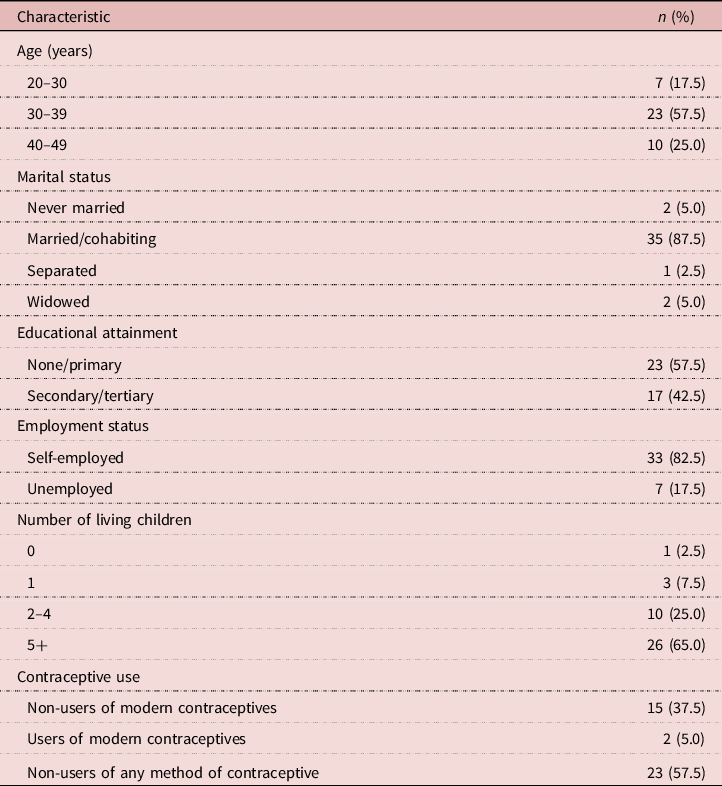
Table 1 shows the socio-demographic characteristics of the participating women. To protect the privacy of the women, the word ‘participant’ is used in the narratives. A considerable percentage of the participants were under 40 years of age and about 87.5% were married. More than half (57.5%) had primary level education, while 42% had secondary/higher level education. The majority of the women were self-employed and had more than five children. Of all 40 participants, only two (5%) were using modern contraception. Of the remaining 38, fifteen (37.5%) were non-users of modern contraceptive, while 23 (57.5%) were non-users of any method of contraception.
Percentage distribution of study participants by background characteristics, resettlement camps, Akwa Ibom State, Nigeria, N=40

Participants’ knowledge of modern contraceptives
One of the recurrent themes that emerged during the women’s narratives in the FGDs was their level of knowledge of modern contraceptives. Many of the participants expressed sufficient knowledge of family planning and contraceptives, and reported that the health centre located outside the camp was their primary source of information on contraceptive. Most of the participants reported that they knew about contraceptives before they visited the health centre for routine antenatal care.
One participant narrated:
I have good knowledge of family planning. Information about various types of contraceptive is readily available at government clinics and maternity homes. Health workers usually give elaborate discussions of family planning during health talks. I was encouraged to ask questions bothering me on any of the contraceptive devices before I took my informed decision to adopt the injectable contraceptive. (FGD participant 1, married user, Ikot Ediom camp)
Another participant stated:
I know what contraceptive is. I am aware of about two or three types of contraceptive devices available for use. Health personnel informed me about the various contraceptive devices during my antenatal clinics. My husband tried out condom once, and the sexual satisfaction was not there. We did not enjoy our intercourse at all, so I stopped using it. (FGD participant 9, married, Ikot Adaidem camp)
Notably, only a few participants claimed complete ignorance about any modern contraception and birth control. For instance, one participants from Ikot Ediom camp said:
I do not know what you mean by modern contraceptives.
Participants’ use of modern contraceptives
Of the 40 participants, only two reported using modern contraceptives (implant and male condoms) to delay or prevent pregnancy. One of the women (a single mother of 6) admitted:
I have no barrier accessing family planning. I get it at the health centre. I went to the health centre and they inserted something [implant] in my hand. I am not married, so I don’t want to have more children. (FGD participant 10, unmarried user, Ikot Adaidem camp)
Despite the knowledge of contraception expressed, more than a third of the participants (fifteen, 37.5%) reported not using modern contraceptives. This result is as expected because modern contraceptive use is generally low in Nigeria, particularly among internally displaced persons. A participant echoed the popular view:
I am not using any contraceptive. I have never taken or used any contraceptive to prevent my pregnancy. Childbirth is a test of womanhood. People who do anything to prevent pregnancy are tampering with their womanhood. Childbearing is a divine blessing, and it is measured by the number of children one can deliver. (FGD participant 8, married non-user, Ikot Ediom camp)
Participants’ use of natural or traditional methods of contraception
Although most of the participants reported not currently using, or never used, modern contraceptives, some of the women admitted using natural and traditional methods of contraception and had good knowledge of safe and unsafe periods. One participant narrated:
I have heard about family planning, and I know about safe and unsafe periods. But I do not take pills or injections as a means of contraception. I monitor my menstrual cycle to ensure that I do not have sexual intercourse with my husband during unsafe days. Although this really took some effort, we managed the situation by exploring several strategies, such as mutual avoidance of emotional contacts. Sometimes I pick offence over minor issues with my husband for some days to reduce the level of affection around us. All these tactics helped us to play with time until we arrived at safe days for maximum sex. (FGD participant 8, married, Ikot Adaidem camp)
Another participant explained in more detail her use of the safe period:
I practise safe period counting. If I have my menstruation say on the 8th, two weeks will pass before I have sexual intercourse. If you do not count safe period after menstruation, afia aya umia. That is, you will be trapped [pregnant]. (FGD participant 4, married, Ikot Ediom camp)
In some cases, the participants reported the use of a traditional herb known as Billygoat Weed (Ageratum congzoides) as a contraceptive. This herb is used by men (husbands) and is believed to be effective in the reduction of sperm potency and the possibility of pregnancy. One participant explained:
Those weeds [Billygoat Weed] planted there is what we use in this camp to help us space our children. Any time we do not want pregnancy to occur my husband drinks traditional herb prepared with goatweed and this concoction will make his sperm to become watery and infertile for about two weeks and reduce the risk of unwanted pregnancy. So many other people have been using the goatweed over the years and the success rate is high. No known side-effect has so far been recorded. (FGD participant 3, married, Ikot Adaidem camp)
Reasons for participants’ non-use of modern contraceptives
The participants gave several reasons for not using modern contraceptive. These have been arranged under the sub-themes misconceptions, fear of real side-effects, religious and cultural beliefs, health care system, economic factors and extramarital sex-related reasons.
Misconceptions
Misconceptions about the side-effects of contraceptives emerged as a significant reason for non-use. There was a general belief or misconception that contraceptive was not good and could cause some health problems such as blockage of the fallopian tube and consequently infertility. Participants also expressed a fear that infertility could lead to marital infidelity. For instance, if the use of contraception results in infertility, it could cause the man to be unfaithful and even desire to have children outside marriage. In the opinion of one of the women during FGD:
Some contraceptives can block the fallopian tubes and render you infertile especially the pills. So I don’t take them. The drugs can prevent a woman from getting pregnant forever. Some men engage in extramarital sex to have children because their wives cannot conceive again after using contraceptive. It can cause bleeding too. I am not sure there are any contraceptives without side-effects. (FGD participant 9, non-user, Ikot Ediom camp)
Beliefs that contraceptives cause secondary infertility, sickness, misfortune or even death were also reasons given for non-use. These are deeply rooted in culture and tradition and transmitted across generations by parents or ancestors.
One participant expressed her fears thus:
I do not use family planning because it has side-effects. I know someone who had three children and after that decided to do family planning to enable her prevent pregnancy for some time. But when she was ready, she could no longer take in. There is this strong belief that her current problem was because of the contraceptive she had used. My late grandmother used to tell us that if one uses any form of contraceptive to prevent pregnancy, it will hunt the person in real life and can cause sickness, misfortune and sometimes death’. (FGD participant 4, non-user, Ikot Ediom camp)
Fear of real side-effects
Another reason for non-use was fear of real side-effects. A few participants who had used some modern methods of contraception reported experiencing some health issues such as bleeding and stomach pains.
One participant narrated her experiences:
I went to the hospital, they inserted something in my body, and they call it coiling [IUD]. But it was not good. It made me bleed, so I had to remove it. It is still disturbing me up till now. At times I have very serious stomach pain because of the contraceptive. This turn of event has adversely affected my sexual life with my husband because I am not always readily available for sex every time he needs me due to stomach pains. (FGD participant 6, married, Ikot Adaidem camp)
Religious and cultural beliefs
Narratives concerning religious beliefs surfaced as another sub-theme and one of the key reasons for non-use of contraceptive services. Some of the participants expressed the opinion that ‘children are from God’ and that it is therefore unacceptable to use contraceptive to prevent pregnancy. Given the religious background of the participants and indoctrination, contraception is regarded as a serious interference with the divine plan of God. One participant stated:
I do not want any control over my pregnancy, children come from God. Any child God gives me, I will take, so I am not using any contraceptive. In my religion, no restriction was placed on the number of children that should come. My religion does not support abortion; any device used in preventing pregnancy is regarded as abortion. (FGD participant 1, non-user, Ikot Adaidem camp)
Another study participant re-iterated:
The teachings of my religion do not approve of any means of obstructing pregnancy. Even our customary laws view it as abortion. To me, contraceptive prevents pregnancy and this is an indirect abortion because it prevents the birth of a child. I want to give birth to as many children as possible because they are a divine gift from God. (FGD participant 2, non-user, Ikot Ediom camp)
In many cases, participants recounted that prayer was a very powerful tool for preventing pregnancy, and thus there was no need for contraception. As previously indicated, most of the participants emphasized that contraception contradicts their personal religious beliefs and in situations where pregnancy is not wanted or desired, women resort to prayer and fasting. The participants expressed much faith in the efficacy of prayer based on personal experiences. One participant recounted her experience as follows:
I have a firm belief in prayer, because of my experience. There was a time I went to the hospital for family planning and they put a certain contraceptive device in my hand, but it was not good for my body, so I went back to the hospital and it was removed. I started fasting and prayer and told God no more children and God answered my prayers. (FGD participant 4, non-user, Ikot Adaidem camp)
The desire for more children was a commonly reported reason for the non-use of contraception. Culturally, in African society and particularly Nigeria, children are sources of social security, status enhancement and cheap labour for the family; and the participants attested to this fact. Women depend on the children to do farm work, and a means of livelihood and survival:
In our culture, children are the pride of the family. The family size determines one’s social status among other things. Children are our source of help in this camp and during the farming season. My husband encouraged me to give birth to as many children as God will give us so that we can have enough hands for farm work when they grow up. I cannot use contraceptive because I need more children. Large families are fearful during local conflicts in the community. (FGD participant 7, married non-user, Ikot Ediom, camp).
Another participant from Ikot Adaidem camp re-iterated:
I don’t want to stop childbearing; I want to have more children as our culture demands.
Economic factors
Most women in IDP camps do not have a stable means of livelihood and barely survive on people’s goodwill. Given the poor economic situation, it is difficult to pay for consumables and access modern contraceptive services. Narratives from some participants revealed the women’s inability to pay for family planning services and transport costs to access modern contraceptives in a distant hospital:
I am not working, so I do not have money to pay for contraceptive. When you go to the health centre, they charge you so much money and I do not have that kind of money to pay them. The health centre in the camp is closed because the nurses are not paid and I do not have money to pay for transport to Anua general hospital. It is very far from the camp. (FGD participant 8, non-user, Ikot Ediom camp)
Another participant expressed the challenge she experienced accessing contraceptive services in hospitals:
Money is our major challenge in the hospital. My husband does not contribute anything in terms of where I access family planning services. Distance is a problem, and I have difficulty accessing means of transportation to obtain contraceptive services because of lack of money. In the hospital, everything [consumables] is paid for. (FGD participant 5, married, Ikot Adaidem camp).
Health care system
One of the important reasons that emerged during the women’s narratives was the unavailability of contraceptive services and non-functionality of health care posts in the camps. This, however, reveals Nigeria’s inadequate health care infrastructure, which perhaps contributes to inaccessibility of health care services, including contraceptive services. Some of the participants reported limited access to health facilities and lack of workers to take care of the reproductive health care needs of women. The nearby health centres were seen to be ill-equipped. Others expressed the problem of distance to health facilities offering quality health care services. For example, a 37-year-old mother of nine children narrated:
The problem we have is lack of family planning clinics and hospitals for IDPs and the good ones are far from the camp. The only health centre in the camp is not functioning and the one close to the camp has one community health worker and has no equipment and drugs [contraceptives]. The government should establish a hospital in the camp. (FGD participant 3, married, Ikot Adaidem camp)
Extramarital sex
Some of the young widows and never-married participants expressed a lack of interest in modern contraception because culturally, extramarital affairs are forbidden. In their opinion, contraceptive use can encourage immoral and extramarital sex, which is unacceptable in their society. One of the widows (aged 40) explained the popular reasons for non-use as follows:
I no longer need a man in my life. Moreover, I am a widow. My husband is late, why will I need contraceptive? Contraceptive will encourage immorality and extramarital affairs among widows and other single women, which is an abomination. Family planning is not part of our tradition and culture. (FGD participant 11, non-user, Ikot Adaidem camp)
Discussion
This study explored the reasons for non-use of modern contraception among internally displaced Bakassi women in Akwa Ibom State, southern Nigeria. Interestingly, many of the participating women expressed some level of knowledge of modern contraceptives and indicated that health centres were their major source of information. Surprisingly, this knowledge does not translate into contraceptive use, with many of the participants reporting non-use of modern contraception. Of the 40 participants, only two reported using modern contraceptives, namely implants and condoms. Interestingly, one of the women – a never-married 25-year-old mother of six children – reported using an implant device to avoid having more children. This suggests safe sex practice and the need to improve access to contraceptive services, and unmet need for contraception among internally displaced women. Other contraceptive methods used by the participants were natural and traditional methods including abstinence, menstrual cycle regulation and herbs.
The study identified a wide range of reasons for non-use of modern contraceptives, and these included a combination of misconceptions, religious, economic, social, cultural and health care system factors. The overarching reason for the non-use of contraception was misconception about the potential side-effects of contraceptives, albeit a few narratives were based on real-life experiences of side-effects such as bleeding and stomach pain. One misconception was that contraceptives could block the fallopian tube, and cause disease, sickness and infertility. Some participants even viewed contraception as an abomination that can lead to punishment such as barenness, infertility in men who conspired, and even death, among other superstitious beliefs. These findings corroborate other studies (Ankomah et al., Reference Ankomah, Anyanti and Oladosu2011; Gueye et al., Reference Gueye, Speizer, Corroon and Okigbo2015; Parks, Reference Parks2019). The gross misconception found in this study may have emanated from incorrect or incomplete knowledge of safe and effective contraception (Ankomah et al., Reference Ankomah, Anyanti and Oladosu2011). Another plausible explanation may be deep-rooted cultural norms and beliefs about the side-effects of contraceptives handed down by the generations, as indicated in the narratives. These misconceptions are barriers to the use of contraceptives and, in turn, fighting unwanted pregnancy and unsafe abortion (Adongo et al., Reference Adongo, Tabong, Azongo, Phillips, Sheff, Stone and Tapsoba2014), which are common reproductive health challenges among IDPs. However, these findings may aid in the development of targeted interventions to educate internally displaced women to dispel their misperceptions about the safety of contraceptives and ensure adequate access to family planning services. The adverse effects of contraceptives reported by a few participants may be related to the hormonal content of contraceptives (Endogenous Hormones and Breast Cancer Collaborative Group, 2002; Parks, Reference Parks2019).
Religious belief emerged as a key reason for the non-use of contraception. Interestingly, some of the women reported that contraception to prevent pregnancy was against their personal religious beliefs. Children were believed to come from God, and the effort to control pregnancy by contraception was contrary to divine purpose; hence prayer was believed to be the only accepted way of preventing pregnancy. This lends credence to a study in Nigeria which reported that Christians, particularly those affiliated to the Catholic Church, officially believe that birth control is a violation of natural law and that sexual intercourse is for the express purpose of procreation (Obasohan, Reference Obasohan2015; Pandia Health, 2020). Despite the Catholic Church’s prohibition on contraceptive use, it is essential to note that most studies find no difference in contraceptive use when comparing Catholics and non-Catholics (Obasohan, Reference Obasohan2015; Wusu Reference Wusu2015; Lasong, et al., Reference Lasong, Zhang, Gebremedhin, Opoku, Abaidoo and Mkandawire2020). The majority of the study women were affiliated to religious groups (not shown) that believe using contraception is intrinsically evil, and encourage use of natural birth control methods instead. This finding clearly shows that religious beliefs greatly influence internally displaced women’s sexual and reproductive behaviour.
The participants’ narratives on religious beliefs may be explained by Christian ideas about contraception that come from church teachings and dogma or the ‘Church founders hypothesis’, which are subject to different Christian interpretations and perceptions. Notably, in the first centuries of Christianity, contraception and abortion were regarded as wrong because of their association with paganism (Jones & Dreweke, Reference Jones and Dreweke2011). In contemporary Christianity, some of these teachings are still upheld among religious groups and individuals, as demonstrated by most participants in this study.
Other important reasons given for non-use of contraceptives were the cost of accessing contraceptive services (lack of income) and the unavailability of contraceptives. This finding is in line with other studies (Imo et al. Reference Imo, Okoronkwo and Ukoji2015; Ononokpono et al., Reference Ononokpono, Odimegwu and Usoro2020). Although contraceptives are free in government hospitals in Nigeria, medical consumables (gloves, bandages, syringe etc.) are not usually provided with the products. Inaccessibility of contraceptives was expressed in terms of cost of consumables and distance to the health facility and transportation. The problem of access to and non-use of contraception was exacerbated by the poor socioeconomic status of the participants; the majority were self-employed, and their basic means of livelihood was subsistence.
It is important to highlight that contraceptive services were not available in the camps where the women lived, indicating a health system failure. Even if women want to use contraception, it will be difficult if it is not available or accessible. The non-use of contraception found in this study is partly due to the unavailability of contraceptive services in the camps. Indeed, the health post established at one of the camps to provide reproductive health services was not functional at the time of the survey. The women reported that medical staff employed in the facility stopped working due to non-payment of remunerations. The distance to the nearest health facility, coupled with the problem of transport, posed a challenge to accessing contraceptive services.
Most participating women expressed a desire for more children, highlighting the cultural norm of a large family size in Nigerian society. The total dependence on children for survival could explain the tendency to fear that pregnancy prevention will negatively affect childbearing and, consequently, livelihood. This dependence could further explain the fear of infertility misconstrued as an outcome of contraceptive usage. The narrative that contraceptives encourage immoral and extramarital sex could explain the stigma associated with extramarital sex in a typical Nigerian society, particularly among widows and single women.
This study had some notable limitations. The data were translated from the local language into English, and although verified, some of the original words could have lost their original meaning during translation. However, attention was paid to important narratives to mitigate this problem, emphasizing overarching themes present in the transcripts rather than specific words or phrases used by participants. Admittedly, the use of FGDs in this study may not have elucidated enough information on the reasons for non-use of contraception considering the sensitive nature of the study phenomenon.
In conclusion, this study revealed several reasons for the non-use of contraceptive services among internally displaced Bakassi women in Nigeria. Misconceptions, religious and cultural beliefs, cost and unavailability and inaccessibility of contraceptive services were the key reasons given for participant’s non-use of contraception. These findings have far-reaching policy implications. There is a need for reproductive health education and accurate information about contraception among internally displaced women in the camps to alleviate the fear of side-effects based on misconceptions. Religious beliefs and cultural norms and values inimical to contraceptive usage should be addressed. Contraceptives should be made available and accessible at government health centres near to the IDP camps – not just at distant hospitals. The use of family planning services by internally displaced women in unstable, crisis environments is a life-saving intervention, and these women need to be economically empowered and educated on the benefits of contraception.
Acknowledgments
The authors would like to thank the Nigeria Tertiary Education Trust Fund (TETFUND) for funding this research; the women who participated in this study, for their time and trust during the data collection processes; and the camp heads for permission to conduct the survey and allowing access to the IDP camps. The authors are also grateful for the assistance provided by the field team.
Funding
This work was supported by the Nigeria Tertiary Education Trust Fund under Grant number- TETFUND/DESS/UNI/UYO/2018/RP/VOL.1.
Conflicts of Interest
No potential conflicts of interest are reported by the authors.
Ethical Approval
The University of Uyo Institutional Health Research Ethics Committee (UNIUYO-IHREC) approved the study.