Introduction
Digital platforms have become central infrastructures of everyday life, reshaping how young people communicate, socialize, and participate in culture. Online games and social media, in particular, constitute dense, always‑on environments in which interaction is fast‑paced, repetitive, and structured by platform‑specific mechanics and interfaces (Guralnik and Pavlova Reference Guralnik and Pavlova2020; Kline et al. Reference Kline, Dyer–Witheford and de Peuter2003; Würschinger Reference Würschinger2023). In non‑anglophone contexts, participation in these environments is frequently mediated through English, making digital platforms significant sites of informal linguistic exposure. Although the cultural and economic dimensions of platform globalization have been widely examined, the linguistic consequences – and users’ understandings – of sustained engagement with digitally mediated environments in which English operates alongside Arabic remain insufficiently explored.
In the Saudi context, digital engagement among youth is both intensive and socially embedded, with platforms such as online multiplayer games, Snapchat, TikTok, Instagram and X forming core sites of daily interaction. Saudi Arabia has one of the highest rates of internet connectivity and social media use in the region, and young people spend substantial portions of their daily lives engaged in mobile‑mediated communication, entertainment, and content creation (Communications, Space and Technology Commission 2024; DataReportal 2024).
These conditions are particularly relevant for Saudi Generation Z, whose everyday communication is characterized by mobile‑first interaction, rapid content circulation, online gaming, influencer engagement, short‑form video consumption, and strong peer‑network reinforcement (Al Fraidan Reference Al Fraidan2023; Alghamdi and Petraki Reference Alghamdi and Petraki2018; Ayish and Mellor Reference Ayish and Mellor2015). Existing research on digital lexical innovation suggests that globally circulating platform terminology can become salient through repeated interface exposure and networked interaction (Guralnik and Pavlova Reference Guralnik and Pavlova2020; Würschinger Reference Würschinger2023).
Within this linguistic ecology, Arabic remains the dominant language of everyday interaction, while English‑origin digital vocabulary functions as a visible lexical resource associated with gaming, social media participation and digital identity construction. Previous studies of Gulf digital communication show that English‑origin forms circulate within predominantly Arabic interaction and may acquire locally meaningful uses (Alghamdi and Petraki Reference Alghamdi and Petraki2018; Palfreyman and Al Khalil Reference Palfreyman and Khalil2003). The present study does not independently observe this process; it examines how Saudi participants remember, report, and interpret such vocabulary in their own digital experiences.
Existing research on digital language use in Arab and Gulf contexts has primarily focused on phenomena such as Arabizi and Arabic–English code‑switching. Arabizi – the use of Latin characters and numerals to represent Arabic in digital communication – has been examined as both a pragmatic response to technological constraints and a stylistic marker of youth identity and modernity (Alghamdi and Petraki Reference Alghamdi and Petraki2018; Ayish and Mellor Reference Ayish and Mellor2015; Palfreyman and Al Khalil Reference Palfreyman and Khalil2003). Similarly, studies of code‑switching on social media platforms have shown how bilingual users alternate between Arabic and English to manage stance, index identity and achieve pragmatic effects in online interaction (Aburqayiq et al. Reference Aburqayiq, Altakhaineh and Alsariera2025; Al–Deaibes Reference Al–Deaibes2021; Elhija Reference Elhija2023). While this body of work highlights linguistic flexibility and identity performance, it leaves comparatively underexamined how users themselves represent the routine incorporation of English digital vocabulary into Arabic discourse.
This article addresses that gap through the concept of digi‑borrowing, a term introduced by the author to describe the platform‑linked uptake and local adaptation of digital vocabulary across linguistic communities. In the present study, digi‑borrowing refers specifically to participants’ reported use and interpretation of Arabicized English‑origin terms associated principally with online gaming and social media.
In this study, digital vocabulary refers to English‑origin lexical items closely associated with platform‑mediated environments, including online games, social media platforms, messaging applications, and digital interfaces. These items typically denote platform‑specific actions, roles, mechanics, metrics or interactional practices – for example, lag, respawn, trend and noob – rather than general English vocabulary.
The questionnaire elicited written self‑reports rather than recordings of spoken interaction. Accordingly, the forms presented in this article are standardized Roman‑script reporting labels grouped by the English source term identified by respondents; they are not phonemic transcriptions and do not establish pronunciation or morphosyntactic integration in naturally occurring discourse. Examples include mlaqlq (from lag, referring to connection delay), risbawn (from respawn, the return of a player character after elimination) and trind (from trend, a popular or widely discussed topic). Participants’ recognition and explanations of these labels support analysis of reported familiarity and metalinguistic representation. More systematic claims about phonological, morphological or syntactic integration require spoken or naturally occurring written data.
Platform studies and research on lexical innovation suggest that repeated encounters with interface language, gameplay mechanics, algorithmically circulated content, and peer terminology may create conditions for familiarity and conventionalization (Chen Reference Chen and Fung2013; Guralnik and Pavlova Reference Guralnik and Pavlova2020; Würschinger Reference Würschinger2023). In this article, normalization refers narrowly to participants’ representation of certain forms as familiar, conventional or routinely available within their digital experience. It does not denote independently observed diffusion, community‑wide adoption or diachronic change.
Rather than treating digi‑borrowing solely as a stylistic or identity‑driven phenomenon, this study examines recurring patterns in participants’ self‑reported lexical practices, memories, meanings and perceptions. Its contribution is therefore modest but novel: it explores how Saudi Generation Z participants describe formulaic reuse, lexical alternatives, continuity of meaning and perceived learning in relation to English‑origin digital vocabulary. The analysis does not claim to measure naturally occurring use, actual exposure, proficiency or development over time.
Although the present study focuses on Saudi Arabic, the concept of digi‑borrowing may also be applicable to other linguistic communities in which users report adapting globally circulating digital vocabulary to local language practices. Comparative observational work would be required to test that broader applicability.
Digi‑borrowing in platformed media ecologies
Scholarship on digital media has consistently highlighted online platforms as key sites for the emergence of new cultural forms, identities, and practices. Studies of the East Asian games industry, for example, demonstrate how online games operate through processes of glocalization, whereby globally circulating formats are localized to align with regional tastes, identities and consumption patterns (Chen Reference Chen and Fung2013; Robertson Reference Robertson, Featherstone, Lash and Robertson1995; Straubhaar Reference Straubhaar2007). Japanese and Korean games have been described as hybrid cultural products that combine Western narrative structures with local aesthetics and social norms (Aoyama and Izushi Reference Aoyama, Izushi, Power and Scott2004; Hjorth Reference Hjorth2006; Iwabuchi Reference Iwabuchi2002, Reference Iwabuchi and Tobin2004). This work shows that platforms do not merely distribute content; they reorganize participation, interaction and cultural production within globally connected environments (Consalvo Reference Consalvo2006; Kline et al. Reference Kline, Dyer–Witheford and de Peuter2003).
While this literature has been instrumental in theorizing cultural hybridity and identity formation, it has paid comparatively limited attention to users’ metalinguistic understandings of everyday digital vocabulary. Interfaces, commands and community‑specific terminology provide recurrent linguistic input, but the consequences of such exposure cannot be inferred from exposure alone. The present study therefore asks how participants remember and describe their encounters with a relatively narrow and repetitive set of English‑origin digital terms, rather than claiming to observe the developmental effects of those encounters.
In Arab digitally mediated communication, existing research has primarily focused on Arabizi and Arabic–English code‑switching. Arabizi – the use of Latin characters and numerals to represent Arabic – has been examined as both a pragmatic adaptation to technological constraints and a stylistic resource for indexing youth identity and modernity (Alghamdi and Petraki Reference Alghamdi and Petraki2018; Ayish and Mellor Reference Ayish and Mellor2015; Palfreyman and Al Khalil Reference Palfreyman and Khalil2003). Studies of code‑switching on social media similarly show how bilingual users alternate between Arabic and English to manage stance, achieve communicative goals and perform cosmopolitan identities (Aburqayiq et al. Reference Aburqayiq, Altakhaineh and Alsariera2025; Al–Deaibes Reference Al–Deaibes2021; Elhija Reference Elhija2023). Collectively, this work frames Arab digital spaces as sites of linguistic flexibility, identity negotiation and language ideology.
Less attention has been given to how users conceptualize English lexical items that are repeatedly incorporated into Arabic digital interaction. Digi‑borrowing is used here as an analytical category for those participant‑reported forms. Unlike Arabizi, which concerns script choice, or code‑switching, which foregrounds alternation between recognizable language resources, digi‑borrowing directs attention to respondents’ descriptions of English‑origin digital words as familiar Arabicized labels. The present self‑report data cannot determine whether participants lack awareness of foreign origins or whether forms are fully integrated into Arabic morphosyntax; these remain hypotheses for naturally occurring discourse analysis (Armstrong Reference Armstrong2016; Thomason and Kaufman Reference Thomason and Kaufman1988).
Contact‑linguistic accounts treat lexical borrowing as a socially mediated process whose degree of integration must be established through evidence of form, distribution, and use (Thomason and Kaufman Reference Thomason and Kaufman1988). Digital communication may enable rapid circulation of new lexical material, as studies of web‑based neologisms and lexical innovation suggest (Guralnik and Pavlova Reference Guralnik and Pavlova2020; Würschinger Reference Würschinger2023). That scholarship provides a rationale for examining platform‑linked terms, but it does not by itself demonstrate that the forms elicited here have diffused rapidly, stabilized diachronically or become community‑wide norms.
Digi‑borrowing can also be interpreted through translanguaging and sociocultural perspectives. Translanguaging conceptualizes bilingual communication as the flexible deployment of an integrated semiotic repertoire rather than the alternation of discrete linguistic systems (García and Wei Reference García and Wei2014). Sociocultural theory emphasizes that linguistic knowledge is mediated through participation in socially organized activity (Vygotsky Reference Vygotsky1978). These perspectives help situate respondents’ accounts of English‑origin platform terms within broader practices of digital participation, while the present questionnaire reveals participants’ interpretations of those practices rather than directly observing them (Hopkyns Reference Hopkyns, Siemund and Jakob R. E.2021).
Usage‑based approaches offer a more specific theoretical link between repeated encounters and lexical familiarity. They emphasize the role of frequency, repetition, and experience in recognition, retrieval, and entrenchment (Al Fraidan and Alaamri Reference Al Fraidan and Alaamri2025; Bybee Reference Bybee2006; Ellis Reference Ellis2002). This perspective motivates questions about whether familiarity with platform‑specific terms is associated, in participants’ own accounts, with broader lexical flexibility or transfer. It remains a theoretical interpretive frame in this study because actual exposure frequency, processing and development were not independently measured.
Corpus linguistics also provides useful procedures for organizing and counting lexical material (Biber et al. Reference Biber, Conrad and Reppen1998; Egbert et al. Reference Egbert, Larsson and Biber2020; Paquot and Gries Reference Paquot and Gries2020). Nevertheless, the material analyzed here is not a corpus of naturally occurring discourse. It is a participant‑generated lexical inventory derived from questionnaire responses. Frequency summaries therefore show how many respondents mentioned each grouped form and which contexts they reported; they do not show token frequency in communication or provide an independent evidential stream.
Exposure and use are consequently treated as related but distinct constructs. Exposure refers to participants’ reported encounters with English‑origin digital terminology through interfaces, gameplay, social media and peer communication. Use refers to their own accounts of incorporating such terminology into communication. Neither construct was observed directly, and the study does not infer a causal relationship between them. Instead, it analyzes how respondents link exposure, familiarity, reported use and perceived learning in their narratives.
The study integrates platform studies, sociocultural theory, usage‑based research and lexical development as complementary interpretive perspectives. Platform studies identify technological and interactional conditions under which terminology may circulate (Chen Reference Chen and Fung2013; Kline et al. Reference Kline, Dyer–Witheford and de Peuter2003); sociocultural theory situates lexical practices within participation in shared activities (Vygotsky Reference Vygotsky1978); usage‑based theory explains why repeated encounters may be experienced as familiarity (Bybee Reference Bybee2006; Ellis Reference Ellis2002); and lexical research distinguishes recognition from flexible, transferable knowledge (Nation Reference Nation2001). These perspectives guide interpretation of self‑reports rather than serving as evidence that the predicted processes occurred.
For this study, productive lexical use means the ability – when independently demonstrated – to deploy lexical items flexibly across contexts, adapt them to new situations, and integrate them into broader repertoires. Lexical diversification refers to access to multiple expressions for similar meanings. Because no productive vocabulary task or naturally occurring discourse sample was collected, the study assesses only participants’ reports of flexibility, alternatives, and transfer. These reports are relevant to language awareness, but they are not direct measurements of productive control.
The four labels retained in the article – formulaic imitation, restricted lexical repertoire, lexical fossilization and illusion of competence – are therefore interpretive categories rather than independently verified outcomes. Formulaic imitation refers to participants’ descriptions of habitual repetition. Restricted repertoire refers to reported reliance on a small set of salient terms, not a measured repertoire‑size deficit. Lexical fossilization refers cautiously to reported continuity of platform‑linked labels or meanings, not diachronic arrest. Illusion of competence refers to a reported mismatch between perceived lexical learning and respondents’ own accounts of limited transfer; it is not a diagnosis of false belief or a substitute for proficiency testing. Repetition and formulaic language are not treated as inherently problematic (Ellis Reference Ellis2002; Wray Reference Wray2002).
In this sense, digi‑borrowing remains a critical lens on possible linguistic constraint while the empirical contribution of the present study is deliberately exploratory. By focusing on reported patterns, meanings, salience, and language perceptions rather than isolated forms alone, the study identifies questions that future observational, longitudinal and performance‑based research can test.
Methodology
Empirically, the study of digi‑borrowing requires an approach that can document both the lexical items participants recall and the meanings they assign to them. The present study therefore adopts an exploratory qualitative design supported by descriptive frequency analysis of a participant‑generated lexical inventory (Braun and Clarke Reference Braun and Clarke2006, Reference Braun and Clarke2021; Egbert et al. Reference Egbert, Larsson and Biber2020; Paquot and Gries Reference Paquot and Gries2020). The design examines self‑reported lexical practices, memories and language perceptions; it does not observe discourse or test linguistic competence.
Research design and questions
The study investigates how Saudi youth represent and interpret English‑origin digital vocabulary in an Arabic‑speaking context. The research questions are framed around participants’ perceptions and reports so that the claims remain aligned with the questionnaire‑based design.
The study is guided by the following overarching research question:
How do Saudi Generation Z participants report and interpret their engagement with English‑origin digital vocabulary in platform‑mediated contexts?
To address this broader question, the study examines five related dimensions:
1. How do participants describe the habitual or formulaic use of digi‑borrowed forms?
2. How do participants describe the availability and use of Arabic or English lexical alternatives?
3. How do participants describe the maintenance and meanings of frequently reported forms across contexts?
4. How do participants interpret the relationship between familiarity with digi‑borrowed vocabulary and their perceived English learning or competence?
5. Which digi‑borrowed forms and platform contexts are most frequently reported?
Together, these questions examine reported lexical practices and metalinguistic perceptions. They do not presuppose that formulaicity, restriction, stabilization or competence has been independently observed.
Participants and sampling
The study focuses on Saudi Generation Z, commonly defined as individuals born between the mid‑1990s and early 2010s (Dimock Reference Dimock2019). The recruitment notice specified Saudi youth as the target population, and the questionnaire’s demographic section recorded respondents’ self‑reported age, gender, educational level, nationality and patterns of digital engagement. Eligibility was limited to respondents who identified as Saudi and were aged 16–24 at the time of data collection. A purposive sample of 87 participants was retained: 32.2 percent were male and 67.8 percent female, and most were high‑school or undergraduate students. These characteristics are self‑reported rather than independently verified.
Participants also described varying degrees of engagement with English in digital contexts, ranging from bilingual Arabic–English interaction to predominantly Arabic use. Most reported daily social‑media use, and many described frequent gaming or other interactive digital activity. These responses provide contextual information about perceived exposure and participation; they should not be treated as objective screen‑time or exposure measures.
Data collection
Data were collected through an online questionnaire distributed via WhatsApp, Instagram, Telegram and Twitter/X. These channels were used for recruitment and access; their use as distribution channels does not itself establish that digi‑borrowed forms emerge or circulate on them. The questionnaire was administered entirely in Arabic and contained demographic items, structured prompts, and open‑ended questions.
Representative English translations of the prompts asked participants to:
RQ1. list English‑origin digital, gaming‑related, or socially popular terms they commonly use;
RQ2. identify the English word or expression from which they believed each reported form originated and explain what the form meant to them;
RQ3. identify the context or contexts in which they reported using each item, including gaming, social media, messaging, and offline conversation; and
RQ4. explain why they used such terms and whether familiarity with them affected their perceptions of learning or using English.
Participants were not introduced to the term digi‑borrowing. It was applied subsequently as an analytical label. The source‑term prompt was included to examine participants’ own awareness of relationships between reported forms and English‑origin counterparts.
The instrument was developed in Arabic and reviewed by three subject‑matter experts for conceptual clarity, cultural appropriateness and coverage of relevant digital contexts. Appendix A provides representative English translations of the participant‑facing prompts.
Responses were written. Quotations in the Results section are English translations of Arabic answers. Lexical items in italics are standardized reporting labels supplied by the researcher for consistency; phonemic transcription is not used. Where respondents supplied spelling variants associated with the same perceived English source and meaning, those variants were grouped under one reporting label for the descriptive frequency summary. The original spellings remain part of the underlying questionnaire dataset.
The frequencies reported below are therefore respondent‑mention counts, not token frequencies in naturally occurring discourse. They indicate the salience of grouped lexical items within this questionnaire sample.
Analytic strategy
The analysis used a hybrid inductive–deductive thematic procedure alongside a descriptive summary of the participant‑generated lexical inventory. Both analyses drew on the same questionnaire dataset and were used for complementary description, not independent triangulation.
Because the study relies on questionnaire responses, the analysis concerns participants’ reported practices, perceptions, memories and interpretations rather than directly observed linguistic behavior. The author conducted all coding; no inter‑coder reliability statistic is claimed. Peer debriefing was used to review category definitions and selected extracts, while final coding decisions remained with the author.
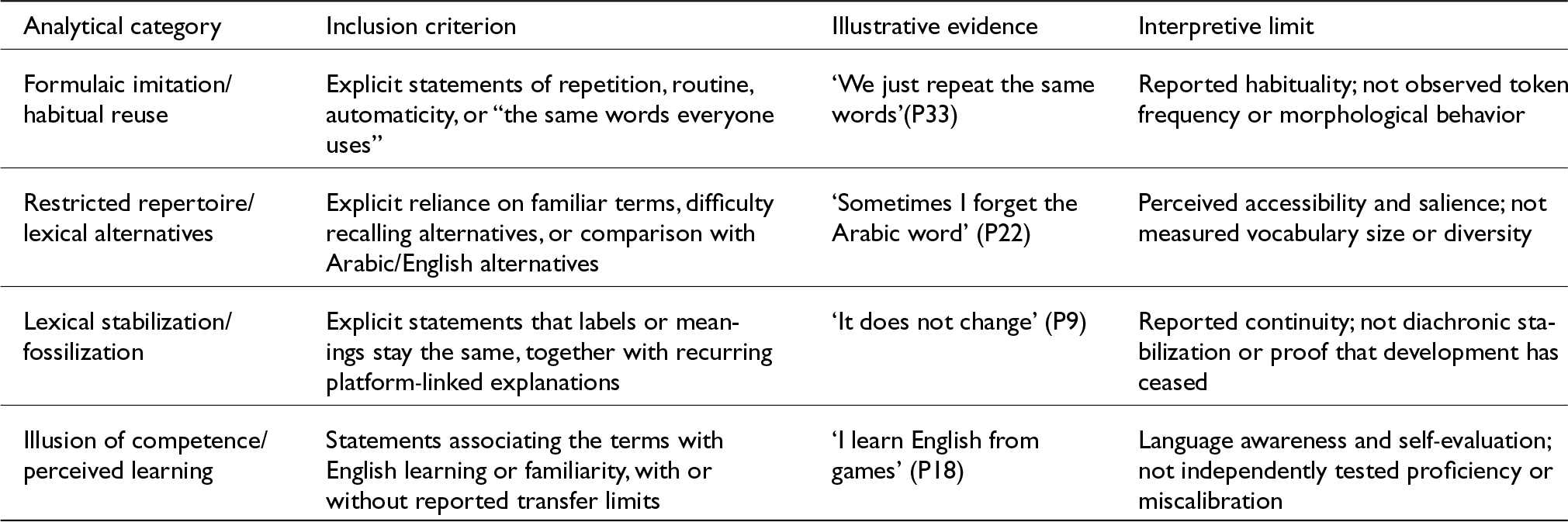
A response was assigned to an analytical category only when it contained an explicit statement matching the inclusion criterion summarized in Table 1. Categories were not mutually exclusive, and percentages use the full sample of 87 respondents as the denominator. The reported percentages therefore represent the number of respondents whose answers were coded within a category, not proportions of observed utterances.
Analytical categories, inclusion criteria and interpretive scope

Table 1 Long description
The table organizes four analytical categories used to interpret participant comments about language use and learning. Formulaic imitation or habitual reuse is included when speakers explicitly mention repetition or automatic phrasing, illustrated by We just repeat the same words (P33), and is limited to self-reported habit rather than observed usage patterns. Restricted repertoire or lexical alternatives covers reliance on familiar terms or difficulty recalling other words, such as Sometimes I forget the Arabic word (P22), and is limited to perceived accessibility rather than measured vocabulary breadth. Lexical stabilization or fossilization is identified when participants say labels or meanings stay unchanged with recurring platform-linked explanations, for example It does not change (P9), but it does not demonstrate long-term stabilization or halted development. Illusion of competence or perceived learning includes statements linking terms to English learning or familiarity, such as I learn English from games (P18), and is limited to self-evaluation rather than independently tested proficiency.
Analysis proceeded in three stages:
In the first stage, open coding stayed close to participants’ wording and identified references to platform contexts, habitual repetition, lexical alternatives, reported meanings, perceived learning and transfer. This stage was inductive in the limited sense that initial labels were generated from recurring language in the responses rather than assigned immediately to the four interpretive labels in the title.
In the second stage, the open codes were compared with the study’s sensitizing concepts and research questions. Related codes were organized into the four interpretive categories – formulaic imitation; restricted lexical repertoire; lexical stabilization/fossilization; illusion of competence – while preserving counter‑evidence such as reports of offline use or cross‑context transfer. This stage was deductive and theory‑informed; the revised manuscript no longer describes the final categories as wholly emergent.
In the third stage, all reported forms were compiled into a participant‑generated lexical inventory. AntConc was used to search and count standardized item labels after spelling variants had been grouped by perceived English source and reported meaning. The resulting tables summarize respondent mentions and reported contexts. They do not constitute a corpus of discourse, establish actual usage frequency, or independently verify the thematic interpretations.
Table 1 presents the category definitions, inclusion criteria, illustrative evidence, and interpretive limits used in the revised analysis. Tables 2–5 then summarize lexical mentions, meanings, perceptions and contexts reported in the questionnaire.
Most frequently mentioned digi‑borrowed forms (N = 87)

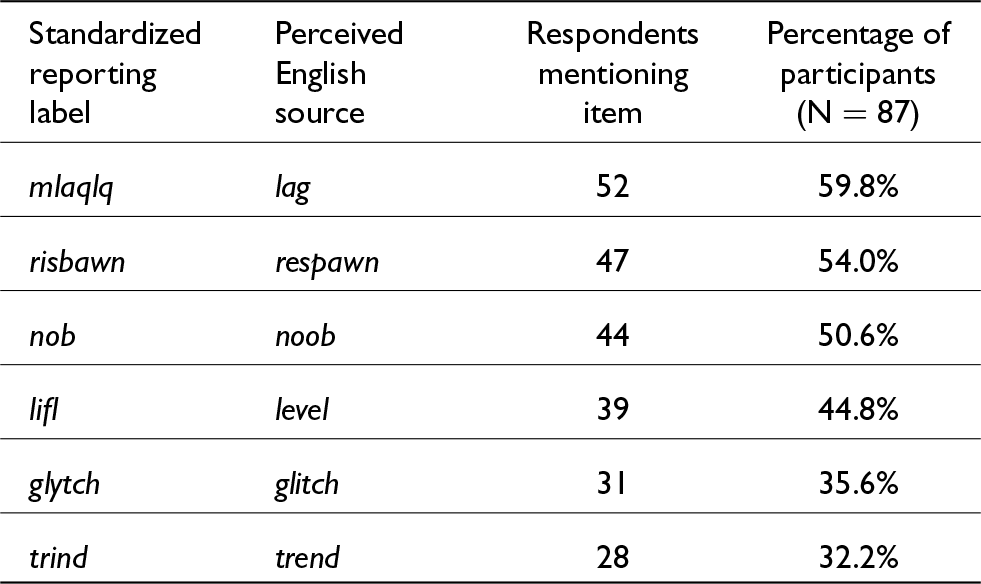
Table 2 Long description
Among 87 participants, mlaqlq, perceived to derive from lag, was mentioned by 52 respondents (59.8%); risbawn, from respawn, by 47 (54.0%); nob, from noob, by 44 (50.6%); lifl, from level, by 39 (44.8%); glytch, from glitch, by 31 (35.6%); and trind, from trend, by 28 (32.2%). Frequencies count respondents who mentioned each grouped item at least once; percentages do not sum to 100 because respondents could mention multiple items.
Note. Frequency is the number of respondents who mentioned a grouped item at least once. Percentages use N = 87. Respondents could mention multiple items, so percentages do not sum to 100 percent. Spelling variants were grouped under standardized reporting labels by perceived English source and reported meaning.
Consistency of participant‑reported meanings for frequently mentioned forms

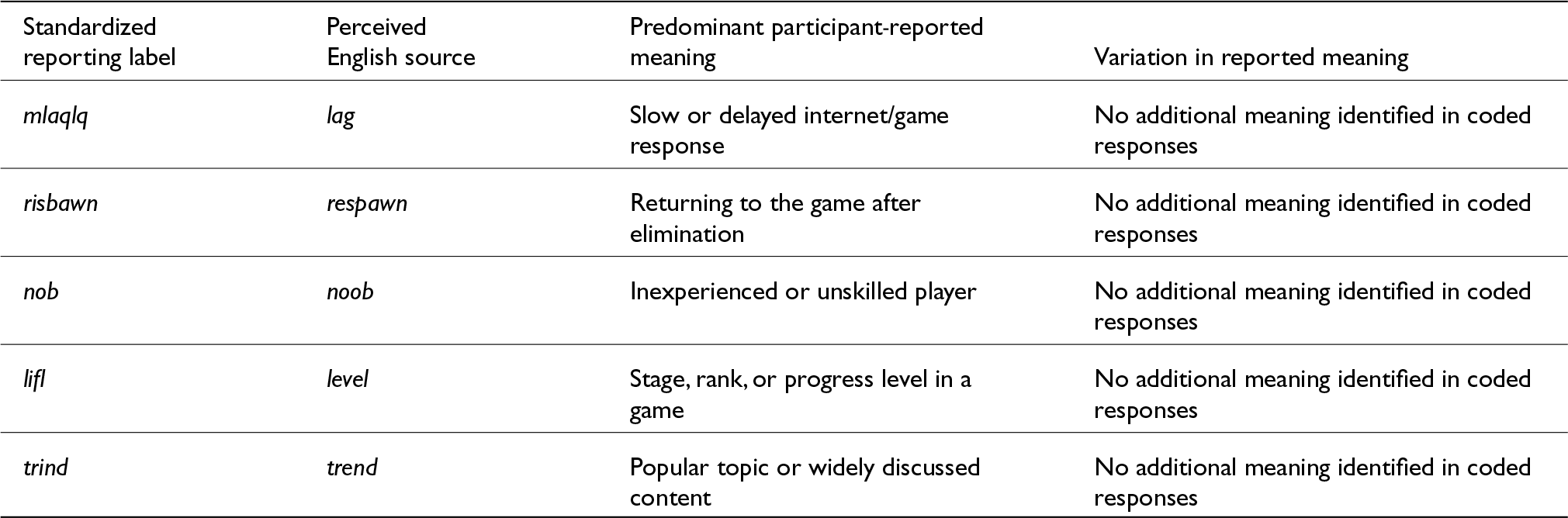
Table 3 Long description
Five standardized reporting labels are paired with their perceived English sources and predominant participant-reported meanings. Mlaqlq, from lag, means slow or delayed internet or game response. Risbawn, from respawn, means returning to the game after elimination. Nob, from noob, means an inexperienced or unskilled player. Lifl, from level, means a stage, rank, or progress level in a game. Trind, from trend, means a popular topic or widely discussed content. For all five forms, no additional meaning was identified in the coded responses.
Reported perceptions of lexical learning and transfer

Table 4 Long description
The table lists six standardized digi-borrowed forms, their perceived English source words, and how many of 87 participants mentioned each item, with the corresponding share of participants. mlaqlq (from lag) is most frequent, mentioned by 52 participants, about 60 percent. Next are risbawn (from respawn) with 47 mentions, about 54 percent, and nob (from noob) with 44 mentions, about 51 percent. Mid-range items are lifl (from level) with 39 mentions, about 45 percent, and glytch (from glitch) with 31 mentions, about 36 percent. The least mentioned among these is trind (from trend) with 28 mentions, about 32 percent. Counts reflect whether a participant mentioned an item at least once, and participants could mention multiple items, so the percentages are not intended to add up to a full total.
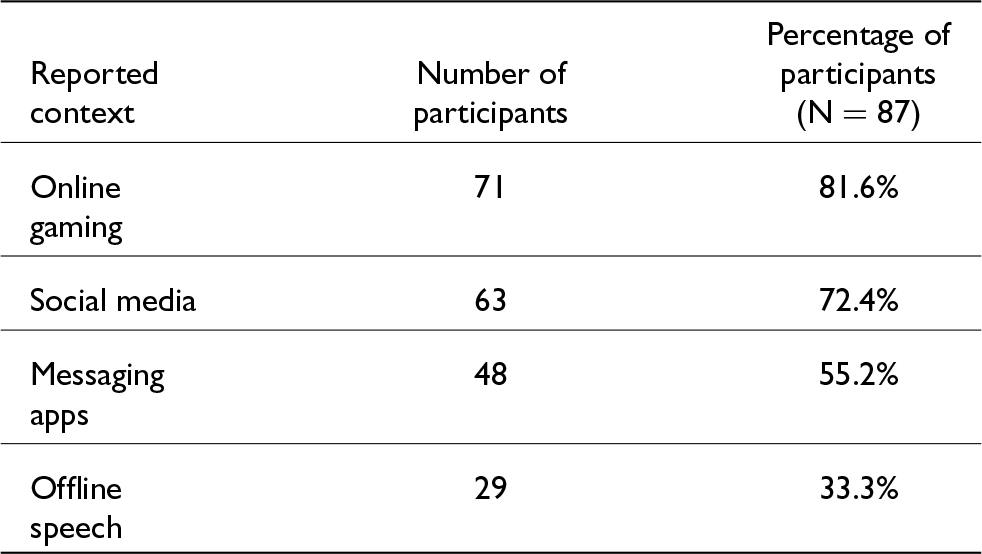
Reported contexts of use (N = 87)

Table 5 Long description
Among 87 participants, 71 (81.6%) reported using digi-borrowed forms in online gaming, 63 (72.4%) on social media, 48 (55.2%) in messaging applications, and 29 (33.3%) in offline speech. Participants could report more than one context, so percentages do not sum to 100.
For example, statements containing explicit expressions such as ‘always,’ ‘repeat,’ or ‘the same words everyone uses’ were first coded as habitual repetition and later interpreted under formulaic imitation. Mentions of forgetting or preferring alternatives were coded under lexical alternatives. Statements about learning English were kept separate from statements about inability to form sentences or use words beyond a platform context. Frequency counts were then used only to show how many respondents mentioned grouped labels, not to prove formulaicity or restriction.
Analytic rigor was supported through iterative re‑reading, an audit trail of category definitions and grouping decisions, peer debriefing on selected extracts, and explicit attention to contradictory or qualifying cases. Because all evidence comes from one questionnaire, the study claims internal consistency across descriptive summaries rather than triangulation between independent data sources.
Researcher positionality
The author is a Saudi linguist whose research interests include language change, digital communication, and language learning in technology‑mediated environments. This background informed the concept of digi‑borrowing and may have sensitized the analysis to repetition, constraint, and perceived competence. To reduce confirmatory interpretation, the analysis distinguishes participants’ words from the author’s analytical labels, reports counter‑examples, and limits conclusions to self‑reported awareness and practice.
Ethical considerations
This study was conducted in accordance with established research ethics guidelines. Ethical approval was granted by the Research Ethics Committee at King Faisal University (Ref. No. KFU‑REC‑2024‑MAY‑ETHICS3339; approval date 13 May 2024). Data collection took place over a three‑month period from January to March 2025.
All participants received a clear description of the study’s purpose, procedures, voluntary nature and use of data. Informed consent was obtained electronically, and parental or guardian consent was secured for participants under 18. No identifying information was included in the analytical dataset; responses were stored securely, and participants were informed of their right to withdraw without penalty.
Results
The Results section reports patterns in participants’ questionnaire responses and in the lexical inventory generated from those responses. The thematic categories and frequency tables summarize different aspects of the same self‑report dataset; they are not independent evidence of naturally occurring language use.
Table 1 outlines the four interpretive categories used to organize the findings. The categories reflect a hybrid inductive–deductive analysis: participant wording generated initial codes, while the title concepts served as sensitizing labels during the second‑stage interpretation.
As Table 1 indicates, each category is tied to explicit participant language and to a defined interpretive limit. The following sections present the reported patterns while distinguishing them from direct observation of discourse, repertoire size, semantic change, or proficiency.
1. Reported formulaic or habitual use (RQ1)
Sixty‑eight of the 87 participants (78.2 percent) supplied at least one response coded as habitual or repetitive use, particularly in relation to gaming. This figure represents respondents whose written answers contained explicit descriptions of repetition or routine; it is not a frequency count of their actual utterances.
Participants described this perceived habituality in comments such as:

These translated quotations support the interpretation that some respondents experienced the forms as familiar and formulaic. The italicized lexical labels are standardized by the researcher; they should not be read as verbatim evidence of spelling or pronunciation. The self‑reports do not establish how often the items were used in naturally occurring interaction or whether speakers produced morphological variants.
The lexical inventory complements this account only by showing salience across respondents: a relatively small group of standardized labels was mentioned by many participants. It does not independently demonstrate repetitive use or a restricted repertoire.
Table 2 shows that mlaqlq, risbawn, and nob were especially salient in the elicited inventory. The table does not report token frequency in actual communication.
2. Reported lexical alternatives and repertoire perceptions (RQ2)
Sixty‑one participants (70.1 percent) provided responses coded as reliance on familiar digi‑borrowed terms or difficulty retrieving an alternative. This percentage represents a category in self‑reported metalinguistic commentary; it is not a measure of participant‑level vocabulary size, lexical diversity, or comparative repertoire restriction.
Participants referred to Arabic or English alternatives in comments such as:

The first quotation presents the digi‑borrowed item as a readily available substitute, whereas the second explicitly reports transfer beyond gaming. Together, they show that participants’ accounts were not uniformly context‑bound. They support analysis of perceived accessibility and lexical choice, but not a conclusion that respondents objectively possessed a reduced repertoire compared with a baseline group.
The concentration of mentions in Table 2 is therefore interpreted as shared salience within the questionnaire sample, not as proof of reduced lexical diversity.
3. Reported continuity of forms and meanings (RQ3)
Fifty‑seven participants (65.5 percent) produced answers coded as continued use of the same label or platform‑linked meaning. The category captures respondents’ perceptions of continuity; it does not establish diachronic stabilization, fossilization over time, or morphological invariance in naturally occurring discourse.
Participants expressed this perception in statements such as:

These comments reveal what respondents regarded as salient about the forms. They should not be interpreted as direct linguistic analysis of actual inflection, derivation, pronunciation, or syntax.
Table 3 summarizes the predominant meanings participants associated with five frequently mentioned labels. The relative consistency of these written explanations motivates the interpretive category of lexical stabilization. In the title and discussion, lexical fossilization is used cautiously to denote this reported continuity, not longitudinal evidence that development has ceased.
As Table 3 shows, participants generally linked the grouped labels to conventional platform meanings such as connection delay, return after elimination, inexperience, game level, and trending content. This demonstrates shared recognition in the questionnaire responses. It does not establish semantic stability across naturally occurring contexts or over time.
§The table also reflects the researcher’s grouping of written variants by perceived English source and meaning; it should not be read as evidence that all respondents used identical spellings.
4. Perceived lexical learning and reported transfer (RQ4)
Forty‑nine participants (56.3 percent) made statements associating digi‑borrowed vocabulary with familiarity or perceived English learning. This category records language awareness and self‑evaluation; no independent proficiency or productive‑vocabulary assessment was administered.
Examples include:

Other participants reported limits in transferring that familiarity:

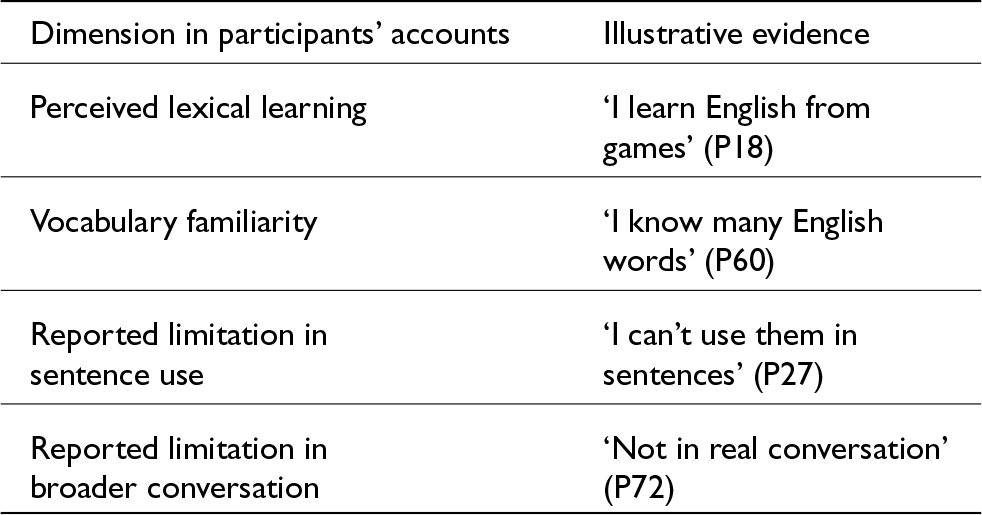
These accounts indicate that some respondents distinguished learning individual words from broader communicative competence. They do not establish that participants’ perceptions were objectively false. The term illusion of competence is therefore treated as an interpretive label for a reported mismatch between lexical familiarity and self‑reported transfer, not as a measured cognitive error.
Table 4 juxtaposes selected expressions of perceived lexical learning with reports of transfer limitations. Because other responses, including P51 and the offline‑use reports in Table 5, indicate some cross‑context use, the pattern is best understood as uneven or partial transfer rather than a uniform absence of transfer.
5. Reported platform contexts (RQ5)
Gaming was the most frequently reported context for digi‑borrowed forms, followed by social media, messaging applications, and offline speech (Table 5). These figures describe respondents’ selected or narrated contexts; they do not identify where the forms originally emerged or how they diffused.
Seventy‑one participants reported online gaming and 63 reported social media, while 29 reported offline speech. The offline figure is particularly important because it qualifies any claim that the vocabulary remains wholly platform‑bound.
Overall, the Results identify recurring patterns in participants’ representations of digi‑borrowing: habituality, salience of a shared lexical inventory, perceived continuity of meanings and perceived lexical learning with uneven transfer. All findings derive from one questionnaire and should be interpreted as exploratory evidence of reported practices and language awareness.
Discussion
The study’s central contribution lies in describing how Saudi Generation Z participants represent and evaluate English‑origin digital vocabulary. Their accounts were organized through the interpretive lenses of formulaic imitation, restricted lexical repertoire, lexical stabilization or fossilization, and illusion of competence. These labels preserve the paper’s critical argument about possible linguistic constraint, but the evidence supports claims about reported practices, salience and language ideology – not direct claims about naturally occurring behavior or development.
The self‑reports suggest that platform‑mediated terminology is experienced by many respondents as familiar, repetitive, and closely linked to gaming and social‑media participation. Platform and usage‑based theories provide plausible explanations for such experiences, but the study did not measure exposure or demonstrate that platform structures caused the reported patterns. The theoretical claim is therefore that platform conditions may help contextualize participants’ accounts, not that those conditions have been empirically isolated as causal mechanisms.
Previous research has emphasized flexibility, identity performance, and pragmatic choice in Arab digital practices (Al–Deaibes Reference Al–Deaibes2021; Elhija Reference Elhija2023; Palfreyman and Al Khalil Reference Palfreyman and Khalil2003). The present study adds a modest critical perspective by showing that respondents also describe repetition, reliance on familiar labels, and uneven transfer. This is a first exploratory step toward studying constraint; observational corpora, lexical‑diversity measures and longitudinal or performance data are needed before claiming that digi‑borrowing objectively narrows repertoires or changes language development.
The formulaic‑imitation interpretation rests on participants’ explicit descriptions of automatic or repeated use. Such descriptions are compatible with established accounts of formulaic language and frequency effects (Ellis Reference Ellis2002; Wray Reference Wray2002). Formulaicity is not inherently deficient: fixed expressions can support participation and processing. The critical question raised by the self‑reports is whether familiarity remains platform‑specific or becomes available for flexible use – a question the present design cannot resolve behaviorally.
Similarly, the restricted‑repertoire interpretation concerns perceived accessibility of alternatives rather than measured lexical deficiency. Shared mention of mlaqlq, risbawn and related items may reflect common communicative needs, cultural salience or questionnaire prompting rather than objectively limited vocabulary. P51’s report of using the terms outside games and the 29 reports of offline speech also show that cross‑context transfer occurred for at least some respondents. The findings therefore suggest possible concentration and uneven diversification, not verified narrowing relative to a comparison baseline.
The consistency of participant‑supplied meanings is compatible with an interpretation of lexical stabilization, but it is not evidence of diachronic fossilization. Respondents mainly supplied the conventional meanings of lag, respawn, noob, level and trend. This reveals shared metalinguistic recognition. Establishing stabilization or fossilization would require repeated observations over time, contextualized utterances and analysis of semantic and morphological variation.
Participants’ statements about learning English are best interpreted as language‑awareness data, consistent with recent Saudi research examining stakeholder perceptions of vocabulary learning in technology‑mediated environments (Al Fraidan and Alkuwaity Reference Al Fraidan and Alkuwaity2026). Some respondents associated lexical familiarity with learning, while others explicitly distinguished knowing platform words from forming sentences or participating in broader conversation. The term illusion of competence captures this reported tension, but the study did not measure proficiency and cannot establish that anyone overestimated actual ability. A more literal description of the evidence is perceived lexical learning accompanied by self‑reported limits – and some exceptions – in transfer.
Implications, limitations and future research
These findings contribute to discussions of translanguaging by emphasizing how participants evaluate recurring multilingual resources within platform‑mediated activity (García and Wei Reference García and Wei2014). They neither contradict translanguaging theory nor establish that digital multilingualism necessarily restricts development. Instead, they show that users may simultaneously experience familiar hybrid forms as resources for participation and as vocabulary whose relevance or transfer they perceive as limited.
More broadly, the concept of digi‑borrowing identifies a research agenda at the intersection of platform studies, sociolinguistics, and language awareness. The present questionnaire supports a descriptive account of salient forms, reported contexts, perceived meanings and beliefs about learning. It does not demonstrate emergence, diffusion, stabilization, lexical fossilization, repertoire reduction or platform effects. Those stronger propositions remain hypotheses generated by the interpretive framework.
The pedagogical implications should therefore be treated as possibilities rather than prescriptions derived from measured learning outcomes. Teachers might use familiar digital vocabulary as a starting point for rephrasing, semantic comparison, sentence construction and cross‑context transfer activities. Such interventions could test whether platform‑linked familiarity can support broader lexical exploration, but their effectiveness requires separate evaluation.
Several limitations should be acknowledged. The study relies on a one‑time questionnaire and a participant‑generated lexical inventory rather than naturally occurring discourse. Its frequency tables record respondent mentions, not usage frequency. The thematic and lexical summaries come from the same dataset and do not constitute independent triangulation. The questionnaire did not include a proficiency test, productive vocabulary task, longitudinal follow‑up or comparison group.
The analysis was conducted by one researcher using a hybrid inductive–deductive framework. Although category definitions, an audit trail, peer debriefing, representative prompt wording and counter‑examples improve transparency, the categories remain interpretive and partly shaped by the study’s theoretical concerns. Future research should analyze naturally occurring Arabic digital discourse, include spoken and Arabic‑script forms, document spelling and morphological variation, compare participant‑level repertoire sizes, and follow forms across time.
The sample is limited to self‑identified Saudi Generation Z respondents and cannot be generalized automatically to other populations or linguistic ecologies. Nonetheless, the study provides a clearly delimited first step: it documents how one group reports and understands a shared set of English‑origin digital terms and identifies testable questions for broader comparative research.
Conclusion
This exploratory study has examined digi‑borrowing as a participant‑reported feature of Saudi youth digital practices. The questionnaire reveals a salient inventory of Arabicized English‑origin terms, especially in gaming‑related contexts, and recurring self‑reported themes of habitual repetition, lexical alternatives, continuity of meaning and perceived lexical learning with uneven transfer.
The findings support a modest but novel contribution to research on language awareness and digital linguistic ideology. They show how participants represent familiar platform terminology and how some connect that familiarity to English learning or competence. They do not directly establish naturally occurring patterns of use, causal effects of exposure, repertoire restriction, diachronic fossilization or language development.
The concepts of formulaic imitation, restricted lexical repertoire, lexical fossilization and illusion of competence are therefore retained as critical interpretive lenses rather than verified outcomes. In that qualified sense, digi‑borrowing offers a useful vocabulary for examining both the participatory value and the perceived constraints of English‑origin digital terms in Arabic interaction.
Future observational and longitudinal research can determine whether the self‑reported patterns identified here correspond to actual discourse, productive lexical behavior and change over time. The present study establishes the reported lexical and ideological terrain on which that research can build.
AI use statement
The author used OpenAI ChatGPT (GPT‑5 series, accessed through https://chatgpt.com during manuscript preparation and revision between April and August 2026) to assist with language refinement, organization, and clarity of expression. The tool was not used to collect or generate study data, perform the coding, calculate the reported results, or make final interpretive decisions. All AI‑assisted output was reviewed, verified and revised by the author, who takes full responsibility for the manuscript, source accuracy, analysis, interpretation and conclusions.
Funding
This work was funded by the Deanship of Scientific Research, Vice Presidency for Graduate Studies and Scientific Research, King Faisal University, Saudi Arabia (Grant No. KFU264431).

ABDULLAH A. AL FRAIDAN IS Professor of Linguistics and Artificial Intelligence in the Department of English Language, College of Arts, King Faisal University, Saudi Arabia. His research interests span applied linguistics, sociolinguistics, language assessment, vocabulary development, digitally mediated language practices, and artificial intelligence in language education. His recent work examines the changing relationship between language, digital platforms and emerging technologies, particularly in Saudi and EFL contexts. He coined the term Digi-borrowing to conceptualize the incorporation and local adaptation of English-origin digital vocabulary within Arabic-speaking digital communities. Alongside his academic work, he has held several leadership positions in higher education, e-learning, digital transformation and innovation. He currently serves as President of the King Faisal University Innovation District. Email: afridan@kfu.edu.sa
Appendix A. Representative Questionnaire Prompts (English Translation)
The original questionnaire was administered in Arabic. The following English translations reproduce the substance of the participant-facing prompts relevant to this article; the analytical term digi-borrowing was not shown to participants.
1. Please write the English or trendy digital words that you commonly use when gaming, messaging or using social media.
2. For each word, write the English word you believe it comes from and explain what it means to you.
3. Where do you usually use each word? You may identify more than one context, such as online gaming, social media, messaging applications or offline conversation.
4. Why do you use these words? Do they make you feel that you are learning or using English? Please explain.
5. Demographic items recorded age, gender, educational level, nationality and reported patterns of digital engagement.