


Introduction
As reported by producers in the most recent dairy study, respiratory disease was responsible for antibiotic treatment of 12.4% of pre-weaned dairy calves and 22.5% of the pre-weaned dairy calf deaths (USDA, 2008, 2009). In dairy calves examined by a veterinarian, the reported incidence and prevalence of pre-weaned dairy calf respiratory disease are even higher at 25.6 (Virtala et al., Reference Virtala, Mechor, Grohn, Erb and Dubovi1996) and 14.3% (Lago et al., Reference Lago, McGuirk, Bennett, Cook and Nordlund2006), respectively.
The economic costs attributed to respiratory disease of calves, including treatment expense, mortality, premature culling, reduced growth, impaired fertility, and reduced milk production in the first lactation on a typical Dutch farm ranges from $21.37 to 66.32 (median: $36.19) (van der Fels-Klerx et al., Reference van der Fels-Klerx, Sørensen, Jalvingh and Huirne2001). An earlier US study (Kaneene and Hurd, Reference Kaneene and Hurd1990) reported the total cost, including prevention, of pre-weaned respiratory disease to be $14.71 per calf.
Despite the prevalence and importance of respiratory disease in pre-weaned calves, the diagnosis is problematic and delayed diagnosis may result in prolonged use of antibiotics, a high recurrence rate, and the development of refractory sequelae such as chronic lung injury, pulmonary abscessation, ear infections, and endemic herd respiratory disease. The potential reasons for poor farm detection of dairy calf pneumonia are numerous and include the lack of veterinary input and training, poor knowledge of clinical signs of respiratory disease by farm staff, inaccurate detection methods, inappropriate timing of respiratory disease screening, lack of time, personnel limitations, poor equipment, limited animal contact, and other social pressures.
Regular on-farm screening for disease in pre-weaned dairy calves is rare. Instead, appetite-based observations or other empiric measurements all too frequently serve as the basis for identifying sick calves. Without regular screening for respiratory disease, dairy calf respiratory disease detection on farms is poor (McGuirk, unpublished data). Although the correlation between clinical signs of respiratory disease and lung lesions at slaughter in young dairy calves may depend on severity of disease, timing of screening and duration of disease (Leruste et al., Reference Leruste, Brscic, Heutinck, Visser, Wolthuis-Fillerup, Bokkers, Stockhofe-Zurwieden, Cozzi, Gottardo, Lensink and van Reenen2012), an on-farm screening procedure performed on a regular basis by individuals trained to recognize and grade selective clinical signs associated with respiratory disease may help identify previously unrecognized respiratory problems. Early recognition by a respiratory-scoring system can prompt further diagnostic testing (ultrasound, other imaging, airway sampling, and blood testing) or treatment, depending on the farm protocol.
Respiratory-scoring system
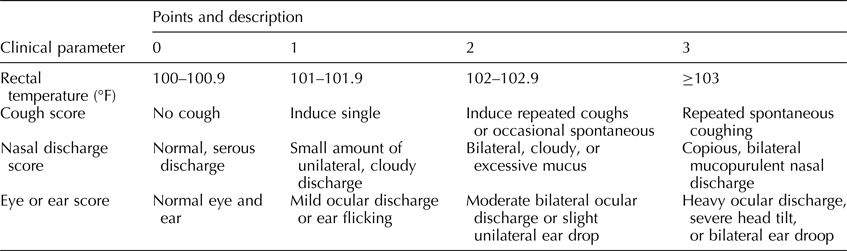
The basis of the clinical signs-based respiratory-scoring system described here is that when two or more examination parameters are moderate or severely abnormal, respiratory disease is present. The examination parameters and graded scale evaluation criteria are summarized in Table 1 and available at: http://www.vetmed.wisc.edu/dms/fapm/fapmtools/8calf/calf_respiratory_scoring_chart.pdf
Clinical parameters and point scale used for respiratory clinical scoring.

As characterized in Table 1, points range from 0 to 3 as clinical signs progress from normal (0), to mildly abnormal (1), to moderately abnormal (2), and to severely abnormal (3). Calves with a total respiratory score ≥5 or that have two or more clinical parameters with score 2 or 3 are considered to have respiratory disease. For calves in group pens, the respiratory-screening process can be modified: http://www.vetmed.wisc.edu/dms/fapm/fapmtools/8calf/group_pen_respiratory_scoring_chart.pdf
The respiratory-scoring system becomes one of the tools used in a farm's calf health-screening program. A successful screening program has three components: (1) daily observations; (2) twice weekly screening tests; and (3) a defined exam process. Respiratory scoring is part of the twice-weekly health-screening program, but it is also used when workers doing daily observations have marked an individual calf as needing a more detailed examination. Calves selected for daily examination may be high risk calves (assisted delivery, poor calf vigor score, and failure of passive transfer), recheck calves, calves found standing when 90% are sleeping, calves slow to stand at feed delivery, calves with diarrhea, calves with sunken eyes, calves with abnormal posture, calves that are coughing or breathing abnormally, or calves that have blood visible externally (nose, mouth, skin, or feces). Respiratory disease prevalence increases with age in pre-weaned calves (Lago et al., Reference Lago, McGuirk, Bennett, Cook and Nordlund2006) so strategic use of a standardized respiratory screening procedure to identify and treat-affected calves just prior to weaning can positively impact the common occurrence of post-weaning pneumonia.
With the regular implementation of a standardized scoring system to detect respiratory and other disease in pre-weaned calves, additional labor will be required. From a University of WI Extension study (http://eauclaire.uwex.edu/files/2013/07/ICPA-2013-PPT-Overview.pdf), it has been estimated that, on average, 1 full time equivalent (FTE) employee is needed for each 100 calves to perform the routine daily chores. We estimate that an additional 0.5 FTE is needed for every 100 calves to perform daily and weekly health-screening procedures such as the standardized respiratory-scoring system described here. Initially, farms can expect increases in number of calves treated, treatment costs, respiratory morbidity, and calls to the veterinarian. At the same time, the mortality rate from respiratory disease is expected to decrease. Over time, decreases in the calf treatment rate, number of days of treatment, treatment relapses, treatment costs, and morbidity and mortality measures will all be appreciated. Long-range productivity and profitability of replacement heifers add value and worker satisfaction with performance of the calves, reduces employee turnover, and improves motivation and job performance. Individual calf-scoring results can be entered into a record system to track performance and cost, monitor disease incidence, analyze treatment efficacy, or create valuable health reports. When a change in prevalence of respiratory disease is detected, appropriate diagnostic testing can be focused on the most recent, untreated diseased calves.
Summary and conclusions
Individual respiratory-screening exams performed twice weekly can improve respiratory disease detection in pre-weaned dairy calves. Early detection with appropriate diagnostic testing and effective treatments will minimize antibiotic use, disease recurrence, chronic respiratory disease cases, and endemic dairy calf pneumonia.