Introduction
Bell's palsy bears the name of the British surgeon-anatomist Sir Charles Bell (1774–1842), who between 1821 and 1844 published about his discovery that the facial nerve innervates the muscles of facial expression and the trigeminal nerve is mainly responsible for facial sensation.Reference Koehler, Bruyn and Pearce1–Reference Shaw13 Before that time, the functions of the facial and trigeminal nerves were poorly understood. For example, it was believed by many that the facial and trigeminal nerves were both responsible for facial sensation and facial movement.Reference Van de Graaf, Beurskens, van Gelder, Heymans, Manni and Nicolai2, Reference Bell11, Reference Mettler14–Reference Dieffenbach16 In his influential book The Nervous System of the Human Body, Bell compiled the original manuscripts of his investigations on the facial and trigeminal nerves. He illustrated these with a series of interesting and illuminating cases, several of which comprised the clinical entity we now call Bell's palsy.Reference Bell12 Bell's discoveries not only improved knowledge of the function of the facial nerve, but also drew the attention of the medical world to facial paralysis. The latter fact is illustrated by the increased number of scientific papers on Bell's palsy produced after Bell's publications, in what we may call the ‘post-Bell era’. Eventually, by the mid-nineteenth century, Bell's name had become attached to facial paralysis through the eponym ‘Bell's palsy’.Reference Romberg15, Reference Sanders17–Reference Hutchinson and Hughlings Jackson19
Strikingly, only three documents on idiopathic peripheral facial paralysis dating from the ‘pre-Bell era’ are currently known.Reference Van de Graaf, Beurskens, van Gelder, Heymans, Manni and Nicolai2, Reference Pearce4, Reference Douglas and Thomas20, Reference Bird and Nicolaus21 The first appeared in 1686, when Cornelis Stalpart van der Wiel (1620–1702) from The Netherlands published a case of idiopathic peripheral facial paralysis, which he had observed in 1683, in his thereafter widely known treatise One Hundred Rare Observations in Medicine, Surgery and Anatomy.Reference Van de Graaf and Nicolai3, Reference Stalpart van der Wiel22 James Douglas (1675–1742) from Scotland was responsible for the second description, in 1704; however, this handwritten note remained unknown for more than 250 years.Reference Douglas and Thomas20 In 1797, Nicolaus Anton Friedreich (1761–1836) of Germany published the third account, describing three cases of idiopathic peripheral facial paralysis, which he called ‘rheumatic paralysis of the facial muscles’.Reference Pearce4, Reference Bird and Nicolaus21, Reference Friedreich23 All three documents were ‘dead literature’ until they were brought to life again in the second half of the twentieth century. Reference Van de Graaf and Nicolai3, Reference Douglas and Thomas20, Reference Bird and Nicolaus21
However, the question arises of whether Stalpart van der Wiel, Douglas and Friedreich were the only ones to recognise idiopathic peripheral facial paralysis as a distinct clinical entity prior to Bell.
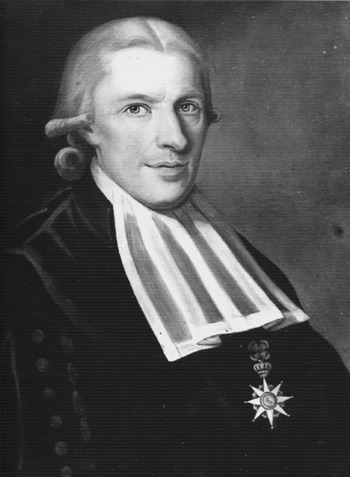
The Index Medicus database provides no additional literature on idiopathic peripheral facial paralysis from the pre-Bell era (searching using the key words ‘facial nerve’ and ‘facial paralysis’). However, a recent search of the Index Catalogue of the Library of the Surgeon-General's Office of the United States Army (using the same key words) led us to three new documents on idiopathic peripheral facial paralysis from the pre-Bell era.24 These manuscripts were all published by Professor Evert Jan Thomassen à Thuessink (1762–1832) (Figure 1) of our institution, the University of Groningen in the north of The Netherlands.Reference Schuurman and Thomassen à Thuessink25–Reference Forsten Verschuir, Dijkers and van de Graaf27 At the library of the University of Groningen, a fourth paper on idiopathic peripheral facial paralysis by Thomassen à Thuessink was subsequently discovered.Reference Thomassen à Thuessink28 Thomassen à Thuessink questioned whether idiopathic peripheral facial paralysis was a new disease, as opposed to facial paralysis due to stroke. He tried to answer this and other questions in his manuscripts, the first being a preliminary paper on the subject,Reference Thomassen à Thuessink26 the second a case study by his colleague Jan Bloemert Schuurman (1767–1841) from Steenwijk,Reference Schuurman and Thomassen à Thuessink25 and the third an extensive, 98-page dissertation in Latin by his pupil Willem Hendrik Forsten Verschuir (1778–1812).Reference Forsten Verschuir, Dijkers and van de Graaf27 In the fourth and final paper on the subject, Thomassen à Thuessink provided some additional cases and final remarks.Reference Thomassen à Thuessink28
Professor Evert Jan Thomassen à Thuessink, by Anna Wilhelmina Böhl (1912). Reproduced with permission from the University Museum Groningen.

The purpose of the current article is to illustrate the life of Evert Jan Thomassen à Thuessink and to discuss what motivated him to study the clinical entity now termed Bell's palsy (but which he, like Friedreich, termed ‘rheumatic paralysis of the facial muscles’). Moreover, we wish to illuminate Thomassen à Thuessink's considerations and conclusions regarding the diagnosis, aetiology and treatment of the condition. We also discuss his work in the light of the scientific and medical circumstances of his times.
For these purposes, we translated Thomassen à Thuessink's work from the original Dutch and Latin.
Evert Jan Thomassen à Thuessink
Evert Jan Thomassen à Thuessink was born in 1772 in Zwolle, The Netherlands, where his father was mayor.
After Thomassen à Thuessink had graduated from medical school at the University of Leiden, he made a ‘peregrinatio academia’ (a trip to renowned foreign hospitals), in those days a common habit among recently graduated medical doctors. Thomassen à Thuessink visited hospitals in Paris, London and Edinburgh.Reference Terwisscha van Scheltinga29
In 1793, he was appointed Professor in Practical Medicine at the University of Groningen in the north of The Netherlands. However, in contrast to what his teaching contract suggested, Thuessink initially had to limit his teaching to theoretical education, as there was no University Hospital in Groningen at the time.
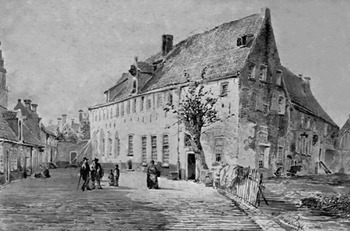
This changed in 1795 when the French army occupied the Groene Weeshuis (green orphanage) (Figure 2) in Groningen and made it their military hospital, and Thomassen à Thuessink had the idea to use the wounded and ill for his teachings. In 1797, the first University Hospital in Groningen was established, and the Groene Weeshuis became the Nosocomium Academicum (University Hospital).
The Groene Weeshuis, by Albert Jurardus van Prooijen (1858). Reproduced with permission from the Collection Groninger Museum.

In those days, there were only two small rooms (one for female and one for male patients), each having four beds. There were no surgical or gynaecological clinics, but Thomassen à Thuessink did start an out-patient clinic. He treated his first patients on 11 November 1797. Patients who were admitted to the hospital were primarily selected for their usefulness for medical teaching, as the primary purpose of the University Hospital was not patient care but medical student education.Reference Terwisscha van Scheltinga29, Reference Tammeling30 During his years as a professor, Thomassen à Thuessink published several articles and books in which he described and discussed cases observed at the University Hospital.Reference Terwisscha van Scheltinga29
‘On rheumatic paralysis of the facial muscles’
Idiopathic peripheral facial paralysis first attracted Thomassen à Thuessink's attention in the winter of 1802, when his colleague from Steenwijk, Jan Bloemert Schuurman, referred two patients with the condition to the University Hospital in Groningen for treatment.Reference Schuurman and Thomassen à Thuessink25, Reference Thomassen à Thuessink26 Thomassen à Thuessink's motivation for his subsequent investigations into this clinical entity become clear in the following statement.
‘Although rheumatic illnesses are common and well known in all cold and humid northern countries, such as The Netherlands, and cold can affect the whole body, and even sometimes result in paralysis of the upper and lower extremities, I do not know any example in the ancient writings of paralysis of the facial muscles of this aetiology.’Reference Thomassen à Thuessink26
Soon, Thomassen à Thuessink observed more cases which he reported in his manuscripts. His description of the clinical entity was quite accurate. He noted the acute or subacute onset of complete unilateral facial paralysis. Furthermore, he noted not only that the tongue was unaffected, but also that the masticatory muscles were hardly affected. Facial sensation was normal, as was sensation throughout the rest of the body. Muscle strength, other than that on the affected side of the face, was unimpaired. The paralysis was often preceded by a few local inflammatory signs, such as pain and redness in and around the ear, mastoid and neck.Reference Schuurman and Thomassen à Thuessink25–Reference Forsten Verschuir, Dijkers and van de Graaf27 Overall, the patients he had examined were ‘healthy, but they were inclined to have rheumatic illnesses and toothache’. Almost all patients in his study ‘developed the paralysis after exposure to cold or rain after having been warm and sweaty’. The majority of his patients was male, with only one being female, but Thomassen à Thuessink considered the condition not to be sex-related ‘as men are probably more exposed to cold than women’. He thought that idiopathic peripheral facial paralysis could affect patients of all ages. Most patients recovered within several weeks to months.Reference Thomassen à Thuessink26 Thomassen à Thuessink correctly located the problem in ‘the seventh cranial nerve, exiting the skull from the stylomastoid foramen’, and briefly described the peripheral course of the facial nerve through the parotid gland. According to him, the facial paralysis was caused by exposure of the affected side of the face to cold, resulting in ‘precipitation of rheumatic substance on the facial nerve’. He remarked, ‘it is well known that rheumatic substance can precipitate on a nerve, resulting in deprivation of the function of the muscles which receive branches of the nerve, and thus become paralysed’.Reference Thomassen à Thuessink26
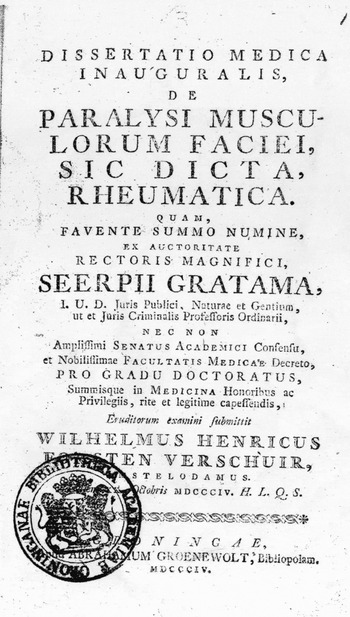
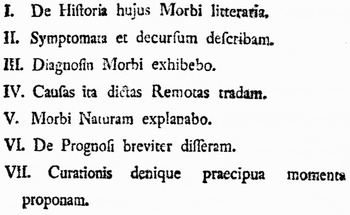
Thomassen à Thuessink wondered ‘whether the clinical entity was a new disease or whether it had been confused with facial paralysis due to stroke’. Because he considered ‘knowledge of this affection [to be] of utmost importance’, he showed one of his idiopathic peripheral facial paralysis patients several times to his students at the University Hospital.Reference Thomassen à Thuessink26 In addition, in order ‘to inform the medical world of this relatively unknown disorder’, he had his pupil Willem Hendrik Forsten Verschuir search the literature for earlier documents on idiopathic peripheral facial paralysis, and also had him write an extensive review on the topic in 1804.Reference Thomassen à Thuessink26 Forsten Verschuir's thesis De Paralysi Musculorum Faciei, sic dicta Rheumatica (on rheumatic paralysis of the facial muscles) (Figure 3) consisted of 98 pages. It is divided into seven chapters which discuss the literary history of idiopathic peripheral facial paralysis along with its symptomatology and course, differential diagnosis, aetiology, pathogenesis, prognosis, and treatment (Figure 4).Reference Forsten Verschuir, Dijkers and van de Graaf27
Frontispiece of Forsten Verschuir's 1804 thesis De Paralysi Musculorum Faciei, sic dicta Rheumatica (On Rheumatic Paralysis of the Facial Muscles). Reproduced with permission from the collection of the Library of the University of Groningen.

Contents of Forsten Verschuir's thesis De Paralysi Musculorum Faciei, sic dicta Rheumatica. Reproduced with permission from the collection of the Library of the University of Groningen.

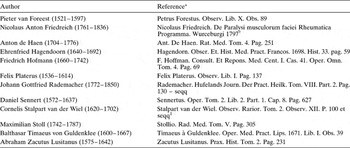
Forsten Verschuir concluded in his thesis that idiopathic peripheral facial paralysis was not a new disease and had previously been recognised by several physicians as a distinct clinical entity (Table I).Reference Forsten Verschuir, Dijkers and van de Graaf27 He discussed the publications of Stalpart van der Wiel (1683) and Friedreich (1797, 1798), but he was not aware of the aforementioned manuscript by Douglas.Reference Forsten Verschuir, Dijkers and van de Graaf27 In classical writings, such as those of Hippocrates and Galen, he found some sketchy accounts of what might have been paralysis of facial muscles. However, according to Forsten Verschuir, the first accurate historical description of idiopathic peripheral facial paralysis appeared to be Stalpart van der Wiel's 1686 account.Reference Forsten Verschuir, Dijkers and van de Graaf27
Alphabetic list of authors and their manuscripts, as cited in Forsten Verschuir's thesis De Paralysi Musculorum Faciei, sic dicta Rheumatica Reference Forsten Verschuir, Dijkers and van de Graaf27

* Unfortunately, Forsten Verschuir did not state the publication date of the manuscripts; in addition, many of the references are incomplete and therefore very difficult to trace. †The original 1797 thesis in Latin by Nicolaus Anton Friedreich; Thomassen à Thuessink also knew the 1798 German translation of the thesis.Reference Thomassen à Thuessink26‡According to Forsten Verschuir, Stalpart van der Wiel's 1683 case is the first accurate historical case report. In 2005, the case was discovered and discussed by R C van de Graaf and J-P A Nicolai.Reference Van de Graaf and Nicolai3
In Forsten Verschuir's time, the main reason that idiopathic peripheral facial paralysis was hardly known as a distinct clinical entity was the fact that physicians had generally confused it with other diseases.Reference Forsten Verschuir, Dijkers and van de Graaf27 The disease category with which it had most often been confused was what is now known as central facial paralysis due to ‘apoplexy’ or stroke. For example, Friedreich had stated in 1797 that: ‘in the doctrine, rheumatic paralysis of the facial muscles is part of a stroke’. Therefore, in the pre-Bell era many cases of idiopathic peripheral facial paralysis were probably diagnosed as stroke and treated as such.Reference Friedreich31 Forsten Verschuir discussed the contemporary literature on stroke, and concluded that the main differences between idiopathic peripheral facial paralysis and central facial paralysis were the absence of sensory loss, loss of sight, impaired memory, headache, vertigo, paralysis of the limbs, or paralysis of the tongue.Reference Forsten Verschuir, Dijkers and van de Graaf27 Forsten Verschuir, like Friedreich, did not mention the clinical difference in the involvement of the upper third of the face in peripheral facial paralysis, in contrast with central facial paralysis.Reference Forsten Verschuir, Dijkers and van de Graaf27, Reference Friedreich31
The second disease category that Forsten Verschuir differentiated from idiopathic peripheral facial paralysis was ‘spasmus cynicus’ or ‘dog spasm’.Reference Forsten Verschuir, Dijkers and van de Graaf27 Stalpart van der Wiel had already remarked that ‘spasmus cynicus’ was a term used by many classical authors for all types of twisted mouths, probably including facial paralysis.Reference Stalpart van der Wiel22 Forsten Verschuir agreed with Stalpart van der Wiel that ‘spasmus cynicus’ was merely a spastic disorder of facial muscles rather than a palsy. Reference Forsten Verschuir, Dijkers and van de Graaf27
The third disease that Forsten Verschuir differentiated from idiopathic peripheral facial paralysis was the clinical entity now called trigeminal neuralgia, which he termed ‘dolor faciei convulsivus’ or ‘prosopalgia’. He recognised the clinical differences between idiopathic peripheral facial paralysis and trigeminal neuralgia. But as ‘local pain [often] precedes the facial paralysis in idiopathic peripheral facial paralysis patients, and both diseases are often difficult to differentiate, [and] sometimes even occur at the same time’, Forsten Verschuir concluded that both conditions must be closely related. He considered idiopathic peripheral facial paralysis and trigeminal neuralgia to be ‘different expressions of merely the same affection’.Reference Forsten Verschuir, Dijkers and van de Graaf27, Reference Thomassen à Thuessink28 Moreover, he stated that, since idiopathic peripheral facial paralysis and trigeminal neuralgia often had the same cause, i.e. exposure to cold, both diseases must be treated in the same way.Reference Forsten Verschuir, Dijkers and van de Graaf27, Reference Thomassen à Thuessink28
Thomassen à Thuessink believed that ‘cold resulted in precipitation of rheumatic substance on the facial nerve’, thereby causing facial palsy. He disagreed with Joseph Herrmann Brünninghausen (1761–1834), who commented on the German translation of Friedreich's thesis, and who had postulated that the paralysis resulted from swelling and hardening of the nerve sheath in the mastoid and was therefore the result of nerve compression.Reference Friedreich31 Although Thomassen à Thuessink agreed with Brünninghausen that ‘often in rheumatic illnesses the membranes swell and thicken’, for him it ‘could not explain why in some cases all and [in] some only part of the facial muscles would be paralyzed’.Reference Thomassen à Thuessink26 Moreover, he wondered ‘why[, …] in case[s] of compression, such as in cases of parotid tumours, the facial nerve is [often] not affected’.Reference Thomassen à Thuessink26 He believed that ‘the bigger [the] part of the nerve affected by the rheumatic substance, the more muscles will be paralyzed and vice versa’.Reference Thomassen à Thuessink26
Once the correct diagnosis has been made, Thomassen à Thuessink considered it important to determine whether the condition was still in its ‘initial inflammatory phase’ or had already progressed to a chronic phase. If treated in the initial phase, it had been found to recover completely in most cases. The treatment consisted of ‘anti-inflammatory means and refrigerant and relaxing diaphoretics’, and aimed to remove the ‘rheumatic substance’ from the facial nerve.Reference Forsten Verschuir, Dijkers and van de Graaf27 ‘Once in the later phase[,] external and internal stimulating medicines and ointments and eventually electrostimulation [successfully applied by Friedreich]Reference Friedreich31 might be helpful’.Reference Thomassen à Thuessink26 However, Thomassen à Thuessink believed that the prognosis for idiopathic peripheral facial paralysis was less fortunate when treatment was delayed, ‘as the changes in the affected nerve become irreversible’.Reference Forsten Verschuir, Dijkers and van de Graaf27
Discussion
In general, it seems that the real issue regarding idiopathic peripheral facial paralysis was not understood until after Bell's publications between 1821 and 1844. In the pre-Bell era, for example, many believed that the facial and trigeminal nerves were both responsible for facial sensation and facial movement.Reference Van de Graaf, Beurskens, van Gelder, Heymans, Manni and Nicolai2, Reference Bell11, Reference Mettler14–Reference Dieffenbach16 This erroneous belief seems to have led to confusion between idiopathic peripheral facial paralysis and other facial afflictions, but it also resulted in the unfortunate habit among many surgeons of dividing the facial nerve instead of the trigeminal nerve in cases of severe facial pain.Reference Bell11, Reference Dieffenbach16 This mutilating practice was eventually abandoned by most surgeons after Bell had improved understanding of the functions of the facial and trigeminal nerves.Reference Dieffenbach16 Bell not only improved the knowledge of facial nerve function, but also, with his many publications, drew widespread attention for the different types of facial paralysis, such as the clinical entity now termed Bell's palsy.
It has been stated that Bell may have read the English translation of Friedreich's thesis,Reference Bird and Nicolaus21, Reference Peitersen32 suggesting that Bell was perhaps influenced or stimulated by that work to undertake his research on facial paralysis. A translation of Friedreich's work was published in the Edinburgh Medical Journal in 1800, at which time Bell was a medical student in Edinburgh.Reference Bird and Nicolaus21, Reference Peitersen32 Forsten Verschuir's thesis was also reviewed and summarised in several foreign medical journals.Reference Callisen33 It is not known if Bell was aware of his work. In his principal manuscripts, Bell made no mention of the earlier writings on idiopathic peripheral facial paralysis by Friedreich and Thomassen à Thuessink.Reference Bell8–Reference Bell12 It seems unlikely that Friedreich's or Thomassen à Thuessink's work inspired Bell to perform his experiments, as Bell's primary interest was not facial paralysis as a clinical entity but rather the use of cases of facial paralysis to show that the function of the facial nerve was distinct from that of the trigeminal nerve. In his 1827 work ‘Appendix to the Papers on the Nerves, containing Consultations and Cases’, Bell wrote ‘it was not my intention to write on this part of practice, but the reader will see how the subject has grown upon me’.Reference Bell9 An anonymous reviewer of this work remarked ‘Mr. Bell, however, was more intent on elucidating the physiology and pathology of the superadded system of nerves, than on any therapeutical measures employed in removing morbid affections’.34
Like Stalpart van der Wiel and Friedreich, Thomassen à Thuessink considered exposure to cold or ‘rheumatism’ to be the cause of idiopathic peripheral facial paralysis. Thus, the ‘cold theory’ is historically the oldest hypothesis on the aetiology of idiopathic peripheral facial paralysis. In those days, ‘rheumatism’ was a routine medical diagnosis. It was a broadly defined group of illnesses characterised by fevers, aches and debility after exposure to cold, and was believed to be a disease principally of cold and humid northern countries.Reference Davis35–Reference Meininger and Verkroost38 Bell also propagated the cold theory, as did many after him. At the end of the nineteenth century, however, it was stated that ‘It is generally thought that facial paralysis a frigore (Bell's palsy) is perfectly known in all its details and its origins. This is a mistake’.Reference Beyerman39 At that time, some authors rejected the cold theory, and, ever since, a multitude of other aetiological explanations (e.g. vascular ischaemia, autoimmune disease and viral infection) has been proposed.Reference Zulch, Vinken and Bruyn6, Reference Peitersen32, Reference Pearce40 However, despite all this scientific effort, the underlying cause of Bell's palsy has still not been established.Reference Zulch, Vinken and Bruyn6, Reference Peitersen32, Reference Finsterer40, Reference Rath, Linder, Cornblath, van de Graaf, Ijpma, Nicolai and Werker41 It seems that, even today, the old cold hypothesis is still alive, as it was recently stated that ‘some patients report exposure to an air-condition outlet, or an open window before the attack’.Reference Finsterer40 Is exposure to cold really a possible aetiological factor in some cases of Bell's palsy? What, exactly, happens to the facial nerve of these patients after exposure to cold air? These remarks express the uncertainties still lurking in the quest to establish the nature of Bell's palsy, a quest that started approximately 200 years ago when Thomassen à Thuessink published the results of the first extensive study of idiopathic peripheral facial paralysis in history.
Acknowledgments
The authors thank Prof Dr M J van Lieburg for assistance in locating Thomassen à Thuessink's manuscripts and the names of the authors of the earlier literature cited by Forsten Verschuir in his thesis. We also thank H Dijkers for his vital help with translating Forsten Verschuir's thesis from Latin to English.