1 Introduction
Considering the large number and diversity of users of information technologies, it cannot be denied that performing an adaptive process in any computer system would increase user satisfaction. However, in order that the users may take advantage of a system that fits their characteristics, the adaptive process must be carefully designed. Especially, the task of user modeling has a decisive influence on the suitability of the adaptation produced. The user modeling is a complex task, which has been widely studied in intelligent systems (Kok, Reference Komatani, Ueno, Kawahara and Okuno1991). Thus, machine learning offers the solution to many problems in user modeling. Though, the application of machine learning algorithms in user modeling is not without complications (Martin, Reference Medina-Medina, Molina-Ortiz and García-Cabrera2004), and remains as an important point where further work is needed.
The areas where user-adaptive systems can be found are very miscellaneous, for example: telecommunications, multimedia, finance, service industries, health care, transportation, and manufacturing industries (Jameson, Reference Jameson2001). In particular, in educational environments where the users aim is to learn a set of concepts and items of information, the adaptive process can reduce the problems of disorientation, lack of comprehension, and discouragement that frequently affect students and can provide an autonomous and reflective learning experience (Alfonseca et al., Reference Alfonseca, Rodríguez and Pérez2007).
Focusing us on adaptive systems for education, most of current developments arising from the extensive work that had already been conducted into artificial intelligence, more concretely from the fields of adaptive hypermedia systems (AHS) (Brusilovsky, Reference Brusilovsky1996; Höök, Reference Höök1997) and intelligent tutoring systems (ITS) (Sleeman & Brown, Reference Stock, Zancanaro, Busetta, Callaway, Krüger, Kruppa, Kuflik, Not and Rocchi1982; Bailey et. al., Reference Bailey, Hall, Millard and Weal2007). Both, AHS and ITS, are used for computer-based instruction; however, their strengths lie in different subjects: the first is better suited to the learning of concepts, while the second generally assist in the application of these concepts to solve problems. Consequently, some authors argue the need of provide a full learning environment where both methods of instruction be combined (Nicholas & Martin, Reference Pekrun2008).
Another related field where the user adaptation has important benefits is the information filtering and retrieval performed by the information retrieval (IR) systems (Belkin & Croft, Reference Belkin and Croft1992). In these systems, the documents, resources, or items returned in response to a user’s query can be adjusted to the users preferences, which can be directly obtained by means an explicit question to the user or can be inferred from the results of their previous queries using a mechanism of relevant feedback.
In any case, the adaptive process enables the system to adjust its appearance and functionality to the specific features of each user, therefore providing a more effective and pleasant cooperation between person and machine. In consequence, an adaptive system is not only more useful, but also more usable in the broadest sense of the word. Of course, to perform this adaptation, the system must manage a set of data about the user, which can include their personal context, knowledge, experience, interests, preferences, goals, needs, intentions, physical and psychological state, location, and other information. The set of features that is taken into account depends on the system’s application domain and is known as the user model (UM). The content of the UM is an important part in the design of the adaptive system, and should be taken into account during the requirements analysis and specification phases (Berrais, Reference Berrais1997). Thus, the authors think it is important to have mechanisms to adequately describe the UM and facilitate its analysis and design. One such mechanism is the taxonomy that is presented later.
The UM is the image of the user inside the system; in fact, it has been defined by several authors as ‘the user mirror’ (Vogiatzis et al., Reference Vildjiounaite and Kallio2004). For the adaptation to be reliably useful, the UM must truly function as a mirror, that is, the UM must be continuously updated so that it always reflects the user’s current state. In summary, the UM can be defined as the representation of the user that is stored, managed, and queried by the system to adjust some of its structure and functionality according to previously defined adaptation mechanisms. Regarding the aims of user modeling, a number of different papers can be found in the literature, such as an UM ontology called general user model ontology (GUMO) for distributed UMs in semantic web (Heckmann et al., Reference Heckmann, Schwarzkopf, Mori, Dengler and Kröner2007), an UM-based link annotation to fit the educational hypermedia to the goals and knowledge of each student (Brusilovsky & Eklund, Reference Brusilovsky, Chavan and Farzan1998), a methodology that applies textual content analysis to personalize a news service (De Buenaga et al., Reference De Bra, Houben and Wu2001), a user modeling method for a tailored selection of multimedia content from a corpus of TV programs (Pogacnik et al., Reference Rich2005), and a three-dimensional UM used to produce custom-made responses in dialogue systems (Komatani et al., Reference Kok2005). In addition, some efforts have been made to develop models and tools that enable the design and construction of generic reusable UMs, such as um (Kay, Reference Kay1995), a toolkit for reusable and long-term UMs based on evidence.
This paper is structured as follows: Section 2 draws the main utilities of having an UM taxonomy and proposes a taxonomy that makes it possible to classify any UM from various perspectives related to the structure and management of UM. During the specification of the taxonomic criteria, the taxonomy is used to partially describe a set of adaptive systems, some of which are reference systems in the field of user modeling. Section 3 presents two different applications of the proposed taxonomy. The first application uses the taxonomy in order to describe the task of user modeling in a concrete adaptive system semantic, systemic and evolutionary model for the development of adaptive hypermedia (SEM-HP) (Medina-Medina et al., Reference Medina-Medina, Molina-Ortiz and García-Cabrera2005). The second application of the taxonomy outlines the general features that the authors believe are best suited to be part of the UM in an educational system. Finally, Section 4 briefly presents the conclusions of the work.
2 User model taxonomy
As noted earlier, the UM is one of the most important components of an adaptive system because it determines the adjustments that can be made to enrich user interaction. Consequently, the authors believe that it is important to establish a set of criteria to situate any UM among the diversity of models that can be found in the large corpus of scientific literature on the topic. Although the power of classification that the taxonomy provides is its main advantage, there are others equally important. Thus, the authors, like others authors such as Fensel (Reference Fensel2001), consider that some additional advantages that can provide the use of an UM taxonomy are as follows: the establishment of a common design vocabulary for UMs, a mechanism to abstract the user modeling process, the agreed specification of the protocol (set of functional characteristics) that should satisfy an UM depending on the type of adaptive application where it is used and the portability of the UM between different applications.
A new taxonomy is proposed here because very few UM taxonomies were found in the literature, and those that were found focus on only a few aspects of UMs or are specific to a particular type of adaptive system. Among these, the taxonomy of beliefs and goals for UMs in dialog systems proposed in Kobsa (Reference Kobsa1989) should be noted. This author also makes a systematic review of research results in the field of generic user modeling (GUM) systems (Kobsa, Reference Kobsa2007). However, these works are more focused on system architectures and applications; in the way they are structured and the services they offer. By contrast, the aim of this article is not to provide a Generic UM (the mentioned author proposes as desirable characteristics in GUM systems: generality, including domain independence, expressiveness and strong inferential capabilities, support of quick adaptation, extensibility, import of external user-related information, management of distributed information, support for open standards, load balancing, failover strategies, transactional consistency, and privacy support), but to offer a taxonomy to catalog the UMs and to make comparisons in terms of its abilities to adapt. Therefore, the authors of this paper are interested in how to model and design an UM, that is what information should be stored on the user, how it is, how to organize that information and then how to manage that information to provide adaptations, and to update the model according to the behavior of the system (the use of the system by the user).
Therefore, the taxonomy presented here aims to provide a classification system that covers most of the current variety of UMs, establishing a general framework upon which other researchers and designers can work. To accomplish this, the proposed taxonomy collects and organizes 20 taxonomic categories which represent different classification criteria. The term used to label each criterion of the taxonomy has been carefully chosen by the authors according to the semantic of the classification described by the criterion. In addition, the authors have tried to adhere to current nomenclature in the names of the types the UMs included as alternatives regarding to each taxonomic criterion. With this aim, the authors have chosen labels commonly accepted and with a precise meaning in the scientific literature about adaptive systems, in cases in which these terms already existed. Figure A1 (Appendix) shows the approximate number of scientific papers that use each one of the existing terms included in the taxonomy (this study justifies its adoption). Figure A1 also offers useful information to get a rough idea about the main challenges addressed by the scientific community in relation with the user modeling, and about the characteristics of the UM proposed to solve the problems encountered.
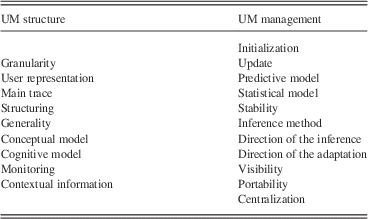
Nevertheless, defining an UM taxonomy is not easy. As mentioned in the previous section, the user modeling task is performed in a very different way in each adaptive system. As a starting point, it should be noted that this task always includes two separate parts: (1) the structure and representation of the information stored in the model, and (2) the management of that information. On the one hand, when focusing on information representation, two main questions arise: Which features will be stored in the UM?, and How will this information be structured?. On the other hand, when referring to the management of the model information, the three key questions are as follows: How is the UM initialized?, How and when is it updated?, and How is it used?. According to this distinction, two main taxonomic categories can be distinguished: UM structure and UM management. Table 1 lists the classification criteria included in the proposed taxonomy, according to the two categories just mentioned.
Classification criteria

UM=user model.
The proposed taxonomy is a descriptive taxonomy, but also incorporates some examples using systems widely referenced in the scientific literature such as adaptive hypermedia application model (AHAM) (De Bra et al., Reference De Buenaga, Maa, Daz and Gervs1999), GUMO (Heckmann et al., Reference Heckmann, Schwarzkopf, Mori, Dengler and Kröner2007), or web-based hierarchical universal reactive learning environment (WHURLE) (Zakaria et al., Reference Vogiatzis, Tzanavari, Retalis, Avgeriou and Papasalouros2002); as well as an analytical mechanism to determine the type of an UM according to each criterion of the taxonomy. This mechanism is a set of validation questionnaires that pose, in a simple and directed way, the deliberations needed for the taxonomic classification of the UM. The questionnaires are given in brief format in Figures A2 and A3 (Appendix).
The following sections briefly explain the classification criteria included in the taxonomy. For each criterion, its meaning and the main existing alternatives are described. Specifically, Section 2.1 describes the criteria related to UM structure (Figure 1), and Section 2.2 covers the criteria related to UM management (Figure 2). In both cases, a brief justification is presented when one of the possible alternatives for one classification criterion is especially suitable for modeling a student in an educational environment.
Taxonomy: user model (UM) structure

Taxonomy: user model (UM) management
2.1 Classification criteria related to user model structure
The granularity of a model can be fine when an individual user is considered (individual user model) or coarse when a group of users is modeled (user group model). The composition and size of groups varies substantially from one adaptive system to another. For example, in an educational system, a team of students or a classroom may be modeled (Kosba et al., Reference Kosba, Dimitrova and Boyle2004), while in a virtual travel agency, the system may model a group of tourists that want to travel together (Ardissono et al., Reference Ardissono, Goy, Petrone, Segnan and Torasso2001). Sometimes the group includes all the users of the system. Thus, the system can provide an adaptation that enables a specific user to benefit from the collective experience (Brusilovsky et al., Reference Brusilovsky and Eklund2004).
As for the internal representation of the user, it is possible to use either stereotypes or an overlay model. Stereotypes classify users so that certain features of a new user can be assumed knowing the class or stereotype to which the user belongs. The stereotype approach, commonly used in everyday life, is also very frequently used in adaptive systems (e.g. in the Grundy book recommendation system (Rich, Reference Ritter and Young1999)). Stereotypes are simply collections of features or facets that describe a type of user. Among others, social, cultural, or knowledge stereotypes can be distinguished. For example, ‘beginner’, ‘apprentice’, and ‘expert’ are knowledge stereotypes often used in educational systems. The overlay model uses a more specific user representation which is normally based on the conceptual structure of the application domain. A well-known example is the AHAM model (De Bra et al., Reference De Buenaga, Maa, Daz and Gervs1999). However, overlay models are difficult to initialize, so they are often combined with stereotypes, producing hybrid models such as the one used in the WHURLE learning environment (Zakaria et al., Reference Vogiatzis, Tzanavari, Retalis, Avgeriou and Papasalouros2002). In addition, there are other models of representation such as the differential model (Kay, Reference Kay2000), which is basically an overlay model on expected knowledge (domain knowledge that the user should have previously achieved); the perturbation model (Kass & Finin, Reference Kass and Finin1988), which represents users as the subset of expert’s knowledge (overlay model) plus their mal knowledge (user’s errors caused by erroneous belief or lack of knowledge) and the plan model (Kobsa, Reference Kobsa1993), which consists of a sequence of users’ actions to achieve their desires or goals.
The main trace establishes the main aspect of the user that will be taken into account to perform future adaptations. Sometimes it can be difficult to identify only one trace as the main one, so several main traces can be chosen. The traces determine the content and sometimes also the structure of the UM. For example, in IR systems, the system traces the users interests and preferences about the information resources, products, or services being offered, while in educational systems, the system mainly traces the users knowledge about the concepts or information resources that must be learned. In fact, the issue of knowledge tracing has been extensively studied (Beck & Chang, Reference Beck and Chang2007). In addition, it is also possible to trace the location of the users or the tasks that they are performing. An example of the latter is the task-oriented web UM proposed by Jin et al. (Reference Jin, Zhou and Mobasher2005) to capture users navigational process.
The internal structure of the information stored in the UM is very different from one adaptive system to another and obviously will be influenced by the three previous criteria. For this reason, distinct approaches to structuring an UM are found in the scientific literature. The simplest organize information through a set of attribute-value pairs (which can also be triples or n-tuples), which can be adapted easily to a table format. An example of this is the UM defined in AHAM (De Bra et al., Reference De Buenaga, Maa, Daz and Gervs1999). Others alternatives are formal approaches such as Bayesian networks (Henze & Nejdl, Reference Henze and Nejdl1999) or Petri nets (Jianghui, Reference Jianghui2006) and the conceptual approaches which will be discussed later. A more structured approach is the episodic approach (Weber, Reference Villon and Lisetti1996), in which information is organized as a sequence of episodes that in turn are structured. This alternative permits combining several ways of structuring. An example is similarity-usage based retrieval (SUBR) (Khemani et al., Reference Khemani, Sadiq, Bangani and Rao2006), a recommender system that can learn from its experience with the user. The UM in SUBR is an episodic memory of the user’s preferences represented by triplets of the form (description, lesson, usage).
As for the general nature of the information stored in the model, it is possible to set up two types of UM (Rich, Reference Ritter and Young1999): short term if the UM contains very specific information (such as the last sentence that the user has typed), and long term if it stores more general information (such as the users experience level in mathematics). Usually, the more specific information makes it possible to design local or short-term adaptation strategies, and the general information permits the development of global or long-term strategies. Most UMs are hybrid in this regard because they combine both types of information.
Conceptual models manage an explicit representation of the concepts and conceptual relations associated with the information managed by the system. Most conceptual models use ontologies to structure the UM. This is the case with the semantic web usage log preparation model (SWULPM) (Zhang et al., Reference Weber2007), which represents the UM by a concept graph called a c-graph. Among the models based on ontologies, it is possible to distinguish those that use a general ontology (e.g. GUMO (Heckmann et al., Reference Heckmann, Schwarzkopf, Mori, Dengler and Kröner2007)) and those that use a domain-dependent ontology. The authors believe that knowledge-domain-dependent ontologies are usually more suitable for educational applications. This is why, in their proposal for creating educational hypermedia systems, the SEM-HP model (Medina-Medina et al., Reference Medina-Medina, Molina-Ortiz and García-Cabrera2005), the UM is built on the conceptual structure underlying the information domain provided to the user.
Cognitive models store information related to the user’s cognitive resources, such as perception, memory, or processing. The aim of using a cognitive model is usually explaining and predicting the users behavior. An example is the HTAmap framework (Heinath et al., Reference Heinath, Dzaack, Wiesner and Urbas2007), which provides a cognitive model based on predefined activity patterns or the work presented in Ritter and Young (Reference Ryan and Deci2001) to improve the design of interfaces. Cognitive models usually rely on psychological theories and can focus on a specific task, a cognitive process, or on the interaction between two or more processes. In IR systems, they are usually used to reveal the search strategies followed by the users of the system, while in educational systems, they are focused on the learning process. There are also psychological UMs that are able to discover the emotions of the user. For example, the Psycho Physiological Emotional Map (Villon & Lisetti, Reference Van Labeke, Brna and Morales2006) takes psychological and physiological measures and establishes associations between them to define the users emotional map.
To a greater or lesser extent, all adaptive systems must perform a monitoring process to supervise the users activity. Depending on which aspects of the user can be supervised, the information stored in the model and consequently the main trace changes substantially. For example, one can track user interface events, location, movement, audio, video, etc. In information systems, counting the number of accesses to a document and the time spent can be enough, while in life-logging systems, the monitoring is much more complex and requires the use of several devices, such as cameras, microphones, global positioning system (GPS), accelerometers, and gyroscopes. For example, the system proposed by Aizawa et al. (Reference Aizawa, Tancharoen, Kawasaki and Yamasaki2004) enables recording of all the users experiences during the day: places visited, conversations that have taken place, documents handled, and so forth.
Finally, an UM can be context dependent or context independent depending on whether contextual information is considered. There are many different types of contexts, for example, the technological context (features of the technical equipment used by the user) or the institutional context (role of the user in the organization where he or she belongs). An instance of a contextual UM can be seen in the Home Amigo intelligent environment (Vildjiounaite & Kallio, Reference Vildjiounaite and Kallio2007), which stores the users interaction history in tuples of the form (context, user action). This system, among its other functionalities, adapts the TV programming depending on who is in the room and configures the shopping list taking into account forthcoming holidays and trips.
2.2 Classification criteria related to user model management
Once the UM structure has been defined, two key aspects are its initialization and update. The initialization can be total, partial, or null, depending on whether, when the model is created for a new user, the system defines all, some, or none of the information. This initialization can be performed by default or using registration forms.
Regarding update, it is said that an UM is static if the information stored in it is rarely or never updated, while an UM is dynamic if it frequently changes adjusting its information to the users evolution. For example, in an educational UM, the learner model must evolve in parallel with the progress achieved by the student in the learning process. This update can be explicit or implicit. In an explicit or active update, the user is requested in some way to collaborate. The most typical example involves update forms (tests and surveys) that must be filled in by the user. An implicit or non-intrusive update is performed without the user being interrupted in any way while using the system. The most typical example is when the UM is updated only by observing the users behavior. This is the case in the PEACH museum (Stock, Reference Terry2007), where, among other non-intrusive data, the sequence of visits and the time spent are taken into account to guide the user within the museum.
The systems that perform an implicit update of the UM carry out an inference process to deduce the necessary changes in the model from the user’s behavior. Going one step further, some systems are able to predict the users behavior and anticipate certain aspects of the model such as the users goals, actions, and preferences. Among predictive models, two main approaches are used (Zukerman & Albrecht, Reference Zakaria, Moore, Ashman, Stewart and Brailsford2001) as follows: content-based and collaborative models. Content-based models are used when past behavior is considered to be a reliable indicator of future behavior, because the approach used here is to build the UM using data about the user’s previous behavior. Collaborative models are used when it is possible to assume that a user will behave similarly to others. In this case, the UM is built using data about a group of users, although it is used to make predictions about an individual user. For example, the navigational sequence performed by a group of students in their learning process can provide guided routes for new users. These two approaches have often been combined, giving rise to hybrid systems that perform a content-based prediction based on the result of a collaborative prediction or vice versa. For example, an educational system could predict how much time a student will take to master a topic, taking into account the student’s previous learning process and the time that other students in the same class have taken to learn that topic.
Closely related to predictive models are statistical models. A statistical UM uses sample results to make statements about an unknown parameter related to the user. Each parameter can represent an aspect of the future behavior of the user, such as goals, preferences, problems, actions, or location. In the area of artificial intelligence, many techniques exist that can be applied to statistical models (Zukerman & Albrecht, Reference Zakaria, Moore, Ashman, Stewart and Brailsford2001) such as: linear models, term frequency, inverse document frequency (TFIDF) -based models, Markov models, neural networks, classification, rule induction, Bayesian networks, and many others.
No matter how the UM is updated, with regard to the stability of the information, a distinction is made between a long-term UM and a short-term UM. In a long-term UM, the model is retained across the different working sessions that the user participates with the system. Therefore, the model’s life is often very prolonged in time, and its contents can be used to define different states in the user’s evolution. In a short-term UM, the temporal validity of the UM is very limited, and it may even be restricted to one session. This is the case in the medical-record management system presented by Ferri (Reference Ferri1996), which manages a short-term individual model which is created in each session and deleted at the end of it to personalize each medical consultation. In the case of educational systems, the UM is usually hybrid, because it needs to manage both relatively permanent information, such as the level of the student in each subject, and other, more transient information such as documents visited or exercises solved.
According to Jameson (Reference Jameson2001), there are mainly two types of inference methods for the learning and decision-making necessary for adaptation: theory-based and data-based. Theory-based inference methods work with predefined models which are then adapted to each individual user. Often these methods use stereotypes to construct theoretical models. In a data-based inference method, the main source of information processed to perform the adaptation is a set of system usage data obtained during user interactions.
In the second case, user modeling is particularly important, and it can be labeled as push or pull depending on the direction of the inference (De Vrieze et al., Reference De Vrieze, Van Bommel, Van Der Weide and Klok2005). In a push UM, the inference is done when pushing the data to the UM. Therefore, the model stores final values, that is, the information deduced through the inference process. These models are usually well-structured, easily understood, and of a relatively small size, and use update rules to propagate user events into the UM values. Therefore, when performing the adaptation, the model is queried without further processing. Push models are very popular in educational systems, like, for example, the AHAM model (De Bra et al., Reference De Buenaga, Maa, Daz and Gervs1999). Unlike push UMs, in a pull UM, the inference is done when pulling the data from the UM. Hence, a pull UM contains all the events performed by the user. In other words, the model is a log of the user’s history that will be processed at the moment when the adaptation is required by deriving high-level attributes from the stored events. Models of this type are more expandable, but have disadvantages regarding size and speed. Of course, there are hybrid UMs in which the inference is done in both directions.
Similarly, it can be said that UM usage regarding the direction of the adaptation can be of two types: exploitation, when the adaptation tends to make the UM converge, and exploration, when the adaptation tends to diverge from the UM. Hence, exploitation of the UM has a conservative nature and involves performing an adaptation process in the same direction as the information stored in the UM. An example, in an educational system, would be to recommend to the student only the kind of documents that completely fit the preferences and interests captured in the model. On the other hand, exploration emphasizes an adaptation that slightly deviates from the information stored in the model. Therefore, the system gives recommendations about which it is less certain, with the aim of discovering the potential interests of the user. This approach can avoid the situation in which the system stagnates in an outdated representation of the user, as might happen with exploitation (e.g. the system recommends a certain kind of document because it is in the UM, which causes the user to visit this kind of document more often, which in turn reinforces this preference in the UM, avoiding visits to other kinds of documents in which the user might also be interested). Again, there are hybrid systems that combine exploitation and exploration, such as the personalized IR system described in Sia et al. (Reference Sleeman and Brown2007). In the case of educational systems, exploitation enables directed learning, in which the contents are presented to the students in their final form and the pupil is required only to acquire and retain them, while exploration requires the students to discover for themselves the important concepts and conceptual relationships.
UM visibility refers to the ability of the users to see the contents of their model so that they are conscious of how they are seen by the system. Regarding visibility, and depending on the decisions of privacy, two types of UMs can be distinguished: open and closed. An open UM, metaphorically called a ‘glass box’, provides a way for the user to visualize the information stored in the model. In an educational system, an open UM can motivate the user because it enables the learning progress to be explicitly observed. Some systems go a step further and allow the users to modify the contents of their UM if they believe that it does not correspond to reality. An example in which this kind of control is given to the user is the e-learning system LeActiveMath (Van Labeke et al., Reference Martin2007). On the other hand, a closed UM, metaphorically called a ‘black box’, does not allow users to see directly or to change the contents of their UMs.
As for portability, it is said that an UM is portable if it can be completely or partially reused, with small or moderate adaptations, in applications that are different from the one for which it was created. Standardization of the model is important because it allows several adaptive systems to interoperate so that users can transport their personal models from one system to another, keeping the same image in all of them. Specifically, Vogiatzis et al. (Reference Vildjiounaite and Kallio2004) propose that for standardization of UMs, the following standards should be considered: IEEE Personal and Private Information, the PAPI standard, the IMS Learner Information Package, and the LIP standard. Another important issue related to portability is the privacy of user data, that is, the user must be informed and agree that data recorded on a system to be exported and used in a different system.
With regard to centralization, most UMs are centralized, but there are also decentralized UMs that allow information to be stored in distributed repositories. This is the case for the decentralized UM architecture proposed by Heckmann et al. (Reference Heckmann, Schwarzkopf, Mori, Dengler and Kröner2007), which structures the information by sentences written in UserML (a markup language for UMs) stored in distributed repositories using extensible markup language (XML), resource description framework (RDF), or structured query language (SQL).
3 Applying the taxonomy
In this section, the authors use the taxonomy in two applications with different levels of abstraction. The most concrete application aims to describe an existing adaptive system in a complete and non-ambiguous way (Section 3.1); while that the more general application is used to discuss the features that should have the user modeling for educational purposes (Section 3.2). Thus, the authors try to show the usefulness of taxonomy to classify and specify a particular system and to establish the requirements that a future system should satisfy.
3.1 User modeling in SEM-HP
One of the main aspires of our taxonomy is to provide a systematic mechanism to describe an adaptive system from the multiple perspectives of the UM managed to produce the adaptation. In this spirit, the authors are going to describe, via the taxonomy, their own adaptive system, the SEM-HP model (Medina-Medina et al., Reference Medina-Medina, Molina-Ortiz and García-Cabrera2005). This is a semantic, systemic, and evolutionary model to design AHSs, which proposes an incremental design process and a specific architecture based on this process. The architecture is divided in four interrelated subsystems. The memorization subsystem is responsible for maintaining the information provided by the hypermedia system. This information is organized using a conceptual map (represented by a semantic net), which shows the underlying concepts to each information item and the relations between them. The authors name  $$CS_{M} $$
(Conceptual Structure of Memorization) to this conceptual map. The presentation subsystem permits to create partial views of the complete conceptual map with the intention of focusing on more specific knowledge sub-domains. Each partial conceptual map is denominated
 $$CS_{P} $$
(Conceptual Structure of Presentation) and contains a subset of the concepts, information items, and relations included in the
 $$CS_{M} $$
. The navigation subsystem establishes the navigability of the conceptual relations included in the different views. Finally, the learning subsystem is responsible for making adjustments to the hypermedia system during the browsing of the user.
Subsequently, the authors use the taxonomy to describe the learning subsystem of SEM-HP in terms of adaptation and user modeling. Figure 3 shows a possible representation of the taxonomic description performed for the SEM-HP’s UM. This description also could have been visualized using others graphical formalism, for example: templates of specification (such as Tables 2 and 3), trees, graphs, or markup languages such as XML.
Learning Subsystem of SEM-HP
User model for education: structure
User model for education: management
From the perspective of the structure, Figure 3 indicates that in SEM-HP two UMs with different levels of granularity are maintained: an individual UM for each user in the system and a group UM for the set of all the users. Both models are structured in episodes. In an individual UM there is an episode for each CS M browsed for the modeled user, while that in the group UM there is an episode for each CS P in the system. Each individual episode is represented using an overlay model on the concepts and information items in the CS M associated with the episode. The overlay model is structured as a set of pairs (attribute value) and stores for each element (item or concept) the degree of knowledge that the user has about that element. So, the user knowledge is the main trace of the UM, although their preferences, interests, and goals also are stored. In addition, the system monitors the information that the user visits to register the number of times that each information item is accessed. Finally, a few general features (such as the user experience in hypermedia navigation) are represented using stereotypes (‘novice’, ‘expert’, etc.). Each episode in the group UM is organized using a transition matrix. The transition matrix stores the number of times that some user has followed a conceptual relation. That is, given any two concepts, A and B, in the CS P, the associated matrix states the times a user had visited an information linked to the concept B when the last information he had visited was linked to the concept A.
From the perspective of the management, Figure 3 specifies that in SEM-HP the initialization of the UM is hybrid: personal data require explicit initialization but the rest of the data have a default initialization (e.g. the transition matrixes are created with zero value for all the conceptual relations). The update of the UM is dynamic and allows explicit and implicit updates. The explicit updates are possible because the individual UM is open to view and modify. The implicit updates are mainly based on the monitoring of the user’s browsing process (the inference method is data based). The inferences are performed using a push model (e.g. the degree of knowledge of the user about a item is calculated after each visit of the user by applying a set of update and knowledge rules predefined by the author of the hypermedia system) (Medina-Medina et al., Reference Medina-Medina, Molina-Ortiz and García-Cabrera2005). The stability of the group UM is short term, while the stability of the individual UM is hybrid (some attributes change frequently as the number of visits and others are more long term as the subject experience) and depends on each individual. The transition matrixes are statistically analyzed to identify changes needed in the navigation structures (e.g. unnecessary or missing elements in the CS P) (Medina-Medina et al., Reference Méndez and Greenberg2006). In addition, the group UM permits a collaborative prediction, that is, the navigation strategies carried out by the users of the system are used to predict and improve the navigation of future users (e.g. if most of users follow a conceptual relation that does not exist in the CS P, the relation is added and made available to new users). Finally, the UM is exploited and explored to generate the adaptation of the system during a guided navigation mode and during a free navigation mode, respectively (Medina-Medina et al., Reference Medina-Medina, Molina-Ortiz and García-Cabrera2005).
3.2 User modeling in educational adaptive systems
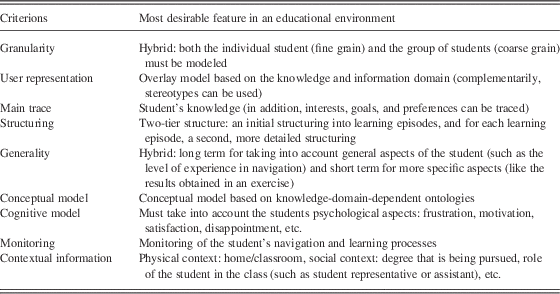
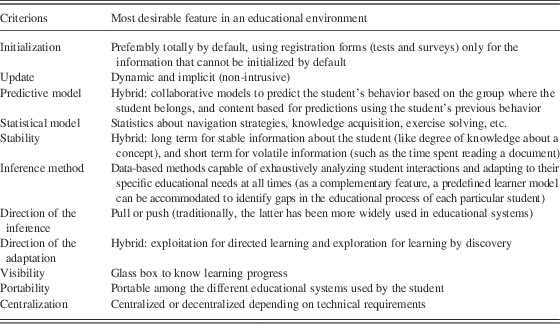
The adjustments made to a system are determined by the UM that the system operates, and vice versa. Therefore, user modeling is a crucial aspect of an adaptive system that must be designed with care. Throughout this article, the focus has been on adaptation in an educational environment. For this reason, before concluding this discussion, it is necessary to determine what options among those outlined above are more beneficial in this type of system. Tables 2 and 3 (based on Table 1) summarizes the set of features that the authors believe should be present in the UM of an educational adaptive system. These desirable features are organized according to the taxonomic criteria described earlier. Some of these features have already been mentioned in the preceding paragraphs, while others are mentioned here for the first time in this paper. In either case, the authors’ analysis (summarized in the tables), does not mean that all educational systems have to present exactly this set of structural and functional characteristics during their user modeling. This is just a starting point, and recommended features must be adjusted and qualified according to the particularities of each system and its environment.
As commented at the beginning of this section, many of the choices for educational UMs summarized in Tables 2 and 3 were already discussed when the taxonomy was described in Sections 2.1 and 2.2. To complete this argument, some additional considerations are added below:
∙ The work of Méndez and Greenberg (Reference Nicholas and Martin2006), like others in the area, show that ontologies are useful for creating models of teaching. They define an axis along which students can mentally organize their vision of the information domain underlying the knowledge domain. Ontologies also provide a meta-level of knowledge representation which permits connections between different knowledge domains. According to these studies, the authors consider the integration of conceptual models a factor that increases the learning through the use of educational systems.
∙ Numerous studies support the benefits of computer-supported collaborative learning (Jong et al., Reference Jong, Chan, Wu and Lin2006) in the educational process, advocating that students learn best from interacting with other group members. For this reason, the authors consider it is important to model, not only individual students, but also groups of students who work together in group learning tasks (collaborative works).
∙ Learning is a process that can be decomposed into episodes. Each learning episode reflects a change in student knowledge motivated by some event (Terry, Reference Terry2006). The episodes are stored and organized in episodic memory for later retrieval as part of an explicit learning process. Therefore, the authors believe it is desirable that an educational UM try to simulate episodic memory, thus establishing a second level or tier in the structure of the student model.
∙ The impact of emotions and other psychological factors in the performance of any task is clear. In the case of educational activities, numerous studies have attempted to answer certain questions related to psychological factors involved in learning tasks (Efklides & Volet, Reference Efklides and Volet2005). Some of these questions, mentioned in Pekrun (Reference Pogacnik, Tasic, Meza and Kosir2005), are as follows: ‘Which emotions are experienced by students in learning, and what is their phenomenology?’, ‘What is the functional importance of emotions for students’ interest, metacognition, problem solving, and performance?’, and finally, ‘Can desirable student emotions be fostered by modifying instruction and teacher behavior?’. The answers to these questions suggest that it is interesting to include in the student model parameters to represent some of the cognitive aspects that may influence the educational process.
∙ Different researches argue that the learning context determines the way that students address an educational process. Activity theory (Bertelsen & Bodker, Reference Bertelsen and Bodker2003) has been used to analyze the influence of the learning context. In particular, Govender (Reference Govender2009) defines three types of learning context: (a) the institutional context, divided into two main groups: face-to-face educational institutions and distance-learning institutions; (b) the disciplinary context, where given an institutional context, there will be a diversity of disciplinary contexts, each one with features that are specific to that discipline; and (c) the personal context, that is, the attitudes and objectives expressed by the students in connection with the object of study. The authors believe that all these contexts should be considered in the student model.
∙ Finally, the theory of self-determination (Ryan & Deci, Reference Sia, Zhu, Chi, Hino and Tseng2004) supports the statement that feelings of autonomy and competence have a highly positive impact on students during their learning. Self-determination theory is a macro-theory that deals with human motivation and personality. The theory studies the motivation behind the decisions that people make without any outside influence, focusing on the behavior of an individual which is due to self-motivation and self-determination. This theory points in the direction of giving students some control over their educational process, and therefore towards student models that reflect this.
In conclusion, as shown in Tables 2 and 3, the best feature for each criterion in an educational environment is usually the most versatile, that is hybrid solutions. In addition, solutions based on knowledge representation and those oriented to facilitate adaptation of the instructional process are preferred. Thus, in e-learning solutions is recommended to represent the conceptual domain to learn and the student’s behavior in terms of knowledge and achievements, as well as the inclusion of contextual and emotional aspects that can contribute to the acceleration and improvement of the learning progress.
4 Conclusions and further work
User modeling is a task that has been performed in many different ways because of the wide variety of information and services offered by adaptive systems. To help the reader perceive some order in the diversity of UMs, this work has focused on defining a general taxonomy. This taxonomy aims to provide a framework to classify UMs, to describe concisely individual adaptive systems, and to compare different systems from several perspectives.
The first intention of this paper is to classify and describe the major user modeling approaches found in the literature. However, the taxonomy proposed here also offers a simple notation and categorization scheme that makes it possible to characterize any proposal and to compare it with other related proposals according to the structure of the UM (nine classification criteria) and the management of UM (11 classification criteria). In particular, this work has focused on educational hypermedia systems and on identification of the characteristics that the authors believe should be in the UM of an educational system to achieve adaptive learning: a granularity accommodating both individual users and user groups, an overlay model, ontological representations, a dynamic and non-intrusive update procedure, glass-box visibility, and a data-based inference method, among the most important.
Consistent with this, the authors’ hypermedia model for educational adaptive systems, SEM-HP (Medina-Medina et al., Reference Medina-Medina, Molina-Ortiz and García-Cabrera2005), has been described using the taxonomy, showing that the SEM-HPs UM has almost all the features identified as desirables in education environments (Tables 2 and 3). Specifically, the model only excludes two desirable features: a cognitive model with the emotions of the user and a mechanism to permit the portability of the UMs managed in the system. Currently, the authors are working to incorporate both features into SEM-HP.
Concluding, as pointed out in Fensel (Reference Fensel2001), the authors consider that taxonomies provide a shared and common understanding of a domain that can be communicated between individuals, which can be used on a set of heterogeneous and widely spread applications. So, in addition to the uses already mentioned above, the authors highlight other advantages of having a taxonomy to classify the UMs used in adaptive systems to agree on the main concepts involved in the task of user modeling, to define a common vocabulary that enables designers to exchange information systematically about the structure and use of the UM, to provide a basis to facilitate the abstraction of the process of user modeling, to establish a nomenclature for specifying the interface or protocol that an UM has to satisfy for a particular adaptive application, to serve as a starting point for discussing and establishing the most appropriate features for an UM depending on the type of adaptive application, and to provide a specification to facilitate the portability of the UM of an adaptive system to another system. In particular, the authors consider this last point, the exchange of UMs, a key element if we want to build a universe of adaptive systems that can operate in a networked, allowing the reusing of the inferences made about the user (internal representation of the user) in each system. In this sense, the proposed taxonomy is a starting point that can do a little closer the achieving of that goal.
Acknowledgments
This research is supported by the Spanish MCYT R+D projects TIN2008-06596-C02-02, TIN2007-64718, and TIN2007-60199, as well as the FPU program, and by the Andalusian Government R+D projects P08-TIC-03717 and P11-TIC-7486.
Appendix
Frequency of use of the taxonomys terms taken from the existing literature on user modeling: the authors count the number of scientific papers using each term by doing searches of the term (indicated in the legend of the each graphic), in Google Scholar
Analytical survey: structure. UM=user model
Analytical survey: management. UM=user model