While ancient music was inherently ephemeral, gone once its sound ceased, an extensive record of portable objects, visual art, and ethnohistoric documents attest to its importance in pre-Columbian Mesoamerica. Musical instruments appear in exclusive high-status contexts such as palaces (Inomata and Stiver Reference Inomata and Stiver1998; Stockli Reference Stockli2007) and temple precincts (Both Reference Both2005a). Musicians and instruments were painted onto temple walls (Gann Reference Gann1901; Miller Reference Miller, Benson and Griffin1988) and in the pages of codices. They occur in caches in public spaces (Both Reference Both2005a) and in tombs (Caso and Bernal Reference Caso and Bernal1952). Instruments can be found in the form of modest ceramic whistles and ocarinas in domestic middens and non-elite burials (Barber and Hepp Reference Barber and Hepp2010; Hepp Reference Hepp2007; King Reference King2003; Martínez López and Winter Reference Martínez López and Winter1994; Sánchez Santiago Reference Sánchez Santiago2005; Yaeger Reference Yaeger2000). Their ubiquity in the archaeological record emphasizes their significance; people of all social positions played musical instruments for a wide range of purposes. While the documentation and organology of Mesoamerican musical instruments has a long scholarly history (Both Reference Both and Mirelman2010), consideration of the social context of pre-Columbian music is a topic that has only recently been broached by researchers (Both Reference Both and Jones2005b, Reference Both2007; Houston et al. Reference Houston, Stuart and Taube2006; Olivier Reference Olivier and Keber2002; Taube Reference Taube, Fields and Zamudio-Taylor2001). The more recent studies suggest that music was not simply an aural accompaniment to certain kinds of social action and that musical instruments were more than tools for producing sound. Instead, recent research suggests that music and instruments were enmeshed in communication and interaction between humans and other animate entities within the Mesoamerican universe.
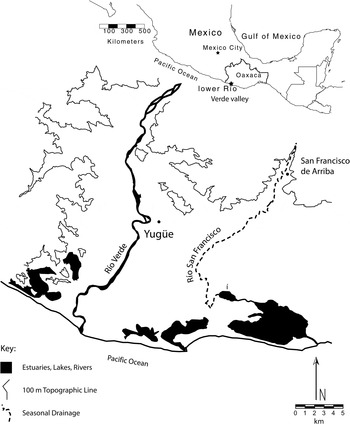
Drawing on these ideas, we seek to expand the discussion of music in pre-Columbian Mesoamerica through the detailed examination of a Terminal Formative period (150 b.c.–a.d. 250) burial from the site of Yugüe in the lower Río Verde Valley on the Pacific coast of Oaxaca (Figure 1). Burial 14-Individual 16 (B14-I16) consisted of a sub-adult male wearing an iron-ore mirror and holding an elaborately incised bone flute. Both the incising on the instrument and its archaeological context offer a unique opportunity to consider the social context of music and musical instruments at Yugüe and in Mesoamerica more broadly. Like many Mesoamerican instruments (Hammond Reference Hammond1972; Marti Reference Marti1955, Reference Marti1968; Martínez López and Winter Reference Martínez López and Winter1994; Mendoza Reference Mendoza1941; Payne and Hartley Reference Payne and Hartley1992; Peterson Reference Peterson1952; Sánchez Santiago Reference Sánchez Santiago2005), the Yugüe flute bears the portrait of an anthropomorphic figure (see Figure 10). Given the ability of portraits to literally embody the essence of a depicted entity in Mesoamerican ontologies (Furst Reference Furst1995; Guernsey Reference Guernsey2006; Houston et al. Reference Houston, Stuart and Taube2006; Houston and Stuart Reference Houston and Stuart1998; Monaghan Reference Monaghan and Monaghan2000; Stuart Reference Stuart1996), we argue that the Yugüe flute was an animate object with a voice and a life essence that actively participated in social action. Attributing animacy to the flute requires us to consider musical production as part of interactions between human and “nonhuman” beings (following Walker Reference Walker, Mills and Walker2008; see also Gell Reference Gell1998; Latour Reference Latour1999; Mills and Ferguson Reference Mills and Ferguson2008) rather than simply as human-produced harmonic or rhythmic sound. It also suggests that B14-I16 was not simply the interment of a young man and his possessions, but rather the multiple burial of animate beings linked, in life and in death, through their social relationships with one another.
The lower Río Verde Valley with sites mentioned in the text.

ARCHAEOLOGICAL CONTEXT
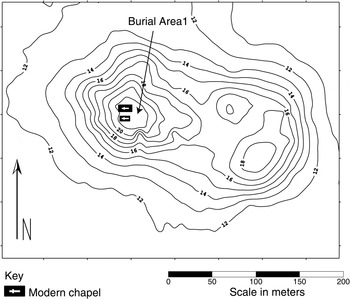
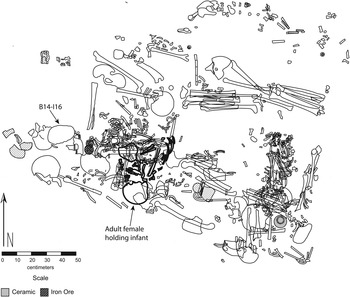
Burial 14-Individual 16 was recovered from a late Terminal Formative period (a.d. 100–250) cemetery located at the summit of the 10 m high earthen platform that comprises much of Yugüe's 9.75-ha area (Barber Reference Barber2005; Joyce Reference Joyce and Joyce1999) (Figure 2). The area was not domestic, and was used for collective ritual and burial throughout the Terminal Formative period (Barber Reference Barber2005). The cemetery, or Burial Area 1 (BA1), was a discrete burial group containing the remains of at least 44 individuals (Figure 3). The east and south limits of BA1 were abrupt and formed a clear right angle, suggesting that the burials had been emplaced beneath the floor of a now-invisible superstructure built of earth and organic materials. Sub-floor collective burial in non-residential buildings was practiced throughout the Late (400–150 b.c.) and Terminal Formative periods in the lower Verde region (Barber Reference Barber2005, Reference Barber2008; Joyce Reference Joyce1991a, Reference Joyce1991b, Reference Joyce1994). Both primary and secondary burials were present, and the majority of primary interments had been disturbed by the placement of subsequent individuals. Both sexes were represented, and ages ranged from neonate to elderly adult (Mayes and Barber Reference Mayes and Barber2008). In general, individuals in the cemetery had been emplaced following a standard pattern. Adults were buried in an extended position, on their right sides with their heads to the west. Juveniles were placed perpendicular to the adults, on their left sides with their heads to the south. There were several exceptions to this pattern, in part due to cultural disturbance caused by later interments. In one case, an adult female holding an infant was interred following the pattern for a juvenile (Burial 8-Individual 8) (Figure 3). Four individuals had either grave goods or dental modification (Table 1). Five ceramic vessels were also present in the fill of the burial area but could not be definitively associated with any particular individual due to the commingling of remains. Small, unshaped fragments of the soft local granodiorite bedrock were placed beneath the skulls of six individuals: three adult males, two adult females, and one juvenile. Only one of these individuals, a young adult male (see Table 1), also was interred with offerings.
Topographic map of the Yugüe platform with excavation areas indicated.

Burial Area 1, Yugüe.

Burial offerings and dental modification, Terminal Formative period

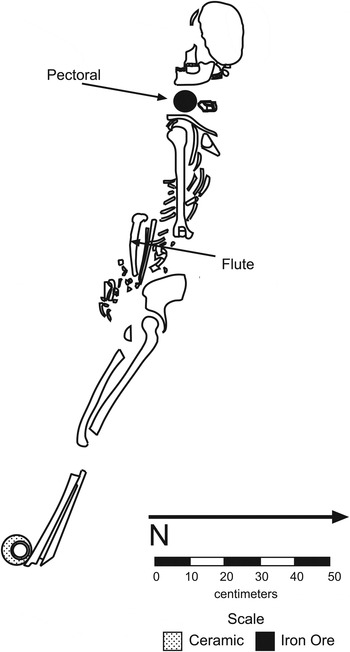
Burial 14-Individual 16 was a sub-adult male between 15 and 17 years of age buried according to the pattern of other adults in the cemetery (Barber Reference Barber2005:394–395) (Figure 4). No burial pit was evident, unsurprising given that six individuals were buried later in the superimposed fill; there were no pathologies that could indicate cause of death (Mayes and Barber Reference Mayes and Barber2008). An iron-ore and plaster disc was located below B14-I16′s mandible (Figure 5) and the flute was resting against his left forearm. The fingers of his left hand were curled around the bell of the instrument. The mouthpiece of the instrument was near his elbow, and the stops were facing away from his body. A line of six fragments of granodiorite had been placed beneath the flute.
Burial 14-Individual 16, Yugüe.

Iron-ore and plaster pectoral recovered with B14-I16.

While it is not possible to reject the hypothesis that I16 was a human sacrifice, we believe that the burial context and contents more strongly support the interpretation that he was a prominent community member who died of natural causes.Footnote 1 BA1 itself was a supra-domestic burial location for individuals of varying social positions (Barber Reference Barber2005). The very elaborate items with which I16 was buried distinguish him from the other 43 individuals buried in the cemetery. However, at least one adult woman from BA1 had pyrite incrustations in her incisors and a juvenile was interred holding a string of white stone and greenstone beads. Burial offerings from earlier interments nearby also contained grave goods, including a greenstone pendant interred with a juvenile and four ceramic jars placed in the burial of an adult. Thus, several individuals of different ages and sexes buried in this part of the site were distinguished from others through grave goods. The fact that some, but not all, individuals were interred with grave goods suggests that people with differing access to social valuables were buried there. Pathologies within the cemetery also varied, with some individuals showing limited post-weaning evidence for physical stress and others manifesting health problems like anemia and arthritis that may have been influenced by lower social status (Mayes and Barber Reference Mayes and Barber2008; Melmed Reference Melmed2006). BA1 also contained both sexes and all ages, reiterating the area's use as a local, collective burial site. All of the intact adult interments in BA1 follow an azimuth of 15° east of north, a locally-significant orientation repeated site-wide in architecture, burials, and caches for at least 400 years. We doubt that a human sacrifice would be included in a community cemetery. There is also the issue of Yugüe's size. At 9.75 ha, it was a third-order site in the lower Verde's Terminal Formative site hierarchy and over 20 times smaller in area than the regional political center of Río Viejo. While regional political relations at this time are not well understood, we find it unlikely that a small site such as Yugüe would be a locus at which human sacrifice was carried out.
PHYSICAL CHARACTERISTICS OF THE YUGÜE FLUTE
The Yugüe Flute as a Musical Instrument
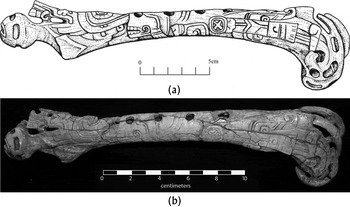
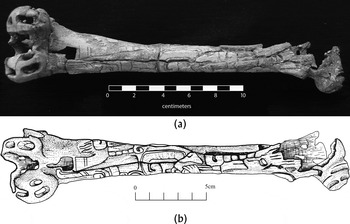
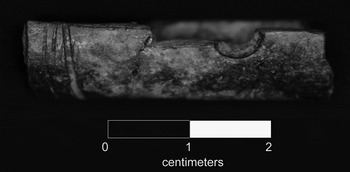
The Yugüe flute was a vertically held external duct flute (following Hornbostel and Sachs Reference Hornbostel and Sachs1961:26) made from the left femur of a white-tailed deer (Odocoileus virginianus) (see Barber et al. Reference Barber, Santiago and Olvera2009) (Figures 6 and 7). When played, the bone would have been held in an inverted position with the embouchure at the distal end of the bone and the bell at the proximal end. There are four stops running down the ventral side with a probable fifth stop near the bell of the flute on the bone's dorsal side. While four stops are common in Mesoamerican flutes, frequently occurring in examples made of ceramic from the Classic (a.d. 300–800) and Postclassic (a.d. 800–1521) periods (Both Reference Both2002; Crossley-Holland Reference Crossley-Holland1980; Marti Reference Marti1978; Payne and Hartley Reference Payne and Hartley1992), instruments with stops on both sides of the windway are uncommon. Like all instruments in the duct-flute family, external-duct flutes produce sound by forcing air over a beveled edge in the instrument's windway; the edge is usually located on a square aperture somewhere below the mouthpiece (Crossley-Holland Reference Crossley-Holland1980). In external-duct flutes, a duct separate from the main resonating chamber of the instrument is used to channel air over the beveled edge. In the case of the Yugüe flute, a separate duct was necessary for the production of sound because the aperture is located approximately 1.5 cm below the dorsal projection of the distal condyles, making it impossible to blow directly onto the beveled edge (see Figure 7). No duct was found with the instrument when it was excavated, indicating either that the flute was interred without the duct or that the duct was made from organic material that did not preserve. Because of the instrument's extremely fragile condition, it cannot be played. Information on the range of tones the flute produced is therefore unavailable.
Yugüe flute, lateral view.

Yugüe flute, dorsal view.

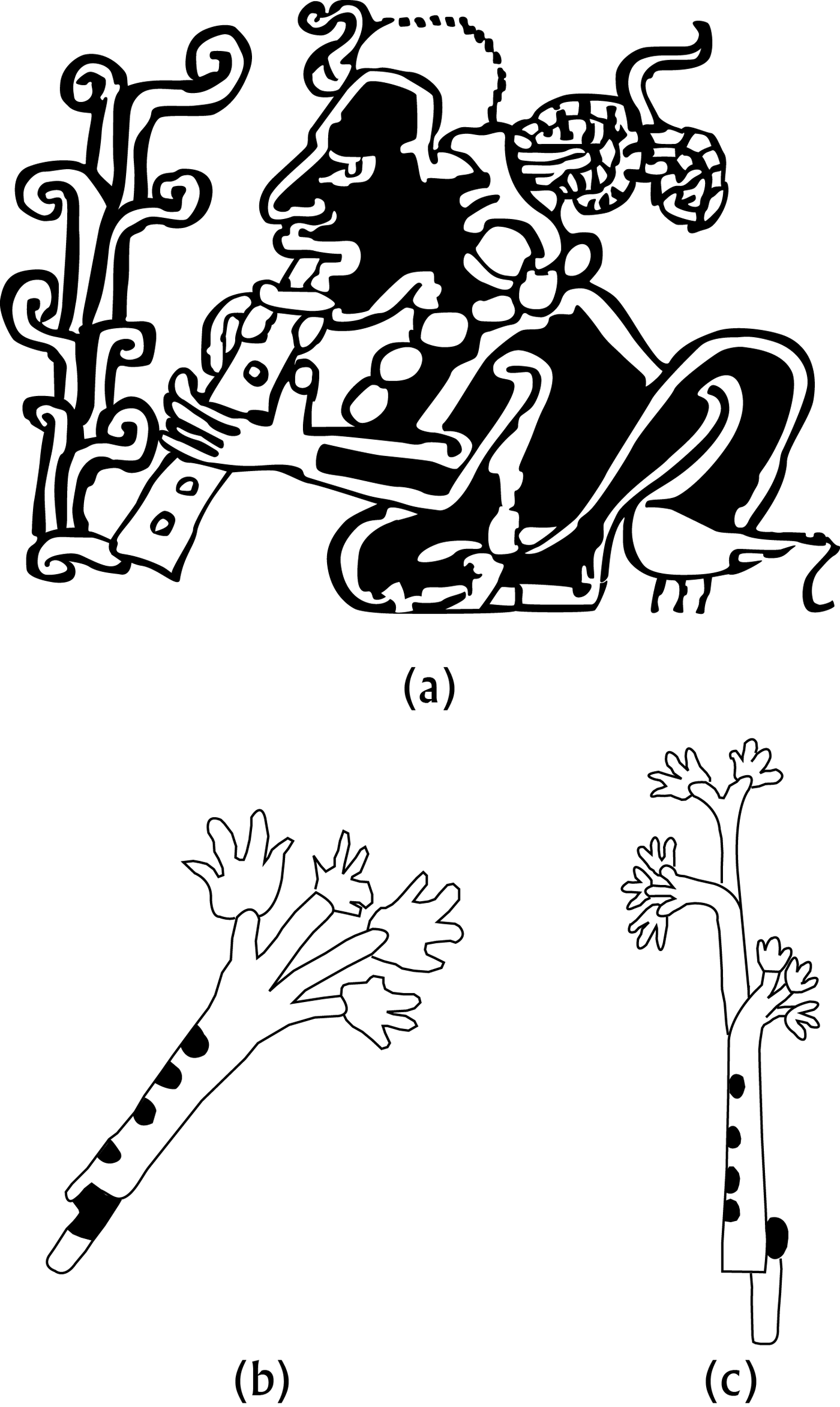
External-duct flutes are documented in Mesoamerican ethnography, ethnohistory, and archaeology (Barber et al. Reference Barber, Santiago and Olvera2009). Flutes with external ducts of perishable material have been described ethnographically for the Lacandon Maya (Marti Reference Marti1968), the Pames of northeast Mexico (Contreras Arias Reference Contreras Arias1988), the Yaquis of Sonora (Desmore Reference Desmore1972), and the Coras of Nayarit (Jauregi Reference Jauregi1993). External-duct flutes are depicted in the Dresden Codex, the Codex Tonindeye, and the Codex Iya Nacuaa (Figure 8).Footnote 2 The duct flutes depicted in the two Mixtec Codices are part of a place name sometimes translated as the “Hill of the Flowery Flutes,” a location that Manuel Hermann Lejarazu (Reference Hermann Lejarazu2006) has argued was probably located on the coast of Oaxaca. Interestingly, these possibly coastal flutes have a sound mechanism very similar to that of the Yugüe flute, with an external duct and an aperture on the side opposite the stops (Barber et al. Reference Barber, Santiago and Olvera2009). There is also an external-duct flute made of bone from Totolapan, in highland Oaxaca, that lacks archaeological provenience but may be Postclassic in date (Barber et al. Reference Barber, Santiago and Olvera2009). The Yugüe flute is currently the earliest example of an external-duct flute reported for Mesoamerica.
External-duct flutes depicted in pre-Columbian codices: (a) flute player from the Dresden Codex (Redrawn from Thompson [Reference Thompson1972] by W. Bayuk), (b) “Hill of the Flowery Flutes” from the Codex Tonindeye (Redrawn from Nuttall [Reference Nuttall1975]), (c) “Hill of the Flowery Flutes” from the Codex Ica Nacuaa (Redrawn from Caso and Leon-Portilla [Reference Caso and León-Portilla1996]).

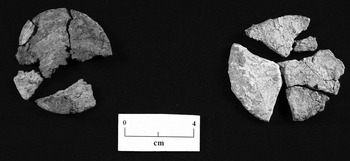
Although unusual because of its raw material and elaboration, the Yugüe flute is part of a well-documented body of musical instruments recovered from pre-Columbian contexts in the lower Río Verde Valley and Oaxaca. The burned fragments of at least one other incised bone flute were found in a Terminal Formative midden located near BA1 at Yugüe (Figure 9). Ceramic ocarinas and whistles are common in Terminal Formative middens at sites throughout the region. The ceramic instruments tend to be zoomorphs, usually in the shape of birds, which produce up to three notes and a range of microtones (Barber and Hepp Reference Barber and Hepp2010). Ceramic flutes and whistles have been recovered from Late Classic (a.d. 500–800) and Early Postclassic (a.d. 800–1200) period domestic deposits at the site of Río Viejo (Barber and Hepp Reference Barber and Hepp2010; King Reference King2003). Beyond the lower Verde, ceramic ocarinas and whistles are common in Terminal Formative contexts elsewhere in Oaxaca (Martínez López and Winter Reference Martínez López and Winter1994; Sánchez Santiago Reference Sánchez Santiago2005, Reference Sánchez Santiago2009). Five other bone flutes, all dating to the Classic or Postclassic period, have been recovered at sites in highland Oaxaca (Barber et al. Reference Barber, Santiago and Olvera2009).
Burned fragment of incised bone flute, Yugüe.

The Yugüe Flute as an Art Object
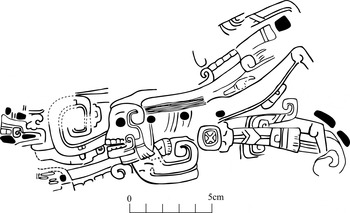
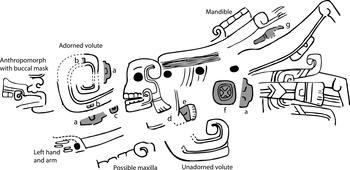
In addition to being the earliest intact example of a Mesoamerican bone flute, the Yugüe flute can be distinguished from most pre-Columbian Mesoamerican flutes due to the artistry of its design (Figures 10 and 11). The central element of the image is an anthropomorphic male figure in profile facing toward the bell of the instrument. The individual is rendered in low relief, with the surrounding cortical bone excised so that the central figure is set slightly above the background. The head and torso of the figure are “skeletonized” (following Furst Reference Furst and Boone1982) while the limbs are fleshed. The individual's head is depicted as a skull and the eye orbit is one of the stops of the flute. Hair, perhaps in the form of a scalp lock, and ribs are depicted. The figure's feet wrap around the mouthpiece end of the flute. What is probably the left arm and hand extend forward, with the stop on the underside of the flute serving as the palm of the figure's hand. The individual wears a loincloth and there is a cartouche with crossed bands at his waist, perhaps representing a belt or buckle. The figure wears a pectoral, to which is attached a tasseled rectangular object that may be a mirror.
Rollout of incising, Yugüe flute.

Graphic elements incised on Yugüe flute: (a) trefoil, (b) paired dots, (c) U-infixed motif, (d) pectoral, (e) mirror?, (f) crossed-bands, (g) handled implement.

Additional motifs that accompany the central figure are also rendered in low relief. A volute adorned with dots and a trefoil element emanates from the mouth and nasal aperture of the skull. Attached to the volute is an anthropomorphic face in profile. This second individual wears a buccal mask over the mouth and in front of the nose. A second volute carved around the femoral head of the deer bone emanates from the buccal-masked figure's mouth (see Figure 6). Two anthropomorphic jaw bones are present: a mandible and possibly a maxilla. Between the right arm and left leg is a curved implement with a handle. Details on the central figure and additional elements are rendered in shallow, fine incision. Tassels on the loincloth and possible mirror, for instance, are depicted as shallow tics in the elevated surfaces of each element. There are also a series of small openings and deep carvings around both the embouchure and bell of the flute (see Figure 6). Damage to the lateral side of the bone has obscured additional incised motifs.
The incisions make use of the bone's topography to imbue a sense of three-dimensionality to the design. The bend in the individual's left knee, for instance, is incised over a protuberance in the distal diaphysis of the bone. The front and back portions of the loin cloth appear on different sides of the bone. And the carvings on the femoral head create a three-dimensional volute emanating from the mouth of the buccal-masked figure.
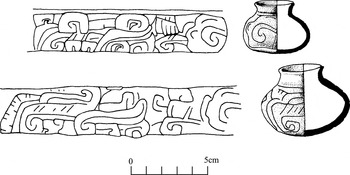
The rendering of the image and the motifs present reveal evidence of cultural transmission between both highland-coastal and transcoastal interaction spheres. The cluttered organization of the incised design on the flute is reminiscent of later Formative period art from the southern highlands and coast of Mesoamerica. The entire bone is carved or incised, with little open space between elements. Similarly crowded incising is present on some contemporaneous local ceramics (Barber and Joyce Reference Barber and Joyce2004; Joyce Reference Joyce1991a; Joyce et al. Reference Joyce, Winter and Mueller1998) (Figure 12). Cluttered images are also characteristic of two Terminal Formative period incised bones from Chiapa de Corzo (Dixon Reference Dixon1958), stelae from Izapa (Norman Reference Norman1973; Smith Reference Smith1984), Kaminaljuyu (Parsons Reference Parsons1986), and Takalik Abaj (Smith Reference Smith1984:Figures 43–45), and indeed much Formative period Maya-style art (e.g., plates in Fields and Reents-Budet Reference Fields and Reents-Budet2005). Late and Terminal Formative period Zapotec art, on the other hand, is less involuted. Stone monuments such as the carved orthostats from Building L-sub (Scott Reference Scott1978) and incised slabs of Building J (Caso Reference Caso1938:12–16; Marcus Reference Marcus, Flannery and Marcus1983b) from Monte Alban, and the ballplayers from Dainzu (Orr Reference Orr1997) lack densely-packed imagery. The use of carving to create a low relief image is also common in Formative period southern Mesoamerica (Guernsey Reference Guernsey2006:1; Norman Reference Norman1973) but not in the Zapotec highlands (Scott Reference Scott1978). Excision to create the appearance of low relief for some design elements occasionally appears on gray ware ceramics in the lower Río Verde Valley, suggesting that relief was employed in the region across several media (Figure 13). The proportions of the skeletal figure, with his long limbs, are also characteristic of art from southern Mesoamerica (Norman Reference Norman1973; Parsons Reference Parsons1986) rather than the squat figures common to Terminal Formative and particularly Classic period Zapotec art (Orr Reference Orr1997; Urcid Reference Urcid2005b, Reference Urcid, García and Guzmán2011).
“Cluttered” image organization from late Terminal Formative period gray ware miniature jars, San Francisco de Arriba (Courtesy of Andrew Workinger; drawing by J. Cruz).

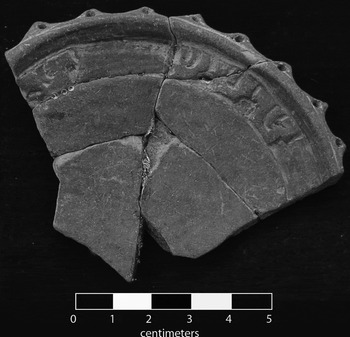
Carving used to create low relief, late Terminal Formative period gray ware plate, Yugüe.

Specific iconographic elements on the flute are related to both highland Oaxacan and southern Mesoamerican imagery. Skeletal imagery does not occur in the Formative period in highland Oaxaca, and is rare in the Classic period (Boos Reference Boos1966; Caso and Bernal Reference Caso and Bernal1952; Orr Reference Orr1997; Scott Reference Scott1978). However, there is a skeletal figure depicted on Izapa Stela 50 (Norman Reference Norman1973:Plates 49–50). The crossed-band motif on the central figure's loincloth also appears on five stelae at Izapa (2, 4, 11, 22, and 60) (Norman Reference Norman1973), but it does not appear in Zapotec art until the Classic period, when it is modeled on ceramic urns (Sellen Reference Sellen2007). The buccal mask worn by the individual adhering to the central volute is typical of Zapotec imagery from the later Formative and Classic periods. Celestial jaws, which we argue below are indicated by the two anthropomorphic jaw bones on the Yugüe flute, are common in Formative period Mesoamerican art (Norman Reference Norman1976; Smith Reference Smith1984; see also Taube Reference Taube1995) but do not appear in Zapotec art until the Classic (Marcus Reference Marcus, Flannery and Marcus1983d:137). The use of human-like teeth in celestial jaws occurs in Classic period Zapotec art (Urcid Reference Urcid2005b) but not in southern Mesoamerican art (Guernsey Reference Guernsey2006:79). Finally, the trefoil motif on the Yugüe flute closely matches Zapotec renditions of vegetation (Sellen Reference Sellen2007; Urcid and Winter Reference Urcid and Winter2003). We suspect that the mix of stylistic and iconographic conventions evident on the Yugüe flute is representative of a local artistic style, although defining such a style will require a larger iconographic database.
ICONOGRAPHY OF THE YUGÜE FLUTE
The central figure on the flute bears elements pertaining to both death and fertility, embedding it within widespread Mesoamerican rain, wind, and agriculture deity complexes (Nicholson Reference Nicholson, Ekholm and Bernal1971:414, 416; Vail Reference Vail2000). It is possible that the figure represents a human in the midst of a ritual transformation, however most partially-skeletal male figures in Mesoamerican iconography have been interpreted as depictions of a death god analogous to Aztec Mictlantecuhtli (Bernal et al. Reference Bernal, Chan and Barbachano1968:26; Byland Reference Byland, Diaz and Rodgers1993; Gutiérrez Solana and Hamilton Reference Gutiérrez Solana and Hamilton1977:41, Figure 1; Jansen Reference Jansen1981:110, Figure 5; Schellhaus Reference Schellhaus1904; Taube Reference Taube1992). Both Mictlantecuhtli and Maya God A, also a death divinity, were associated with sacrifice (Nicholson Reference Nicholson, Ekholm and Bernal1971:427; Taube Reference Taube1992:13). While the skeletal features of the central figure on the flute and perhaps the handled object near the right hand could suggest a connection with death or sacrifice; skeletal characteristics can also indicate generative capabilities (Furst Reference Furst and Boone1982:220; Klein Reference Klein2000:11; Norman Reference Norman1976:147). Several pre-Columbian divinities that were not specifically representative of death had skeletal permutations or features, including: Quetzalcoatl (Nicholson Reference Nicholson, Ekholm and Bernal1971:429, Figure 46), Cihuacoatl (Milbrath Reference Milbrath1996), the Cihuateteo and Tzizimime (Klein Reference Klein2000), and the creator gods in the Mixtec Codex Yuta Tnoho (Furst Reference Furst and Boone1982:209; Jansen and Pérez Jiménez Reference Jansen and Jiménez2007:71, Figure 3.2).Footnote 3 A Late Formative period (400 b.c.–a.d. 250) example comes from Izapa Stela 50 (Norman Reference Norman1973:Plate 50; 1976:145, Figure 3.35), on which an umbilicus extending from the rib cage of a skeleton is held by a fleshed winged figure (see also Miller Reference Miller and Hammond1974). The umbilicus is an explicitly life-giving organ, and on Izapa Stela 50 it is adorned with serpentine motifs that connect the scene to rain and fertility.
On the Yugüe flute, agricultural fertility and life-giving phenomena like rain and wind are referenced in several ways. Trefoil motifs are attached to the loincloth and the sound scroll extending from the mouth of the skeletal figure (see Figure 11). Trefoils have long been recognized as representations of vegetation, particularly maize, in Zapotec iconography (Boos Reference Boos1966; Caso and Bernal Reference Caso and Bernal1952; Sellen Reference Sellen2007; Urcid and Winter Reference Urcid and Winter2003). Hanging from the skeletal figure's loincloth is a trefoil with two interior curved lines, which Sellen (Reference Sellen2007:244) has identified specifically as a maize kernel in Zapotec iconography.
An anthropomorph wearing a buccal mask is attached to the central volute on the Yugüe flute. Buccal masks were an important signifier of Cociyo, the Zapotec deity credited in Colonial and Historic period accounts with controlling clouds, rain, wind, thunder, and hail (Caso and Bernal Reference Caso and Bernal1952; Marcus Reference Marcus, Flannery and Marcus1983e; Masson Reference Masson2001; Seler Reference Seler1904; Sellen Reference Sellen2002b; Taube Reference Taube, Fields and Zamudio-Taylor2001; Urcid Reference Urcid2001, Reference Urcid2009; von Winning Reference Von Winning1987). We follow Sellen and others (Masson Reference Masson2001; Sellen Reference Sellen2002a, Reference Sellen2002b, Reference Sellen2007) in identifying Cociyo, and the Chatino equivalent Tyoo (Urcid Reference Urcid2009:30), as deities related to the buccal-masked central Mexican and Mixtec gods Tlaloc, Ehecatl, and Lord 9 Wind (Jansen and Pérez Jiménez Reference Jansen and Jiménez2007:74; Nicholson Reference Nicholson, Ekholm and Bernal1971:414; Sellen Reference Sellen2002b:6) rather than just the name given to the animating force within lightening (Marcus Reference Marcus1978, Reference Marcus, Flannery and Marcus1983e). As we discuss below, we also recognize the significance of animism in pre-Columbian Chatino religious belief and assert that both divine and more generalized animate forces are referenced on the Yugüe flute iconography.
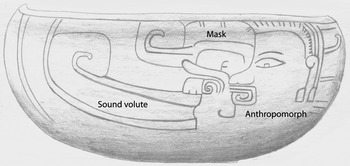
A Cociyo-like deity is identifiable in Zapotec script and ceramic urns prior to 300 b.c. (Caso and Bernal Reference Caso and Bernal1952:25; Urcid Reference Urcid1992; Reference Urcid2005b:Figure 1.21) and was the Zapotec expression of a broader group of Mesoamerican rain divinities that extended back to the Middle Formative period (800–400 b.c.) (Covarrubias Reference Covarrubias1957; Taube Reference Taube1995). By the Early Classic period (a.d. 300–500), there was a well-established set of conventions pertaining to Cociyo both in texts and on other media such as Zapotec ceramic urns and tomb murals (Marcus Reference Marcus, Flannery and Marcus1983c, Reference Marcus1992a; Masson Reference Masson2001; Sellen Reference Sellen2002b; Urcid Reference Urcid2005a, Reference Urcid2005b). Cociyo was usually characterized by a short, straight or up-turned buccal mask, fangs, a bifid tongue, and an orbital plaque or elaborate eyebrows (Boos Reference Boos1966; Caso and Bernal Reference Caso and Bernal1952:17; Marcus Reference Marcus, Flannery and Marcus1983c; Sellen Reference Sellen2007; Urcid Reference Urcid2001:Figure 4.13, 2009). The individual from the Yugüe flute shares several of these characteristics, notably the straight buccal mask, fang, and possibly the orbital plaque. The adornment above the eye is indicated by the line curving upward from the circular eye-opening. While the anthropomorph on the Yugüe flute is one of only four incised renditions of anthropomorphic faces from the Terminal Formative period in the lower Río Verde Valley (Figure 14), the unadorned, almond-shaped eyes of those individuals could mean that the divergent eye form on the flute was intentional.
Incised image of anthropomorph wearing mask and producing sound, late Terminal Formative gray ware bowl, Yugüe (Drawing by J. Cruz).

Together, the buccal-masked figure, the trefoils, the paired dots, and the “U-infixed medallion” (Guernsey Reference Guernsey2006:102) describe the sound generated by the skeletal male as life-giving and beautiful. The buccal-masked individual indicates that the sound is imbued with rain and wind while the trefoils indicate that the sound bears with it life in the form of vegetation. Paired dots frequently appear on sound volutes in Zapotec iconography (Marcus Reference Marcus, Flannery and Marcus1983a:Figure 7.4, 1983d:Figure 5.7; Urcid Reference Urcid2005b:Figures 5.14, 5.30, 5.45) and are common in visual art throughout Mesoamerica during the pre-Columbian era (see Houston et al. Reference Houston, Stuart and Taube2006; Houston and Taube Reference Houston and Taube2000:274–275). Houston and Taube (Reference Houston and Taube2000:275) argue that these elements depict either flowers or jade beads. In other words, the dots describe the beauty, purity, potency, or nobility of the sound (see Taube Reference Taube2004). The beauty of the sound may also be indicated by the U-infixed medallion just in front of the skeletal figure's mouth, which Guernsey (Reference Guernsey2006:102) argues indicates flowery attributes on winged figures on Izapa stelae 4 and 60. Flowery or beautiful sound descriptors for flute music are in keeping with ethnohistoric evidence. In a study of musical terms from sixteenth-century dictionaries, Stanford (Reference Stanford1966) found that “clear” and “high-pitched” sounds like those of a flute were preferred for voices and for instruments. The Mixtec term ndadze, for instance, means “ugly” but also “low-pitched,” and the word nahuatl means both “sonorous” and “high-pitched.” The adornments on the sound volute can be compared with the lack of adornments on the volute located next to the figure's rib cage. While the dorsal area of the flute has been damaged, the latter volute appears to emanate from the figure's pectoral. We believe that the lack of adornments here indicates that a different phenomenon is being depicted, probably smoke.
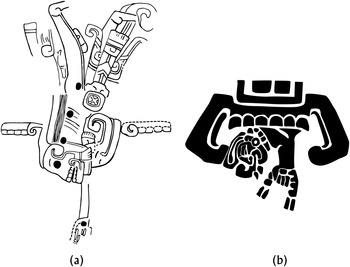
The skeletal figure, and by extension the sound he produces, enters the mundane world from the celestial realm through a portal represented by the mandible and possible maxilla next to his arms (Figure 15). Portals between existential realms were frequently depicted as jaws in Formative period Mesoamerican art (Grove Reference Grove, Clark and Pye2000; Taube Reference Taube1995:93–94). Images of figures descending from celestial jaws are found on stone monuments from Late Formative Izapa and Kaminaljuyu (Guernsey Reference Guernsey2006:78–79, 92) and in Oaxaca during the Late Classic and Postclassic periods (Caso Reference Caso1928; Hermann Lejarazu Reference Hermann Lejarazu2008; Marcus Reference Marcus1992a:238, Reference Marcus, Chase and Chase1992b:232–234; Sellen Reference Sellen2007:296; Urcid Reference Urcid1992:193, Figure 4.105; 2001). In general, celestial jaws had zoomorphic features likened to those of a jaguar, serpent, bird, or some combination thereof (Caso Reference Caso1928; Guernsey Reference Guernsey2006; Marcus Reference Marcus, Flannery and Marcus1983d:140; Norman Reference Norman1976:23; Quirarte Reference Quirarte1973:17; Sellen Reference Sellen2007:297; Stirling Reference Stirling1943:62; Taube Reference Taube1995:93; Urcid Reference Urcid2005b:53–54). While the anthropomorphic jaws on the flute are unusual in comparison to portal imagery elsewhere in Mesoamerica, we believe that the mandible and maxilla are nonetheless celestial referents. A link between celestial portals and human jaws in some Zapotec art is evidenced by the presence of dental modification on the teeth of celestial jaws carved into the interior door jambs of Late Classic Cerro de la Campana Tomb 5 (Urcid Reference Urcid2005b:Figures 5.24,5.25). Urcid (Reference Urcid2005b:79) observes that the modification depicted matches that found archaeologically in human teeth. The crossed-bands motif on the loincloth provides an additional indicator of the skeletal figure's celestial origin. Although crossed-bands can simply indicate portals or openings (Grove Reference Grove, Clark and Pye2000:288–289), the motif also has strong celestial connotations in many contexts. The winged figure painted at Oxtotitlan, Guerrero, wears a crossed-band motif on his chest (Grove Reference Grove, Clark and Pye2000:Figure 8). All of the winged figures from the corpus of depictions on stelae at Izapa bear this motif in their wings (Norman Reference Norman1973:Plates 3–4, 7–8, 51–52); it appears in the avian headdress of a ruler on Kaminaljuyu Stela 11 (Guernsey Reference Guernsey2006:92), in the wings of an avian figure from Takalik Abaj Altar 30 (Guernsey Reference Guernsey2006:Figure 5.3), and on a celestial band from Altar 13, also from Takalik Abaj (Guernsey Reference Guernsey2006:Figure 5.17).
Idealized image of (a) Yugüe flute, and (b) descending figure on Late Classic period Stela MNA 6-6059, Monte Alban (from Caso [1928:Figure 81]; redrawn by W. Bayuk).

The body position of the skeletal figure and its orientation on the flute further support the interpretation that the individual is descending through a celestial portal. The skull is perpendicular to the torso, one arm is extended, the legs are slightly separated and one knee is bent. Izapa Stelae 2, 4, and 23 all depict anthropomorphs descending from celestial jaws (Norman Reference Norman1973:Plates 4, 8, 38; Smith Reference Smith1984:10). On Stela 4, the descending figure is shown with its head rotated perpendicular to its torso (Norman Reference Norman1973:Plates 7, 8) while Stela 23 shows a descending male figure wearing a loincloth set between slightly separated and bent legs (Norman Reference Norman1973:Plates 37 and 38). Figures descending from celestial jaws with a rotated head and extended arm are common in later Zapotec and Mixtec art (Caso Reference Caso2002:296, 299; Hermann Lejarazu Reference Hermann Lejarazu2008:53, 57; Marcus Reference Marcus, Flannery and Marcus1983a:194, Figure 7.4; Urcid Reference Urcid2005b:126–127). In addition, the skeletal figure would have appeared in a descending position when the instrument was held in the bell-down playing position. Because it is a vertical flute, the Yugüe flute could be played most comfortably with the bell of the instrument pointing towards the ground (Barber et al. Reference Barber, Santiago and Olvera2009). Although playing postures are in part culturally defined, the Dresden Codex provides a pre-Columbian depiction of the bell-down playing position for an external-duct flute (see Figure 8a). Of course a portable object can be moved, making it possible for the instrument's player to place the central figure in a flying position (when the bell was parallel to the ground) or an ascending position (when the bell was skyward) although both playing positions would have been uncomfortable to sustain.
Taken together, the Yugüe flute's iconography presents a complex of intertwined elements that are tied not only to the incised design, but also the artifact's function and raw material. The skeletal figure whose body extends almost the entire length of the flute provides an anthropomorphized portrait of the instrument's animating force. The figure is oriented on the flute such that the volute that depicts his breath or voice extends towards the bell of the instrument, thus indicating that the figure's breath/voice was the music of the flute. In addition, the sound production mechanism of the instrument is literally incorporated into the figure's body. His eye orbit was unquestionably a stop, and the probable stop on the underside of the instrument was incorporated into what may have been the palm of the figure's left hand. The other three stops are located near potent (Houston et al. Reference Houston, Stuart and Taube2006:134–179; Marcus and Flannery Reference Marcus and Flannery1996:18–19; Schele and Miller Reference Schele and Miller1986:110) parts of the body: the neck (possibly the larynx), beneath the ribs (the heart), and between the legs (the genitalia). Producing musical notes with the flute would have required the player to touch different parts of the skeletal figure's body; covering his eyes, holding his hand, touching his heart, and so on. Finally, the figure's skeletal mien could be in part a reference to the fact that the flute was made of bone.
The flute's music, indicated by the adorned sound-scroll, makes manifest a second entity. That the buccal-masked figure and the skeletal figure are separate beings is evident in the placement of the former on the sound scroll. If the skeletal figure were wearing the anthropomorphic entity as a mask, the mask would have been depicted immediately in front of the skull and the sound scroll would have extended from the mouth of the mask. For instance, a contemporaneous bowl from Yugüe depicts a masked figure with a sound volute extending from the combined mouths of the mask and anthropomorph (see Figure 14). The avian-costumed anthropomorph from Oxtotitlan also wears a mask painted immediately in front of his face. Because it is located on the sound scroll rather than in front of the skull, the buccal-masked entity probably represents a deity related to the later Chatino rain god Tyoo that was made manifest through music.
The three-dimensional volute at the bell of the flute represents the culmination of the musical experience. Extending from the mouth of the buccal-masked figure, the second volute wraps around the bell of the instrument and is located exactly where sound was emitted. Thus the imagery on the flute can be interpreted as depicting an animating essence of celestial origin (the skeletal figure) whose voice makes manifest a Tyoo-like divinity (the buccal-masked figure). The voice of the divinity, in turn, is audible in the flute's music.
LIFE, DEATH, AND MUSIC AT YUGÜE
Burial 14-Individual 16 was the multiple burial of two animate beings: a human and a flute. The life essence of the flute had a celestial, non-human origin. As several scholars have noted, Mesoamerican animating essence was not coherent and discrete (Furst Reference Furst1995; Houston et al. Reference Houston, Stuart and Taube2006; Houston and Stuart Reference Houston and Stuart1996, Reference Houston and Stuart1998; López Austin Reference López Austin, Ortiz de Montellano and de Montellano1990:137, Reference López Austin1997). It could be divided, broken, shared, and transferred (Furst Reference Furst1995). One means of sharing animating essence was through portraiture (Houston et al. Reference Houston, Stuart and Taube2006; Houston and Stuart Reference Houston and Stuart1996, Reference Houston and Stuart1998; López Austin Reference López Austin, Ortiz de Montellano and de Montellano1990:137–139; Stuart Reference Stuart1996). Houston and colleagues (2006:74) observe an “essential sameness between image and subject in Maya belief” that was likely pan-Mesoamerican and that had considerable time-depth (see also Houston and Stuart Reference Houston and Stuart1996, Reference Houston and Stuart1998). Furst (Reference Furst1995:95) sees the identical practice among the Mexica, who “[in] fixing the image of the gods or ancestors…may have held and kept available for their own use the spirits' vitalizing power and animating force.” To bear the image of an animate being was, to some degree, to be that being—what Monaghan (Reference Monaghan and Monaghan2000:29) calls a “focus on surfaces” in Mesoamerican conceptions of divinity. Further, as a sound-producing entity the Yugüe flute was doubly-endowed with vital force. In Mesoamerican ontologies, to have a voice is to be alive (Houston et al. Reference Houston, Stuart and Taube2006:36; Houston and Taube Reference Houston and Taube2000; Monaghan Reference Monaghan1995:98; Taube Reference Taube, Fields and Zamudio-Taylor2001).
The Yugüe flute was not a being independent of its player, however. When B14-I16 died, so did the instrument; it was buried rather than kept aboveground to be played by someone else. The flute's interment also indicates that the instrument had been emplaced much like a dead human being. The flute sat atop six fragments of stone similar to those that had been set under the crania of several individuals in BA1. None of the other portable objects in the cemetery had been as carefully placed nor did they have stone fragments beneath them.
If B14-I16 contains the remains of not one, but two once-living beings, it begs the question of what kind of relationship obtained between them. The bones of B14-I16's left hand were not clutching the instrument across the diaphysis of the bone, a configuration that would have covered the portrait. Instead, the flute was set against B14-I16's forearm with the incised skull facing up. His hand cupped the bell, cradling the instrument much as an adult female (Burial 8-Individual 8) elsewhere in the cemetery was interred cradling an infant (see Table 1 and Figure 3). We believe that both the iconography and the deposition of flute and human imply the existence of a social relationship between the two that was more like the relationships that existed between people than like the kinds of subject-object relationships often assumed for the buried dead and associated offerings. Rather than a musician buried with the flute they owned, we see in B14-I16 the interment of an inextricably linked pair each of whom was capable of both acting and causing action. Indeed, it was such a potent relationship that one could not live without the other. We do not mean to imply that either B14-I16 or the flute became inert or “essenceless” once they had been interred. Indeed, both human and instrument were treated with considerable care for some time after their burial. Despite six subsequent interments in the superimposed sediment, B14-I16 remained fully articulated and the flute remained in his grasp. Most other individuals in the cemetery were partially or significantly disarticulated by later burials (Barber Reference Barber2005; Mayes and Barber Reference Mayes and Barber2008). There is considerable evidence from elsewhere in Oaxaca (Feinman et al. Reference Feinman, Nicholas and Baker2010; Lind and Urcid Reference Lind and Urcid2010:Chapter 6; Middleton et al. Reference Middleton, Feinman and Villegas1998) and Mesoamerica (McAnany Reference McAnany1995:60–63) that the physical remains of the dead continued to interact with and serve as points of reference for the living. Post-interment efforts to keep B14-I16 intact indicate that his physical remains and the flute had continuing significance for Yugüe's Terminal Formative period residents.
B14-I16 and the flute were a pair with exceptional capabilities. The flute, as we have already discussed, was an instrument with a celestial essence that shared its voice with a divinity. In indigenous ontology, it was a liminal entity (Chase and Chase Reference Chase, Chase, Cecil and Pugh2009) existing in both the celestial and terrestrial realms of existence. It served as a link between these two realms by making the voices of celestial entities audible to listeners in the terrestrial world. Mirrors were similarly endowed with the ability to connect different realms of existence, particularly the terrestrial and subterranean realms. Both Taube (Reference Taube and Berlo2002) and Olivier (Reference Olivier and Besson2003:240–265), in their extensive discussions of the iconography and ethnohistory of mirrors in central Mexico, observe that mirrors could provide passageways or openings between different planes of existence. At times analogous to eyes (Olivier Reference Olivier and Besson2003:249–250; Taube Reference Taube and Berlo2002:181–182), mirrors could serve as windows through which deities or ancestors could view the living and vice versa. Mirrors sometimes were understood to be the surface of water or the earth (Olivier Reference Olivier and Besson2003:260–261; Taube Reference Taube and Berlo2002:186–189), or caves (Taube Reference Taube and Berlo2002:194), all of which were important transition points between the terrestrial and subterranean realms. Mirrors were related to fire (Carlson Reference Carlson and Benson1981; Taube Reference Taube and Berlo2002) and “the ‘nocturnal and watery’ aspect of the sun” (Olivier Reference Olivier and Besson2003:262). Together, human, flute, and mirror would have existed at the intersection between the various planes of existence, embodying the universe itself.
Liminal spaces were incredibly important and dangerous locations for a human being (Monaghan Reference Monaghan and Monaghan2000:36; Viveiros de Castro Reference Viveiros de Castro2004), making B14-I16's youth and presence at a small site like Yugüe particularly interesting. While ethnohistoric documents describe a wide range of ritual practitioners (Klein Reference Klein2000; López Austin Reference López Austin1967; Nicholson Reference Nicholson, Ekholm and Bernal1971), archaeological studies of the topic have focused on the capabilities and responsibilities of rulers and/or elites (Lohse Reference Lohse, Gonlin and Lohse2007). Given the presence of the mirror and flute, B14-I16 was almost certainly a ritual practitioner. It is unlikely that he was a member of the lower Río Verde Valley's ruling elite, however, since he was buried in a collective burial area at a small site. Instead, he appears to have been an individual of high status in the context of Yugüe; a local or intermediate elite (see papers in Elson and Covey Reference Elson and Alan Covey2006). Both flute and mirror attest to B14-I16's access to socially-valued items with restricted circulation. Mirrors were consistently associated with elites across Mesoamerica from the Formative period through the Postclassic (Miller and Martin Reference Miller and Martin2004; Schele and Miller Reference Schele and Miller1986; Taube Reference Taube and Berlo2002). The nearest sources of iron-ore and lime for making plaster were the Oaxaca highlands (Pires-Ferreira Reference Pires-Ferreira and Flannery1976), and the mirror pectoral worn by B14-I16 is the only such item currently known from Oaxaca's coast. The flute is also a unique item because it would have required specialized knowledge and skill to produce (Inomata Reference Inomata2001, Reference Inomata, Hruby and Flad2007). Mesoamerican elites from at least the Middle Formative period fostered both long-distance economic relationships (Graham Reference Graham, Masson and Friedel2002; Hirth Reference Hirth, Chase and Chase1992) and relationships with non-human entities and ancestors in the celestial realm and underworld (Guernsey and Love Reference Guernsey, Love, Fields and Reents-Budet2005:41; Joyce Reference Joyce, Dobres and Robb2000; McAnany Reference McAnany1995). So B14-I16 had social relationships that spanned not just the various existential realms but also more mundane geographic and economic spheres, situating him in the broader context of pre-Columbian status relations as a local elite with significant ritual capacity and responsibilities. His burial reiterates that in the Terminal Formative period lower Río Verde Valley, at least, some ceremonial abilities were not exclusive to rulers.
The exact nature of such ceremonial acts must remain conjectural. However, the iconography of the flute implies that communication with celestial entities, and particularly a Tyoo-like rain divinity, took place within range of the flute's sound. As an animate, liminal entity the flute would have been a fundamental and engaged participant in ritual at Yugüe. Music produced by the flute (and its player) was not just sound accompaniment to some other kind of ritual action. This music was itself the ritual action: part of a conversation between the everyday and the divine. B14-I16 was not a performer providing sound to a passive audience. Like later Aztec musicians, he was an “expert [mediator…who] established a form of communication with the spiritual world that helped the voices of the gods to be heard” (Both Reference Both and Jones2005b:6270). He was distinct from those later musicians in that the complex institutional framework through which Aztec temple music was produced likely did not exist in the Terminal Formative period lower Río Verde Valley. Aztec temple instruments, also animate, generally were stored in special facilities separate from the people who played them (Both Reference Both2007:97). The relationship between the Yugüe flute and player was far more intimate, resulting as it did in shared death and burial. B14-I16 was likely a ritual specialist who also had non-musical expertise, as evidenced by his mirror pectoral. While the flute has occupied much of the discussion here, the mirror may have had equal significance in terms of ancient ritual action. We believe that B14-I16 was a local conduit, someone who could contact both celestial and underworld entities on the behalf of either his kin group or the broader community of Yugüe. His age and his burial at a small site emphasize that significant social responsibilities fell not just on rulers or adults. B14-I16 hints at the diversity and complexity of Terminal Formative period ceremonial practices in the lower Río Verde Valley.
CONCLUSION
The music of the Yugüe flute was a creative and transformative phenomenon enabling both humans and non-human beings to shift experiential perspectives in such a way that each could interact with the other (Viveiros de Castro Reference Viveiros de Castro2004). It delimited an aural space that was shared by the living and the divine. The creation of such spaces was fundamental to the successful completion of a wide range of social transactions in pre-Columbian Mesoamerica, from petitioning for rain to human sacrifice to enthronement to war (Both Reference Both2007; Houston et al. Reference Houston, Stuart and Taube2006; Miller Reference Miller, Benson and Griffin1988; Olivier Reference Olivier and Keber2002; Stanford Reference Stanford1966). Musical instruments were not inert objects manipulated by musicians during these transactions, but rather active participants. Many, if not all, pre-Columbian musical instruments probably were animated by virtue of their voices and any images they carried on their surfaces. The Yugüe flute is an unusual example because of its elaborate incising, archaeological context, and raw material, but the many more mundane instruments found in middens or domestic interments may have held a similar place in pre-Columbian ontologies. These variations in context, instrument type, and instrument elaboration merit further exploration because music was fundamental to the ancient Mesoamerican lived experience.
RESUMEN
Este documento examina el contexto social de la música e instrumentos musicales en la Mesoamérica precolombina por medio del detallado análisis de un entierro del sitio de Yugüe, en el valle inferior del río Verde de Oaxaca. El entierro (E14-I16) contenía un sub-adulto de género masculino con una flauta de hueso inciso y un espejo de hematita con escayola en la parte trasera. La flauta de Yugüe es uno de los objetos portátiles más elaborados que se conoce en la parte baja del valle del río Verde inferior y es la flauta de hueso documentada como la más antigua en Mesoamérica. Las incisiones en el instrumento representan a una figura masculina parcialmente esquelética que desciende a través de un portal celestial. La voz de la figura está representada como una espiral adornada con íconos que indican fertilidad, lluvia y belleza. Hemos interpretado la figura esquelética como la entidad que anima la flauta y cuya voz se escuchaba cuando se tocaba el instrumento. El estilo de las incisiones y los elementos iconográficos presentes revelan influencias de los zapotecas de las tierras altas y de Mesoamérica del sur.
En base al contexto arqueológico del instrumento y su incisión elaborada, pensamos que la flauta fue categorizada durante la ontología precolombina como un objeto animado que participaba activamente en la acción ceremonial de Yugüe. Mientras que la naturaleza de tal ceremonia permanece poco clara, las incisiones en la flauta nos indican que el instrumento era capaz de manifestar las fuerzas divinas afiliadas con la lluvia, el viento y la fertilidad agrícola. Una representación inciso de un cuchillo en el instrumento sugiere que el sacrificio también tomó parte del ritual durante el cual se tocaba la flauta. El instrumento, el espejo y el individuo con el cual estos elementos fueron enterrados formaron parte de una acción ceremonial, la cual era esencial para la supervivencia de la pequeña comunidad a la cual todos pertenecían. Su conexión con la vida y la muerte, nos sugiere que la música no era un simple acompañamiento auditorio para el ritual, sino un aspecto fundamental del mismo.
ACKNOWLEDGMENTS
We would like to thank the Instituto Nacional de Antropología e Historia for sanctioning the excavations and artifact analysis on which this paper is based. We are particularly indebted to: the President and members of the Consejo de Arqueología; the directors of the Centro INAH-Oaxaca, including Nelly Robles Garcia, Enrique Fernandez Dávila, and Eduardo López Calzada. Funding for archaeological field research in the lower Río Verde Valley was provided by grants from the following organizations: National Science Foundation (BCS-0202624), Foundation for the Advancement of Mesoamerican Studies (#02060), the Association of Women in Science, the Women's Forum Foundation of Colorado, Sigma Xi, Colorado Archaeological Society, and the University of Colorado at Boulder. Gonzalo Sanchez provided invaluable information about the pre-Columbian music of Oaxaca. Many people helped us with illustrations, including Juan Cruz, Lucas Martindale Johnson, Whitney Bayuk, Lana Williams, Samantha Pietruszewski, and Allison Matos. We received valuable feedback on earlier drafts of this paper from Javier Urcid, Arlen Chase, Stephen Houston, Arnd Adje Both, Adrián Velázquez Castro, and an anonymous reviewer. The views expressed herein are our own.