Reuterin is a low molecular weight antimicrobial compound that comprises monomeric, hydrated monomeric and cyclic dimeric forms of 3-hydroxypropionaldehyde (3-HPA), and which shows a broad spectrum of antimicrobial activity against Gram-positive and Gram-negative bacteria, yeasts and moulds (Vollenweider and Lacroix, Reference Vollenweider and Lacroix2004; Gomez-Torres et al., Reference Gomez-Torres, Avila, Delgado and Garde2016). Lactic acid bacteria (LAB) are well-known reuterin producers, especially Lactobacillus reuteri and Lactobacillus coryniformis (Chung et al., Reference Chung, Axelsson, Lindgren and Dobrogosz1989; Martin et al., Reference Martin, Olivares, Marin, Xaus, Fernandez and Rodriguez2005).
Reuterin is produced from glycerol. A common production method is the double fermentation method (Luthi-Peng et al., Reference Luthi-Peng, Scharer and Puhan2002; Pilote-Fortin et al., Reference Pilote-Fortin, Said, Cashman-Kadri, St-gelais and Fliss2021). In this method, LAB cells are harvested in a preculture, collected and suspended in a glycerol buffer solution, and then reuterin is produced under anaerobic conditions at 37°C. Incubation conditions such as temperature are based on a study detailing the production conditions of Lb. reuteri (Chung et al., Reference Chung, Axelsson, Lindgren and Dobrogosz1989). Even though these conditions are considered to be suitable for Lb. reuteri, whether temperature and other conditions are optimal for other reuterin-producing LAB species remains unclear. Nakanishi et al. (Reference Nakanishi, Tokuda, Ando, Yajima, Nakajima, Tanaka and Ohmono2002) examined the production conditions of Lb. coryniformis and revealed the effects of calcium carbonate and glycerol concentrations on reuterin production. However, the effects of the temperature and aerobic conditions remain unclear.
Recently, numerous attempts have been made to extend the shelf life of fermented milk, including yoghurt and cheese, by adding reuterin-producing LAB to produce reuterin in situ (Martin-Cabrejas et al., Reference Martin-Cabrejas, Langa, Gaya, Rodriguez, Landete, Medina and Arques2017; Ortiz-Rivera et al., Reference Ortiz-Rivera, Sanchez-Vega, Gutierrez-Mendez, Leon-Felix, Acosta-Muniz and Sepulveda2017; Vimont et al., Reference Vimont, Fernandez, Ahmed, Fortin and Fliss2019; Pilote-Fortin et al., Reference Pilote-Fortin, Said, Cashman-Kadri, St-gelais and Fliss2021). In these cases, reuterin-producing LAB was added to milk together with starter LAB, such as Lactobacillus delbrueckii and Streptococcus thermophilus, such that they coexist in the product. Reuterin-producing LAB coexist with moulds when utilised in mould-type cheeses. However, the antimicrobial activities against starter LAB and cheese moulds are unknown.
In this study, reuterin-producing Lb. coryniformis isolated from Japanese pickles were identified, and the optimum incubation conditions for reuterin production were investigated. Furthermore, the minimum inhibitory concentration (MIC) of reuterin was determined towards starter LAB and cheese moulds.
Materials and methods
Identification of lactic acid bacteria
The reuterin-producing LAB strain WBB05 was originally isolated from homemade Japanese pickles and was selected because of its antibacterial activity. This strain was routinely grown in MRS broth (de Man et al., Reference de Man, Rogosa and Sharpe1960) at 30°C. This strain was identified based on its physiological and biochemical characteristics, as described by de Vos et al. (Reference de Vos, Garrity, Jones, Krieg, Ludwig, Rainey, Schleifer and Whitman2009) and Wood and Holzapfel (Reference Wood and Holzapfel1995), and using 16S rDNA sequencing.
The tests included Gram staining, a catalase test, a growth temperature test, the production of gas from glucose, the type of lactic acid isomers, NH3 production from arginine, and carbohydrate (22 sugar) fermentation. The growth temperature test was conducted for up to 7 d of incubation in MRS broth containing 0.006% BCP (bromocresol purple). The production of gas from glucose was tested in the medium (tryptone: 10 g/l; yeast extract: 5.0 g/l; glucose: 50 g/l; Tween 80: 1.0 g/l; L-cysteine HCl monohydrate: 0.1 g/l; and manganese sulphate: 0.04 g/l; pH 6.8 ± 0.2) with a Durham fermentation tube. The lactic acid isomers produced from glucose were assayed by high-pressure liquid chromatography (HPLC) equipped with a Sumichiral OA-5000 column (Sumika, Japan) (Otsuka et al., Reference Otsuka, Okada, Uchimura and Komagata1994). The carbohydrate fermentation profile was determined as follows. Individual sugar solutions were prepared at 5.0% (w/v), except esculin, which was a 2.5% (w/v) solution, and solutions were sterilized using a 0.22-μm membrane filter (Sartorius, Minisart, Germany). Sterile filtrate sugar (0.5 ml) was added to 4.5 ml of autoclaved basal medium (tryptone: 10 g/l; yeast extract: 5.0 g/l; Tween 80: 1.0 g/l; L-cysteine HCl monohydrate: 0.1 g/l; and BCP: 60 mg/l; pH 6.8 ± 0.2). This strain was subcultured in 5 mL MRS broth at 30°C for 24–48 h, and the culture was centrifuged (1,500 × g; 10 min). The cells were washed with 5 ml sterile 0.8% NaCl solution, and 50 μl of this cell suspension was inoculated into 5 mL of 22-sugar medium. BCP colour changes in the medium caused by acid production were observed every day for 7 d of incubation at 30°C.
The strain was also identified by 16S rDNA sequence analysis. Total DNA was extracted from this strain for 16S rDNA gene analysis (Reyes-Gavilan et al., Reference Reyes-Gavilan, Limsowtin, Tailliez, Sechaud and Accolas1992). The partial 16S rRNA gene was amplified by PCR using Takara EX Taq (Takara Bio, Shiga, Japan). The bacteria-specific primer sequences were 5′-GTTTGATCCTGGCTCA-3′ (10F) and 5′- TACCTTGTTACGACTT −3′ (1500R), and PCR was performed in 30 cycles (30 s at 94°C, 60 sat 55°C and 60 s at 70°C). PCR products were purified with phenol extraction and ethanol precipitation. The purified fragments were then sequenced. Sequencing reactions of the purified fragments were performed in a Bio-Rad DNA Engine Dyad PTC-220 Peltier thermal cycler using an ABI BigDye Terminator v3.1 cycle sequencing kit with AmpliTaq DNA polymerase (FS enzyme, Applied Biosystems, CA, USA). The fluorescently labelled fragments were purified using an ethanol precipitation protocol. The samples were resuspended in distilled water and subjected to electrophoresis in an ABI 3730xl sequencer (Applied Biosystems). The obtained sequences were analysed using the BLAST search program.
Effect of culture condition on reuterin production
Reuterin was produced as follows. Lb. coryniformis WBB05 was incubated under static conditions for all the tests. The sub-cultured Lb. coryniformis WBB05 was incubated in 50 mL of MRS or gMRS (containing 20 mM glycerol) at 30°C for 24 h. The optical density at 660 nm (OD660) was used to estimate biomass after incubation. The culture was centrifuged (1500 × g, 10 min), and the pellet was washed with sterile 0.8% saline solution. The cells were suspended in 10 mL of sterile 200 mM glycerol solution with or without 5 g/l CaCO3. This suspension was incubated for 24 h at 15, 20, 25, 30 and 37°C under aerobic or anaerobic conditions. The suspension was then centrifuged (1500 × g, 10 min), and reuterin concentration and purity of the supernatant were evaluated using the colourimetric method and HPLC. The effect of the incubation time was investigated at 0, 6, 12, and 24 h at 20°C under aerobic or anaerobic conditions.
Reuterin quantification
Reuterin quantification was performed following the colourimetric method proposed by Circle et al. (Reference Circle, Stone and Boruff1945) and Ortiz-Rivera et al. (Reference Ortiz-Rivera, Sanchez-Vega, Gutierrez-Mendez, Leon-Felix, Acosta-Muniz and Sepulveda2017), with some modifications. Briefly, 500 μL of filtered sample solution was mixed with 350 μl of 95% ethanol and 150 μl of 0.1 M tryptophan solution (dissolved in 0.05 M HCL), and then 2.0 mL of 35% HCl was added to the mixture. This mixture was incubated at 40°C for 30 min in a water bath and the absorbance was read at 560 nm. A calibration curve of acrolein was constructed in the range of 0.5–10 mM, and the reuterin concentration was calculated by comparing the absorbance values of the samples with the acrolein curve, assuming that 1 mol of reuterin was dehydrated to 1 mol of acrolein that reacted with tryptophan in the presence of HCl.
Reuterin purification
Reuterin was purified for minimum inhibitory concentration assay. Purification was performed according to the modified method of Arques et al. (Reference Arques, Fernandez, Gaya, Nunez, Rodriguez and Medina2004). Briefly, a silica gel 60 (Wakogel C-100, Fujifilm Wako Pure Chemical, Osaka, Japan) column (20 × 300 mm) was equilibrated with acetonitrile/water (70 : 30 v/v). The cell-free supernatant was applied to the column and reuterin was eluted with the same solvent. The presence of reuterin in the eluted fractions was detected using the colourimetric method described above. To assess the purity of reuterin, the collected fractions were analysed by HPLC with refractive-index detection (column: SCR-102H (Shimadzu, Kyoto, Japan); mobile phase: 5 mM perchloric acid; flow rate: 1.0 ml/min; temperature: 35°C). Fractions containing reuterin were pooled, and acetonitrile was removed by evaporation. Pooled fractions were stored at −20°C until use.
Minimum inhibitory concentration of reuterin to bacteria and fungi
The minimum inhibitory concentrations (MICs) of reuterin against bacteria and fungi were determined using 2-fold serial dilutions as follows. The indicator strains are shown in Table 2; eight LAB strains, one yeast, three filamentous fungi and three food-borne bacteria. These microorganisms were purchased from NBRC (Biological Resource Center, NITE), MAFF (Research Center of Genetic Resources of the Ministry of Agriculture, Forestry and Fisheries, Japan), and American Type Culture Collection (ATCC), and the others were isolated in our laboratory. In brief, 1000 μl of 2-fold serial dilutions of reuterin solution (50 and 1 mM) was added to 1000 μl of broth medium. The broths used in this study were MRS for lactobacilli, M-17 (Terzaghi and Sandine, Reference Terzaghi and Sandine1975) supplemented with 0.5% of glucose instead of lactose for Streptococcus and lactococci, and YM broth (yeast extract: 3.0 g/l; malt extract: 3.0 g/l; peptone: 5.0 g/l; and glucose: 10 g/l; pH 6.2 ± 0.2) for fungi, respectively. Then, the cultures of the indicator bacteria and yeast and a spore suspension of filamentous fungi were inoculated into this medium. The inoculated medium, supplemented with reuterin, was incubated at 30 and 37°C, respectively. Growth inhibition in each tube was determined by measuring the OD660. The MIC was defined as the lowest concentration of reuterin that demonstrated no microbial growth (OD660 < 0.2) after 2 d of incubation for bacteria and 7 d of incubation for fungi.
Statistical analysis
To identify the differences in the incubation conditions and incubation time for reuterin production, one-way analysis of variance (ANOVA) was applied to the means, and significant differences between the means were determined by the Tukey–Kramer test (P < 0.01) using Statview 5.0 software (SAS Institute, Cary, NC, USA).
Results
Identification
As shown in Table 1, Lb. coryniformis WBB05 is a catalase-negative, Gram-positive, and rod-shaped organism. This strain grew at 15°C, but not 45°C, and produced no gas from glucose. This strain fermented mannitol but not amygdalin, arabinose, cellobiose, melezitose or xylose. The near full-length 16S rDNA sequence of this strain (accession number: LC729527) showed 98% homology with Lb. coryniformis.
Characteristics of Lb. coryniformis WBB05

Symbols: + , positive; −, negative.
Effect of culture condition on reuterin production
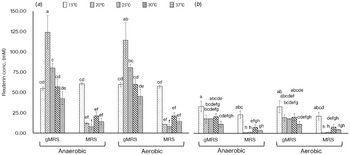
The biomass values of this strain after preculture in gMRS and MRS were 3.59 ± 0.25 and 3.68 ± 0.24, respectively. Figure 1a shows reuterin production by Lb. coryniformis WBB05 in 200 mM glycerol solution containing 5 g/l CaCO3 at 15, 20, 25, 30, and 37°C under anaerobic and aerobic conditions when precultured in gMRS and MRS, respectively. The highest reuterin production (approximately 120 mM) was observed when the strain was precultured in gMRS and incubated anaerobically and aerobically at 20°C, followed by incubation at 25°C. No differences were found between the anaerobic and aerobic conditions at all temperatures. Productivity was higher when the strain was precultured in gMRS rather than MRS at all tested temperatures, except at 15°C and 37°C (for which there were no significant differences).
Reuterin production by Lb. coryniformis WBB05 in 200 mM glycerol solution containing 5 g/l CaCO3 (a) and no CaCO3 (b). Means with different letters are significantly different (P < 0.01).

Figure 1b shows reuterin production by Lb. coryniformis WBB05 in 200 mM glycerol solution containing no CaCO3 at 15, 20, 25, 30, and 37°C under anaerobic and aerobic conditions when precultured in gMRS and MRS, respectively. A small amount of reuterin was produced under all the conditions in the absence of CaCO3. The highest reuterin production (approximately 30 mM) was observed after incubation at 15°C, and there were no significant differences in production under all conditions at 15°C. This value was approximately four times lower than that obtained at 20°C with CaCO3. Even under calcium-free conditions, productivity tended to be higher when the strain was precultured in gMRS rather than MRS. No differences were found between anaerobic and aerobic conditions at any temperature.
The optimum conditions for reuterin production by Lb. coryniformis WBB05 were preculturing in gMRS and incubation at 20°C in a glycerol solution containing CaCO3; no significant differences were found between anaerobic and aerobic conditions. Figure 2 shows reuterin production by Lb. coryniformis WBB05 for up to 24 h under optimum anaerobic and aerobic conditions. Reuterin production reached a maximum within 6 h and remained constant thereafter. No differences were observed between the anaerobic and aerobic conditions.
Reuterin production by Lb. coryniformis WBB05 in 200 mM glycerol solution containing 5 g/l CaCO3 after preculture in gMRS broth.

Minimum inhibitory concentration of reuterin
The MIC results for the bacteria and fungi are listed in Table 2. Highly purified reuterin which was free from contaminants such as glycerol and 1,3-propanediol, was obtained after purification for use in this test (Supplementary Fig. 1). The most resistant strains were Pediococcus pentosaseus and reuterin-producing Lb. coryniformis. Lb. delbrueckii subsp. bulgaricus, one of the yoghurt starters, and Lactococcus lactis subsp. lactis biovar diacetylactis, which is used in fermented butter starters, also showed high resistance. In contrast, Streptococcus thermophilus, one of the yoghurt starters, and Lc. lactis, which is used in cheese starters, showed relatively low resistance. The tested fungi had low resistance, and Penicillium camemberti, which is used for white mould cheese such as Camembert cheese, showed very much lower resistance. Food-borne bacteria, such as Escherichia coli, Listeria monocytogenes, and Staphylococcus aureus, showed low resistance compared to LAB.
Minimum inhibitory concentration (MIC) of reuterin towards LAB, fungi, and food-borne bacteria

a Purchased from the Biological Resource Center, NITE.
b Purchased from research center of genetic resources of the Ministry of Agriculture, Forestry and Fisheries, Japan.
c Purchased from American Type Culture Collection.
Discussion
In this study, the highest reuterin production was obtained at an incubation temperature of 20°C. There are some reports of reuterin produced by LAB, most of them using incubation at 37°C. This seems to be based on studies of Chung et al. (Reference Chung, Axelsson, Lindgren and Dobrogosz1989) and Luthi-Peng et al. (Reference Luthi-Peng, Scharer and Puhan2002) that have examined the effect of temperature using Lb. reuteri during reuterin production. Chung et al. (Reference Chung, Axelsson, Lindgren and Dobrogosz1989) and Luthi-Peng et al. (Reference Luthi-Peng, Scharer and Puhan2002) investigated the productivity of reuterin across a temperature range of 5°C to 55°C using Lb. reuteri, and both studies reported that 37°C was the most productive temperature. However, little is known about the optimum temperature of Lb. coryniformis. Only Nakanishi et al. (Reference Nakanishi, Tokuda, Ando, Yajima, Nakajima, Tanaka and Ohmono2002) reported that 25°C was the most productive temperature for Lb. coryniformis, though they did not report the amount of reuterin produced at below 25°C. In the present study, the Lb. coryniformis WBB05 was further examined at below 25°C and the highest productivity was observed at 20°C. These results suggest that the optimum temperature for reuterin production depends on the species, that is, 37°C for Lb. reuteri and 20–25°C for Lb. coryniformis. This suggests that when reuterin-producing LAB are applied as adjunct starters to fermented foods to prolong shelf life, they should be used properly according to the fermentation temperature. In other words, a higher reuterin concentration can be expected with Lb. reuteri in fermented milk such as yoghurt fermented at relatively high temperatures of approximately 40°C, whereas Lb. coryniformis may have higher reuterin concentration in some cheeses fermented at relatively low temperatures (approximately 25°C). It can be expected that Lb. coryniformis is more effective at prolonging the shelf life of low-temperature fermented foods.
In this study, the amount of reuterin produced by Lb. coryniformis WBB05 was similar when comparing anaerobic and aerobic conditions at the same temperature, contrasting with previous findings. Two studies examined the effects of anaerobic and aerobic conditions on reuterin production, one with Lb. reuteri and the other with Lb. coryniformis (Chung et al., Reference Chung, Axelsson, Lindgren and Dobrogosz1989; Nakanishi et al., Reference Nakanishi, Tokuda, Ando, Yajima, Nakajima, Tanaka and Ohmono2002), and both studies showed minimal reuterin production under aerobic conditions. In contrast, Lb. coryniformis WBB05 exhibited high reuterin productivity even under aerobic conditions, which could be beneficial for its application in food production. In this study, the time required for production to reach a maximum was 6 h and production then remained constant until 24 h. Previous studies have reported that the maximum was reached between 2 and 12 h, which is in good agreement with our findings (Talarico et al., Reference Talarico, Casas, Chung and Dobrogosz1988; Chung et al., Reference Chung, Axelsson, Lindgren and Dobrogosz1989; Luthi-Peng et al., Reference Luthi-Peng, Scharer and Puhan2002; Nakanishi et al., Reference Nakanishi, Tokuda, Ando, Yajima, Nakajima, Tanaka and Ohmono2002).
Cleusix et al. (Reference Cleusix, Lacroix, Vollenweider, Duboux and Le Blay2007) reported the MIC of reuterin produced by Lb. reuteri against LAB. The MICs ranged from 15 to 40 mM for Lb. acidophilus and Lb. casei and 30–50 mM for Lb. reuteri. In our study, MIC towards LAB species commonly used in the dairy food was lower than in previous research. The reason for this decrease could be attributed to the difference in cultivation conditions. While others conducted anaerobic cultivation of LAB in a 96-well plate, we employed aerobic cultivation in test tubes. Another possible factor is the composition of reuterin, which contains multiple substances such as acrolein, apart from 3-HPA. The varying proportions of these substances might explain the decrease.
Vimont et al. (Reference Vimont, Fernandez, Ahmed, Fortin and Fliss2019) and Pilote-Fortin et al. (Reference Pilote-Fortin, Said, Cashman-Kadri, St-gelais and Fliss2021) reported the MIC of reuterin produced by Lb. reuteri toward food-contaminating fungi, Aspergillus niger, A. versicolor, Aureobasidium pullulans, Eurotium rubrum/amstelodami, Penicillium chrysogenum, P. citrinum, P. commune, P. crustosum, P. roqueforti, and Mucor racemosus, to be in the range of 0.1–7.8 mM. In this study, MIC towards white mould cheese starters were firstly reported, and the MICs (0.125 and 0.0625 mM) were found to be more susceptible than the previous studies. Reuterin-producing LAB are expected to be inoculated directly into fermented dairy foods to produce reuterin in situ, to provide antibacterial properties to the foods, and to extend their shelf life. However, an adjunct starter of reuterin-producing LAB may cause fermentation failure by inhibiting the growth of LAB and mould starters. Future work is needed to investigate the effects of reuterin in fermented dairy products since only in vitro experiments were done in this study.
In conclusion, we found that the reuterin-producing Lb. coryniformis WBB05 produced reuterin even under aerobic conditions at low temperatures, unlike previously reported results for Lb. reuteri. Because of this feature, it is expected to be applicable to a wide range of foods. However, when the strain WBB05 is used for fermented milk products such as cheese if the strain is not used appropriately, it will cause poor fermentation because reuterin shows high antifungal activity against white mould growing in cheese. It is necessary to examine the effect of reuterin in fermented milk products in future.
Supplementary material
The supplementary material for this article can be found at https://doi.org/10.1017/S002202992300047X.