INTRODUCTION
It is well known, among linguists at least, that France is not a monolingual country.Footnote 3 However, much less is known about the ways in which the regional varieties that are spoken in France coexist with the national language. Many researchers have characterised the bilingual situations observed in several parts of the country as diglossia (Manzano, Reference Manzano2005). Yet, as Martinet (Reference Martinet1982) and Manzano (Reference Manzano2005) note, this characterisation may fail to capture the many ways in which language and social structure interact in different communities as well as the dynamic nature of any language contact situation. Furthermore, a quick review of the literature reveals that diglossia does not necessarily have the same meaning for all. As a result, there is still much disagreement as to whether speech communities in France can be described as diglossic.
In this paper, we analyse French and Picard data extracted from sociolinguistic interviews to determine whether the two closely-related varieties maintain distinct grammars or whether, as is claimed by some, they now constitute varieties of the same language. In Section 1, we review key aspects related to the notion of diglossia and contrast the diglossic and variationist approaches. Section 2 presents the sociolinguistic situation of Picardie, highlighting issues pertaining to the sociolinguistic and structural relationship between French and Picard. In Section 3, we home in on structural aspects – rather than on the functional distribution of the two varieties – and discuss two seemingly irreconcilable approaches, i.e., the Diglossic Model and the variationist approach, focusing on subject doubling and ne deletion. Our research methodology is described in Section 4, and the results of our study are presented and discussed in Section 5. In Section 6, we propose a model that attempts to reconcile the notions of diglossia and variation.
1 DIGLOSSIA AS A SOCIAL AND LINGUISTIC CONCEPT
In his classic article, Charles Ferguson (Reference Ferguson1959) examines four speech communities in which two highly distinct varieties of the same language coexist. What characterises these communities and distinguishes them from other societies in which two or more linguistic varieties are used is a constellation of social and linguistic characteristics. Specifically, all four communities feature a Low (L) variety acquired as a mother tongue by (virtually) all speakers and used in informal social settings. Superimposed to the L variety is a High (H) variety learned later in life, whose use is reserved for formal settings. This functional complementary distribution of the H and L varieties is considered by many to be the single most important component of diglossia. In an article entitled ‘Diglossia revisited’, Ferguson reaffirms the importance of the criteria that he viewed as crucial characteristics of any diglossic community, and stresses that the two varieties should be ‘fairly closely related to one another’ and that users should ‘always view the two as the same language’ (Ferguson, Reference Ferguson and Elgibali1996: 57).
It is undeniable that Picard and French are closely related – both varieties stem from the langue d'oïl in northern France. However, the perception of users as to whether or not they are part of the same language is far from unanimous. Indeed, several speakers and linguists (e.g., Éloy, Reference Éloy1997; Cerquiglini, Reference Cerquiglini1999) recognise that, in spite of their linguistic similarity, the two Gallo-Romance varieties should be regarded as distinct languages. Another view, defended, for example, by Poignant (Reference Poignant1998), Pooley (1996) and Hornsby (Reference Hornsby2006), claims that the Picard language that existed alongside French in the Middle Ages has been absorbed into regional French. Under this view, varieties that others call ‘Picard’ and ‘French’ constitute two poles of a linguistic continuum called ‘French’. One consequence of such an analysis is that the structural differences that characterise these two poles may be viewed as deriving from a single grammar.
Thus, even if the relationship between an H and an L variety meets many classic criteria for diglossia (acquisition, functional differentiation in contexts of use, level of prestige, literary tradition, etc.), it does not exclude the possibility that the two varieties represent, structurally, different points on a standard-to-dialect continuum rather than a true diglossic situation, where sharp differencesFootnote 4 that go beyond a formal–informal continuum distinguish the H and L varieties:
[T]he researcher can document a continuum of forms between the H and L varieties [. . .], but I felt then and still feel that in the diglossia case the analyst finds two poles in terms of which the intermediate varieties can be described; there is no third pole. (Ferguson 1991/Reference Ferguson and Elgibali1996: 59)
The differences between standard and colloquialFootnote 5 French illustrate how the same data are subject to either type of analysis. Rowlett (Reference Rowlett2007), Culbertson (Reference Culbertson2010), Massot (Reference Massot2010) and Zribi-Hertz (Reference Zribi-Hertz2011), among others, adopt a diglossic analysis; for these researchers, variation results from code-switching between two distinct but overlapping grammars. Others (Gadet, Reference Gadet2007; Coveney, Reference Coveney, Martineau and Nadasdi2011, among others) consider variation to be inherent to any grammarFootnote 6 and view the differences between standard and colloquial French as resulting in a standard-to-dialect continuum, i.e., gradient differences generated by the grammar of French. In this paper, we analyse French and Picard data to determine whether the patterns specific to each variety sharply differ from each other, thus supporting distinct grammars for each one, or whether the differences are simply quantitative, a finding that would provide evidence that the varieties referred to as ‘Picard’ and ‘French’ constitute two poles of a single grammar.
2 LANGUAGE VARIATION IN PICARDIE
Picard is a Gallo-Romance language closely related to French and spoken in northern France and southern Belgium. Like other regional languages in France, it is severely endangered. Yet, despite predictions over the past few centuries concerning its imminent disappearance, Picard has made its entrance into the 21st century and still enjoys a certain vitality, notably in Vimeu, a region located in the westernmost part of the Somme department.
2.1 Picard in Vimeu
As is typical of any endangered language, attempts to investigate the linguistic structure of Picard and its conditions of use are complicated by a number of factors. One is the fact that vitality varies across communities, such that conclusions based on data from one community may not hold for others. This is the case if we compare the Vimeu area – the focus of the current study – with the town of Avion (Pas-de-Calais), investigated by Hornsby (Reference Hornsby2006), or with the urban and semi-urban areas of the Nord département investigated by Pooley (1996, 2004, among others): the latter studies depict sociolinguistic situations in which Picard has either disappeared or was about to at the time of data collection. For instance, in his introduction, Hornsby (Reference Hornsby2006:1) notes that the fieldwork he conducted in Avion in 1988 could not have been carried out 20 years later due to the decline that Picard has suffered there. As for Pooley (1996:2), he describes Picard as the ‘corpse’ upon which Chtimi, the mixed variety he investigates, is built.
The region of Vimeu was selected for the present study precisely because, compared to areas which were more severely affected by the First World War (Carton, Reference Carton1981), Picard still enjoys a greater vitality there. During her exploratory fieldwork trip in 1995, J. Auger visited Picard-speaking regions in northern France and Belgium and met scholars, activists, and Picard speakers. The decision to focus her research on Vimeu was based on two characteristics that single this region out: the literary effort that has flourished there over the past 50 years, and her ability to find relatively young picardisants du cru, i.e., speakers for whom Picard remains an everyday language of communication. In her three subsequent visits to the region, she interviewed many speakers who were involved in promoting Picard, as well as picardisants du cru, and took part in private gatherings during which Picard was used. Based on her experience in the region and on the linguistic analyses we have conducted on both local French and Picard varieties, we believe that Picard continues to exist separately from French in Vimeu and that this region constitutes an ideal test case for the idea of a diglossic community in northern France. We are aware, however, that our analysis and conclusions may not extend to other regions where Picard is, or was, used.
Another reason for our focus on the Vimeu region is the considerable variation that characterises Picard and French in northern France and southern Belgium. For instance, the word-final devoicing analysed by Pooley (1996) is unattested in the Vimeu area. Similarly, while verbal negation is typically expressed by point in Vimeu and Valenciennes, nin characterises Roubaix, Borin, Gondecourt and La Gleize, and pas is the dominant form in Lille and Tourcoing (Pooley, 1996: 170).
Given such an extensive geographical variation and the fact that, until recently, Picard was associated essentially with daily oral usage,Footnote 7 it is not surprising that it has been the object of little standardisation. While many monographs describing the Picard spoken in specific locations have been published, their purpose was not to provide a standard for Picard. The recent revival movement that affects many regional languages has favoured, in Picardie, the emergence of numerous authors and the development of a literary standard. However, to this day, this standard remains more implicit than explicit, and, most importantly, it does not seek to impose a single, unified, norm. This is clear in messages posted in Achteure, an electronic list devoted to Picard, where different orthographies are used and regional features are visible, as well as in the editorial policy of Ch'Lanchron, a quarterly magazine written entirely in Picard that has been published for 32 years. While Ch'Lanchron promotes a uniform orthography throughout its pages, the texts it publishes feature several elements that reflect the diverse regional origins of its authors (Auger, Reference Auger, Joseph, DeStefano, Jacobs and Lehiste2003a).Footnote 8
2.2 Picard, French, and varieties in between
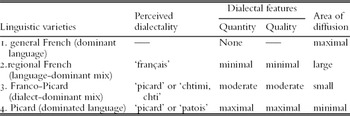
In his analysis of northern France's sociolinguistic situation, Carton (Reference Carton1981) distinguishes four varieties based on their proportion of Picard and French features. This typology (see Table 1) schematises the fact that, in addition to speech excerpts that clearly reflect Picard grammar or French grammar, mixtures of Picard and French are often observed in speech. Given Carton's typology, Pooley's (1996) work, and Poignant's (Reference Poignant1998) claim that ‘ces langues [d'oïl] proprement dites ont disparu et les parlers actuels ont été largement influencés par le français’, we can wonder whether Picard and French continue to exist as two distinct linguistic varieties or whether intense contact and extensive bilingualism have resulted in a blurring of the boundaries between them and in the creation of a single variety that incorporates elements from both.
Typology of varieties along a French-Picard continuum (adapted from Carton, Reference Carton1981:17; Carton, Reference Carton2010:42)

According to Carton's typology, criteria such as the quantity and quality of dialectal features, as well as the breadth of the geographic diffusion area, are used to classify varieties as French (Varieties 1 and 2) or PicardFootnote 9 (Varieties 3 and 4). As for the two intermediate varieties, they can also be distinguished by the speakers’ intentions: while variety 3 is often intended by speakers as Picard, speakers view variety 2 as French. In fact, most scholars agree that speakers of regional French are usually unaware of the regionally-marked nature of their speech (Carton, Reference Carton1981; Offord, Reference Offord1990; Hornsby & Pooley, Reference Hornsby, Pooley, Hintze, Pooley and Judge2001); to them, ‘regional French’ is simply ‘French’.
Excerpts (1)-(3) illustrate Carton's varieties 1 to 4 as they are found in Vimeu. Excerpts (1) and (2) represent varieties 1 and 4 respectively. Variety 1 is viewed by users as FrenchFootnote 10 and displays distinctly French morphology (e.g., 3sg -ait [ɛ] imperfect: il s'occupait ; 1sg possessive determiner mon), phonology (e.g., vowel epithesis: choses de [də] la ferme), and lexicon (e.g., beaucoup, chaussures). Variety 4 is viewed as Picard, and displays Picard morphology (e.g., 3sg -oait [wɛ] imperfect: i réparoait ; 1sg possessive determiner min; 3pl /t:/: il avoait't [avwɛt:]), phonology (vowel prosthesis: min grand-père éd [ed] Bienfay), and lexicon (e.g., gramint, queuchures).
-
(1) Variety 1, French : [. . .] et mon grand-père était cordonnier // c'était l'cordonnier du village <du village> hum // et = mais en été il tenait pas beaucoup à c'qu'on lui apporte des chaussures parce que il s'occupait de la moisson, de tout ça (Joseph L., French interview)
-
(2) Variety 4, Picard : [. . .] y avoait gramint d'métiers XXX gramint d'gins il avoait't deux métiers. <ahh. . .> Un métier d'hiver, un métier d'étè. [. . .] Min grand-père éd Bienfay i fzoait cordonnier l'hiver, pis à mzure l'étè, au soèr, i réparoait chés queuchures in étè, mais quand meume in étè i faisoait pas grand-chose, i foaisoait la tchulture. (Joseph L., Picard interview)
‘there were many occupations [unintelligible]. Many people had two jobs. One winter job, one summer job. [. . .] My grandfather from Bienfay did shoemaking in the winter, and sometimes in the summer, in the evening, he fixed shoes in the summer, but still he didn't do much, he farmed’.
-
(3) a. Variety 2, Regional French: Le français = // l'français est // il est plutôt euh. . . il est = // on dit que quand qu'on cause euh // picard // pis qu'on mélange du français avant, on fait d'od’dravie hein. // Bon ben là e-ch’français c'est d'ol’dravie aussi hein. // Parce que là y = y a quand même un = un mélange. // Et tous les ans dans chés dictionnaires, // eh ben ils rajoutent des mots mais c'est des mots // anglais hein. (Gérard D., French interview)
b. Variety 3, ‘Franco-Picard' : pour travailler pour des grandes surfaces, i feut. . . éq cha aille vite pis qu'cha fuche bien foait. Mais ch'est difficile éd concilier chés deux in même temps, hein. (Gérard D., Picard interview)
‘to work for superstores, it needs. . . to go fast and to be well done. But it's hard to do both at the same time.’
Excerpts (3a) and (3b) show a greater amount of mixing. Extracted from an interview conducted in French, (3a) is assumed to represent variety 2. In fact, much like (1), the matrix language in (3a) is seemingly French, as shown by the greater proportion of French forms (e.g., French-like aussi, avant, c'est [se], and fait instead of Picard-like étou ‘also’, édvant, ch'est [ʃe], and foait, respectively). Yet, unlike (1), Picard-like determiners ( chés , e-ch’ [əʃ]) are embedded in the utterance. Finally, excerpt (3b), taken from an interview conducted in Picard, contains a clear French morphological form (French subjunctive aille instead of Picard voèche) embedded in an otherwise Picard matrix (e.g., definite determiner chés; subjunctive fuche ); it appears to represent Franco-Picard, which most users classify as ‘picard’ rather than ‘français’. Such mixed usages are recognised by Picard speakers who often refer to them as dravie, a term that originally refers to a mixture of fodder fed to horses but which has come to designate the tendency to sprinkle Picard words into a French structure (Vints d'amont, ii) or, as Gérard D. makes clear in (3a), French words into a Picard structure.
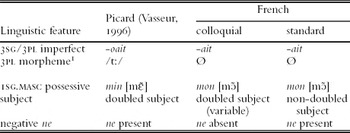
Table 2 presents a few features that distinguish Picard and French. As we can see, for morphological variables (e.g., imperfect, 3pl and 1sg.masc possessive morphemes), Picard differs from both colloquial and standard French. However, in syntax, and to some extent in phonology (e.g., the simplification of word-final obstruent-liquid clusters; Villeneuve, Reference Villeneuve2011), Picard typically contrasts with standard French while following the same patterns as colloquial French; this is the case, for instance, for subject doubling. The preservation of the negative particle ne in both Picard and standard French, but generally not in colloquial French, is a notable exception to this trend.
A few linguistic features of Picard and French varieties

1For regular verbs and tenses other than the future.
3 SUBJECT DOUBLING AND NE DELETION IN VIMEU VARIETIES
Inspired by Massot (Reference Massot2008; Reference Massot2010), who interprets the fact that some feature combinations are impossible as evidence that colloquial and standard French features are generated by distinct grammars, we examine subject doublingFootnote 11 and negative ne deletion to determine whether the difference between French and Picard is purely quantitative – this could mean that the two varieties share a common grammar which allows variation – or whether it is also qualitative – in this case, the two varieties would be viewed as deriving from two distinct grammars. While subject doubling is described as categorical in Picard (e.g., Edmont, Reference Edmont1897/1980:10; Ledieu, Reference Ledieu1909/2003:42; Debrie, Reference Debrie1974; Vasseur, Reference Vasseur1996:61),Footnote 12 its use has been reported as variable in every variety of colloquial French in which it has been studied (e.g., Ashby, Reference Ashby1977; Campion, Reference Campion1984; Beaulieu & Balcom, Reference Beaulieu and Balcom1998; Fonseca-Greber, Reference Fonseca-Greber2000; Coveney, Reference Coveney, Hansen and Mosegaard2003; Auger & Villeneuve, Reference Auger, Villeneuve, Remysen and Vincent2010). Thus we can expect doubled subjects to be less frequent in French than in Picard. The opposite relationship is expected to hold for ne deletion: while ne deletion is possible in Picard, it is less frequent than in colloquial French (Auger & Villeneuve, Reference Auger, Villeneuve, Meyerhoff and Nagy2008). Beyond these quantitative differences, we seek to determine whether the interaction between subject doubling and ne deletion patterns differently in French and in Picard: if Picard and French do result from distinct grammars, we can expect distinct patterns of variable interaction in the two languages.
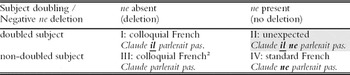
Table 3, which summarises the predictions made by the Diglossic Model of French concerning the interaction of ne deletion and subject doubling, shows that French utterances are expected to fall mostly in quadrants I (colloquial French) and IV (standard French). As for quadrant III, it is expected to contain colloquial French utterances in which ne is deleted and the subject is not doubled. While both standard and colloquial French allow non-doubled subjects, either because quantified NPs disfavour doubling or because the clause contains background information (Massot, Reference Massot2010), the occurrence of such a non-doubled subject without negative ne is only possible in colloquial French, since according to Zribi-Hertz (Reference Zribi-Hertz2011: 242) ne deletion is not generated by a standard French grammar. The co-occurrence of a doubled subject with negative ne, found in quadrant II, is unexpected in either colloquial or standard French since these structures belong to the non-overlapping parts of their respective grammars.
Predictions of the diglossic model concerning the interaction of ne deletion and subject doubling in French1

1Quadrants I and IV correspond to Massot's (Reference Massot2010:102) Zone A and Zone C respectively.
2Although Zribi-Hertz (Reference Zribi-Hertz2011:232) implies that even quantified subjects are doubled in dialectal/colloquial French (e.g., tout le monde il est gentil, personne il m'aime), this type of subject has been shown to strongly disfavour doubling (e.g., Nadasdi, Reference Nadasdi1995; Auger & Villeneuve, Reference Auger, Villeneuve, Remysen and Vincent2010).
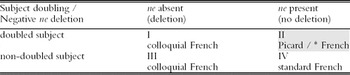
Given the differences highlighted above, we expect the Picard data to fall in different quadrants (see Table 4). Specifically, the occurrence of doubled subjects with negative ne (e.g., Claude i n’parlerait point) in quadrant II – the very pattern deemed unexpected in French – is expected in Picard, as both subject doubling and the presence of ne characterise this variety. Since subject doubling is described as categorical in Picard, we do not expect to observe non-doubled subjects (e.g., Claude (én’) parleroait point) except for quantified subjects. In addition, doubled subjects co-occurring with ne deletion (e.g., Claude i parleroait point) are expected to represent a rare combination in this language, as rates of ne deletion are still relatively low in both written and spoken Picard (Auger and Villeneuve, Reference Auger, Villeneuve, Meyerhoff and Nagy2008: 241).
Predictions concerning the interaction of ne deletion and subject doubling in Vimeu French and Picard, based on a diglossic Model approach

Table 4 summarises our predictions based on the assumption that the Diglossic Model applies to our data. If our Vimeu Picard and French data are generated by different grammars, we would expect most Picard utterances to fall in quadrant II, most French utterances to fall in quadrants I or IV, and a small proportion of French utterances (e.g., non-doubled quantified NPs without negative ne) to fall in quadrant III.
However, if Picard and French constitute poles within the same variety and the variation observed between them results from language-internal constraints, as claimed by variationist sociolinguists, we might expect utterances to be more evenly distributed among the four quadrants in each variety. That is, while we may observe uneven distributions reflecting greater probabilities of co-occurrence of some structures, no combination should be ruled out. In short, we propose that the proportion of Picard and French forms found in quadrant II can help determine whether or not these two linguistic varieties represent two distinct grammars.
4 METHODOLOGY
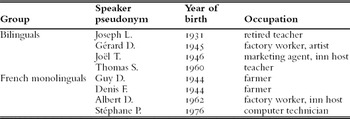
To determine whether the variable use of French-like and Picard-like variants is due to a blurring of linguistic boundaries resulting in a single grammar or whether this practice reflects code-switching between the two varieties, we analyse Vimeu Picard and French oral data from Picard–French bilingual men, and Vimeu French oral data from French monolingual men.Footnote 13 Our French data are extracted from a corpus collected by A.-J. Villeneuve in 2006–2007; data for Picard were collected by J. Auger between 1996 and 1998. Here, we analyse data for four monolingual and four bilingual men, a total of more than six hours of interview conducted in French. The same four bilingual men, all of whom acquired Vimeu Picard in their childhood and are actively involved in the Picard revitalisation movement, provide the data for spoken Picard, extracted from three hours of interview.
For subject doubling, all preverbal nominal subjects and third person strong pronouns – French lui, eux, elle(s) and Picard li, eux, Footnote 14 elle – were extracted from the corpus, as exemplified in (4), and coded for the presence or absence of a doubled clitic. We excluded tokens in which we perceived a prosodic break between the subject noun phrase and the rest of the utterance, as these were deemed to be cases of left dislocation rather than subject doubling.
-
(4)


Previous studies of subject doubling found that 1st and 2nd person strong pronouns moi, nous, toi, vous are doubled (quasi-)categorically in French (Nadasdi, Reference Nadasdi1995; Coveney, Reference Coveney2005; Auger & Villeneuve, Reference Auger, Villeneuve, Remysen and Vincent2010); examples such as (5) are therefore excluded from the data given that they do not allow variation. Postverbal subjects (cf. 6) and constructions involving the 3sg strong neuter pronoun ça or its Picard equivalents (cf. 7), in which a subject clitic must be present, are excluded for the same reason.
-
(5)
-
(6)
-
(7)


For ne deletion, all negative verbal phrases were extracted from the corpus and coded for the presence (cf. 8a-b) or absence (cf. 8c-d) of the negative particle ne/n’. Ambiguous cases where the negative particle cannot be distinguished from a liaison consonant (e.g., French on [n] avait pas l'baccalauréat) or from the clitic en, realised as a geminate [n] before a vowel-initial verb, (e.g., Picard a m'étonnroait qu'Léopold i nn’ [n:] euche point perlè ‘it would surprise me that Léopold would not have talked about it’) were excluded from the data.
-
(8)

Since collocations (e.g. il y a, c'est, il faut) involve near categorical ne deletion in European French (Ashby, Reference Ashby1981; Moreau, Reference Moreau1986; Coveney, Reference Coveney1996/2002) and in Vimeu French and Picard (Auger & Villeneuve, Reference Auger, Villeneuve, Meyerhoff and Nagy2008), they are excluded from the results discussed below.
5 RESULTS
5.1 Rates of ne deletion and subject doubling in French and Picard
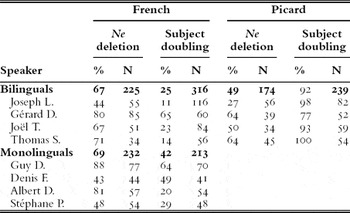
Table 6 reports the frequencies with which ne deletion and subject doubling are observed in our data.
Subjects' demographic information

Ne deletion and subject doubling in Vimeu French and Picard

Focusing first on the data for bilingual speakers, we see that they delete ne less often when speaking Picard than when speaking French. While the difference in ne deletion rates across languages for individual speakers does not reach statistical significance, probably due in part to the small Ns per speaker, the global difference for the group of bilinguals is significant (χ2(1) = 12.1; p ≤ .001). The numbers for subject doubling also reveal clearly distinct behaviours in each language, with significantly more subject doubling in Picard than in French, globally (χ2(1) = 249.41; p < .001) and for three of the four speakers. The only speaker for whom rates of subject doubling in Picard and in French do not significantly differ is Gérard D.: his French is characterised by frequent doubled subjects (65%), and his doubling rate in Picard is considerably lower (77%) than the other three speakers’. However, the fact that Gérard D. does not double quantified subjects (cf. 9), unlike other speakers (cf. 10), explains part of this lower rate. Such a pattern is not surprising, as quantified subjects cannot be dislocated (Rizzi 1986) and are the last ones to be affected by subject doubling. Given Auger's (Reference Auger2003b; Reference Auger2003c) demonstration that the extension of subject doubling to quantified subjects is a very recent development in Picard, Gérard D.'s grammar can be viewed as more conservative than the other Picard speakers’. If we exclude these six quantified subjects, his doubling rate reaches 87% (40/46) in Picard, a rate much closer to those of the other speakers.Footnote 15
-
(9)
-
(10)


Turning now to a comparison of bilinguals’ and monolinguals’ French data, we see that the two groups of speakers behave similarly with respect to ne deletion. Indeed, not only are the average deletion rates for the two groups not statistically different (χ2(1) = 0.18; p = .670), they are virtually identical. However, a very different picture obtains for subject doubling. While we may expect that linguistic transfer from Picard would cause bilinguals to display high doubling rates in French, we find the opposite: monolinguals, on average, use subject doubling significantly more than bilinguals (42% vs. 25%; χ2(1) = 17.42; p ≤ .001). Among monolinguals, the older speakers, Guy D. and Denis F., use subject doubling significantly more than younger speakers (χ2(1) = 25.26; p ≤ .001). Among bilinguals, the difference between Gérard D., who doubles 65% of his subjects in French, and the other three speakers, whose rates vary between 11% and 23%, is also significant (χ2(1) = 63.20; p ≤ .001).
These differences in doubling rates in bilinguals’ Picard and French can be attributed, in our opinion, to the fact that our bilingual speakers, who are all involved in promoting Picard, have developed an increased awareness of the structure of each variety. Given that subject doubling is a fairly salient structure (cf. Coveney Reference Coveney2005:103, who identifies it as a possible ‘badge of Picard identity’), it is not surprising to observe a clear contrast between bilinguals’ and monolinguals’ French for subject doubling, but not for ne deletion, as well as a clearer difference between bilinguals’ Picard and French for doubling than for ne deletion. Similarly, the fact that Gérard D. is the only bilingual speaker for whom the subject doubling rates do not significantly differ across languages – in fact, he doubles French subjects as often as the two older monolinguals – can be attributed to the fact that he is the only bilingual speaker who has written very little in Picard; his lower linguistic awareness appears to favour more transfer across languages.
5.2 The interaction of ne deletion and subject doubling
Although the examination of each linguistic variable reveals significant differences between French and Picard, one could still argue that such quantitative differences are the result of language-internal variation within a single grammar. Yet, we believe that an analysis of the interaction between ne deletion and subject doubling in each variety offers compelling evidence for Picard and French as two structurally distinct linguistic codes. Indeed, if we now examine tokens in which a subject that can be doubled occurs in a negative clause, we see that ne deletion and subject doubling go hand in hand in French but not in Picard.
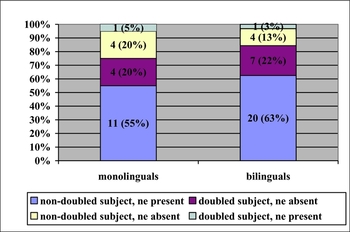
Figure 1 shows that the distribution of data across the four possible patterns of ne deletion and subject doubling in French is gradient rather than abrupt: while the most common pattern involves non-doubled subjects and overt ne for both bilingual and monolingual speakers, all three other combinations are attested. The fact that the difference in patterns between monolinguals and bilinguals is not statistically significant (p = .924)Footnote 16 suggests that both groups of speakers use the same linguistic system.
French ne deletion and subject doubling, monolinguals vs. bilinguals

Figure 1 also shows that the pattern predicted to be ungrammatical by the Diglossic Model, i.e., the co-occurrence of a doubled subject with the negative ne particle, is observed in our corpus. Although infrequent, this pattern is clearly grammatical in Vimeu French, at least for two speakers: one monolingual (cf. 11a) and one bilingual (cf. 11b). This confirms Coveney's (Reference Coveney, Martineau and Nadasdi2011:76) observation that such constructions are possible in Picardie French, contrary to the predictions made by Massot (Reference Massot2010). This type of co-occurrence in Vimeu French may be due to the fact that in Vimeu Picard, this very pattern characterises the standard variety as it is described in Vasseur (Reference Vasseur1996) and illustrated in local publications (Auger, Reference Auger, Joseph, DeStefano, Jacobs and Lehiste2003a; Auger, Reference Auger, Landrecies and Petit2003d).
While the co-occurrence of non-doubled subjects and ne deletion is expected (cf. quadrant III in Table 4), it is nevertheless interesting to note that for the two French monolinguals for whom a non-doubled subject co-occurs with ne deletion, three of their four tokens involve a quantified NP (cf. 12a-c), a context known to disfavour subject doubling. For bilingual speakers, the lack of subject doubling does not seem to be attributable to quantification, as shown in (13). We will return to the importance of these facts and discuss how their existence warrants the development of a model that aims to capture variable as well as categorical patterns.
-
(11)
-
(12)
-
(13)


Footnote 17 The existence of tokens of ‘unexpected’ patterns (cf. 11a-b), in addition to those predicted by the Diglossic Model approach (cf. Table 3), supports Coveney's (Reference Coveney, Martineau and Nadasdi2011) observation that much of language use is variable and that the tendency for linguistic features with similar stylistic values to co-occur within a single utterance is probabilistic rather than categorical in nature.
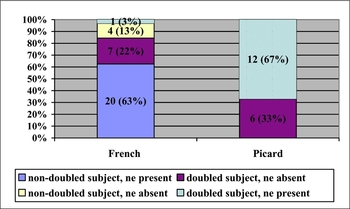
In Picard, the interaction of ne deletion with subject doubling differs from what we observe in French. Our corpus contains 18 negative clauses, only six of which exhibit ne deletion. The difference between bilinguals’ French and Picard utterances shown in Figure 2 is statistically significant (p ≤ .001). While doubled subjects are strongly correlated with ne deletion in French, the most frequent pattern in Picard involves the co-occurrence of negative ne with subject doubling, the pattern deemed ‘unexpected’ in both colloquial and standard French. Since, as we saw earlier, both subject doubling and ne presence are characteristic of Picard (Vasseur, Reference Vasseur1996), their co-occurrence is fully expected in this language. The symbolic value associated with Picard subject doubling – but not with ne preservation – also militates in favour of subject doubling while allowing ne deletion to occur more freely. Furthermore, the large proportion of ne deletion in the bilinguals’ spoken Picard may stem from the fact that ne deletion is frequent in colloquial French, as linguistic transfer may more readily affect a linguistic variable which lacks symbolic value in Picard.
Bilinguals' ne deletion and subject doubling, French vs. Picard

5.3 Another piece of evidence for variation: /l/ deletion in plus
An analysis of the interaction between /l/ deletion in the negative adverb plus and ne deletion shows that, much like subject doubling and ne deletion (cf. Section 5.2), these two variables pattern differently in French and in Picard. In colloquial French, /l/ is frequently deleted in various forms, including in clitic il(s) [i] and negative adverb plus [py] (Frei, Reference Frei1929/1971; Bourciez, Reference Bourciez1958; Ashby, Reference Ashby and Pulgram1984). The deletion of /l/ in these contexts is widespread in Picard, too, where it even affects collocations where /l/ is preserved in French (e.g., non plus [n
 py] ‘neither’). Table 7 shows that the Diglossic Model of French would make predictions for the co-occurrence of ne and /l/ similar to those made for ne and a non-doubled subject in Table 4; once again, Picard forms would appear mostly where French forms are ‘unexpected’.
Predictions concerning the interaction of ne deletion and negative p(l)us in Vimeu French and Picard, based on a diglossic model approach

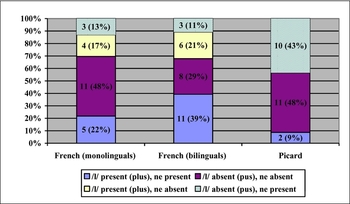
Figure 3 shows that all four patterns are attested in French, and that their distribution in this variety is gradient: although monolingual speakers show a stronger preference (48%) for the predicted colloquial pattern than their bilingual counterparts (29%), the pattern differences between monolinguals and bilinguals are not statistically significant (p = .467). This absence of significant difference between the two groups can be interpreted as evidence of a shared grammar; that is, the difference between monolingual and bilingual speakers is quantitative rather than qualitative.
Ne deletion and p(l)us ‘anymore’ in three Vimeu varieties

However, the patterns used by bilinguals in French and in Picard are significantly different (p ≤ .001). Figure 3 further shows that plus [ply] is marginal in Picard and that unlike French, where ne deletion strongly correlates with /l/ deletion, pus [py] is equally common with ne deletion and ne retention. While the trends described in this section are based on small numbers of tokens, they provide further support for our conclusion that the French and Picard grammars impose different constraints on ne deletion and on /l/ deletion, thus producing different patterns of use in the two varieties.
6 TOWARDS A MODEL THAT RECONCILES VARIATION AND DIGLOSSIA
Can the French–Picard bilingualism that characterises parts of Picardie be described as diglossia? While there is considerable functional specialisation for Picard and French, and the latter must be considered as the H variety, it is nevertheless clear that other social criteria presented as characteristic of diglossic communities by Ferguson (Reference Ferguson1959) do not obtain in contemporary Vimeu. Although the speakers analysed in this paper acquired Picard in their home environment, younger speakers have, at least since the mid 1950s, overwhelmingly acquired the colloquial form of the H variety, French, as their native language, and learned the L variety, as well as the formal form of the H variety, through formal education. Another significant element is the recent literary movement that fosters the production of ‘serious’ publications in Picard. The decision of Le Courrier picard, the main daily newspaper in the Somme department, to feature a first page written entirely in Picard in November 2011 constitutes a striking illustration of the new sociolinguistic value associated with Picard.
Rather than focusing on the social correlates of diglossia, the present analysis has considered two linguistic variables, subject doubling and ne deletion, in assessing the possibility that French and Picard may constitute distinct languages. Our results show extensive variation in both linguistic features in both varieties, thus opening the possibility that the same grammar might govern both varieties and that the differences between them might be quantitative rather than qualitative. However, the fact that the two variables interact differently in each language, with ne retention being strongly correlated with absence of subject doubling in French but not in Picard, provides evidence for two grammars. Thus, despite the great similarity between the two varieties and the bidirectional effects of bilingualism (i.e., linguistic transfer) and language contact that result in some degree of convergence between them, we suggest that Picard and French continue to exist as autonomous linguistic systems in Vimeu.
The recent renewed interest in the concept of diglossia and its appropriateness for French-speaking communities has resulted in numerous studies on the heterogeneous nature of usage, but in no consensus concerning how such heterogeneity should be modeled. We argue that the debate between proponents of a variationist approach (e.g., Gadet, Reference Gadet2007; Coveney, Reference Coveney, Martineau and Nadasdi2011) and proponents of a diglossic approach (e.g., Barra-Jover, Reference Barra-Jover2004; Rowlett, Reference Rowlett2007; Massot, Reference Massot2010; Zribi-Hertz, Reference Zribi-Hertz2011) to colloquial and standard French continues in part because both approaches fail to account for the complexity of the data. Part of the problem stems from the fact that some researchers rely on intuitions rather than on empirical studies. Gadet and Tyne (Reference Gadet, Tyne, Pooley and Lagorgette2012) point out that the diglossic approach, which neatly divides the usage observed into two distinct varieties, is often adopted by scholars whose work falls within the scope of theoretical generative linguistics, while sociolinguists tend to favour variationist analyses. As Buson and Billiez (this volume) show, intuitions about whether a given feature is compatible with formal or informal speech can be quite unreliable. Another contributing factor is the search for utopian varieties and the negation of language-internal variation through a tendency to attribute variable patterns to language obsolescence, contact, or other similar external causes. Even sociolinguists, who are more willing than theoretical linguists to view variation and change as an integral part of language, at times would rather attribute unexpected alternations to language contact or death than view them as an integral part of language.Footnote 18 Finally, a tendency to see diglossia and variation as incompatible has, in our view, had the unfortunate consequence that their combined power has not been given much attention. Two notable exceptions to this approach exist, however. Zribi-Hertz (Reference Zribi-Hertz2011) stresses that diglossia does not exclude variation, but does not try to show how they coexist and interact. As we saw above, Massot (Reference Massot2010) argues that the ways in which variables interact differ depending on whether they belong to the same or different grammars and that empirical studies can thus distinguish between variation and diglossia. While his own study of several variables in the speech of a single speaker has provided evidence for a diglossic analysis of French, we suspect that a study of a larger sample of speakers and, possibly, different sociolinguistic variables would have led him to find a more nuanced, and complex, picture. What is striking, though, is that, as Gadet and Tyne (Reference Gadet, Tyne, Pooley and Lagorgette2012:66) observe, this shared quest for a model that can capture the complexity of linguistic usage by theoretical or empirical researchers has not truly managed to bridge the gap between the two perspectives.
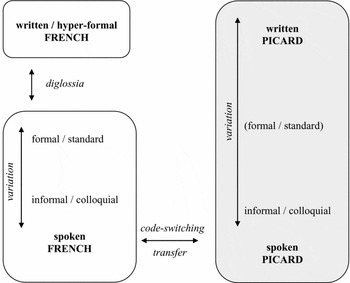
In the remainder of this paper, we build on insights drawn from the recent literature on diglossia and variation to develop a model that recognises three important factors: the diglossic relationship between spoken French and hyperformal / written French, a variety typically not acquired in early childhood by native speakers; the existence of systematic language-internal variation affected by the formality of the communication situation and by social and linguistic constraints; and the possibility of code-switching and transfer between French and Picard. We suggest that such a model (see Figure 4) can best account for the patterns observed in our study.
Modeling diglossia, code-switching and grammar-internal variation

The model we propose captures the lexical and grammatical differences that distinguish French from Picard, and accounts for the fact that subject doubling and ne deletion interact differently in the two varieties, by recognising their existence as separate languages and allowing for the possibility of code-switching between them. Second, our model views the linguistic and social differences between written/hyper-formal French and the spoken language as meeting Ferguson's criteria for a diglossic situation. For instance, written/hyper-formal French is a superposed variety that is learned later in life and not used in informal communication situations. Following Rowlett's (this volume) observation that the extensive overlap that characterises colloquial and hyper-formal French does not warrant positing two complete grammars, we adopt his suggestion that hyper-formal French does not constitute a full, separate grammar but rather a kind of appendix (he uses the term bolt on) that learners must create and expand as they encounter structures that are incompatible with their native grammar. Our proposal differs from previous diglossic analyses in recognising that extensive variation is an integral part of language competence and that any attempt to explain ‘unexpected’ variant combinations by invoking special constraints misses this central factor. Specifically, we propose, following Labov (Reference Labov1972), that variation is constrained by linguistic and social constraints. While variants that carry similar social values are expected to co-occur, each linguistic variable (and variant) is independent of the next, creating the possibility for unexpected, and presumably rarer, combinations such as those mentioned in Coveney (Reference Coveney, Martineau and Nadasdi2011) and Buson and Billiez (this volume). For instance, in (14), the co-occurrence of quoi, a discourse marker associated with colloquial French, and laquelle, a relative pronoun characteristic of the standard variety, is unexpected. In the model we propose, the rarity of such examples is expected and attributed to the low statistical probability that both variants would occur in the same utterance, based on their association with two poles of the stylistic continuum.
-
(14) le lac pourrait représenter une pile quoi – laquelle on charge au maximum (Blanche-Benveniste and Bilger, Reference Blanche-Benveniste and Bilger1999, cited in Coveney, Reference Coveney, Martineau and Nadasdi2011:57)
In addition to explaining examples that some linguists might consider marginal, our model correctly predicts other attested combinations. Our data concerning the interaction of subject doubling and ne deletion in French reveal a non-negligible number of ne deletion cases in sentences in which no doubling is observed. Similarly, our analysis of the interaction between the pronunciation of plus and ne deletion in French reveals that, despite the predominance of the expected correlation between /l/ deletion and ne deletion, non-negligible numbers of tokens of other possible combinations are observed. Thus, rather than explaining every unexpected combination by invoking linguistic and/or social factors, we propose that a model that includes a variationist analysis better accounts for the complex patterns observed. Another advantage of this model is that it allows for individual speakers to favour some colloquial variants and disfavor others. For instance, Coveney (Reference Coveney2004:105) reports that while Speaker 22, a 35-year-old upper class man, exhibits low rates of ne deletion (57%) and subject doubling (6%), a pattern that can be attributed to a generally ‘more formal speech style’, Speaker 21, a 57-year-old middle class woman, displays lower rates of ne deletion (53%) but high rates of subject doubling (37%).
Our analysis of Picard differs from that proposed for French in one crucial respect: written Vimeu Picard does not constitute a separate variety from spoken Vimeu Picard. We argue that there is no need to posit a diglossic relationship between these two poles since the emerging local written standard is based on spoken language. In her work on the development of a literary standard and her comparison between oral and written Picard, Auger (Reference Auger, Pusch and Raible2002; Reference Auger, Landrecies and Petit2003d) showed that written Picard mirrors its spoken counterpart with great accuracy and that the differences that can be observed are quantitative in nature rather than qualitative. In this respect, therefore, the absence of diglossia within Picard is not surprising given that this language does not have a long literary tradition,Footnote 19 a factor which, according to Ferguson (Reference Ferguson1959), favours the development of diglossic communities. If this analysis is correct, the variation that can be observed in Picard has two possible sources: either it is language-internal and can be analysed as resulting from a complex pattern of linguistic constraints, as is the case for word-initial and word-final epenthesis (Auger, Reference Auger and Fontana2000; Reference Auger2001), or it results from linguistic transfer from French.
While the model proposed here is more complex than models that try to account for the variation observed in French either in terms of diglossia or in terms of variation, we believe that it better captures the richness of patterns observed as well as the social conditioning that governs the linguistic choices made by French and Picard speakers in the Vimeu region. Extensive testing of this model remains to be done to see, for instance, whether insertion of French forms into Picard discourse or its converse behaves like other cases of code-switching. We fully expect this testing to reveal weaknesses in our model, but it is our hope that our idea that diglossia, code-switching, and language-internal variation can all characterise a single speech community, thus creating complex patterns that must be untangled, will help us make sense of patterns that have, until now, challenged many of us.