An increasing demand for the evaluation of health technology combined with the pressures of aging populations and the growing prevalence of chronic disease has resulted in an increased interest in understanding not only how health technologies work in general, but specifically how they might work for older adults (Reference Goodman1). The trend of harnessing health technology assessment (HTA) to support market approval and payment functions (Reference Goodman1), and the growing market for technologies developed for older adults (Reference Anderson and Perrin2) suggest a need for tailored HTA for aging-related technologies. HTA for aging-related technologies may warrant special consideration for several reasons, including: (i) the frequency of multiple chronic conditions in older persons, which challenges the applicability of disease-specific technologies (Reference Plsek and Greenhalgh3); (ii) the frequent exclusion of older adults from clinical trials, often as a result of this multimorbidity (Reference Ferrucci, Guralnik and Studenski4); (iii) the prevalence of cognitive impairment, affecting many older adults’ experience with healthcare technology, and their participation in research (Reference Ferris5); (iv) how older adults relate to technology (Reference Anderson and Perrin2), and (v) the importance of caregivers to the health and well-being of older adults (6).
In Canada, the AGE-WELL NCE (Aging Gracefully across Environments using Technology to Support Wellness, Engagement and Long Life Network of Centers of Excellence) has been created as a national research network in technology and aging. Its goal is to support older Canadians in maintaining their independence, health and quality of life through accessible technologies that increase their safety and security, support their independent living, and enhance their social participation (7). AGE-WELL has appeared at a time in which the disparity between needs of practitioners and patients/consumers and the introduction of innovative technologies has been identified as gap in the Canadian context (8). AGE-WELL has emerged, in part, as an effort to fill this gap.
Globally, HTA interfaces with issues of aging, often identifying health technologies that should be accelerated into the health system to assist older populations in aging well, while also identifying innovations that are ineffective and unsuitable for support, or not appropriate for continued use and should, therefore, be eliminated through disinvestment. The current trend in HTA toward patient-centered care, recognizing outcomes important to patients, and patient involvement in HTA (8) supports a movement to identify issues and challenges relevant to HTA and aging internationally, including: (i) additional reasons why HTA for older adults might warrant special consideration; (ii) how technology may or may not be enabling for older adults; and (iii) how older adults can participate more meaningfully in HTA. We convened two panels of international experts in HTA and aging to explore global opinions, ideas, and potential solutions to these issues. Our aim was to identify global themes that highlight the potential and existing issues related to the use of HTA for aging technologies.
METHODS
To explore important issues in HTA and aging internationally, including methods, patient participation, ethical dimensions, financial considerations, policy and regulatory issues, and organization and delivery dynamics, we convened a panel of international experts in HTA and aging-related issues to present at the Health Technology Assessment international (HTAi) 2016 conference in Tokyo. To build on the results of the 2016 panel, and further examine international interest in HTA for aging, a second panel was conducted at HTAi 2017 in Rome. The panelists each provided a case study that highlighted the opportunities, challenges, considerations for, and current context of, aging-related HTA in their country. A summary of these case studies is provided in the Supplemental Materials.
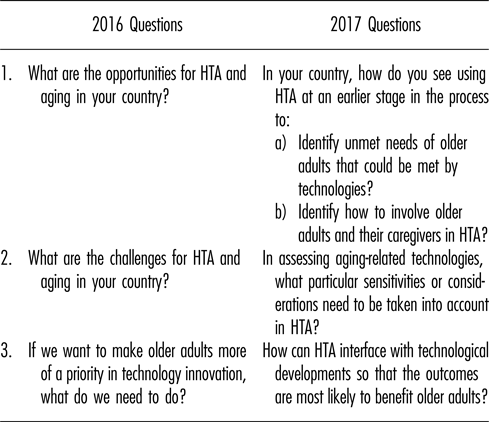
The panels incorporated participatory methods (Reference Beazley and Ennew9) to generate meaningful discussion about the lessons from various countries on how older adults participate in HTA, and why HTA for older adults may need special consideration. Participatory methods allowed the research questions and findings to develop based on the unique perspectives of the panelists and self-selected participants (Reference Beazley and Ennew9). In preparing for each year's presentation, panelists from Canada (affiliated with AGE-WELL), Korea, Italy, China, and Japan responded to three questions (Table 1) by preparing a case study from their respective countries. The panelists met before each conference to review the case studies from each country and identify key concepts relevant to their collective experiences.
Table 1.Questions Answered Through Panel Case Studies
During both panel presentations, participants (n = 24 in 2016; n = 21 in 2017) ranked the five key presented themes according to their importance and relevance to HTA and aging from their perspectives. Participants were provided with participation handouts that prompted discussion and allowed them to vote on the importance of the presented themes. The handouts encouraged the participants to provide additional comments and feedback. The handout responses were documented and analyzed using a process of thematic analysis (Reference Braun and Clarke10). Interested participants provided their contact information for possible involvement in next steps. Twenty-two of the forty-five total participants encouraged further exploration of the issues over the course of both years.
RESULTS
Before the panel presentations in 2016 and 2017, the panelists met to identify the key themes within the presentation content. These themes were presented to and voted on by panel participants using participation handouts.
Key Themes in 2016
The panelists identified the following five key themes in the 2016 panel presentations:
A. Identifying unmet needs of older adults in society that could be met by technology: how can HTA help?
B. Differences in assessment of aging-related technologies: what is the scope? (prevention, health promotion interventions, etc.)
C. Societal, cultural, and ethical trends (e.g., ageism)
D. Place: urban vs rural aging
E. Involvement of older adults and caregivers
Twenty-four participants representing five categories of roles responded on the participation handout: eight were involved in academia, five were students, five gave no designation, three represented industry, and two worked in HTA. The themes were ranked in the following order of importance: A, B, E, C, D. There was moderate interest among those in attendance of further exploring aging and HTA, with half (n = 12) of the participants providing their contact information to continue the discussion.
In the comments provided, themes of political challenges emerged, such as the need for funding and incentives directed at the development of low-cost technologies desired by older people. Participants commented on the need for more information to conduct HTAs for the aging population, noting a lack of evidence for evaluating outcomes in older adults. The importance of both the ease of use of technology and the involvement of older adults in HTA were also highlighted in participants’ comments.
Key Themes in 2017
The following five themes were identified by the panelists from the 2017 presentations:
A. Identification of challenges in HTA and aging
B. Methodological issues in HTA and aging
C. Strategies for engagement in HTA and aging
D. Approaches to advancing the effectiveness of HTA addressing technology and aging
E. Development of an aging-related interest group in HTAi
Twenty-one participants representing four categories responded: ten were researchers, four were students, three were industry representatives, three described themselves as “other,” and one indicated no designation. The themes were ranked in the following order of importance: A, D and E, C, B; where D and E were ranked as equally important. Once again, there was moderate interest in further exploring aging and HTA, with just under half (n = 10) of the participants providing their contact information.
On the participation handouts, the participants were asked to identify the largest challenges and opportunities for HTA and aging. Identified challenges included: difficulty in assessing diverse aging-related technologies with traditional HTA methods; proving cost-effectiveness; high initial costs of implementing technologies; and lack of governmental resources, support, and collaboration for conducting HTA. The identified opportunities included the design of patient-centered technologies, and the implementation of low-cost and efficient technologies to enable self-management at home. In the comments provided by audience members, themes emerged that were related to: developing a specific method or template for aging-related HTA; sharing of data and information; preparing older populations to use technology that helps them age in their preferred environment; and reassessment of high-cost technology that may require disinvestment. Participants additionally commented on the need for further evaluation and understanding of the cost-effectiveness and efficiency of technology for end-of-life and older patients, as well as a need to better understand the role of health technology implemented outside the health system for older adults.
DISCUSSION
The panels brought together international leaders and various key stakeholders in HTA and policy to address issues in HTA and aging at a global scale. These discussions allowed for the examination and synthesis of major global themes in HTA and aging that may provide the basis for future efforts. Taken together, the results of the participant voting and the additional comments at both panels raised three important concepts related to HTA and aging at a global level.
1. Involvement and engagement of older adults is essential to informing the efforts and agenda of HTA and the broader public policy enterprise.
2. A systems approach to thinking about the needs of older persons should support the type and level of care desired by the individual rather than the needs of the healthcare institutions, and HTA should reflect these desires when evaluating technological aides that can support the care preferences of older people.
3. There is potential for health information systems and “big data” to provide better understanding of the needs of older persons, and to support HTA activities that assess usability and utility of technologies aimed at improving the lives of older adults.
Involvement and engagement of older adults in HTA was an important theme in both the 2016 and 2017 panel, being ranked as the third most important theme by panel participants each year. This theme was demonstrated in the panel presentations from Canada, Italy, China, and Japan. Engagement of patients and the public in HTA is thought to allow “faster, evidence based access to innovative technologies that are clinically sound and cost-effective, while helping to eliminate treatments and practices that are shown to deliver limited health benefits or financial value.” (Reference Bowman-Busato11, p 193). However, patient and public involvement is poorly defined, resulting in inconsistent approaches to, and criteria for, patient and public engagement across different HTA organizations, globally (Reference Bowman-Busato11;Reference Whitty12).
An international survey of public engagement in HTA organizations found that 67 percent of respondents had undertaken some form of public engagement activity; however, the nature and extent of these activities seemed to vary from one organization to the next (Reference Whitty12). The 2016 and 2017 panel results confirm the opinion that patient and public engagement is an important component of HTA that can contribute to meaningful outcomes.
Recognizing the technology-related desires or needs of older adults and reflecting those needs within HTA was ranked by audience members as the most important theme in the 2016 panel presentation. This theme was reflected in the panel presentations from Korea, Italy, China, and Japan. Involving older adults, healthcare institutions, and healthcare providers in HTA can help to identify unique needs and values that may be overlooked by those conducting assessments and making recommendations (Reference Facey, Boivin and Gracia13;Reference Bridges and Jones14). It has been argued that HTA should go beyond clinical and cost-effectiveness to harness the valuable perspectives that patients, clinicians, and other end-users can contribute to facilitate stronger recommendations regarding the adoption, use, and sustainability of devices (Reference Facey, Boivin and Gracia13).
Ranked as the second most important theme at the 2017 panel presentation was the development of approaches to advance the effectiveness of HTA for aging-related technologies. One promising approach may be the involvement of older adults in the assessment process for aging technologies to improve the effectiveness of HTA, especially in recommending relevant devices for adoption (Reference Facey, Boivin and Gracia13;Reference Bridges and Jones14).
The third major concept emerging from the panels was that data generated from health information systems may prove a valuable resource for evaluating aging-related technologies. This concept was especially prominent in the panel presentation from Japan, but was also discussed by the Canadian, Italian, and Chinese panelists. Harnessing data from health information systems may serve as an advantageous approach to enhancing the effectiveness of HTA for technologies aimed at improving the lives of older people (Reference Dang and Shetye15). The use of “real-world data” generated in electronic health records (EHRs) and patient charts has been discussed as an approach for improving HTA accuracy (Reference Dang and Shetye15). In fact, “real-world data” have been used to predict real-world effectiveness and inform adoption and reimbursement decisions (Reference Garrison, Neuman, Erickson, Marshall and Mullins16). The use of EHR generated data should be further investigated as a strategy for improving the HTA's ability to recommend relevant, sustainable, and effective health technologies for older adults.
In conclusion, this project was undertaken with the vision of finding global overarching themes that could bring together the issues of technological innovation and the use of HTA to help inform policy makers in addressing issues of aging in our societies. Over the past few meetings of HTAi, an interest in aging-related issues has emerged and coalesced. As one participant at our panel stated on their participation handout, “Nothing is stronger than an idea whose time has come” (V. Hugo). We hope to build on the interests and momentum of this community to continue to explore the opportunities for aging and HTA.







 You have
Access
An increasing demand for the evaluation of health technology combined with the pressures of aging populations and the growing prevalence of chronic disease has resulted in an increased interest in understanding not only how health technologies work in general, but specifically how they might work for older adults (Reference Goodman1). The trend of harnessing health technology assessment (HTA) to support market approval and payment functions (Reference Goodman1), and the growing market for technologies developed for older adults (Reference Anderson and Perrin2) suggest a need for tailored HTA for aging-related technologies. HTA for aging-related technologies may warrant special consideration for several reasons, including: (i) the frequency of multiple chronic conditions in older persons, which challenges the applicability of disease-specific technologies (Reference Plsek and Greenhalgh3); (ii) the frequent exclusion of older adults from clinical trials, often as a result of this multimorbidity (Reference Ferrucci, Guralnik and Studenski4); (iii) the prevalence of cognitive impairment, affecting many older adults’ experience with healthcare technology, and their participation in research (Reference Ferris5); (iv) how older adults relate to technology (Reference Anderson and Perrin2), and (v) the importance of caregivers to the health and well-being of older adults (6).
In Canada, the AGE-WELL NCE (Aging Gracefully across Environments using Technology to Support Wellness, Engagement and Long Life Network of Centers of Excellence) has been created as a national research network in technology and aging. Its goal is to support older Canadians in maintaining their independence, health and quality of life through accessible technologies that increase their safety and security, support their independent living, and enhance their social participation (7). AGE-WELL has appeared at a time in which the disparity between needs of practitioners and patients/consumers and the introduction of innovative technologies has been identified as gap in the Canadian context (8). AGE-WELL has emerged, in part, as an effort to fill this gap.
Globally, HTA interfaces with issues of aging, often identifying health technologies that should be accelerated into the health system to assist older populations in aging well, while also identifying innovations that are ineffective and unsuitable for support, or not appropriate for continued use and should, therefore, be eliminated through disinvestment. The current trend in HTA toward patient-centered care, recognizing outcomes important to patients, and patient involvement in HTA (8) supports a movement to identify issues and challenges relevant to HTA and aging internationally, including: (i) additional reasons why HTA for older adults might warrant special consideration; (ii) how technology may or may not be enabling for older adults; and (iii) how older adults can participate more meaningfully in HTA. We convened two panels of international experts in HTA and aging to explore global opinions, ideas, and potential solutions to these issues. Our aim was to identify global themes that highlight the potential and existing issues related to the use of HTA for aging technologies.
METHODS
To explore important issues in HTA and aging internationally, including methods, patient participation, ethical dimensions, financial considerations, policy and regulatory issues, and organization and delivery dynamics, we convened a panel of international experts in HTA and aging-related issues to present at the Health Technology Assessment international (HTAi) 2016 conference in Tokyo. To build on the results of the 2016 panel, and further examine international interest in HTA for aging, a second panel was conducted at HTAi 2017 in Rome. The panelists each provided a case study that highlighted the opportunities, challenges, considerations for, and current context of, aging-related HTA in their country. A summary of these case studies is provided in the Supplemental Materials.
The panels incorporated participatory methods (Reference Beazley and Ennew9) to generate meaningful discussion about the lessons from various countries on how older adults participate in HTA, and why HTA for older adults may need special consideration. Participatory methods allowed the research questions and findings to develop based on the unique perspectives of the panelists and self-selected participants (Reference Beazley and Ennew9). In preparing for each year's presentation, panelists from Canada (affiliated with AGE-WELL), Korea, Italy, China, and Japan responded to three questions (Table 1) by preparing a case study from their respective countries. The panelists met before each conference to review the case studies from each country and identify key concepts relevant to their collective experiences.
Questions Answered Through Panel Case Studies
HTA, health technology assessment.
During both panel presentations, participants (n = 24 in 2016; n = 21 in 2017) ranked the five key presented themes according to their importance and relevance to HTA and aging from their perspectives. Participants were provided with participation handouts that prompted discussion and allowed them to vote on the importance of the presented themes. The handouts encouraged the participants to provide additional comments and feedback. The handout responses were documented and analyzed using a process of thematic analysis (Reference Braun and Clarke10). Interested participants provided their contact information for possible involvement in next steps. Twenty-two of the forty-five total participants encouraged further exploration of the issues over the course of both years.
RESULTS
Before the panel presentations in 2016 and 2017, the panelists met to identify the key themes within the presentation content. These themes were presented to and voted on by panel participants using participation handouts.
Key Themes in 2016
The panelists identified the following five key themes in the 2016 panel presentations:
A. Identifying unmet needs of older adults in society that could be met by technology: how can HTA help?
B. Differences in assessment of aging-related technologies: what is the scope? (prevention, health promotion interventions, etc.)
C. Societal, cultural, and ethical trends (e.g., ageism)
D. Place: urban vs rural aging
E. Involvement of older adults and caregivers
Twenty-four participants representing five categories of roles responded on the participation handout: eight were involved in academia, five were students, five gave no designation, three represented industry, and two worked in HTA. The themes were ranked in the following order of importance: A, B, E, C, D. There was moderate interest among those in attendance of further exploring aging and HTA, with half (n = 12) of the participants providing their contact information to continue the discussion.
In the comments provided, themes of political challenges emerged, such as the need for funding and incentives directed at the development of low-cost technologies desired by older people. Participants commented on the need for more information to conduct HTAs for the aging population, noting a lack of evidence for evaluating outcomes in older adults. The importance of both the ease of use of technology and the involvement of older adults in HTA were also highlighted in participants’ comments.
Key Themes in 2017
The following five themes were identified by the panelists from the 2017 presentations:
A. Identification of challenges in HTA and aging
B. Methodological issues in HTA and aging
C. Strategies for engagement in HTA and aging
D. Approaches to advancing the effectiveness of HTA addressing technology and aging
E. Development of an aging-related interest group in HTAi
Twenty-one participants representing four categories responded: ten were researchers, four were students, three were industry representatives, three described themselves as “other,” and one indicated no designation. The themes were ranked in the following order of importance: A, D and E, C, B; where D and E were ranked as equally important. Once again, there was moderate interest in further exploring aging and HTA, with just under half (n = 10) of the participants providing their contact information.
On the participation handouts, the participants were asked to identify the largest challenges and opportunities for HTA and aging. Identified challenges included: difficulty in assessing diverse aging-related technologies with traditional HTA methods; proving cost-effectiveness; high initial costs of implementing technologies; and lack of governmental resources, support, and collaboration for conducting HTA. The identified opportunities included the design of patient-centered technologies, and the implementation of low-cost and efficient technologies to enable self-management at home. In the comments provided by audience members, themes emerged that were related to: developing a specific method or template for aging-related HTA; sharing of data and information; preparing older populations to use technology that helps them age in their preferred environment; and reassessment of high-cost technology that may require disinvestment. Participants additionally commented on the need for further evaluation and understanding of the cost-effectiveness and efficiency of technology for end-of-life and older patients, as well as a need to better understand the role of health technology implemented outside the health system for older adults.
DISCUSSION
The panels brought together international leaders and various key stakeholders in HTA and policy to address issues in HTA and aging at a global scale. These discussions allowed for the examination and synthesis of major global themes in HTA and aging that may provide the basis for future efforts. Taken together, the results of the participant voting and the additional comments at both panels raised three important concepts related to HTA and aging at a global level.
1. Involvement and engagement of older adults is essential to informing the efforts and agenda of HTA and the broader public policy enterprise.
2. A systems approach to thinking about the needs of older persons should support the type and level of care desired by the individual rather than the needs of the healthcare institutions, and HTA should reflect these desires when evaluating technological aides that can support the care preferences of older people.
3. There is potential for health information systems and “big data” to provide better understanding of the needs of older persons, and to support HTA activities that assess usability and utility of technologies aimed at improving the lives of older adults.
Involvement and engagement of older adults in HTA was an important theme in both the 2016 and 2017 panel, being ranked as the third most important theme by panel participants each year. This theme was demonstrated in the panel presentations from Canada, Italy, China, and Japan. Engagement of patients and the public in HTA is thought to allow “faster, evidence based access to innovative technologies that are clinically sound and cost-effective, while helping to eliminate treatments and practices that are shown to deliver limited health benefits or financial value.” (Reference Bowman-Busato11, p 193). However, patient and public involvement is poorly defined, resulting in inconsistent approaches to, and criteria for, patient and public engagement across different HTA organizations, globally (Reference Bowman-Busato11;Reference Whitty12).
An international survey of public engagement in HTA organizations found that 67 percent of respondents had undertaken some form of public engagement activity; however, the nature and extent of these activities seemed to vary from one organization to the next (Reference Whitty12). The 2016 and 2017 panel results confirm the opinion that patient and public engagement is an important component of HTA that can contribute to meaningful outcomes.
Recognizing the technology-related desires or needs of older adults and reflecting those needs within HTA was ranked by audience members as the most important theme in the 2016 panel presentation. This theme was reflected in the panel presentations from Korea, Italy, China, and Japan. Involving older adults, healthcare institutions, and healthcare providers in HTA can help to identify unique needs and values that may be overlooked by those conducting assessments and making recommendations (Reference Facey, Boivin and Gracia13;Reference Bridges and Jones14). It has been argued that HTA should go beyond clinical and cost-effectiveness to harness the valuable perspectives that patients, clinicians, and other end-users can contribute to facilitate stronger recommendations regarding the adoption, use, and sustainability of devices (Reference Facey, Boivin and Gracia13).
Ranked as the second most important theme at the 2017 panel presentation was the development of approaches to advance the effectiveness of HTA for aging-related technologies. One promising approach may be the involvement of older adults in the assessment process for aging technologies to improve the effectiveness of HTA, especially in recommending relevant devices for adoption (Reference Facey, Boivin and Gracia13;Reference Bridges and Jones14).
The third major concept emerging from the panels was that data generated from health information systems may prove a valuable resource for evaluating aging-related technologies. This concept was especially prominent in the panel presentation from Japan, but was also discussed by the Canadian, Italian, and Chinese panelists. Harnessing data from health information systems may serve as an advantageous approach to enhancing the effectiveness of HTA for technologies aimed at improving the lives of older people (Reference Dang and Shetye15). The use of “real-world data” generated in electronic health records (EHRs) and patient charts has been discussed as an approach for improving HTA accuracy (Reference Dang and Shetye15). In fact, “real-world data” have been used to predict real-world effectiveness and inform adoption and reimbursement decisions (Reference Garrison, Neuman, Erickson, Marshall and Mullins16). The use of EHR generated data should be further investigated as a strategy for improving the HTA's ability to recommend relevant, sustainable, and effective health technologies for older adults.
In conclusion, this project was undertaken with the vision of finding global overarching themes that could bring together the issues of technological innovation and the use of HTA to help inform policy makers in addressing issues of aging in our societies. Over the past few meetings of HTAi, an interest in aging-related issues has emerged and coalesced. As one participant at our panel stated on their participation handout, “Nothing is stronger than an idea whose time has come” (V. Hugo). We hope to build on the interests and momentum of this community to continue to explore the opportunities for aging and HTA.
SUPPLEMENTARY MATERIAL
Supplementary File 1: https://doi.org/10.1017/S0266462318000600
CONFLICTS OF INTEREST
Dr. Kume reports grants from Japan Agency for Medical Research and Development, during the conduct of the study; personal fees from GlaxoSmithKline K.K., personal fees from SRL, inc, personal fees from Miraca Research Institute G.K., personal fees from Otsuka Pharmaceutical Co., Ltd., outside the submitted work. All other authors have nothing to disclose.