Implications
Results from this study provide a better understanding of the factors associated with lambing difficulty and lamb mortality and can aid producers in making more informed management decisions before, and at the point of lambing. Examples include choice of sire breed, optimum age at first lambing and group management of ewes after pregnancy scanning. Results from this study can also be used to develop superior statistical models for genetic evaluations and the estimated regression coefficients can add to more precise bio-economic models to evaluate alternative production systems and help to generate accurate economic values for breeding objectives.
Introduction
Lamb mortality is not only a major contributor to overall sheep productivity and profit (Morris et al., Reference Morris, Hickey and Clarke2000), but also impacts consumer perception of sheep production systems (Dwyer et al., Reference Dwyer, Lawrence, Brown and Simm1996). Lamb mortality levels vary greatly between populations and environments, and range between 8% and 25% (Binns et al., Reference Binns, Cox, Rizvi and Green2002; Nowak and Poindron, Reference Nowak and Poindron2006; Riggio et al., Reference Riggio, Finocchiaro and Bishop2008). Considerable labour input is required at lambing to ensure high levels of lamb survival (Fisher, Reference Fisher2003) and therefore knowledge of the at-risk groups of animals for lambing difficulty or neonatal mortality may aid in more targeted management at lambing, as well as pre-lambing management strategies.
Lamb mortality and lambing difficulty have both been documented to be influenced by a range of factors including ewe maternal behaviour and lamb capacity for survival, as well as farm management and environmental factors (Morris et al., Reference Morris, Hickey and Clarke2000; Dwyer and Lawrence, Reference Dwyer and Lawrence2005; Swalha et al., Reference Swalha, Conington, Brotherstone and Villaneva2007). Lambing dystocia alone has been reported to account for up to 11% of lamb mortality (Wiener et al., Reference Wiener, Woolliams and MacLeod1983). Moreover, to date, no study has examined the risk factors that influence lambing difficulty and lamb mortality in a series of simple and multiple regression models across a large number of purebred and crossbred animals on commercial farms. The objective of the present study, therefore, was to establish the risk factors associated with both lambing difficulty and lamb mortality in the Irish sheep multibreed population. Results from this study will aid producers with on-farm management decisions such as breed choice, optimal age at first lambing and management of ewes pre-lambing based on pregnancy scan results. The information will also provide useful input parameters for bio-economic models in the development of economic values for breeding objectives, as well as the basis for the statistical models in national genetic evaluations.
Materials and methods
Data
A total of 135 470 lambing events from 42 675 ewes in 839 crossbred (45 453 lambing events from 31 flocks) and purebred (90 017 lambing events from 808 flocks) flocks between the years 2008 to 2014 were available from the Sheep Ireland database. Sheep Ireland is the national body responsible for purebred and crossbred sheep genetic evaluations in Ireland; data generated for the genetic evaluations includes a combination of farmer scored traits (i.e. lambing data) as well as technician assessed traits (i.e. ultrasound scanning data). The two lambing traits considered in the present study were lambing difficulty and lamb mortality. In Ireland, lambing difficulty is subjectively scored by producers, at the ewe level, on a scale of one to four as: 1=no lambing assistance/unobserved, 2=slight assistance, 3=severe assistance and 4=veterinary assistance (including caesarean). Each participant in Sheep Ireland is provided with a notebook annually to record all lambing data; a clear description is provided of the four distinct lambing difficulty classes to record.
Lamb mortality is recorded by producers as whether a lamb was alive (mortality=0) or dead (mortality=1) within 24 h of birth. For lamb mortality, only purebred and crossbred flocks that recorded between 2% and 25% lamb mortality annually were retained for analysis (n=28 266 lambs excluded from analysis).
Lambing events were discarded if the date or flock of birth were unknown (n=5148). For lamb mortality, lambs with ⩽50% of their breed fraction known were removed (n=15 068). Ewes with missing or parities >10 were discarded and ewe parity was categorised as 1, 2, 3, 4 or ⩾5. Age of the ewe at first lambing was categorised as ewe lambing either: (1) between 8 and 18 months of age, or (2) between ⩾18 and 28 months of age. Ewes that lambed for the first time <8 months of age were excluded from the analysis. Litter size was defined as the number of lambs born (alive or dead) per lambing event. Only litter sizes between one (singles) and four (quadruplet) were retained for analysis. For lamb mortality, only lambs with a recorded weight at birth between 2 and 8 kg were retained; lamb birth weight was rounded to the nearest half kilogram.
Purebred and crossbred animals (i.e. lambs for the analysis of lamb mortality and ewes for the analysis of lambing difficulty) were classified into breeds based on the most dominant breed proportion of both parents. The 10 most common breeds recorded in the Sheep Ireland database (Belclare, Blackface Mountain, Charollais, Easy Care, Galway, Llyen, Mayo-Connemara Mountain, Suffolk, Texel and Vendeen) were considered; animals of ‘other’ breeds were classified as a separate category. For example, a purebred Texel animal was coded as Texel (i.e. ewe)×Texel (i.e. ram), whereas an animal produced from a Belclare cross Suffolk was classified as Belclare (i.e. ewe)×Suffolk (i.e. ram); where the back pedigree (i.e. sire or dam) were of unknown breed proportion, animals were coded as ‘unknown other’.
Contemporary groups for lambing difficulty and mortality were defined as flock-year-week of lambing for each trait separately. Following all edits, 45 737 lambing difficulty records from 490 purebred and 22 crossbred flocks and 52 728 lamb mortality records from 34 836 lambing events in 332 purebred and 20 crossbred flocks remained.
Statistical analysis
Risk factors associated with lambing difficulty were determined in crossbred and purebred flocks combined using linear mixed models in PROC HPMIXED (SAS Inst. Inc., Cary, NC, USA; SAS Institute, 2011). Risk factors associated with the logit of the probability of lamb mortality was modelled using generalised estimating equations in ASReml (Gilmour et al., Reference Gilmour, Gogel, Cullis and Thompson2009), assuming a binomial distribution of the data. Both contemporary group of flock-year-week of birth and ewe were included as random effects in all models.
Potential risk factors were considered separately in a series of simple regression models. Risk factors considered for both traits included month and year of lambing, parity of ewe (1, 2, 3, 4, ⩾5), age at first lambing of ewe (>8 and <18 months of age or ⩾18 and <28 months of age), animal breed composition (i.e. the lamb for the analysis of lamb mortality and the ewe for the analysis of lambing difficulty) and litter size (single, twin, triplet or quadruplet). Lambing difficulty (1=no assistance/unobserved; 2=slight assistance; 3=severe assistance; 4=veterinary assistance), gender of lamb (male or female) and birth weight (2 to 8 kg; class effect in increments of 0.5 kg) were considered as a potential risk factor when the dependent variable was lamb mortality.
For each of the two dependent variables, a multiple regression model was also built up using stepwise forward–backward regression, including interactions of biological interest; the significance threshold for entry and exit of variables into/from the model was set at 1%.
Results
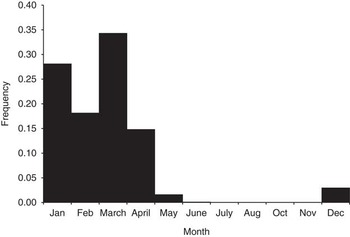
The majority (i.e. >80%) of lambings occurred in the spring months of January to March, inclusive (Figure 1). Across all data, Texel (25%), Suffolk (17%) and Charollais (13%) represented the main breed composition of animals. The distribution of lambing difficulty recorded in crossbred (mean=1.35; SD=0.69) and purebred (mean=1.45; SD=0.73) ewes was similar. The mean prevalence of perinatal mortality was 5.11% (SD=22.03%) in the crossbred and 8.95% (SD=28.54%) in the purebred lambs, with 46.05% and 22.27% of dead lambs having experienced some lambing assistance (i.e. slight, severe or veterinary assistance) or lambing dystocia (i.e. severe or veterinary assistance), respectively. Average birth weight was 4.61 kg (SD=1.18). Average litter size per lambing event was 2.01 (SD=0.70) and 1.87 (SD=0.67) in crossbred and purebred flocks, respectively.
Frequency distribution of number of lambs born by calendar month.

Lambing difficulty
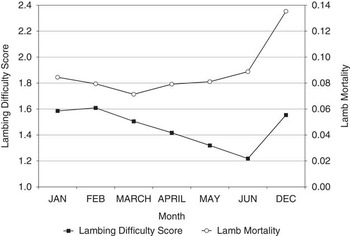
In the simple regression model the risk factors that were associated with lambing difficulty included year and month of birth, litter size, ewe parity and ewe breed. Age at first lambing was not associated with lambing difficulty in the simple regression model. Greatest lambing difficulty was recorded in 2009 (1.75±0.04), whereas the lowest incidence of lambing difficulty was recorded in 2010 (1.49±0.03). The most difficult lambings were for ewes lambing in February, with the least difficult lambing for ewes lambing out of season in June (Figure 2). Ewes bearing quadruplets experienced the greatest lambing difficulty (1.75±0.03; P<0.001) while ewes bearing twins experienced the least lambing difficulty (1.48±0.01). Lambing difficulty for triplet (1.56±0.02) and single (1.58±0.01) bearing ewes was intermediate and not different from each other but was less than observed for quadruplet bearing ewes and greater than observed for twin bearing ewes.
Mean lambing difficulty score (scale of one to four as: 1=no lambing assistance/unobserved, and 4=veterinary assistance) and incidence of lamb mortality per month of birth (standard errors included in error bars) esimated in the simple regression model.

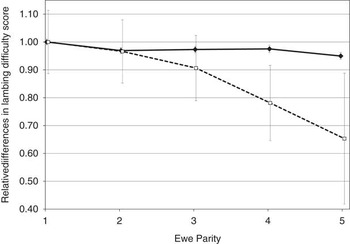
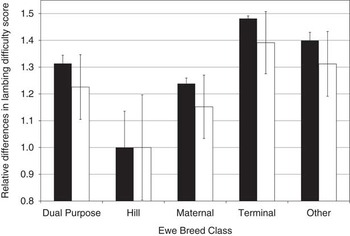
First parity ewes experienced greater (P<0.001) lambing difficulty (1.56±0.02) than older ewes; lambing difficulty for ewes of parity two or greater did not differ from each other (Figure 3). Irrespective of whether the ewe was purebred or crossbred, more difficult lambings were recorded for the Suffolk, Texel and Vendeen ewes (P<0.001) compared with the Belclare and Blackface Mountain ewes. When ewe breed was grouped into five broad classifications based on the dominant breed composition (i.e. terminal, dual purpose, hill, maternal and ‘other’), terminal breed ewes experienced the greatest lambing difficulty, with the lowest lambing difficulty recorded for hill-bred ewes (P<0.001; Figure 4).
Mean lambing difficulty score for ewe parity (standard errors included in error bars) relative to a first parity ewe estimated in the simple (-♦-) and multiple regression model (-□-).

Mean lambing difficulty score for ewe breed class (standard errors included in error bars) relative to the hill ewe breed estimated in the simple (black bards) and multiple regression model (white bars).

The association between all the aforementioned risk factors and lambing difficulty score persisted in the multiple regression model; no significant interaction between the factors existed. The random effects of contemporary group (flock-year-week of birth) and ewe included in the multiple regression model explained 22% and 5% of the overall variation in lambing difficulty, respectively. In the multiple regression model, the association between the risk factors and lambing difficulty did not differ from the trend described in the simple models. However, a greater differential in lambing difficulty score among ewe parities existed in the multiple regression model, with older ewes (i.e. >3 parity) experiencing less lambing difficulty relative to the levels reported in the simple models (Figure 3). Similarly for ewe breed class, lower lambing difficulty scores were recorded for the terminal, maternal, dual purpose and other breeds in the multiple regression model, while the least squares means for the hill breeds remained consistent in the both the simple and multiple regression model (Figure 4).
Lamb mortality
Factors associated with lamb mortality in the simple regression models were year and month of birth, gender, birth weight, litter size, lambing difficulty, breed of the lamb, ewe parity and age at first lambing of the ewe. The predicted probability of a dead lamb within 24 h of birth increased (P<0.001) annually from 0.02 in 2008 to 0.10 in 2014. Lambs born in December had the greatest predicted probability (P<0.001) of dying within 24 h of birth (0.14; Figure 2). Male lambs were 1.31 times (95% CI=1.22 to 1.55; P<0.001) more likely to die compared to female lambs.
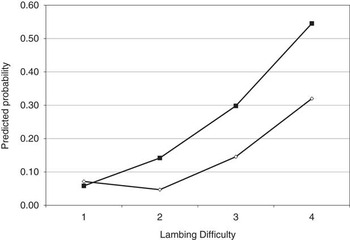
Very light (i.e. 2 kg) and very heavy (i.e. 8 kg) lambs were 6.45 (95% CI=5.31 to 8.56; P<0.001) and 2.60 times (95% CI=1.38 to 5.33; P<0.001) more likely to die compared with a 4 kg lamb, respectively. Relative to twin born lambs, the odds of a single, triplet and quadruplet born lamb dying was 0.88 (95% CI=0.81 to 0.95; P<0.001), 1.89 (95% CI=1.75 to 2.07; P<0.001) and 2.63 (95% CI=2.15 to 3.22; P<0.001), respectively. Lambs that experienced a more difficult birth had a greater probability of dying (P<0.001); the predicted probability of a dead lamb at birth for lambs that required no assistance, slight, severe and veterinary assistance was 0.07, 0.05, 0.15 and 0.32, respectively (Figure 5).
Predicted probability of lamb mortality (standard error included as error bars) for lambing difficulty score from the simple (-◊-) and multiple regression (-■-) models.

Lambs from first parity ewes were at greater (P<0.001) risk of dying relative to lambs from older parity ewes. Relative to a lamb born from a primiparous ewe lambing between 18 and 28 months of age, the odds of a lamb from a primiparous ewe lambing <18 months of age dying was 1.09 (95% CI=1.01 to 1.17; P<0.005). The risk of lamb mortality varied greatly by lamb breed; lamb mortality in purebred lambs was 2.00 times (95% CI=1.63 to 2.45; P<0.001) more likely to occur than in crossbred lambs. The greatest predicted lamb mortality incidence was recorded in purebred Vendeen (0.12), Galway (0.10) and Easy Care (0.09) lambs, while the lowest predicted lamb mortality incidence was recorded in purebred Blackface Mountain (0.03), Texel crossbred (0.03) and Charollais crossbred (0.02) lambs. Relative to lambs classified as terminal breeds, the odds of lamb mortality in hill, maternal and dual-purpose lambs was 0.77 (95% CI=0.47 to 1.27), 0.97% (95% CI=0.86 to 1.10) and 1.25 (95% CI=1.03 to 1.51; P<0.001), respectively.
Factors that remained associated with lamb mortality in the multiple regression model were month of birth, gender, birth weight, litter size and lambing difficulty score; no significant interactions were observed between the factors. Therefore, following adjustment for factors such as birth weight, litter size and lambing difficulty score, the association between ewe parity, age at first lambing, year of lambing and lamb mortality (P>0.001) no longer existed in the multiple regression model. The random effects of contemporary group (i.e. flock-year-week of birth) and ewe included in the multiple regression model explained 27% and 21% of the overall variation in lamb mortality, respectively. In the multiple regression model, the association between the aforementioned factors and lamb mortality did not differ from the trends observed in the simple regression models. The differential in the odds of a mortality event did however widen for lambing difficulty score in the multiple regression model, especially as lambing difficulty score increased. Relative to a lamb born requiring no assistance, the odds of mortality occurring in a lamb that required slight, severe or veterinary assistance at lambing was 1.15 (95% CI=0.96 to 1.36), 1.86 (95% CI=1.50 to 2.29; P<0.001) and 2.67 (95% CI=1.78 to 4.00; P<0.001), respectively in the multiple regression model (Figure 5).
Discussion
Lambing difficulty and lamb mortality are two key components affecting farm productivity and profitability. A combination of management and environmental factors has previously been documented to be associated with lambing difficulty and lamb mortality in the United Kingdom (Wiener et al., Reference Wiener, Woolliams and MacLeod1983; Dwyer et al., Reference Dwyer, Lawrence, Brown and Simm1996), New Zealand (Morris et al., Reference Morris, Hickey and Clarke2000; Everett-Hincks et al., Reference Everett-Hincks, Lopez-Villalobos, Blair and Stafford2005), Australia (Geenty et al., Reference Geenty, Brien, Hinch, Dobos, Refshauge, McCaskill, Ball, Behrendt, Gore, Savage, Harden, Hocking-Edwards, Hart and van der Werf2014) and the United States (Gama et al., Reference Gama, Dickerson, Young and Leymaster1991; Southey et al., Reference Southey, Rodriguez-Zac and Leymaster2004) sheep populations. No study has to date examined the association between lambing difficulty and mortality and risk factors in a series of simple regression models and multiple regression models across a diverse sheep population. As evidenced from the present study, many factors were associated with both lambing traits investigated and most associations persisted after adjustment for other risk factors in the multiple regression model.
Population statistics in this study corroborate statistics from other international sheep populations. The proportion of lambs delivered without human intervention in the present study (68.17%) was similar to the 63.2% documented by Dwyer and Bünger (Reference Dwyer and Bünger2012) in four breeds commonly used in the United Kingdom. The incidence of lamb mortality rate in the present study (8.33%) was within the range (8% to 25%) reported internationally in sheep (Binns et al., Reference Binns, Cox, Rizvi and Green2002; Riggio et al., Reference Riggio, Finocchiaro and Bishop2008; Maxa et al., Reference Maxa, Sharifi, Pedersen, Gauly, Simianer and Norberg2009).
Litter size
Greater lambing difficulty and mortality have been previously associated with larger litters (i.e. triplets and quadruplets) and also with singleton lambs (Everett-Hincks et al., Reference Everett-Hincks, Lopez-Villalobos, Blair and Stafford2005; Sawalha et al., Reference Swalha, Conington, Brotherstone and Villaneva2007; Maxa et al., Reference Maxa, Sharifi, Pedersen, Gauly, Simianer and Norberg2009). Although differences in lamb mortality between triplets and twins have previously been explained by less variability in birth weight of twins relative to triplets (Everett-Hincks et al., Reference Everett-Hincks, Lopez-Villalobos, Blair and Stafford2005), the differences in lamb mortality between twins and triplets in the present study could not be attributed to birth weight alone, as the association between litter size and lamb mortality remained in the multiple regression model, even after accounting for differences in birth weight.
Malpresentation of the lamb at birth may explain some of the observed lambing difficulty and lamb mortality differences between litter sizes (Speijers et al., Reference Speijers, Carson, Dawson, Irwin and Gordon2010; Dwyer and Bünger, Reference Dwyer and Bünger2012). Larger lambs (e.g. singleton lambs) may be forced into an incorrect position during the passage into the birth canal due to their size, but this risk cannot be attributed to greater birth weight or increased lambing difficulty alone. This suggests that other factors, such as lamb viability or ewe condition at lambing, may play an important role in lamb mortality associated with singleton lambs. For multiple lambs, malpresentation in the form of a breech or head placed backwards in the birth canal, are more common (Dwyer, Reference Dwyer2003; Dwyer and Bünger, Reference Dwyer and Bünger2012), thus leading to a requirement for human intervention but also a greater likelihood of mortality possibly due to asphyxia. Another risk factor for lamb mortality is the reduced ability of a ewe to maintain contact with multiple lambs at birth (Alexander et al., Reference Alexander, Stevens, Bradley and Barwick1990; Nowak and Poindron, Reference Nowak and Poindron2006), especially in extensive systems.
Ewe parity
The greater incidence of lambing difficulty and lamb mortality in younger ewes (i.e. first parity ewes) relative to older ewes corroborates previous studies in sheep (Southey et al., Reference Southey, Rodriguez-Zac and Leymaster2004; Everett-Hincks et al., Reference Everett-Hincks, Lopez-Villalobos, Blair and Stafford2005; Macfarlane et al., Reference Macfarlane, Matheson and Dwyer2010) and cattle (Mee et al., Reference Mee, Berry and Cromie2008 and Reference Mee, Berry and Cromie2011). The association between ewe parity and lamb mortality, however, disappeared in the multiple regression model; supplementary analysis revealed that litter size and lamb breed accounted for the differences in lamb mortality across the different parities. Parity differences in lambing difficulty could, however, not be fully explained by differences in litter size or ewe breed; rather the differences in lambing difficulty score between younger and older ewes was greater in the multiple regression model (Figure 3). The differences in lambing difficulty score between parities may be partly explained by the extended labour experienced by younger ewes (Nowak and Poindron, Reference Nowak and Poindron2006) experiencing birthing for the first time.
Age at first lambing (i.e. lambing between 8 and 18 months of age or ⩾18 and 28 months of age) was shown to be associated with both lambing difficulty and lamb mortality in the simple regression model. The association did not persist for either lambing trait in the multiple regression model thus indicating that first parity ewes (irrespective of age at first lambing) can be managed similarly at lambing, once cognisance is taken of factors such as ewe breed and litter size.
Breed
The greater lambing difficulty observed in the present study for ewe terminal breeds, especially the Texel and Suffolk breeds, is in agreement with previous studies (Dwyer and Lawrence, Reference Dwyer and Lawrence2005; Speijers et al., Reference Speijers, Carson, Dawson, Irwin and Gordon2010; Dwyer and Bünger, Reference Dwyer and Bünger2012). The breed differences in ewe lambing difficulty score observed herein could not, however, be attributed to litter size or birth weight alone, since the difference between the breeds remained even after adjustment for differences in litter size and birth weight. Other factors such as the shape (e.g. conformation) of the lamb (Speijers et al., Reference Speijers, Carson, Dawson, Irwin and Gordon2010) and the length of gestation and birthing labour (Dwyer et al., Reference Dwyer, Lawrence, Brown and Simm1996; Matheson et al., Reference Matheson, Rooke, McIlvaney, Jack, Ison, Bünger and Dwyer2011) may partly explain the differences observed between the breeds.
The greater lamb mortality recorded in purebred lambs compared with crossbred lamb corroborate the conclusions of Wiener et al. (Reference Wiener, Woolliams and MacLeod1983). The difference in lamb mortality between purebred and crossbred lambs in the present study may be partly explained by the influence of heterosis on lamb viability, and subsequently on lamb mortality (Gama et al., Reference Gama, Dickerson, Young and Leymaster1991). Dwyer (Reference Dwyer2014) reported greater levels of maternal care in hill breeds relative to lowland breeds; this may account for the lower mortality levels recorded for the Blackface Mountain breed in the presented study relative to the lowland breeds.
Gender
The greater lamb mortality in male lambs has been documented previously in sheep (Morris et al., Reference Morris, Hickey and Clarke2000; Nowak and Poindron, Reference Nowak and Poindron2006; Maxa et al., Reference Maxa, Sharifi, Pedersen, Gauly, Simianer and Norberg2009) and is consistent with that observed in other species, including cattle (Mee et al., Reference Mee, Berry and Cromie2008). Some studies have postulated that increased lamb mortality in males may be due to differences in birth weight (Smith, Reference Smith1977; Gama et al., Reference Gama, Dickerson, Young and Leymaster1991; Nash et al., Reference Nash, Hungerford, Nash and Zinn1996). In the present study, however, greater lambing difficulty and mortality were still evident in male lambs even after adjusting for gender differences in birth weight. This therefore suggests that factors other than birth weight (e.g. morphological characteristics) are responsible for differences in lamb mortality. Previous studies have reported that male lambs are more likely to be malpresented at birth (Dwyer, Reference Dwyer2003), experience longer labours (Dwyer et al., Reference Dwyer, Lawrence, Brown and Simm1996) and are at greater risk of dying due to pneumonia or starvation (Southey et al., Reference Southey, Rodriguez-Zac and Leymaster2004); these factors may help explain the greater intervention required and greater mortality risk associated with male lambs in the present study.
Birth weight
The greater lamb mortality for very light or very heavy lambs in the present study agrees with previous results in the United States (Smith, Reference Smith1977), Australia (Geenty et al., Reference Geenty, Brien, Hinch, Dobos, Refshauge, McCaskill, Ball, Behrendt, Gore, Savage, Harden, Hocking-Edwards, Hart and van der Werf2014) and the United Kingdom (Sawalha et al., Reference Swalha, Conington, Brotherstone and Villaneva2007) sheep populations and is also consistent with the reported optimum birth weight of 3.0 to 5.5 kg to avoid the requirement for assisted lambings and mortality (Nowak and Poindron, Reference Nowak and Poindron2006; Speijers et al., Reference Speijers, Carson, Dawson, Irwin and Gordon2010). Greater lamb mortality in light lambs has been attributed to hypothermia, lack of fat reserves and mismothering (Morris et al., Reference Morris, Hickey and Clarke2000; Nowak and Poindron, Reference Nowak and Poindron2006); poorer ewe uterine contractions for lambs of low birth weight results in slower parturition (Dalton et al., Reference Dalton, Knight and Johnson1980), which may also result in greater lamb mortality. Previous studies have shown that heavier lambs are more likely to die at birth due to dystocia (Smith, Reference Smith1977; Nowak and Poindron, Reference Nowak and Poindron2006; Maxa et al., Reference Maxa, Sharifi, Pedersen, Gauly, Simianer and Norberg2009); however, results from the present study suggest that heavier lambs still remain at greater risk of dying even after adjustment for their greater requirement for assisted lambing. Other factors such as lamb vigour or starvation due to dystocia, as a result of the longer time-period required for lambs to stand and stuck (Dwyer et al., Reference Dwyer, Lawrence, Brown and Simm1996), may help explain the greater lamb mortality in heavier lambs.
Lambing difficulty association with lamb mortality
As expected, lambs that required more lambing assistance at birth had a greater odds of dying at birth (Smith, Reference Smith1977; Maxa et al., Reference Maxa, Sharifi, Pedersen, Gauly, Simianer and Norberg2009; Speijers et al., Reference Speijers, Carson, Dawson, Irwin and Gordon2010). The greater lamb mortality attributable to greater lambing difficulty could, however, not be fully explained by differences in birth weight, litter size or breed; lambs that required severe or veterinary assistance at birth still had a greater odds (odds ratio of 4 and 10, respectively) of dying at birth compared with lambs that required slight assistance, even after accounting for the aforementioned factors. A longer labour period has been shown previously to increase lamb mortality (Alexander et al., Reference Alexander, Stevens, Bradley and Barwick1990) through an increased risk of brain trauma and hypoxia in the lamb (Haughey, Reference Haughey1993). Ewes that experienced difficult lambing have also been shown to be slower to display maternal groom behaviour and are more likely to reject their lambs (Dwyer, Reference Dwyer2014). Both factors may help to explain the association between lambing difficulty and lamb mortality.
Conclusions
A large number of phenotypic factors were associated with lambing difficulty and lamb mortality. Although some factors are not under direct management control (i.e. gender of lamb, litter size, year of lambing), many factors can be adapted by producers to improve lambing performance and both overall farm productivity and animal welfare. Examples include the management and nutrition of single v. multiple bearing ewes pre lambing, month of lambing and the breed choice of sire for use on younger females.
Acknowledgement
Funding from the Department of Agriculture, Food and Marine Research Stimulus Fund (RSF 11/S/133) is gratefully acknowledged.