Introduction
In normal aging, the decrease in the syntactic complexity of written production is usually associated with deficits in working memory, with reduced speed of information processing, and with changes in the effectiveness of inhibitory control, despite the fact that vocabulary level is preserved (Kemper et al., Reference Kemper, Greiner, Marquis, Prenovost and Mitzener2001a; Reference Kemper, Marquis and Thompson2001b). Low educational level may exacerbate these aging effects, as it can also affect the course of intellectual skills in the aging process (Snowdon et al., Reference Snowdon, Kemper, Mortimer, Greine, Wekstei and Marksbery1996; Engelman et al., Reference Engelman, Agree, Meoni and Klag2010; Kemper et al., Reference Kemper, Bontempo, McKedy, Schmalzried, Tagliaferri and Kieweg2011).
The Mini-Mental State Examination (MMSE; Folstein et al., Reference Folstein, Folstein and McHugh1975; Bertolucci et al., Reference Bertolucci, Brucki, Campacci and Juliano1994) sentence item asks the respondent to write a sentence of his/her free choice. Taken in isolation, the sentence can be used to evaluate the textual production of the elderly adults. In addition, comparing the phrase to the MMSE total score may provide clues to understanding the cognitive performance of older people. In particular, it may help us assess the impact of global cognitive status over textual production. Also, the consideration of the relationship between sociodemographic characteristics such as gender, age, educational level, and verbal fluency and grammatical complexity may help us understand the constraints and opportunities throughout the lifespan involved in cognitive aging.
Few studies have investigated the textual performance of older adults in the MMSE. A previous retrospective study of 280 patients at a geriatric day hospital investigated the relationship between aspects of the MMSE sentence and the overall MMSE score (McCarthy et al., Reference McCarthy2004). Total MMSE score correlated with legibility, number of words, and emotional tone of the sentence. Women who wrote in lower case had a higher MMSE than those who wrote in capitals. Yet, the study was limited by the fact that some participants had significant cognitive impairment. Shenkin et al. (Reference Shenkin, Starr, Dunn, Carter and Deary2008) found no significant association between objective MMSE sentence criteria (such as number of words, word length, or frequency), legibility, or tone and measured cognitive ability or physical disability. However, estimates of intelligence from the MMSE sentence correlated significantly with cognitive ability.
In an effort to further our knowledge regarding the information contained in the MMSE sentence writing among healthy older adults, we performed content analysis of the textual production of 577 community-dwelling older adults in response to the MMSE sentence. The study objectives were: (a) to investigate the degree of fluency and grammatical complexity of the textual production of participants, and (b) to analyze the impact of gender, age, and education, as well as the overall cognitive status over the language performance of the elderly adults.
Methods
Participants and procedures
In the context of a population-based study on frailty and aging, a probability sample was constructed including community-dwelling elderly (n = 900) living in Campinas, a city in Southeastern Brazil, with 1,054,669 inhabitants, of which 7.82% were 65 years and older (IBGE, 2009). The urban census tracts were used as sampling units. During household recruitment, the elderly adults who had severe sensory deficits, i.e. functional, communication, and motor impairment, were excluded from the sample. Most participants who came for a subsequent data collection effort at a nearby senior center were women (69.33%). Their ages ranged between 65 and 97 years, with an average of 72.78 years (SD = 5.82). The average schooling level was 4.59 years (SD = 4.23).
The study was approved by the Ethics Committee of the Faculty of Medical Sciences from the State University of Campinas (Protocol no. 208/2007). Upon arrival, participants signed an informed consent form. All individuals completed the MMSE (Folstein et al., Reference Folstein, Folstein and McHugh1975; Bertolucci et al., Reference Bertolucci, Brucki, Campacci and Juliano1994; Brucki et al., Reference Brucki, Nitrini, Caramelli, Bertolucci and Okamoto2003) and self-report questions on gender, age, and years of schooling. These questions were part of a vast research protocol that included measures of frailty (Fried et al., Reference Fried2001) physical and mental health, lifestyle, functional ability, depressive symptoms, stressful life events, perceived social support, and psychological well-being.
Participants were grouped in age ranges from 65 to 69 years, 70 to 74 years, 75 to 79 years, and 80 years and more, and in educational levels as never attended school, 1–4, 5–8, 9–11, and 12 years and over.
Textual production written in response to the MMSE sentence was transcribed and subjected to content analysis by two independent observers. A word was defined as a unit of written language expressed between two blank spaces or between a blank space and a punctuation mark. A sentence was regarded as textual production with complete meaning, consisting of one or more words, with or without a verb, and by one or more affirmative, negative, interrogative, exclamatory, and imperative phrases. A phrase was defined as any part of a sentence nucleated by a verb. Sentences could be simple when composed by a single phrase, or compounded, when formed by more than one phrase or idea (Houaiss, Reference Houaiss2009). The word was taken as the unit of analysis for verbal fluency and the phrase (or idea) as the unit of analysis for grammatical complexity. Verbal fluency was defined in terms of the number of words produced and grammatical complexity by the number of phrases or interrelated ideas expressed in response to the MMSE sentence. The definition of grammatical complexity was based on the concept of propositional density used by Kemper et al. (Reference Kemper, Marquis and Thompson2001a; Reference Kemper, Marquis and Thompson2001b) and Snowdon et al. (Reference Snowdon, Kemper, Mortimer, Greine, Wekstei and Marksbery1996).
We calculated the total MMSE score for each participant and they were classified as cognitively impaired or unimpaired. For this purpose, we adopted as cut-off scores the education-adjusted means reported by Brucki et al. (Reference Brucki, Nitrini, Caramelli, Bertolucci and Okamoto2003), minus a standard deviation. The cut-off scores were 17 for illiterate elderly, 22 for older people with one to four years of schooling, 24 for those with five to eight years, and 26 for those who reported having nine or more years of schooling.
Data analysis
Descriptive analyses were carried out for the MMSE total score and the textual production variables, according to gender, age, and education. The subsample of participants who responded to the MMSE sentence was compared to those who did not answer as to gender, age, education, and MMSE total score.
We also calculated MMSE subdomain scores for Time Orientation (items 1–4), Spatial Orientation (items 5–10), Immediate Memory (items 11–13), Attention and Calculation (items 14–18), Memory Recall (items 19–21), Language (items 22–24 and 29), Commands (items 25–28), and Constructive Praxis (item 30). Correlations were calculated, adjusted for gender and age, between the number of words and the number of ideas and MMSE total and subdomain scores. As many correlations were calculated, in these correlational analyses, a more conservative p-value was used (p ≤ 0.001). In other study analyses, p-value was set at 0.05.
Results
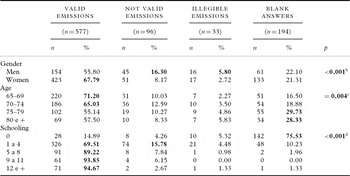
The examination of responses to the MMSE sentence from the 900 elderly participants of the main study revealed that 323 seniors were not able to write a meaningful sentence and they were excluded from the present study. Among them, 194 left the item blank, 96 responded with one or more words that did not communicate an idea, and 33 gave illegible answers. Among the 577 respondents whose text could be analyzed, the majority was women, was between 65 and 74 years old, had formal schooling, and did not exhibit cognitive impairment suggestive of dementia in the MMSE (Table 1). Among the 323 elderly whose answers were excluded, 40.56% had cognitive impairment, while in the group with included answers only 13.86% had cognitive impairment (χ2 = 82.25, df = 1, p < 0.001).
Number and percentage of elderly adults according to performance in the MMSE sentence, stratified by gender, age, and education (n = 900)

aχ2 = 25.75, df = 3;b χ2 = 21.14, df = 3; cχ2 = 24.18, df = 9;
dχ2 = 465,64, df = 12.
Tests comparing the means for age, years of schooling, and cognitive status of the included versus the excluded groups for MMSE sentence revealed that the elderly adults with excluded answers were older, less educated, and had lower MMSE scores than those with included answers (Table 2).
Comparison of elderly adults whose answers to the MMSE sentence were included versus excluded, according to age, schooling, and MMSE total score (n = 900)

Mann–Whitney U test. MMSE: Mini-Mental State Examination.
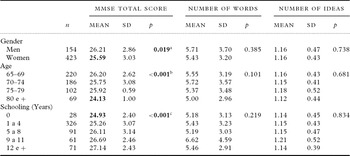
In the group that responded to the MMSE sentence, women, those who were 80 years and older and those who had never gone to school performed significantly lower in the MMSE total score than those who were 65–69 years and had attended school for one year or more. However, there were no statistically significant differences for sex, age, and schooling in textual performance, as to the number of words and phrases produced (Table 3). The average number of words for elderly adults who had their response to the MMSE sentence analyzed (n = 577) was 5.51 (SD = 3.34) and the average number of ideas was 1.16 (SD = 0.44).
Comparison of cognitive and textual performance according to gender, age, and schooling (n = 577)

MMSE: Mini-Mental State Examination.
aMann–Whitney U test; b.cKruskal–Wallis test and Dunn post hoc.
There was a statistically significant correlation between the number of written words and the scores in the Language domain of the MMSE (Table 4). The MMSE total score and the other domains did not correlate with fluency or grammar complexity scores (Table 4).
Correlation between the text production and cognitive variables adjusted for gender and age (n = 577)

MMSE: Mini-Mental State Examination. rho = Spearman's correlation coefficient; p-value sign. if ≤ 0.001.
Discussion
The present study described the performance of community-dwelling elderly adults in the sentence writing task of the MMSE and investigated whether it was influenced by gender, age, and schooling. We also examined the association between textual fluency and grammatical complexity and performance in the MMSE. Younger participants, women, those with formal education (in contrast to those who had never attended school) and those with higher performance in the MMSE were more likely to complete the MMSE sentence writing task. This finding illustrates the integrated influence of aging and education on cognition. However, once the participants had managed to complete the task, the respondents did not differ on verbal fluency or on the grammatical complexity. In other words, textual fluency and complexity were not influenced by sex, age, or schooling. The study brings about novel information as the sample was from a developing country and it included elderly adults with heterogeneous educational experience.
It is possible that this result was influenced by the task instruction, as it required the writing of a simple sentence. This fact may have discouraged some participants from writing complex sentences. In fact, similar results were found in a previous study (Shenkin et al., Reference Shenkin, Starr, Dunn, Carter and Deary2008). The finding that text fluency and complexity were not modulated by age may indicate that linguistic performance is relatively unaffected by aging, remaining stable until advanced ages, in agreement with previous cognitive aging studies (Salthouse, Reference Salthouse2010).
From a clinical standpoint, the results suggest that the most relevant information generated by the MMSE sentence is whether the elderly can or cannot write the sentence. Having written it, the number of words or ideas expressed may not be useful for identifying elderly people with cognitive decline, as the instruction may restrain the complexity of the sentence writing task. Other researchers have suggested that deterioration in spelling, poor narrative organization, word errors and perseverations, reduced syntactic complexity, and shorter sentences might signal pathological cognitive impairment characteristic of the dementias (Lezak, Reference Lezak1995; Hughes et al., Reference Hughes, Graham, Patterson and Hodges1997).
As to the relationship between textual production and mental status, the present findings suggest better linguistic performance for those with higher scores in the Language subdomain of the MMSE. This finding reflects the well-established notion in the field of neuropsychology that cognitive functions are integrated and covary significantly. In this case, it is expected that writing longer sentences should be dependent on language (i.e. vocabulary) abilities.
Among the limitations of the study, we include the fact that the meaning of the written words and sentences was not analyzed, and these analyses might be informative. In addition, cognitive testing was limited to the MMSE due to the larger study design. Future studies involving this sample should also investigate the influence of other variables, such as physical and mental health variables on cognitive performance. Among the strengths of the study we indicate its population-based design and the fact that the sample includes a wide range of educational profiles and the presence of a significant number of elderly adults with limited or no educational experience.
Conclusions
This research offers additional evidence to support the well-known influence of formal education and age on cognitive (MMSE total score) and linguistic performance (sentence writing) of older people, as textual production, as well as overall scores were influenced by these variables. It highlights the fact that being able to write the MMSE may have clinical significance. However, the information extracted from the MMSE (total score and textual production) should be considered in light of the sociocultural context of the individual.
Conflict of interest
None.
Description of the author's roles
A.L. Neri and M.S. Yassuda contributed equally to this work, planning the study design, supervising data collection and analysis, and preparing the paper. L.L. Ongaratto transcribed textual data and performed content analysis in collaboration with the other authors.
Acknowledgments
The authors wish to thank Andrea Cristina Garofe Fortes-Burgos, Efigênia Passarelli Mantovani, Flavia Silva Arbex Borim, Stella Vital de Souza Torres, Débora Sousa Dias-Harmitt, and Natália Oliveira Rodrigues.