

The Diagnostic and Statistical Manual of Mental Disorders (5th ed.; DSM-5; American Psychiatric Association, 2013) recognises four eating disorder (ED) diagnoses: anorexia nervosa (AN), bulimia nervosa (BN), binge eating disorder (BED), and other specified feeding or eating disorder (OSFED), previously termed eating disorder not otherwise specified (EDNOS). The International Classification of Disease — Tenth Edition (ICD-10; World Health Organization, 1992) recognises AN, BN, and eating disorder unspecified (EDU). The primary features of concern for AN involve excessive food restriction and weight loss; for BN, episodes of binging and purging; and for BED, episodes of binging; while OSFED and EDU characterise clinically significant ED that do not meet criteria for another ED. A complex blend of biopsychosocial factors has been found to increase risk for, and/or contribute to, the development and maintenance of ED. These include the interactions between: (1) evolved drives for hedonic and homeostatic eating (Lutter & Nestler, Reference Lutter and Nestler2009); (2) consequences of sustained energy deficit, which can include loss of control eating, preoccupation with food, social withdrawal and isolation, depression, difficulties in attention, comprehension and judgment (Keys, Brozek, Henshel, Mickelson, & Taylor, Reference Keys, Brozek, Henshel, Mickelson and Taylor1950; Polivy, Zeitlin, Herman, & Beal, Reference Polivy, Zeitlin, Herman and Beal1994); (3) various physiological and psychological factors, such as excessive stress (Razzoli, Pearson, Crow, & Bartolomucci, Reference Razzoli, Pearson, Crow and Bartolomucci2017), heightened perfectionism, neuroticism, avoidance motivation, sensitivity to social reward, and lower extraversion and self-directedness (Farstad, McGeown, & von Ranson, Reference Farstad, McGeown and von Ranson2016); (4) cyclical cognitive, emotional and behavioural processes (Murphy, Straebler, Cooper, & Fairburn, Reference Murphy, Straebler, Cooper and Fairburn2010); (5) family functioning involving heightened conflict, lower intimacy and lower democratic parenting (Bowles, Kurlender, & Hellings, Reference Bowles, Kurlender and Hellings2011), and general interpersonal difficulties (Arcelus, Haslam, Farrow, & Meyer, Reference Arcelus, Haslam, Farrow and Meyer2013); and (6) cultural influences (Fernandez & Pritchard, Reference Fernandez and Pritchard2012). ED are associated with increased risk of morbidity and mortality and reduced quality of life (Crow et al., Reference Crow, Peterson, Swanson, Raymond, Specker, Eckert and Mitchell2009; Pohjolainen et al., Reference Pohjolainen, Koponen, Rasanen, Roine, Sintonen and Karlsson2016).
There is some evidence for multiple psychological interventions leading to weight gain and reduction of ED symptomology among adults with AN, with no single approach showing superiority (Galsworthy-Francis & Allan, Reference Galsworthy-Francis and Allan2014; Hay, Reference Hay2013). Cognitive behavioural therapy (CBT) is the most evidence-based intervention for binge–purge abstinence and treatment completion among those with BN (Hay, Reference Hay2013). However, at follow-up, around 50% do not experience remission from ED (Fairburn et al., Reference Fariburn, Cooper, Doll, O'Connor, Bohn, Hawker and Palmer2009). Steinhausen and Weber's (Reference Steinhausen and Weber2009) review found that 23% experience a chronic protracted course of BN and 22% will cross over to another ED. They report that many also have another psychiatric disorder at outcome. These outcomes highlight the need to further develop and refine theory and intervention regarding ED. The following section will discuss compassion focused therapy (CFT) and one of its underlying theories, social mentality theory (SMT), and their clinical application to ED through group intervention and compassion-focused therapy for ED (CFT-E). The article will then use SMT as a framework through which to integrate and consider systematic reviews regarding psychological ED research.
Compassion-Focused Therapy
CFT is an integrative, transdiagnostic therapy that focuses on developing compassionate self-to-other and self-to-self relating, and as such is particularly relevant for those who experience high levels of shame and self-criticism (Gilbert, Reference Gilbert2010). CFT theory is rooted in evolutionary psychology and affective neuroscience research, and focuses on the importance of social mentalities and emotion-regulation systems in mental health.
Social Mentality Theory
Evolved biosocial goals
Gilbert (Reference Gilbert1989, Reference Gilbert1995, Reference Gilbert and Baldwin2005) developed the term social mentalities to loosely describe how people become mentally and physically organised in terms of attention, emotion, cognitive processing styles and behaviour, in order to engage in certain types of relationships that are guided by evolved biosocial goals. Examples of such goals include care-giving, care-receiving, cooperation, mating, and competition/social ranking (Buss, Reference Buss2005). SMT is concerned with the behavioural strategies used to achieve these goals, the emotional experience of meeting, trying to meet, or failing to meet these goals, and the cognitive capacities humans have developed in line with these goals (Gilbert, Reference Gilbert2014).
Early interpersonal experiences and social mentalities
Early experiences of safeness, appropriate mirroring, and warmth and care are considered to support the development of a sense of self that is safe in relationships, cared for and understood (Gilbert, Reference Gilbert and Baldwin2005). These experiences are thought to set the stage for activation of the care-giving, care-receiving, and cooperative social mentalities in later life (Gilbert, Reference Gilbert and Baldwin2005). Through such early experiences individuals are taught to develop regulation skills that partly involve self-soothing and soothing through social connection when threat arises (Cozolino, Reference Cozolino2014; Gilbert, Reference Gilbert and Baldwin2005; Schore, Reference Schore2000). In contrast, early experiences of threat and non-investment from the care-giver may prime the individual's defence system for greater activation, contribute to the individual experiencing social interactions as threatening, and leave the individual with limited experience of social connection as soothing, and a sense that they are viewed negatively by others (Cozolino, Reference Cozolino2014; Gilbert, Reference Gilbert and Baldwin2005). In this way, insecure attachment patterns or early interpersonal trauma may create a setting for less activation of caring or cooperative mentalities and greater activation of a competitive social mentality (Gilbert et al., Reference Gilbert, Broomhead, Irons, McEwan, Bellew, Mills and Knibb2007; Matos, Ferreira, Duarte, & Pinto-Gouveia, 2014; Troop & Hiskey, Reference Troop and Hiskey2013; Sloman & Taylor, Reference Sloman and Taylor2016). Gilbert et al. (Reference Gilbert, McEwan, Irons, Broomhead, Bellew, Mills and Gale2009) found that those who feel unsafe in relationships and who strive to compete in social situations experience more depression, anxiety and stress. McEwan, Gilbert, and Duarte (Reference McEwan, Gilbert and Duarte2012) found a strong association between feeling unsuccessful in competition and depression. Within the attachment literature, research has suggested that insecure attachment style is an important risk factor for a wide range of health problems (Mikulincer & Shaver, Reference Mikulincer and Shaver2012).
Emotion regulation systems and social mentalities
CFT categorises emotions by their functions for: (1) alert to threat and activation of defence behaviours, (2) incentivisation of seeking behavior, and (3) to allow for rest and digest (Gilbert, Reference Gilbert2014). These have been named the threat system, drive system, and soothing system. For many, the soothing system is activated by social connection, during which people tend to experience peace, contentment and social safeness. The ways in which these three systems regulate each other is considered important in understanding mental health and ill health. For example, when an individual experiences threat, but is then able to activate the soothing system in the appropriate context, this is considered conducive to mental health (Gilbert, Reference Gilbert2014). However, if an individual's threat system is activated and they struggle to regulate this through the soothing or drive systems, or if they primarily rely on the drive system for regulation, they may experience ill health.
CFT suggests that the development of a compassionate social mentality can aid in emotion regulation by developing compassionate self-to-self, self-to-other, and other-to-self relating, along with activation of the soothing system and experiences of social safeness (Gilbert, Reference Gilbert2015).
Compassion-Focused Therapy for Eating Disorders
Through functional analysis of the three emotion systems among those with ED, Goss and Gilbert (Reference Goss, Gilbert, Gilbert and Miles2002) suggest two affect regulation models that may contribute to the development and maintenance of restrictive and binge/purge patterns. In both, genetics, temperament, early attachment history, experiences of rejection or abuse, and cultural messages regarding weight and shape are considered to predispose an individual to experiencing high levels of shame, contributing to the development of an ED. In restrictive eating cycles, the experience of excessive shame may drive a focus toward body image and weight control, in line with cultural messages, in order to defend against negative social outcomes. When control is successful they may experience pride; when it is unsuccessful, more shame. In this way, restriction is reinforced positively by pride, and negatively by avoidance of shame, that is, a shame-pride cycle (Goss & Gilbert, Reference Goss, Gilbert, Gilbert and Miles2002). In binge cycles, experiences of shame are proposed to contribute to affect instability, particularly in interpersonal contexts. This leads to the use of binging for short-term affect management, which may be reinforced by dissociation from negative feelings and a potential increase in positive feelings. In the long run, binging is thought to lead to fear of discovery, concealment and self-disgust, contributing to greater shame, that is, a shame-shame cycle (Goss & Gilbert, Reference Goss, Gilbert, Gilbert and Miles2002).
Goss and Allan (Reference Goss and Allan2010) integrated elements of CFT into an existing CBT group intervention for those with ED, from which they have developed CFT-E. CFT-E suggests that the efficacy of existing therapies is limited by the individual experiencing heightened levels of threat and difficulties in accessing the social soothing system. Thus, a key aim is to help the individual increase access to this system through the practice of compassionate self-to-self, self-to-other, and other-to-self relating. Gale, Gilbert, Read, and Goss (Reference Gale, Gilbert, Read and Goss2014) report that 73% of those with BN, 30% of those with EDNOS, and 21% of those with AN were considered recovered after a CFT-E intervention. An RCT comparing CFT-E and CBT-E is currently underway, with a specific focus on the relevance of early trauma on outcomes in each group (Vrabel, 2016).
There is emerging evidence to suggest that ED difficulties can be conceptualised through a SMT framework. High levels of unfavourable social rank perceptions, insecure striving, and social comparison among those with ED may suggest a heightened competitive social mentality (Matos et al., 2014; Pinto-Gouveia, Ferreira, & Duarte, Reference Pinto-Gouveia, Ferreira and Duarte2014). Furthermore, initial decreases in shame during treatment are associated with faster decreases in ED symptomology, highlighting the importance of targeting shame in ED treatment (Kelly, Carter, & Borairi, Reference Kelly, Carter and Borairi2014).
The Present Review
There is emerging evidence to suggest that ED difficulties can be conceptualised through a SMT framework. High levels of unfavourable social rank perceptions, insecure striving, and social comparison among those with ED may suggest a heightened competitive social mentality (Matos et al., 2014; Pinto-Gouveia et al., Reference Pinto-Gouveia, Ferreira and Duarte2014). There are many ED theories and research streams that offer useful understanding of ED. Because SMT tries to offer a broad understanding of human functioning, it may be able to act as a meta-theory or framework within which to integrate a number of these otherwise distinct research streams. Thus, the aim of the present review is to use SMT as a framework to guide a scoping review of existing systematic reviews and meta-analyses, integrating and presenting a large body of ED research to add further understanding to existing ED research and theories.
Method
The methodology for this scoping review was based on the frameworks set out by Arksey and O'Malley (Reference Arksey and O'Malley2005) and Levac, Colquhoun, and O'Brien (Reference Levac, Colquhoun and O'Brien2010). The review involved five stages: (1) identifying the research question, (2) identifying relevant studies, (3) study selection, (4) charting the data, and (5) collating, summarising and reporting results.
Research Question
The review was guided by the question, ‘How does existing eating disorder (ED) research fit with Gilbert's (Reference Gilbert1989, Reference Gilbert1995, Reference Gilbert and Baldwin2005) concept of social mentalities?’ A scoping review was considered appropriate as it offers a methodology to address a broad research question by systematically searching and collating a large body of research regarding a complex and heterogeneous topic (Arksey & O'Malley, Reference Arksey and O'Malley2005; Levac et al., Reference Levac, Colquhoun and O'Brien2010). The initial aim was to review primary research articles; however, there were a large number of systematic reviews and meta-analyses returned in the search. Given that such reviews aim to synthesise a large body of research while taking into account quality of evidence, a review of reviews was considered a useful approach in addressing the research question.
Search Strategy
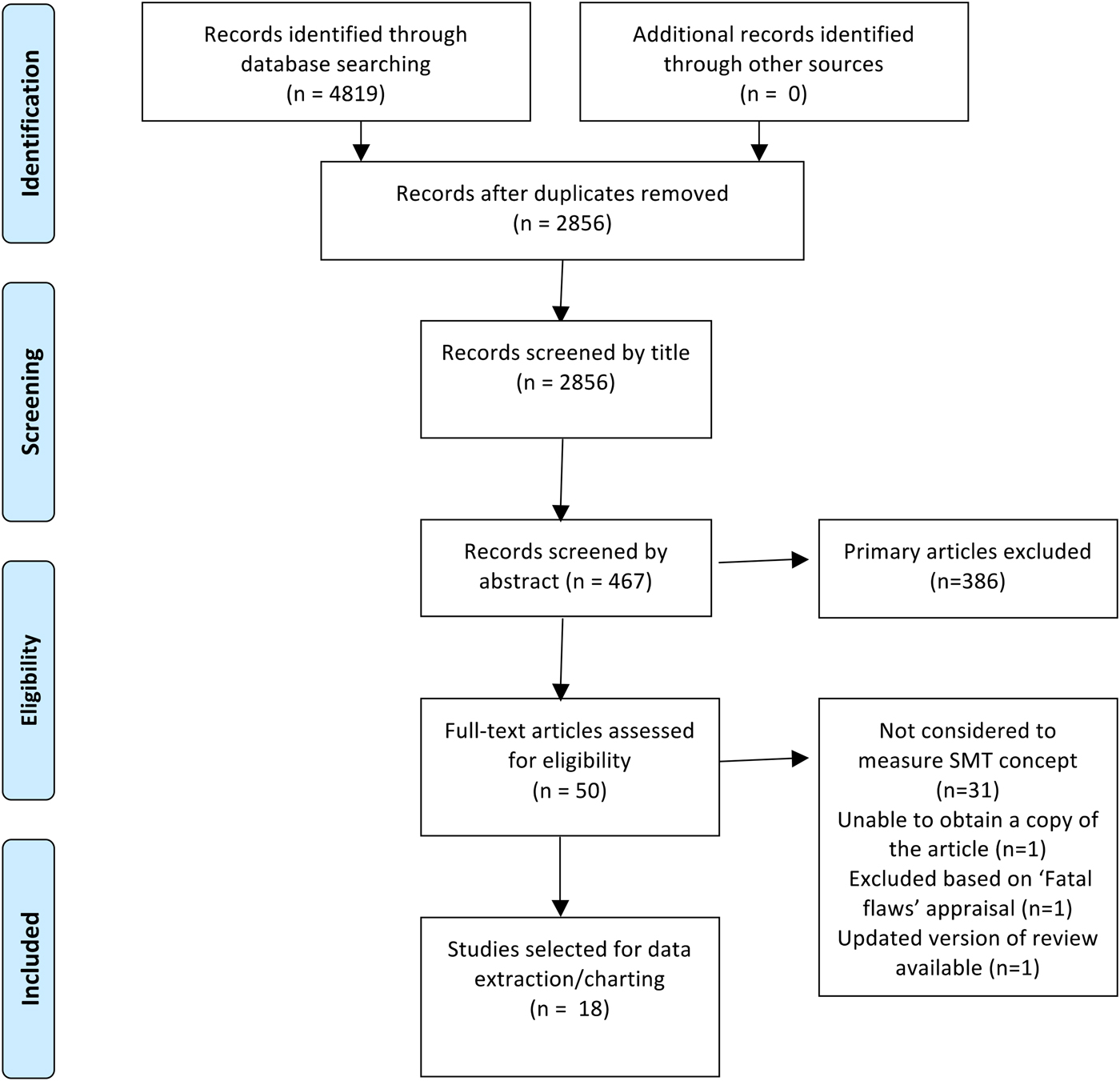
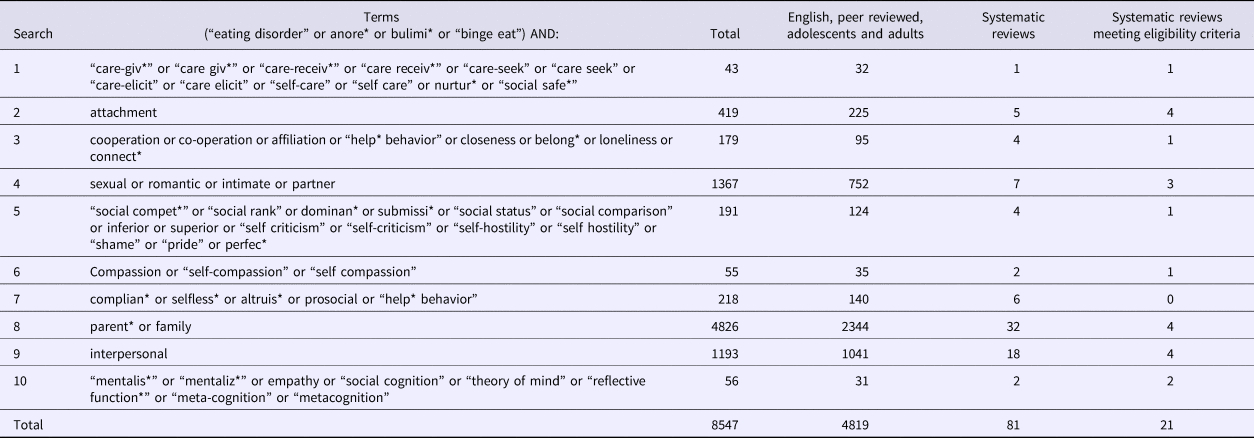
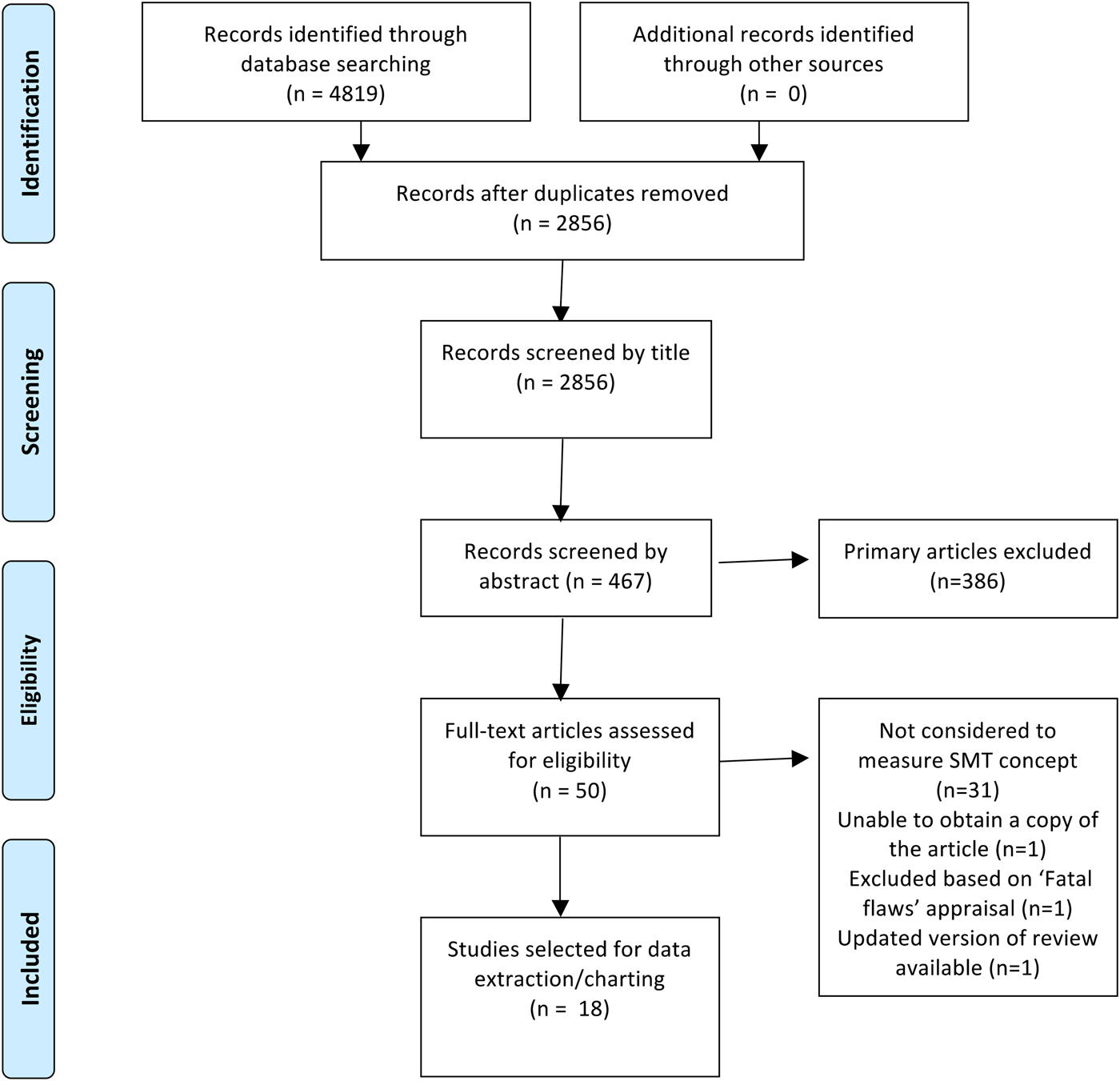
A number of steps were taken in order to choose relevant search terms. First, a systematic search was carried out on Psycinfo using the term “social mentalit*”, yielding 18 results. Of these, six were book chapters that were not accessible, one was a duplicate, and five were not relevant to SMT. Two further articles were identified after reviewing the reference lists of identified articles. These eight articles were reviewed and terms that were relevant to SMT were identified. These terms reflected the core concept behind SMT, that people engage in different evolved relational patterns, in particular involving care, cooperation, and competition with others and within themselves. These terms were combined with the ED search terms, “eating disorder*” or “anore*” or “bulimi*”, or “binge eat*”. A systematic search was then carried out on August 10, 2016, in PsycINFO. The specific searches carried out are outlined in Table 1. See Figure 1 for a flow diagram of the search process.
Flow diagram of study selection process.
Search Terms and Identified Reviews (Before Duplicates Removed)

Eligibility Criteria
The following eligibility criteria guided study selection. Two reviewers independently reviewed search results according to the eligibility criteria below. The key search terms guided decisions as to whether a concept relevant to SMT was addressed. Where reviewers were unsure, this was discussed with reference to key SMT texts, and a joint decision was made to include or exclude the study. The eligibility criteria were: (1) English language; (2) peer-reviewed journal articles; (3) systematic reviews or meta-analyses; (4) adult or adolescent participants who met the diagnosis for ED or experiencing clinical ED symptoms; where all participants were non-clinical, the study was excluded; where all participants were children, the study was excluded; (5) quantitative or qualitative data regarding a concept considered relevant to SMT. Studies that focused exclusively on intervention outcome were excluded.
Quality Check Framework
There are mixed views regarding the need to appraise study quality in scoping reviews (Arksey & O'Malley, Reference Arksey and O'Malley2005; Levac et al., Reference Levac, Colquhoun and O'Brien2010). By their nature, systematic reviews and meta-analyses generally select high quality studies to synthesise. However, to ensure a basic level of quality appraisal in this review, Dixon-Woods et al.’s (Reference Dixon-Woods, Cavers, Agarwal, Annandale, Arthur, Harvey and Sutton2006) ‘fatal flaws’ criteria were applied. This criteria asks: Are the aims and objectives of the research clearly stated? Is the research design clearly specified and appropriate for the aims and objectives of the research? Do the researchers display enough data to support their interpretations and conclusions? Do the researchers provide a clear account of the process by which their findings were produced? Is the method of analysis appropriate and adequately explicated? Only one study was judged of poor quality and excluded. The quality of remaining reviews was assessed by whether they applied the Preferred Reporting Items for Systematic Reviews and Meta-Analyses (PRISMA) or similar guidelines, how they considered biases in primary studies, and whether they considered these in reporting of their findings.
Data Extraction
A form was developed to extract study characteristics, including authors, publication year, study design, participant characteristics, measure of ED, measure of SMT concept, and relevant finding(s).
Data Summary and Synthesis
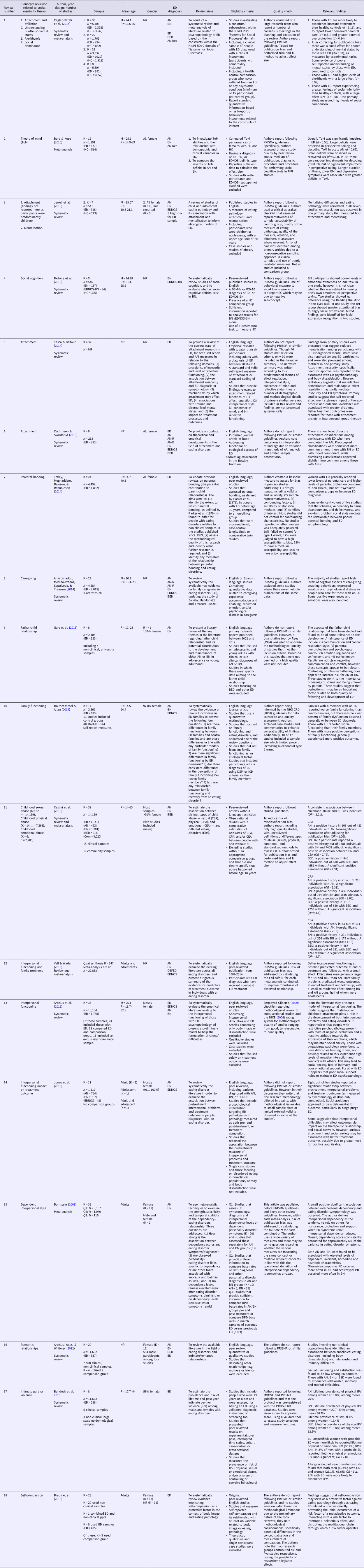
The above information was then presented in Tables 2 and 3, with an accompanying narrative. These findings were then considered, using SMT as a framework through which to interpret the findings.
Overview of Review Characteristics and Relevant Findings

Note: AN = anorexia nervosa, BED = binge eating disorder, BN = bulimia nervosa, ED = eating disorder, EDNOS = eating disorder not otherwise specified, K = number of studies, MOOSE = Meta-Analysis of Observational Studies in Epidemiology (Stroup et al., Reference Stroup, Berlin, Morton, Olkin, Williamson, Rennie and Thacker2000), NHS CRD = National Health Service (UK) Centre for Reviews and Dissemination, NR = not reported, OR = odds ratio, OSFED = other specified feeding or eating disorder, PRISMA = Preferred Reporting Items for Systematic Reviews and Meta-Analyses (Moher, Liberati, Tetzlaff, Altman, D& The PRISMA Group, Reference Moher, Liberati, Tetzlaff and Altman2009).
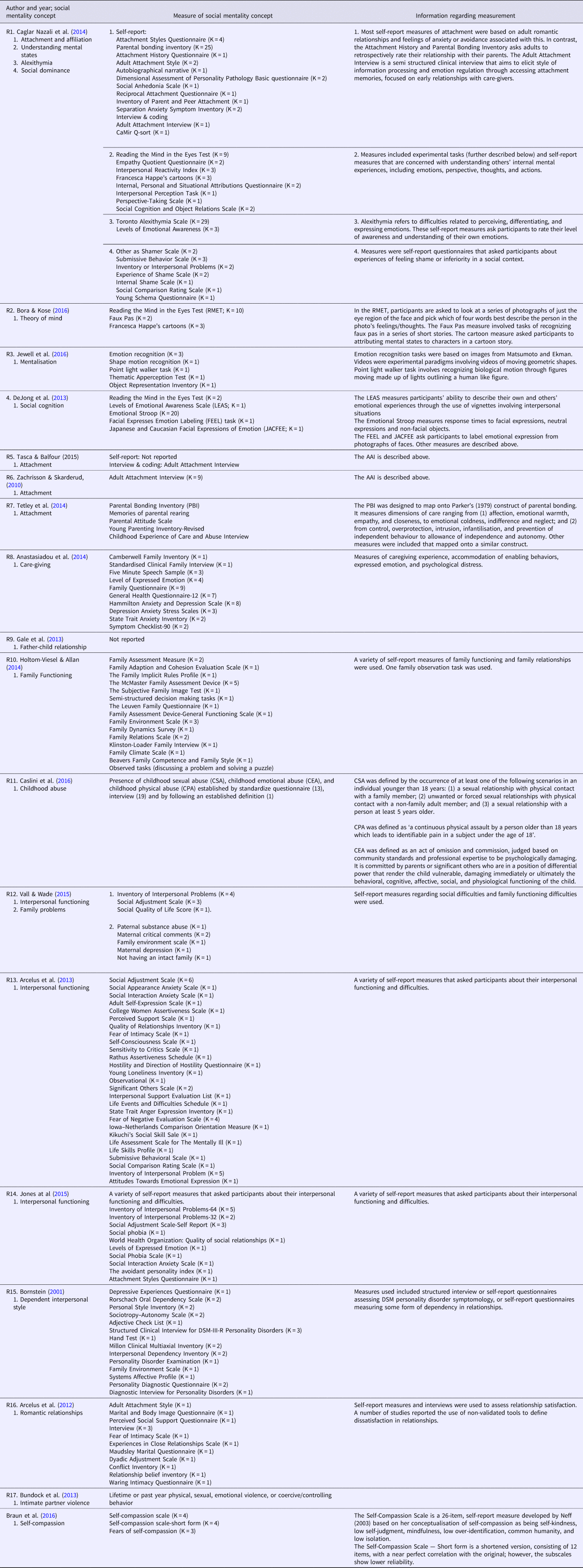
Measures of Concepts Relevant to Social Mentality Theory Across 18 Included Reviews

Note: K = number of studies.
Results
Methodological Characteristics
Eighteen systematic reviews were included; of these, five conducted meta-analyses. The methodological characteristics and key relevant finding(s) of included reviews are presented in Table 2. Reviews were published between 2001 and 2016, 17 of which were between 2012 and 2016. Reported pooled sample sizes ranged from 233 to 22,853. Ten reviews reported information regarding age. Of these, seven included adolescent and adult populations, one included children and adolescents, and two included only adults. The oldest reported mean age was 44 years. Ten reviews reported gender. The majority of participants was female. Seven reviews reported male participants. Four of these consisted of less than 10% males. Three reviews that investigated father-child relationships and romantic relationships included more male participants without ED. Almost all explicitly stated review aims and all reported eligibility criteria. Of these, 12 reported only including English language studies, one reported the inclusion of Spanish language, and one reported no language restriction. All measured ED by either diagnosis or a validated measure of ED symptomology. All reported on multiple ED diagnoses, while most attempted to separate findings according to diagnosis. Eight studies reported following PRISMA guidelines (Reviews [R] 1, 2, 3, 4, 8, 10, 11, 12, 13, 15). Four studies reported using alternative review guidelines or tools to appraise quality of primary studies (R 7, 9, 13, 15). Five studies did not report following guidelines or detailed appraisal of quality of the primary studies beyond meeting eligibility criteria and limited consideration in the discussion (R 5, 6, 14, 16, 18).
Measurement of social mentality theory concepts
Various measures were used to address the concepts considered relevant to SMT. These are listed in Table 3, with a brief description regarding measurement. The majority of measures were observational or experimental for theory of mind, social cognition and mentalisation, and self-report for other constructs. Interview and coding forms of measurement were also used in attachment research.
Overview of Findings
The identified reviews covered a number of concepts considered relevant to SMT. These included attachment style and experiences of parental bonding (K = 4), family functioning (K = 3), care-giving to those with ED (K = 1), childhood emotional, physical and sexual abuse (K = 1), social competition (K = 1), social cognition (K = 4), interpersonal functioning (K = 6), and self-compassion (K = 1). Some studies covered more than one relevant concept.
Attachment and parental bonding
The findings suggest that those with ED are likely to experience insecure attachment styles, and report lower parental care and greater parental over-protection compared to healthy controls (R1, R5, R6). R5 and R9 propose that maladaptive perfectionism and emotion regulation may be such mechanisms. There is some evidence that attachment style may also contribute to the efficacy of certain interventions. R5 reported that avoidance has been associated with greater drop out, and better treatment outcomes have been observed among those with attachment anxiety in interpersonal group therapy.
Family functioning and care-giving experiences
Families of those with ED report poorer family functioning than healthy controls (R10, R12). No specific style of dysfunction was observed generally, or between diagnoses (R10). Those with ED perceived worse family functioning than other family members (R10). Those who reported better family functioning generally experienced better treatment outcomes, with a small to moderate effect (R12). Gale, Cluett, and Laver-Bradbury's (Reference Gale, Cluett and Laver-Bradbury2013) qualitative review (R9) suggests that unresolved conflict, conflictual communication, and communication that fosters rigidity and conformity between father and child may present a risk factor for the development of ED. R8 found that care-givers of people with ED reported experiencing difficulties in their role, with high levels of enabling behaviours, expressed emotion, and psychological distress. Participants caring for individuals with a longer illness duration reported greater care-giving burden. However, some participants also report positive aspects of care-giving likely related to the positive aspects of their relationship (R8).
Child abuse
Those with any ED were 3.21 times more likely to have experienced any child abuse compared to community samples (R11). A consistent significant association was not found between AN and child sexual abuse (CSA), while those with BN and BED were 2.73 and 2.31 times more likely, respectively, to have experienced CSA (R11). Child physical abuse (CPA) was 3.31 times more likely among AN, 2.65 times more likely among BN, and 3.1 times more likely among BED (R11). Childhood emotional abuse (CEA) was 4.15 times more likely among BN and 3.7 times more likely among BED (R11).
Interpersonal functioning
Relationship difficulties in adulthood were reported in multiple reviews (R12, 13, 14, 15, 16, 17). Arcelus et al.’s (Reference Arcelus, Haslam, Farrow and Meyer2013) review suggest that the most prevailing interpersonal difficulties for those with restrictive symptomology are a fear of negative evaluation and of expressing emotions, while interpersonal distrust and conflictual interactions are most reported for those with binge/purge symptomology. These experiences are thought to contribute to social anxiety and fear of intimacy, and subsequently, poorer emotional support (R13).
Pretreatment interpersonal problems were associated with poorer treatment outcome (R5, R12, R14), with a small effect size (R12). In line with Tasca and Balfour's (Reference Tasca and Balfour2014; R5) finding regarding avoidance, anxiety and treatment outcome, Jones, Lindekilde, Lubeck, and Clausen (Reference Jones, Lindekilde, Lubeck and Clausen2015; R14) highlight that social avoidance may be somewhat detrimental for outcome potentially by contributing to poorer therapeutic relationship and social support. In contrast, social anxiety may improve treatment outcome for some, where need for positive appraisal may contribute to treatment completion. Note that R5 and R14 are reviews that did not report a detailed quality appraisal. A small positive association between interpersonal dependency and ED was identified, with higher levels reported as people experience higher levels of symptomology (R17). Bornstein (Reference Bornstein2001) defines interpersonal dependency as looking to others for support, nurturance and protection; however, it is not clear whether the included measures meet this definition.
There is some evidence from R16 (which did not include a detailed quality appraisal) that people with ED tend to experience dissatisfaction in their romantic relationships along with poorer sexual functioning and satisfaction. Those with ED have also been found to have a higher past year prevalence and lifetime likelihood of experiencing intimate partner violence, with lifetime prevalence ranging from 12.5–66.7%, and past year prevalence at 16.4% for males and 25.1–63.6% for women (R17).
Social cognition
Evidence suggests that those with ED may demonstrate poorer recognition or understanding of mental or emotional states of others (R1, R2, R3, R4), and of themselves (R1). These results are primarily from asking participants to name emotions in photographs of faces or the eyes specifically, and to identify emotion and socially relevant information in cartoons or scenarios, both in experimental settings. R1 report an overall small effect after adjusting for publication bias. R2 report a large deficit in perspective taking (e.g., recognising a faux pas in a series of short stories or attributing mental states to characters in a short story) and decoding (correctly naming mental states of a person based on a picture of their eyes) among those with acute AN, compared to controls. These participants had greater depressive symptoms, longer illness duration, and lower BMI. Those who were recovered from AN showed a modest impairment in both aspects, while those with BN showed a modest impairment in decoding, but not in perspective taking (R2). R3 also demonstrates an association between metalising difficulties and eating pathology among adolescents, but highlights the likely risk of bias among primary studies. R4 included experimental tasks of perspective taking, recognising emotions and mind states, and processing emotion words. They report inconclusive or no difference among four studies. In one study, those with BN showed greater attentional bias to angry faces, and in another they showed poorer global emotional recognition. However, the primary authors did not state whether scores of lower emotional recognition are for self or other understanding.
Social rank
Caglar-Nazali et al. (Reference Caglar-Nazali, Corfield, Cardi, Ambwani, Leppanen, Olabintan and Treasure2014; R1) reported that those with ED report experiencing greater feelings of social inferiority, submissive behaviour and shame, compared to healthy controls, with a large effect. One primary study also reported increased social comparison among those with ED.
Self-compassion
Braun, Park, and Gorin (Reference Braun, Park and Gorin2016; R18) identified self-compassion as a consistently relevant construct regarding eating pathology. Primary studies with clinical and non-clinical populations suggest an association between higher self-compassion and lower ED symptomology. Primary studies with community samples also found negative associations between self-compassion and theorised ED risk factors, including body dissatisfaction, social comparison, thin-ideal internalisation, and drive for thinness. A small number of primary studies also reported associations between self-compassion and protective factors such as body image flexibility, body appreciation, and mindful or intuitive eating. Furthermore, one primary study suggested that low self-compassion can have a negative impact on intervention outcome.
Discussion
This article presents a large body of psychological ED research summarised and critiqued in eighteen systematic reviews, through the lens of Gilbert's (Reference Gilbert1989, Reference Gilbert1995, Reference Gilbert and Baldwin2005) social mentality theory (SMT). This review highlights the importance of interpersonal difficulties among those with ED. These difficulties are apparent through findings of higher levels of insecure attachment, poorer perceived family functioning, and higher levels of child abuse.
The interpersonal difficulties were reflected in different measurements, including poorer theory of mind and mentalising tasks, trouble expressing emotions and trusting others, heightened conflict, and higher levels of interpersonal partner violence. Interpersonal difficulties were also identified in treatment outcome research, with poorer interpersonal and family functioning associated with poorer outcomes. In terms of intrapersonal relating, those experiencing ED reported greater feelings of shame and inferiority. Conversely, a compassionate self-relationship was negatively associated with ED symptomology.
Though the findings clearly demonstrate the presence of interpersonal difficulties, it is more difficult to clarify their causes. Given the heightened prevalence of insecure attachment and child abuse, it is likely that these experiences contribute to future insecurity and lack of safeness in adult relationships, along with other posttrauma responses such as emotion-regulation difficulties, negative self-view, and submissive, dominant or inhibited social strategies that aim to manage relational fear (Johnstone & Boyle, Reference Johnstone, Boyle, Cromby, Dillon, Harper, Kinderman, Longden, Pilgrim and Read2018; Pascuzzo, Moss, & Cyr, Reference Pascuzzo, Moss and Cyr2015).
One explanation that has been offered in the literature to explain the findings of poorer mentalising among those with ED is the suggestion that many who experience ED may also meet a diagnosis of autism spectrum disorder (ASD; Huke, Turk, Saeidi, Kent, & Morgan, Reference Huke, Turk, Saeidi, Kent and Morgan2013). However, in contrast, recent smaller scale research has reported superior mentalisation skills among those with ED (Pedersen, Lunn, Katznelson, & Poulsen, Reference Pedersen, Lunn and Poulsen2012; Pedersen, Pulsen, & Lunn, Reference Pedersen, Poulsen and Lunn2015). Thus, it may be that individuals at both ends of the social cognitive spectrum are more vulnerable to experiencing interpersonal difficulties or to developing an ED. Indeed, greater social sensitivity has been suggested as a relevant dimension for mental health difficulties (Dinsdale, Mokkonen, & Crespi, Reference Dinsdale, Mokkonen and Crespi2016).
While neurodiversity may be relevant, this does not detract from the importance of recognising the role of early interpersonal trauma and attachment dynamics in later interpersonal difficulties. From a SMT perspective, early attachment or other relational experiences of danger, fear or incongruence likely contribute to lower levels of social safeness and greater levels of perceived threat in future relationships, facilitating competitive mentalities rather than caring mentalities in otherwise caring relationships (Liotti & Gilbert, Reference Liotti and Gilbert2011), thus leading to increased threat, which inhibits mentalising and reduced soothing and safeness that may otherwise facilitate mentalising (Liotti & Gilbert, Reference Liotti and Gilbert2011). Additionally, in heightened experiences of threat, individuals may experience both inhibition or activation of cognition (Kozlowska, Walker, McLean, & Carrive, Reference Kozlowska, Walker, McLean and Carrive2015). Thus, past social threat may shape future templates for social cognition, even if the social threat is no longer present. In this way the interpersonal difficulties identified in this review, such as imbalanced negative or positive social comparison, difficulty trusting others, or greater attentional bias towards angry facial expressions, can be conceptualised as learned responses to past social threat or interpersonal trauma.
There are a number of limitations to the measures used within the primary studies. It is possible that higher levels of shame among those with ED that could contribute to a negative response bias in self-report measures is a self-conscious affect that involves perceiving the self in a negative light (Nisbett & Wilson, Reference Nisbett and Wilson1977). The experimental tasks used to measure social cognition, asking individuals to consider pictures and videos of facial expressions, may lack ecological validity (Henry, Cowan, Lee, & Sachdev, Reference Henry, Cowan, Lee and Sachdev2015). Additionally, they do not consider what state of mind the individual is in when completing the task, which from a SMT perspective could affect social cognition performance (Liotti & Gilbert, Reference Liotti and Gilbert2011).
Implications for Research
Further discussion outlining the theoretical and methodological similarities or differences between the concepts of theory of mind, mentalisation, reflective functioning and social cognition would be useful. Further research could explore whether: (1) social cognition that is dependent on state of mind or social mentality is warranted — for example, whether social cognitive abilities vary according to levels of social threat or social safeness; (2) there is any identifiable pattern in social cognition abilities that may or may not be in line with past social experiences; and (3) social cognition abilities can be trained among individuals to support recovery from an ED. Recent research has found that after specific and repeated mind training (such as meditation, mental imagery exercises, and interpersonal perspective-taking exercises), healthy adults show improvement in social cognitive behavioural outcomes, along with corresponding changes in magnetic resonance imaging of corresponding brain networks (Valk et al., Reference Valk, Bernhardt, Trautwein, Bockler, Kanske, Guizard, Collins and Singer2017).
An additional area of future research would be to develop measures of social mentalities through assessing motivation, attention, cognition, emotion and physiology in the context of relationships. The development of a comprehensive multimodal assessment may be necessary for this; for example, including self-report questionnaires, third-party reports, social cognition tasks with greater ecological validity, and relatively accessible physiological measures such as heart rate variability, endocrinology, and/or neuro-imaging (e.g., Het et al., Reference Het, Vocks, Wolf, Hammelstein, Herpertz and Wolf2015; Ranzenhofer et al., Reference Ranzenhofer, Engel, Crosby, Haigney, Anderson, McCaffery and Tanofsky-Kraff2016; von Hausswolff-Juhlin, Brooks, & Larsson, Reference von Hausswolff-Juhlin, Brooks and Larsson2015). A recently developed self-report questionnaire relevant to this is Gilbert et al.’s (2017) Compassionate Engagement and Action Scales for Self and Other, which can help to identify compassionate or caring social mentalities.
Last, the present review highlights areas for future systematic syntheses, including shame, self-criticism, pride, loneliness, selflessness/prosocial behaviour, mentalisation as measured by reflective functioning measures such as the Reflective Functioning Scale (Fonagy, Target, Steele, & Steele, Reference Fonagy, Target, Steele and Steele1998) or the Reflective Functioning Questionnaire (Fonagy et al., Reference Fonagy, Luyten, Moulton-Perkins, Lee, Warren, Howard and Lowyck2016), and biological processes considered relevant to SMT.
Implications for Practice
The present findings have important implications for clinical practice. First, within assessment and formulation, clinicians should assess for interpersonal difficulties, their potential role in maintaining the individual's ED, and whether they may be related to attachment style, response to interpersonal trauma, and/or a predisposition towards reduced or heightened social cognition.
Findings point to the importance of the development of a safe therapeutic relationship in which individuals are supported to understand their own and others’ experiences (mentalisation), and to be able to communicate emotions and needs. Additionally, it is important to recognise that caring relationships may be complex for many who have an ED, particularly if previous caring relationships have been threatening (Liotti & Gilbert, Reference Liotti and Gilbert2011), therefore amplifying the importance of being attuned to the process of care-seeking and care-receiving that develops within the therapeutic relationship, regardless of therapeutic modality (e.g., McCluskey, Reference McCluskey2005).
Findings emphasise the importance of supporting individuals to develop socially safe relationships with people who can support them in recovery. Related to SMT, CFT-E emphasises the importance of social support, and qualitative research has found that participants report a strengthening of relationships outside of those within the therapy group after attending CFT-E (Mullen, Dowling, Doyle, & O'Reilly, Reference Mullen, Dowling, Doyle and O'Reilly2018). CFT-E also addresses issues of dominant, submissive and inhibited relating styles that may be a part of relational difficulties for clients.
Limitations
This article has offered a demonstration of how SMT may be used to integrate and consider existing ED research; however, it has been limited to psychological literature. It is likely that some systematic reviews regarding the same topic included the same primary articles, and thus must be considered when interpreting these findings. By only including systematic reviews, some relevant topics were left out; however, these are suggested as areas for future syntheses. The review did not search for evidence that is not consistent with SMT, and thus it was not testing the evidence for SMT, but rather applying SMT as an organising framework for existing findings.
Conclusion
The present review highlights research that suggests that individuals with ED often also experience relationship difficulties, emphasising their importance in conceptualisation and intervention. Interpersonal difficulties appear to often be related to past experiences of social threat and trauma, though the relevance of neurodiversity should also be considered. Regardless of aetiology, it is likely that facilitating clients to develop relationships in which they feel safe and connected, where they can seek a balance for issues of power and care, is important in ED recovery.
Author ORCIDs
Georgina Mullen 0000-0003-2535-3585
Acknowledgments
Thank you to Claudia Scully for her assistance in reviewing articles.
Financial Support
This research received no specific grant from any funding agency, commercial or not-for-profit sectors.
Conflict of Interest
None.
Ethical Standards
This research did not involve human and/or animal experimentation.