

Introduction
Depression and dementia are two of the most prevalent neuropsychiatric diseases in the elderly, yet this population is far from homogeneous in terms of cognitive decline and depressive symptoms. Age-related cognitive decline is usually characterised by mild impairment in a number of cognitive domains (Reference Petersen, Stevens, Ganguli, Tangalos, Cummings and DeKosky1), which are typically manifested as changes in episodic memory and working memory (Reference Dixon, Wahlin, Maitland, Hultsch, Hertzog and Backman2,Reference Amieva, Goff, and Millet3). Late-life depression can lead to cognitive impairment, often misdiagnosed as dementia, and elderly persons who have depression may subsequently develop dementia, which can persist despite improvement in depressive symptoms (Reference Stek, Van Exel, Van Tilburg, Westendorp and Beekman4,Reference Bhalla, Butters and Mulsant5).
Normal ageing is also associated with mild deficits in language functioning, especially in naming abilities and verbal fluency (Reference Carlson, Xue, Zhou and Fried6). Language deficits in Alzheimer's disease (AD) are characterised by lexical access difficulties (word finding deficits and anomia) and progressive deterioration of the semantic system that progresses from impairment in name retrieval to concept retrieval, thus characterising a bottom-up pattern of deterioration (Reference Henry and Crawford7). Depressed patients tend to exhibit diminished fluency in spontaneous speech, shortened length of verbal responses with increased delay (up to minutes) and reduced initiation, where dysprosodia and hypophonia may also be present. Verbal fluency deficits are frequent and confrontation naming difficulties have also been described (Reference Butters, Whyte and Nebes8,Reference Sheline, Barch and Garcia9).
In view of the above-mentioned interrelationship between depression and AD and the fact that both conditions may affect language, the aim of this study was to compare language abilities of late-onset depressed elderly and mild AD patients against performance of healthy elderly. To the best of our knowledge, this is the first report describing linguistic impairment in late-onset depression.
Methods
Thirty patients with mild AD, 25 patients with depression and 30 healthy controls were studied. All participants were native speakers of Brazilian Portuguese, aged over 60 years, and had at least 2 years of formal education. Subjects with a past history or neurological evidence of stroke, neurodegenerative disorders, head injury, serious medical illness, drug abuse, hearing, visual or motor impairment that could have affected their cognitive performance were not included. The control group was defined as subjects living in the community who fulfilled the Mayo Older American Normative Studies (MOANS) criteria (Reference Smith, Ivnik and Petersen10) and achieved normal scores on the neuropsychological evaluation (corrected for age and schooling). The diagnosis of depression was determined according to the DSM-IV criteria (Reference Spitzer, Williams, Gibbon and First11), whereas the diagnosis of probable AD was based on the NINCDS-ADRDA criteria (Reference McKhann, Drachman, Folstein, Katzman, Price and Stadian12). Only mild AD patients (CDR 1) were included.
The neuropsychological evaluation was composed of the following batteries: the Brazilian version of the Mini Mental State Examination (MMSE) (Reference Folstein, Folstein and McHugh13), the Consortium to Establish a Registry for Alzheimer's Disease Battery and the Brief Cognitive Battery-Edu (Reference Nitrini, Caramelli, Porto, Fichman and Formigoni14). Language assessment was performed using the Arizona Battery for Communication Disorders of Dementia (ABCD) (Reference Bayles and Tomoeda15).
Depressive symptoms were evaluated using the Geriatric Depression Scale (GDS) (Reference Yesavage, Brink and Rose16), the Hamilton Depression Scale (HAM-D) (Reference Hamilton17) and the Montgomery and Asberg Depression Rating Scale (MADRS) (Reference Montgomery and Asberg18). Functional abilities were assessed using the Pfeffer Functional Activities Questionnaire (PFAQ) (Reference Pfeffer, Kurosaki, Harrah, Chance and Filos19). Depressed patients were evaluated within 1 week of introducing antidepressant medication.
The performance of the three groups on each task was compared using one-way analysis of variance (ANOVA) with Tukey's post hoc test. The cut-off scores that best discriminated between Controls × Depression and Depression × AD were determined by means of receiver operator characteristics (ROC) curve analysis, along with their respective sensitivities and specificities. Analysis of covariance (ANCOVA) was performed in order to control for the effects of age in the results. All statistical analyses were performed using the Statisticas Program SPSS 10.0.1, for Windows® software and a significance level of 0.05 was adopted.
This study was approved by the local Research Ethics Committee (Hospital das Clinicas – University of Sao Paulo School of Medicine) and all participants or their legal representatives signed an informed consent term prior to enrolling in the study.
Results
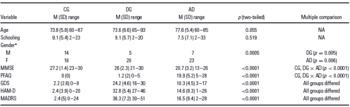
The demographic and clinical characteristics of the sample are shown in Table 1. The mean values for age and schooling level were similar across the three groups. Women predominated in the depression and AD groups. As expected, AD patients had lower scores on the MMSE and PFAQ. In contrast, controls and depression patients did not differ in MMSE and Pfeffer scores. All groups differed in GDS, HAM-D and MADRS scores, with patients in the depression group exhibiting the highest scores, whereas AD patients had scores which were between those of the control and depression groups.
Demographic and clinical characteristics of the sample

* CG, control group; DG, depression group; F, female; M, male; NA, not applicable.
ANOVA with Tukey's post hoc test.
* Chi-squared test.
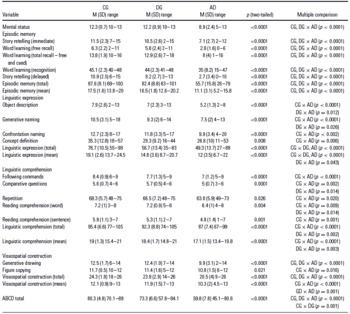
Table 2 shows the performance of the three groups on the ABCD, as well as the results of intergroup comparison. AD patients had the lowest scores in all constructs of the ABCD and had poorer performance than the depression group on most subtests except confrontation naming, concept definition, following commands, repetition and reading comprehension (sentence). The mean scores for the depression group were lower (although not statistically different) than those achieved by the controls in most subtests, while the performance of depression patients did not differ to that of AD patients on the above-mentioned subtests.
Performance of groups and intergroup comparison on the ABCD

CG, control group; DG, depression group.
ANOVA with Tukey's post hoc test.
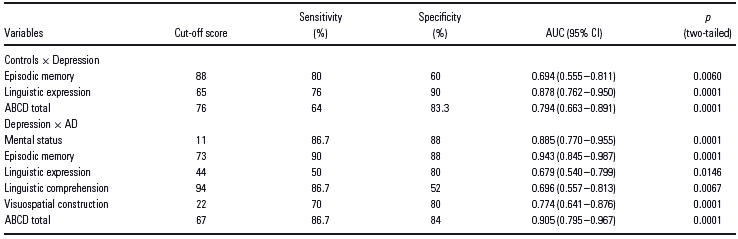
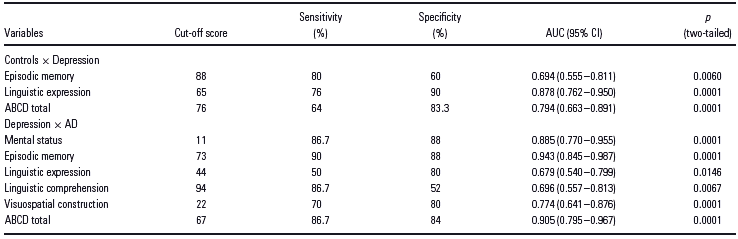
Table 3 shows the cut-off scores (with the respective sensitivities and specificities) that best discriminated controls from depression patients and depression from AD patients. The episodic memory and linguistic expression constructs were the best for discriminating depression patients from controls, whereas the mental status, episodic memory and visuospatial construction constructs were the best for discriminating between depression and AD patients. The ABCD total score proved highly useful for discriminating between the three groups.
Cut-off scores, sensitivity and specificity of ABCD constructs for discriminating between Controls × Depression and Depression × AD (only significant results are shown)
Discussion
Major depressive disorder is common in the general population, having an estimated lifetime prevalence of 15–17% (20). Clinically significant depressive symptoms are present in 11–39% of older adults (Reference Copeland, Beekman and Braam21,Reference Lee and Shinkai22), while cognitive impairment is estimated to affect 17–36% of adults over 65 years (Reference Lee and Shinkai22–Reference Graciani, Banegas, Guallar-Castillon, Domínguez-Rojas and Rodríguez-Artalejo24). Elderly demented patients have shown an even higher prevalence of depression (24%) in epidemiological studies (Reference Lyketsos, Steinberg, Tschanz, Norton, Steffens and Breitner25). In our sample, AD patients had more depressive symptoms than controls, yet remained below the established cut-off scores for the diagnosis of severe depression.
A possible confounder in the interpretation of our data was the fact that the AD group was older than both the control and depressed groups (although not reaching statistical significance), reflecting a natural epidemiological tendency, as advancing age is one of the most powerful risk factors for the development of dementia (Reference Caccappolo-Van Vliet, Manly, Tang, Marder, Bell and Stern26). However, the ANCOVA showed that there was no significant effect of age on linguistic expression (p = 0.074), linguistic comprehension (p = 0.064) and visuospatial construction (p = 0.322), but this effect was detectable in mental status (p = 0.04) and episodic memory (p = 0.01), when comparing AD and depression groups.
It may be difficult to discriminate early dementia from depression based on the clinical and neuropsychological evidence (Reference Tsuno and Homma27,Reference Foldi, Brickman, Schaefer and Knutelska28) because similar cognitive and affective problems can occur in both mild AD and ‘depressive pseudodementia'(Reference Swainson, Hodges and Galton29). Some authors have stated that early- and late-onset depression may be clinically differentiated on the basis of the more pronounced impairment of executive function in the latter, as a result of frontostriatal dysfunction (Reference Butters, Whyte and Nebes8,Reference Herrmann, Goodwin and Ebmeier30). The pattern of cognitive impairment in the late-onset depression remains a matter of controversy because most studies available are modest or small in size and cognitive deficits tend to differ in both nature and severity, between and within studies (Reference Rose and Ebmeier31).
In this study, statistically significant differences between depression and AD groups were identified in most of the ABCD subtests (with AD patients performing worse) except in confrontation naming, concept definition, following commands, repetition and reading comprehension (sentence). The level of performance on these latter tasks by the depressed patients was between the levels attained by the controls and AD patients.
The best constructs for discriminating between depression and AD patients were episodic memory and mental status. The hallmark of AD is marked impairment in episodic memory, which may exist years before a clinical diagnosis of dementia is established (Reference Backman, Small and Fratiglioni32,Reference Chen, Ratcliff and Belle33), but these results are also likely to reflect the older age of the AD group.
Linguistic expression showed good specificity (80%), but low sensitivity (50%) for a cut-off score of 44. Linguistic comprehension had good sensitivity (86.7%), but low specificity for a cut-off score of 94. A more detailed analysis of the subtests embedded in each linguistic construct revealed that the subtest object description (taken from linguistic expression) was the best to differentiate both the groups, with a sensitivity of 80.6% and a specificity of 64% for a cut-off score of 6 (area under the curve, AUC = 0.716; p = 0.0053). Concerning linguistic comprehension, the subtest comparative questions was the most suitable for discriminating AD and depressed patients, with a sensitivity of 77.4% and a specificity of 72% for a cut-off score of 5 (AUC = 0.759; p < 0.0001). Nevertheless, the ABCD total score proved to accurately discriminate between AD and depressed patients, with a sensitivity of 86.7% and a specificity of 84% for a cut-off score of 67 (AUC = 0.905; p = 0.0001).
In some of the linguistic subtests on which the depression and AD groups tend to behave similarly [following commands, repetition and reading comprehension (sentence)], there is an increasing demand on attentional and working memory resources as the number of items (commands to follow, syllables to repeat, length and syntactic complexity of sentences to read) progressively increased and this might account for the resemblance between the groups. Confrontation naming is a task that relies on lexical access and semantic functions, both of which are compromised in AD. Few studies have addressed confrontation naming in depressed subjects, but impairment in this domain has previously been reported by Hill et al. (Reference Hill, Stoudemire, Morris, Martino-Saltzman, Markwalter and Lewison34) and Speedie et al. (Reference Speedie, Rabins, Pearlson and Moberg35) and corroborated by studies of late-onset depression patients (Reference Butters, Whyte and Nebes8). The concept definition task is extensive and is ‘free production' in nature, thus exerting a high demand on the patient's sustained attention and executive functions (including self-monitoring).
In our sample, the depression group had a poorer performance than the control group on most of the ABCD tasks, although this difference did not reach statistical significance. Nonetheless, it was possible to discriminate between these two groups based on the episodic memory and linguistic expression constructs, as well as the total score on the ABCD.
Linguistic expression was the domain that best discriminated between controls and depression, with a sensitivity of 76% and a specificity of 90% (cut-off score 65). The subtests, which most contributed to this differentiation, were the generative naming (a verbal fluency task) and concept definition, followed by confrontation naming and object description, but none of these tests alone achieved sufficient accuracy to allow a reliable differentiation between the groups (defined as an AUC > 0.7 in ROC curve analysis). However, the ABCD total scores showed good specificity in discriminating controls and depression groups (83.3%) for a cut-off score of 76.
Although most of the linguistic subtests rely primarily on lexico-semantic functions supported by attentional, working memory and executive functions, the linguistic expression construct includes subtests where the demand on executive functioning is higher than in the linguistic comprehension construct. Generative naming (a category fluency task), although generally regarded as a valid measure of semantic memory, relies heavily on executive function. In addition, the individual is required to perform this task within a limited period of time (1 min), which makes processing speed an important factor for good performance. Moreover, the semantic category used in the ABCD (means of transportation) poses an additional challenge in relation to the most broadly used ‘animal' category. As previously stated, concept definition and also object description are tasks based on ‘free production', thus demanding adequate executive control.
The episodic memory construct, although not suitable for differentiating controls and depressed patients because of its low specificity, discloses mild impairment in episodic memory in late-onset depressed subjects, as previously reported (Reference Butters, Whyte and Nebes8,Reference Herrmann, Goodwin and Ebmeier30,Reference Wilkins, Mathews and Sheline36).
Patients with late-onset depression have been described as having impairments in executive functioning, processing speed, episodic and semantic memory (Reference Sheline, Barch and Garcia9,Reference Herrmann, Goodwin and Ebmeier37–Reference King, Cox, Lyness, Conwell and Caine39). Sheline et al. (Reference Sheline, Barch and Garcia9) and Delaloye et al. (Reference Delaloye, Baudois and Bilbao40) believe that episodic memory impairment cannot be explained solely by processing resource decreases in late-onset depression patients, suggesting that a primary episodic memory dysfunction is present in this condition which could also account for the naming deficits.
In addition, it could be argued that the mean initial MMSE score of depressed patients of <24 might indicate that many of the subjects had dementia at the start of the study. However, the widely used MMSE cut-off score of <24 for dementia has not been corrected for age or education level. According to cut-off scores adjusted for age and level of education (Reference Brucki, Nitrini, Caramelli, Bertolucci and Okamoto41), the depression group was cognitively impaired at baseline but did not have dementia.
In conclusion, we have found that late-onset depression may impair language functions, especially those related to linguistic production. These specific functions rely on semantic memory and executive functions and these deficits may resemble the early stages of AD. However, depressed elders maintain their learning capacity despite the disease, whereas AD patients exhibit a marked deterioration in this domain. We also conclude that comprehensive batteries such as ABCD, which assess linguistic functions associated with their interrelated cognitive functions (such as memory and visuospatial abilities), are useful instruments for detecting language impairment in late-onset depressive patients yet reliably distinguish them from patients with AD. Further studies involving larger samples are warranted in order to confirm these findings, as are follow-up studies in depressed patients after remission of symptoms as well as those comparing depression and other forms of dementia, especially vascular dementia.