Do legislatures in parliamentary democracies play a significant role in policymaking? If so, are all legislative actors equally able to exercise policy influence? In what circumstances will those who can affect legislative outcomes actually choose to do so? These questions are central to an understanding of representative government in parliamentary democracies. In parliamentary systems, legislatures are typically the only political institutions at the national level that are directly elected by—and thus accountable to—citizens. Furthermore, with only rare exceptions, parliaments must approve all major policy initiatives. And yet, scholars know remarkably little about the extent to which legislatures in parliamentary systems matter. Instead, political scientists with an interest in policymaking in these systems have placed primary emphasis on understanding politics at the government (cabinet) level (see Gamm and Huber 2002, 323). In one sense, this focus on governments is natural. The government appears dominant in the policymaking process, at least with respect to the introduction of legislation (Andeweg and Nijzink 1995, 171). Moreover, since elections usually do not yield a legislative majority for a single party, political elites must engage in a process of complex bargaining that typically results in the formation of multiparty coalitions, which must then strive to retain the confidence of a majority of legislators for the remainder of the parliamentary term. This combination of facts readily suggests that to understand policymaking in parliamentary systems, one must understand above all else the formation and dissolution of coalition governments. Thus, over the last four decades, increasingly sophisticated theoretical and empirical accounts of the “birth” and “death” of coalitions have come to dominate the literature on parliamentary politics. Importantly, these accounts have largely abstracted away from the continuing interactions between coalition partners in the legislative process.1
Important exceptions to this general trend include the work of Carrubba and Volden (2000), Heller (2001), and Huber (1996).
In this article, we argue that a stronger focus on legislative politics in parliamentary systems is indispensable for understanding policymaking in periods of coalition government. In particular, we argue that multiparty governments make use of legislative review procedures to resolve a central tension they face during their tenure—the need for partners with divergent preferences to make joint policy. In making our argument, we draw on, and contribute to, an extensive literature on the delegation problems inherent to modern democratic government. While several scholars have written on the relationship between citizens and government officials (e.g., Lupia and McCubbins 2000 and Strøm 2000), or between elected officials and bureaucrats (Huber and Shipan 2002), our argument focuses on agency problems that emerge between parties in a coalition. A number of recent studies have focused on the same tension (e.g., Müller and Strøm 2000 and Thies 2001) and have highlighted the important functions of cabinet-level institutions in mitigating agency problems within a coalition. Our argument differs from these studies in a significant way. While we do not deny the importance of cabinet-level institutions, we contend that coalition parties use legislative institutions for similar purposes. As a result, one of the central conclusions of our study is that legislatures in parliamentary systems play a much more influential role than is typically acknowledged in the comparative literature. Importantly, unlike studies that have emphasized that legislatures might play a significant role in parliamentary systems because they strengthen opposition parties (e.g., Powell 2000, Saalfeld 2000, and Strøm 1990), this article focuses on the central role that parliamentary institutions play in strengthening government parties that have been forced to delegate important agenda-setting powers to their coalition partners.
We begin the study with a simple model of the interactions between coalition partners that demonstrates that multiparty governments are likely to be plagued by “agency” problems created by delegation to cabinet ministers that increase in severity on issues that divide the coalition. We argue that the process of legislative review presents an important—but understudied—institutional opportunity for coalition partners to overcome these tensions. We then provide an empirical evaluation of our argument using original data collected from two parliamentary democracies that details how government bills have been altered in the legislative process.
COALITION GOVERNMENT, DELEGATION, AND AGENCY PROBLEMS
A central reason for focusing on the “life” of a coalition between formation and termination is that the ongoing policymaking process in coalition governments poses challenges that are typically more muted in single-party governments. Two features in particular make policymaking by coalitions problematic. The first is that coalition government requires parties with preferences that may diverge more or less on specific issues to pursue a common policy. As Strøm and Müller (2000) argue,
Coalition governments manifest some sort of bargain struck between their participating parties. Political parties, or more specifically their leaders, are likely to have different preferences over a broad range of issues, driven at least in part by their motivation to secure for themselves policy benefits, office benefits, and electoral advantage. All of these goods are likely to be scarce, so that not all demands can be satisfied simultaneously…. Electoral advantage is even more strictly constant-sum. Ultimately, one party's gain has to be someone else's loss. In some cases, all incumbent parties may be able to gain at the expense of the opposition, but, much more commonly, coalition parties are in some sort of mutual competition for votes. (257)
Thus, parties that participate in a coalition are engaged in a “mixed motive” game. On the one hand, they have reason to cooperate with their partners to pursue successful common policies. On the other hand, each party faces strong incentives to move policy in ways that appeal to party members and to the constituencies on which the party relies for support. Moreover, electoral calculations provide reasons to appear to work toward providing such policies even when party leaders realize that they may not be able to deliver them in practice. In short, the policy and position-taking incentives of coalition parties continually put them in competition with one another.
Managing the potential conflict engendered by these divergent preferences becomes a central problem because of a second feature of coalition government— delegation. Since the emergence of “modern” parliamentary government, members of the legislature have increasingly entrusted substantial authority to the prime minister and the cabinet (see Bagehot [1872] 1978, Bryce 1921, Cox 1987, and Wheare 1963). This delegation to the cabinet is most evident in the fact that legislative activity in parliamentary systems is centered around government bills (see Andeweg and Nijzink 1995, 171, as well as Gamm and Huber 2002, 323). However, the chain of delegation does not end here. While government bills usually require cabinet approval, cabinets do not “collectively” draft bills. The relatively small size of the cabinet coupled with a high collective workload means that the precise content and wording of a bill are usually decided by the cabinet minister under whose jurisdiction a bill falls (though the minister, of course, may work closely with civil servants in the ministry). In other words, coalition government typically involves delegation that provides considerable discretion to ministers in drafting legislation (Gallagher, Laver, and Mair 2001, 56; Laver and Shepsle 1994, 1996).
Inherently, for coalition parties that are not affiliated with a particular minister, delegation creates risks.2
To isolate the impact of tensions among coalition partners, we treat parties as unitary actors and abstract away from delegation problems that may exist within a party (e.g., Saalfeld 2000). Similarly, we abstract away from principal-agent problems between ministers and bureaucrats (see Huber and Shipan 2002).
Ministers may attempt to make use of their discretion over initial government bills to move policy in directions they favor but that are detrimental to the interests of other coalition members. Even where ministers do not expect to be successful in implementing a particular draft policy, they may want to use their ability to introduce draft legislation to “take a stand” that provides electoral benefits to their party (see Huber
1996). Other coalition parties, in turn, face strong incentives to scrutinize the initial legislative proposals made by individual ministers and to counteract, where necessary, the detrimental effects (from their perspective) of ministerial discretion. In other words, coalition parties face strong incentives to monitor, and if necessary to correct, the actions of “hostile” ministers.
3 The problem of delegation posed by ministerial discretion shares many features of the conventional “principal-agent” framework (Kiewiet and McCubbins 1991) that has been used to discuss agency problems between citizens and government officials (Lupia and McCubbins 2000; Strøm 2000) and between ministers and bureaucrats (Huber and Shipan 2002). Our approach differs in that we place primary emphasis not on asymmetric information (which creates opportunities for shirking in the traditional framework) but on incentives for ministerial position-taking. Nevertheless, the fundamental tension is the same: Ministers, acting as agents of the cabinet as a whole, may not work fully in the interests of all of their principals, thus creating the need for ex post oversight and correction.
The thrust of our argument will be that (under the right circumstances) legislative scrutiny plays a central role in this process. Before turning to the particulars of parliamentary scrutiny, we formalize the delegation problem confronting coalition governments and discuss the circumstances under which ministers are likely to (ab)use their discretion as well as the circumstances under which other members of the coalition will try to counteract ministerial attempts to move policy or to take a position.
MODELING COALITION POLICYMAKING
In modeling the “delegation” problem confronting coalition governments, we focus on the tension created by the need for coalition partners to agree on government policy,4
At the extreme, coalition partners can, of course, choose to leave a coalition rather than agree on a common compromise policy (defined below). Implicitly, we assume that this “participation constraint” is met. Allowing exit would not substantially change the predictions of the model.
the policy and position-taking incentives of individual coalition parties, and the need to delegate to ministers. Consider a coalition composed of two parties (Party A and Party B), confronting a one-dimensional policy space.
5 Substantively, the focus on one dimension captures the fact that policymaking is typically departmentalized along jurisdictional lines with separate ministries drafting legislation that addresses specific policy issues (see Laver and Shepsle 1996). It also simplifies the analysis. However, the argument extends to multidimensional policy spaces.
Assume that Party A's ideal point is located at 0 and Party B's ideal point is located at
X > 0 (thus, as
X increases, the policy divergence between the two parties grows). Because they can only adopt one policy on the issue at hand, the two parties must agree on a policy to implement. Naturally, we would expect the parties to agree on a compromise inside the Pareto set (defined by [0,
X]), but the precise location of the “coalition compromise” will be determined by a bargaining process between the two parties. Although clearly central to an understanding of coalition government, we are not directly concerned with this bargaining problem here. Rather, we are interested in the
derived problem posed by ministerial discretion. Therefore, we will assume an exogenously defined “coalition compromise” in the Pareto set, given by
X/
t, where
t ≥ 1. When
t = 1, the compromise position is equal to the ideal policy of Party B. As
t increases, the compromise position moves toward the ideal point of Party A, e.g., at
t = 2, the compromise solution “splits the difference” between the parties.
6 For example, if the well-known proportionality norm that appears to govern portfolio allocation (Browne and Franklin 1973) also applies directly to policy bargaining, t would equal the reciprocal of the seat share contributed to the coalition's parliamentary weight by Party B.
The coalition compromise X/t can be interpreted in a number of ways. Most obviously, multiparty governments usually negotiate detailed coalition agreements and government policy declarations at the outset of their tenure (Strøm and Müller 2000; see also the essays in Müller and Strøm 2000). The policy positions enshrined in these documents can be thought of as the “compromise positions” to which the parties have agreed and that the coalition has pledged itself to implement. Alternatively, for issues that are not negotiated by parties ex ante and that emerge over the life of the coalition, we can think of the coalition compromise as the policy that would emerge if the coalition parties engage in a “full-fledged” bargaining process, making use of the resources each party has available in trying to shape the final policy outcome. We assume that parties have the same expectations about the location of the compromise policy.
The central tension inherent in coalition government that we want to explore concerns the implementation of these coalition compromises. This tension arises because delegation within the cabinet implies that ministers (aided, of course, by bureaucrats within the respective ministries) play a leading role in drafting the required legislation. Ministers may be tempted to exploit their position in the policymaking process to move policy away from the agreed-on compromise. Anticipating such “shirking,” other coalition partners in turn may have incentives to monitor, and perhaps to counteract, the work of ministers. In short, delegation to ministers creates agency problems for coalition governments that may require institutionalized solutions for “holding ministers accountable.” Consider the following simple game that captures this dynamic:
- A minister belonging to Party A introduces a policy proposal w∈[real ].
- In response to A's proposal, Party B has two courses of action available. It can choose to accept the proposal, or it can expend resources to insist on the coalition compromise X/t and to amend A's proposal accordingly. Doing so demands a resource cost c>0.7
Note that the model makes no assumption about the precise institutional structure in which this “amendment process” takes place. As we explain below, parties can engage in amendment activities in a variety of institutional settings. The specific focus of our investigation will be the legislative process. The parameter c, discussed in more detail below, captures resource and opportunity costs incurred in challenging the ministerial draft (see also Strøm 2000, 272).
- The final policy that is adopted, p, depends on B's reaction to A's proposal. If B expends no effort, the original proposal is implemented and p = w. If B chooses to challenge A's proposal, the coalition compromise is implemented and p = X/t. We assume that Party A must pay a cost of d≥0 if its original proposal is overturned.8
Thus, d captures opportunity costs that have been incurred in drafting a proposal that ultimately does not become law as well as any “audience” costs that the drafting minister/party might suffer by appearing unable to implement the original version of the bill.
We assume that parties are motivated by three considerations: the policy that is adopted, potential position-taking benefits, and the costs that are incurred in the policymaking process. Because Party B does not draft the original bill, we assume that this party's payoff depends simply on the final policy that is adopted, net of any costs that may be expended to challenge and amend the minister's original bill. As is common in spatial models, we treat policy preferences as a linear function of the Euclidean distance between the ideal point of the party (X) and the final policy (p) that is adopted:9
Euclidean preferences are risk-neutral. However, the results do not hinge on this assumption. The substance of the results remains the same with risk-averse preferences, although the equilibrium conditions become more complex.
Party A, which introduces the original government bill, faces a slightly different situation. Like Party B, it derives a payoff from the final policy that is adopted, but additionally, the act of introducing the initial “government bill” provides Party A with the opportunity to reap position-taking benefits. The “unveiling” of a legislative initiative by a minister generally receives considerable media attention, and parties can use bills they initiated to “claim credit” during election campaigns. As a result, by introducing a bill that corresponds closely to its own (and its constituents') ideal policy, Party A can distinguish its proposed policy from the coalition compromise and claim credit for attempting to pull policy toward the preferred outcome of its constituents. We incorporate these added incentives for the proposing minister by assuming that there are two policy-based components to A's utility function. The first term captures the distance between the final policy (p) and Party A's ideal point, while the second term captures the distance between Party A's ideal point and the original proposal (w) made by Party A. This term is weighted by the parameter a > 0, which captures the position taking benefits that are available to the minister's party. As a increases, Party A is punished more severely for making a proposal that deviates from its ideal point, and consequently, the importance of position-taking increases relative to the final policy that is adopted. Finally, we assume that having its draft amended by Party B imposes a cost of d > 0 on Party A. Thus, Party A's preferences are given by
The game has a unique subgame-perfect equilibrium. Before presenting the equilibrium strategies, it is useful to define two thresholds (the substantive interpretation of these thresholds is discussed below). Specifically, the “position-taking threshold” is defined by
and the “amendment threshold” by
The following proposition summarizes the equilibrium strategies:
Proposition: The following strategy profile constitutes a subgame-perfect equilibrium.
Party A: If
, set w = 0. If
and
, set w = 0. If
and
, set
.
Party B: If
, accept w. If
, challenge and amend A's bill.
Consider the intuition underlying this equilibrium. Because rewriting the proposal made by Party A is costly, Party B is willing to accept some deviation from the coalition compromise policy. How much “drift” B is willing to tolerate depends directly on the costliness of “correcting” the minister's bill relative to the “damage” imposed by ministerial divergence. The “amendment threshold” (
) captures this tradeoff. As long as Party A's proposal lies above this threshold, B is willing to accept the minister's draft bill. Note that when the policy divergence between the two parties is sufficiently modest relative to the cost of amending the ministerial proposal, c, the threshold may be negative. In this case, Party A can implement its most preferred policy without being challenged. That is, the cost of challenging the minister may be so large relative to policy divisions between the parties that Party B is willing to tolerate Party A's ideal point rather than to insist on the coalition compromise of X/t. Thus, we observe the kind of ministerial autonomy portrayed by the Laver and Shepsle model (1996), in which parties are essentially able to dictate policy in the jurisdictions under their control. In other words, the Laver and Shepsle model, which predicts ministerial autonomy for all levels of policy divergence, emerges as a special case in our model if c is so large that
for all coalitions. For c small enough that
, however, Party B will find it worthwhile to challenge and correct the ministerial draft if Party A's draft deviates “too far” from the coalition compromise (i.e., if the draft bill falls below the amendment threshold).
Party A, in turn, faces the following consideration. It could draft a bill that does not induce Party B to challenge and rewrite the bill by making a proposal that only approximates the coalition compromise but that is nonetheless acceptable to Party B. Because there always exists such a proposal that is closer to A's ideal point than the coalition compromise, Party A is able (within limits) to exploit its agenda-setting power to bias policy in its favor. In this case, we observe some degree of ministerial drift (but not autonomy) and no challenges by the coalition partner.
The drawback of such a proposal is that it may not maximize position-taking benefits because the minister may have to introduce a draft that deviates from A's ideal point (if
to avoid a challenge from its coalition partner. In such a situation, Party A could pursue the alternative strategy of introducing a bill that maximizes position-taking benefits (setting w = 0) but that will be amended to the coalition compromise by Party B. The “position-taking threshold” indicates when Party A will choose to pursue this second alternative. Importantly, Party A will choose to “take a position” (thereby triggering an effort by B to revise the minister's draft) when the policy distance between the parties grows sufficiently large (i.e.,
). That is, substantial policy divergence within the coalition will trigger ministerial drift from the coalition compromise that is sufficiently large that other coalition members will expend effort to reign in ministerial discretion.
CHALLENGING MINISTERIAL DISCRETION
The model suggests that whether the tension created by delegation to cabinet ministers becomes “problematic” for multiparty governments is largely a function of policy divisions within the coalition. If the coalition is sufficiently divided, ministers face strong incentives to deviate from coalition compromises to “take a position,” triggering attempts by other coalition members to challenge and amend draft legislation to bring it in line with the coalition compromise. In the next section, we present a systematic test of this prediction. First, however, we need to unpack the notion of “challenging and amending” ministerial drafts. The claim that coalition partners possess resources that allow them to challenge and amend the draft legislation introduced by ministers is central to the analysis. But what are these resources? What avenues can coalition parties pursue in counteracting ministerial discretion?
A prominent solution that has recently received some attention from scholars focuses on institutional mechanisms that operate at the cabinet level. For example, Thies (2001) has argued that coalition partners can make use of “junior ministers” (JMs) to shadow ministers belonging to other parties. Similarly, the essays in Müller and Strøm 2000 provide some detail on the use of JMs, as well as the use of cabinet committees and “inner cabinets” to manage the potential conflict created by the combination of ministerial discretion and divergent coalition preferences. The model developed above is directly relevant for such cabinet-level institutions and suggests that these mechanisms will be activated more frequently when the policy divergence between coalition partners is large.
While we believe that cabinet-level institutions may play an important role in managing intracoalition conflict, we also contend that there is a second institutional arena for resolving conflict within multiparty governments that has received surprisingly little attention from scholars. In particular, we focus on the role of institutions at the legislative level that provide coalition partners the opportunity to challenge and amend ministerial policy proposals. Several reasons suggest that a stronger focus on legislative institutions is warranted. One is connected to the size of the cabinet. The same time and resource constraints confronting the cabinet that make delegation to individual ministers necessary in the first place also hinder the ability of ministers to monitor and challenge one another directly. As Thies (2001) points out, for example, smaller parties are often constrained in their ability to use JMs as an effective monitoring tool because they have only a small number of JMs to assign (589). As a result, the costs of trying to monitor hostile ministers from within the cabinet (c) may be so high that coalition partners are effectively forced to rely on mechanisms outside the cabinet to control ministerial discretion. A second reason derives from the formal rules regarding policymaking in parliamentary systems. All major legislation requires the explicit assent of parliament. Thus, while cabinet-level institutions might be used to amend draft bills, these institutions cannot ensure passage of the revised bill until the final parliamentary vote has occurred. Where coalition parties feel the need to counteract “ministerial drift,” they may therefore choose to do so during the legislative process. Indeed, as the descriptive statistics in the next section will show, government bills typically undergo a substantial amount of change in the course of legislative review.
Perhaps the most important reason to focus on the use of legislative scrutiny to counteract ministerial discretion is that parliaments often provide considerable opportunities for this purpose. In particular, many parliamentary systems with proportional representation rules and coalition governments feature systems of strong standing committees that closely correspond to ministerial jurisdictions.10
For example, see Table 2.2 in Powell 2000, 34. The table strikingly reveals the powerful correlation between strong committee systems and parliamentary systems that operate under PR and typically produce coalition governments. The weakest committee systems overwhelmingly occur in majoritarian systems that largely rely on single-party government.
Such systems provide opportunities for committee members to acquire the policy expertise necessary to revise complex legislation. These committees typically have broad powers, including the right to schedule hearings, call witnesses, subpoena relevant documents, and the ability to propose amendments. As a number of scholars have stressed, these institutional provisions provide one important avenue for
opposition parties to influence policymaking (Powell
2000, 32; Saalfeld
2000, 365; Strøm
1990, 71). Another—much less emphasized—aspect of these institutional structures is that they provide a tool that parties in a governing coalition can employ to manage the risks posed by ministerial discretion. Parties can rely on members of their legislative faction to investigate the anticipated consequences of a proposed bill, to study the justifications offered by the drafting minister, to consider available alternative policies, and to draft amendments to ministerial drafts. Moreover, the work of committees typically proceeds behind closed doors, further reducing the cost of challenging and amending ministerial drafts from within the coalition. In other words, parliamentary scrutiny can play a central role in allowing coalition members to counteract the potential problem posed by ministerial discretion. Anecdotal evidence suggests that this is indeed the case. For example, Paterson and Southern (
1991) have observed with respect to Germany that “parliamentary groups of the coalition parties do not accept uncritically government proposals, particularly when such proposals derive from ministries held by another party to the coalition” (120). Naturally, the institutional structure of the legislative process may have significant implications for the efficacy of this mechanism in “correcting” ministerial drafts (i.e., the parameter
c is a function of these institutions).
In summary, our analysis of the central tension in coalition government between the agreement to pursue a compromise policy and the desire (and, if left unchecked, the opportunity) of individual ministers to move policy in directions favored by their respective parties suggests that coalition members will actively monitor, and if necessary correct, the policies proposed by their partners. Moreover, our model suggests that the incidence of amendments to ministerial drafts should become more pronounced as the level of policy disagreement between parties increases. As other scholars have emphasized, such correction may be achieved through cabinet-level institutions. Significantly, we argue that it may also occur during the legislative process. In the remainder of the article, we subject this hypothesis to systematic cross-national analysis.
THE DATA
Testing our argument requires an empirical analysis of the changes made to ministerial draft bills in the course of parliamentary review. To this end, we have constructed an original dataset that details all the modifications made to government-sponsored legislation between introduction and final resolution in Germany (1983–94) and the Netherlands (1982–94).11
We restrict our empirical analysis in this study to the changes made to bills in the lower chamber of parliament, as this is the arena in which most coalition bargaining takes place.
The main advantage of focusing on these countries is that they are similar in terms of a number of coalition-specific features and institutional rules that, in addition to the policy differences between coalition parties, may be relevant in explaining the alterations made to government bills. For example, during our time frame, both countries were governed by coalitions that controlled a majority of legislative seats and contained no surplus members.
12 The three governments in the Netherlands were composed of the CDA and VVD (1982–86, 1986–89) and the CDA and PvdA (1989–94). The three governments in Germany were all coalitions of the CDU/CSU and FDP (1983–87, 1987–90, 1991–94).
Both countries are nonmajoritarian (or “consensus”) democracies with proportional electoral systems and multiple parties that share a number of legislative institutions that strengthen the role of legislators in policymaking. For example, both the
Bundestag and the
Tweede Kamer feature a large number of specialized committees (on which seats are proportionately distributed among parties) with jurisdictions that “shadow” those of government ministries (Inter-Parliamentary Union
1986). The agenda for committee deliberation and plenary debate is determined by the chamber itself (the Netherlands) or by a committee of the chamber in which parties are proportionally represented (the “Council of Elders” in Germany) (Döring 2001). Further, in neither country are committee powers restricted by a prior decision of the plenary on the bill's general principles (Mattson and Strøm
1995). Finally, at the final voting stage on ordinary legislation, the lower houses in both countries employ simple majority decision rules, have the same quorum requirements, and use identical voting methods (a “successive” procedure) on bills and any proposed amendments (Rasch
2000).
13 One potentially relevant procedural difference between the legislatures in Germany and the Netherlands concerns the redrafting authority of committees. We discuss this issue in more detail later in this section.
It is also worth noting that with respect to each of these institutional features, the plurality of parliaments among European democracies fall into the same general category as Germany and the Netherlands. Moreover, most European democracies in the postwar period, just as Germany and the Netherlands, have been governed by minimal winning coalitions (Woldendorp, Keman, and Budge 2000). We therefore believe that these two countries are fairly representative of other European parliamentary democracies in a number of important ways. At the same time, the obvious drawback of our “control by design” strategy is that we will not be able at this juncture to assess the impact of alternative institutional arrangements and coalition attributes on the extent of bill modification. We return to this matter in the conclusion.
Our design also has the advantage of extending over a relatively small number of years, making our investigation less prone to unmeasured temporal effects. Moreover, the choice of time frame allows us to use a fairly recent expert survey conducted by Laver and Hunt (1992), which provides extensive information on both the policy positions and the saliency weights for a large number of parties on a variety of issues. More specifically, each country expert contributing to the study located parties in his or her respective country on a 20-point scale in eight distinct policy areas. They also assessed the saliency that parties assign to each policy area, also on a 20-point scale.14
Like Müller and Strøm (2000), we consider the Laver and Hunt study “the most suitable exemplar of expert judgments” (9). The survey is comprehensive and methodologically rigorous. Although one drawback of expert surveys is that judgments may be “contaminated” from observing party behavior, we view this as less problematic in our case due to the relative lack of information available on changes made to ministerial policy proposals in the legislative process. Moreover, the main alternative to expert surveys, the content analysis of party manifestos conducted by the Comparative Manifestos Project (CMP), has several problems that scholars have increasingly come to view as troublesome. These include the lack of consensus over how to generate policy positions from data that were originally intended to measure issue saliency (Janda et al. 1995), the “ambiguous methodological status of the coding scheme” used to place manifesto quasi-sentences into policy categories (Laver and Hunt 1992, 31), and the substantial amount of intercoder unreliability (Volkens 2001). Also problematic for our purposes is that CMP researchers typically excluded parties that they viewed as “noncoalitionable,” including all far-left parties and far-right religious parties in the Netherlands.
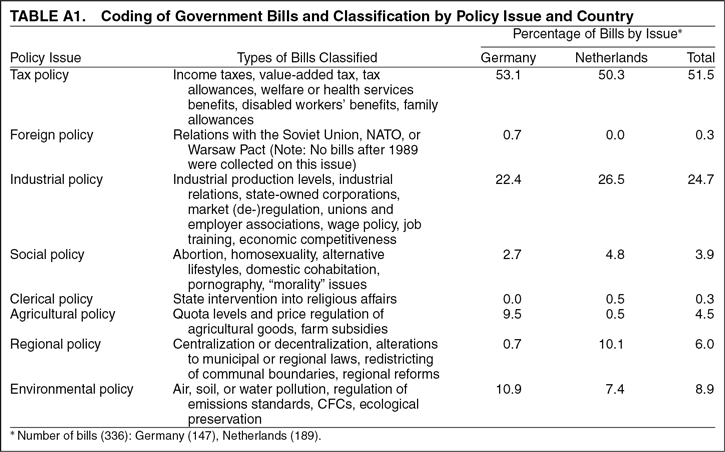
We selected our sample of government bills by starting with the full set of bills introduced in our time frame and then eliminating certain types of bills from consideration. Specifically, we excluded budget bills, budgetary adjustment bills, and bills proposing amendments to the constitution because the rules of procedure associated with them are different from those associated with ordinary legislation (Inter-Parliamentary Union 1986). Of the remaining bills, we excluded any that we could not reasonably classify into the eight policy areas from the Laver and Hunt study. The final dataset consists of 336 bills, each of which is classified into one (and only one) of the eight issue categories. (Examples of the types of bills coded into these categories are given in the Appendix.)
The thrust of our argument is that delegation to cabinet ministers poses a principal-agent problem for coalition governments, that this problem is particularly pronounced on issues that divide the coalition internally, and that parties will take advantage of opportunities presented by the legislative process to counteract the negative effects of delegation to ministers. Moreover, our argument implies that we should see more such “corrective” activity on bills that divide the coalition. As a result, our empirical analysis focuses on the degree to which ministerial drafts of government bills are altered in the course of legislative review. Developing a measure of how bills have changed thus requires a comparison of the final version of the bill adopted by the legislature to the version of the bill drafted by the proposing minister.
Ideally, a summary measure would allow us to assess fully the substantive policy impact of changes made to a draft bill. To make such an assessment, however, we face a rather thorny issue. Specifically, given the technical nature of most modern legislation, grasping the policy significance of changes to a draft bill by classifying the substantive content and language of such changes requires extensive expertise in the policy areas dealt with by the bill. Of course, the issue at the heart of the delegation problem in modern parliamentary systems is that a high level of expertise across multiple issue areas is extremely hard to come by, even for seasoned legislators and cabinet ministers. Naturally, the situation is even worse for political scientists, and any measure based on our perceptions of substantive policy impact is therefore bound to be highly unreliable, especially when applied to a large number of bills across a variety of policy areas.
Given this, we focus instead on developing a more objective measure of change, which we define as the number of article changes made to the draft version of a government bill. Specifically, the measure we will be using as our dependent variable is defined as Number of articles altered (or deleted) in the draft version of bill + Number of new articles added to the draft version of bill.15
In constructing this measure, we did not count any minor copyediting changes made to a bill, such as corrections of spelling, capitalization, and punctuation.
The dependent variable is thus an integer that is bounded from below by zero (a case in which a draft bill is not altered at all in the legislative process) and unbounded from above.
16 Being unbounded from above, this measure allows us to distinguish between a draft bill in which every article is amended and a draft bill in which every article is amended and extra articles are attached, which we would view as a more significant degree of change.
This measure has several virtues. Most importantly, it should tap into the substantive impact of the changes made to a bill. Bills are normally subdivided into numerous articles, and each of these articles addresses a different substantive aspect of the bill. As a result, we believe that articles can justifiably be treated as the logical “policy subunits” of a bill. This belief is reinforced by the fact that final voting on the text of bills in parliamentary systems is normally conducted on an article-by-article basis (see Rasch
2000 for a review of voting procedures in several European legislatures). The second advantage of this measure is that it can be reliably coded by other researchers.
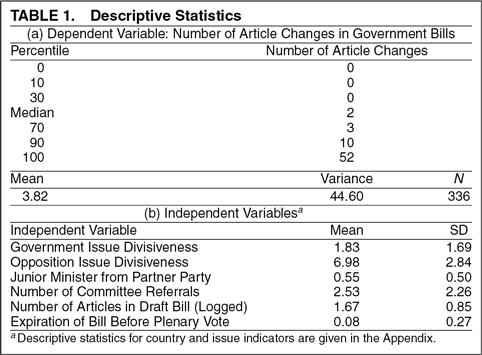
In Table 1a, we present descriptive statistics for this measure for our sample of government bills. We first note that a substantial portion of bills (approximately 30% of the sample) emerges from the legislative process completely unchanged. The remaining 70% of bills, however, are altered to varying degrees before they are passed into law. Specifically, half the bills in the sample receive more than two article changes in the legislature, and on average, there are approximately four article changes per bill. We view this as a substantial degree of change given that the average draft bill in the sample is about eight articles long.
We now turn to a discussion of how we constructed the key explanatory variable, as well as the set of control variables, that will be used in our empirical analysis of bill change.17
In addition to the variables discussed here, the event count modeling techniques we use to conduct the analysis, discussed in more detail in the next section, provide estimates for two parameters that concern the rate at which events (in our case, article changes) occur over the course of an observation period. The first of these represents the amount of “exposure” (i.e., the interval of time) over which events are accumulated and counted. Including an additional parameter in the model for the exposure variable and estimating it like any other parameter is seen as the most general means of controlling for variability in time intervals (Maddala 1983, 53; see also King 1989, 124–26). The second parameter represents the degree of overdispersion in the data, which occurs if the article changes made to a bill over the course of the legislative process are not independent. As these variables are not of primary substantive interest to us, we only briefly address their effects in our discussion of the analysis and findings.
(The descriptive statistics for these variables are given in
Table 1b.) Our central theoretical claim is that as the coalition becomes more divided on policy, coalition partners are more likely to make use of the legislative process to “correct” government bills. To evaluate this claim empirically, we draw upon the Laver–Hunt expert survey to develop a measure of the degree of policy divergence within the coalition. In constructing this measure, which we term
government issue divisiveness, we first used the 20-point Laver–Hunt position scores to calculate the absolute policy distance (in the relevant issue area) between the partner party in the coalition and the party that controls the ministry responsible for drafting the bill. (To account for the possibility that larger parties may be in a better position to initiate changes because they control more legislative resources, e.g., more committee assignments and votes in the chamber, this distance is weighted by the proportion of legislative seats controlled by the partner.) Second, we weighted this distance measure by a measure of the relative saliency coalition parties assign to the issues being dealt with by the bill.
18 Our measurement of government issue importance (saliency) was computed by first scaling the Laver–Hunt saliency scores so that an issue of average saliency for any government party receives a score of one. We then calculated a coalition-specific relative saliency score on each issue by summing these (weighted) party-specific scores across the parties in government. Our government saliency measure has the property that a score greater than one indicates a relatively more salient issue for the coalition, while a scaled score less than one indicates a relatively less salient issue.
The purpose of this final weighting is to account for the possibility that whether a given bill is sufficiently divisive to prompt parties to engage in position-taking and amendment activity may depend on the degree to which parties care about the issues under consideration.
We also take into account a number of other variables we believe should be relevant in explaining the changes made to government bills. First, it is possible that the divisions that exist between the party of the proposing minister and its coalition partners also exist between the minister and parties in the opposition (i.e., the minister's party could hold an extreme position with respect to all parties in the legislature on the issues at hand, not just the parties in the coalition). To isolate the effect of intracoalition policy differences on changes to government bills, we must therefore also consider the policy preferences of the opposition. This also allows us to assess the empirical strength of previous comparative research that has highlighted the opportunities legislative institutions provide to opposition parties for exerting influence over policymaking (Döring 1995; Müller and Strøm 2000; Powell 2000; Strøm 1990). To this end, we have constructed a variable (developed along the same lines as the government divisiveness variable) that measures the policy distance between parties in the opposition and the minister responsible for initiating the bill (opposition issue divisiveness). If the opposition does possess significant influence over policymaking, we should expect to see more changes being made to those bills dealing with issues that greatly divide opposition parties from the party of the minister proposing them.
We also include an indicator for whether the ministry from which a draft bill is initiated contains a junior minister from the partner party of the proposing minister. Recall that, although we expect the legislature to be a central arena in which coalition parties amend proposals originating from ministries controlled by their partners, it is likely that changes in proposals are also made at an earlier stage, such as in meetings of the cabinet or of the relevant cabinet committees, or in the originating government department at the earliest drafting stages. While we cannot directly observe this presubmission process, we would expect a greater degree of amendment activity to occur at these stages, all else equal, the greater the level of information available to coalition partners concerning the actions of the originating minister and any feasible alternatives to the policies being proposed in the draft. As Thies (2001) and several contributors to the Müller and Strøm 2000 volume have pointed out, appointing junior ministers to a “hostile” ministry is a common means employed by coalition parties to gather such information and “keep tabs” on their partners. To the extent that junior ministers serve this purpose, we should expect that ministerial deviations from the coalition compromise are more likely to be “caught early,” and that accordingly there will be less need for change at the legislative stage. In other words, we expect the presence of a partner party in the ministry drafting a bill to reduce the number of changes made to the bill in the legislature.
Another control variable we incorporate into the model is the number of committees to which a government bill is referred. It is quite common for bills to be referred to more than one legislative committee. In our sample, between two and three committees, on average, are assigned the task of reviewing a government bill. In general, we expect to see more changes made to bills, other things equal, the greater the number of committees involved in the review process. That is, the greater the number of legislators from a party who are able to scrutinize a minister's proposal, the greater the likelihood that deviations from the coalition agreement can be caught and corrected.
We include two other variables that take account of the amount of material and time legislators have to work with when they are reviewing a government bill. The first of these variables, the number of articles in the draft version (which we log in the statistical analysis), is meant to account for the possibility that draft bills with many articles are likely to have more articles changed than draft bills with few articles. Even though our measure of the dependent variable allows article changes to exceed the number of articles in the original bill, we believe it is probably easier for legislators to rewrite an existing article than to add a new one. Thus, we would expect a positive relationship between the number of draft articles and the number of articles changed. Second, we include an indicator for the expiration of a bill before the plenary vote. For our purposes, a bill is defined as expired if it does not reach the final voting stage in the lower house by the time the governing coalition leaves office. Naturally, we expect to find that such bills have not been changed as extensively as bills that received a full review in the legislative process.19
There are 26 such bills in our sample. In these cases, since we have no final version of the bill to use in our comparison, we count the number of article changes in the bill that had been adopted at the committee stage. Dropping these bills entirely from the sample does not change our findings in any appreciable way.
As discussed earlier, we have focused our attention on Germany and the Netherlands because of their similarities in a number of important respects. That said, we recognize that these two countries (or any two countries, for that matter) will not be completely alike in terms of all the details of the review procedures used to scrutinize legislation. For example, one potentially important difference in the legislative processes is that in Germany, a bill may be altered by a majority of committee members before it is sent to the floor, while in the Netherlands, committee members can only offer amendments to bills in their deliberations, which are then subject to a majority vote of all legislators at the plenary stage. Because this difference allows correction of ministerial drafts “behind closed doors” in Germany (which would imply a lower cost of revision), we might expect to see more extensive changes being made in the German case. Naturally, having just two countries in the study means that we can address such differences only in a limited way—namely, by including a country indicator variable in the analysis—and that we must be cautious about drawing inferences concerning the effects of different legislative procedures solely on the basis of this indicator.20
Importantly, we would not expect the presence or absence of committee redrafting authority to alter the nature of the relationship between bill change and coalition policy divergence. That is, regardless of whether the changes made to bills occur primarily at the committee stage or at the floor stage, we would expect to see a greater number of them on more divisive legislation. Nonetheless, as a robustness check, we also investigate in the empirical analysis whether “depooling” bills in the two systems has any impact on our conclusions.
Finally, we include separate indicators for the particular issue area addressed by a bill in recognition of the possibility that bills dealing with certain types of issues are always changed more or less extensively, regardless of the policy preferences of coalition partners. This could occur for a variety of reasons. For example, one possibility is that some types of issues are inherently more complex than others, thereby requiring greater informational resources from legislators to initiate changes. Another possibility is that outside lobby groups or advisory bodies are better organized in some policy areas than in others, and consequently, the information provided to legislators by these groups will make proposing feasible changes to government bills more or less difficult to achieve.
ANALYSIS AND FINDINGS
We use an event count model (specifically, the negative binomial) to assess the empirical validity of our argument. Event count models have become the standard approach in political science applications where the question of interest concerns the number of events that occur over a particular period of time, such as in the present case, where we focus on the number of article changes made to a bill over the course of the legislative process. In most event count formulations, the systematic component of the parameter λi, which is defined as the rate of event occurrence for an observation period i, is expressed as an exponential function of a set of covariates in X. Thus, for a random event count Yi, the rate of event occurrence is defined simply as λi = eXi β. The stochastic component of λi is most often assumed to follow the Poisson distribution, which implies that the events accumulating during the observation period are conditionally independent and that the rate of event occurrence is homogeneous across any given time period. These are clearly strong assumptions that are probably violated in our case. In particular, we expect that once party groups have expended the legislative resources to make one substantive change to a government draft bill, it is marginally less costly to make several more changes. This is known as positive contagion, which results in overdispersion in the random event count, Yi.21
That is, the variance of Yi will be greater than its mean. The Poisson distribution, however, restricts the variance to equal the mean (equidispersion). The costs of incorrectly assuming equidispersion are standard errors that are generally biased downward (King 1989).
The general solution for dealing with overdispersion involves the use of a distribution known as the negative binomial, which allows λ
i to vary across an observation period (see King
1989) and which allows for estimation of the degree of overdispersion as a parameter from the data.
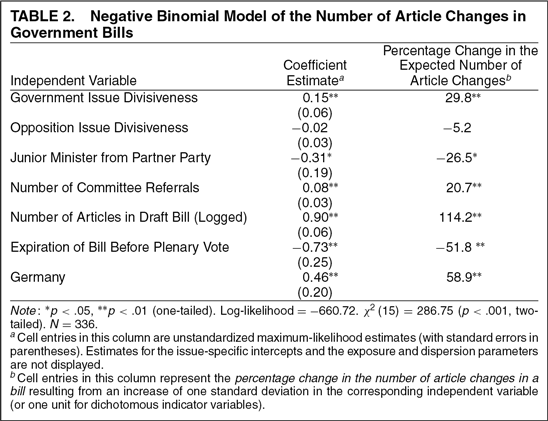
In Table 2, we present the results of the negative binomial analysis. In column 2, we present the parameter estimates for our independent variables, expressed in terms of their relationship to the number of article changes.22
The coefficient estimates for the issue-specific intercepts and the exposure and overdispersion parameters are not displayed (but are available upon request). Most significantly, these results show that the dispersion parameter from the negative binomial model (with a coefficient estimate of 0.41 and a standard error of 0.07) is statistically different from zero (p<.001). This implies that we can safely reject the null (Poisson) assumption of independence and homogeneity in the article changes made to a bill over the period of legislative review.
A positive coefficient implies that an increase in the level of the associated independent variable will increase the number of articles in a bill that are changed in the legislative process, while a negative coefficient implies a decrease in the number of article changes. As with most other nonlinear models, the coefficient estimates from an event count model do not lend themselves to a particularly intuitive interpretation. To assess the substantive significance of our findings, we therefore focus on two quantities that are readily interpretable. First, since the negative binomial is a log-linear model, it permits an odds ratio (or relative risk) interpretation of the estimated coefficients. Accordingly, in the third column in the table, we re-express the parameter estimates for all variables in terms of the percentage change in the expected number of article changes in a bill, which is calculated as [100(
eβ (x + δ) +
eβx)]/
eβx for a change of δ units in the associated independent variable,
x. (We set δ equal to one standard deviation for continuous variables and one unit for dichotomous indicator variables.) Following our discussion of these effects, we then show how a change in our main variable of interest, government issue divisiveness, affects the
predicted number of article changes made to the typical government bill in our sample.
One of the first messages we draw from the results in Table 2 is that policy divisions between coalition partners have the expected impact on the number of article changes made to government bills. The findings are consistent with our argument that bills dealing with issues that are more divisive for the government are changed more extensively in the legislative process. Specifically, from the third column in the table, we see that over any given period of legislative review, a one–standard deviation increase in issue divisiveness for the coalition increases the expected number of article changes in a bill by approximately 30%.23
In ancillary analysis, we strip the coalition divergence variable of its saliency and seat weights, but we find that this makes virtually no difference in the results reported in Table 2.
In contrast, we find no evidence that opposition issue divisiveness has an impact on changes in government bills. This null finding is at odds with much of the conventional wisdom in comparative research that portrays legislatures in these “consensus” systems as arenas in which opposition parties can exert real influence in policymaking. If opposition parties in fact have the power to influence policy in meaningful ways, then we should expect to see them use it to a greater degree on those policy proposals that are presumed to deviate more widely from their preferred policy outcomes. Our finding that they are not, in fact, able to effectuate greater change in conflictual policies is all the more striking when placed in the context of the descriptive statistics presented in Table 1, which show that, on average, the issue divisions between opposition parties and the party of the proposing minister are almost four times the size of issue divisions within the cabinet.
Significantly, we also find that bills drafted in government departments where the proposing minister and junior minister come from different parties are changed less extensively in the legislative process than bills coming from departments having no coalition partner presence. Specifically, we see about a 27% reduction in the number of article changes in bills that come from ministries with this form of “power-sharing” at the top. This result fits nicely with the logic laid out by Thies (2001), who suggests that when coalition parties succeed in placing their own members in a position to serve as junior ministers in “hostile” ministries they are able to keep tabs on one another more effectively.
Another notable finding involves the number of committee referrals. We find that bills are changed more extensively in cases where several committees are reviewing a bill simultaneously. Specifically, for every two additional committees assigned to review a bill, the number of articles expected to be changed in the legislative process goes up by approximately 20%. The results also show that bills with more articles in the original draft ultimately experience a greater number of article changes than bills with few articles. Moreover, we see that bills that do not go through a full review in the legislative process have about half the number of article changes as bills that make it to the final voting stage. Finally, Table 2 shows that bills in Germany tend to experience more article changes than bills in the Netherlands. Earlier, we highlighted the redrafting authority of legislative committees in these countries as probably the most significant difference between their review procedures in the lower chamber. We stress again, however, that we must be careful in drawing inferences about the effects of specific procedural differences based on the results of a lone country indicator. For now, we simply note that our findings regarding the effects of coalition policy divergence hold even while taking country differences into account, and that further cross-national work needs to be done before we can draw valid conclusions about the role of legislative procedures in facilitating changes to government bills.24
Using the fractional pooling techniques suggested by Bartels (1996), we also check the robustness of the findings to our choice to pool bills across these two systems. In fractional pooling, each observation in a (country) subsample is weighted by a pooling fraction, γ, which reflects the degree to which one believes the observation should be discounted. Using multiple values of γ, we perform tests of parameter equality where the null hypothesis is that the fractionally pooled coefficient estimates are equal to the fully pooled estimates (γ=1) shown in Table 2. Fortunately, the results from this exercise show that even when γ=0 (i.e., when we run separate country-by-country regressions), the coefficient on government issue divisiveness in each country is positive (0.23 in the Netherlands and 0.44 in Germany) and statistically significant, and in no case are we able to reject the null hypothesis of parameter equality, with one interesting exception. Specifically, when we set γ=0, the coefficient on opposition issue divisiveness for German bills, which is negative and statistically different from zero, becomes statistically different from the slightly negative (but statistically insignificant) coefficient from the fully pooled model. Thus, in Germany, it appears that bills that separate opposition parties from the minister are discernibly less likely to be changed extensively in the legislative process.
We now return to considering the effect of our main independent variable of interest by investigating how different levels of coalition policy divergence affect the predicted number of article changes in government bills. We do this through the use of statistical simulations using the CLARIFY software (Tomz, Wittenberg, and King 2003). First, we simulate the model parameters based on the point estimates and variance–covariance matrix from the model in Table 2. We repeat this procedure 1,000 times. Then we use these sets of simulated parameters to generate a set of predicted values of the number of article changes for a low level of government issue divisiveness (one standard deviation below the mean level of divisiveness), holding all other variables at their means. This allows us to approximate the entire distribution of predicted values for this level of divisiveness. Then, using the same set of simulated parameters, we generate a set of predicted values of the number of article changes for a high level of government issue divisiveness (one standard deviation above the mean level of divisiveness), again holding all other variables at their means. This gives us a second distribution of predicted values.
In Figure 1, we present the results of these simulations for a bill of average length (about eight articles). The arrows indicate the median outcome in the predicted number of article changes for each level of divisiveness. As a comparison of the two curves shows, bills that divide coalition partners are predicted to be changed substantially more in the legislative process than bills that do not divide them. The median number of article changes made to a relatively divisive bill is expected to be twice as large as the number of changes made to a relatively nondivisive bill. Moreover, a considerable number of nondivisive government bills, over 20%, are predicted to experience no change at all, compared with only about 8% of divisive bills. Finally, we see that a substantial portion of divisive bills is expected to experience a large number of article changes. Compared to only 4% of nondivisive bills, approximately 15% of divisive bills are predicted to have at least as many article changes as there are actual articles in the draft bill. These predictive results obviously lend strong support to our central claim that policy divisions between coalition partners have a considerable substantive impact on the extent of changes made to bills in the legislative process.
Government Issue Divisiveness and Predicted Change in Legislation
CONCLUSION
The study of coalition government in parliamentary democracies has been divorced from the study of legislatures for far too long. Beyond taking account of the constitutional requirements that connect legislatures to the formation and termination of coalitions, coalition scholars have traditionally paid little attention to the role of parliaments in policymaking and governance. Similarly, comparative legislative scholars, impressed by the dominance of cabinet-sponsored legislation in parliamentary systems and the cohesive voting behavior of highly disciplined parties, have diagnosed a “marginalization of parliament” or “parliamentary decline” (see Gamm and Huber 2002). Our argument challenges this assessment. We move legislative politics to a more prominent position in understanding multiparty government by considering how coalition partners might use legislative institutions to achieve their separate, and often competing, electoral and policy goals.
In placing greater emphasis on the role of legislatures in parliamentary systems, our argument complements other recent approaches that have paid more attention to the interplay between parliamentary institutions and multiparty governance. The emphasis of these studies has primarily been to show that the legislative process bolsters the opportunities of opposition parties to wield influence over the direction of public policy. Thus, Strøm (1990) and Powell (2000) have highlighted the central role of strong committee systems for strengthening the opposition during the legislative process. In contrast, we have focused on the central role of the legislative process in strengthening government parties that have been forced by the requisites of modern parliamentary government to delegate important agenda-setting powers to their coalition partners. Such delegation creates inherent tensions between coalition partners that grow particularly strong on issues that sharply divide them. In part, coalition governments attempt to manage these tensions through cabinet-level institutions (Müller and Strøm 2000; Thies 2001). A key argument of our study is that the legislative process provides another important institutional device that coalition partners use to counteract the influence of ministers who may have incentives to draft bills that more closely reflect the preferences of their own constituents than the agreed-on coalition compromise.
In testing this argument, we drew on a unique dataset that tracks the legislative history of more than 300 government bills in two parliamentary democracies. These data allow, for the first time, a systematic analysis of the changes made to a large number of government-sponsored bills across a number of different issue areas. Consistent with our argument, this analysis demonstrates that ministerial drafts are likely to be changed more extensively in the legislative process the greater the level of policy divisiveness among parties that participate in the coalition. Perhaps surprisingly, we find no evidence that greater policy divergence between ministers and the opposition leads to more extensive change in government bills, despite the fact that there seems to be no shortage of bills that divide them.25
This fits nicely with our previous finding that greater division between the opposition and the proposing minister on a bill only slightly increases the odds that the bill will experience delay in the legislative process (Martin and Vanberg 2004).
Taken together, these findings suggest that the process of legislative review provides an advantage to parties that participate in government by allowing them to manage the tensions created by the need to govern jointly, but it may not provide as many advantages to parties relegated to the opposition benches as previously believed.
We make these claims bearing in mind two qualifications that warrant further investigation in future studies. The first is that our analysis has focused on situations in which coalition parties collectively control a legislative majority. A substantial number of governments in parliamentary democracies, however, control only a minority of legislative seats. By definition, such minority governments must depend on at least one opposition party to stay in office. A valuable extension of our argument would be to examine whether, and to what degree, the preferences of opposition parties matter in these situations. The second qualification is that we have confined our empirical analysis to “consensus” or “proportional” systems, which provide substantial opportunities for legislative review of government bills. Although these types of systems are predominant among parliamentary democracies in which coalition government is common (see Powell 2000, 34), we recognize that there is variation in the strength of legislative institutions, even among consensus systems. More significant from our perspective are the differences between consensus systems and their “majoritarian” counterparts. In majoritarian systems, the ability of parties to use the legislative process to review government bills is greatly diminished. Committees in these systems are relatively few in number, they are generally nonspecialized (with policy jurisdictions that only weakly correspond to those of government departments), and they are typically restricted in their ability to make major changes to government bills. As a result, coalition parties will have a more difficult time making use of the legislative arena to police their partners. We would not be surprised to find that multiparty governments in these systems rely more heavily on cabinet-level institutions to resolve intracoalition conflicts and/or that these governments more closely resemble a pattern of “ministerial autonomy” than the pattern of “ministerial correction” uncovered in this study.
In conclusion, our findings are significant because they suggest a perspective on legislative institutions in parliamentary systems that has received little attention to date. The same legislative institutions that have traditionally been associated primarily with opposition influence also play a central role within coalition governments by enabling parties with divergent preferences to pursue compromise policies successfully. Parliaments are important not only as fora in which the government and opposition interact. The legislative process also provides an institutional mechanism that may be central to the ability of coalition governments to solve intracoalition conflicts and to contain the potentially detrimental effects of delegation to ministers. Naturally, our results represent only a beginning, and in future work we hope to explore more fully the implications of the qualifications noted above for the ability of coalition governments to “govern jointly.”
We thank the National Science Foundation for supporting this research (Martin, SES 0241466; Vanberg, SES 0241536). We also thank Randy Stevenson and seminar participants at Emory University for their comments on a previous version.






Comments
No Comments have been published for this article.