Introduction
Financial challenges brought up by natural disasters have increased substantially in recent decades with increased exposure to disasters and individuals’ financial preparedness as a critical component of a disaster-resilient society. Reference Cutter, Ahearn and Amadei1,Reference Hallegatte, Vogt-Schilb, Rozenberg, Bangalore and Beaudet2 Financial preparedness could help to absorb unplanned, short-term expenses, and could enable individuals to adopt mitigation measures and take protective action. Reference Wang3,Reference Eisenman, Cordasco, Asch, Golden and Glik4 Financial preparedness also contributes to reducing the risk of falling into poverty as a result of experiencing a disaster. Reference Hallegatte, Vogt-Schilb, Rozenberg, Bangalore and Beaudet2,Reference Wang3 Nevertheless, a study reported that only 67% of US households set aside some money for an emergency, and 50% of them had set aside no more than $500 for an emergency in 2018. 5 The recent experience of COVID-19 has further raised societal-wide attention to the importance of financial preparedness and how disaster experiences would affect future financial preparedness for disaster. Reference Warmath, O’Connor, Newmeyer and Wong6
According to the protective action decision model, previous disaster experience and disaster exposure could increase risk perceptions, and thus promote disaster preparedness. Reference Lindell and Perry7 Although some studies supported that exposure to disasters could increase risk perceptions and thus result in better disaster preparedness, few have examined the impact of the proximity of experiencing disasters (i.e., how close the disaster experiences were) on disaster preparedness. Reference Malmin8,Reference McNeill, Killian, Moon, Way and Betsy Garrison9 In this study, we used a nationally representative sample and investigated how the proximity of disaster experience was associated with financial disaster preparedness. It included the likelihood of individuals setting aside money for emergencies and the amount of money set aside.
Methods
Data used in this study were from the 2018 National Household Survey (NHS) conducted by the Federal Emergency Management Agency (FEMA). 5 The NHS includes a nationally representative sample to investigate individuals’ preparedness actions, attitudes, and motivations. The data are publicly available with no identifiers of individuals and thus exempt from IRB approval. 5
The original sample included 5003 adults (aged 18 years and older). After excluding 106 respondents who did not report information on financial preparedness, the working sample included 4779 respondents. There were 2 dependent variables. The first 1 indicated whether individuals set aside any money for an emergency based on the question ‘Do you have money set aside for emergency?’ (0 = no, 1 = yes). The other indicated the amount of money set aside based on the question ‘Can you give me a ballpark figure for the amount you have set aside?’ if respondents confirmed that they did set some money aside. A logarithm transformation (log+1) was used for the amount to adjust for skewness.
The independent variable is the proximity of disaster experiences. Respondents were first asked: ‘Have you or your family ever experienced the impacts of a disaster?’ If the answer was yes, they were followed up with the question ‘When did you or your family experience a disaster?’ In cases where the respondents report more than 1 personal experience of a disaster, they were directed to think about the most recent experience. 5 dummy variables were constructed, i.e., no experience (reference), 1 year ago and less, 2 - 5 years ago, 6 - 10 years ago, 11 - 15 years ago, and 16+ years. The use of dummy variables would help to show a non-linear relationship while reducing the influence of outliers and avoiding overfitting the model.
A series of sociodemographic covariates were controlled. Respondents’ age was categorized into 4 groups: 1) those aged 18 to 44, 2) 45 to 64, 3) 65 to 74, and 4) 75+. Other control variables included gender (0 = male, 1 = female), education (0 = less than college education, 1 = college education or more), Hispanic origin (0 = no, 1= Hispanic, Latino, or Spanish origin), White (0 = other, 1= White), homeownership (0 = rented, 1 = homeowner), income (What is your total monthly household income, before taxes?), having a minor child in the household? (0 = no, 1 = yes), caregiving responsibility (Do you currently live with or have primary responsibility for assisting an elderly person or someone with a disability who requires assistance? 0 = no, 1 = yes), and disability (Do you have a disability or a health condition that might affect your capacity to respond to an emergency? 0 = no, 1 = yes).
Authors conducted Multiple Imputation (MI) to impute missing values for analytical variables. The Multiple Imputation by Chained Equations (MICE) was used to create 20 data sets with imputed values for all missing data points to augment the dataset. With the assumption of missing at random, this technique is regarded as providing unbiased estimates and increased statistical power; it has been used widely and is generally regarded as performing better than traditional missing value methods such as listwise deletion. Reference Little and Rubin10 For those chained equations, multinomial logistic regression was used for disaster proximity in years and age groups; logistic regression was used for gender, college, Hispanic, White, homeownership, having a minor, caregiving responsibility, and disability; and truncated regression was used for income with a restricted range greater than or equal to 0.
First, logistic regression analysis was used to examine the effects of disaster experience on financial preparedness (N = 4779). Model 1 focused on a dichotomous variable indicating whether the respondents had any disaster experiences and Model 2 focused on the proximity of the experiences. Second, multiple regressions were used to examine the effect of disaster experience on the amount of financial preparedness for disaster among those respondents who reported having money aside (N = 2253). Similarly, Model 3 focused on a dichotomous variable indicating whether the respondents had any disaster experiences, and Model 4 focused on the proximity of the experiences. Stata/ SE 16.0 (Stata Corp. LLC, College Station, Texas, USA) was used for analysis.
Results
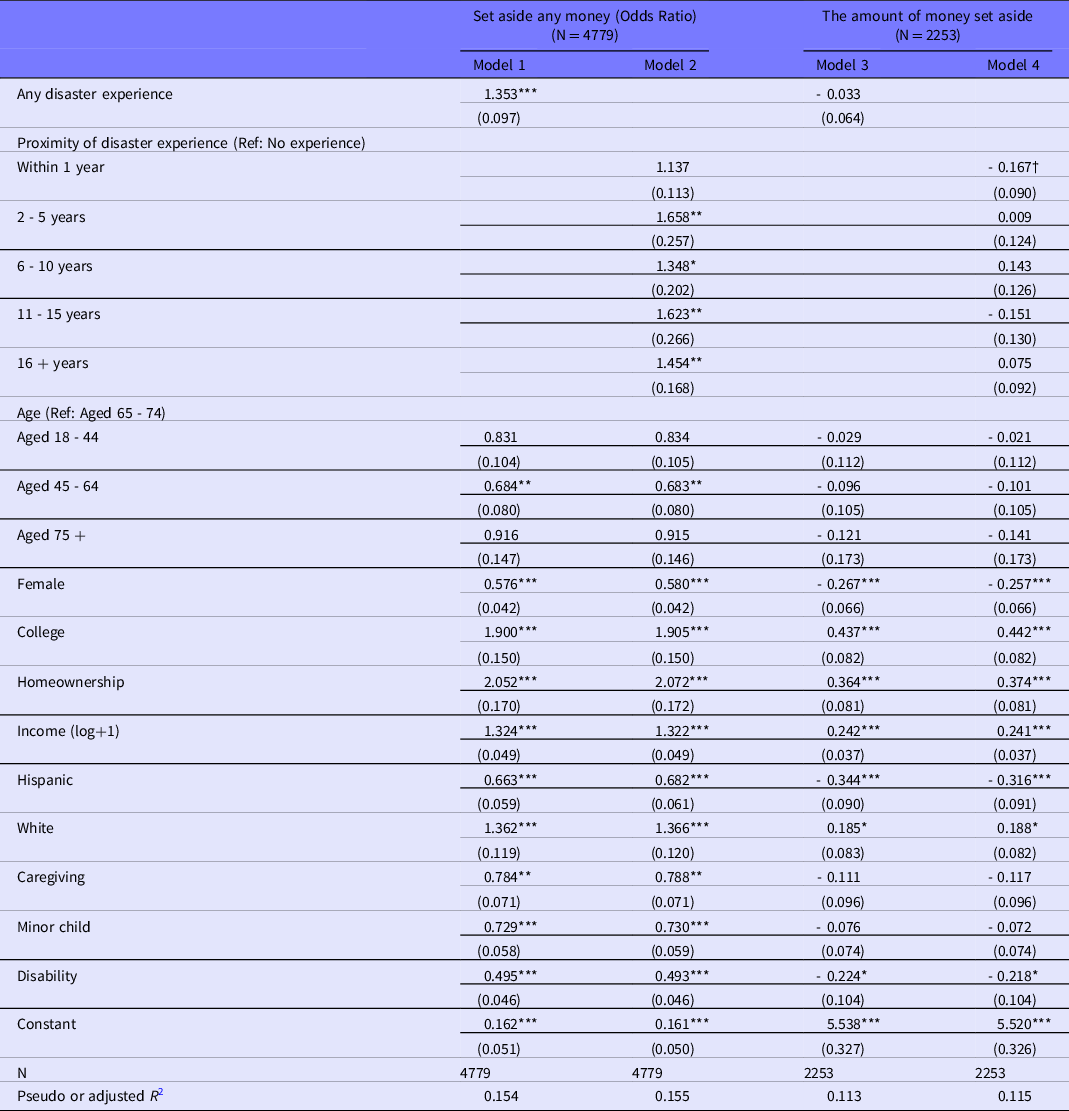
Table 1 showed the effects of the proximity of disaster experience on financial preparedness for emergencies. Model 1 showed that experiencing a disaster increased the odds of setting aside money for emergencies (Odds Ratio (OR) = 1.35, P < 0.001). Model 2 showed that except for those who experienced the disaster recently, i.e., within 1 year, the effect of experiencing a disaster was significant for all others who experienced a disaster, even more than 16 years ago. Specifically, ORs were 1.66 (P < 0.01) for 2 - 5 years, 1.35 (P < 0.05) for 6 - 10 years, 1.62 (P < 0.01) for 11 - 15 years, and 1.45 (P < 0.01) for 16+ years, relative to those who had no disaster experiences.
The effects of the proximity of disaster experiences on financial preparedness

Note: standard error in parentheses.
† P < 0.05, *P < 0.05, **P < 0.01, ***P < 0.001
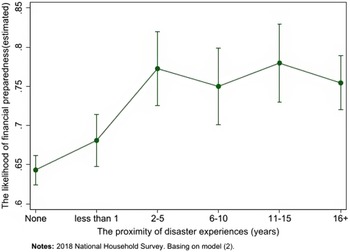
Figure 1 presented the predicted likelihood of setting money aside for emergencies for people based on Model 2. Those who experienced disasters 2 - 5 years ago were most likely to be financially prepared. The point estimation of the likelihood for them to set money aside (i.e., 78.3%) was about 10 percentage points higher than that of those who had not experienced a disaster (i.e., 68.6%).
Estimated likelihood of financial preparedness by the proximity of disaster experiences.

In Models 3 and 4, the effects of disaster experiences on the amount of money set aside were analyzed. Neither any experience (in Model 3) nor the proximity of disaster exposure (in Model 4) had significant impact. The effects of other factors on the amount of money set aside were consistent across Models 3 and 4. In Model 3, having a college or above level education (B = 0.44, P < 0.001), homeownership (B = 0.36, P < 0.001), higher income (B = 0.24, P < 0.001), and being White (B = 0.19, P < 0.05) were associated with more money set aside; whereas being female (B = -0.27, P < 0.001), Hispanic (B = -0.34, P < 0.001), and having disabilities (B = -0.22, P < 0.05) were associated with less money set aside.
Discussion
This study investigated the effects of the proximity of disaster experiences on financial preparedness for emergencies. The findings showed that compared to those who did not experience a disaster, only those who experienced disasters within 1 year were not significantly more likely to prepare. The probable reason is that in the year of the disaster, households were unable to make immediate disaster responses, mainly because of a significant loss in assets, decline in income, or increase in expenditure. Reference Hallegatte, Vogt-Schilb, Rozenberg, Bangalore and Beaudet2 This study showed that the impact of disaster experience reached its maximum after 2 - 5 years and persisted since then. This study also showed that the proximity of experience of disasters had no significant impact on the amount of money prepared for an emergency, which might suggest that even with higher risk perceptions due to disaster experiences, the actual amount set aside could be limited by the capacity to save.
Limitations
In this study, we focused on the proximity of disaster experience and its impact on individuals’ financial preparedness, without considering a more complex picture of disaster experiences. Disaster experiences include many factors such as the actual exposure to disasters, the intensity of disasters experienced, the type of disaster experienced, and the compounding effect of experiencing diverse types of disasters, etc. Future studies could have a more detailed examination of how those more nuanced experiences of disasters contribute to disaster preparedness. In addition, although NHS was based on a national sample, it was conducted only in English or Spanish, which could exclude those who could have language barriers, and thus caution should be taken for generalizability.
Conclusions
In conclusion, individuals’ disaster financial preparedness is a critical component of a disaster-resilient society. Reference Cutter, Ahearn and Amadei1 The study highlights the following findings. First, the impact of disaster experience on disaster preparedness could last for many years, even after 16 years as shown in this study on financial preparedness. Second, the impact of disaster experience could be more important for whether to set aside money than how much to set aside. Third, the impact of previous disaster exposure depends on the proximity of the disaster. Overall, we suspect that increased risk perception related to previous experiences of disasters is more relevant to the likelihood of preparing financially (i.e., whether they set aside money). But other capacity-related factors, such as income and having a disability, are more important to the amount of money set aside for emergencies. Disasters result from a combination of hazards, exposure, and vulnerabilities; they present risks when impact outweighs capacities, and thus certain populations and communities are especially vulnerable. Reference Cutter, Ahearn and Amadei1 Those findings could guide practitioners to pay special attention to those who experienced a disaster within 1 year and to those vulnerable populations who lack the capacity to prepare financially. Those empirical findings could also provide more insights on why and how people prepare for emergencies and disasters, and thus guide theoretical advancement concerning people’s proactiveness and disaster preparedness.
Acknowledgment
This project was partially supported by the National Science Foundation (CMMI 1839516) and a post-doc fellowship provided by the School of Social Work at the University of Texas at Arlington.
Authors contributions
Guanggang Feng: data analysis and writing; Zhen Cong: study design, conceptualization, and writing.