




No CrossRef data available.
The Importance of Developing Rigorous Social Science Methods for Community Engagement and Behavior Change During Outbreak Response
Published online by Cambridge University Press: 09 July 2020
Abstract
Despite growing international attention, the anthropological and socio-behavioral elements of epidemics continue to be understudied and under resourced and lag behind the traditional outbreak response infrastructure. As seen in the current 2019 coronavirus disease (COVID-19) pandemic, the importance of socio-behavioral elements in understanding transmission and facilitating control of many outbreak-prone pathogens, this is problematic. Beyond the recent strengthening of global outbreak response capacities and global health security measures, a greater focus on the socio-behavioral components of outbreak response is required. We add to the current discussion by briefly highlighting the importance of socio-behavior in the Ebola virus disease (EVD) response, and describe vital areas of future development, including methods for community engagement and validated frameworks for behavioral modeling and change in outbreak settings.
Information
- Type
- Commentary
- Information
- Disaster Medicine and Public Health Preparedness , Volume 15 , Issue 6 , December 2021 , pp. 685 - 690
- Copyright
- Copyright © 2020 Society for Disaster Medicine and Public Health, Inc.
References
REFERENCES
Bempong, N-E, Ruiz De Castañeda, R, Schütte, S, et al. Precision global health – the case of Ebola: a scoping review. J Glob Health. 2019;9(1). doi: 10.7189/jogh.09.010404.CrossRefGoogle ScholarPubMed
Wells, CR, Pandey, A, Ndeffo Mbah, ML, et al. The exacerbation of Ebola outbreaks by conflict in the Democratic Republic of the Congo. Proceed Nat Acad Sci. 2019;116(48):24366.CrossRefGoogle ScholarPubMed
World Health Organization. Social science research projects for the Ebola response in the DRC and neighbouring countries. 2019. https://www.who.int/risk-communication/social-science-research-for-ebola/en/. Accessed January 19, 2020.Google Scholar
Roca, A, Afolabi, MO, Saidu, Y, Kampmann, B. Ebola: a holistic approach is required to achieve effective management and control. J Allergy Clin Immunol. 2015;135(4):856–867.CrossRefGoogle ScholarPubMed
Abramowitz, SA, Hipgrave, DB, Witchard, A, Heymann, DL. Lessons from the West Africa Ebola epidemic: a systematic review of epidemiological and social and behavioral science research priorities. J Infect Dis. 2018;218(11):1730–1738.Google ScholarPubMed
Wilkinson, A, Parker, M, Martineau, F, Leach, M. Engaging “communities”: anthropological insights from the West African Ebola epidemic. Philos Trans R Soc Lond B Biol Sci. 2017;372(1721). doi:10.1098/rstb.2016.0305.CrossRefGoogle ScholarPubMed
Moon, S, Sridhar, D, Pate, MA, et al. Will Ebola change the game? Ten essential reforms before the next pandemic. The report of the Harvard-LSHTM Independent Panel on the Global Response to Ebola. Lancet. 2015;386(10009):2204–2221.CrossRefGoogle ScholarPubMed
Mohatt, NV, Thompson, AB, Thai, ND, Tebes, JK. Historical trauma as public narrative: a conceptual review of how history impacts present-day health. Soc Sci Med (1982). 2014;106:128–136.CrossRefGoogle ScholarPubMed
Laverack, G, Manoncourt, E. Key experiences of community engagement and social mobilization in the Ebola response. Glob Health Promot. 2016;23(1):79–82.CrossRefGoogle ScholarPubMed
Enria, L, Lees, S, Smout, E, et al. Power, fairness and trust: understanding and engaging with vaccine trial participants and communities in the setting up the EBOVAC-Salone vaccine trial in Sierra Leone. BMC Public Health. 2016;16(1):1140.CrossRefGoogle ScholarPubMed
Bedson, J, Jalloh, MF, Pedi, D, et al. Community engagement during outbreak response: standards, approaches, and lessons from the 2014–2016 Ebola outbreak in Sierra Leone. bioRxiv. 2019;epub:661959.Google Scholar
Durojaye, ET, Mirugi-Mukundi, G. The Ebola virus and human rights concerns in Africa. Afr J Reprod Health. 2015;19(3):18–26.Google ScholarPubMed
Chan, M. Ebola virus disease in West Africa – no early end to the outbreak. N Engl J Med. 2014;371(13):1183–1185.CrossRefGoogle ScholarPubMed
Vinck, P, Pham, PN, Bindu, KK, et al. Institutional trust and misinformation in the response to the 2018–19 Ebola outbreak in North Kivu, DR Congo: a population-based survey. Lancet Infect Dis. 2019;19(5):529–536.CrossRefGoogle Scholar
Jacobsen, KH, Aguirre, AA, Bailey, CL, et al. Lessons from the Ebola outbreak: action items for emerging infectious disease preparedness and response. Ecohealth. 2016;13(1):200–212.CrossRefGoogle ScholarPubMed
Dada, S, McKay, G, Mateus, A, Lees, S. Lessons learned from engaging communities for Ebola vaccine trials in Sierra Leone: reciprocity, relatability, relationships and respect (the four R’s). BMC Public Health. 2019;19(1):1665.CrossRefGoogle Scholar
World Health Organization. Key messages for social mobilization and community engagement in intense transmission areas. September 2014. https://www.who.int/csr/resources/publications/ebola/social-mobilization-guidance/en/. Accessed January 19, 2020Google Scholar
Joint workshop: community engagement in and for ethical research in outbreaks of infectious diseases and other humanitarian crises. Dakar, Senegal: 2019. https://www.nuffieldbioethics.org/assets/pdfs/Research-in-global-health-emergencies-Dakar-Workshop.pdf. Accessed January 19, 2020.Google Scholar
Thiam, S, Delamou, A, Camara, S, et al. Challenges in controlling the Ebola outbreak in two prefectures in Guinea: why did communities continue to resist? Pan Afr Med J. 2015;22 (Suppl 1):22–22.Google Scholar
Tengbeh, AF, Enria, L, Smout, E, et al. “We are the heroes because we are ready to die for this country”: Participants’ decision-making and grounded ethics in an Ebola vaccine clinical trial. Soc Sci Med (1982). 2018;203:35–42.CrossRefGoogle Scholar
Verelst, F, Willem, L, Beutels, P. Behavioural change models for infectious disease transmission: a systematic review (2010-2015). J Royal Soc Interface. 2016;13(125):20160820.CrossRefGoogle Scholar
Sharareh, N, Sabounchi, N, Sayama, H, MacDonald, R. The Ebola crisis and the corresponding public behavior: a system dynamics approach. PLoS Curr. 2016;8. doi: 10.1371/currents.outbreaks.23badd9821870a002fa86bef6893c01d.Google ScholarPubMed
Wilken, JA, Pordell, P, Goode, B, et al. Knowledge, attitudes, and practices among members of households actively monitored or quarantined to prevent transmission of Ebola virus disease – Margibi County, Liberia: February–March 2015. Prehosp Disaster Med. 2017;32(6):673–678.CrossRefGoogle ScholarPubMed
Tenkorang, EY. Ebola-related stigma in Ghana: individual and community level determinants. Soc Sci Med. 2017;182:142–149.CrossRefGoogle ScholarPubMed
Keeling, AW. Ebola: how a people’s science helped end an epidemic. Nurs Hist Rev. 2019;27(1):165–166.CrossRefGoogle ScholarPubMed
Blanchet, K, Ramesh, A, Frison, S, et al. Evidence on public health interventions in humanitarian crises. Lancet. 2017;390(10109):2287–2296.CrossRefGoogle ScholarPubMed
Spengler, JR, Ervin, ED, Towner, JS, et al. Perspectives on West Africa Ebola virus disease outbreak, 2013–2016. Emerg Infect Dis. 2016;22(6):956–963.CrossRefGoogle Scholar
Svoronos, T, Mate, KS. Evaluating large-scale health programmes at a district level in resource-limited countries. Bull World Health Organ. 2011;89(11):831–837.CrossRefGoogle Scholar
Linsley, P, Howard, D, Owen, S. The construction of context-mechanisms-outcomes in realistic evaluation. Nurse Res. 2015;22(3):28–34.CrossRefGoogle ScholarPubMed
Gilmore, B, Adams, BJ, Bartoloni, A, et al. Improving the performance of community health workers in humanitarian emergencies: a realist evaluation protocol for the PIECES programme. BMJ Open. 2016;6(8):e011753.CrossRefGoogle ScholarPubMed
Van Belle, SB, Marchal, B, Dubourg, D, Kegels, G. How to develop a theory-driven evaluation design. Lessons learned from an adolescent sexual and reproductive health programme in West Africa. BMC Public Health. 2010;10:741.CrossRefGoogle ScholarPubMed
Stellmach, D, Beshar, I, Bedford, J, et al. Anthropology in public health emergencies: what is anthropology good for? BMJ Glob Health. 2018;3(2):e000534.CrossRefGoogle Scholar
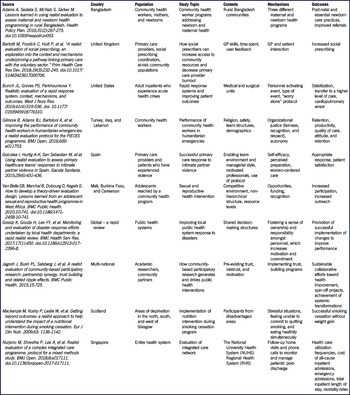
TABLE 1 Different Context-Mechanism-Outcome Studies
 You have
Access
- 21
- Cited by
INTRODUCTION
Recent large disease outbreaks, including the current 2019 coronavirus disease (COVID-19) pandemic and the Ebola virus disease (EVD) epidemic in the Democratic Republic of the Congo (DRC), highlight limitations in global epidemic response. Despite efforts, initial responses to these outbreaks were slow or yielded suboptimal outcomes.Reference Bempong, Ruiz De Castañeda and Schütte1,Reference Wells, Pandey and Ndeffo Mbah2 Major efforts are underway to strengthen responses, including establishing rapid vaccine pipelines, new therapeutics, more robust detection methods, and epidemiological characterization of novel pathogens.3 However, anthropological and socio-behavioral elements of epidemics, which are of prime importance in understanding transmission and control facilitation, continue to be understudied, under-resourced, and lag behind traditional outbreak response infrastructure.Reference Roca, Afolabi, Saidu and Kampmann4,Reference Abramowitz, Hipgrave, Witchard and Heymann5 Beyond strengthening global outbreak response capacities and global health security measures, a greater focus on socio-behavioral components of outbreak response is essential. This article adds to current dialogues by briefly highlighting the importance of socio-behavioral elements in EVD response, discussing vital areas of development, including methods for community engagement and validated frameworks for behavioral change, and proposing research methods to include socio-behavioral elements in outbreak settings.Reference Abramowitz, Hipgrave, Witchard and Heymann5–Reference Moon, Sridhar and Pate7
SOCIAL SCIENCE, COMMUNITY ENGAGEMENT, AND THE EVD RESPONSE
A socio-behavioral perspective is fundamental to understanding the historical and ongoing factors that have shaped EVD outbreaks, including historical trauma from Western colonization and cultural marginalization of communities within outbreak areas.Reference Mohatt, Thompson, Thai and Tebes8–Reference Bedson, Jalloh and Pedi11 Increased fear and lack of control coupled with activities of foreign organizations can lead to actions perceived as infringements on human rights by evoking past colonial activities that quickly degrade trust and respect.Reference Durojaye and Mirugi-Mukundi12 This is evident from the community perspective and mistrust toward the implemented policies around contact measures and burial practices, particularly in Guinea during the West Africa EVD outbreak.Reference Chan13 This understanding then provides context to the documented high levels of (1) mistrust toward responders, typically epidemiologists and clinicians; (2) attacks targeting health care workers and facilities; and (3) decreased health-seeking behavior amongst potential cases in the EVD outbreaks in Western and Central Africa.Reference Roca, Afolabi, Saidu and Kampmann4,Reference Vinck, Pham and Bindu14
In the West Africa EVD outbreak, social science research and community engagement were eventually used to address these challenges and improve response efforts by drawing on previous ethnographic studies, as well as field research as part of the response.Reference Abramowitz, Hipgrave, Witchard and Heymann5,Reference Wilkinson, Parker, Martineau and Leach6,Reference Laverack and Manoncourt9,Reference Jacobsen, Aguirre and Bailey15,Reference Dada, McKay, Mateus and Lees16 These community engagement activities include recruiting local staff for social mobilization activities, working with religious leaders, engaging local journalists and radio, and hosting local community meetings.Reference Wilkinson, Parker, Martineau and Leach6 Effective community engagement, informed by social science research, can ensure that interventions are adapted to and by local communities. This leads to improving outbreak response by decreasing levels of anxiety and fear, improving dialogue between responders and communities to ensure effective communication around key public health measures, increasing support and reporting by the community, and encouraging acceptance and implementation of community interventions, which, ultimately, lower transmission rates.Reference Moon, Sridhar and Pate7,17,18 Documented successes of effective community engagement integrate elements of bottom-up approaches that empower local communitiesReference Thiam, Delamou and Camara19 and respect both the local power dynamicsReference Laverack and Manoncourt9,Reference Enria, Lees and Smout10 and cultural norms.Reference Wilkinson, Parker, Martineau and Leach6 The involvement of social science research is also important in vaccine and treatment trials for emergent diseases. Such involvement can help address community and participant anxieties as well as hopes for the candidate vaccines or treatments, motivations for participation, and the social, political, economic, and historical context of trials.Reference Enria, Lees and Smout10,Reference Tengbeh, Enria and Smout20 Further to this, research from the Sierra Leone EVD vaccine trials described how, by interacting with various community leaders, researchers understood the fragmented nature of community hierarchies and were able to diversify engagement strategies to reach different populations within the community.Reference Enria, Lees and Smout10 Therefore, consideration of power dynamics, fairness, and trust in implementing an outbreak response program are critical.Reference Enria, Lees and Smout10 In order to address these elements, there has been the design and deployment of “rapid social science” research/tools in the 2018–2020 DRC outbreak. However, there is still a need for a validated process integrating social science and epidemiological data to support community engagement during outbreaks.Reference Bedson, Jalloh and Pedi11
INCLUSION OF SOCIO-BEHAVIORAL VARIABLES INTO TRANSMISSION MODELS
Infectious disease transmission models can estimate a range of outbreak parameters, including number of cases, duration, dynamics, and/or impact of control interventions. Model outputs are frequently used to guide response strategies, policies, and resource allocation, and can be powerful tools given appropriate assumptions and variables. Human infectious disease transmission is invariably shaped by individual and population behaviors, yet these variables rarely, if ever, are included in mathematical transmission models.Reference Verelst, Willem and Beutels21 For example, World Health Organization (WHO) data suggest that burial practices were linked to 60%–80% of cases in West Africa, resulting in EVDs classification as a behavioral disease.Reference Sharareh, Sabounchi, Sayama and MacDonald22 Despite the importance of understanding behavior in transmission dynamics, a systematic review found that most models of behavioral change are purely theoretical and lack scientific validation.Reference Verelst, Willem and Beutels21
Some studies have attempted to find variables for socio-behavioral modeling by using cross-sectional knowledge-attitude-practice (KAP) surveys to quantify socio-behavioral factors.Reference Wilken, Pordell and Goode23,Reference Tenkorang24 KAP studies are easily deployable with quick analysis, making them highly desirable for acute outbreaks. While these studies are useful for some basic modeling, they only indicate general behavioral factors and are unable to explain underlying social factors that shape disease transmission. For example, a KAP study conducted in Liberia found that EVD transmission awareness was poor and education was needed to improve outcomes, but was unable to describe how and to what degree education could modify behavior.Reference Wilken, Pordell and Goode23 Similarly, a cross-sectional KAP study conducted during the West Africa EVD outbreak found that myths and stigma affected risk perception and, critically, behavior.Reference Tenkorang24 While data from these studies could be used to improve prediction models of vulnerable populations, they do not elucidate the social forces that need to be understood to affect behavioral change.
Building behavioral change models requires an understanding of underlying sociocultural structures. For example, while a KAP study may be able to identify burial practices as a risky behavior, it will not explain how to mitigate or shape this behavior positively. Understanding that emotions are a principal driver behind the act of participating in funerary rituals reveals that behavior change will be successful only when risky practices are replaced by ritually and emotionally meaningful equivalent safer practices.Reference Keeling25 The importance of behavioral modeling and adaptation demonstrated by recent EVD outbreaks has created a call for systematic integration of these elements into an outbreak response.Reference Wilkinson, Parker, Martineau and Leach6,Reference Bedson, Jalloh and Pedi11,Reference Blanchet, Ramesh and Frison26
CONSIDERATIONS FOR INTEGRATING SOCIAL SCIENCE AND EPIDEMIOLOGICAL APPROACHES
Challenges stem from core epistemological differences between traditional outbreak responders, typically epidemiologists and clinicians approaching problems from a scientific paradigm, and social scientists who approach similar problems from a humanistic paradigm; thus, effective collaboration is limited. Developments that integrate appropriate social science and epidemiological methodologies have not been fully tested and validated through scientific experimentation.Reference Spengler, Ervin and Towner27 Therefore, a more structured and rigorous approach for community engagement and socio-behavioral models is crucial for a successful outbreak response.Reference Abramowitz, Hipgrave, Witchard and Heymann5,Reference Blanchet, Ramesh and Frison26
There are a number of theoretical frameworks for context-specific research that incorporates socio-behavioral elements, including alternative randomized controlled trials, process evaluation, multiple case study design, and realist evaluation (context-mechanism-outcome [CMO] studies).Reference Svoronos and Mate28 Of these developing methodologies, realist valuations, or CMO studies, present the greatest utility, adaptability, and applied outcomes. CMOs create (1) a generalized theory of how a system works and (2) specific actions/mechanisms that can be taken in described contexts to lead to desired outcomes.Reference Linsley, Howard and Owen29 An advantage of this study design is that theory and specific variables are tested and compared in multiple contexts. Theory and variables from CMOs can be tested by future CMO studies to continue evaluation of underlying theories, interventions, and outcomes. By design, this creates a systematic evaluation enabling necessary validation of research methods through an iterative process. Previously, CMO studies were used to better understand and modify complex socio-behavioral interactions, such as improving performance of community health workers in humanitarian crisesReference Gilmore, Adams and Bartoloni30 or studying influences of social networks on behavioral change in adolescent sexual and reproductive health in West Africa.Reference Van Belle, Marchal, Dubourg and Kegels31 Table 1 displays different CMO studies, the contexts that they have been used in, and example variables.
Different Context-Mechanism-Outcome Studies
Another approach to standardizing variables and outcomes is a system dynamics approach, which uses multiple social and epidemiological inputs to demonstrate the impact that behavioral feedback has on outbreak outcomes. A post hoc system dynamics model using an integrated set of causal relationships from social science research on EVD was able to recreate epidemiological outcomes reported by the WHOReference Sharareh, Sabounchi, Sayama and MacDonald22 and found that behavioral and sociocultural factors are needed to fully interpret transmission dynamics observed in the West African EVD outbreak.
Once standardized, these methods and models could be used for different aspects of response, including program design, formative research, community engagement programs, case investigation, socio-behavioral models, and post hoc assessment.Reference Stellmach, Beshar and Bedford32 All such methodologies should be scientifically studied for effectiveness, which presents a challenge for acute outbreak responses since there is no ability to test methods before implementation. One approach to mitigate this would be to test these methods in non-acute settings, where infectious diseases are endemic. This could also address ethical challenges implementing new methods in fragile outbreak settings with already vulnerable populations. While validation of methods/models may involve culturally specific elements, adaptable frameworks, like CMO studies, should be used to attempt to standardize across environments.
CONCLUSIONS
Currently, the WHO lists 50 active social science projects related to the ongoing EVD outbreak in the DRC, Uganda, Rwanda, and Burundi.3 These projects are being used to engage local leaders and track migration patterns and disease transmission.3 These efforts demonstrate the direction that needs to be taken to integrate socio-behavioral science into outbreak response while also highlighting the necessity of a systematic approach to validate elements of successful community engagement integration into cohesive response efforts.
This article has (1) highlighted the importance of community engagement and inclusion of socio-behavioral models in outbreak response, (2) outlined challenges associated with integrating social science methodologies into outbreak response, and (3) suggested possible solutions for creating scientifically validated methods/models for integration of social science research, including CMO studies and system dynamics. This article reemphasizes rigorously testing and validating methods as crucial. The implications of this article advocate for needed inclusion of community engagement and socio-behavioral models in the ongoing COVID-19 response. Additionally, these approaches can be further analyzed once the pandemic has come to an end. With stronger social science methods, higher quality data will bolster community engagement and behavioral change, leading to improved outcomes for EVD and future outbreaks.
Conflict of Interest Statement
The authors have no conflicts of interest to declare.