Seeking to prepare her friend Lucretia Tox for the revelation of Mr Dombey's engagement, Louisa Chick, Dombey's sister, turns to the natural world to illustrate the inevitability of change:
It's a world of change. . . . Why, my gracious me, what is there that does not change! Even the silkworm, who I am sure might be supposed not to trouble itself about such subjects, changes into all sorts of unexpected things continually. (434; ch. 29)
For Mrs Chick, the silkworm seems to exemplify the truism that change is a natural and inevitable part of life but, in the context of global sericulture, her example is perhaps more apposite than she realizes. Silk production not only radically terminates the natural metamorphosis from caterpillar to moth, it also constitutes an industry subject to the volatilities of global trade and regulation, the cycles of fashion, the impact of new technologies, not to mention the vagaries of disease, climate and habitat. While Britain had been importing raw silk from China in limited supplies from the eighteenth century onwards, by the time Dombey and Son was written, the devastation of sericultural crops in France and Italy by a disease which had been spreading since the 1820s allowed Britain to benefit from the treaty port system (established as a result of the Opium Wars) and re-export raw silk to the Continent (Ma 332–3).Footnote 1 Thus, silk – circulating around the world, and linking producers of the raw material in India, China, or Japan with child labourers in Macclesfield, handloom weavers in Spitalfields, textile designers in France, and wealthy consumers in London – positions the humble silkworm within complex and dynamic networks of uncertain sustainability.
Dombey and Son, I will argue, is a novel vitally concerned with sustainability – with how lives and livelihoods are maintained and continued (or not), and with the conditions required for a person to flourish and survive in environments that may well be hostile or volatile. In recent years, the concept of sustainability has taken on a new resonance. Pressing concerns regarding climate change, environmental degradation and diminishing energy reserves have resulted in a new understanding of sustainability in terms of strategies designed to minimize the harmful environmental effects of human activity and avoid the depletion of natural resources. Twenty-first century ideals of sustainability, then, arise in response to a recognition of the precariousness of our purchase on the planet and our vulnerability as a result of a dependence on fossil-fuel economies. The term sustainability in the environmental/ecological sense with which we are familiar in the twenty-first century was of course not used explicitly in this way by Dickens or, indeed, during the nineteenth century (the OED does not record the current usage occurring until the latter part of the twentieth century). There was, however, an emerging awareness of crisis from around the mid-nineteenth century onwards, derived from a growing sense that “forces of exponential increase” – in population, technological capabilities, or the rate of usage of natural resources – were impinging on, or in conflict with, the limits of environmental conditions and, as Allen MacDuffie has recently noted, there is at times a more modern understanding of the term sustainability “lurking around the edges of discussion” in the work of Dickens (102, 103). The fragility and instability of human and natural resources, and the deeply complex interweaving of the two, are at the heart of Dombey and Son where the misery of the vulnerable is described as “but a drop of water in the sea, or. . .a grain of sea-sand on the shore” (508; ch. 33). “Swallowed up” by the city, the poor and dispossessed become “Food for the hospitals, the churchyards, the prisons, the river” (508; ch. 33), a powerful image that conflates ingestion with abjection and brings to mind another sense of sustainability present in Dombey and Son: namely, to sustain or maintain a person in life or health, not only to provide the resources needed to remain alive but to “keep (a person, the mind, the spirits, etc.) from failing or giving way” (OED).
The narrator's indictment of the forces that have “swallowed up” vulnerable lives draws attention to the disjuncture between the industrial and urban expansion of the period and the well-being of individuals and communities, problematizing the possibility of sustainability in the 1840s. Attentive to the costs of survival as much as the potential for flourishing, Dombey and Son considers the problem of how “naturecultures” (Haraway, How 105–06) may be sustained in a changing and disrupted world. I draw on Donna Haraway's concept of “natureculture” in this context not only because it conveys the inextricability and contingency of the two domains – nature and culture – but because, for Haraway, this concept underpins an ethics “committed to the flourishing of significant otherness” that rejects a survival-at-any-cost mentality (Companion 3). A similar ethical dimension may be seen in Rosi Braidotti's deployment of the concept of sustainability as “a regrounding of the subject in a materially embedded sense of responsibility and ethical accountability for the environments she or he inhabits” (Transpositions 137).Footnote 2 Braidotti's “ethical subject of sustainable becoming” who “practices a humble kind of hope, rooted in the ordinary micro-practices of everyday life: simple strategies to hold, sustain and map out thresholds of sustainable transformation” (Transpositions 278) in fact sounds a lot like Florence Dombey. Not only does Florence manage to flourish in a persistently hostile environment, she becomes the means by which others are renewed or re-connected to a sustaining network of intimacy and belonging through her openness to others and her refusal to foreclose the other by assuming that they are fully known or unable to be transformed. This openness of course makes Florence vulnerable – most significantly, to persistent emotional abuse by her father – and unsettles contemporary readers who may be uncomfortable with what seems like Florence's masochistic loyalty to her father. In the character of Florence, however, Dickens exposes the painful cost of what being committed to the flourishing of the other might require.Footnote 3 I want to propose, then, that different senses of sustainability at play in Dombey and Son effectively allow the novel to link the potential crisis of economic and environmental sustainability in the early Victorian period with the problem of “sustainable becoming”: the challenge of finding or maintaining emotional sustenance and psychological sustainability in a “world of change” while remaining ethically accountable to the environments one inhabits.Footnote 4
In recent ecocriticism, however, sustainability has come under (what I am tempted to call sustained) critique, with the charge that the concept has become “articulated too firmly to a technocratic, anthropocentric perspective” (Alaimo 563) that, in effect, merely works to maintain current levels of capitalist consumption (Keller 580). Further, for some critics, it is not merely the application of sustainability but the concept itself that is problematic, construed as “an unnatural value” that posits an ideal of an unchanging ecosystem that seems almost synonymous with iterability, outside of time and history.Footnote 5 Cultural narratives about sustainability, argues Steve Mentz, construct “a fantasy about stasis” as “unchanging harmony” and are a form of “pastoral nostalgia” that “imagines a happy, stable relation between human beings and the nonhuman environment” (586, 587). Against (or after) sustainability, Mentz contends, we need different “narratives about our relation to the biosphere” that recognize “the disruption of human lives by nonhuman forces” (587) and treat “dynamic change as a fundamental feature of all natural systems” (591).Footnote 6
The pitting of sustainability against an understanding of change, disruption and upheaval, however, requires further interrogation. Does an ideal of sustainability simply posit a desire for, or fantasy of, stasis? Surely, just as the circumstances to which sustainability is a response – threats to elements of the environment deemed of value (whether species, landscapes, resources, cultural practices or communities) – are dynamic and shifting, so too must any strategy that seeks to protect those elements be characterized by adaptation, reflexivity, and experimentation. Such strategies are thus always and unavoidably implicated in processes of flux or history and, to have any hope of being effective, cannot be fixed and inflexible, nor aim to achieve an unalterable state of preservation. In support of this more dynamic view of sustainability, Gillen D'Arcy Wood has argued that “Sustainability studies begins from the principle that all systems, human and natural, are characterized by complexity and nonlinear change” (6) and an “understanding of the natural world as an open, dynamic system subject to nonlinear transformations, feedback loops, and multiscalar interactions” that “[necessitate] acknowledging the limits of human knowledge” and agency (3). And it is in such acknowledgement – an awareness of our limits, in every sense – that an ethical dimension of sustainability may emerge, one that calls into question not only our current practices and assumptions, but the terms of our very survival.
In Dombey and Son, it is mostly those who refuse to acknowledge limits – of their desires, their mortality, their power – who ultimately founder within a novel that explores, in Mentz's terms, the cultural meanings that “emerge through encounters between human experience and disorderly ecologies” (588). Dickens, however, goes further than this: throughout the novel, and particularly in the fates of the central characters of Dombey Senior and Florence Dombey, the author considers not only what is worth sustaining in an environment of expansionary capitalism and technological innovation but how we should live in the face of the uncertainty and instability that results from such changes. The experience of living in what Zygmunt Bauman has called, in a related context, “liquid modernity” – a term that seeks to capture the lack of groundedness and the “melting” of certainties in modernity (3) – provides the context within which Dickens questions assumptions about survival and sustaining forms of connection in the “natureculture” of the late 1840s.Footnote 7
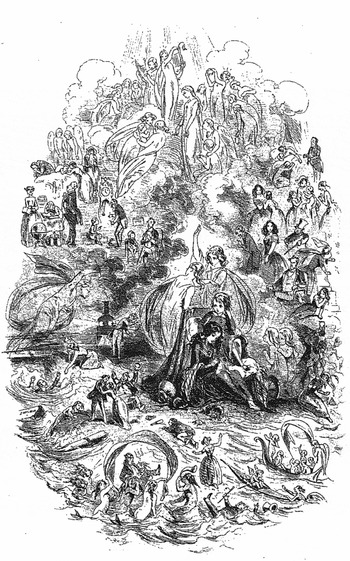
To propose that, in Dombey and Son, change is the “principle condition of experience” (Marcus 298) and that human subjects are challenged in such an environment to foster or maintain ethical relations with each other in response is hardly in itself a new idea in critical responses to the novel. It is now almost fifty years since Steven Marcus observed that Dombey and Son is organized “around two massive images which [Dickens] opposes and relates to each other. . .the sea and the railroad, which function as actual presences in the novel,. . .and also appear symbolically, in a multitude of permutations” (297) and which, together, hold in tension the novel's exploration of social and organic transformation. While the impact of the railway on Dombey and Son often figures in critical treatment of the novel, however, the sea has received less attention, even though it is given a prominent position in the lower half of the original frontispiece illustration (see Figure 1). The sea is in fact barely mentioned in Marcus's chapter and has until recently been largely overlooked even in the burgeoning field of ecocriticism. As both Mentz and Dan Brayton have argued, the emphasis on the “green,” the terrestrial, as the foundation of environmental scholarship has precluded sufficient consideration of the significance of the “global ocean” in shaping our understanding of nature and our response to the environmental challenges of our own time (Brayton 18). The sea has too often been consigned “to the realm of chaos, the primordial, and the nonhuman” (Brayton 23). “Imagining earth as ocean rather than garden,” however, broadens our understanding of the vast networks and precarious ecologies in which human life is located (Mentz 587). In a novel where maritime imagery, voyages, accoutrements and enterprises loom large, where almost all the characters go to sea (as sailors, traders, travellers, even transported convicts like Alice Marwood) or at least to the seashore, and where a shipwreck changes the fate of so many, the ocean and the shore are important devices through which Dombey and Son maps the fragility and mobility of familial, social and economic structures. While Dickens does draw on the symbolic associations of the sea – most notably in his use of the maritime sublime such as in the opening chapter where Fanny Dombey, “clinging fast to that slight spar in her arms [her daughter Florence], drifted out upon the dark and unknown sea that rolls round all the world” (10; ch. 1) – the sea's function in Dombey and Son is as much economic and literal as metaphorical and warrants greater consideration in this light. From the house of Dombey to the Wooden Midshipman, lives depend on the sea.Footnote 8 The novel's persistent imagery of organic growth, figured positively as flourishing and blooming, or negatively as forcing and cultivation, is juxtaposed with the depiction of the irresistible currents, waves and flows of the ocean to represent an ecology beyond “pastoral stasis” (Mentz 588), one shaped by the blue as well as the green, where radical disruption is unavoidable and where the problem of survival always has an ethical dimension.
Frontispiece from H. K. Browne (Phiz), Dealings with the Firm of Dombey and Son: Wholesale, Retail and for Exportation (London: Bradbury and Evans, 1846).

In Dombey and Son, three distinct kinds of space – what I will call the grey (the built environment associated with urban modernity), the green (gardens and the countryside) and the blue (oceans and rivers) – are each in their varying ways sites of disruption, change and uncertainty, but they are also linked in networks of relations like ecosystems, with a shared susceptibility to natural phenomena (such as the weather, seasons and tides). As a novelist of the city, Dickens is often perceived to have no deep interest in nature, although his tendency to juxtapose disparate things, human and non-human, necessarily insists on the significance of “contiguous associations” (Freedgood 17) between nature and culture, urban and pastoral, that exemplify what Jonathan Bate refers to as the “law of community ecology” whereby “biodiversity is the key to the survival and adaptation of ecosystems” (442). Biodiversity depends, Bate argues, on a principle of “illusory excess”: “an ecosystem needs a sufficient diversity of species to regenerate itself; species which serve no obvious purpose in one homeostasis may play a vital role in changed environmental circumstances” (442). The social world in which the lives of the Dombeys are unavoidably connected to, and influenced by, the lives of the Toodles or the eccentric community centred on the Wooden Midshipman illustrates such “illusory excess” mapped onto the diverse and changing landscapes of city and towns, intercalated with history and culture, and stretching from Europe to the West Indies and the Antipodes.Footnote 9 The possibility for connection or catastrophe (even catastrophe through connection) that these social and topographical networks generate creates the kind of “changed environmental circumstances” that require adaptation to survive.Footnote 10
While the grey urban landscapes of the novel often have some connection, however tenuous, with green spaces as sites of sociality – from Princess's Place to the Kettles’ garden at Twickenham – in Dombey and Son the blue world emerges as the most powerful conduit for bringing people and things together, and providing the means by which lives are salvaged and re-launched, as it were. Paul's unlikely friendship with old Glubb at Brighton, the snugly homosocial world of Gills, Cuttle and Bunsby, and the reconciled extended Dombey family on the “sea-beach” at the novel's end (924; ch. 62) all associate the sea with enduring relationships grounded in acceptance and reciprocity. At the same time, it is also the blue world that presents the most immediate and least controllable threat to human survival, as lives and livelihoods founder at sea, most notably represented in the shipwreck of the Son and Heir during Walter's voyage to Barbados, echoing the death of the son and heir, Paul Dombey, and foreshadowing the fall of the house of Dombey. A not uncommon consequence of a reliance on increasingly global networks of trade and imperialism in the period, shipwrecks highlighted the costs of modern mobility and consumption (Thompson 17).Footnote 11 In the midst of the increasingly global realm of modernity, “What the waves are always saying” in Dombey and Son is a message about the limits of human agency and achievement, most dramatically represented by death itself.
At the opening of the novel, the hubristic delusions of Dombey Senior are expressed through imagery that encodes not only an instrumentalist approach to the earth and its resources associated with limitless capitalist expansion but with a view of nature as predictable, containable, and manageable, that will be dismantled by ensuing events:
The earth was made for Dombey and Son to trade in, and the sun and moon were made to give them light. Rivers and seas were formed to float their ships; rainbows gave them promise of fair weather; winds blew for or against their enterprises; stars and planets circled in their orbits, to preserve inviolate a system of which they were the centre. (2; ch. 1)
The continuation of such a system depends on the exploitation of natural resources both at home and abroad, but with the birth of a vulnerable heir and the death of Dombey's wife in the first chapter, the survival of Dombey and Son is always perilously close to death and decay. When, during the period of mourning, “Mr Dombey ordered the furniture to be covered up. . .to preserve it for the son” (24; ch. 3), the home itself becomes a grave or mausoleum, as the narrator describes the wrappings on the household effects as like “ghastly bandages” or “winding sheets” in a house that exudes “Odours, as from vaults” (24; ch. 3), a deathly legacy that awaits the infant heir. The sense of decay that permeates the Dombey home even extends to the street and neighbourhood beyond: “Every gust of wind that rose, brought eddying round the corner from the neighbouring mews, some fragments of the straw that had been strewn before the house when [Fanny Dombey] was ill, mildewed remains of which were still cleaving to the neighbourhood” (24; ch. 3).
In contrast to the mouldy straw outside the Dombey home, symbolic both of death and the house's tainting influence, fresh hay, later in the novel, bridges the divide between country and city, enclosing both within a shared sensory environment:
They were making late hay, somewhere out of town; and though the fragrance had a long way to come, and many counter fragrances to contend with among the dwellings of the poor. . ., yet it was wafted faintly into Princess's Place, whispering of Nature and her wholesome air, as such things will, even unto prisoners and captives, and those who are desolate and oppressed. (433; ch. 29)
What may at first sight appear a rather optimistic account of the “wholesome” influence of nature on the city, as Miss Tox is distracted from her daily routine of domestic beautification by the balmy breeze, is a more complex account of an urban ecosystem, a network of relations permeated by the sights, sounds and smells of other places and things that intersect, overlap and contend for space and the right to thrive in “natureculture,” just as Dickens's description includes a diverse range of social actors. The narrator's vision, equally encompassing Miss Tox, the “pot-boy,” the flower seller, and the “smoky sparrows” of Princess's Place, seems at one and the same time to enumerate the social heterogeneity of the setting and to dissolve the boundaries that separate the human and non-human elements of the scene. Nor does he simply emphasize the commonality of all living things in an attempt to ameliorate the most dismal aspects of city life, for the natural imagery in the passage can evoke negative as well as positive connotations: Miss Tox's gloves for housework are “like dead leaves” (432; ch. 29) and the flower seller makes his “daisies shudder in the vibration of every yell he gave” (433; ch. 29).
Nevertheless, the relatively paltry signs of a benign nature in the heart of the city are sufficient to cause Miss Tox to recall her childhood “passed at a seaport, among a considerable quantity of old tar, and some rusticity,” and to fall “into a softened remembrance of meadows, in old time, gleaming with buttercups, like so many inverted firmaments of golden stars” (433; ch. 29). The language which conveys Miss Tox's reminiscences may be indulgently sentimental but it provides another instance where the spaces of the grey, green and blue are connected and where the recognition of such connection suggests the possibility for “sustainable becoming” within the ordinary moments of daily life (Braidotti, Transpositions 278). Miss Tox is an ambiguous character in Dombey and Son: her name sounds far from wholesome (she is almost toxic) and her daily routine involves a relentless clipping of the new growth on her plants. In this scene, however, her detection of a “fresh scent” “that turned [her] thoughts upon the country” (432; ch. 29) foreshadows her own transformation when, after her hopes for marriage are dashed and she is removed from Mr Dombey's orbit, she looks further afield for new connections and relationships and becomes a vital part of a cross-class network of support, communication and friendship (through the Toodles). Just as her plants are spared their daily pruning when her energies are re-directed to more altruistic concerns, so Miss Tox experiences a modest form of flourishing, foreshadowing the capacity of others to be re-adapted to their environment in more harmonious ways (such as Mr Dombey's redemption will demonstrate, most dramatically). In this scene of life in Princess's Place, then, Dickens's deployment of organic imagery – representing both growth and decay – is associated with the novel's exploration of the values and ethics of sustainability: what are the right conditions for flourishing as a form of ethical becoming? Or what impedes such growth and leads to noxious proliferation and decay on the one hand or a failure to thrive on the other?
A powerfully negative example of growth in Dombey and Son is provided through the extended metaphor of “forcing,” referring to a process whereby flowers or vegetables are produced outside their normal season through artificial structures that create optimal growing conditions, such as greenhouses or cold frames. The metaphor of forcing is first introduced in the novel in humorous, if rather poignant, terms at Doctor Blimber's school at Brighton, where Paul Dombey is sent as a result of his father's impatience for him to grow up and occupy his place in the family firm:
Doctor Blimber's establishment was a great hothouse, in which there was a forcing apparatus incessantly at work. All the boys blew before their time. Mental green-peas were produced at Christmas, and intellectual asparagus all the year round. Mathematical goose-berries (very sour ones too) were common at untimely seasons, and from mere sprouts of bushes, under Doctor Blimber's cultivation. Every description of Greek and Latin vegetable was got off the direst twigs of boys, under the frostiest circumstances. Nature was of no consequence at all. (150; ch. 11)Footnote 12
The misery of the boys subjected to this educational approach and the arrested psychological and intellectual development that results are made plain, but Blimber's boys are not the only characters associated with hothouse “forcing” in Dombey and Son. While Blimber's boys wilt under the forcing process, Major Bagstock becomes resistant to his environment through his own “hothouse” experience. As the Major reminisces of his regimental days (using his characteristic third-person discourse): “the time was, when he was forced, Ma'am, into such full blow, by high hothouse heat in the West Indies, that he was known as the Flower. A man never heard of Bagstock, Ma'am, in those days; he heard of the Flower – the Flower of Ours” (388; ch. 26). Unlike the unfortunate schoolboys, such as Toots who describes himself as a “Blighted flower” as a result of his years at Blimber's (923; ch. 62), the Major's experience of “forcing” has left him apparently resilient: “‘The Flower may have faded. . .but it is a tough plant yet, and constant as the evergreen’” (388; ch. 26). His capacity for survival in adverse conditions (many of which are self-inflicted, as in his frequent over-indulgence at table) parallels his moral turpitude, his willingness to do whatever it takes to survive, to live at the expense of others and to drain their resources.
Another of the novel's survivors and a loyal ally of the Major's, Mrs Skewton has similarly learnt to survive through a parasitic reliance on others. She credits nature for her enduring bloom, but is the object of the narrator's unrelenting satire for her determination to resist the ageing process and her frequent lament that the world “is a false place. . .where Nature is little regarded” (389; ch. 26). She is an easy target, the unnatural mother whose devotion to her daughter is as false as her complexion, and the descriptions of her nightly returns to her “natural” state allow an almost gruesome insight into the physical reality behind the façade. Mrs Skewton may occupy a “bower” (388; ch. 26) and be attended by Flowers (her maid), but the recurrent allusions to Cleopatra do more than mock her pathetic attempts at seduction: they firmly associate her with an artificial preservation of life that borders on mummification. When the narrator observes that, during her lingering decline, Mrs Skewton was “turning of the earth, earthy” (602; ch. 40), it is almost as if the process of decomposition has begun prior to her death, such is her state of corruption.Footnote 13 Mrs Skewton's impassioned espousal of the values of youth, feeling and simplicity invokes a conventional metaphor of cultivation to represent the acculturation of young women (comparing the young Florence unfavourably with her daughter Edith, Mrs Skewton observes: “it shows. . .what cultivation will do” (450; ch. 30)), but, in this construction, cultivation is not only coded as feminine inauthenticity but marked as consonant with (sexual) corruption and the opposite of (parental) nurture.Footnote 14
If, in Dombey and Son, (masculine) forcing and (feminine) cultivation are negatively inflected, however, thriving remains a mysterious process: for much of the novel, the evil James Carker is described as “thriving” at the expense of others (518; ch. 34), like a canker, but the pure Florence Dombey also “thrived and grew beautiful,” “unaided by [her father's] love” (594). Deriving her name from the Latin floreo (“I flower, blossom”), Florence is always closely connected with flowers, as when she sits “in an arbour in the garden one warm morning. . .wreathing flowers” (365; ch. 24), and she somehow manages to “bloom” (339; ch. 23) in adverse circumstances.Footnote 15 Florence's capacity to flourish in a metaphorically cold environment embodies an existential dilemma at the heart of the novel: can a person flourish in isolation? What are the resources for emotional sustainability and how are they acquired? Unlike Martha, the sickly daughter of a labourer whom Florence pities, observing that Martha fails to thrive despite her father's attentive love (368-69; ch. 24), Florence flourishes in neglect, like the weeds and mould that grow in and around her house while, Penelope-like, she makes “nosegays” for her absent father, “changing them as one by one they withered and he did not come back” (339; ch. 23). This strange analogy by which the pure heroine blooms in a manner similar to the unchecked decay of the family home problematizes any simple schema of benevolent nature in Dombey and Son, a novel in which the binary between natural/unnatural keeps threatening to collapse as the narrator reverses the terms.Footnote 16 Like a place of sinister enchantment in a fairy tale, the Dombey home causes “hecatombs of furniture” (339; ch. 23) to atrophy like living creatures and other forms of life proliferate there in a riotous assemblage of spiders, rats and grubs. Grass sprouts on the roof and “fungus trees grew in corners of the cellars” (338; ch. 23), but “Florence gave to every lifeless thing [there] a touch of present human interest and wonder” (338; ch. 23).
The contradiction by which the Dombey house is simultaneously associated with proliferating life and the decay of death positions Florence within an uncanny “wilderness” (339; ch. 23), a term used on all but one occasion in the novel in relation to the solitary girl. The only exception is the first usage in the famous description of Staggs's Gardens, an area in Camden Town undergoing transformation with the coming of the railway:
Everywhere were bridges that led nowhere; thoroughfares that were wholly impassable; Babel towers of chimneys, wanting half their height; temporary wooden houses and enclosures, in the most unlikely situations; carcases of ragged tenements, and fragments of unfinished walls and arches, and piles of scaffolding, and wildernesses of bricks, and giant forms of cranes, and tripods straddling above nothing. There were a hundred thousand shapes and substances of incompleteness, wildly mingled out of their places, upside down, burrowing in the earth, aspiring in the air, mouldering in the water, and unintelligible as any dream. (68; ch. 6)
Here, the chaos and contradiction arising from the commingling of creativity and destruction, images of life and death, nature and urban, threaten to overwhelm signification, making the space dream-like in its unintelligibility. The repeated use of plural forms (“bridges,” “chimneys,” “arches”) emphasizes the multiplication and massification of the urban landscape but the unusual plural of “wildernesses” stands out in this context. Dickens seems to combine the oldest sense of the word, as “a waste or desolate region” (OED def. 2) with one the OED attributes to the later Little Dorrit (1856): a “mingled, confused, or vast assemblage or collection of persons or things” (OED def. 4). As elsewhere in the novel, however, the word “wilderness” is contiguous with a form of the word “wild,” strongly connoting an element of untamed nature, and warning against a too reductive reading of this complex passage. Some critics (e.g., Buckland) have stressed the negative images of waste, decay and destruction, and the narrator's ironic use of the term “sacred grove” to mock the residents’ view of their neighbourhood, their inability to acknowledge the reality of the present upheaval they are witnessing. But the “Staggs Gardeners,” as the narrator calls them, are shown to have already adapted to, and transformed, their unprepossessing urban environment. The scene is not of a lost pastoral but of an always-already historicized and contested urban space, subject to change and conflict concerning its use, meaning, and purpose. Just as the residents dispute the origin of the name of their location (after stags or a “deceased capitalist” of that name), so they mingle old and new in a productive, dynamic, if contentious network of relations between human and non-human: they recycle urban detritus to fence spaces where they “trained scarlet beans, kept fowls and rabbits” (69; ch. 6). The Staggs Gardeners demonstrate a capacity for adaptation and self-sufficiency under threat from what is only the latest transformation of the location. Despite the threatening scale of this new upheaval, there is a kind of sustainable community clinging on in Staggs Gardens and this passage seems to encapsulate Dickens's ambivalence about the urban as a productive juxtaposition of people, animals, objects, processes, and spaces, generating possibilities for new connections or ways of living, as well as more sinister encounters or outcomes. Life and death, danger and community, energy and atrophy, all coexist here in an undetermined, and as yet indeterminable, outcome.
Thereafter, every usage of the word “wilderness” in Dombey and Son bears a close relation to Florence. After the description of Florence's home as a “wilderness” in the absence of her father, the next usage occurs when, on the night that Mr Dombey returns home with his second wife, Florence “dreamed of seeking her father in wildernesses, of following his track up fearful heights, and down into deep mines and caverns,” before seeing, in her dream, both her father and stepmother dead, as well as her already dead brother Paul in company with Walter Gay, then presumed dead (537; ch. 35). Like the multiplying deaths of those dearest to her, the “wildernesses” of Florence's dream landscape are again plural, emphasizing her desolation in a “place apart from, and opposed to, human culture” (Garrard 67). Perhaps the most striking usage of wilderness imagery, however, is when Florence flees her home in desperation, having been struck by her father when she had sought to comfort him on the night Edith Dombey deserts him. “In the wildness of her sorrow, shame and terror,” Florence hurries through the city streets, and “thought of the only other time she had been lost in the wild wilderness of London” as a child when she had fallen victim to the criminal intent of Good Mrs Brown (705; ch. 48). On this later occasion, however, the “wild wilderness” is not simply external to Florence (in the form of the menacing labyrinth of the city), but internalized in the “wildness” of her own extreme emotions. She is a girl gone wild, not in the sense of a liberating release of libidinal energy or escape from social convention, but rather in the inability she feels to contain the feelings that threaten to engulf her and rob her of her capacity to sustain herself. Nowhere in the novel is the term wilderness used to refer to a kind of pristine, natural space, but to places, either real or imaginary, where a solitary subject struggles, overwhelmed by a “vast assemblage of persons [and] things,” and fearing the loss of meaningful connection, which is key to emotional sustainability in Dombey and Son.
There is a limit, then, to the individual's capacity to flourish in isolation and while it may be true that an “ecosystem does not have a centre; it is a network of relations” (Bate 443), Florence's mobility and her capacity to connect disparate others across class, location and temperament establish her vital role in the sustainable ecosystem that the novel, by its conclusion, imagines as a possibility (if a precarious one). Just as she survives and is sustained against the odds, so she is the means for others to flourish (with the notable exceptions of the characters to whom she is closest: her mother, brother and stepmother). As David Toise argues,
Florence has to create, on her own, other relationships distinct from concerns of commodity exchange. . . . Excluded from a familial structure based on a system of alliance and primogeniture,. . .Florence redefines family as delimited. . .by a set of emotional ties;. . . . rather, her feelings can circulate outside a biologically defined family. (338–39)
In this way, the character of Florence also becomes crucial to the novel's exploration of economic sustainability and the forms of capitalist enterprise that connect diverse characters. Dombey Senior embodies a residual form of capitalism, grounded in protectionist trade and the “rigid control of limited resources in early modernity,” in marked contrast to Carker who represents “the endless acquisitiveness of consumer capitalism” (Toise 334).Footnote 17 The death or bankruptcy of these characters coincides with the success of others: by the novel's conclusion, Walter Gay is “appointed to a post of great trust and confidence” by the shipping company who employed him after his rescue from shipwreck and is “mounting up the ladder with the greatest expedition. . .assisted by his uncle at the very best possible time of his fortunes” (923; ch. 62), after Sol Gills's forgotten investments magically come to fruition. Like the “fiction of a business,” “better than any reality,” that satisfies Captain Cuttle (in his new partnership with Sol), Dombey Senior is also sustained by John and Harriet Carker's benevolent deception whereby “a certain annual sum that comes he [Dombey] knows not how. . .and. . .that is. . .an act of reparation” (921; ch. 62). As Walter's wife and loved by Gills, Cuttle and (eventually) her father, Florence connects all these characters in a network of relationships that both transcends the economic and also links the circulation of feeling with capital so that economic sustainability becomes a strange amalgam of an emergent mode of capitalism – distinct from the types associated with Carker or the (unreformed) Dombey – and values such as cooperation and generosity.
The casualties along the way to economic rescue – Paul Dombey, the sinking of the ship the Son and Heir, the presumed loss of livelihood of those who had worked in the offices of Dombey and Son “as if they were assembled at the bottom of the sea” (182; ch. 13) – are replaced by a reconstituted social network of proliferating sentimental ties: as Hilary Schor reminds us, the novel also ends with “two Susans and three Florences” as reproduction reinvigorates families and other forms of affective bonds (69). The shoring up of natural and financial resources, then, seeks to establish the sustainability of positively-charged social networks, linking classes and building new forms of social alliance and sentiment, underpinned by the appearance of a future generation that seems to guarantee the future emotional and economic well-being of all the central characters.Footnote 18 In this aspect, the novel comes close to endorsing a kind of Malthusian political economy, of sustaining the nation through (the right kind of) population growth, as enthusiastically espoused by Sownds, the beadle, who refutes Mrs Miff's disdain for lower-class marriage. “It must be done, Ma'am,” Sownds urges, “we must marry ‘em. We must have our national schools to walk at the head of, and we must have our standing armies. We must marry ‘em. . .and keep the country going” (849; ch. 57).
And yet, surrounding all, including the nation itself, is the sea. In the closing chapter of the first instalment, the narrator observes that there was never “a story told, expressly with the object of keeping boys on shore, which did not lure and charm them to the ocean” (45; ch. 4), and in Dombey and Son there are two boys who cannot be kept on shore: Walter Gay, inexorably drawn to the romance of the sea due to his early exposure to dramatic seafaring stories and the fascinating contents of his uncle Sol's nautical shop; and Paul Dombey who, daily wheeled down to the seaside at Brighton as his health declines, experiences the siren-like pull of the sea: “the wind blowing on his face, and the water coming up among the wheels of his bed, he wanted nothing more” (117; ch. 8). The blue world increasingly draws Paul away from his fantasy of living one day in an Edenic green domain with Florence.Footnote 19 Instead, Paul confides to Toots his desire to “die on a moonlight night” after one night seeing from his window, “A boat with a sail. . .in the full light of the moon. The sail like an arm, all silver,. . .seemed to beckon. . .me to come!” (180; ch. 12). Paul's obsessive fascination with the sea is also heightened by his growing bond with Glubb – the “old, crab-faced man, in a suit of battered oilskin, who had got tough and stringy from long pickling in salt water, and who smelt like a weedy sea-beach when the tide is out” (116; ch. 8) – who tells Paul of “the deep sea” (160; ch. 12), while on “the margin of the ocean every day” (116; ch. 8) and who comes to rival Florence in the dying boy's affections.Footnote 20
Unlike Paul, Walter, of course, survives the “lure and charm” of the ocean – his survival of the wreck of the Son and Heir is partly attributed to his childhood pleasure in tales of “brave actions in shipwrecks” (729; ch. 44) – and he declares that his “calling” is “making voyages to live” (751; ch. 50). If, as George P. Landow has argued, the shipwreck in nineteenth-century literature and art functioned to represent a dramatic rupturing of continuity and connection that is emblematic of modernity, as “the shipwrecked voyager. . .is suddenly cut off from his past and thrust into a terrifying new existence” (18), Walter Gay's shipwreck is ultimately a liberating opportunity to create a new future for himself, freed from his dependent status as an exploited employee of the House of Dombey. Walter's survival is effectively an endorsement of a new paradigm of masculinity that can thrive in circumstances where others perish but a form of heroism that is premised on, and motivated by, selfless loyalty to family and other bonds of affection rather than an individualistic quest for personal gain (such as motivates Carker). Through Walter's desire to succeed, others are sustained, too: his uncle Sol's melancholy journey to search for his shipwrecked nephew eventually gives both Captain Cuttle and Sol Gills a new purpose and occupation and, on Walter's return, Florence's life is definitively transformed. Immediately after their marriage, Walter and Florence sail for China, a voyage depicted initially in terms of the maritime sublime that symbolically links the moonlit ocean with “love, eternal and illimitable, not bounded by the confines of this world” and also continues to connect the newlywed couple with the dead Paul (856; ch. 57).Footnote 21 As others have noted, though, the newlyweds embark on a voyage associated with the taint of opium trade in the wake of the Opium Wars, linking Walter's success at sea with the fortunes of Empire (Perera 607–09, Nunokawa 40). While for young Paul Dombey, the far-flung Empire was associated with death (“If you were in India, I should die, Floy” [117; ch. 8]), the birth of Florence's own son Paul at sea connects life, death and Empire with the blue world.
In the final tableau of the family on the seashore, however, it is the mythic dimension of the blue domain that is stressed rather than the possibility for maritime mastery that the myth of Empire required. It is notable that the modern man on the rise, Walter Gay, is absent from this scene as the narrator describes “a young lady, and a white-haired gentleman,” with “two children: boy and girl” and “an old dog” – a family grouping where the paternal role is occupied by the now-humbled Dombey senior (924; ch. 62). Julian Moynahan has interpreted this closing tableau as a sign that “Dombey has at last come to terms with the watery element – sea, river, and tears” (125) after the patriarch's earlier loss of liquidity in the form of capital. In a pre-feminist reading of the novel, Moynahan's unease about “the ocean of tears” as “an image of the good society” (130) associates Dombey's fate with a loss of masculinity, and the absence of the vigorous Walter Gay from this closing scene lends a sombre note to the novel's conclusion, stressing the penitence of the patriarch rather than the success of his son-in-law. There is another figure, however, who has had her own encounter with “the watery element” earlier in the novel and whose absence from the reconciled family at the novel's close undermines the happy ending to a degree. Edith Dombey, after her mother's death in Brighton, goes to the “margin of the unknown sea; and. . .standing there alone, and listening to its waves, has dank weed cast up at her feet, to strew her path in life withal” (621; ch 41). One of Dickens's most powerful depictions of a rebellious woman, Edith is here brought to the brink of the “unknown,” forced to confront elemental forces and question her own terms of survival, aware both of the limits and costs of her agency. Like young Paul Dombey, she is attentive to what the waves were saying – a sign of a character aware of her own vulnerability on the liminal space of the seashore. Unlike Paul, however, Edith survives beyond the end of the novel, but, despite her tears (915; ch. 61), cannot be welcomed back into the expanded and flourishing network of sentimental attachments with which the novel concludes, demonstrating the limits of emotional sustainability that can be imagined in Dombey and Son: the humbled patriarch can be accommodated, but not the rebellious woman.Footnote 22
The sea-shore is, then, a place where characters come to an understanding of limits, personal or natural, but the novel also insists we turn our eyes beyond the shores of Britain to consider the magnitude of modernity, for good or ill. In an image that associates the increasingly global scale of pollution and corruption with the maritime networks on which the Empire relied, from the Thames to the Antipodes, the narrator warns that “the same poisoned fountains that flow into our hospitals and lazar-houses, inundate the jails, and make the convict-ships swim deep, and roll across the seas, and over-run vast continents with crime” (684-5; ch. 47). In this image, the interdependence of the grey, green, and blue domains results in a nightmarish scenario of globalization in which all are implicated and none are immune from the punitive consequences of modernity. Like the horses driven to the point of collapse during Carker's final flight to his death, the storms that cause the shipwreck of the Son and Heir, or the fungus trees that flourish in the neglected Dombey home, the natural forces and resources at work in Dombey and Son reveal the fragility of both human and non-human survival and problematize the role of human agents in the ecosystems they inhabit.
In a recent consideration of the tension between environmental sustainability and sustainable becoming in the twenty-first century, Stacey Alaimo concludes: “Rather than approach this world as a warehouse of inert things we wish to pile up for later use, we must hold ourselves accountable to a materiality that is never merely an external, blank, or inert space but the active, emergent substance of ourselves and others” (564). The question of what is sustainable – for individuals, families, communities, environments, even nations – and what might sustain us, and the world in which we live with others, is one beyond the scope of any novel to resolve, even if Dombey and Son concludes with the hope that some at least may be re-claimed and re-connected in networks that allow them to flourish. And that is why the novel ends on the seashore – that most shifting and unpredictable of locations where the surest footed may stumble and the landscape is never entirely fixed or stable – and shows us Dombey, chastened and reunited with his family, but perhaps never entirely at ease in an environment where to be ethically accountable to others is to be constantly reminded of our own vulnerability inhabiting “liquid modernity.” The ambiguity of the metaphor of fluidity – connoting a powerful process of transformation but one with a frightening potential to sweep us away from familiar moorings – is present in the maritime imagery and devices throughout Dombey and Son. The “global ocean” (Brayton 18) is the domain of death, but also of rescue, of loss as well as gain. It could be argued, then, that Dombey and Son models the problem of sustainability rather than its solution. The survival of the family is underpinned by a form of financial rescue that seems to rely on maintaining imperial expansion and economic growth. The transformation of individual characters, however, holds out the hope that it is possible to offer emotional sustenance to others through a greater awareness of one's own limitations and the precarity of life itself. If it is ultimately a personal solution to a global problem, the magnitude of which is made plain by the maritime networks of trade and conquest that drive and frame the narrative of Dombey and Son, it is also one that asks us to consider how far an acknowledgement of our own vulnerability, like Dombey's, might take us.