1 Introduction
In academic discourse, the term ‘tautological compound’ (also referred to occasionally as ‘pleonastic compound’ – see, e.g., Reference CarrCarr 1939 or Reference CooperCooper 1904) has been typically used to refer to two distinct – but closely related – phenomena: (1) compounds whose constituents are synonymous with one another (such as subject matter); and (2) compounds where the meaning of the second member is already included in the meaning of the first member (such as oak tree). It should be pointed out, however, that some scholars have meshed the two categories into one and have not paid particular attention to differentiating between them (e.g. Fay Reference Fay1913: 113; Woods Reference Woods1957: 50). For instance, in his analysis of tautological compounds in The Ancient Mariner by Coleridge, Cooper (Reference Cooper1904) applies the term to both word-formation types indiscriminately. Thus, living-life (which is a compound based on synonymous constituents) is treated essentially the same as skiff-boat (where the meaning of the left-hand constituent is already included in the meaning of the right-hand member). Others, however, have used the term ‘tautological compound’ for either one of the processes mentioned above. Accordingly, Bloomfield (Reference Bloomfield1920: 343) and Reppert (Reference Reppert1954: 8), and more recently Harbus (Reference Harbus2003: 99) and Renner (Reference Renner2008: 610), use the expression to refer to a compound that has two synonymous constituents. At the same time, Emerson (Reference Emerson1919: 505) and Willetts (Reference Willetts1960: 73) refer to ‘tautological compound’ as an expression where the meaning of the first element is included in that of the second.
Perhaps the reason why there is such inconsistency as to what lexical item a tautological compound denotes is that not much has been said about them in traditional accounts of compounding (e.g. Bauer Reference Bauer1983; Fabb Reference Fabb, Spencer and Zwicky1998; Jespersen Reference Jespersen1954; Katamba Reference Katamba2005), which typically relegate them to a marginal area of the English language. Furthermore, such coinages are deviant in two senses of the word. First, at face value such combinations can be considered as prime examples for the redundancy of language (hence the modifier in their name, ‘tautological’); after all, what is the point of denoting an entity as tuna fish, if tuna would suffice? Interestingly, the morphological literature on tautological compounds lacks a clarification on their supposedly ‘tautological’ nature, which, therefore, calls for some explanation here.
A tautological statement ‘is automatically true by virtue of its own meaning, but informationally empty’ (Saeed Reference Saeed2009: 88), as in the case of, for example, My son is a boy. Applying this idea to compounds, a tautological combination, therefore, contains an element that is already included in the meaning of the other element, which implies that the latter is ‘informationally empty’ (ibid.), hence redundant and repetitive with respect to the overall meaning of the compound. Therefore, tautological compounds should be necessarily redundant, as they contain an informationally superfluous constituent.
This is not to claim, however, that redundancy cannot serve as a guiding principle in language and communication. On the contrary, redundancy is part and parcel of how we speak. According to Darian (Reference Darian1979: 57) the ‘redundancy factor’ of the world's languages is between 35 and 50 percent, with isolating languages like Samoan at the lower end of the scale and case-governed, highly inflected types such as German at the other end. Nevertheless, the reason why tautological compounds are interesting from the point of view of redundancy is that they seem to go against the main governing criterion of compounding, efficiency of meaning and form, which Brekle (Reference Brekle, Dressler and Meid1978) referred to very aptly as the ‘Minimax Principle’ – that is, that the speaker tries to minimize the surface complexity of the utterance while at the same time aiming to maximize the information that is communicated to the hearer.
Tautological compounds also seem to be deviant in the sense that they do not follow normal compound-forming rules, as both constituents can function as the semantic head. This goes against ‘normal’ English compounds, which follow the Right-Hand Head Rule (Williams Reference Williams1981), meaning that the right-hand member denotes the larger semantic category to which the compound as a whole belongs (i.e. apple tree is a subcategory of tree). Accordingly, although tuna fish is a type of fish, and oak tree is a type of tree, the right-hand member spells out the larger semantic category to which the left-hand member belongs to (and not the compound as a whole, as in the case of the majority of English compounds). In pairings of synonyms, such as subject matter, the Right-Hand Head Rule does not work either, as both constituents, in principle, can function as semantic heads.
Marginality and deviancy, however, are no proper reasons to discard tautological compounds from a linguistic analysis. As underlined by Bauer & Renouf (Reference Bauer and Renouf2001: 120), there are plenty of ‘unexpected trends’ in English word formation, and a full analysis or description of the English language needs to fit these exceptional types in and provide an explanation for them. Bauer & Renouf's claim is highly relevant for the present study as well, since they ask one of the most basic questions in word formation: if a pattern is atypical, does it also mean that it is exceptional? Their paper suggests that the answer to this question is negative.
Therefore, the aim of the present article is alleviate this gap in English morphology by examining the various functions that so-called tautological compounds play in language. As it will be argued below, the term ‘tautological compound’ is a misnomer, as such compounds are by no means tautological and hence redundant in their meaning. Instead, it is claimed here that such composites are coined because they serve a number of purposes – such as categorization, upgrading of concepts, emphasis and clarification. The structure of the article is as follows: section 2 offers an overview of how (and under what name) tautological compounds have been treated in morphological literature and clarifies the concept itself by establishing two separate types that have often been meshed under the umbrella term of ‘tautological compound’. Sections 3 and 4 are devoted to the analysis of the functions that these two word-formation types have in English respectively. The last, fifth section concludes.
2 What is a tautological compound?
In morphological literature, tautological compounds have rarely solicited a separate section or subcategory; instead, they have been typically relegated to and discussed under the more general category of ‘coordinate compounds’, which, very loosely speaking, are units where both constituents are of equivalent status and can be considered, therefore, as heads (see Spencer Reference Spencer1991: 311). Note, however, that there is no agreement on the label ‘coordinate’ in the literature for that matter: Spencer (ibid.), on the one hand, treats ‘coordinate’ as an interchangeable term with ‘appositional’ or ‘dvandva’. Jespersen (Reference Jespersen1954: 147–8), on the other, uses the term ‘appositional compound’ for a combination of two words where the members are of equal status, but points out that this equality of the constituents is misleading, as one of the members in the compound enjoys a more ‘superior status’ than the other. Therefore, boy-king is not a boy and a king at the same time, but a ‘boy who is also a king’, or ‘a king who is still a boy’. Jespersen also remarks that the order of the constituents in an appositional compound is difficult to predict (i.e. whether the compound will be boy-king or king-boy), although he immediately contradicts this observation by asserting that the first constituent typically determines the sex or the age of the entity that the compound denotes (as in maid servant, hen pheasant or doe rabbit for instance – all examples are taken from Jespersen). In the present article compounds where the first element is a sex/age-marker will not be considered as tautological, and thus will not be discussed in detail. Nevertheless, in his discussion of appositional compounds, Jespersen also lists a couple of examples that might be considered as tautological compounds – namely subject matter, pathway and courtyard – although without making explicit reference to the tautological nature of these expressions. Fabb (Reference Fabb, Spencer and Zwicky1998) also does draw attention to the fact that appositional compounds can be a combination of synonyms – as an example he cites the Haitian word toro-bèf, literally ‘bull-cow’, which denotes the male species.
Much needed clarification of the topic is offered by Bauer (Reference Bauer2008: 2), who makes note of the fact that the term ‘dvandva’ has been applied in the morphological literature (imprecisely) to various different phenomena – other than that originally defined in Sanskrit grammar, according to which a ‘dvandva compound’ is a combination of two elements linked by and (dvandva actually means ‘two-by-two’ or ‘pair’ – see ibid.). From this it follows that a dvandva has two semantic heads. Appositional compounds (where the compound refers to two aspects of a single individual, and not to two separate individuals, such as girlfriend) are not considered by Bauer as a type of dvandva. Instead, it is proposed that both dvandvas and appositional compounds (among others) form subtypes under the general category of ‘coordinated compounds’ (compounds whose constituents are of equal status). In a later article, Bauer (Reference Bauer2010: 203) relegates tautological compounds under ‘co-compounds’,Footnote 2 but as his use of ‘co-compound’ is more-or-less equivalent to that of ‘coordinated compound’ (see above), following Bauer (Reference Bauer2008) I will also use the term ‘coordinated compound’ and will consider tautological compounds as constituting one of its subclasses.
However, as already alluded to in section 1, ‘tautological compound’ is an umbrella term that includes two distinct, but related types: compounds where the left-hand member is a hyponym of the right-hand member; and those which are based on the pairing of two synonymous words. Therefore, in the following I will discard the original term and introduce two new ones instead, in order to differentiate between the two different types of so-called ‘tautological compounds’: (1) hyponym-superordinate compounds (such as oak tree, tuna fish, etc.) – that is, there is a species–genus relationship between the two entities;Footnote 3 and (2) synonymous compounds (such as pathway and subject matter). The following sections will analyse both types in detail and will aim to uncover the various functions they might serve in language and communication.
3 Hyponym-superordinate compounds
Hyponym-superordinate compounds can be paraphrased as composites of [AB], where ‘A is by definition [a member of the class] B’ (Hatcher Reference Hatcher1952: 15; emphasis as in original). The question necessarily arises why we need an explicit B element in the compound expression if A is already included within the set of B. Explanations are few and far between in the morphological literature. In Bauer's (Reference Bauer1978: 85–6; Reference Bauer1983: 94–5) definition, for instance, the left-hand member of an endocentric nominal compound carries the ‘primary defining characteristic of the subgroup denoted by the compound as a whole’ – accordingly, the primary defining characteristic of policedog is that it is used in connection with the police. One of the consequences of this observation is that hyponym-superordinate type formations should not in principle exist. The fact that they are part of everyday language is explained by Bauer on the basis of the following: (1) the compound has either a non-redundant meaning, as in the case of vegetable marrow, where the modifier serves to contrast the entity from bone marrow; (2) or the modifier is indeed redundant, but ‘fits with the primary defining features’, as exemplified by puppy dog or palm tree. The reasoning in the second point is slightly contradictory, since the main feature of a primary defining characteristic (as put forth by Bauer) is that it is, in essence, non-redundant.
Further perspectives on the question at hand are offered by Marchand (Reference Marchand1969: 40), who lays down two important points in his brief discussion of hyponym-superordinate compounds (which he refers to as ‘subsumptive’ or ‘subordinative’ compounds within the larger group of ‘copula compounds’). First of all, he makes a distinction between oak tree and teaching profession: while an oak ‘can only be a tree’ 1969: 41), profession is an ad hoc, assumed ‘genus’ of teaching (as, in Marchand's words, teaching can be a number of things: ‘a vocation, a pastime, a bore’). Second, he calls attention to a significant restriction with regard to hyponym-superordinate compounds: the order of the entities is fixed in the sense that the species must precede the genus. There is no *tree oak or *profession teaching for that matter. (I will return to these observations later on in the article.)
One of the most in-depth analyses of hyponym-superordinate compounds has been offered by Hatcher (Reference Hatcher1952), who discusses them under the category of appositional compounds, which she defines as a unit that is composed of ‘two names for the same object’. When an appositional compound [X Y] provides two names for the same entity (as in pumice stone), then the first constituent [X] ‘assigns’ (1952: 4) the second constituent [Y] to a subdivision of the species, that is, we have a species–genus relationship between the two elements (also referred to by Hatcher as a relationship between specific and general). Compounds of this type abound in the English language: elm tree, oak tree, daytime, winter season, tennis game, teaching profession, growing-up process, smoking habit, marriage relationship – to name just a few (all examples are taken from Hatcher). Nevertheless, the question necessarily arises: why do such – seemingly redundant – compounds exist? As it will be argued in the following, hyponym-superordinate compounds are there for a reason, as they serve two distinct, yet important functions in language – namely, categorization and the upgrading of concepts.
3.1 Categorization
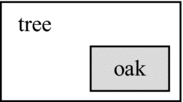
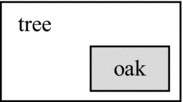
Hyponym-superordinate compounds (such as oak tree, chess game, tuna fish, jaybird, etc. – to name but a few) are characterized by a lower-order category label in the modifier position and a higher-order category label in the head position. The ‘tautological’ or redundant nature of hyponym-superordinate compounds stems from the fact that any category within a taxonomy is always included in the category immediately above it (Rosch et al. Reference Rosch, Mervis, Gray, Johnson and Boyes-Braem1976: 383). In sum, hyponym-superordinate compounds can be depicted by a simple diagram, as exemplified by oak tree (see figure 1).
Oak tree as a series of inclusive sets (after Bauer Reference Bauer2008: 15)
Why do hyponym-superordinate compounds exist, however, if the entity denoted by the first constituent is already ‘included’ conceptually in the entity denoted by the second one? The answer most probably lies in the acquisition of categories. One of the most important characteristics of categorization is that children categorize differently from adults. While adults group things on the basis of taxonomies, children often put things together on the basis of associations, subjective preferences, etc. (Rosch et al. Reference Rosch, Mervis, Gray, Johnson and Boyes-Braem1976: 414). Moreover, the taxonomic hierarchies used by adults are often difficult to grasp for children, who on the one hand have more difficulty in learning the terms for the subordinate and superordinate levels than that of the basic level. On the other hand children are often unwilling to acknowledge that the same thing can be called by both a basic-level term, such as cat, and a superordinate one, such as animal (Gelman et al. Reference Gelman, Wilcox and Clark1989: 310). These difficulties in acquiring taxonomies can be traced back to the fact that children do not understand the inclusive nature of categories (ibid.). However, as pointed out by Clark (Reference Clark2009: 274), children start producing root compounds that denote subcategories from the age of two. In such expressions, children consistently put the term denoting the higher-order category in the right-hand position, and use these coinages especially for contrastive purposes, as in the case of car smoke (‘exhaust’) versus house smoke (which comes from a chimney). Consequently, hyponym-superordinate compounds might be remnants of this early process of acquiring taxonomies; put simply, they ‘make the relation between [taxonomical] levels explicit . . . [s]o it may be easier to understand that an oak-tree is a tree than that an oak is a tree’ (Gelman et al. Reference Gelman, Wilcox and Clark1989: 310).
Nevertheless, the problem with this reasoning is that it does not explain why this process does not extend over all of our subordinate categories, and why it is limited to a group of compounds only. Therefore, a further explanation needs to be found to adequately justify the existence of coinages such as oak tree. A further clue is provided in Clark (Reference Clark2009: 268), who states that children ‘rely on the paradigms they know, particularly when trying to contrast two objects, actions, or properties that are near neighbours’. These ‘paradigms’ are none other than already existing forms and compounding patterns. Consequently, oak tree fits in with the compound-forming pattern of X+tree, such as apple tree and plum tree. In these cases, apple and plum are used as basic-level terms for the fruit that such trees bear, and the X+tree pattern denotes ‘a tree that bears X’. The entrenchment of this pattern might have led to its extension to those cases as well where X denotes the tree itself, and not exclusively the fruit.
Evidence for the hypothesis that hyponym-superordinate compounds serve important categorizational purposes is well reflected in novel coinages as well, where the superordinate term helps to identify (and categorize) the entity denoted by the more specific term. This process is nicely illustrated by the compound notebook, which started off as a hyponym-superordinate compound, notebook computer, when it made its first appearance. According to the OED, the first citation of notebook comes from the New York Times in 1983, when it appeared in the following headline: ‘Tandy to introduce “Notebook” computer’. Here, computer played an important role in identifying and explaining the motivation for the coinage of the expression (and hence disambiguating the meaning of the electronic gadget from its original meaning as a ‘small book with blank or ruled pages for writing notes in’ (OED)). However, as the concept of ‘notebook’ became increasingly widespread (and people were able to identify it as a portable computer), the superordinate category, computer, lost its significance, which meant that notebook computer has been increasingly replaced by notebook.Footnote 4
Supplementary evidence for the categorizational role of hyponym-superordinate compounds is provided by the fact that the order of the constituents within this compound type is not random (as alluded to by Marchand Reference Marchand1969: 42; Bauer Reference Bauer1978: 86). It is always the superordinate term that features in the right-hand slot, while the hyponym occupies the left-hand position (i.e. we do not have examples such as *tree oak, *game chess, *dog hound or *fish tuna). Therefore, in all of these compounds the right-hand constituent serves a rather similar categorizing function as the right-hand constituent of the vast majority of English compounds that adhere to the so-called Right-Hand Head Rule (whereby the right-hand member of a compound is the expression's semantic head, specifying the category to which the compound as a whole belongs – e.g. a dog house is a type of house, an apple tree is a type of tree, etc.). This ordering of the constituents is in line with the familiarity hierarchy, which spells out that the more familiar (i.e. the hyponym in the case of hyponym-superordinate compounds) always precedes the less familiar in noun phrase sequences (Allan Reference Allan1987: 52).
This categorizational role of hyponym-superordinate compounds is also brought out in bureaucratic language and journalese. Consider the examples marriage relationship or growing-up process – both examples are cited as representing official, bureaucratic language (Hatcher Reference Hatcher1952), where it is customary to add a more general, superordinate term to a more specific one in order to provide a ‘framework’ for the specific term, thereby focusing the attention on one particular aspect of the specific term and assigning the entity denoted by the specific term in the more general ‘scheme’ of things (Hatcher Reference Hatcher1952: 13; Marchand Reference Marchand1969). In this role, the head element serves as a handy means to ‘isolate and label’ (Hatcher Reference Hatcher1952: 14) various aspects of our personal, social and professional lives. At the same time, the head element – by virtue of its ‘categorizational’ role – helps us to zoom in on one particular aspect of the entity in question (that is specified by the first constituent of the compound). Accordingly, marriage relationship focuses on the reciprocal partnership of the individuals in marriage, while marriage, as a single unit and without the superordinate element, is a more collective and general term that can be applied to a number of things that are elements of the category of marriage: the length of the marriage, the individuals who are married, the legal aspects of marriage, the benefits of marriage, the hardships of marriage, etc. The same happens in the case of teaching profession. As a single unit, the first constituent can refer to imparting knowledge or giving direction and guidance (as provided by the definitions of the OED), which are primarily actions. However, with profession in the head position, the compound as a whole emphasizes one particular aspect of teaching – its status as a profession – thereby changing the way we perceive teaching from being primarily an action to a thing.
As regards to journalese, one can cite birthday event or fire incident among others, in which cases the rather general terms event and incident are added to the more specific birthday and fire, respectively.Footnote 5 The head nouns play a categorizational role in both compounds, allowing us to concentrate on one particular aspect of birthdays (namely, their celebration) and fires (that is, their occurrence and hence their possible containment). Interestingly, at the same time, there is a definite elevation of status happening in both cases: a birthday event sounds more grandiose than just a simple birthday (which is quite evident in the quote as well; viz. ‘A birthday dinner is suddenly transformed into a birthday event’ – my emphasis, RB), and a fire incident implies something more serious than just a simple fire. In journalism this might be a handy tool to raise the significance of a news item and thereby grab the reader's attention.
3.2 Upgrading concepts
Upgrading or raising the significance of things is not a particular feature of journalese; it shows up in other areas of life as well, especially in official, bureaucratic language, where it is rather common to use coinages such as marriage relationship, smoking habit, growing-up process, teaching profession or panic reaction (to name but a few; the examples are from Hatcher Reference Hatcher1952). Why is there such an inclination for this type of compound formation in bureaucratese? The first reason is related to the more general predilection for the creation of nominalizations, which are typically more difficult to process by hearers/readers than their longer, non-nominalized equivalents, and which might be a handy feature from the speaker’s/writer's point of view. Furthermore, they do not require an explicit subject, which means that the speaker/writer does not have to assume responsibility for what is being said (Allan & Burridge Reference Allan and Burridge1991: 205). As a further motivating factor, nominalizations ‘streamline’ the ‘Y of X’ genitive phrase into a more condensed (compound) form, thereby lending it a more ‘technical’ sense – e.g. ‘profession of teaching’ becomes teaching profession (Hatcher Reference Hatcher1952: 14).
The second reason why hyponym-superordinate compounds show up in abundance in bureaucratic language is related to the upgrading of concepts – put simply, by assigning a somewhat redundant superordinate category to any concept is to elevate or dignify it in the process (Allan & Burridge Reference Allan and Burridge1991: 206. The matters that bureaucrats manage are often ‘so mundane’ and ‘trivial’ that they use this special word-formation process to ‘obfuscate the mundane . . . and endow it with gravity’ (ibid.). A similar opinion is formed by Hatcher (Reference Hatcher1952: 13), who claims that hyponym-superordinate compounds add ‘a note of dignity with a suggestion of the official’.
The reason why hyponym-superordinate compounds feel more ‘dignified’ than their single-unit counterparts can be accounted for by the conceptual metaphor more of form is more of content (Lakoff & Johnson Reference Lakoff and Johnson1980: 127), whereby a linguistic unit that is longer (i.e. has a larger form, such as a compound unit) is perceived to carry more information (more content) than a single-word unit.Footnote 6 The same guiding principle can be observed in the use of hyponym-superordinate compounds in journalese (cf. the above-mentioned birthday event or fire incident), with the aim of attaching more importance to a particular news item.
4 Synonymous compounds
In general, not much has been said in the morphological literature on synonymous compounds, which are based on two synonymous terms. Synonyms will be considered here as ‘different phonological words which have the same or very similar meanings’ (Saeed Reference Saeed2009: 65), with the obvious disclaimer that ‘true or exact synonyms are very rare’ (ibid.) – necessarily implying that a compound composed of two synonyms cannot ever be in essence tautological. Nevertheless, scholars who have made reference to synonymous compounds typically point out only their tautological nature. Renner (Reference Renner2008: 610), for instance, alludes to synonymous compounds as ‘tautological compounds’, which are a subtype of coordinate compounds (i.e. compounds ‘composed of two elements which belong to the same lexical category and are co-hyponyms’) and notes that ‘tautological compounds’ can function as nouns (as in pathway), verbs (e.g. hustle-bustle) or even adjectives (such as squiggly-wiggly). The problem with alluding to such coinages as ‘tautological’ is that the label implies a sense of redundancy and semantic emptiness.
Nevertheless, not all scholars writing on the subject advocated the view that synonymous compounds are tautological. In his comparative analysis of co-compounds, Wälchli (Reference Wälchli2005: 143–4) terms synonymous compounds as ‘synonymic co-compounds’ (which is in itself a rejection of the tautological nature of such coinages), and argues that in various languages of the world, such compounds have specific functions. On the one hand, they are used to express more abstract entities, as in the case of Khalkha, where üzel bodol (‘view-thought’) denotes ‘opinion’. Second, synonymic compounds can also refer to the collective: the meaning of Chuvash jură-kĕvĕ (‘song-motif/melody’) is ‘songs’. While these two functions do not seem to hold for English synonymous compounds (whose motivations, therefore, must be sought for elsewhere), Wälchli's claims are highly relevant for the present study as well, by introducing the idea that synonymous compounds are coined for a particular communicative purpose, and as such, both components play a role in the overall meaning (hence there are no semantically empty, ‘meaningless’ constituents). In what follows, the article will present two possible motivational forces for the coinage of synonymous compounds in English.
4.1 Emphasis
It has already been noted that the collocation of synonyms can be used as an emphatic device in order to express strong emotions (Ullmann Reference Ullmann1977: 153). See, for instance the following examples from the starting lines of Hamlet's first soliloquy (cited by Ullmann Reference Ullmann1977: 153): ‘O, that this too too solid flesh would melt, / Thaw, and resolve itself into a dew!’ (Act I, scene 2). In the quoted lines the collocation of the synonymous verbs intensifies the emotions felt by Hamlet (and note also the reduplicated too, which has a similar function). Collocation is relatively common on the phrasal level as well – as exemplified by binomials, which are often formed by the conjoining of two synonyms, as in the case of null and void, rules and regulations or ways and means (Gustafsson Reference Gustaffson1975; Malkiel Reference Malkiel1959; Norrick Reference Norrick1988). The main function of synonymous binomials is to emphasize ‘the mutual semantic ground of the two members’ (Gustaffson Reference Gustaffson1975: 12), although at the same time the two synonyms side-by-side might also evoke a sense of contrast, as they can ‘arouse different connotations from one another and their combination may suggest an inclusiveness neither member can alone’ (Norrick Reference Norrick1988: 79). Norrick cites bought and paid for and over and done with, where the second constituent (paid for and done with respectively) adds a note of ‘finality’ to the expression that the first constituent would not have been able to achieve independently.
It is an intriguing question whether synonymous compounds in English are productive.Footnote 7 There are some instances of the use of synonymous compounds in English poetry, as in the works of Coleridge, who often paired synonyms with one another to increase the poetic or epic effect, as in the case of the already cited living-life (Cooper Reference Cooper1904: 224). The Old English epic verse Solomon and Saturn II has also exploited this word-formation process: the two elements of the compound mōdsefa (‘mind’, ‘disposition’) individually denote ‘mind’. According to Harbus (Reference Harbus2003: 99), the pairing of the two words simply adds emphasis. Nevertheless, the question of productivity in everyday language is indeed an interesting one, especially in light of the fact that the collocation of synonyms in units larger than compounds, such as binomial expressions, is rather common in present-day American English (Gustaffson Reference Gustaffson1975; Malkiel Reference Malkiel1959).
Works on the subject of synonymous compounds (such as Renner Reference Renner2008) rarely mention novel instances; a typical and often-cited example is pathway. However, pathway might be simply considered as an analogical formation on the basis of highway (the first mention of which dates back to 859 – OED), i.e. a kind of way.Footnote 8 Accordingly, while highway denotes a larger (i.e. main) road, pathway, in this respect, is a smaller and narrower ‘road’ (cf. also carriageway, originating from 1800).Footnote 9 Nevertheless, Renner's (Reference Renner2008) other examples, teeny-tiny or hustle-bustle, can be considered as synonymous compounds that have been conjoined for most likely an emphatic effect. According to the OED, teeny was originally a playful, ‘childish’ variation of tiny (the first citation of teeny is from 1825). Hustle-bustle (‘a bustle in which there is much hustling or jostling’), a rhyming compound, points to a very interesting phenomenon of English: namely, quite a few rhyming compounds, especially those denoting sound, are constituted of two meaningful and synonymous units, which at the same time are semantically related to the overall meaning of the compound as well. Examples include crack-rack (‘an echoic word representing or describing a succession of cracks’), where the second constituent, rack (‘a rush; a rapid advance, esp. towards or into collision with something; a hard blow or push’), is very close in meaning to both crack and the overall meaning of the expression. A similar process can be observed in huff-puff (‘moved with every puff of wind’), which is yet again a concatenation of two meaningful – and synonymous – words. As elucidated by Benczes (Reference Benczes2012), the rhyming feature of such expressions is neither accidental, nor without meaning or function, as it ntensifies the overall meaning of the expression. Therefore, the rhyme is used as a means of emphasis, which supports the hypothesis that synonymous compounds are coined for an emphatic effect.Footnote 10
The examples cited above are all lexicalized, and the question necessarily arises whether contemporary English uses synonymous compounding at all. I believe that the answer to this question is a tentative ‘yes’. Synonymous ‘compounds’ are now appearing in a new, blended form, as the following examples illustrate: chillax (‘to calm down or relax’ from chill+relax),Footnote 11chivers (‘chills or shivers’ from chill+shivers), confuzzled (‘a heightened state of bewilderment and puzzlement, usually caused by the individual in question not understanding the situation or conversation’ from confused+puzzled).Footnote 12 Blends are not very distinct from compounds – Lehrer (Reference Lehrer2003: 371) in fact alludes to them as ‘underlying compounds’. Although blends were rather peripheral in English word formation in the past (Bauer Reference Bauer1983), they are now on the increase, as they are considered as ‘clever, trendy, eye-and-ear-catching words’ (Lehrer Reference Lehrer2003: 371) that people enjoy creating. Therefore, this shift from synonymous compounds to synonym-based blends is a simple reflection of the current trends in English word formation.
While it is impossible to estimate the percentage of such new coinages in English in general, the Rice University Neologisms DatabaseFootnote 13 does provide some indication of their frequency. This database is an ongoing compilation of neologisms posted by Rice University students (it has 8,041 terms at present). According to my informal survey, approximately 5 per cent of the blends are based on the combination of two synonymous terms, which means that the pairing of synonyms in a blend-like format is indeed a productive, though less frequent word-formation method in English. The vast majority of these neologisms are evaluative adjectives (e.g. crunky ‘poor quality’ from crappy+junky; terrifitastic ‘great, fantastic’ from terrific+fantastic; vexellent ‘wonderfully excellent’ from vunderbar+excellent) or descriptive ones (e.g. gigantamous or ginormous both meaning ‘very large’ from gigantic+enormous),Footnote 14 and their main purpose – similarly to the poetic examples from the Old English epic verse Solomon and Saturn II or from the works of Coleridge – is to accelerate the individual meaning of the component words (i.e. to simply add emphasis). Interestingly, this feature was also often alluded to in the definitions that the students provided about the blends.Footnote 15
4.2 Clarification
The collocation of synonyms can also be used to ‘make one's meaning clearer’ (Ullmann Reference Ullmann1977: 153). Many of the collocations of the English language, such as liberty and freedom, stem from the desire to clarify one's message as best as possible. As Ullmann argues, in the Middle Ages it was common to explain the meaning of a French word in a text by adding its native synonym. This trend also showed up in compounds, too, motivating the creation of synonymous coinages such as courtyard and subject matter.
According to Kate Burridge (p.c.), it is reasonable to assume that the practice of adding a native synonym to a French word became a stylistic feature of prose. Legal doublets (and triplets)Footnote 16 might have started off with a clear function, but the original motivation became obscured and such expressions turned into self-generating idiosyncrasies of the jargon. Eventually, the process has become a stylistic feature of the variety. This phenomenon has its counterpart in art history as well – skeuomorphs are features that were once necessary (on a building for example) but are now applied for purely decorative purposes. Skeuomorphs also abound on artefacts – such as the note-taking application of Apple computers, which resembles a physical binder. Gessler (Reference Gessler, Porto, Saravanan, Waagen and Eiben1998: 229) refers to skeumorphs as ‘material metaphors’ that serve an important function: they help to familiarize us with the new and unfamiliar by drawing on conventionalized and widely accepted patterns.
As regards to courtyard, the second constituent, yard (‘a comparatively small uncultivated area attached to a house or other building or enclosed by it’) is the Old English equivalent of the first constituent. Court derives from French court, denoting ‘enclosure’ (Barnhart Dictionary of Etymology; henceforth BDE). In fact, the BDE gives ‘courtyard’ as one of the definitions of the French court, which in itself points to the tautological nature of the compound. Nevertheless, it should be noted that the compound courtyard is not fully tautological, as it refers to an enclosure ‘within the precincts of a large house, castle, homestead, etc.’, that is, the compound's meaning specifies the nature of the building a courtyard can belong to. While any home could have a yard (cf. front/back yard) or a court for that matter, only larger and more prominent buildings could come with a courtyard. Accordingly, a courtyard must be larger in size than a yard or a court (see also the definition of yard: ‘a comparatively small uncultivated area . . .’; emphasis added). In this respect, courtyard can be considered as being motivated by the more of form is more of content metaphor (as in the case of the examples in section 3.2), whereby the effect of the two synonyms ‘adds up’ to an increase in the overall size of their referents.
Subject matter seems to be a quite straightforward case as well. Matter, which is of Anglo-Norman origin, predates the Latinate subject (< Old French suget) by at least one hundred years (the first citation of matter is from 1230; ibid.). Therefore, it seems plausible to assume that subject matter (first citation from 1380) was also an instantiation of the trend to clarify non-native words with their native (or more conventionalized) synonyms. It is an intriguing question what difference there is (if there is any at all) among the use of subject, matter and subject matter. Following an informal survey of the CoCA corpus,Footnote 17 what can be seen is that both subject and matter (used in the sense of ‘issue’ or ‘focus of interest’) are about a third less frequent than subject matter used in the same sense. One possible reason for this phenomenon is that subject is more inclined to appear as a modifier in N + N combinations, such as the CoCA examples subject area, subject entity, subject concept, etc. (while this is very rare in the case of subject matter), and can also be used in a number of other senses (such as ‘being under the control of somebody or something’ or as ‘a part of a sentence’). Matter is also inclined to appear in the sense of ‘substance’ (as in the CoCA example of ‘inorganic matter’). While a more detailed analysis is required to examine the exact distribution of these words in relation to one another, what can be tentatively concluded is that subject matter has a more narrower use than the other two terms, and as such, appears more frequently in the sense of ‘issue’ – which seems to corroborate the idea that the pairings of synonyms add an emphatic effect (while subject or matter can have a number of different senses individually, when used side by side, as in subject matter, they can only refer to the ‘issue at hand’).
5 Conclusions
The aim of the article was to examine the role of compounds that have been loosely referred to as ‘tautological’ in academic discourse. As has been demonstrated above, there has been much confusion with regard to (1) what lexical items the term ‘tautological compound’ denotes; and (2) under what larger class of compounding (appositional, coordinate, dvanda, etc.) tautological compounds actually belong to. With regard to the first issue, the article has argued that the term ‘tautological compound’ is a misnomer, and has differentiated between two distinct, but related subtypes: hyponym-superordinate compounds (such as tuna fish and oak tree), and synonymous compounds (such as subject matter or courtyard). Nevertheless, both types are similar to some degree to one another in the sense that they do not have explicit heads, as both constituents can be considered as such. Therefore, it has been argued that hyponym-superordinate compounds and synonymous compounds should be treated as a subclass of coordinated compounds.
It has also been demonstrated that the two subtypes are by no means redundant: they, in fact, serve a number of diverse and important roles. Accordingly, hyponym-superordinate compounds are remnants of our early acquisition of taxonomical relations by making the link between the hierarchical levels explicit. At the same time, hyponym-superordinate compounds are also used to dignify and upgrade concepts via the conceptual metaphor more of form is more of content, whereby a linguistic unit that has a larger form is perceived to carry more information (that is, more content) than a single-word unit.
Synonymous compounds have been shown to possess an emphatic feature, which has been exploited mainly in poetic language (as in the works of Coleridge). However, it has been maintained that synonymous compounds are still alive in everyday language, though in a slightly different form – as synonym-based blends. Synonymous coinages have also been motivated by the need to clarify a non-native word with its native counterpart.
While tautological compounds have been around for a rather long time in the English language, they have received very little attention (if at all) from linguists. Yet they provide fascinating insights into the motivational processes behind compounding. It is hoped, therefore, that the paper has managed relegate this much neglected category to its proper, well-deserved place within English word formation.