INTRODUCTION
Within a few years young children typically acquire the main grammatical features of their native language. Very efficient processing mechanisms which enable them to detect distributional properties of their language input seem to contribute to this fast acquisition. For instance, frequencies of words and syllables have been shown to support the segmentation of speech as well as the acquisition of new words (e.g. Bortfeld, Morgan, Golinkoff & Rathbun, Reference Bortfeld, Morgan, Golinkoff and Rathbun2005; Goodman, Dale & Li, Reference Goodman, Dale and Li2008; Saffran, Aslin & Newport, Reference Saffran, Aslin and Newport1996). In this article we examine how the distributional pattern of another language entity, i.e. the frequency of subsyllables, affects the production of inflected word forms in German-learning children with typical and atypical language development.
Children's sensitivity to the frequencies of subsyllables, that is, the probabilities of phonemes and phoneme sequences occurring within syllables and at specific syllable positions (Bailey & Hahn, Reference Bailey and Hahn2001; Vitevitch, Reference Vitevitch2003), has previously been demonstrated in a number of different domains. Jusczyk, Luce and Charles-Luce (Reference Jusczyk, Luce and Charles-Luce1994) showed that English infants as young as 0;9 prefer to listen to syllables composed of vowel–consonant combinations in the syllable rhyme that have a high frequency of occurrence in the ambient language (e.g. /ɨs/, /ɛm/) compared to combinations with a lower frequency (e.g. /uʃ/, /ɔd/). Furthermore, it has been shown that English-learning infants aged 0;9 use the frequencies of within- and between-word consonant clusters to detect word boundaries in a speech stream (Mattys & Jusczyk, Reference Mattys and Jusczyk2001) by considering sequences with low word internal transitional probability as belonging to two different units (e.g. /mk/, /vt/). Archer and Curtin (Reference Archer and Curtin2008) demonstrated effects of subsyllabic frequencies with even younger children. They showed that English-learning infants aged 0;6 listen longer to nonce words with high-frequency stop–liquid cluster onsets (e.g. /tr/, /pr/) than to words with low-frequency onset clusters (e.g. /dr/, /bl/). Nazzi, Bertoncini and Bjeljac-Babic (Reference Nazzi, Bertoncini and Bjeljac-Babic2009) found that between ages 0;6 and 0;10 a preference for words with high-frequency labial–coronal sequences (e.g. /bode/, /byte/) compared to low-frequency coronal–labial sequences (e.g. /dobe/, /tyba/) emerges in French-learning infants.
These findings demonstrate that within their first year of life infants seem to compute subsyllabic frequencies in their linguistic input and to exploit this information in their speech processing, for example in finding word boundaries. At a later age subsyllabic frequencies seem to support further processes relevant for language acquisition. Hollich, Jusczyk and Luce (Reference Hollich, Jusczyk, Luce, Scarabela, Fish and Do2002) provide evidence that English-speaking children aged 1;5 acquire words with high-frequency phonemes and phoneme sequences more easily than words with low-frequency phonemes and sequences. Storkel (Reference Storkel2001), as well as Storkel and Rogers (Reference Storkel and Rogers2000), showed that new labels for unknown objects were learned more proficiently by preschool- and school-aged children if these labels consisted of high-frequency phonemes and two-phoneme sequences (biphonemes) (e.g. /wæt/, /hæp/) compared to low-frequency ones (e.g. /naƱb/, /gim/). This effect showed up in comprehension tasks like picture selection as well as in production tasks like naming.
An impact of subsyllabic frequencies on the repetition of words and nonce words has been observed not only for typically developing (TD) children but also for children with specific language impairment (SLI). Thus, TD-children and children with SLI correctly repeated words and nonce words consisting of high-frequency phonemes and high-frequency biphonemes more often than those consisting of low-frequency ones (e.g. Beckman & Edwards, Reference Beckman, Edwards, Broe and Pierrehumbert2000; Coady, Evans & Kluender, Reference Coady, Evans and Kluender2010a, Reference Coady, Evans and Kluender2010b; Edwards & Beckman, Reference Edwards and Beckman2008; Richtsmeier, Gerken & Ohala, Reference Richtsmeier, Gerken and Ohala2011; Stokes, Wong, Fletcher & Leonard, Reference Stokes, Wong, Fletcher and Leonard2006; Zamuner, Reference Zamuner2009). As high subsyllabic frequencies facilitate the repetition of words and nonce words not only in TD-children but also in children with SLI, this indicates that children with SLI extract regularities related to these frequencies in a similar manner to their unimpaired peers (Coady et al., Reference Coady, Evans and Kluender2010a: 506).
Contrary to this, an analysis by Marshall and van der Lely (Reference Marshall and van der Lely2006), based on data from van der Lely and Ullman (Reference van der Lely and Ullman2001), revealed diverging effects of subsyllabic frequencies on the language performance of TD-children and children with SLI when the production of inflected word forms is considered. Marshall and van der Lely investigated English-learning children's production of regular past tense verb forms (-ed suffix) in two conditions: in one condition the inflected forms had high-frequency clusters, e.g. /st/ as in crossed, which also occur in many English monomorphemic words such as frost, mist, and lost. In the other condition the clusters of the inflected verb forms were of low frequency, e.g. /md/ as in slammed, based on a lack of these clusters in monomorphemic English words. The production of the inflected forms was not affected by these different cluster frequencies in a group of TD-children, but interestingly children with SLI were more successful in producing inflected verb forms with high cluster frequencies than ones with low cluster frequencies. Marshall and van der Lely suppose a deficient morphosyntactic bootstrapping that hinders the children with SLI from analyzing affixes and from isolating them from word stems successfully. Therefore – unlike typically developing children – they do not instantiate a rule-based mechanism for the generation of inflected words that is not influenced by phonotactic properties. Instead, these children rely more on phonological or lexical properties. Concordantly, Marshall, Marinis and van der Lely (Reference Marshall, Marinis and van der Lely2007) found that English-speaking TD-children but not children with SLI were able to use the phonotactics of morphologically complex forms to parse passive sentences. In a sentence–picture matching task TD-children showed more correct matches between a sentence and a picture when the past participles contained consonant clusters which do not occur in monomorphemic words (e.g. scrubbed). For children with SLI no difference between cluster types that occur or do not occur in monomorphemic words was found, indicating that children with SLI could not use phonotactics as a cue to the existence of a stem + suffix boundary. According to Marshall and colleagues (Reference Marshall and van der Lely2007) this is further evidence that in children with SLI morphosyntactic bootstrapping is impaired.
Not only subsyllabic frequencies but also frequencies of entire inflected verb forms (which may be confounded) were found to affect verb inflection in children with SLI but not in TD-children. For instance, Oetting and Horohov (Reference Oetting and Horohov1997) investigated six-year-old English-speaking children with SLI and found that high-frequency regularly inflected verb forms (e.g. pulled, jumped) were produced correctly more often than low-frequency ones (e.g. smelled, brushed). No such frequency effect was found in TD-children matched for verbal abilities. A similar result was reported by van der Lely and Ullman (Reference van der Lely and Ullman2001) for eleven-year-old English-speaking children with SLI, who also showed better performance when producing high-frequency regularly inflected verb forms (e.g. robbed, crossed) than low-frequency ones (e.g. flapped, flushed), whereas for six- and seven-year-old TD-children no such difference was found.
Leonard, Davis and Deevy (Reference Leonard, Davis and Deevy2007) investigated the impact of phonotactic probabilities on the production of past tense forms of nonce verbs in English-learning children with SLI and TD-children. Half of the nonce verbs showed a high phonotactic frequency (the summed positional and biphone frequencies) of both the stem (e.g. /pæb/) and the entire inflected verb form (stem + inflection, e.g. /pæbd/) while the other half had a low phonotactic frequency (e.g. /jɔb/, /jɔbd/). It was found that children with SLI were less likely to inflect the nonce verbs of low frequency than those of high frequency. Such a difference showed up neither for TD-children matched for age nor for TD-children matched for mean length of utterance. Leonard and colleagues interpreted their findings as suggesting that children with SLI have a limited capacity to produce past tense forms and therefore rely more heavily on a new verb's typicality. The studies by Leonard and colleagues (Reference Leonard, Davis and Deevy2007), van der Lely and colleagues (Marshall & van der Lely, Reference Marshall and van der Lely2006; van der Lely & Ullman, Reference van der Lely and Ullman2001) and Oetting and Horohov (Reference Oetting and Horohov1997) consistently point to qualitative differences between the performance of TD-children and children with SLI: while the production of inflected verb forms seems to be affected by phonological or lexical properties of the target word in children with SLI, this observation has not been made for typically developing children. Findings by Marchman, Wulfeck and Ellis Weismer (Reference Marchman, Wulfeck and Ellis Weismer1999) add to this. They found that children with SLI but not typically developing children were affected by the quality of the final consonant of the verb stem in producing past tense forms of English verbs.
So far, evidence for such a qualitatively different performance pattern is restricted to children learning English, a language with a rather impoverished inflectional system. Our study looked at the performance in inflecting nonce verbs of German children with SLI and the potential effect of subsyllabic frequencies of the inflected form. German provides an interesting case to test the cross-linguistic reliability of the findings with the English-speaking children as German is a highly inflecting language with a much more complex inflectional verbal paradigm than the English system. In German, verbs are inflected for number, person and tense with a high inventory of different suffixes used in verb marking. Furthermore, and different from English, the verb stem itself does not appear as a dominant form in the paradigm and does not function as the non-finite form, which also carries an inflectional ending (-en) in German. The occurrence of the same verb stem with different inflectional suffixes in German children's input may facilitate the generation of morphological paradigms in language acquisition and thereby the establishment of a rule-based mechanism to produce inflected word forms in the sense of a morphosyntactic bootstrapping mechanism as proposed for example by van der Lely and Ullman (Reference van der Lely and Ullman2001) and Marshall and van der Lely (Reference Marshall and van der Lely2006). These factors may diminish differences between TD-children and children with SLI in their production of inflected verb forms.
To test whether the production of inflected nonce verbs is affected by subsyllabic frequencies in German-learning children with SLI, we adopted a sentence completion task in which the children were asked to produce nonce verbs inflected for 3rd person singular (with the regular -t suffix) resulting in forms with either high or low subsyllabic frequency. Subsyllabic frequency was manipulated by the vowel length of the nonce verb stem, which always consisted of a CVC or CVVC sequence with either a short (V) or a long vowel (VV). Inflecting these vowel stems for the 3rd person singular leads either to a VCt]σ- or a VVCt]σ-subsyllable, the latter of which is highly infrequent in German monomorphemic words. The nonce verbs were introduced to the children using sentences in which the verb was inflected for 3rd person plural (with the regular -en suffix). The performance of a group of children with SLI was compared to that of two groups of TD-children: one group of children matched for chronological age (CA-children) and a second group of younger children matched for verbal abilities (VA-children). Before running the experiment, we did corpus analyses of German adult- and child-directed speech to check the distributions of the two types of subsyllables, VCt]σ and VVCt]σ, in German in general and in children's input.
Corpus analyses
According to the six-million-word corpus of the German CELEX database (Baayen, Piepenbrock & Gulikers, Reference Baayen, Piepenbrock and Gulikers1995), VCt]σ-subsyllables are more frequent than VVCt]σ-subsyllables in German adult-directed speech: 93% of all word tokens with a (V)VCt]σ-subsyllable contain a VCt]σ-subsyllable and only 7% a VVCt]σ-subsyllable (Mann–Whitney U test: U = 3440·5, z = 2·238, p = ·025). We checked whether the higher frequency of VCt]σ- over VVCt]σ-subsyllables also holds for child-directed speech (CDS). Analyses of data from twenty-two children from the Szagun corpus (child ages between 1;4 and 2;1) taken from the CHILDES database (MacWhinney, Reference MacWhinney2000) revealed that significantly more word types with VCt]σ-subsyllables (71% of all word types with (V)VCt]σ-subsyllables) than with VVCt]σ-subsyllables (29%) occur in CDS (t-test: t(21) = 15·128, p < ·001), and that also significantly more word tokens with VCt]σ-subsyllables (90%) than with VVCt]σ-subsyllables (10%) appear (t(21) = 9·986, p < ·001).
Therefore, in CDS as well as in adult-directed speech the diverging frequency of VCt]σ- and VVCt]σ-subsyllables corresponds to the diverging number of monomorphemic words containing these subsyllables. Whereas many monomorphemic words show VCt]σ-subsyllables (e.g. Nacht /naxt/ ‘night’, Bild /bɨlt/ ‘picture’, kalt /kalt/ ‘cold’), nearly none exist with VVCt]σ-subsyllables (except e.g. Mond /mo:nt/ ‘moon’). Instead, VVCt]σ-subsyllables are almost always inflected verb forms (e.g. wohnt /vo:nt/ ‘lives’, fehlt /fe:lt/ ‘lacks’, malt /mɑ:lt/ ‘paints’). In the CELEX database 99% of all word tokens with VVCt]σ-subsyllables are inflected verb forms. The corpus of CDS shows a similar distribution with VVCt]σ-subsyllables occurring significantly more often as inflected verb forms (97%) than as monomorphemic word types (3%) (t(21) = 12·623, p < ·001). Again, in the CDS corpus, 90% of the word tokens with VVCt]σ-subsyllables are inflected verb forms and only 10% are monomorphemic words (t(21) = 8·064, p < ·001) (see also Aichert, Marquardt & Ziegler, Reference Aichert, Marquardt and Ziegler2005). Summarizing, the corpus analyses confirm that VCt]σ-subsyllables are much more frequent than VVCt]σ-subsyllables and that VVCt]σ-subsyllables occur almost exclusively in inflected verb forms in German adult- and child-directed speech.
METHOD
Participants and language assessment measures
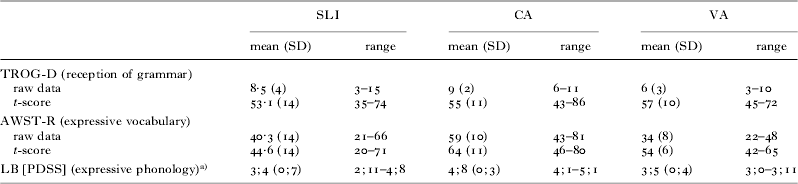
A total of forty-six children, sixteen children with specific language impairment and thirty typically developing children, participated in the study (see Table 1). At the time of investigation all children with SLI were receiving treatment from speech and language therapists due to developmental language disorders. Sixteen of the typically developing children were matched to the children with SLI in chronological age (t-test: t(30) = 0·007, p > ·05). The remaining fourteen were significantly younger than the children with SLI (t-test: t(28) = 11·095, p < ·001) but comparable to them regarding verbal age, which was established through language assessment measures (see below).
Participants

key: N = number, a) stated in years; months, SLI = children with specific language impairment, CA = typically developing children with same chronological age as SLI, VA = typically developing children with same verbal age as SLI.
Neither the children with SLI nor the CA- or VA-children had known hearing disorders, neurological abnormalities, or organic or cognitive impairments. Delayed development of motor skills was reported for some children with SLI by their parents. But for all children the acquisition of language abilities was the major developmental atypicality. All children were from monolingual German-speaking homes.
Three standardized German tests of language abilities were conducted with all children. The TROG-D (Test for Reception of Grammar in German; Fox & Schoop, Reference Fox and Schoop2006) was applied to test the grammatical abilities. Lexical abilities were established by the AWST-R (Test for Expressive Vocabulary in German; Kiese-Himmel, Reference Kiese-Himmel2005). Additionally, a subtest (LB) of the PDSS (Patholinguistic Assessment of Developmental Language Disorders in German; Kauschke & Siegmüller, Reference Kauschke and Siegmüller2009) was adopted in order to assess the expressive phonological abilities of the children.
For the SLI-group, the results confirmed a delayed language development. Thus, every child with SLI showed language abilities below the norm in at least one of the tests applied, i.e. a t-score below 40, one delayed phonological error pattern (a delay of more than six months; Crystal, Fletcher & Garman, Reference Crystal, Fletcher and Garman1989) or at least one atypical phonological error pattern (Fox & Dodd, Reference Fox and Dodd1999). For CA- and VA-children, all measures were at or above age-level expectations (see Table 2).
Language assessment measures

key: SLI = children with specific language impairment, CA = typically developing children with same chronological age as SLI, VA = typically developing children with same verbal age as SLI, SD = standard deviation, a) phonological age regarding the measured phonological error patterns (stated in years;months).
The SLI- and VA-groups' performances did not differ significantly in any of the three language assessments (Mann–Whitney U test: TROG-D: U = 70, z = 1·755, p = ·079; AWST-R: U = 84·5, z = 1·145, p > ·05; LB [PDSS]: U = 68, z = 1·413, p > ·05), although the results of the TROG-D indicate that the children with SLI performed marginally better in reception of grammar than the VA-children. The CA-children and the children with SLI showed comparable abilities in the TROG-D (Mann–Whitney U test: U = 122·5, z = 0·209, p > ·05), but the performance in expressive vocabulary and expressive phonology of the children with SLI was significantly below the CA-children's (AWST-R: U = 38, z = 3·394, p = ·001; LB [PDSS]: U = 8, z = 4·392, p < ·001). All together, the CA-children showed better language abilities than the children with SLI in expressive vocabulary and expressive phonology, while children with SLI and VA-children showed comparable levels of performance.
Additionally, spontaneous speech samples were recorded from all children. These were analyzed regarding the production of words with VCt]σ- and VVCt]σ-subsyllables. Only words not followed by words with initial /t/ or /d/ were considered, to allow an unambiguous decision as to whether the crucial consonant /t/ was the final consonant of the subsyllable VCt]σ or VVCt]σ. The analysis revealed that all children with SLI and all TD-children produced monomorphemic words with VCt]σ- and with VVCt]σ-subsyllables spontaneously (e.g. Bild /bɨlt/ ‘picture’, Stift /ʃtɨft/ ‘pencil’, Mond /mo:nt/ ‘moon’). Furthermore, all TD-children and fourteen of the sixteen children with SLI used inflected verb forms for 3rd person singular with VVCt]σ-subsyllables spontaneously (e.g. fegt /fe:kt/ ‘brushes’, malt /mɑ:lt/ ‘paints’) and all children produced verb forms with VCt]σ-subsyllables (e.g. fällt /fɛlt/ ‘falls’, kommt /kɔmt/ ‘comes’). This indicates that all children used verb inflection for 3rd person singular (-t suffix) and that in nearly all children these forms contained VCt]σ- as well as VVCt]σ-subsyllables.
Material
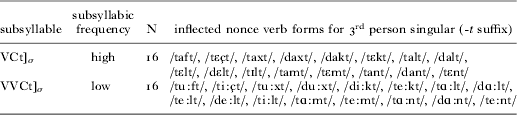
The stimuli used in this experiment consisted of 32 nonce verbs. When inflected for 3rd person singular 16 of these nonce verbs resulted in forms with high-frequency VCt]σ-subsyllables; the other 16 nonce verbs yielded forms with low-frequency VVCt]σ-subsyllables. Different vowels and different postvocalic consonants (stops, fricatives, liquids and nasals) were selected to create the nonce stems (see Table 3).
Target nonce verbs with VCt]σ- and VVCt]σ-subsyllables
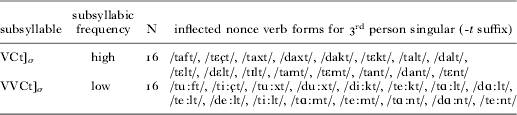
key: N = number.
Analyses of CDS (22 Szagun-corpora from CHILDES; MacWhinney, Reference MacWhinney2000) showed that the selected 16 VCt]σ-subsyllables appeared significantly more often in real word tokens (81% of all word tokens with (V)VCt]σ-subsyllables) than the chosen 16 VVCt]σ-subsyllables (19%) (t(21) = 7·788, p < ·001). Additionally, no monomorphemic word with one of the chosen VVCt]σ-subsyllables was contained in the corpus, suggesting that the selected VVCt]σ-subsyllables occur only in inflected verb forms for 3rd person singular.
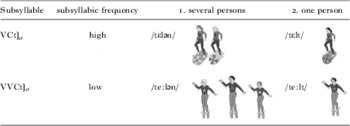
The onsets of all nonce verbs consisted of /t/ or /d/ because these coronal stops are unmarked and acquired early (Levelt, Reference Levelt1994). The purpose of this was to simplify the target structures and to focus on the subsyllables. For each nonce verb a pair of two pictures was created from clipart software that served to illustrate the meaning of the nonce verb. One of the pictures showed several persons performing an action for which no real German verb label exists. The second picture of the pair showed only one person performing the same action as in the first picture. An example is shown in Table 4.
Example of the illustrations of the nonce verbs

The 32 test items were presented in a pseudo-randomized order with the following restrictions. First, maximally two nonce verbs from the same subsyllable type (VCt]σ or VVCt]σ) occurred in sequence. Second, two nonce words that only differed in vowel length, e.g. /tɛlt/ and /te:lt/, never occurred in sequence. In addition to the 32 test items, four further nonce verbs were created and illustrated (/tɛft/, /tɨnt/, /to:lt/, /tu:lt/) to be used as practice items.
Procedure
At the beginning of each trial, the first picture with multiple actors was presented to the child. The nonce verb was introduced by the experimenter by describing the action in the picture using five standardized short sentences. The nonce verb occurred once in each of these sentences, e.g. Die Mädchen /tɛlən/. Schau mal, die Mädchen /tɛlən/! Ganz doll /tɛlən/ die Mädchen. Sie /tɛlən/. Die Mädchen /tɛlən/. (‘The girls /tɛlən/. Look, the girls /tɛlən/! They /tɛlən/ really hard. They /tɛlən/. The girls /tɛlən/.’). All the sentences contained a plural subject such that the nonce verb always occurred inflected for 3rd person plural (-en suffix). Then the second picture of the pair showing only one person performing the action was presented. In this context, the experimenter elicited a verbal response from the child by uttering: Da ist noch ein Mädchen. Was macht es? Das Mädchen … (‘There is another girl. What is she doing? The girl …’). Thereby, the production of the nonce verb inflected for the 3rd person singular was elicited from the child. The elicitation of the inflected nonce verbs at the end of a sentence avoided any impact of coarticulation of following consonants on the realization of the inflectional ending. While the child received feedback on the productions in the practice trials, no feedback was given during the test phase. A puppet was involved in the procedure in order to maintain the child's interest in the experiment. The child was told that the puppet likes to learn new words and that the child could help her.
Testing was accomplished in individual sessions lasting between 15 and 30 minutes. The whole experiment was audio-recorded. In addition, the productions of the children were immediately written down during the procedure by the experimenter. Afterwards, these notes were checked against the recordings and transcribed using the International Phonetic Alphabet (IPA). To check the reliability of the transcriptions, 10% of the recordings were transcribed by a second coder who had not seen the children before. There was a high correlation between the first and the second transcription (Pearson: r = ·96).
Scoring
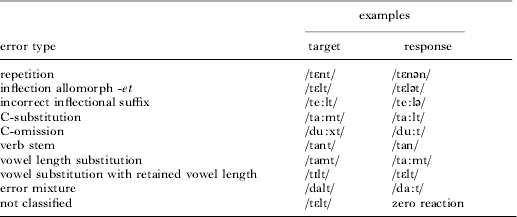
All responses that contained a correct realization of the intended VCt]σ- or VVCt]σ-subsyllables were considered as correct. Substitutions of the phonemes /t/ or /d/ in the onset of the syllables were ignored as their occurrence was not relevant for the purpose of the study. Incorrect responses were assigned to ten different error types (see Table 5).
Error types and examples

key: C = consonant.
The error type repetition reflected an imitation of the previously presented nonce verb form without inflecting it properly using the regular singular inflectional ending. The error type inflectionallomorph-et contained productions of an allomorph of the inflection for 3rd person singular in German which regularly applies following verb stems ending in /t/ or /d/ (e.g. rett-et /rɛtət/ ‘rescues’, red-et /re:dət/ ‘tells’) (e.g. Hall, Reference Hall1992; Penke, Reference Penke2006). As none of the nonce verb stems used in this experiment ended in /t/ or /d/, the use of the allomorph -et was not phonologically motivated here, and thus was considered an error. Children also produced incorrect inflectional suffixes like -e (1st person singular). Furthermore, they substituted or omitted the final consonants of the stem (C-substitutions and C-omissions) or they produced the bare verb stem without any inflectional ending (verb stem). Vowel length substitution was considered a separate error category because vowel length defined the phonemic contrast between VCt]σ- and VVCt]σ-subsyllables. Thus, a separate analysis of vowel length substitutions could shed light on the question of how far this phonemic contrast was preserved in the errors of the children. Other vowel errors were classified as vowel substitution errors with retained vowel length. Responses were considered as error mixtures if at least two of the error types occurred within the same production. Finally, not classified involved responses that could not be allocated to one of these categories, as for example zero reactions.
RESULTS AND DISCUSSION
Correct responses
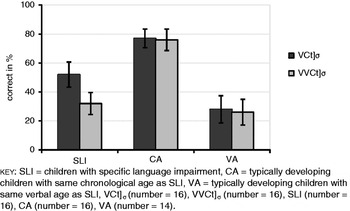
The mean percentages of correctly produced VCt]σ- and VVCt]σ-subsyllables for children with SLI, CA- and VA-children are presented in Figure 1.
Mean percentages of correct responses for VCt]σ- and VVCt]σ-subsyllables.

Non-parametric tests were used for the statistical analyses because the data were not normally distributed. Overall (taking VCt]σ- and VVCt]σ-subsyllables together), the children with SLI produced significantly fewer correctly inflected forms for 3rd person singular than the CA-children (Mann–Whitney U test: U = 47, z = 3·060, p = ·002), but the performance by the children with SLI did not differ significantly from the VA-children's (U = 82·5, z = 1·233, p > ·05).
Furthermore, we analyzed whether the responses by children with SLI, CA- and VA-children were similarly affected by subsyllabic frequencies. To this end, a differential score for the number of correct answers in the VCt]σ- and VVCt]σ-subsyllable conditions (VCt]σ minus VVCt]σ) was calculated and submitted to a Kruskal–Wallis test, which revealed a significant difference between the groups (χ2(2, N = 46) = 14·736, p = ·001). Thus, children with SLI, CA- and VA-children were differently affected by the subsyllabic frequencies when producing the verb forms. Further analyses contrasted the percentages of correct responses in the two subsyllable conditions for each group. Whereas for the CA-children (Wilcoxon test: z = ·315, p > ·05) and for the VA-children (z = 0·628, p > ·05) no significant difference arose, the children with SLI produced significantly more correctly inflected verbs with VCt]σ- than with VVCt]σ-subsyllables (z = 3·189, p = ·001). A look at individual responses confirmed the group results: every child with SLI who produced inflected nonce verbs for 3rd person singular produced more correct VCt]σ- than VVCt]σ-subsyllables. In contrast, the individual outcomes of the CA- and VA-children were more balanced between the VCt]σ- and VVCt]σ-subsyllable conditions. Thus, only four CA- and six VA-children showed more correct productions in the VCt]σ- than in the VVCt]σ-subsyllable condition. Fisher's Exact Test reached significance when comparing the proportion of children across the groups which showed better performance on VCt]σ- than VVCt]σ-subsyllables versus the reverse pattern (children with SLI vs. VA-children: p = ·011; children with SLI vs. CA-children: p = ·003).
Summarizing, the analysis of the correct responses reveals that the children with SLI showed better performance in inflecting nonce verbs for 3rd person singular (with the regular -t suffix) when the inflected form resulted in a high-frequency VCt]σ-subsyllable than when it resulted in a low-frequency VVCt]σ-subsyllable. In contrast, for both groups of TD-children a similar level of performance in both conditions was found. Thus, only the children with SLI and not the typically developing children were affected by the subsyllabic types with a facilitating effect of high frequency.
Incorrect responses
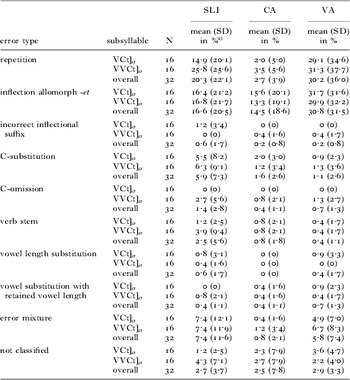
In addition to analyzing the correct responses, the types of incorrect responses were also considered, but in a more detailed fashion. The mean percentages of all error types are given in Table 6.
Mean percentage of different error types

key: C = consonant, N = number, SD = standard deviation, SLI = children with specific language impairment, CA = typically developing children with same chronological age as SLI, VA = typically developing children with same verbal age as SLI, a) percentage based on total reactions.
Only the four most frequently occurring error types in each child group (SLI, CA and VA) were analyzed statistically. Across all three child groups, these were the error types repetition, inflectionallomorph -et, C-substitution and verb stem. Although error mixture and not classified errors were two of the four most frequent error types in CA- and VA-children, they were not considered further because of their low informative value. In contrast, vowel length substitutions did not belong to the four most frequently occurring error types in any of the groups. Nonetheless, this error type was included in the analysis because vowel length was the crucial feature that distinguished VCt]σ- and VVCt]σ-subsyllables, and thus was the most important distinctive feature the children had to realize in the two subsyllable conditions.
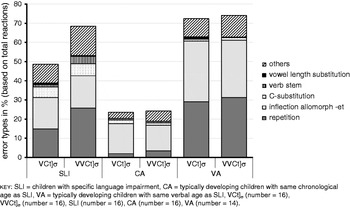
All other error types, namely incorrect inflectional suffix, C-omission and vowel substitution with retained vowel length appeared with very low frequency, so these three error types were combined into one group (others) together with the low informative error types error mixture and not classified (see Figure 2).
Mean percentages of error types.

All children produced repetitions and the inflection allomorph -et as the two major error types. A comparison between the groups revealed that the children with SLI produced more repetitions than the CA-children (Mann–Whitney U test: U = 63, z = 2·544, p = ·011), but as many as the VA-children (U = 98·5, z = 0·566, p > ·05). In contrast, inflection allomorph -et occurred to the same extent in children with SLI and CA-children (U = 115, z = 0·497, p > ·05) as well as in children with SLI and VA-children (U = 98, z = 0·588, p > ·05). Furthermore, no significant difference between children with SLI and CA-children was found for verb stems (U = 109·5, z = 0·919, p > ·05) and vowel length substitutions (U = 112, z = 1·437, p > ·05). The same holds for the comparison between children with SLI and VA-children (verb stems: U = 90, z = 1·236, p > ·05; vowel length substitutions: U = 106·5, z = 0·439, p > ·05). Vowel length substitutions appeared rarely in the data of all children, indicating that the realization of vowel length was very robust across all children. Regarding C-substitutions, group differences emerged: C-substitutions occurred significantly more often in children with SLI than in VA-children (U = 65·5, z = 2·194, p = ·028) and marginally more often in children with SLI than in CA-children (U = 83, z = 1·850, p = ·064).
An analysis of the number of repetitions per subsyllabic condition within the groups revealed that children with SLI repeated more nonce verbs when the target inflected verb form had a VVCt]σ- than when it had a VCt]σ-subsyllable (Wilcoxon test: z = 2·586, p = ·01). In the group of CA-children (z = 0·850, p > ·05) and VA-children (z = 0·848, p > ·05) no such difference was observed. Thus, subsyllabic structure had an impact on the number of nonce verbs that were simply repeated instead of correctly inflected only in the group of children with SLI, and not in either group of TD-children. For all other error types, namely inflection allomorph -et, C-substitution, verb stem, vowel length substitution and others, no significant differences between the VCt]σ- and VVCt]σ-subsyllable conditions were found in any group of children. Thus, for all children the occurrences of these error types were independent of whether the target structures contained a VCt]σ- or a VVCt]σ-subsyllable.
In sum, there are three main results of the error analyses. First, the overall analyses revealed that the children with SLI produced as many repetitions as the verbal age-matched TD-children, but the occurrence of this error type was affected by the subsyllabic structure only for the children with SLI, as more repetitions occurred in the VVCt]σ- than in the VCt]σ-subsyllable condition. Second, the children with SLI substituted the postvocalic consonants (C-substitutions) more often than the verbal age-matched TD-children, but all children produced this error type independently of the subsyllabic structure. Third, for all other error types there was no difference between children with SLI and TD-children and also no difference between both subsyllable conditions within all groups.
GENERAL DISCUSSION
In our study we asked whether subsyllabic frequencies affect the production of inflected nonce verbs (3rd person singular) in German-speaking children with specific language impairment and with typical development. The results demonstrate that the accuracy of the children with SLI was significantly higher for inflected nonce verbs with high-frequency VCt]σ-subsyllables than for those with low-frequency VVCt]σ-subsyllables, but no such difference emerged for TD-children. Thus, an impact of subsyllabic frequencies was observed specifically in children with SLI. These findings are compatible with the results of Marshall and van der Lely (Reference Marshall and van der Lely2006) and Leonard and colleagues (Reference Leonard, Davis and Deevy2007) for English-speaking children. Our study provides the first cross-linguistic evidence from a language with a much more complex inflectional system that phonotactic properties of words have a specific impact on the inflection performance of children with SLI while TD-children with the same chronological age or comparable verbal performance show no evidence of phonotactic effects on their inflection performance.
This discrepancy in results between the groups might indicate that children with SLI and TD-children rely on different underlying mechanisms when producing inflected nonce words. The pattern may suggest that the observed impact of phonotactic frequencies on inflection is a specific marker for children with SLI. However, some previous studies have reported impacts of frequency in TD-children as well. Marchman (Reference Marchman1997) found that high-frequency regular verbs were more likely to be inflected correctly than low-frequency ones by English-learning children of a broad age range of 3;8 to 13;5. A study by Murphy, Dockrell, Messer and Farr (Reference Murphy, Dockrell, Messer and Farr2008) revealed the same frequency impact for regular verb inflection for children aged 6;8. Matthews and Theakston (Reference Matthews and Theakston2006) observed frequency effects only for verbs with -t/-d as the final consonant of the verb stem for five- and seven-year-old children. However, contrary to these findings, an impact of phonotactic frequencies on the production of inflected verb forms has so far only been evidenced for children with SLI and not for TD-children – as in our study and those of Marshall and van der Lely (Reference Marshall and van der Lely2006) and Leonard and colleagues (Reference Leonard, Davis and Deevy2007).
Based on their findings, Marshall and van der Lely (Reference Marshall and van der Lely2006) argue for a morphological deficit in children with a specific grammatical impairment (G-SLI) such that these children rely on the storage of inflected forms and not on their generation by a rule-based mechanism. Due to a more effective storage of words with high phonotactic frequencies, they are more easily produced. This would also affect the formation of inflected forms by analogy, leading to a more effective creation of forms with high phonotactic frequencies compared to forms with low phonotactic frequencies. In contrast, TD-children apply rule-based mechanisms that are not sensitive to the phonotactic properties of the resulting forms.
In line with the results of Leonard and colleagues (Reference Leonard, Davis and Deevy2007), our findings show that children with SLI are also affected by phonotactic properties in the production of inflected nonce words, which indicates that the impact that phonotactics has on inflection is not necessarily a consequence of the storage of whole inflected forms as lexical entries. Moreover, in both studies children with SLI showed the ability to inflect nonce words regularly, which indicates that they have the competence to generate morphologically complex forms according to the inflectional system. However, that this competence is influenced by phonological factors could suggest that creation by analogy as assumed in connectionist models (Daugherty & Seidenberg, Reference Daugherty and Seidenberg1992; Plunkett & Marchman, Reference Plunkett and Marchman1993; Rumelhart & McClelland, Reference Rumelhart, McClelland and MacWhinney1987) is a more relevant underlying mechanism in children with SLI as compared to TD-children. Thereby, a high number of phonologically similar lexical neighbours might have facilitated the production of inflected verb forms in children with SLI because “as a general rule, representations are likely to activate each other when they are similar, and less likely to activate each other when they are dissimilar” (Thiessen, Reference Thiessen2007:19; see also Hillinger, Reference Hillinger1980; McRae & Boisvert, Reference McRae and Boisvert1998). The VVCt]σ-subsyllables used in our study only rarely occur in German monomorphemic words. This sparse phonological neighbourhood might have provided less facilitation of the inflection of the corresponding verb forms compared to the more dense neighbourhoods of the verbs with the VCt]σ-subsyllables.
Furthermore, our study also reveals that the influence of phonotactics on verb inflection is not restricted to children with SLI with specific deficits in morphosyntax, which was the criterion of inclusion in the study by Marshall and van der Lely (Reference Marshall and van der Lely2006) and also van der Lely and Ullman (Reference van der Lely and Ullman2001). In our study the children with SLI were not selected based on the presence of a specific grammatical impairment. Compared to the TD-children matched for chronological and verbal age in our sample, the children with SLI were mainly impaired in expressive vocabulary and phonology, while their grammatical performance as measured by sentence comprehension using the TROG-D (Fox & Schoop, Reference Fox and Schoop2006) was not significantly below that of the verbal age-matched group. This leads to the question of whether there are sources other than a morphosyntactic impairment that may lead to the observed pattern in the children with SLI.
A possible reason for the phonotactic effect on the performance of the children with SLI is that the higher complexity in syllable structure of VVCt]σ-subsyllables compared to VCt]σ-subsyllables made the production of inflected verb forms with VVCt]σ more difficult. Syllable models of German typically assume that syllables with long vowels have a branching nucleus in which the vowel fills two V-slots while in syllables with short vowels the vowel only fills one V-slot (Hall, Reference Hall1992; Wiese, Reference Wiese2000). Thus, in the syllables used in our study, the subsyllables with long vowels (VVCt]σ) had an additional V-slot and thus were phonologically more complex than the subsyllables with short vowels (VCt]σ). As Fikkert (Reference Fikkert1994) has shown for Dutch, the acquisition of syllables with a branching nucleus like CVVC is only observed at a later stage in the acquisition of phonological structure than that of CVC-syllables, with children initially replacing CVVC-syllables by either CVV- or CVC-syllables. The same was found for English-learning (Kehoe & Stoel-Gammon, Reference Kehoe and Stoel-Gammon2001) and for German-learning children (Grijzenhout & Joppen-Hellwig, Reference Grijzenhout, Joppen-Hellwig and Lasser2002; Kehoe & Lleó, Reference Kehoe and Lleó2003). Thus, one could assume that it is not just the subsyllabic frequency that is relevant for the performance of the children with SLI in our study, but also the higher phonological complexity of the VVCt]σ-subsyllables.
Indeed, there are some studies arguing for phonological complexity as one factor that influences verb inflection. Marshall and van der Lely (Reference Marshall and van der Lely2007) found that phonological complexity had an impact on the production of verbs with past tense -ed. English-speaking children with SLI avoided producing inflected past tense verb forms to a higher degree when the test words resulted in final consonant clusters (e.g. hugged) than when they resulted in single consonants (e.g. paid). For typically developing children no such difference has been observed (see also Theodore, Demuth & Shattuck-Hufnagel, Reference Theodore, Demuth and Shattuck-Hufnagel2011). Song, Sundara and Demuth (Reference Song, Sundara and Demuth2009) found impacts of phonological complexity on the production of morphologically marked forms for younger typically developing children. In this study, English-speaking children at the age of two produced the suffix -s of the 3rd person singular more often when single consonants appeared at the right edge of the syllable (e.g. cries) than when clusters resulted (e.g drives). Both Song and colleagues and Marshall and van der Lely compared the production of single consonants and consonant clusters in inflected verb forms. In contrast, in our study we compared VCt]σ and VVCt]σ – both containing consonant clusters and only diverging in vowel length – which reflects a different phonological contrast than the one between numbers of final consonants. In our study, the vowel length was very resistant to false productions in all children, i.e. vowel length errors almost never occurred.
Several observations from our data speak against an explanation only in terms of phonological complexity. First, a subsuming analysis of those error types that lead to a change in the target syllable structure, namely inflection allomorph -et, vowel length substitution, C-omission, verb stem and incorrect inflectional suffix, did not yield significant differences between the VCt]σ- and VVCt]σ-subsyllable conditions – neither for children with SLI (z = 0·847, p > ·05), nor for CA-children (z = 0·281, p > ·05), nor for VA-children (z = 0·239, p > ·05). Thus, there is no evidence that the phonologically more complex subsyllables (VVCt]σ) evoked a higher number of errors leading to a reduction in the complexity of the syllable than the less complex subsyllables (VCt]σ) – neither for the children with SLI nor for the TD-children. Further, in the VVCt]σ-condition, errors that lead to a less complex syllable structure occurred to the same extent in VA-children and children with SLI (U = 99, z = 0·544, p > ·05). This indicates that the phonological development of syllable structure seems to be the same in the children with SLI and VA-children. The differences between the children with SLI and VA-children only became obvious in C-substitutions, as the children with SLI substituted the final consonant of the verb stem more often than the typically developing children – an error that does not lead to a simplification of the syllable structure. Furthermore, for the children with SLI there was no significant correlation between the performances in the phonological task (LB [PDSS]) (Kauschke & Siegmüller, Reference Kauschke and Siegmüller2009) and their correct responses in the more complex VVCt]σ-condition (r = ·503, p > ·05). Thus, we assume that the higher phonological complexity as well as the stronger muscle exertions – necessary to produce the long tense vowels of the VVCt]σ-subsyllables compared to the short lax vowels of the VCt]σ-subsyllables (Kehoe & Stoel-Gammon, Reference Kehoe and Stoel-Gammon2001) – were not the essential factor that caused the difference between the two experimental conditions in the children with SLI. A purely phonological impairment or delay would not predict differences between the production of inflected and morphologically simple words with the same phonotactic structure – a topic that should be looked at more closely in further research.
To conclude, the higher syllabic complexity of the VVCt]σ-subsyllables does not per se seem to account for the fewer correct responses given by the children with SLI in this condition. It appears that the frequencies of the subsyllables have the main effect. A strong interpretation of this impact would be that the children with SLI do not produce the inflected forms based on morphosyntactic rule formation because subsyllabic frequency effects are not expected in this case. Instead, these children seem to rely more heavily on existing lexical entries. However, this does not imply that the children with SLI have a general impairment in generating inflected forms. The children with SLI were as likely as the chronological and verbal age-matched TD-children to erroneously use the inflection allomorph -et instead of the correct -t to inflect the nonce verbs. This finding shows that the children with SLI possess some degree of knowledge of verb inflection despite their limited skill in this domain, as observed in many other studies (see Oetting & Hadley, Reference Oetting, Hadley and Schwartz2009, for a review). Our results are compatible with the assumption that the regular rule formation in children with SLI is limited rather than missing (Ullman & Gopnick, Reference Ullman and Gopnick1999; van der Lely & Ullman, Reference van der Lely and Ullman2001) and that this limited ability causes a greater dependency on the new verb's typicality (Leonard et al., Reference Leonard, Davis and Deevy2007). New verbs that differ highly from existing lexical entries (those with a VVCt]σ-subsyllable) may bring the children closer to their limits in applying a morphological rule more quickly. In this regard, an overuse of ‘zero-marking’ (Marchman, Reference Marchman1997: 299), that means the production of bare verb stems could be a frequent result and is indeed described as a hallmark feature of children with SLI acquiring English (Bishop, Reference Bishop1994; Leonard et al., Reference Leonard, Davis and Deevy2007; Marchman, Reference Marchman1997; Rice & Oetting, Reference Rice and Oetting1993). The children with SLI in our study often produced verb forms with -en. These forms not only correspond to the previously presented forms in the test but also coincide with the infinitive form of German verbs, which German-learning typically developing children use persistently before they consistently produce inflected verb forms (Verrips & Weissenborn, Reference Verrips, Weissenborn and Meisel1992). Thus, whereas English-speaking children use bare stem forms of the verb as infinitives, German-speaking children use infinitival verb forms with the suffix -en. For German-speaking children with SLI an extended optional infinitive stage has been observed. Rice, Ruff Noll and Grimm (Reference Rice, Ruff Noll and Grimm1997) found that German children with SLI aged 4;0 to 4;8 were more likely than younger TD-children, aged 2;1 to 2;7, to use infinitival lexical verbs in declarative sentences. Thus the high occurrence of repetitions in the errors of the children with SLI may be an overuse of the infinitival form, especially in those cases in which the production of the form inflected for the 3rd person singular was especially hard for the children, i.e. in the VVCt]σ-subsyllable condition.
But what does the main result of our study, that children with SLI are affected by subsyllabic frequencies when inflecting verbs, mean for clinical diagnostics and treatment of these children? First, the acquisition of the regular inflectional marking for 3rd person singular (-t suffix) might not be ensured until the child utters inflected verb forms with VVCt]σ-subsyllables. Since these verb forms get less support through stored subsyllables and phonologically similar lexical entries, their formation depends mainly on morphological processes. Thus, inflected verb forms for 3rd person singular with VVCt]σ-subsyllables in the speech of a child with SLI could indicate the completed acquisition of verb inflection.
In German, the acquisition of verb finiteness markings and therefore subject–verb agreement is highly associated with the emergence of the verb-second construction, and German children with SLI are often delayed in acquiring verb-second (Clahsen, Eisenbeiss & Penke, Reference Clahsen, Eisenbeiss, Penke and Clahsen1996). Based on the results of this study, in the treatment of missing verb-second constructions, subsyllabic frequencies of inflected verb forms could be considered: perhaps inflected verb forms with low-frequency VVCt]σ-subsyllables should be primarily included in order to reduce the impact of subsyllabic frequencies on verb inflection. VVCt]σ-subsyllables as reliable indicators of inflected verb forms could facilitate the morphosyntactic bootstrapping for children with SLI. Thus, the special status of VVCt]σ-subsyllables could enable children with SLI to detect the final -t as an inflection morpheme more easily and therefore allow these children to discover the inflection rule more quickly, finally helping to push the acquisition of verb-second constructions.