INTRODUCTION
Bromine (Br) in the particulate phase of sediments is thought to be associated with organic matter (OM) (Harvey, Reference Harvey1980). For a long time, halogen elements were thought to behave mostly conservatively in the soil and aquatic environment. Today, halogen elements are known to be involved in a large number of biogeochemical mechanisms related to the transformation of OM (Biester et al., Reference Biester, Selimović, Hemmerich and Petri2006; Leri and Myneni, Reference Leri and Myneni2012). Br is abundant in some oceanic and lacustrine sediments resulting from long-term leaching and enriching processes and biosynthesis, and in the lacustrine system, it has been suggested as a biogenic element or bioenriching element (Chu et al., Reference Chu, Sun, Li, Li, Wang, Xie, Shang, Li and Yang2013). Although it is known that primary producers, such as macroalgae, synthesize brominated organic compounds, as well as heterotrophic organisms, neither the chemical nature nor the origin of the association of Br with OM is completely understood (Mayer et al., Reference Mayer, Schick, Allison, Ruttenberg and Bentley2007). The association of Br with OM in sediments provides the opportunity to consider Br determinations as a tool to study OM processes in aquatic systems. For example, considering that marine systems have higher Br levels than terrestrial, the ratio of Br concentrations ([Br]) to OM contents ([OM]) in sediment was used as an indicator of OM source in estuarine-marine systems (Mayer et al., Reference Mayer, Macko, Mook and Murray1981, Reference Mayer, Schick, Allison, Ruttenberg and Bentley2007; ten Haven et al., Reference ten Haven, de Leeuw, Schenck and Klaver1988). With similar bases, Ziegler et al. (Reference Ziegler, Jilbert, de Lange, Lourens and Reichart2008) tested Br determinations by X-ray fluorescence core-scanning in marine sediment sequences to represent marine OM. In freshwater systems, a study on lake sediments associated the [Br] increase with a change in the source of OM, noting that Br is strongly enriched in soil OM, and erosion is the likely controlling factor in this case (Oldfield et al., Reference Oldfield, Wake, Boyle, Jones, Nolan, Gibbs, Appleby, Fisher and Wolff2003). More recently, Gilfedder et al. (Reference Gilfedder, Petri, Wessels and Biester2011) studied concentrations and fluxes of dissolved Br species on lake sediments and concluded that the Br to organic carbon ratio could be a tool to distinguish between autochthonous and allochthonous material. However, little research can be found in the literature on Br in sediments from freshwater systems.
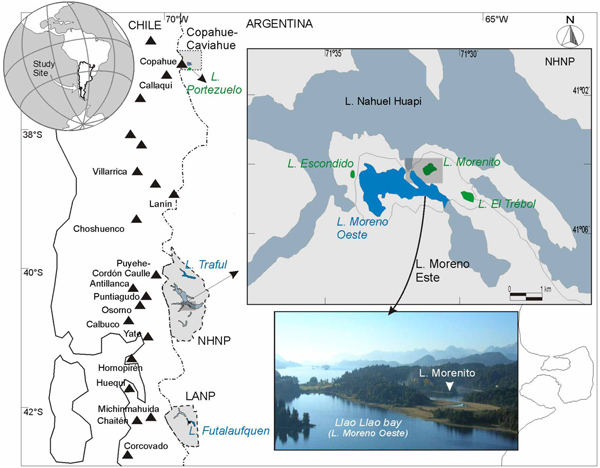
Lake Morenito, a small shallow lake situated in Nahuel Huapi National Park (NHNP; Fig. 1), became an independent water body after the artificial closure of a Lake Moreno Oeste bay in AD 1960, providing a unique opportunity to evaluate the variation of different environmental records determined in sediment sequences associated with this event. The well-recorded lake closure modified the aquatic dynamics and likely the primary production composition, and hence OM inputs to sediments. Therefore, the study of [Br] and [OM] in a sediment sequence before and after Lake Morenito closure may provide clues on the association of Br with OM sources. The parameter to consider to study Br as an OM tracer is the ratio of [Br] (μg/g) to [OM] (wt%) in sediments (Br:OM). Variations on OM inputs to lake sediments can be associated with environmental changes, such as average temperature or precipitation, providing Br:OM ratio information on those environmental alterations modifying OM production. Moreover, volcanic eruptions are a known source of halogen elements to the atmosphere. The environmental impact of halogen element releases depends on the characteristics of the source and also depends on each particular event (Bureau et al., Reference Bureau, Keppler and Métrich2000; Oppenheimer et al., Reference Oppenheimer, Tsanev, Braban, Cox, Adams, Aiuppa, Bobrowski, Delmelle, Barclay and McGonigle2006; Witt et al., Reference Witt, Mather, Pyle, Aiuppa, Bagnato and Tsanev2008). Volcanic events are frequent in the study region; they are recorded in tephra layers in sediment sequences (Daga et al., Reference Daga, Ribeiro Guevara, Sánchez and Arribére2010, Reference Daga, Ribeiro Guevara, Poiré and Arribére2014, Reference Daga, Ribeiro Guevara and Arribére2016). Br:OM ratios may provide information on the impact of the volcanic events to the environment.
Lakes studied for bromine concentration to organic matter contents ratios, in sedimentary sequences (Northern Patagonia Andean range). Shallow lakes El Trébol, Escondido, Morenito, and Portezuelo in green; and deep lakes Futalaufquen, Moreno Oeste, and Traful in blue. Black triangles indicate active volcanoes. (For interpretation of the references to color in this figure legend, the reader is referred to the web version of this article.)

We hypothesize that Br:OM ratios in lacustrine sediment sequences reflect modifications in OM sources that can be associated with environmental changes, providing valuable information for paleolimnological studies. Accordingly, this work aims to evaluate Br:OM ratios in a sediment sequence from Lake Morenito (the study case) comparing the situation before and after lake closure, contrasted also with a Lake Moreno Oeste sequence (representing Lake Morenito before closure), in order to associate Br:OM ratio variations with the environmental alteration caused by lake closure. The information that provides the analysis of Br:OM ratios before and after Lake Morenito closure to evaluate environmental changes needs to be tested with other lacustrine systems. Sedimentary sequences from two lakes with similar characteristics as Lake Morenito before closure, Lake Futalaufquen in Los Alerces National Park (LANP) and Lake Traful in NHNP (Fig. 1), and from three lakes similar to Lake Morenito after closure, Lake El Trébol and Lake Escondido in NHNP and Lake Portezuelo in the Copahue volcano region (Fig. 1), were studied for Br:OM ratios.
LAKES STUDIED
Sedimentary sequences were extracted from shallow lakes Morenito (the study case), El Trébol, Escondido, and Portezuelo; and deep lakes Moreno Oeste, Futalaufquen, and Traful (Fig. 1, Table 1). These lakes are situated close to the Southern Volcanic Zone, one of the active volcanic regions of the Andes (Stern, Reference Stern2004). In the last centuries, several eruptions affected the study areas: mainly from Puyehue–Cordón Caulle volcanic complex (PCC) and Osorno and Calbuco volcanoes in NHNP (Daga et al., Reference Daga, Ribeiro Guevara, Sánchez and Arribére2010, Reference Daga, Ribeiro Guevara, Poiré and Arribére2014; Romero et al., Reference Romero, Morgavi, Arzilli, Daga, Caselli, Reckziegel and Viramonte2016); from the Huequi, Chaitén, and Michinmahuida volcanoes—and accessory cones—in LANP, with the last volcanic event from volcano Chaitén in AD 2008 (Watt et al., Reference Watt, Pyle, Mather, Martin and Matthews2009; Daga et al., Reference Daga, Ribeiro Guevara and Arribére2016); and from the Copahue volcano in the Copahue-Caviahue zone (Caselli et al., Reference Caselli, Agusto, Velez, Forte, Bengoa, Daga, Albite, Capaccioni, Tassi, Vaselli and Caselli2015). This resulted in the deposition of large quantities of volcanic ash, producing several discernable tephra layers in the sedimentary sequences.
Characteristics of the lakes studied and average bromine to organic matter ratios (Br:OM) of sedimentary sequences.

a Average; standard deviation in parentheses. Br is expressed in μg/g; OM is expressed in wt%.
b Ribeiro Guevara et al. (Reference Ribeiro Guevara, Rizzo, Sánchez and Arribére2003).
c Daga et al. (Reference Daga, Ribeiro Guevara, Sánchez and Arribére2010).
d Daga et al. (Reference Daga, Ribeiro Guevara and Arribére2016).
e Estimated from tephra correlation.
f Before lake closure.
g After lake closure.
h Estimated from 137Cs dating.
Lake Morenito is shallow, cold polymictic because it occasionally freezes. Higher total P (TP; 3–4 µg/L in Lake Moreno Oeste and 12–15 µg/L in Lake Morenito) and dissolved organic carbon (DOC; 0.6 mg/L in Lake Moreno Oeste and 2 mg/L in Lake Morenito) concentrations indicate a different trophic condition to that of Lake Moreno Oeste (Fig. 1, Table 1) (Queimaliños, Reference Queimaliños2002). Lake Morenito was a Lake Moreno Oeste bay, transformed to a separate lake after AD 1960 when a division was constructed isolating it from Llao Llao bay (Massaferro et al., Reference Massaferro, Ribeiro Guevara, Rizzo and Arribére2005). Afterward, Lake Morenito became an independent water body, having a connection to Lake Moreno Oeste at high water level (Modenutti and Pérez, Reference Modenutti and Pérez2001) (Fig. 1). Lake Morenito has a littoral zone covering a large fraction of lake surface colonized by the emergent Schoenoplectus californicus (Meyer) Soják reed and submersed Potamogeton linguatus Hangstr. (Bastidas Navarro et al., Reference Bastidas Navarro, Modenutti, Callieri, Bertoni and Balseiro2009b), whereas the lake bottom is covered mostly by Myriophyllum quitense Humboldt, Bonpland et Kunth, 1823, and Nitella C. Agardh, 1824, with a significant seasonal change in the water surface extension enhancing the incidence of macrophytes dynamics in the aquatic system.
Lake Moreno Oeste: Lake Moreno is a lacustrine system divided in two basins, Lake Moreno Oeste and Lake Moreno Este, joined by a narrow connection. Both lakes are warm monomictic and ultraoligotrophic systems, stratified from late spring to early autumn (Fig. 1, Table 1) (Queimaliños, Reference Queimaliños2002). Lake Moreno Oeste is surrounded mostly by native forest dominated by Nothofagus dombeyi (Mirb.) Oerst. and lesser amounts of Austrocedrus chilensis (D. Don) Pic. Serm. et Bizzarri. This environment has persisted during the last millennium, with variations in the relative vegetation composition (Whitlock et al., Reference Whitlock, Bianchi, Bartlein, Markgraf, Marlon, Walsh and McCoy2006). The sampling point selected is located at Llao Llao bay, a subbasin with a rather flat bottom at 20 m depth, without tributaries, integrated with the Lake Morenito area before closing (Fig. 1).
Lake Traful is a deep, monomictic, ultraoligotrophic system, situated 50 km to the north of Lake Morenito (Table 1; Díaz et al., Reference Díaz, Pedrozo, Reynolds and Temporetti2007; Vigliano et al., Reference Vigliano, Macchi, Alonso, Denegri, García Asorey and Lippolt2008). Nutrient levels (total nitrogen: 48.7 µg/L; total phosphorus: 8.8 µg/L) are similar to Lake Moreno Oeste, as well as chlorophyll a concentration (0.4 µg/L). Like Lake Moreno Oeste, Lake Traful does not exhibit submerged vegetation in most of the lake bottom, with small areas colonized by Nitella sp. and Myriophyllum sp. only (Vigliano et al., Reference Vigliano, Macchi, Alonso, Denegri, García Asorey and Lippolt2008).
Lake Futalaufquen is a deep, oligotrophic system, located 200 km to the south of Lake Morenito (Table 1). Lake Futalaufquen extends over 44.6 km2 of old fluvial valleys deepened by glacial erosion, collecting waters from a 2920 km2 catchment area characterized by high mountains and several lakes (Pizzolon, Reference Pizzolon, Calcagno, Fioriti, Pedrozo, Vigliano, López, Rey, Razquin and Quirós1995). Vegetation is dominated by A. chilensis; N. dombeyi; Nothofagus pumilio (Poepp. et Endl.) Krasser, 1896; and Nothofagus antarctica, with shrublands dominating between 1000 and 1200 meters above sea level (m asl).
Lake Escondido and Lake El Trébol are small, shallow, closed system lakes situated near Lake Morenito and Lake Moreno Oeste (Fig. 1, Table 1). Lake Escondido is colonized by the emergent Schoenoplectus californicus from the shoreline to 2 m depth and by the submersed Potamogeton linguatus from 2 to 5 m depth. Macrophytes and allochthonous contributions from the surrounding forest, dominated by Nothofagus dombeyi, cause high DOC levels, 2.7 to 3 mg/L (Bastidas Navarro and Modenutti, Reference Bastidas Navarro and Modenutti2007; Bastidas Navarro et al., Reference Bastidas Navarro, Modenutti, Callieri, Bertoni and Balseiro2009b), when compared with the deep lakes of the region, particularly with Lake Moreno Oeste, as well as with Lake Morenito. Lake El Trébol is also colonized by Schoenoplectus californicus and Potamogeton linguatus and is surrounded by a Nothofagus dombeyi and Austrocedrus chilensis mixed forest. DOC levels, 2.3 mg/L (Bastidas Navarro et al., Reference Bastidas Navarro, Modenutti, Callieri, Bertoni and Balseiro2009b), are similar to Lake Morenito.
Lake Portezuelo is a small, shallow, oligo- to mesotrophic water body, situated 13.5 km to the southeast of the Copahue volcano (Table 1). Approximately 30% of Lake Portezuelo's bottom is covered by emergent macrophytes of the family Cyperaceae (sedges). The shallow area of the littoral zone is covered by the submerged macrophyte Myriophyllum sp., and the rest of lake's bottom, except the deepest area, is covered by Nitella sp. The lake is situated in a Patagonic steppe environment (1735 m asl), dominated by grass and few shrubs.
MATERIAL AND METHODS
Coring and sampling
Short sediment cores were recovered with a messenger-activated gravity-type corer. Sampling sites were selected in a flat area of the lake bottom, in the deepest zone of the water bodies. The cores were cut longitudinally and subsampled in 1 cm steps after visual inspection, except when natural boundaries were identified. Tephra layers were identified visually in the sequences by color and grain size, and characterized under binocular magnifying glass. Each sediment layer subsampled was freeze-dried until constant weight was achieved. Dried sediment samples were homogenized with an agate device, without grinding, and aliquots were conditioned afterward for analysis.
Analytical techniques
Br concentrations in sediments were determined by Instrumental Neutron Activation Analysis (INAA) at the Laboratorio de Análisis por Activación Neutrónica (Centro Atómico Bariloche, Argentina). Rubidium (Rb), considered an indicator of lithogenic inputs to the lake (Boës et al., Reference Boës, Rydberg, Martinez-Cortizas, Bindler and Renberg2011), was also determined in Lake Morenito and Lake Moreno Oeste sediments by INAA. The samples were irradiated in the RA-6 nuclear reactor. They were transferred to fresh vials after irradiation to avoid interference of vial impurities, and measured afterward using an intrinsic High Purity Germanium (HPGe) n-type detector, 12.3% relative efficiency, and a 4096-channel analyzer. Elemental concentrations were determined using the absolute parametric method. Analytical errors differ for each sample analyzed because they depend on their composition, varying from 7% to 14%. A detailed description of the analytical procedures is provided in Daga et al. (Reference Daga, Ribeiro Guevara, Poiré and Arribére2008).
Dissolved organic matter (DOM) from Lake Morenito and Lake Moreno Este (Fig. 1) was also analyzed by INAA for trace element composition, because DOM may provide clues on OM sources and on the association with Br, as will be discussed subsequently. In austral spring, 200 and 340 L of water were collected from Lake Morenito and Lake Moreno Este, respectively, and DOM was concentrated 20-fold by a reverse osmosis system after filtration by 5 µm pore size filter (Queimaliños, C., 2015, personal communication). The concentrated DOM solution was freeze-dried afterward and irradiated in sealed quartz ampoules for INAA.
The [OM] of the freeze-dried sediments was estimated by loss on ignition at 550°C (LOI550) for 4 h (Heiri et al., Reference Heiri, Lotter and Lemcke2001). Although amounts of volatile, nonorganic sediment components may bias LOI550 for representing OM contents, the correlation of LOI550 with total organic carbon determinations is usually good (Bertrand et al., Reference Bertrand, Boes, Castiaux, Charlet, Urrutia, Espinoza, Lepoint, Charlier and Fagel2005), and LOI550 is a parameter easy to determine and widely used to evaluate OM contents in sedimentary sequences (Heiri et al., Reference Heiri, Lotter and Lemcke2001; Smol, Reference Smol2008).
Br in sediment sequences is analyzed here to provide information in paleolimnological studies associated to OM; the parameter studied is [Br], expressed in μg/g, normalized by [OM] estimated by LOI550, in wt% (Br:OM ratios).
Tephra layers from NHNP lakes were morphologically and geochemically characterized for tephrochronological correlations by Daga et al. (Reference Daga, Ribeiro Guevara, Poiré and Arribére2008, Reference Daga, Ribeiro Guevara, Sánchez and Arribére2010, Reference Daga, Ribeiro Guevara, Poiré and Arribére2014), whereas those from the Lake Futalaufquen sequence were studied by Daga et al. (Reference Daga, Ribeiro Guevara and Arribére2016).
The sediment accumulation rate of the sediment sequences was determined by 210Pb and 137Cs dating techniques (Robbins and Herche, Reference Robbins and Herche1993; Ribeiro Guevara and Arribére, Reference Ribeiro Guevara and Arribére2002; Ribeiro Guevara et al., Reference Ribeiro Guevara, Rizzo, Sánchez and Arribére2003). 210Pb, 226Ra (in secular equilibrium with supported 210Pb), and 137Cs specific activity was measured in each layer by high-resolution gamma-ray spectrometry. The Constant Rate of Supply model was used for 210Pb dating (Robbins and Herche, Reference Robbins and Herche1993; Ribeiro Guevara et al., Reference Ribeiro Guevara, Rizzo, Sánchez and Arribére2003). For 137Cs dating, the specific activity profiles were compared with the fallout sequence determined in this region, associated mainly with South Pacific nuclear tests from AD 1966 to AD 1974 (Ribeiro Guevara and Arribére, Reference Ribeiro Guevara and Arribére2002). Sequence dating was performed in deep layers in Lake Futalaufquen also by accelerator mass spectrometry 14C (Daga et al., Reference Daga, Ribeiro Guevara and Arribére2016) (Table 1). The accumulation rate was estimated by tephrochronology in Lake Escondido because 210Pb and 137Cs specific activity profiles did not provide reliable data for dating. A diluted tephra at 0.69 g/cm2 depth was identified under petrographic microscope and characterized corresponding to PCC AD 1960 and Calbuco AD 1961 events (Table 1). Low 210Pb flux combined with two tephra layers in the upper core section did not allow sequence dating in Lake Portezuelo. The 137Cs specific activity profile correlation with 137Cs fallout in the region (Ribeiro Guevara and Arribére, Reference Ribeiro Guevara and Arribére2002) associated the sequence layer at 6.23 g/cm2 (18 cm) depth with AD 1962, immediately above a microtephra identified as the Copahue volcano sourced from AD 1961. An estimation of the sedimentation flux was obtained from137Cs, after exclusion of the contribution of two coarse tephras recorded in layers above 6.23 g/cm2 depth (Table 1).
Biogenic silica (BSi) concentration was measured in Lake Morenito sediments using the method outlined by DeMaster (Reference DeMaster1981). Sediment samples that weighed about 20 mg were leached in 1% Na2CO3, and aliquots were analyzed for BSi concentrations using the reduced molybdosilicate acid colorimetric method. Weight percent of total silica was plotted versus time, and the extrapolated intercept was used to calculate the BSi concentration of the sediment.
Data analysis
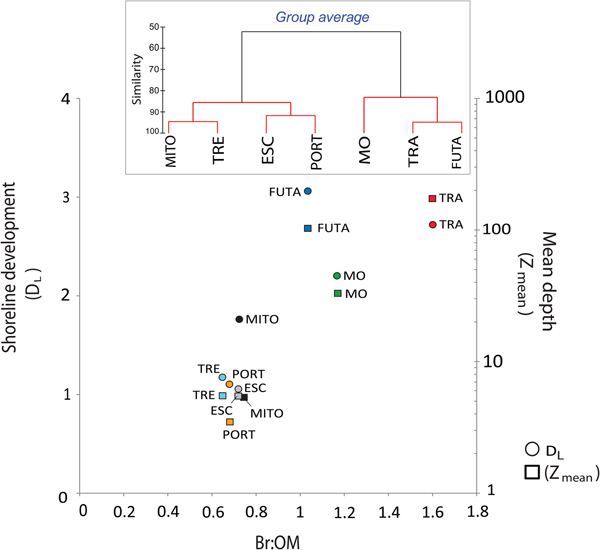
The association of morphometric parameters mean depth and shoreline development with Br:OM ratios was analyzed by a hierarchical agglomerative clustering with group average linking on the Bray-Curtis coefficient (Clarke and Warwick, Reference Clarke and Warwick2001). The profile similarity (SIMPROF) test (α = 0.05; 999 permutations) was applied to discriminate significant groups in the cluster analysis (Clarke et al., Reference Clarke, Somerfield and Gorley2008). The analyses were carried out using PRIMER 6 software.
RESULTS
Sediment sequences dating
Sedimentation fluxes determined are reported in Table 1. Lake Morenito closure in AD 1960 modified drastically the water body dynamics, and probably the sedimentation flux changed after AD 1960. 210Pb dating technique allows the identification of sedimentation flux changes along the sedimentary sequence, but unsupported 210Pb was below detection limit in layers deep enough to determine the effect of lake closure. Therefore, 210Pb and 137Cs dating in upper Lake Morenito layers cannot be extrapolated to deeper layers, and tephrochronology becomes the only trustworthy dating tool to define the chronological framework of Lake Morenito sequence before AD 1960 (Fig. 2). Nine tephras were characterized in the Lake Moreno Oeste sequence, allowing dating and source identification of the upper ones (Fig. 3). The three upper tephras corresponded to PCC and Calbuco events at AD 1960 (PCC)–1961 (Calbuco), AD 1917 (Calbuco)/1929–1932 (Calbuco), and AD 1893–1895 (Calbuco)/1893 (PCC). The fifth correlated with a PCC event possibly at AD 1759 (Lara et al., Reference Lara, Moreno, Naranjo, Matthews and Pérez De Arce2006), and the sixth would correspond to an Osorno volcano eruption at AD 1640–1644, whereas other tephra were not correlated (Daga et al., Reference Daga, Ribeiro Guevara, Sánchez and Arribére2010). The uppermost tephra was identified under binocular magnifying glass analysis, associated to a high concentration of fine glass shard particles diluted in bulk sediment. Three tephras were characterized in the Lake Morenito sequence. The concordance in the tephra characteristics (grain size, color, juvenile particles, morphological features of the primary components, and geochemistry) with those tephras identified in Lake Moreno Oeste defined the chronological framework of the Lake Morenito sequence before closure. The volcanic deposits identified in the Lake Morenito sequence correspond to tephras assigned to AD 1960–1961, AD 1893, and AD 1759.
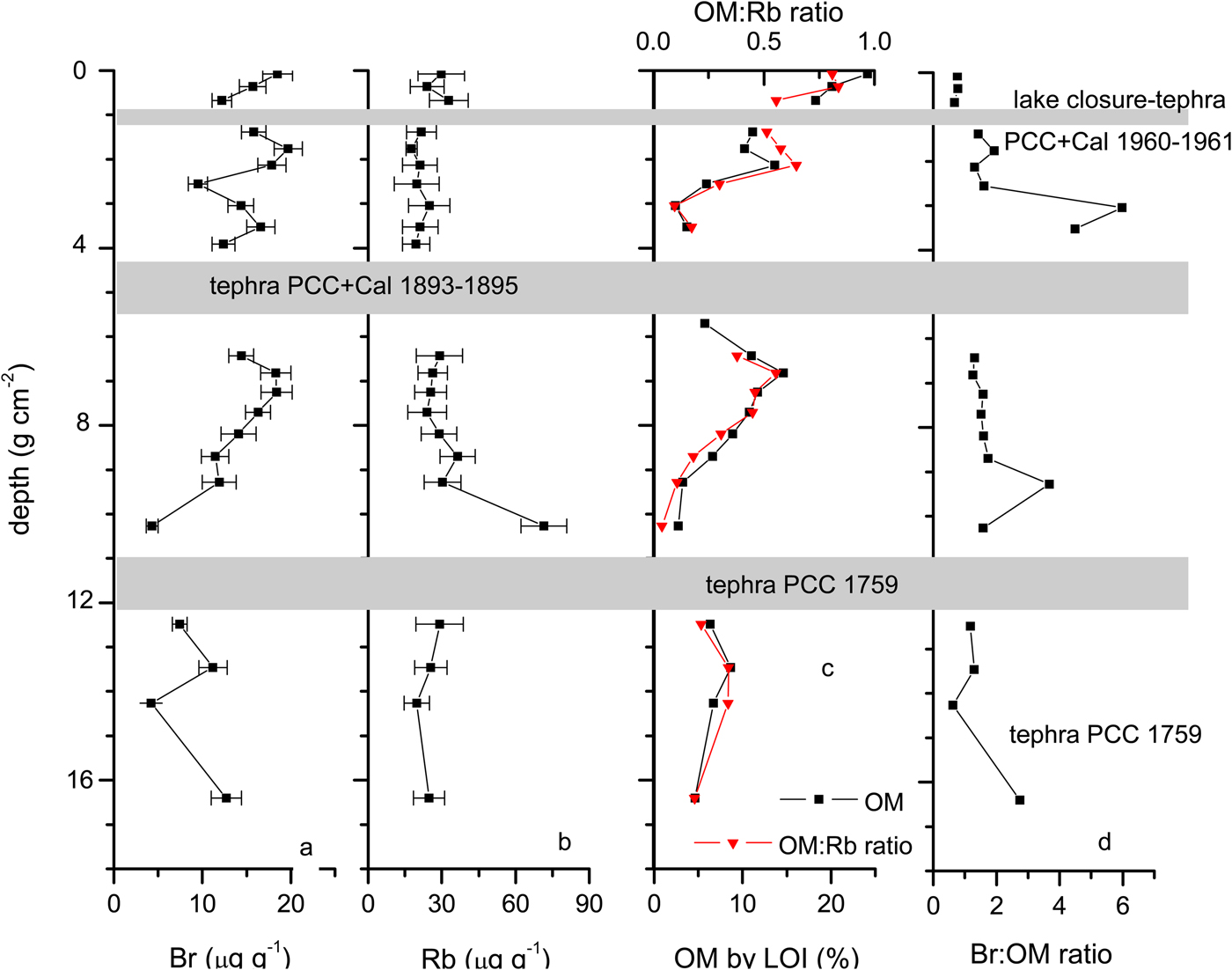
(color online) Concentration versus depth profiles in Lake Morenito sediment sequence. (a) Bromine (Br) concentration; (b) rubidium (Rb) concentration; (c) organic matter (OM) concentration determined by loss on ignition at 550°C (LOI550), and OM concentration normalized by Rb concentration; (d) Br to OM ratios (Br:OM). Tephra layers are indicated:. Cal, Calbuco volcano; PCC, Puyehue–Cordón Caulle volcanic complex (marked with a gray line).

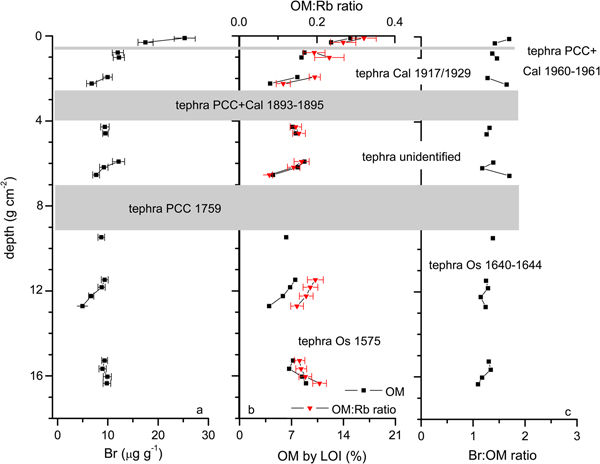
(color online) Concentration versus depth profiles in Lake Moreno Oeste sediment sequence. (a) Bromine (Br) concentration; (b) organic matter (OM) concentration determined by loss on ignition at 550°C (LOI550), and OM concentration normalized by Rb concentration; (c) Br to OM ratios (Br:OM). Tephra layers are indicated:. Cal, Calbuco volcano; Os, Osorno volcano; PCC, Puyehue–Cordón Caulle volcanic complex (marked with a gray line).

Br:OM ratios
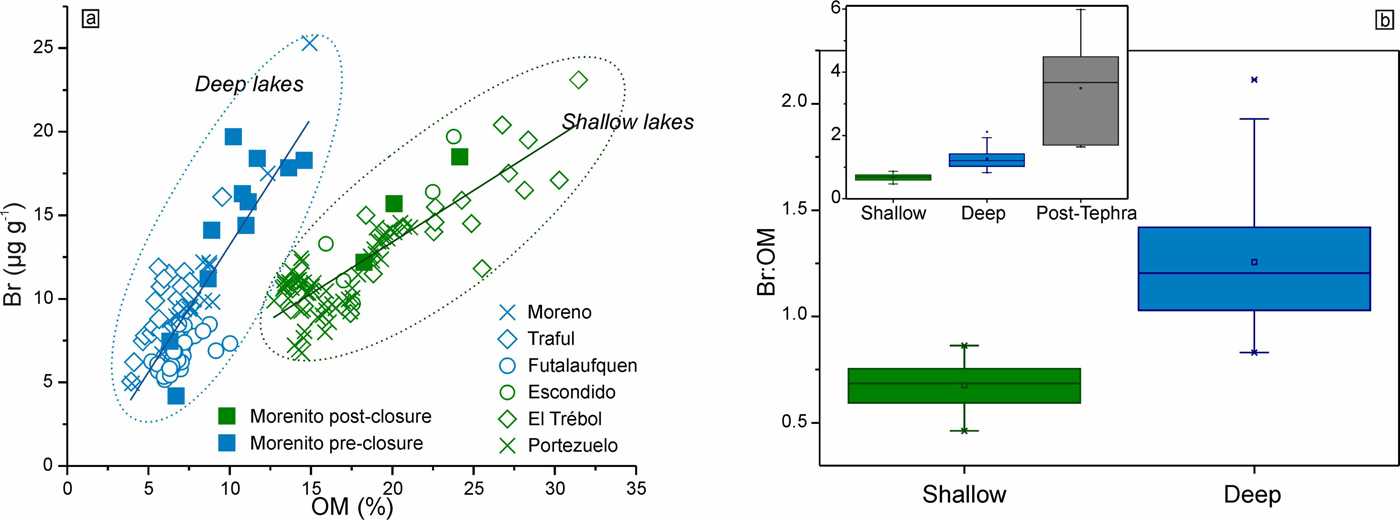
Br:OM ratios in the sediment sequences studied are presented versus depth profiles, together with Br and LOI550 determinations (Br is not reported for tephra layers because volcanic ash content dominates, not representing Br association with OM) (Supplementary Tables 1 to 7). Figure 2 presents Lake Morenito profiles, and Figure 3 those for Lake Moreno Oeste; whereas Figure 4 presents shallow lakes Escondido, El Trébol, and Portezuelo data, and Figure 5 deep Lake Futalaufquen and Lake Traful profiles. Figure 6a presents all [OM] and [Br] analyzed here, including the linear fitting for each lake group, whereas Figure 6b shows Br:OM ratios grouped per lake characteristics (shallow and deep) and those values corresponding to upper tephra layers.
Concentration versus depth profiles of bromine (Br), organic matter (OM) determined by loss on ignition at 550°C (LOI550), and Br to OM ratios (Br:OM) in sediment sequences from shallow lakes El Trébol, Escondido, and Portezuelo (only visible tephras are indicated). Tephra layers are indicated.

Concentration versus depth profiles of bromine (Br), organic matter (OM) determined by loss on ignition at 550°C (LOI550), and Br to OM ratios (Br:OM) in sediment sequences from deep lakes Futalaufquen and Traful.

(a) Bromine concentrations (Br) versus organic matter (OM) contents determined by loss on ignition at 550°C (LOI550) for the sediments studied; shallow lakes in green, and deep lakes in blue. The linear fitting is shown for each group of lakes. (b) Box plot of the Br to OM ratios grouped by lake characterization, including (in gray in the inset) those values corresponding to sediment upper tephra layers. (For interpretation of the references to color in this figure legend, the reader is referred to the web version of this article.)

Two different features can be distinguished in the Br:OM ratio profiles: sharp increases after some volcanic events, recorded by tephra layers, and steady values in different time periods along the sequence. Br:OM ratios increased up to sixfold after some volcanic events, decreasing to the previous values afterward. Particularly in the Lake Morenito sequence, the ratio Br:OM showed background values ranging from 0.7 to 1.9, with sharp increases after volcanic events registered in AD 1893–1895, and in AD 1759, reaching values up to 6 (Fig. 2d). These tephras were associated with PCC and Calbuco events. In the Lake Moreno Oeste sequence, upper layers showed rather constant Br:OM ratios (Fig. 3c), averaging 1.53 (0.15) (average value in 0–5 cm layers; standard deviation in parentheses). Consistent with Lake Morenito results, after AD 1759 and AD 1893–1895 volcanic events, there is an increase in Br:OM ratios compared with layers previous to the volcanic event and also compared with the upper layer (Fig. 3c).
The analysis of Br:OM steady values based on the Lake Morenito case study, focused on the effect of lake closure, also compared with Lake Moreno Oeste values that represent Lake Morenito preclosure conditions. The Br:OM correlations observed in Lake Morenito were tested in shallow lakes Escondido, El Trébol and Portezuelo, and in deep lakes Futalaufquen and Traful. Average values of Br:OM ratios, excluding those layers increased after volcanic events, are reported in Table 1. Lake Morenito sediment sequence showed steady Br:OM values before lake closure, averaging 1.38 (0.31) ([OM] from 5% to 14%), but Br:OM ratios were lower after lake closure, averaging 0.74 (0.06) ([OM] from 18% to 24% in uppermost layer) (Fig. 2c and d, Table 1). The Br:OM ratios in Lake Moreno Oeste were similar all along the sequence, averaging 1.31 (0.14), with [OM] ranging from 4% to 15% in the uppermost layer (Fig. 3b and c). The Br:OM steady values in shallow lakes ranged from 0.65 to 0.72 (Table 1). El Trébol and Portezuelo sequences showed little variation along the Br:OM ratio profiles ([OM] from 15% to 31% in Lake El Trébol, and from 10% to 20% in Lake Portezuelo), whereas Lake Escondido sequence exhibited high variability of Br:OM ratios in layers above the diluted tephra associated with PCC AD 1960 and Calbuco AD 1961 events (0.69 g/cm2 depth) (the lowest Br:OM value, 0.31, is considered an outlier and excluded from calculation) ([OM] from 10% to 24%) (Fig. 4). Deeper Lake Escondido layers were not considered for the analysis because volcanic ashes were identified in most of them, biasing calculations. Deep lakes showed average Br:OM values from 1.03 to 1.60 (Table 1). In Lake Traful, [OM] ranged in low values (4–9.5%), and Br:OM ratios were stable along the sequence (Fig. 5). Deep sediment layers in Lake Futalaufuquen, corresponding to ~AD 400–1500 accumulation period, exhibit low [OM] (5–7%), with the exception of those corresponding to ~AD 800–900 with increasing [OM] to 10% (Fig. 5). Excluding ~AD 800–900 sediment layers, Br:OM ratios are stable along the ~AD 400–1500 accumulation period.
DISCUSSION
Br and OM source
OM constitutes an important fraction of lake sediments. It is made up of a complex mixture of lipids, carbohydrates, proteins, and other biochemicals contained in the tissues of living benthic microorganisms and contributed from the detritus of organisms formerly living in the lake and its watershed. OM from primary producers can be divided into two geochemically significant groups on the basis of their biochemical compositions: (1) nonvascular plants that lack woody and cellulosic tissues, such as simple algae, and (2) vascular plants that have these tissues, such as grasses, shrubs, and trees. These latter types of plants exist on land and in the shallow parts of lakes as bottom-rooted, emergent vegetation. Humic substances are diagenetically formed from these biochemical starting materials (Meyers and Ishiwatari, Reference Meyers and Ishiwatari1993) and constitute the major part of the complex OM mixture in sediments; between 60% and 70% of OM in young lacustrine sediments is constituted by humic substances, rising to more than 90% in older sediments (Meyers and Lallier-Verges, Reference Meyers and Lallier-Vergès1999). Particulate detritus of primary producers, both riparian and aquatic, is the primary OM source to lake bottom deposits. The relative contribution of riparian and aquatic OM sources is influenced strongly by lake morphology, watershed topography, and their relative abundance (Meyers and Ishiwatari, Reference Meyers and Ishiwatari1993). Although an important portion of this OM is degraded chemically and biologically within the water column, a significant portion reaches the sediment surface, where it is subjected to further chemical and biological transformations. Significant microbial degradation of OM occurs already within the water column; however, peptides, carbohydrates, and other organic compounds of high molecular weight are adsorbed to metal oxides and mineral particles within the water column, which protects them against degradation and leads to an enrichment of molecules of higher molecular weight on the sediment surface (Kappler et al., Reference Kappler, Ji., Schink and Brune2001).
Phytoplanktonic productivity and allochtonous sources from the drainage basin are the primary sources of the DOC pool in oligotrophic waters (Wetzel, Reference Wetzel2001). Queimaliños et al. (Reference Queimaliños, Reissig, Diéguez, Arcagni, Ribeiro Guevara, Campbell, Soto Cárdenas, Rapacioli and Arribére2012) observed in Lake Moreno that the incorporation of allochtonous DOM is likely favored by the bacterivorous behavior of planktonic organisms, mixotrophic flagellates, and ciliates, which dominate the pelagic food webs of this lake. DOC contributes to sediment OM after adsorbed to inorganic or organic particulate matter and then undergoes polymerization to particulate form. A small fraction aggregates, flocculates, and shifts to colloidal and particulate states. A variety of processes transform OM in relatively short times, until its burial in the lake bottom. For example, a study in Lake Michigan (a large oligotrophic lake) showed that only 6% of the organic carbon photosynthetically formed in surface waters reaches bottom sediments at 100 m depth, whereas nearly 85% of the carbon is oxidized before leaving the epilimnion. To remark, in large oligotrophic lakes the source of sediment OM is more associated to particulate inputs (particulate organic matter; POM) and to the result of DOM transformations in the water column (biological, chemical and physical), DOM which may be highly affected by allochtonous inputs. In more shallow water bodies, OM has shorter sinking times and, consequently, lesser exposure to oxidation in the water column. Shallow lakes usually have sediments richer in OM than deep lakes (Meyers and Ishiwatari, Reference Meyers and Ishiwatari1993), also observed here (Fig. 6a).
Scarce research can be found in the literature on Br in freshwater sediments. Among those few works published, Gilfedder et al. (Reference Gilfedder, Petri, Wessels and Biester2011) reported that Br is quantitatively stored in the sediments with little rerelease, making it a reliable paleoproxy for lake productivity. In marine systems, Leri et al. (Reference Leri, Hakala, Marcus, Lanzirotti, Reddy and Myneni2010) linked the organic Br in sediments to biological production that persist through humification of OM, being the biogeochemical cycling of Br between organic and inorganic (dissolved in pore water) forms part of the burial and degradation of OM. Indeed, the ratios of Br to organic carbon (OC) can be quite stable during sedimentary diagenesis. Sedimentary Br:OC ratios also appear somewhat independent of variations in redox conditions and other parameters in sedimentary and bottom water environments (Leri et al., Reference Leri, Mayer, Thornton and Ravel2014). Particularly relevant regarding the present approach is the work by ten Haven et al. (Reference ten Haven, de Leeuw, Schenck and Klaver1988). They observed that sediment Br:OC ratios, computed by the slope of the linear regression of Br versus OC concentrations, are constant for a certain marine environment and significantly different among environments like the Mediterranean Sea, the Gulf of Maine, the Barents Sea, the Namibian shelf, or the Persian Gulf, tracing OM contributions.
The association of Br with OM in terrestrial environments was studied by Leri and Myneni (Reference Leri and Myneni2012). They found that inorganic Br is transformed to organic compounds in forest soils associated to plant litter degradation, through enzymatic processes. Inorganic Br absorbed by the growing plants transforms to organic Br when the plant litter decays, and this organic Br is incorporated into soil OM (Leri and Myneni, Reference Leri and Myneni2012). Afterward, the OM inputs to lakes from the catchment, both POM and DOM, contain organic Br that circulates in the water body and is incorporated to sediments. These processes, which could happen in macrophyte litter decaying in sediments as well, explain the strong association of Br with OM in lake sediments and sustain the use of Br as OM tracer in freshwater systems.
Lake Morenito: case study to evaluate Br:OM ratios to provide information in paleolimnological studies
Lake Morenito closure from Lake Moreno Oeste in AD 1960 modified the aquatic system dynamics and lake productivity. This is observed in BSi contents, which recorded a sharp increase in lake productivity; BSi averaged 27 (10) mg/g in sediments accumulated before lake closure, increasing to 85.6 (4.9) mg/g afterward (three uppermost layers). OM contents exhibit a similar trend (Fig. 2c), but regarding OM degradation with core depth, particularly in upper layers, it is not possible to consider OM to evaluate productivity changes. Lake Morenito closure was coeval with PCC AD 1960 and Calbuco AD 1961 eruptions, but because of the volcanic ash distribution patterns, the impact of these events in Lake Moreno Oeste was very limited. In fact, the record of these events in Lake Moreno Oeste sedimentary sequence is a microtephra, identifiable under binocular magnifying glass only (Daga et al., Reference Daga, Ribeiro Guevara, Sánchez and Arribére2010).
Considering that before closure Lake Morenito was a Lake Moreno Oeste bay, integrated with Llao Llao bay, the comparison between these systems could provide clues on the impact of the aquatic dynamics modification, particularly on primary producers. Currently, Lake Moreno Oeste is an ultraoligotrophic system, whereas Lake Morenito is more productive, having an oligotrophic condition (Queimaliños, Reference Queimaliños2002). Plankton abundance is up to one order of magnitude larger in Lake Morenito compared with Lake Moreno Oeste, with different composition (Queimaliños, Reference Queimaliños2002; Alonso et al., Reference Alonso, Rocco, Barriga and Battini2004). As it was described previously, Lake Moreno Oeste is a deep lake, whereas Lake Morenito is shallow, with most of the lake bottom covered by macrophytes. Macrophyte colonization and dynamics in Lake Morenito appear to be the most significant difference compared with Lake Moreno Oeste, Llao Llao bay, regarding primary producers. Accordingly, the twofold decrease in Br:OM ratios after lake closure in AD 1960 can be explained by the change in aquatic system dynamics, with an increase in the incidence of autochthonous primary producers such as submerged and emergent macrophytes (which is the present situation) compared with a more pelagic source, similar to Lake Moreno Oeste.
The modification of sediment OM after Lake Morenito closing, regarding both the concentration increase and the change in composition expressed in the decrease of Br:OM ratios, could be associated with allochtonous inputs. Rubidium can be considered a reference lithophile element in paleolimnological studies (Boës et al., Reference Boës, Rydberg, Martinez-Cortizas, Bindler and Renberg2011) and can be associated with the geologic component of terrestrial inputs to the lake. If the increase of OM in the sediment sequence on upper layers would be associated with allochtonous inputs, the [OM] should correlate with the geologic fraction of these inputs, and hence with [Rb]. Rubidium concentrations in Lake Morenito sediment sequence are quite stable all along the sedimentary sequence (from 20 to 35 µg/g), particularly in layers before and after lake closing, with the exception of the layer immediately above PCC AD 1759 tephra (Fig. 2b; Supplementary Table 1). The increment of [Rb] on this layer is because of resuspension of fine volcanic ashes after deposition or transport from the watershed, provided that [Rb] in these pyroclastic products (in the range of 77 µg/g; Daga et al., Reference Daga, Ribeiro Guevara, Poiré and Arribére2014) is higher than in bulk sediments. The incidence of volcanic ash presence in bulk sediments depends on the granulometry of the pyroclastic material, on the deposition and after deposition lake bottom conditions, and on the material available in the catchment. Although the sediment layer at 10.3 g/cm2 depth exhibits a high incidence of previous PCC AD 1759 tephra, with a [Rb] close to that of PCC volcanic ash (consistent with a decrease in [OM]; Fig. 2c), the sediment layer at 3.91 g/cm2 depth shows no effect of the previous tephra, and the layer at 0.67 g/cm2 depth, deposited after lake closure and PCC-Calbuco eruptions at AD 1960–1961, exhibits a slight increase of [Rb] compared with previous and upper layers. Therefore, provided that [Rb] remains stable all along the sedimentary sequence (excluding the tephra effect), particularly after lake closure, it can be concluded that there were no significant variations in allochtonous inputs, and that the strong increase in [OM] after lake closure (from about 10% to 24% in the upper most layer; Fig. 2c) is not attributable to allochtonous inputs but generated by autochthonous sources. The usual way to evaluate the incidence of allochtonous inputs when analyzing sedimentary sequences is to normalize parameters like [OM] by a lithophile element; the similarity in both profile trends is considered evidence of similar allochtonous inputs in the period studied (Boës et al., Reference Boës, Rydberg, Martinez-Cortizas, Bindler and Renberg2011). In the Lake Morenito sequence, [OM] normalized by [Rb] exhibits a similar trend to [OM] (Fig. 2c) attributable to [Rb] ranging in similar values along the sequence as discussed previously. Similarly, [OM] normalized by [Rb] is stable along Lake Moreno Oeste sedimentary sequence (Supplementary Table 2), particularly after OS AD 1640–1644 tephra, which is the range of Lake Morenito sequence (Fig. 3b), showing stable allochtonous inputs to Lake Moreno Oeste sediments also.
The analysis of DOM from Lake Morenito and Lake Moreno Este showed [Br] twofold higher in Lake Moreno Este compared with Lake Morenito (77.9 ± 5.7 and 35.9 ± 2.6 µg/g, respectively). Lake Moreno Este dynamic is largely dominated by the pelagic zone, similar to Lake Moreno Oeste (Queimaliños et al., Reference Queimaliños, Reissig, Diéguez, Arcagni, Ribeiro Guevara, Campbell, Soto Cárdenas, Rapacioli and Arribére2012). Lake Moreno Este DOM results from the combination of the catchment contributions and pelagic generation, whereas Lake Morenito DOM incorporates to these two sources autochthonous production associated with macrophyte development which dominates, increasing significantly DOC levels respect to Lake Moreno Oeste (2 and 0.6 mg/L, respectively). As discussed previously, the increase of primary productivity in Lake Morenito after lake closure was associated with the development of the macrophyte-rich environment, and deeper layers represent similar conditions as Lake Moreno Oeste at present, whereas allochthonous inputs remained similar. The production of organic Br could be associated with primary producers’ litter decay processes (Leri and Myneni, Reference Leri and Myneni2012). The twofold difference between Br contents in DOM from Lake Morenito and Lake Moreno Este may record the differences in these processes in catchment soils and posterior circulation in the pelagic media together with autochthonous production, compared with those processes in the macrophyte-rich environment of the shallow Lake Morenito. This is based on the fact that macrophytes dominate OM production in shallow lakes, particularly in Lake Morenito, as noted previously. The ratio of [Br] in DOM from Lake Morenito and Lake Moreno Este (2.2) is similar to that observed for Br:OM ratios in deeper Lake Morenito sediments and those accumulated after Lake Morenito closure (1.38 and 0.74, respectively; ratio: 1.9). This suggests that the differences in the processes of production and circulation of organic Br recorded in DOM for the catchment-pelagic sources (Lake Moreno Oeste) and for the macrophyte-rich environment (Lake Morenito) apply also for POM. Therefore, higher Br:OM ratios in deep layers of Lake Morenito could represent the processes of production and circulation of organic Br occurring in the catchment and in the pelagic media, whereas the lower Br:OM ratios recorded after lake closure represent those processes in a macrophyte-rich lake environment.
Therefore, Br:OM variations along a sedimentary sequence could be associated with environmental changes affecting the development of autochthonous primary producers, such as average temperature or precipitation. Ratios greater than 1 could be associated with allochthonous and more pelagic autochthonous OM sources, whereas values in the range of 0.7 could be associated with higher incidence of autochthonous macrophyte development. Thus, Br:OM in sediment sequences could be considered a paleolimnological parameter to provide relevant information on environmental changes.
Br:OM ratios in shallow and deep lakes
In order to test the association of Br:OM ratios in sediments with those lake productivity characteristics observed before and after Lake Morenito closure, sedimentary sequences from three lakes with similar characteristics as Lake Morenito before closure (deep lakes Moreno Oeste, Futalaufquen, and Traful; Fig. 1), and from three lakes similar to Lake Morenito after closure (shallow lakes Escondido, El Trébol, and Portezuelo; Fig. 1), were studied (Table 1). Shallow and deep lakes contrast in productivity characteristics, mainly in OM levels (Fig. 6a) and in the contribution of macrophytes to primary autochthonous productivity, as described previously.
Averaged Br:OM ratios divided the lakes studied into two groups (Kruskal-Wallis test, P < 0.05; Fig. 6b). One group includes shallow lakes Escondido, El Trébol, and Portezuelo, and Lake Morenito after closure, with Br:OM ratios ranging from 0.68 to 0.74. The other group includes deep lakes Futalaufquen and Traful, Lake Moreno Oeste, and Lake Morenito before closure, with Br:OM ratios ranging from 1.0 to 1.6 (Table 1). Lake groupings can also be observed in Figure 6a, where the linear fitting of [Br] versus [OM] helps to better visualize the difference in Br:OM ratios between shallow and deep lakes and provides representative values of Br:OM ratios for each group. The slope of the linear fitting (Br:OM ratio) for deep lakes is 1.52 ± 0.11 (R 2 = 0.67, analysis of variance [ANOVA] P < 0.0001), whereas for shallow lakes it is 0.618 ± 0.042 (R 2 = 0.72, ANOVA P < 0.0001). This lake grouping is consistent with the association of Br:OM ratios with the characteristics of the autochthonous primary productivity observed in Lake Morenito before and after lake closure and discussed in the previous section.
The association of Br:OM ratios with the characteristics of the autochthonous primary productivity lead to significant inferences in lower layers of the Lake Futalaufquen sedimentary sequence. A period with higher productivity ([OM] from 8% to 10%, increased from 6% to 7% values) associated with a warmer and drier environment was recorded in ~AD 800–900 sediment layers in the Lake Futalaufquen sediment sequence. This environmental alteration could modify water body levels, increasing the incidence of littoral productivity in comparison with pelagic contributions. This hypothesis was confirmed by the δ13C increase observed in this period (Daga, R., Ribeiro Guevara, S., Vreča, P., Lojen, S., Rizzo, A., Poiré, D., Arribére, M.A., unpublished manuscript). Br:OM ratios decreased from 1.2–1.3 to 0.73–0.75 at layers where [OM] reached the highest values (9–10%) (Fig. 5), with a similar trend as that discussed before. Accordingly, the variation of Br:OM ratios suggests a strong development of autochthonous macrophytes in the lake or in the tributaries in this period, consistent with the increase in the incidence of littoral productivity postulated by Daga et al. (unpublished manuscript).
Br:OM ratios and lake morphometric parameters
Lake morphometric parameters are strongly associated with the relative contribution of littoral and pelagic OM (Meyers and Ishiwatari, Reference Meyers and Ishiwatari1993). Shoreline development (ratio of the shoreline length to the circumference of a circle of area equal to that of the lake) reflects the incidence of littoral communities, and mean depth represents the relationship of lake volume to surface area. The extent of shallow water in a lake is a determining factor in the interrelationships of the zones of photosynthetic production and decomposition and determines the area available for the growth of rooted aquatic plants and associated littoral communities (Wetzel, Reference Wetzel2001). Therefore, there is an association between these morphometric parameters and the relative contribution of littoral and pelagic OM sources (Meyers and Ishiwatari, Reference Meyers and Ishiwatari1993). Mean depth is particularly relevant in this case, because due to the particular characteristics of these transparent, oligotrophic systems, the mean depth between 5 and 6 m in the shallow lakes is the depth of large development of macrophytes, but observed only in isolated patches between 20 and 30 m mean depth (Vigliano et al., Reference Vigliano, Macchi, Alonso, Denegri, García Asorey and Lippolt2008; Bastidas Navarro et al., Reference Bastidas Navarro, Balseiro and Modenutti2009a).
The relation of average Br:OM ratios with the morphometric parameters divided the lakes studied into two groups according to the lake characteristics described previously; higher Br:OM ratios associate with higher mean depth and with higher shoreline development (Fig. 7). Lake Morenito is situated in an intermediate position regarding the shoreline development, because of the irregular shape. This grouping, supported by the cluster analysis shown in Figure 7, is consistent with the hypothesis that Br:OM ratios can be associated with lake characteristics regarding OM sources to sediments, and, therefore, consistent with the hypothesis that variations in Br:OM ratios along a sedimentary sequence reflect variations in the aquatic system as described previously.
(color online) Bromine concentration (μg/g) to organic matter (OM) determined by LOI550 (wt%) ratios (Br:OM) versus lake morphometric parameters, including cluster analysis.  $D_L = L/2\sqrt {\pi + A} $;
 $Z_{{\rm mean}} = V/A$; where L is the perimeter, A is the surface area, and V is the volume of each lake. ESC, Lake Escondido; FUTA, Lake Futalaufquen; MITO, Lake Morenito; MO, Lake Moreno Oeste; PORT, Lake Portezuelo; TRA, Lake Traful; TRE, Lake El Trébol.

Br and volcanic events
Volcanic events are a known source of halogen element contamination to the environment (Bureau et al., Reference Bureau, Keppler and Métrich2000; Oppenheimer et al., Reference Oppenheimer, Tsanev, Braban, Cox, Adams, Aiuppa, Bobrowski, Delmelle, Barclay and McGonigle2006; Witt et al., Reference Witt, Mather, Pyle, Aiuppa, Bagnato and Tsanev2008; Kutterolf et al., Reference Kutterolf, Hansteen, Freundt, Wehrmann, Appel, Krüger and Pérez2015). There is scarce research on halogen element releases associated with volcanic activity in Patagonia, but the study of lichens for bioindication of atmospheric elemental contamination generated by the PCC eruption in 2011 provided evidence of Br releases associated with the volcanic event (Bubach et al., Reference Bubach, Pérez Catán, Arribére and Ribeiro Guevara2012). The almost instantaneous input of high amounts of material to the environment represented by a tephra deposition also exerts a physical effect on the biotic ecosystem. Therefore, those sharp increases in Br:OM ratios observed in Lake Morenito and Lake Moreno Oeste after the PCC and Calbuco coarse tephras recorded in AD 1759 and AD 1893–1895 can be explained by (1) extra Br inputs to the ecosystems generated by these volcanic events or (2) modifications of the relative contributions of OM sources attributable to the environmental impact of the volcanic ash fall (note that [OM] in these layers is lower than in sediments below the tephra and also in layers after system recovery; Figs. 2 and 3). The increase in Br:OM ratios is notable up to two to three sediment layers above the tephra, meaning that the impact on the environment lasted several years (Fig. 2d and c). Sediments deposited immediately after the tephra layers may content volcanic particles associated with reworking or catchment effects. However, this ratio increase is not related to the tephra itself. PCC and Calbuco tephras contain lower [Br] (PCC: 4.4–6.5 µg/g, Calbuco: 1 µg/g; Daga et al., Reference Daga, Ribeiro Guevara, Poiré and Arribére2014) than sediment below tephra layers (8–20 µg/g). Therefore, the presence of ashes in those layers dilutes [Br] in the sediments if it is present and cannot be associated with the increase in Br:OM ratios.
On the other hand, the tephra corresponding to AD 1960–1961 Calbuco and PCC mixed deposits (identified as diluted tephras in the background sediment) did not show Br:OM increase in layers above, in both lakes. The analysis of Lake El Trébol and Lake Escondido sediment sequences, situated in the same area as Lake Morenito and Lake Moreno Oeste (Fig. 1), showed consistent results, with no sharp increase in Br:OM ratios associated with the AD 1960–1961 Calbuco and PCC volcanic events (the period covered by Lake El Trébol and Lake Escondido sequences excludes previous volcanic events). These results reveal that these particular Calbuco and PCC events had no significant impact of Br inputs to the environment in this area, and/or the diluted feature of the tephra (millimeter thickness and fine grain size) was not enough to affect the OM structure, in contrast to previous eruptions.
The characteristics of the volcanic source and the eruptions determine the emitted halogen elements. Recently, Kutterolf et al. (Reference Kutterolf, Hansteen, Freundt, Wehrmann, Appel, Krüger and Pérez2015) showed increase of Br (and chloride) concentrations from mafic to intermediate volcanic rock compositions (~45–52 and ~53–63 wt% SiO2, respectively), with broadly similar trends up to 65 wt% SiO2, for Plinian eruptions in Central America. In the present case, PCC historical eruptions correspond to more evolved products (68–71 wt% SiO2; Lara et al., Reference Lara, Moreno, Naranjo, Matthews and Pérez De Arce2006) than Calbuco (55–59 wt% SiO2; López-Escobar et al., Reference López-Escobar, Parada and Moreno1992); this could generate emission differences. The combination of both emitted products and dispersion may cause the difference between the impact of PCC and Calbuco events, with no significant Br impact on the environment of the Lake Morenito area associated with AD 1960–1961 eruptions, but relevant impact after the AD 1759 and AD 1893–1895 events. Geochemistry and distribution patterns are unknown for halogen element releases in the PCC and Calbuco events; hence Br:OM ratios provide valuable information.
The estimation of the period of Br:OM ratio increase in Lake Moreno Oeste, Llao Llao bay, after the Calbuco/PCC AD 1893–1895 volcanic events, determined from the sedimentation flux obtained in upper layers, resulted in 25 yr. The increase in Br:OM ratios after the PCC AD 1759 event corresponded to 32 yr of sediment accumulation (notice that this calculation cannot be performed for the Lake Morenito sequence because the sedimentation flux determined by 210Pb and 137Cs techniques in upper layers is not valid before lake closure). Summarizing, Br:OM ratios reflect the impacts of PPC and Calbuco volcanic events in the release of Br to the environment or in the modification of the OM sources' structure, impacts that lasted in the ecosystems for approximately 30 years until previous levels were recovered.
Five tephra layers were identified in the Lake Futalaufquen sequence, corresponding to the ~AD 1500–2009 accumulation period (Daga et al., Reference Daga, Ribeiro Guevara and Arribére2016). No relevant increase in Br:OM ratios was observed after these volcanic event records (Fig. 5). Similarly, no increase in Br:OM ratios was observed above the tephra identified in the Lake Portezuelo sequence (Fig. 4).
CONCLUSIONS
The ratio of [Br] to [OM] evaluated by LOI550, Br (μg/g):OM (wt%), in short lacustrine sedimentary sequences was studied as a parameter for paleolimnological studies in shallow and deep lakes from the North Patagonia Andean range, to provide information on those environmental alterations modifying OM production.
A decrease in Br:OM ratios after Lake Morenito closure in AD 1960 was associated with an increase of primary autochthonous productivity attributable to the development of submerged and emerging macrophytes. Lake Moreno records at Llao Llao bay, located beside Lake Morenito at present and integrated within the same water body before closure, showed Br:OM ratios similar to those before Lake Morenito closure, consistent with the hypothesis that the modification in the primary productivity structure after Lake Morenito closure generated a decrease in Br:OM ratios.
The study of sedimentary sequences from the other five lakes showed consistent results with the hypothesis constructed on the data from Lakes Morenito and Moreno. Sedimentary records from three small, shallow systems, which exhibit large participation of submerged and emerging macrophytes in primary productivity like Lake Morenito, verified the correlation of Br:OM ratios with the primary productivity composition in Lake Morenito after closure. On the other hand, sedimentary sequences from two deep, ultraoligotrophic lakes, with little development of littoral macrophytes, showed Br:OM ratios consistent with Lake Morenito before closure and Lake Moreno Oeste values. Moreover, lake morphometric parameters shoreline development and, particularly, mean depth were correlated with Br:OM ratios, dividing lakes in two groups consistently with the lakes characterization described previously.
Therefore, Br:OM ratios can be associated with the structure of primary autochthonous productivity in paleolimnological studies, with values of about 0.7 associated with significant macrophyte contributions and higher values (from 1 to 1.6) associated with a more pelagic contribution.
Consequently, Br:OM ratio variations along a sedimentary sequence can be associated with modifications to the structure of the primary autochthonous productivity of the water body, providing information on environmental changes.
Also, Br:OM ratios could provide information on the impact of volcanic events registered in sediment sequences. Lake Morenito and Lake Moreno Oeste sequences showed sharp increases in Br:OM ratios after eruptions of PCC and Calbuco volcanic systems in AD 1759 and AD 1893–1895, recording the impact of the volcanic events lasting for approximately 30 yr until previous levels were recovered. Otherwise, no significant impact was registered by Br:OM ratios after the AD 1960–1961 PCC and Calbuco volcanic events. Therefore, Br:OM ratios combined with tephra identification and characterization provided information on the impact of volcanic events on the environment.
ACKNOWLEDGMENTS
The authors wish to express their gratitude to the reactor RA-6 operation staff for their assistance in sample analysis, to Claudia Queimaliños for assistance on the analysis of DOM and for her valuable comments, and to two unknown reviewers, whose comments greatly improved the manuscript.
SUPPLEMENTARY MATERIAL
To view supplementary material for this article, please visit https://doi.org/10.1017/qua.2018.125