Introduction
Notwithstanding significant progress in reducing the number of new HIV infections and in lowering the number of AIDS-related deaths, the disease continues to pose serious risks ‘as one of the leading causes of death globally and … projected to continue as a significant global cause of premature mortality in the coming decades,’ (UNAIDS, 2009). The threat posed by HIV/AIDS to our progress and very survival was considered sufficiently serious for the combating of this disease to figure explicitly as Goal 6 in the Millennium Declaration in 2000 (United Nations, 2010). The efforts to contain this deadly disease and limit its consequences rest principally on a twin strategy of (a) prevention through greater awareness and a more sound knowledge of the disease combined with the empowerment of women and promotion of safe sex practice, and (b) reduction of deaths from HIV/AIDS through the increased availability of antiretroviral drugs.
Sub-Saharan Africa is the region most heavily affected by HIV and southern Africa has the worst statistics on HIV prevalence within it. According to the estimates available in the latest AIDS epidemic update (UNAIDS, 2009), in 2008 sub-Saharan Africa accounted for 67% of new HIV infections among adults, 91% of new HIV infections among children and 72% of the world's AIDS-related deaths. According to the 2010 country progress report on Botswana put out by UNAIDS, Botswana is one of the nine southern African countries that continue to bear the global burden of HIV and AIDS, with each country having an adult prevalence of more than 10%. The 2008 Botswana AIDS Impact Survey (BAIS) estimated that 17.6% of the population aged 18 months and above was HIV positive in that year. The corresponding figure in the 2004 BAIS was 17.1%. The HIV prevalence in the country is therefore levelling off at around 17%. The 2010 Botswana country report also injects some optimism by reporting that HIV prevalence among young people aged 15–24 years has been declining consistently since 2001. Botswana has made substantial progress on ARV treatment. The high rate of HIV-infected people on ART is likely to have a strong preventive impact on further spread of the disease.
HIV and AIDS have had a devastating impact on Botswana. Life expectancy at birth in Botswana fell from 65 years in 1990–95 to less than 40 years in 2000–2005, a figure about 28 years lower than it would have been without AIDS (see: http://www.avert.org/aids-botswana.htm). The deaths of working adults have serious micro- and macro-economic implications in Botswana, with the loss of income pushing many families into poverty, and the economic output reduced by the loss of workers and their skills. As noted by Brigaldino (Reference Brigaldino2002), ‘economic development is being hit hard by the epidemic’. The social implications have also been considerable. An estimated 93,000 children have lost at least one parent to the epidemic in Botswana. As reported in Sharma & Seleke (Reference Sharma, Seleke and Pinkowski2008), ‘there have been projections that by 2010, more than 50 percent of the country's children will be AIDS orphans and the average life expectancy will have fallen from 47 to 27 years’.
The first reported case of HIV/AIDS in Botswana was in 1985. However, it was not until the late 1990s that serious action was taken to prevent the spread of the disease. Since then, however, the authorities have tried seriously to address the problem by developing a national strategic framework and implementing a series of initiatives to stem and reverse the tide of the HIV/AIDS epidemic. While the early focus was on preventive health care, the emphasis had switched, by 1993, to treatment involving comprehensive medical and social care due to the HIV prevalence registering rates upwards of 20%. However, as pointed out by Sharma & Seleke (Reference Sharma, Seleke and Pinkowski2008), ‘Botswana is still in a state of paralysis with the AIDS virus continuing as the deadliest enemy the country has faced,’ (p. 322).
The prevalence of HIV in Botswana is the subject matter of this study. Apart from the seriousness of the HIV/AIDS epidemic in that country, Botswana also stands out as an unlikely country for such dismal HIV statistics. A country with a stable political regime, the sparsely populated Republic of Botswana was once considered an African ‘success story’, recording one of the highest economic growth rates in the world. As the referee of this paper pointed out, a possible explanation lies in the fact that many Botswana men worked outside their country, the stable nuclear family was rare and multiple partners were common in Botswana well before the epidemic.
Uganda pre-dates Botswana in the earliest known case of HIV and, at one point, was at risk of being the most HIV-infected country anywhere in the world. However, that situation changed quickly and Uganda is now seen as the most dramatic African success story with the estimated HIV prevalence rate falling from about 15% in 1992 to 5% in 2001 (Schoepf, Reference Schoepf2003), though the rate has increased somewhat since then. As per the last Uganda HIV & AIDS Sero-Behavioral Survey (UHSBS 2004/05), the country has a HIV prevalence rate of 6.4% in adults and 0.7% in children. Uganda's rate of HIV prevalence among adults is well below half that of Botswana.
Why wasn't the success story of Uganda repeated in Botswana? Heald (Reference Heald2002, Reference Heald2006) identifies some factors specific to Botswana that may have reduced the effectiveness of international efforts and policies to limit the spread of HIV, and may have even led to counterproductive results – such as Tsawana ideas of morality and illness that saw it as a purely local disease. The disease was shrouded in secrecy, and information campaigns to promote condom usage and ARV therapy were not as successful as elsewhere. Also, as Seidel (Reference Seidel2003) has noted, there was a perception among the locals, NGOs, etc. that, ‘HIV interventions are donor driven … some international agencies appear to act on the basis of shallow knowledge,’ making it very difficult for global efforts at prevention and recovery to succeed in Africa as much as it could have been elsewhere.
The principal motivation of this study is threefold: (a) to measure awareness and knowledge of HIV/AIDS in Botswana, (b) to examine the interaction of knowledge, safe sex practice and HIV prevalence with one another and, in particular, provide evidence on the question: does the adoption of safe sex practices lower the chance of being infected with the disease?; and (c) to pay particular attention to the role of women's bargaining power, as manifest though increased condom usage, in preventing HIV/AIDS and provide evidence on this issue. On (a), a significant feature of this study is the comparison of HIV awareness and soundness of knowledge between Botswana and India. These two countries provide a useful bilateral comparison since, while one (Botswana) has a high rate of HIV prevalence but with low absolute numbers because of its smaller population base, the other (India) has a lower rate of HIV prevalence but with much larger potential for absolute devastation simply because of its much larger population base. However, the principal vehicles for transmission of the disease are different between the two countries: for example, multiple sex partners in Botswana and drug use and commercial sex in India. On (c), while female bargaining power and the role that women play in improving household outcomes have featured prominently in the economics literature (see, for example, Basu (Reference Basu2006) and Lancaster et al. (Reference Lancaster, Maitra and Ray2006)), the issue has been much less prominent in the context of HIV. There is, however, some evidence of the positive role that women's empowerment plays in increasing HIV awareness and condom awareness in the South Asian context (see, for example, Schuler & Hashemi (Reference Schuler and Hashemi1994) for Bangladesh, and Bloom & Griffiths (Reference Bloom and Griffiths2007) for India). There is no such evidence for Africa. The present study fills this gap by examining the evidence for Botswana in the interrelated contexts of safe sex practice and HIV prevalence.
Though HIV has huge economic ramifications, the absence of empirical evidence on (a), (b) and (c), and the failure to apply the methodological developments in the economics/econometric literature in the HIV context, reflects partly the lack of suitable data sets, and partly the lack of interest on this topic among economists. Both of these are now changing with more information on HIV knowledge and prevalence now being available through questions asked of respondents on their knowledge and awareness of HIV, and blood testing done on the respondent's HIV status. Moreover, the availability of information on HIV knowledge and prevalence, along with that on household characteristics, has enabled the portrayal of the profile of an individual that is at particular risk from HIV and allowed the subject to receive greater scrutiny from applied economists. Botswana and India are prime examples of countries that have, in recent years, made such integrated information on household characteristics, knowledge and prevalence of HIV available in unit record form making the present study possible. Set in the context of a country (Botswana) that is one of the most HIV-infected countries in the world, it is difficult to exaggerate the policy importance of the results of this investigation. The study also shows the potential for wider application of some of the recent methodological developments in the applied economics/econometrics literature, especially in an area that is crying out for such applications.
The present study is an extension of Ray & Sinha (Reference Ray and Sinha2010)'s study that proposed a methodology for quantifying the soundness of knowledge of HIV and applied it to India. Ray & Sinha (Reference Ray and Sinha2010) had shown that the recent advances in the measurement of multi-dimensional deprivation can be used to measure one's understanding of the disease, and provided Indian evidence in support of the proposed methodology. The present study provides further support by providing comparable evidence from Botswana. Besides extending the study to Botswana, this paper follows up the earlier investigation by asking: (i) does soundness of knowledge of HIV/AIDS matter in the adoption of safe sex practice?; and (ii) does the adoption of safe sex practice help to prevent HIV prevalence in Botswana? On the way, and making use of the rich information base provided by the Botswana data, the present study shows how the technique of finite mixtures model can be used to provide evidence on the determinants of safe sex practices and soundness of one's knowledge of HIV/AIDS.
Methods and Data
The measure of knowledge
Following an earlier study (Ray & Sinha, Reference Ray and Sinha2010), this study distinguishes between HIV awareness and knowledge. An individual may be aware of HIV but may not know much of the true nature of the disease. Further, an individual may have reasonably sound knowledge of aspects of the disease but may still be unaware of its lethal consequences. While awareness is easy to detect as a binary variable, measuring knowledge and giving it a cardinal number is less easy as the information is contained in multiple questions and in the individual respondents' responses.
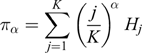
Let nj denote the number of individuals that gave incorrect answers to exactly j questions j∈{1,…, K}. Let the total number of individuals be denoted by n. Then, a measure of incorrect knowledge of HIV/AIDS is given by:
,
where  , j∈{1,…, K}.
The term Hj denotes the proportion of respondents who gave incorrect answers to exactly j questions; πα is a linear combination of the Hj values, and measures the lack of soundness of the respondent's knowledge, i.e. ignorance, of the true nature of HIV. In the case of perfect knowledge, Hj=0 for all j, and the measure of ignorance, πα=0. At α=1, π α measures the total number of incorrect responses  jnj as a proportion of the total number of responses by all the respondents (nK). The reader is referred to Ray & Sinha (Reference Ray and Sinha2010) for further details. The parameter α, chosen a priori, reflects subjective judgement. As α increases from 1 to higher values, πα gives greater weight to the ignorance rates of individuals that gave incorrect answers to more and more questions, i.e. the more ignorant individuals and, at very high α values, πα measures the magnitude of extreme ignorance. This is similar to the interpretation of α as an ‘inequality aversion’ parameter in the Atkinson (Reference Atkinson1970) inequality measure. An important feature of the ignorance measure, given by (eqn (1)), that is exploited is that the measure is decomposable between subgroups: for example, between rural and urban residents, or between men and women respondents. This enables the subgroup's share of the whole country's ignorance of the disease to be calculated, such that the shares add up to 100 across all the exhaustive set of subgroups. A comparison between a subgroup's ignorance share and that of its population share establishes whether that subgroup is more or less ignorant of the disease than the others.
Unobserved heterogeneity in individual sexual behaviour: the finite mixtures model
The technique of finite mixtures models is useful in data sets such as on HIV knowledge and sexual practices that involve a great deal of individual heterogeneity. As explained in a recent study that applies such a technique (Deb et al., Reference Deb, Gallo, Ayyagari, Fletcher and Sindelar2009) in analysing BMI and alcohol consumption:
The finite mixture model provides a natural and intuitively attractive representation in a finite, usually small, number of finite mixtures latent classes, each of which may be regarded as a ‘type’ or a ‘group’. Estimates of such finite mixture models may provide good numerical approximations even if the underlying distribution is continuous … the finite mixture approach is semi-parametric – it does not require any distributional assumptions for the mixing variable – under suitable regularity conditions is the semi-parametric maximum likelihood estimator of the unknown density.
A particular advantage of the finite mixture model estimation in the present context is that it gives the policymaker some idea on how unobserved heterogeneity at individual level can influence sexual behaviour and knowledge of HIV/AIDS and how to devise differentiated and group-specific policies on HIV prevention taking note of possible heterogeneity in the population so as to maximize their effectiveness. For reasons of space, the finite mixtures model and estimation are not described in detail here; the reader is referred to Laird (Reference Laird1978), Deb & Trivedi (Reference Deb and Trivedi1997) and Deb et al. (Reference Deb, Gallo, Ayyagari, Fletcher and Sindelar2009) for such details.
The finite mixtures model estimation is preceded by simultaneous estimation of the determinants of (a) HIV awareness, (b) HIV knowledge, (c) condom use during last sex, and (d) HIV prevalence, where the interaction between some of these variables is taken into account. Of particular interest in these results is the nature and magnitude of the impact of female bargaining power on condom usage, and that of condom usage and multiple sex partners on HIV prevalence.
Construction of the wealth index
Another feature of this study is the evidence that it provides on whether the wealthier individuals in Botswana exhibit significantly different HIV knowledge, condom usage, practice on multiple sex partners and HIV prevalence from the less affluent individuals. To investigate the wealth effect, the household data on asset and Principal Components Analysis (PCA) was used to construct a wealth distribution. Principal Components Analysis is a statistical technique based on the idea that an underlying latent variable is predictable on the basis of observed data. The objective of this technique is to use a set of observed data to reduce the number of variables in the data set to extract orthogonal linear combinations of variables or components (referred to as first principal component, second principal component etc.) that most efficiently encompass the common information. Each component is a weighted average of the underlying indicators. Weights are chosen so as to maximize the explained proportion of the variance in the original set of indicators; see, for example, Vyas & Kumaranayake (Reference Vyas and Kumaranayeke2006) for further details. The wealth index constructed for the present analysis uses a set of household assets and dwelling characteristics that are available in the data sets for both countries, i.e. Botswana and India. These include the dwelling's construction material, i.e. type of flooring, type of walls, type of exterior walls and type of roofing; the source of household drinking water; availability of electricity in the household; type of toilet facility; per capita rooms in the house; and ownership of fan, radio, sewing machine, refrigerator, bicycle, motorcycle and car. Based on the wealth index, the households were arranged in an increasing order by their per capita wealth. The households were then partitioned into three groups: 0–20%, 20–50% and 50–100% depending on their percentile in the wealth distribution, and referred to accordingly in Table 3.
Data
The data for this paper were drawn from the Botswana AIDS Impact Survey (BAIS-II) conducted in 2004. This survey was designed to generate a nationally representative population-based estimate of HIV prevalence and to identify and measure factors, such as behavioural, knowledge, attitudes and cultural influences, that are associated with the HIV epidemic in Botswana. The BAIS, which is Botswana's version of the Demographic and Health Survey, is a series of nationally representative demographic surveys of population aged 10–64 years, documenting knowledge, attitudes, behaviour and cultural factors that might influence HIV infection, prevention and impact mitigation. The survey also included a component on voluntary HIV testing among the population aged 18 months to 64 years, in order to generate a nationally representative population-based estimate of HIV/AIDS prevalence. The BAIS-II survey used the 2001 Population Housing Census as a sampling frame, and was stratified by administrative districts and major population centres. The survey utilized household, individual, workplace and community questionnaires.
The Indian data set, which enabled a comparison between India and Botswana on HIV awareness and knowledge, is contained in the third National Family Health Survey (NFHS-3), which was carried out in 2005–06. The NFHS-3 provided information on the respondents' awareness of HIV/AIDS (yes/no). Respondents who showed awareness were asked questions on various aspects of the disease. The NFHS-3 had comprehensive coverage since it included all the constituent states of the Indian Union. It was therefore directly comparable in both quality and coverage with the Botswana data set (BAIS-II). Also, both data sets corresponded to almost contemporaneous years: 2004 for Botswana and 2005–06 for India. However, the NFHS-3 data set had very limited information on blood testing and respondents' HIV status, restricting the information to only the most HIV-prevalent states in India. In contrast, the Botswana data set provided comprehensive coverage of the information on the respondents' HIV status. Hence, the comparison between India and Botswana in this study is limited mostly to their HIV/AIDS awareness and knowledge. The Botswana data set allowed us to proceed with the study on HIV prevalence.
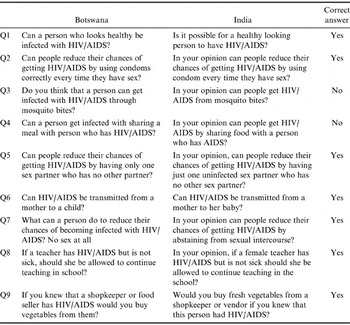
Table 1 presents the set of questions on respondents' knowledge of HIV/AIDS that were asked in BAIS-II, and used in the construction of a nine-point ‘incorrect knowledge’ index for the present analysis. This table also presents the corresponding questions asked of Indian respondents in NFHS-3. As Table 1 shows, the questions on HIV in BAIS-II are nearly identical to those used in NFHS-3. Unfortunately, no question was asked on the respondent's awareness of the lethal nature of HIV.
List of questions on HIV/AIDS in Botswana (BAIS-II) and India (NFHS-3)a

a These were the common set of questions asked in Botswana and India. Each incorrectly answered question takes the value 1 and correctly answered question takes the value 0. The incorrect answers are added to compute the multi-dimensional ignorance index.
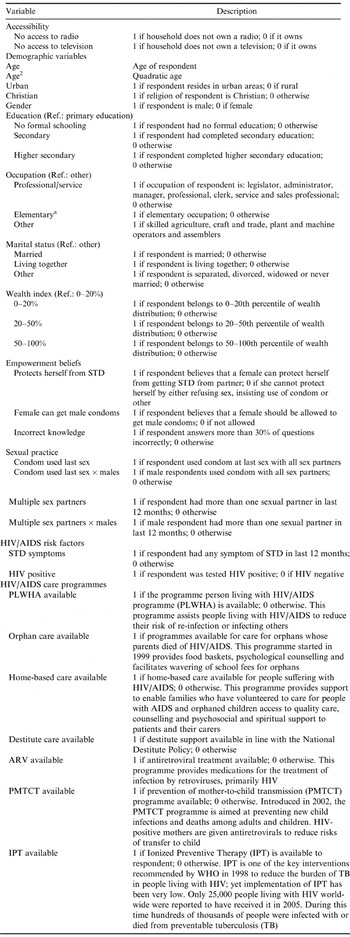
The data for Botswana contains the information on respondent's sexual history, which outlines the number of sexual partners that the respondent had in the last 12 months and whether a condom was used with each sexual partner at last sex. This information, along with actual prevalence of HIV/AIDS, is used to assess the underlying factors influencing individual's sexual behaviour using more than one indicator. Table 2 lists the variables used in the regression equations.
Description of regression variables

a Elementary occupations refer to occupations such as street vendors, shoe cleaning, domestic helpers, helpers and cleaners in offices, rubbish collectors, farm hands and labourers.
Results
Awareness and knowledge: Botswana and India
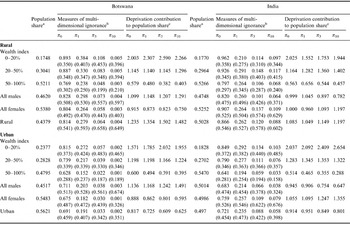
The estimates of lack of sound knowledge of HIV/AIDS, or knowledge deprivation, in Botswana and India, calculated using the multi-dimensional ignorance measure (eqn (1)), are reported in Table 3. The left-hand side presents the estimates for Botswana, and the right-hand side those for India. The Indian estimates, calculated from the National Family Health Survey (NFHS-3) data set for 2005–06, are presented for comparison between the two countries. This table reports the ignorance estimates for a variety of α values, and separately for rural and urban areas and for males and females. The estimates measure the extent of lack of knowledge of HIV, with higher values denoting greater ignorance. The term π0 measures the proportion of respondents who gave an incorrect answer to at least one question. The term π1 measures the proportion of total answers taken over all the respondents that were incorrect. For example, in rural Botswana, 81.4% of all respondents gave (at least) one incorrect answer or, alternatively, 18.6% gave correct answers to all questions. The figures in parentheses give the share of ignorance of HIV among the whole population that can be attributed to the subgroup shown.
Multi-dimensional measure of HIV ignorance in Botswana and India

a Share of population by wealth index, gender and rural/urban sector.
b Deprivation contribution (πi/∑πi) by wealth index, gender and rural/urban sector in parentheses.
c (πi/∑πi)/population share.
There are some common features between the two countries. The rural areas display larger ignorance, both in terms of the measure, and their share of the whole country's ignorance, than the urban areas in both countries. The rural share of ignorance increases with α in both countries, i.e. as the calculations are limited to the households that have given more and more incorrect answers. Again, in both countries, ignorance decreases with increasing affluence, i.e. as we move up the wealth distribution. A comparison of the population and deprivation shares shows that the lower wealth percentiles bear a disproportionately larger share of the country's ignorance of the disease, and that this disproportion increases with α in both countries. This is seen more clearly from the ratio of deprivation contribution to population shares at various α values of πα reported in Table 3. A value of the ratio greater than unity suggests that a member of the corresponding subgroup is relatively more ignorant than the ‘average’ individual in that country. The advantage of these population share deflated deprivation contributions is that they help to profile an individual whose ignorance of the disease is so acute as to require targeted information campaigns. The values of this ratio confirm that in both countries the rural individual is less knowledgeable than the rest, and so is the individual in the bottom 20th percentile of the wealth distribution. There is, in fact, remarkable similarity between the relative magnitudes of ignorance or knowledge deprivation of HIV/AIDS of the rural population and that of the bottom 20th percentile between the two countries. In both countries, for example, an individual in the bottom 20th percentile exhibits ignorance of the disease that is approximately twice that of the average person. In contrast, there is no such agreement on gender, with females in Botswana showing greater knowledge of the disease than males, in sharp contrast to females vis-à-vis males in India.
There are other significant differences between Botswana and India. India displays larger ignorance of HIV than Botswana when they are compared across wealth percentiles and across rural/urban areas. In fact, India's lack of understanding of the disease in relation to Botswana becomes more and more evident as α increases. This largely reflects the fact that HIV has attracted much more media attention in Botswana than in India, has a higher profile in Africa than in Asia, and has a longer history of known prevalence in the former. The awareness campaigns have been more effective in Botswana. Clearly, India has ground to cover to catch up with Botswana. At the aggregate country level, India stands out as one of the most ill-informed countries in the world on HIV/AIDS, with less than 30% of its women in the age group 15–24 years, and between 30 and 40% of its men in the same age group, having comprehensive correct knowledge of HIV over the period 2003–2008 (United Nations, 2010, p. 41). However, Table 3 also shows that the picture is sharply reversed when we differentiate by gender, with females displaying much more ignorance than males in India, unlike in Botswana. Indeed, the male/female differential is so sharply reversed that males in Botswana are much more ignorant than their counterparts in India. This has the significant twofold policy implication: (a) informed campaigns in India, which is sitting on a possible HIV epidemic, need to be targeted at women, who have been widely reported as one of the most ill-informed group on HIV in the world, and (b) given the increased knowledge of HIV by women vis-à-vis men in Botswana, households with greater female bargaining power and with greater say in decision-making such as safe sex practice in that country are likely to be better protected from the disease. The latter is consistent with evidence from the regression equations estimates from Botswana presented below. The lesson for India is to target women – both the awareness and information campaigns – and help them acquire greater say in adopting safe sex practice.
Association between knowledge, safe sex practice and HIV prevalence
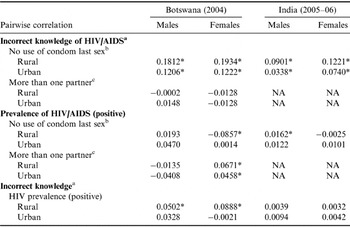
Table 4 presents the strength of association between incorrect knowledge, safe sex practice and HIV prevalence by reporting the pair-wise correlation for Botswana and (where available) for India. The Indian evidence, which is reported for comparison, is limited since information on HIV prevalence is available in only a few states where testing was done and HIV status reported in the NFHS-3 data set. Note, also, that for religious and cultural reasons, the practice of multiple sex partners is much less prevalent in India than in Botswana. Both countries provide evidence of statistically significant and positive association between incorrect knowledge (defined as more than three incorrect answers) and no condom usage in last sex. This result points to the role played by increasing knowledge of the disease in promoting condom use. Note, however, that both in terms of the correlation magnitude and the level of significance, the evidence is not overwhelming for either country. In other words, simply improving knowledge will not ensure safe sex practice. This result is consistent with the observation of Dinkelman et al. (Reference Dinkelman, Levinsohn and Majelantle2006), also based on Botswana data, that, ‘it may be overly optimistic to hope for reductions in risky behaviour through the channel of HIV-information provision alone’. Part of the reason lies in the nature of the questions that were asked, none of which directly tested the individual's awareness of the lethal consequences of HIV that can be caused by unsafe sex practice. In both countries, however, the strength of association is higher among females than among males and higher in the rural areas than in the urban. The evidence from Botswana supports the idea that females with multiple sex partners are at increased risk from HIV, and this is true of the rural and the urban female. The higher correlation between incorrect knowledge and HIV prevalence, in both size and significance, in Botswana than in India reinforces the point made earlier that HIV has a longer history and a more visible profile in Botswana than in India, and the link between incorrect knowledge and prevalence is therefore somewhat stronger in the former.
Correlation between incorrect knowledge and risky sexual practices in Botswana and India

a Incorrect HIV/AIDS knowledge is a binary variable that is 1 if incorrect knowledge index is greater than 3 (i.e. more than three questions out of nine were answered incorrectly by the individual) and 0 if incorrect knowledge index is less than or equal to 3.
b Risky sexual behaviour is represented by a binary variable that takes the value 1 if condom was not used by the individual at last sex and 0 otherwise.
c Risky sexual behaviour is represented by a binary variable that takes the value 1 if person has more than 1 sex partner in last 12 months and 0 otherwise.
* Significant at 5% level.
Mixed process estimation of HIV awareness, knowledge, safe sex practice and prevalence
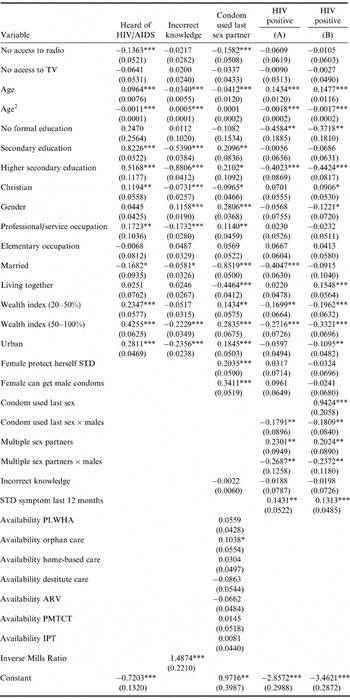
Table 5 presents the results of the joint estimation of a four-equation model that models awareness of HIV/AIDS, incorrect knowledge, condom used at last sex with all sex partners and prevalence of HIV/AIDS as a binary, multinomial logit, probit and logit respectively. The model was estimated recursively where these categorical dependent variables of interest were estimated as a function of a set of individual and household characteristics. The BAIS-II survey was designed to ask respondents ‘knowledge’ questions only if they were aware of the disease. Therefore estimating a model with incorrect knowledge only would result in sample selection bias. This issue is addressed by estimating a Heckman two-stage model to obtain a correction factor (Inverse Mills Ratio) for sample selection bias, which is included in the ‘incorrect knowledge’ equation along with other covariates. The presentation of the estimates side-by-side allows a convenient comparison of the nature and magnitude of the effect of the household and regional characteristics of the respondents. For example, the respondent's age has non-linear but reverse effects on her/his awareness and lack of knowledge of the disease. The relationship is an inverted U-shape for the former and U-shaped for the latter. The magnitude of the age2 coefficient suggests that awareness (i.e. ‘heard’) peaks at around 48 years and, among those who have heard of the disease, the extent of ignorance of the nature of the disease troughs at around 34 years.
Joint estimation of HIV/AIDS awareness, knowledge, condom use and prevalence in Botswana

Standard errors in parentheses.
*p<0.10; **p<0.05; ***p<0.01.
Older individuals are less likely to use condoms. The risk of HIV increases with age, reaching a maximum at around 36 years, and then starts to decline. This is an important result that suggests that individuals in the age group 35–40 years are at highest risk from the disease. In fact, the risk of infection arises earlier. As the reviewer pointed out, African women tend to be infected in their late teens and twenties, and men in their late twenties and thirties. Radio, rather than TV, is a more accessible source of information in a developing country, which explains why individuals without access to radio are less likely to be aware of the disease and less likely to use condoms. This does not, however, have any effect on HIV prevalence. Education, at varying levels, has an effect on HIV awareness and knowledge, and also on condom usage and HIV prevalence, which makes it a powerful tool in stopping the spread of the disease. Individuals who have received higher secondary education are more knowledgeable of the disease, marginally more likely to use condoms, and display much lower prevalence of HIV than others. Wealth has the strongest effect on awareness, condom usage and prevalence. Relatively affluent individuals, namely those in the 50–100% wealth percentile, are more likely to use condoms and are less exposed to infection. Married individuals and those living together are less likely to use condoms. However, while the former are less likely to be infected, there is no similar evidence for those living together. The latter result, including the weaker size of the coefficient of condom usage for unmarried couples, may be explained by the fact that the group of individuals ‘living together’ includes both heterosexual and same-sex couples. Moreover, married couples are more likely to be aware of their partner's HIV status than the non-married/separated/divorced couples and consequently are less likely to use condoms. Ceteris paribus, men are more likely to use condoms and less likely to be infected with HIV. Consistent with the weak correlation between knowledge and condom usage and between knowledge and prevalence, the knowledge variable has no discernible effect on either. This reinforces the point made earlier that simply educating individuals on some aspects of the disease without stressing its lethal consequences may not have much of an effect in preventing the spread of the disease.
It is interesting to note the strong positive impact of female bargaining power on condom usage. For example, those who believe that females should be able to buy condoms for their male partners are more likely to use condoms. However, controlling for the adoption of safe sex practice, female bargaining power has no further effect on prevalence. This suggests that greater say by the females in household decisions works exclusively through the adoption of condom usage and has no direct effect on prevalence.
Of further interest in these results is the effect of unsafe sex practices, namely no condom usage and multiple sex partners, on HIV prevalence. To check on the robustness of the evidence, two alternative specifications of the HIV prevalence equation, which differ only with respect to condom usage by the female, were estimated. These are referred to as ‘HIV Positive (A)’ and ‘HIV Positive (B)’ in Table 5. Specification (A) considers only condom usage by the male, while Specification (B) allows condom usage by both males and females. The two sets of estimates are presented side-by-side. Individuals with multiple sex partners are at increased risk from HIV, with the higher risk mainly affecting females, not the males. The gender interaction coefficient is negative and cancels out the coefficient of multiple sex partners suggesting that the effect is negligible for males. Both sets agree that females with multiple sex partners are at increased risk from HIV infection. This result is robust to the introduction of condom protection by females in the HIV prevalence equation. The nature and size of the coefficient of condom protection by the male is robust to the introduction of the variable denoting condom protection by the female. In either case, the evidence suggests that males are protected from HIV by condom usage. However, on allowing adoption of condom protection by the females, the results suggest that, ceteris paribus, such females are more exposed to HIV. This suggests that females who use condoms are likely to pick up HIV from other channels that were not controlled for in these equations.
Finite mixtures model estimates
The strategy to prevent HIV rests on (a) increasing knowledge of the disease, and (b) promoting safe sex practices such as condom usage and reduction in the number of people with multiple sex partners. The determinants of (a) and (b) are examined here, taking note of the heterogeneity in the respondents.
While lack of knowledge is measured by the percentage of incorrect responses, safe sex practice is measured by (i) the number of sex partners, and (ii) the number of times condoms were used in the previous sexual encounters. More than in other data sets, the data set on HIV-related issues covers a heterogeneous set of respondents that vary in their individual characteristics, sexual practice and in the nature of the possible transmission of HIV to and from others. Such heterogeneity may give rise to an aggregated picture that may give misleading representation of the heterogeneous components.
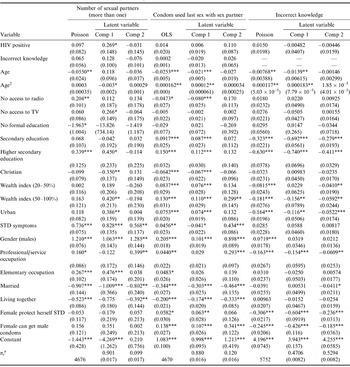
To tackle the issue, estimation of finite mixtures models was performed based on latent variable analysis to split the heterogeneous sample into homogenous components. The latent variable analysis for the number of condoms used in previous sex encounters assumed normal distribution of the two latent classes, while a Poisson distribution was assumed in the case of the number of sex partners and the number of incorrect responses. The results of the three finite mixtures estimations are presented in Table 6. The results of the traditional estimation of the three dependent variables, namely, Poisson for number of sexual partners and the number of incorrect answers, and ordinary least squares (OLS) for the number of condoms used in the previous sexual encounters, are also presented in Table 6 for comparison. To simplify the calculations, the estimations were restricted to the case of two components.
Ordinary least squares Poisson and finite mixture model estimates

a Probability that the observation lies in Component i.
Robust standard errors in parentheses.
*p<0.10; **p<0.05; ***p<0.01.
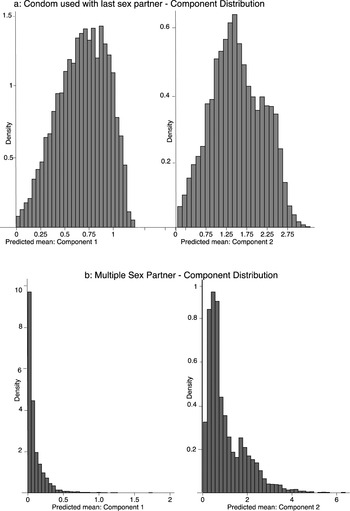
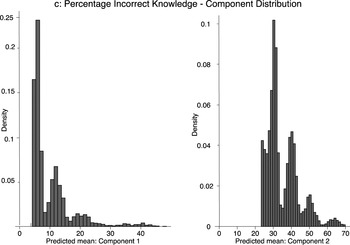
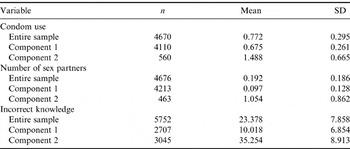
The last row in Table 6 reports the probability of an observation being a member of the two components in the case of each of the three dependent variables. The membership is almost equally split between the two components in the case of the knowledge variable but, in the other two cases, Component 1 dominates overwhelmingly. There are several examples of heterogeneity between the estimates. For example, there is positive association between the number of sex partners and HIV prevalence in the dominant Component 1 in the first latent regression, but not in Component 2, nor in the Poisson estimates. This result points to the danger of the disease spreading due to the tendency of HIV-positive individuals to have multiple sex partners. The danger is further underlined by the statistical insignificance of the coefficient estimate of HIV status in the regression equation of the number of condoms used in the previous sexual encounters. This shows that there is no evidence to suggest that HIV-infected individuals are using condoms in their sexual encounters. Couples who are married or living together will have fewer sex partners and, also, will use condoms less frequently. This reflects the familiarity of the partners with another, though less so for unmarried couples. These results are robust between the two components in each case. Consistent with the results of Table 5, the magnitudes of the estimates are smaller for couples who live together compared with the estimates for the married couples. Consistent with the earlier results, the dominant Component 1 provides evidence suggesting that greater empowerment of women leads to increased use of condoms, though there is no similar evidence to suggest that it has a significant effect on the number of multiple sex partners. The component densities of the three latent regression dependent variables, along with the summary statistics, are presented in Fig. 1 and Table 7, respectively. They provide further evidence of heterogeneity between the components. Figure 1b shows, for example, that Component 1 involves individuals with fewer sex partners than Component 2, as confirmed by their respective means. Figure 1a shows that Component 1 members use condoms less frequently than Component 2 members, while Fig. 1c shows that Component 1 members are more knowledgeable of the disease (i.e. have a lower percentage of answers that are incorrect) than those in Component 1. These are confirmed by the component means reported in Table 7.
Predicted mixture density of sexual behaviour and knowledge (see Table 7 for summary statistics).


Summary statistics for sexual behaviour and knowledge: entire sample and mixture density

Conclusion
This study extends the work of Ray & Sinha (Reference Ray and Sinha2010) and shows the usefulness of the knowledge measure proposed in that study in comparing knowledge of HIV between Botswana and India. While one country (Botswana) has a high rate of HIV prevalence but with low absolute numbers because of its smaller population base, the other (India) has a lower rate of HIV prevalence but with much larger potential for absolute devastation simply because of its much larger population base. The lower awareness and knowledge of the disease in India than in Botswana is a significant result, and points to the lessons that Asia can learn from Africa's longer experience with HIV and its information campaigns on the disease. The Botswana/India comparison brings out several similarities and differences between the knowledge base of HIV in the two countries. A prominent feature of the differences is that while females are better informed of the disease than males in Botswana, the reverse is the case in India. The paper also presents evidence that points to the role played by affluence and education in increasing knowledge, promoting safe sex and reducing HIV prevalence in Botswana. It also presents evidence from Botswana on the positive role played by empowering women in promoting safe sex practices such as condom use. The comparisons between Botswana and India need to be qualified by noting that they differ with respect to the factors that are associated with the spread of HIV: for example, multiple sex partners in Botswana and drug use in India. This suggests the need to formulate different policy interventions in the two countries to contain the spread of HIV. The results of this study point to multiple sex partners as a significant source of the spread of HIV in Botswana. Another worrying result is that there is no evidence to suggest that HIV-infected individuals are using condoms in their sexual encounters.
The interaction between knowledge of HIV and adoption of safe sex practice is not as strong as one might expect, nor is the nature of the effect of safe sex practice on HIV prevalence always in the expected direction. The former result suggests that greater awareness and knowledge of the disease may not necessarily suffice in encouraging HIV preventive sexual practices. The paper produces evidence that shows the vulnerability of females with multiple sex partners to infection with HIV/AIDS. Botswana needs to do more to discourage multiple sex partners as part of its HIV prevention programme. The recent success of ART in helping HIV-infected people live longer with the disease may have had counterproductive consequences by instilling a sense of complacency, as reflected in the absence of evidence that people with HIV are adopting safe sex practices in order to prevent the further spread of the disease (Garnett & Anderson, Reference Garnett and Anderson1996). By using the information on HIV status of the respondents, the present study underlines the importance of regular testing for HIV and on a wider scale. As more information becomes available, especially on HIV prevalence, this will allow further research in an area of policy importance. Countries such as India need to follow the example of Botswana in integrating the results of HIV testing with household attributes and other health-related information.
Acknowledgments
The research for this paper was partly funded by Australian Research Council Discovery Grants (DP0773489, DP0878012) and Monash Faculty Research Grant for new academic (11782200). Helpful comments from an anonymous reviewer are gratefully acknowledged. The authors retain responsibility for any remaining errors.