Kath etal. (Reference Kath, Salter, Bachiochi, Brown and Hebl2021) called for IOP readers to practice what they preach and assess whether their classroom pedagogy can be improved by using evidence-based findings from industrial-organizational (I-O) psychology research. We extend this call by encouraging academics to apply those same principles to undergraduate research experiences in I-O psychology. We use Kath etal.’s four intersections of practice and teaching to organize our recommendations in a timeline spanning from the recruitment of student research assistants (RAs) to the end of their experience as RAs. Perhaps your lab already follows some of these recommendations, and that’s good! These changes can scaffold and support each other, elevating your mentorship from “good” to “great.”
Why focus on research labs?
Foremost, it is clear that research experience pre-graduate school is a critical part of the I-O talent pipeline. Many I-O programs have a formal or informal (e.g., through a compensatory selection model) expectation that their students will have engaged in research prior to entering the graduate program. For some programs, completing research within the context of a class (e.g., a course on research methods) is sufficient, but for many others, more intensive research experiences, such as those offered in academic or applied research positions, are preferred. Applicants with a stronger record of research are considered more competitive and are therefore more likely to be admitted into a graduate program.
We also want to help students develop into knowledgeable and engaged citizens of the world. Students will apply the skills honed in the lab (e.g., teamwork, learning to give/take constructive feedback) whether they continue in their education (in I-O psychology or elsewhere) or enter the workforce; these skills are crucial to future success. We believe I-O psychology research labs must reflect the diverse populations represented in the U.S. workforce if our field wishes to (a) contribute to producing a diverse and scientifically literate population, (b) influence workplace practices and expectations of the college-educated workforce, and (c) have a diverse group of people who engage in I-O psychology in academia and/or practice. Thus, the optimal research lab experience should be evidence-based, fulfilling, and open to students of all backgrounds.
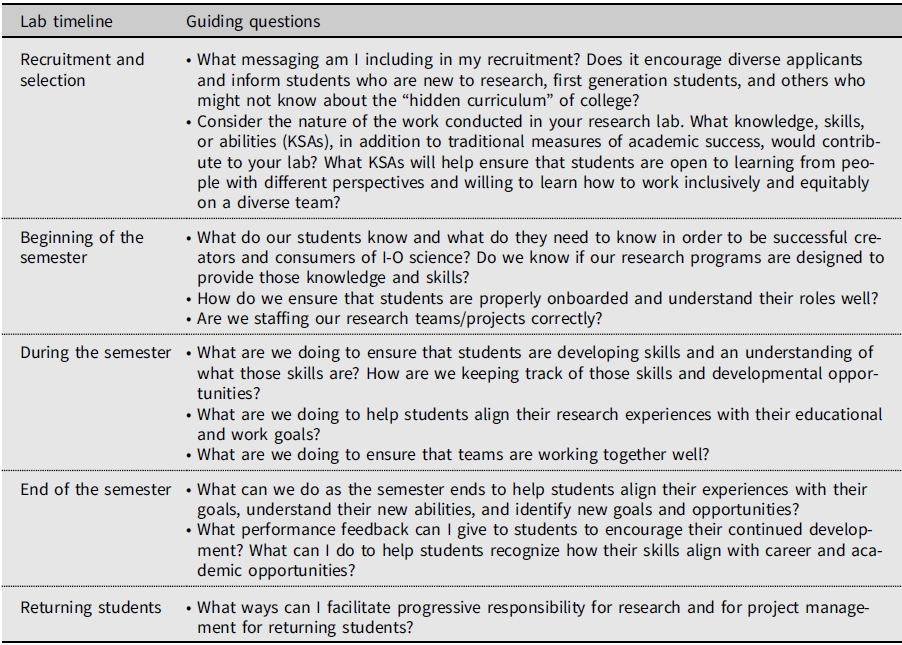
The guiding questions and challenges presented in Table 1 are meant to help you reflect on how you can apply best practices from the field of I-O psychology to your research lab. Building from this foundation, we provide recommendations that can be implemented during four stages: the recruitment and selection of RAs, the beginning of the semester, during the semester, and the end of the semester. Further considerations for students who return as RAs for multiple semesters are also provided. We want to emphasize that these recommendations are not exhaustive, and many may fit into more than one of Kath etal.'s (Reference Kath, Salter, Bachiochi, Brown and Hebl2021) four focal categories.
Table 1.
Guiding Questions and Challenges to Consider
Recruitment and selection
Kath etal. (Reference Kath, Salter, Bachiochi, Brown and Hebl2021) noted that educators are responsible for reaching all students. As such, it is equally important that you reflect on the reach of your research lab through the recruitment and selection of RAs. We ask that you consider how you are recruiting, who you are recruiting, and what criteria you have used to select students in the past.
Recommendations for recruitment and selection
Training and development
Although it is tempting to recruit and select students based only on grades, our position is that academic knowledge is only one part of being a successful lab member. For students, the research lab is a learning setting. We recommend that lab directors identify what skills must be present upon selection, what skills can be developed later through training and development exercises, and what skills and competencies students should develop to work and learn from people with different perspectives.
Diversity and inclusion
As the demographic composition of higher education and the workplace grows more diverse, students will inevitably have the opportunity to work and interact with colleagues who are demographically dissimilar to themselves (Long & Van Dam, Reference Long and Van Dam2019). The benefits of recruiting a more diverse undergraduate research group are threefold: (a) you will conduct better research by bringing together people with different perspectives and experiences; (b) the diversity of the talent in the I-O pipeline increases; and (c) the I-O brand increases because more students—who will eventually become employees and employers—will understand I-O psychology as a science and how valuable and useful our research is. We recommend that you include diversity-related information in recruiting materials; actively recruit minority students, first-generation students, and others who might not know about the “hidden curriculum”
Footnote 1
of college; and consider a rolling or extended recruitment window to allow a broader range of students (e.g., transfer students) the opportunity to join the lab.
Groups and teams
During the selection process, you should consider how students’ prior leadership, work, and team experiences can contribute to your research teams. We suggest that you build teams with a balance of skills and experiences with the expectation that the more technical research-related elements will develop through training and lab experiences.
Transformational leadership
Engage in individualized consideration—specifically, treat applicants like individuals and look at the whole person. Directly ask students to join your lab who show some match with expectations—please don’t overlook enthusiasm, motivation, and a willingness to learn!
Beginning of the semester
Research assistants (RAs) are often essential to the functioning of academic research labs, and yet they are usually not financially compensated for their work; many work on a volunteer basis or pay tuition and fees to receive course credits. With this in mind, you are responsible for ensuring a valuable experience for your RAs. You must be intentional when introducing RAs to their roles.
Recommendations for the beginning of the semester
Training and development
The research lab should be considered an educational and developmental enterprise. However, whereas a student’s role in the classroom is clear, a student’s role as an RA can be less transparent. Role clarity is an important part of the organizational socialization process, as it allows newcomers to identify their duties, required competencies for task completion, and performance expectations in order to be successful (Lapointe etal., Reference Lapointe, Vandenberghe and Boudrias2014; Saks & Gruman, Reference Saks and Gruman2011). To improve role clarity, RAs should be provided with information often found in strong syllabi: a clear statement of learning objectives or goals, the tasks that will be completed, and what is expected of them (Stanny etal., Reference Stanny, Gonzalez and McGowan2015). We recommend that you conduct a needs assessment of your research program (both of the students and the program itself) to identify gaps; establish learning objectives, skills training, and learning assessments for the program; and to ensure you have enough projects and work for each RA (students often pay tuition to work for you—respect their time and money).
Diversity and inclusion
Be aware that the structure of your research lab and the related expectations or requirements imposed on RAs affect the ability of some students to engage in research. Many students are engaged in part- or full-time work in order to afford their university. Requirements like imposing a fixed (rather than flexible or average) minimum number of hours to work per week or requiring RAs to be physically present in a lab for all of those hours (versus allowing them to work remotely or outside of typical working hours) can be restrictive. We recommend that you set the tone for the diversity climate of the lab by emphasizing inclusive principles early in the semester, facilitating group-level norms for working in diverse teams, and considering flexible work arrangements.
Groups and teams
It is helpful to have students work in small project teams for at least a semester, allowing them to build rapport and increase group effectiveness. It is also important to consider team composition and make assignments based on student strengths and weaknesses in certain areas of research (e.g., academic writing, literature reviews, statistics). Creating a group with diverse skill sets provides for students not only a chance to learn from one another but also a place where they can work toward skill mastery by teaching each other. It is also paramount that educators set clear expectations for the students’ responsibilities to each other as team members, empowering students to develop their own shared norms and expectations around communication, time management, lab responsibilities, and the like.
Transformational leadership
You should make it clear to students that while they are making a commitment to the lab, the leaders of the lab are also making a commitment to the students. Like traditional employment, a perceived breach of the psychological contract established between a student and their PI can be detrimental to the student and the overall functioning of the lab (Coyle-Shapiro etal., Reference Coyle-Shapiro, Costa, Doden and Chang2019). You should clearly establish the ways in which you will support the work being done in the lab (e.g., providing adequate training, being available to troubleshoot problems with students) and the mentoring available outside of their research tasks (e.g., graduate school applications). We recommend that you clearly communicate the reciprocal commitments made between the lab and the student’s role as an RA.
During the semester
As the semester progresses and RAs are engaged in the work of the research group, it is important to ensure that the psychological contract developed during the recruitment, selection, and onboarding processes is fulfilled.
Recommendations for during the semester
Training and development
Undergraduate RAs should be learning to think deeply about research rather than simply completing assigned tasks. To do so, you must contextualize how they are contributing to the broader research process and how the skills they are building can be applied going forward. Providing task context could influence the students experience of the task’s meaningfulness and engender more engagement and attention to a task that might otherwise not be perceived as a valuable experience (e.g., data coding), thus facilitating the students’ skill building and overall productivity (Barrick etal., Reference Barrick, Mount and Li2013; Fairlie, Reference Fairlie2011; Kahn, Reference Kahn and Albrecht2010).
We also suggest that you should track the students’ skill development progress and provide frequent developmental feedback. Individual coaching by a mentor or supervisor is an effective way to provide feedback and improve performance over time (Jones etal., Reference Jones, Woods and Guillaume2016). As it is likely that students in your research lab have different levels of research experience, coaching should be individualized, focused on current performance and developmental trajectories for each student relative to their starting KSAOs. Lab-wide KSAO development benchmarks will be less successful because most labs operate with students at different stages of their undergraduate career, which is to the benefit of the lab. Our recommendations to facilitate skill development are to expect and encourage active participation in lab meetings; provide frequent, relevant, and timely feedback to RAs; and track students’ skill development throughout the semester.
Diversity and inclusion
Research shows that most people who earn advanced degrees have parents who at least earned college degrees (Bui, Reference Bui2014; U.S. Department of Education, 2001). A more diverse lab is likely to contain first-generation RAs who are unfamiliar with college’s hidden curriculum, including strategies for managing academic demands and the prospect of graduate school. In the process of mentoring a team in research skills and tasks, you are also in a position to mentor our RAs in college skills and help them navigate the graduate school application processes. You can support diverse teams by encouraging team members to share their knowledge with teammates; reflecting on how the research they are conducting might apply to different jobs, populations, or cultures; and providing RAs with academic and career mentorship.
Groups and teams
Explicitly teaching students how to work more effectively in project-based teams provides RAs with critical workforce skills. One of the most important is managing healthy task interdependence, or how to rely on other teammates in a way that can quickly move a project forward. Regular team meetings are meant to provide a time for RAs to discuss the problems and solutions they have identified in their own workgroups as colleagues. Peer-based feedback and accountability can ensure that projects meet deadlines while removing some of the active management of time deadlines from the PI. Our recommendations for encouraging RAs to engage in group work are to schedule regular team meetings, give students opportunities to give each other developmental feedback and develop peer-reviewing skills, monitor the teams’ progress, and actively resolve conflicts and challenges as they arise
Transformational leadership
Taking an active role in the development of the RAs in your research lab through coaching, developmental feedback, and mentorship will also facilitate closer relationships with the students. As a result, when a student requests a letter of recommendation, you can have a full measurement of their performance in the lab and their improvements over time. We encourage you to seek these relationships and help students think ahead—whether for grad school or for jobs—by teaching them how to write CVs and resumés that capture their contributions to the lab, providing coaching based on developmental feedback to identify students’ strengths and weaknesses, and serving as a mentor for lab-related issues and other professional development topics.
End of the semester
As the end of the semester nears, students and lab leaders could both benefit from meta-cognition exercises where RAs reflect on their experiences in the lab (Bailey etal., Reference Bailey, Barber and Nelson2017). This provides a great opportunity for students to align their experiences with their goals and for lab directors to provide feedback to students. In return, students can provide feedback that can be used to refine the lab structure for future semesters.
Recommendations for the end of the semester
Training and development
Students can write short reflection papers based on prompts designed to stimulate their thinking about the things they learned during the semester. We recommend that you to prompt students’ self-reflection on topics like (a) linking their research experiences to their future academic/career goals; (b) their job performance, areas of excellence, and areas needing improvement; and (c) what skills learned in the lab the students found to be the most useful.
Diversity and inclusion
Make use of surveys to measure the climate of the lab. Conduct exit interviews with students to gain insight as to why they are not returning.
Groups and teams
The students can also be encouraged to discuss their reflections during a team debriefing meeting. During this meeting, you could discuss the tasks and goals that they have accomplished during the semester. We recommend that you have team members provide feedback to each other and to team leaders.
Transformational leadership
As a leader, lab directors can compare the student reflection papers to learning outcomes or stated lab values to determine the efficacy of the RA experience from the student’s perspective and make adjustments to future semesters’ curricula (Hund & Bueno, Reference Hund and Bueno2015). Use responses to re-evaluate answers to the questions posed throughout this paper. Overall, we recommend that you keep track of student success in the long run (internship, job, or graduate school placements); engage in self-reflection (has your set-up worked for you? Do you need more students? Fewer? Does this help or hinder publications?); and celebrate the wins by recognizing the overall progress from the beginning of the school year to the end.
Returning students
Anyone who has been fortunate enough to have excellent students return for multiple semesters knows that they are valuable contributors to the research enterprise. As they develop and master early research skills, RAs need progressively challenging opportunities.
Recommendations for returning students
Training and development
The professional development needs of returning students will evolve as they gain more experience. Having experienced RAs involved in the creation and presentation of research materials can serve to alleviate some of the challenges regarding the expert blind spot (i.e., the phenomena of forgetting the difficulties of initial knowledge acquisition after mastery; see Nathan & Petrosino, Reference Nathan and Petrosino2003). It may be challenging for educators to preemptively address challenges or problems the students face when learning new methods and techniques because it has likely been years (or decades) since we were novices. However, the veteran RAs have recently been novices and will be able to effectively communicate how they overcame the barriers and challenges when learning these methods.
Diversity and inclusion
Everyone should have an equal opportunity to gain progressive experiences in leadership positions. We hope that you will encourage and champion their transition to team leaders and ensure that opportunities for leadership and progressive responsibility are not tainted by implicit leadership bias.
Groups and teams
By giving progressive responsibility to lab members who earn it, veteran RAs can model good behavior for newly recruited RAs in project teams. We encourage you to allow students to receive feedback from peers, subordinates, and lab supervisors.
Transformational leadership
The developing student leaders should be encouraged to help the newer students with troubleshooting and peer mentorship. We recommend that you provide opportunities for students to showcase their mastery through leadership roles.
Conclusion
Kath etal. (Reference Kath, Salter, Bachiochi, Brown and Hebl2021) issued a call to reconsider the ways that we teach I-O psychology to undergraduate students; we issue a call to transform how we practice I-O psychology research with our undergraduates. We hope that this extension of the focal article has provided you with research-based solutions to improve the functioning of research labs and projects that involve undergraduate students. Indeed, the recommendations provided in this response are also pertinent to internship programs in applied settings, shadowing programs for undergraduate and high school students, and independent research projects that are spearheaded by individual students. Implementing these recommendations could benefit any who are engaged in the teaching and mentorship of those at the nexus of their I-O experience.




 You have
Access
Kath etal. (Reference Kath, Salter, Bachiochi, Brown and Hebl2021) called for IOP readers to practice what they preach and assess whether their classroom pedagogy can be improved by using evidence-based findings from industrial-organizational (I-O) psychology research. We extend this call by encouraging academics to apply those same principles to undergraduate research experiences in I-O psychology. We use Kath etal.’s four intersections of practice and teaching to organize our recommendations in a timeline spanning from the recruitment of student research assistants (RAs) to the end of their experience as RAs. Perhaps your lab already follows some of these recommendations, and that’s good! These changes can scaffold and support each other, elevating your mentorship from “good” to “great.”
Why focus on research labs?
Foremost, it is clear that research experience pre-graduate school is a critical part of the I-O talent pipeline. Many I-O programs have a formal or informal (e.g., through a compensatory selection model) expectation that their students will have engaged in research prior to entering the graduate program. For some programs, completing research within the context of a class (e.g., a course on research methods) is sufficient, but for many others, more intensive research experiences, such as those offered in academic or applied research positions, are preferred. Applicants with a stronger record of research are considered more competitive and are therefore more likely to be admitted into a graduate program.
We also want to help students develop into knowledgeable and engaged citizens of the world. Students will apply the skills honed in the lab (e.g., teamwork, learning to give/take constructive feedback) whether they continue in their education (in I-O psychology or elsewhere) or enter the workforce; these skills are crucial to future success. We believe I-O psychology research labs must reflect the diverse populations represented in the U.S. workforce if our field wishes to (a) contribute to producing a diverse and scientifically literate population, (b) influence workplace practices and expectations of the college-educated workforce, and (c) have a diverse group of people who engage in I-O psychology in academia and/or practice. Thus, the optimal research lab experience should be evidence-based, fulfilling, and open to students of all backgrounds.
The guiding questions and challenges presented in Table 1 are meant to help you reflect on how you can apply best practices from the field of I-O psychology to your research lab. Building from this foundation, we provide recommendations that can be implemented during four stages: the recruitment and selection of RAs, the beginning of the semester, during the semester, and the end of the semester. Further considerations for students who return as RAs for multiple semesters are also provided. We want to emphasize that these recommendations are not exhaustive, and many may fit into more than one of Kath etal.'s (Reference Kath, Salter, Bachiochi, Brown and Hebl2021) four focal categories.
Guiding Questions and Challenges to Consider
Recruitment and selection
Kath etal. (Reference Kath, Salter, Bachiochi, Brown and Hebl2021) noted that educators are responsible for reaching all students. As such, it is equally important that you reflect on the reach of your research lab through the recruitment and selection of RAs. We ask that you consider how you are recruiting, who you are recruiting, and what criteria you have used to select students in the past.
Recommendations for recruitment and selection
Training and development
Although it is tempting to recruit and select students based only on grades, our position is that academic knowledge is only one part of being a successful lab member. For students, the research lab is a learning setting. We recommend that lab directors identify what skills must be present upon selection, what skills can be developed later through training and development exercises, and what skills and competencies students should develop to work and learn from people with different perspectives.
Diversity and inclusion
As the demographic composition of higher education and the workplace grows more diverse, students will inevitably have the opportunity to work and interact with colleagues who are demographically dissimilar to themselves (Long & Van Dam, Reference Long and Van Dam2019). The benefits of recruiting a more diverse undergraduate research group are threefold: (a) you will conduct better research by bringing together people with different perspectives and experiences; (b) the diversity of the talent in the I-O pipeline increases; and (c) the I-O brand increases because more students—who will eventually become employees and employers—will understand I-O psychology as a science and how valuable and useful our research is. We recommend that you include diversity-related information in recruiting materials; actively recruit minority students, first-generation students, and others who might not know about the “hidden curriculum” Footnote 1 of college; and consider a rolling or extended recruitment window to allow a broader range of students (e.g., transfer students) the opportunity to join the lab.
Groups and teams
During the selection process, you should consider how students’ prior leadership, work, and team experiences can contribute to your research teams. We suggest that you build teams with a balance of skills and experiences with the expectation that the more technical research-related elements will develop through training and lab experiences.
Transformational leadership
Engage in individualized consideration—specifically, treat applicants like individuals and look at the whole person. Directly ask students to join your lab who show some match with expectations—please don’t overlook enthusiasm, motivation, and a willingness to learn!
Beginning of the semester
Research assistants (RAs) are often essential to the functioning of academic research labs, and yet they are usually not financially compensated for their work; many work on a volunteer basis or pay tuition and fees to receive course credits. With this in mind, you are responsible for ensuring a valuable experience for your RAs. You must be intentional when introducing RAs to their roles.
Recommendations for the beginning of the semester
Training and development
The research lab should be considered an educational and developmental enterprise. However, whereas a student’s role in the classroom is clear, a student’s role as an RA can be less transparent. Role clarity is an important part of the organizational socialization process, as it allows newcomers to identify their duties, required competencies for task completion, and performance expectations in order to be successful (Lapointe etal., Reference Lapointe, Vandenberghe and Boudrias2014; Saks & Gruman, Reference Saks and Gruman2011). To improve role clarity, RAs should be provided with information often found in strong syllabi: a clear statement of learning objectives or goals, the tasks that will be completed, and what is expected of them (Stanny etal., Reference Stanny, Gonzalez and McGowan2015). We recommend that you conduct a needs assessment of your research program (both of the students and the program itself) to identify gaps; establish learning objectives, skills training, and learning assessments for the program; and to ensure you have enough projects and work for each RA (students often pay tuition to work for you—respect their time and money).
Diversity and inclusion
Be aware that the structure of your research lab and the related expectations or requirements imposed on RAs affect the ability of some students to engage in research. Many students are engaged in part- or full-time work in order to afford their university. Requirements like imposing a fixed (rather than flexible or average) minimum number of hours to work per week or requiring RAs to be physically present in a lab for all of those hours (versus allowing them to work remotely or outside of typical working hours) can be restrictive. We recommend that you set the tone for the diversity climate of the lab by emphasizing inclusive principles early in the semester, facilitating group-level norms for working in diverse teams, and considering flexible work arrangements.
Groups and teams
It is helpful to have students work in small project teams for at least a semester, allowing them to build rapport and increase group effectiveness. It is also important to consider team composition and make assignments based on student strengths and weaknesses in certain areas of research (e.g., academic writing, literature reviews, statistics). Creating a group with diverse skill sets provides for students not only a chance to learn from one another but also a place where they can work toward skill mastery by teaching each other. It is also paramount that educators set clear expectations for the students’ responsibilities to each other as team members, empowering students to develop their own shared norms and expectations around communication, time management, lab responsibilities, and the like.
Transformational leadership
You should make it clear to students that while they are making a commitment to the lab, the leaders of the lab are also making a commitment to the students. Like traditional employment, a perceived breach of the psychological contract established between a student and their PI can be detrimental to the student and the overall functioning of the lab (Coyle-Shapiro etal., Reference Coyle-Shapiro, Costa, Doden and Chang2019). You should clearly establish the ways in which you will support the work being done in the lab (e.g., providing adequate training, being available to troubleshoot problems with students) and the mentoring available outside of their research tasks (e.g., graduate school applications). We recommend that you clearly communicate the reciprocal commitments made between the lab and the student’s role as an RA.
During the semester
As the semester progresses and RAs are engaged in the work of the research group, it is important to ensure that the psychological contract developed during the recruitment, selection, and onboarding processes is fulfilled.
Recommendations for during the semester
Training and development
Undergraduate RAs should be learning to think deeply about research rather than simply completing assigned tasks. To do so, you must contextualize how they are contributing to the broader research process and how the skills they are building can be applied going forward. Providing task context could influence the students experience of the task’s meaningfulness and engender more engagement and attention to a task that might otherwise not be perceived as a valuable experience (e.g., data coding), thus facilitating the students’ skill building and overall productivity (Barrick etal., Reference Barrick, Mount and Li2013; Fairlie, Reference Fairlie2011; Kahn, Reference Kahn and Albrecht2010).
We also suggest that you should track the students’ skill development progress and provide frequent developmental feedback. Individual coaching by a mentor or supervisor is an effective way to provide feedback and improve performance over time (Jones etal., Reference Jones, Woods and Guillaume2016). As it is likely that students in your research lab have different levels of research experience, coaching should be individualized, focused on current performance and developmental trajectories for each student relative to their starting KSAOs. Lab-wide KSAO development benchmarks will be less successful because most labs operate with students at different stages of their undergraduate career, which is to the benefit of the lab. Our recommendations to facilitate skill development are to expect and encourage active participation in lab meetings; provide frequent, relevant, and timely feedback to RAs; and track students’ skill development throughout the semester.
Diversity and inclusion
Research shows that most people who earn advanced degrees have parents who at least earned college degrees (Bui, Reference Bui2014; U.S. Department of Education, 2001). A more diverse lab is likely to contain first-generation RAs who are unfamiliar with college’s hidden curriculum, including strategies for managing academic demands and the prospect of graduate school. In the process of mentoring a team in research skills and tasks, you are also in a position to mentor our RAs in college skills and help them navigate the graduate school application processes. You can support diverse teams by encouraging team members to share their knowledge with teammates; reflecting on how the research they are conducting might apply to different jobs, populations, or cultures; and providing RAs with academic and career mentorship.
Groups and teams
Explicitly teaching students how to work more effectively in project-based teams provides RAs with critical workforce skills. One of the most important is managing healthy task interdependence, or how to rely on other teammates in a way that can quickly move a project forward. Regular team meetings are meant to provide a time for RAs to discuss the problems and solutions they have identified in their own workgroups as colleagues. Peer-based feedback and accountability can ensure that projects meet deadlines while removing some of the active management of time deadlines from the PI. Our recommendations for encouraging RAs to engage in group work are to schedule regular team meetings, give students opportunities to give each other developmental feedback and develop peer-reviewing skills, monitor the teams’ progress, and actively resolve conflicts and challenges as they arise
Transformational leadership
Taking an active role in the development of the RAs in your research lab through coaching, developmental feedback, and mentorship will also facilitate closer relationships with the students. As a result, when a student requests a letter of recommendation, you can have a full measurement of their performance in the lab and their improvements over time. We encourage you to seek these relationships and help students think ahead—whether for grad school or for jobs—by teaching them how to write CVs and resumés that capture their contributions to the lab, providing coaching based on developmental feedback to identify students’ strengths and weaknesses, and serving as a mentor for lab-related issues and other professional development topics.
End of the semester
As the end of the semester nears, students and lab leaders could both benefit from meta-cognition exercises where RAs reflect on their experiences in the lab (Bailey etal., Reference Bailey, Barber and Nelson2017). This provides a great opportunity for students to align their experiences with their goals and for lab directors to provide feedback to students. In return, students can provide feedback that can be used to refine the lab structure for future semesters.
Recommendations for the end of the semester
Training and development
Students can write short reflection papers based on prompts designed to stimulate their thinking about the things they learned during the semester. We recommend that you to prompt students’ self-reflection on topics like (a) linking their research experiences to their future academic/career goals; (b) their job performance, areas of excellence, and areas needing improvement; and (c) what skills learned in the lab the students found to be the most useful.
Diversity and inclusion
Make use of surveys to measure the climate of the lab. Conduct exit interviews with students to gain insight as to why they are not returning.
Groups and teams
The students can also be encouraged to discuss their reflections during a team debriefing meeting. During this meeting, you could discuss the tasks and goals that they have accomplished during the semester. We recommend that you have team members provide feedback to each other and to team leaders.
Transformational leadership
As a leader, lab directors can compare the student reflection papers to learning outcomes or stated lab values to determine the efficacy of the RA experience from the student’s perspective and make adjustments to future semesters’ curricula (Hund & Bueno, Reference Hund and Bueno2015). Use responses to re-evaluate answers to the questions posed throughout this paper. Overall, we recommend that you keep track of student success in the long run (internship, job, or graduate school placements); engage in self-reflection (has your set-up worked for you? Do you need more students? Fewer? Does this help or hinder publications?); and celebrate the wins by recognizing the overall progress from the beginning of the school year to the end.
Returning students
Anyone who has been fortunate enough to have excellent students return for multiple semesters knows that they are valuable contributors to the research enterprise. As they develop and master early research skills, RAs need progressively challenging opportunities.
Recommendations for returning students
Training and development
The professional development needs of returning students will evolve as they gain more experience. Having experienced RAs involved in the creation and presentation of research materials can serve to alleviate some of the challenges regarding the expert blind spot (i.e., the phenomena of forgetting the difficulties of initial knowledge acquisition after mastery; see Nathan & Petrosino, Reference Nathan and Petrosino2003). It may be challenging for educators to preemptively address challenges or problems the students face when learning new methods and techniques because it has likely been years (or decades) since we were novices. However, the veteran RAs have recently been novices and will be able to effectively communicate how they overcame the barriers and challenges when learning these methods.
Diversity and inclusion
Everyone should have an equal opportunity to gain progressive experiences in leadership positions. We hope that you will encourage and champion their transition to team leaders and ensure that opportunities for leadership and progressive responsibility are not tainted by implicit leadership bias.
Groups and teams
By giving progressive responsibility to lab members who earn it, veteran RAs can model good behavior for newly recruited RAs in project teams. We encourage you to allow students to receive feedback from peers, subordinates, and lab supervisors.
Transformational leadership
The developing student leaders should be encouraged to help the newer students with troubleshooting and peer mentorship. We recommend that you provide opportunities for students to showcase their mastery through leadership roles.
Conclusion
Kath etal. (Reference Kath, Salter, Bachiochi, Brown and Hebl2021) issued a call to reconsider the ways that we teach I-O psychology to undergraduate students; we issue a call to transform how we practice I-O psychology research with our undergraduates. We hope that this extension of the focal article has provided you with research-based solutions to improve the functioning of research labs and projects that involve undergraduate students. Indeed, the recommendations provided in this response are also pertinent to internship programs in applied settings, shadowing programs for undergraduate and high school students, and independent research projects that are spearheaded by individual students. Implementing these recommendations could benefit any who are engaged in the teaching and mentorship of those at the nexus of their I-O experience.