INTRODUCTION
One of the biggest direct costs that a crop grower faces is fertilizer. For the conventional farmer, chemical fertilizer costs can represent as much as 0·26 of direct costs (L. Connolly & B. Moran, personal communication), thus the farming industry is constrained by fertilizer costs, which have generally risen over time (FAO 2015). As well as being economically costly, chemical fertilizers also have a detrimental effect on the wider environment and on the microorganisms that are important for maintaining a healthy soil (Dobermann & Nelson Reference Dobermann and Nelson2013). It is widely recognized that the current level of fertilizer use is unsustainable in many farming systems and if a more sustainable approach to maintaining crop yield is to be developed, then chemical fertilizer inputs will have to be reduced (Searchinger Reference Searchinger and Searchinger2013).
Fungal endophytes (hereafter ‘endophytes’) are microorganisms that colonize plants without causing any obvious disease symptoms. They are considered ubiquitous and have been found in every plant group studied to date (Brenner et al. Reference Brenner, You and Arnold2008; Nisa et al. Reference Nisa, Kamili, Nawchoo, Shafi, Shameem and Bandh2015) Endophytes have been characterized and described in increasing numbers over the last few years (Vandenkoornhuyse et al. Reference Vandenkoornhuyse, Quaiser, Duhamel, Le Van and Dufresne2015; Wani et al. Reference Wani, Ashraf, Mohiuddin and Riyaz-Ul-Hassan2015), and represent a new resource for improving crop performance without increasing inputs of synthetic chemicals (Le Cocq et al. Reference Le Cocq, Gurr, Hirsch and Mauchline2017). They have demonstrated yield and stress tolerance benefits for barley (Hordeum vulgare) and other crops (Hashem & Ali Reference Hashem and Ali2004; Waller et al. Reference Waller, Achatz, Baltruschat, Fodor, Becker, Fischer, Heier, Hückelhoven, Neumann, Von Wettstein, Franken and Kogel2005; Achatz et al. Reference Achatz, von Rüden, Andrade, Neumann, Pons-Kühnemann, Kogel, Franken and Waller2010; Sun et al. Reference Sun, Johnson, Cai, Sherameti, Oelmüller and Lou2010; Bagde et al. Reference Bagde, Prasad and Varma2011; Khan & Lee Reference Khan and Lee2013; Johnson et al. Reference Johnson, Alex and Oelmüller2014; Murphy et al. Reference Murphy, Martin Nieto, Doohan and Hodkinson2015a , Reference Murphy, Doohan and Hodkinson b ), but these benefits may be reduced or negated in an agricultural field situation due to regularly applied fertilizer and fungicidal treatments (Harvey et al. Reference Harvey, Fletcher and Emms1982; Dobermann & Nelson Reference Dobermann and Nelson2013; Buysens et al. Reference Buysens, Dupré De Boulois and Declerck2015; Prior et al. Reference Prior, Mittelbach and Begerow2017). Another limitation of endophyte crop inoculants is the unpredictable or unknown shelf-life of endophyte formulations as seed dressings or liquid treatments. A survey of different endophyte-based products by Owen et al. (Reference Owen, Williams, Griffith and Withers 2015 ) revealed that a number of them (primarily bacterial) have a very short shelf-life, whereas for other products, ‘use-by’ dates were completely absent. Therefore, the shelf-life stability of the products seems to be highly variable. If endophytes are to play a part in biotechnological agricultural applications, inoculants that are persistent, have a reasonable shelf-life, and that are effective on crops regardless of the chemical treatments must be discovered. Seed dressings are particularly suitable as inoculants because seed companies already have the equipment needed to carry out the dressing as part of their normal seed treatments, in addition to which farmers can use mobile seed dressing units for farm-saved seed.
While the beneficial effects of endophytes on barley in controlled environment experiments for nutrient, drought and pathogen-stressed barley have been previously demonstrated (Murphy et al. Reference Murphy, Martin Nieto, Doohan and Hodkinson2015a , Reference Murphy, Doohan and Hodkinson b , Reference Murphy, Doohan and Hodkinson c ), this does not necessarily mean that the endophytes will be equally as effective in the more complex environment of the field (Selosse & Rousset Reference Selosse and Rousset2011; Kusari et al. Reference Kusari, Singh and Jayabaskaran2014; van der Heijden et al. Reference Van der Heijden, Martin, Selosse and Sanders2015). It is not known how the endophytes will fit into the ‘ecological marketplace’ of the dynamic plant–microbiome system (Nelissen et al. Reference Nelissen, Moloney and Inzé2014). Endophytes have been discovered from many sources (Zuccaro et al. Reference Zuccaro, Lahrmann and Langen2014; Lugtenberg et al. Reference Lugtenberg, Caradus and Johnson2016). However, a previous research has demonstrated that endophytes isolated from crop wild relatives may be more compatible with their associated crop cultivars (Murphy et al. Reference Murphy, Doohan and Hodkinson2015b ). There is also a growing body of evidence showing that consortia of endophytes can be more effective than single endophyte treatments (Vandegrift et al. Reference Vandegrift, Roy, Pfeifer-Meister, Johnson and Bridgham2015). The current work therefore aimed to test the effects of a seed dressing containing a consortium of endophytes, isolated from a wild relative of barley (Hordeum murinum subsp. murinum), on the yield of three barley cultivars with variable inputs of fertilizer over two seasons and on three contrasting field sites.
MATERIALS AND METHODS
Endophyte inoculum
The endophyte inoculum consisted of a mix of equal volumes of four fungal endophytes (Table 1) that were isolated from a wild barley relative, H. murinum subsp. murinum. These strains were obtained from the endophyte collection at the Trinity College of the University of Dublin, Ireland. These particular endophyte strains were chosen because they were previously shown to enhance the growth, development and yield of cultivated barley in growth cabinet experiments (Murphy et al. Reference Murphy, Martin Nieto, Doohan and Hodkinson2015a , Reference Murphy, Doohan and Hodkinson b , Reference Murphy, Doohan and Hodkinson c ) and because they were well suited for use as seed dressings.
The strain code and ITS sequence similarity of endophyte strains used in the present study, showing the relationship to NCBI GenBank accessions

Crop cultivar selection
Three spring malting barley cultivars (the feed cultivar Mickle, the feed and malting cultivar Planet and the malting cultivar Propino) were selected as the experimental subjects (seed source Goldcrop Ltd. Cork, Ireland). Mickle (Sumit × Yard, Breeder: Syngenta Seeds Ltd.) is an established British variety with very high-yield potential. Propino (Quench × NFC Tipple, Breeder: Syngenta Seeds Ltd.) is widely planted across Europe. Planet (Tamtam × Concerto, Breeder: RAGT Seed) is a new cultivar, which is progressing very well across Europe as well as in New Zealand and Argentina. These were chosen on the basis that they are modern and also internationally recognized, so the results will be relevant for a number of years and will be more easily shared for comparative purposes with other growers.
Seed treatment
A dressing was applied to the seeds as a thin film using a Hege 14 seed dresser (Wintersteiger AG, Austria), a device designed to apply treatments to small amounts of seed (100–2500 g). The seed dressing consisted of a liquid carrier to aid seed adhesion (Incotec DOSCO®) mixed with one of two treatment solutions at a ratio of 50 : 50. The two treatments were: (1) untreated (plain water) or (2) an endophyte spore solution (approximately 1000 fungal spores per seed, in pure water suspension). The seed was spun at high speed in the seed dresser while being spray-dressed, resulting in the application of 4 ml of the liquid treatment per kg of seed. The seed dressing dries within minutes. The coated seed was thereafter stored in burlap bags at room temperature (~20 °C) before sowing.
Experimental procedure
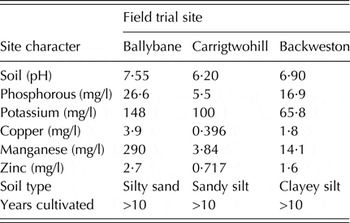
Three trials were conducted on sites that experience different climatic environments (Table 2) and are on different soil types with variable characteristics of fertility (Table 3). The three field trial sites were located in the south of Ireland at Ballybane, Co. Cork (51°51′38″ N, 8°2′56·54″ W, 22 m a.s.l.) and Carrigtwohill, Co. Cork (51°54′38·53″ N, 8°16′49·00″ W, 16 m a.s.l.), and at Backweston, Co. Kildare, in the east of Ireland (51°51′38·52″ N, 8°2′56·54″ W, 51 m a.s.l.). Planet and Propino were grown at all three sites, and Mickle was grown at Carrigtwohill and Backweston. The sites were been maintained on a cereal/rape seed crop rotation for the previous 3 years.
Site-specific climate data for the crop-growing period: Soil Temp figures are means

Field trial sites soil characteristics

Three nitrogen (N) regimes were applied during the growing season: (1) standard N input for the site (100%) (for Ballybane the full rate was 167 kg N/ha, for Carrigtwohill 163 kg N/ha and for Backweston 120 kg N/ha), (2) half of standard N input (50% N) and (3) no extra N (0 N). The barley seeds were dressed with each of the treatments and the seeds sown by direct drilling at a density of 193 kg/ha for Mickle, 207 kg/ha for Planet and 202 kg/ha for Propino. Four replicate trial plots of 1·8 × 12·5 m2 were sown for each treatment, giving a total of 72 plots per field site.
A month before seed sowing, 500 kg/ha 0/10/20 (N/phosphorus (P)/potassium (K)) + 250 kg/ha Granlime was applied as a top dressing, and 250 kg/ha of Sulfacan was applied immediately before sowing. Where appropriate, nitrogenous fertilizer was applied to the growing crops during the growing season at Zadoks growth stage (GS) 32 (2nd node detectable; Zadoks et al. Reference Zadoks, Chang and Konzak1974); 452 kg/ha Sulfacan was applied by Fiona fertilizer spreader to the full rate fertilizer plots, and half of this amount was applied to the 50% fertilizer treatment.
Plots not receiving fertilizer were covered by plastic sheeting during the application process to prevent unwanted drift from fertilized plots. The growing crop received the following fungicidal treatments: GS 39, 750 g/l Fenpropimorph at 0·2 l/ha (Corbel®) and 250 g/l Prothioconazole at 0·4 l/ha (Proline®); GS 41, 41·6 g/l Epoxiconazole + 41·6 g/l Fluxapyroxad + 66·6 g/l Pyraclastrobin at 1·8 l/ha (Ceriaxl®) and 500 g/l Chlorothalonil at 1·0 l/ha (Bravo®). Independent growers recommended this fungicide regime for their particular conditions. At GS 39, the insecticide Sumi-Alpha (Interfarm UK Ltd.), with the active ingredient Esfenvalerate, was applied at 165 ml/ha. All crops were machine-harvested and dried before measuring grain yield and protein content. Grain yield comparisons at a moisture content of 15% were based on yield per plot.
Statistical analyses were carried out using two-way ANOVA with Bonferroni correction, Pearson's Product Moment Correlation (r) and two-tailed Student's t tests (Datadesk 7.01 and Microsoft Excel 2010®).
RESULTS
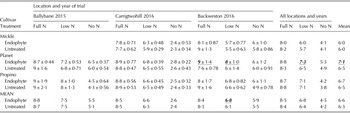
For yield comparisons between endophyte-treated and untreated barley controls, a significant interaction was detected between field site and barley cultivar (P < 0·01). Statistical analyses focusing on endophyte treatment effect on grain yield for the two barley cultivars common to all three sites (Planet and Propino) also found a significant interaction between field site and barley cultivar (P < 0·01). Further analyses revealed significant endophyte-associated yield increases for the Backweston site and for the cultivar Planet. On the Backweston field site, the endophyte treatment with 50% of the standard N input restored yield of cultivar Planet to that of non-endophyte treated plots receiving 100% N input (Table 4). On the same site and with the same cultivar, endophyte treatment significantly increased yield by 15% (P < 0·05) under standard N inputs, and for all three cultivars with 50% N input by a mean 12% (P < 0·05). Over both seasons and all three sites, the endophyte treatment significantly increased the yield of Planet by a mean of 9% (P < 0·05).
Barley grain yield (t/Ha) ± standard deviation, endophyte field trials 2015–2016.

Statistically significant differences (ANOVA, P < 0·05) between endophyte and untreated trials are highlighted in bold underlined italics.
For the endophyte-induced increase in yield over the untreated controls, a strong correlation (r(2) = −1·00, P < 0·001) was found between low seasonal rainfall and yield increase, between high site-specific evaporation and yield increase (r(2) = 0·99, P < 0·001), and between number of degree days above a base of 15·5 °C and yield increase (r(2) = −1·00, P < 0·001). All three of these variable characteristics (low rainfall, high site-specific evaporation and number of degree days over the base) were associated with the Backweston site (Table 2), which also recorded a higher, but not significantly higher, soil temperature. Backweston had <70% of the seasonal rainfall, a mean 21 mm more evaporation and a mean 28 degree days more than that recorded at the other two sites.
While other studies have found that barley grain protein content increased with increasing N rate (Birch & Long Reference Birch and Long1990), no significant treatment interactions or differences in grain N content were found in the present study between barley cultivar or field site, where grain N content was a mean of 9·22% for Mickle, 9·37% for Propino and 9·20% for Planet (data not shown).
DISCUSSION
It is widely recognized that current agricultural chemical use is unsustainable, and when coupled with increasing episodes of extreme weather, especially drought, associated with global climate change, poses serious problems for farmers in the future. Results from studies, such as the current one, offer real hope in finding alternative and sustainable solutions for dealing with these problems.
The most important finding from the current field trials was the endophyte-induced grain yield increase in the barley cultivar Planet. On the Backweston site, endophyte treatment with 50% N input improved Planet yield to a greater level than that of untreated seeds with full N and also increased yield by 15% under full N. The Planet yield increase was the main reason for the overall significant yield increase for all three cultivars at this site, as endophyte-induced yield increases for Mickle and Propino were smaller and non-significant. However, over both seasons and all three sites, the endophyte treatment did significantly increase Planet yield. The consequent economic and environmental savings related to the results for Planet and other compatible cultivars could be huge. Over a quarter of direct costs for cereal growers are related to chemical fertilizer purchases (L. Connolly & B. Moran, personal communication), and if the farmer can forgo some of this cost, as indicated by the current results, then this could represent a saving of up to €165/ha (O'Donovan & O'Mahony Reference O'Donovan and O'Mahony2014) for this particular barley cultivar (based on 50% less nitrogenous fertilizer input). The potential reductions in fertilizer use would also have a beneficial impact on the environment, particularly in relation to reductions of N2O emissions and fertilizer run-off (Biello Reference Biello2008; Johnson & Harrison Reference Johnson and Harrison2015). While using endophytes with lower inputs of N maintains yields typical of higher N inputs, this leaves a potential gap in restoring the crop N take-off; however, the N shortfall can be made up by using other measures such as growing off-season legume cover crops, application of organic manures and smaller incremental N inputs.
The different environmental conditions experienced at each site played a significant part in the yield increases found for Planet. The strong correlation between endophyte-induced yield increase and low rainfall, high evaporation and greater number of degree days suggest that the endophyte consortium is most suited to water-stressed sites and is more yield-beneficial on water-stressed sites. This is consistent with previous findings for this group of endophyte strains, where a controlled environment experiment showed endophyte-induced yield increases in drought stressed barley (Murphy et al. Reference Murphy, Martin Nieto, Doohan and Hodkinson2015a ). The environmental conditions at the endophyte source sites were characterized by relatively low soil moisture (Murphy et al. Reference Murphy, Doohan and Hodkinson2015c ), and may suggest that matching source and sink environmental conditions may be a key factor in endophyte efficacy (Murphy et al. Reference Murphy, Doohan and Hodkinson2016). The low rainfall at the Backweston site was exacerbated by high evaporation, so what little rain did fall evaporated to a greater degree. The relatively low soil potassium level reported for this site (Table 3) may also be a contributory factor, given the importance of this element in plant water relations (Wang et al. Reference Wang, Zheng, Shen and Guo2013).
The significant results in yield increase for Planet indicates that it is more tolerant of drought than the other cultivars, but the breeders of this cultivar (RAGT Seeds Ltd.) could not confirm if this was the case.
While the mechanisms involved in the endophyte-induced yield increases were not investigated in the current study, one would expect these to be multi-factorial (Murphy et al. Reference Murphy, Hodkinson and Doohan2013), and further work is planned to elucidate the particular mechanisms involved in this crop/endophyte symbiosis.
All four of the component strains in the inoculant have increased barley grain yield under various biotic and abiotic stresses in previous controlled environment experiments. Two of the strains (0406052A and 0406052C) increased yield in drought stressed barley primarily through an increase in root biomass (Murphy et al. Reference Murphy, Martin Nieto, Doohan and Hodkinson2015a ). The other two inoculant components (04090103 and 04090604) increased yield in nutrient stressed barley. The strain 04090604 is related to Metarhizium, which has been shown to allow a direct transfer of nutrients such as N from an insect cadaver to the plant (Behie et al. Reference Behie, Zelisko and Bidochka2012). Other researchers have suggested that the incorporation of such strains in agricultural practices may be incredibly promising, providing multiple simultaneous benefits, ranging from plant root defence to plant growth-promoting properties (Sasan & Bidochka Reference Sasan and Bidochka2012; Vidal & Jaber Reference Vidal and Jaber2015). One component of the inoculant (04090103) is also antagonistic towards a wide range of seed-borne barley diseases (Murphy et al. Reference Murphy, Doohan and Hodkinson2015c ). The combination of these four competent strains in the crop inoculant may confer some or all of these beneficial effects on barley crops.
In their meta-analysis of the effects of endophytic fungal symbionts on grasses under drought, Worchel et al. (Reference Worchel, Giauque and Kivlin2013) conclude that the increased growth of grasses conferred from fungal symbionts was greatest at the lowest soil moisture levels. The endophytes in the present study may also have enabled a more efficient nutrient acquisition and use, particularly micronutrients. Previous studies have shown that fungal root endophytes can mobilize and transport phosphorus, N and micronutrients from soil to the infected host plant via plant–fungal interfaces (Sherameti et al. Reference Sherameti, Shahollari, Venus, Altschmied, Varma and Oelmüller2005; Usuki & Narisawa Reference Usuki and Narisawa2007; Upson et al. Reference Upson, Read and Newsham2009; Yadav et al. Reference Yadav, Kumar, Deep, Kumar, Sharma, Tripathi, Tuteja, Saxena and Johri2010).
Furthermore, the endophyte-induced yield increase was apparent even when the crops were treated with cocktails of foliar and systemic fungicides throughout the growing season, so this may indicate that the endophyte effect is tolerant of these fungicides. In a previous controlled environment experiment, it was also shown that the endophyte consortium was tolerant of co-applied fungicidal seed dressings (Murphy et al. Reference Murphy, Doohan and Hodkinson2017). Rolston et al. (Reference Rolston, Archie and Simpson2002) showed tolerance of a Neotyphodium endophyte to fungicides used to control stem rust (Puccinia graminis) in perennial ryegrass seed production; they found that endophyte viability was not affected by single, double or triple applications of azoxystrobin and epoxiconazole during the growing season. It is alternatively possible that the benefits were conferred early, even before fungicide application. Achatz et al. (Reference Achatz, von Rüden, Andrade, Neumann, Pons-Kühnemann, Kogel, Franken and Waller2010) found that the yield benefits induced by the model endophyte Piriformospora indica were primarily due to endophyte-induced increases in early plant development. Buysens et al. (Reference Buysens, Dupré De Boulois and Declerck2015) showed that the fungicides azoxystrobin and pencycuron do not affect arbuscular mycorrhizal fungi (AMF) at threshold concentrations to control Rhizoctonia solani in vitro, and thus have the potential to be used in parallel against Rhizoctonia disease in potato. The current results suggest that endophytes can confer yield benefits while still allowing the farmer to obtain control of fungal pathogens through the use of chemical fungicides. This particular endophyte consortium contains individual strains that have demonstrated biocontrol of pathogens for other crop species such as wheat in controlled environment experiments (manuscript under review). Other fungal endophytes have demonstrated a broad host compatibility across many different plant groups (Kumar et al. Reference Kumar, Sarma, Saharan, Srivastava, Kumar, Sahai, Bisaria and Sharma2012; Ansari et al. Reference Ansari, Trivedi, Sahoo, Gill and Tuteja2013; Johnson et al. Reference Johnson, Alex and Oelmüller2014; Zuccaro et al. Reference Zuccaro, Lahrmann and Langen2014), and further tests will determine if the endophyte inoculant used in the present study has any beneficial effects on other field-grown crops.
To our knowledge, this is the first time that fungal root endophytes isolated from a wild cereal relative have induced yield increases in field-grown cereal crops. The current results show that these endophytes would be particularly effective on sites with low rainfall and low nutrient soils, especially on marginal sites, but more field testing is needed with multiple and co-occurring biotic and abiotic stresses. The relative cheapness and ease of application of the endophyte seed dressing would be particularly attractive to poorer farmers who are unable to purchase expensive chemical fertilizers. In other tests conducted by an industry partner (results not published), it was shown that the endophyte spores can be economically produced on an industrial scale, and these strains have been repeatedly sub-cultured with no apparent loss of competence. Indeed, the endophyte inoculant remains effective as a seed treatment when stored at room temperature for at least 6 months after dressing the seed (Murphy et al. Reference Murphy, Doohan and Hodkinson2017), thus offering an acceptable shelf-life for the seeds of annual cereal crops. It has been shown that these endophytes could be developed as a viable agricultural biotechnology, are relatively cheap to produce and apply, and are effective on crops regardless of the chemical treatments. When they are applied to compatible crop cultivars, then the economic and environmental costs of chemical fertilizers may be significantly reduced.
NOTE
A patent for the use of these endophytes has been filed by Trinity College Dublin and University College Dublin (patent holders), and the use of these endophytes for biofertilization and biocontrol purposes in cereal crop plants by third parties is subject to negotiated agreement with the patent holders and they may not be used without such permission.
We thank: Goldcrop Limited, Cork, Ireland for the generous supply and dressing of barley seeds, and for advice on suitable cultivars to use; Crop Plot Trials and the Irish Department of Agriculture, Food and the Marine for carrying out the field trials; Helena Murphy for proof reading and the de-cluttering of technical terms; laboratory technicians at Trinity College Dublin and University College Dublin for providing supplies and technical support. Science Foundation Ireland funded the 2016 field trials through a Technology Innovation Development Award (Grant Number R15449). Trinity College Dublin provided financial support for the 2015 field trial through a PhD studentship grant.