

Scotland has yielded a rich fauna of Palaeozoic non-marine arthropods. Of particular interest are the terrestrial forms: myriapods (millipedes and centipedes); arachnids (scorpions, trigonotarbids, harvestmen and mites); and hexapods (springtails and insects). Of these, the scorpions were probably primarily aquatic and for one group of myriapods, the extinct Kampecarida, it is not known whether they were terrestrial or aquatic (Shear Reference Shear, Fortey and Thomas1998).
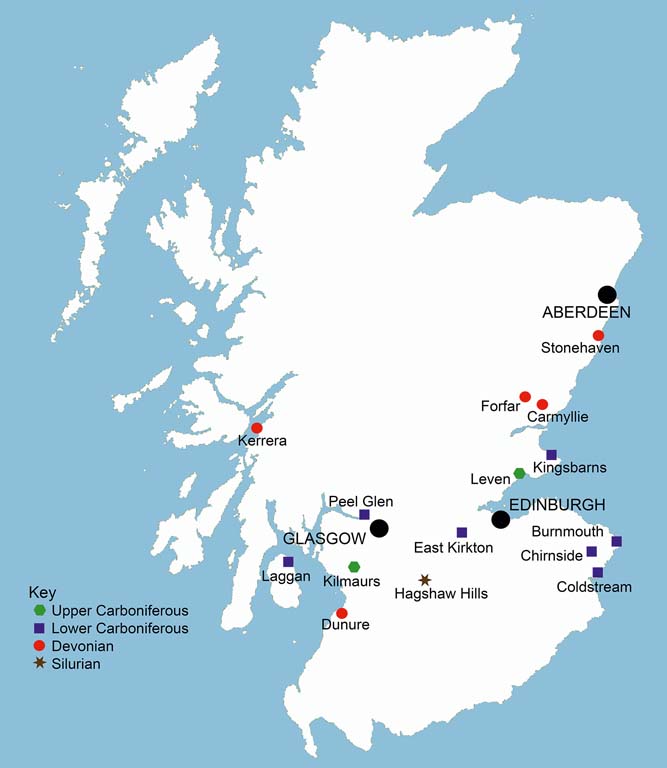
Millipedes (Diplopoda, excluding Kampecarida) are known from the mid-Silurian to Upper Carboniferous of Scotland. The oldest is Casiogrammus ichthyeros Wilson, Reference Wilson2005 from the Hagshaw Hills, Lanarkshire, of Wenlock age. Several specimens from Stonehaven, Aberdeenshire, were considered to be of the same age; however, the beds they came from were recently re-dated as earliest Devonian (Suarez et al. Reference Suarez, Brookfield, Catlos and Stöckli2017). One of them, Pneumodesmus newmani Wilson & Anderson, Reference Wilson and Anderson2004, had spiracles for breathing air. Two other diplopod species from the same locality, Albadesmus almondi Wilson & Anderson, Reference Wilson and Anderson2004 and Cowiedesmus eroticopodus Wilson & Anderson, Reference Wilson and Anderson2004, were probably also terrestrial, based on their affinities to Pneumodesmus (and being members of the same extinct superorder Archipolypoda). Other records of Palaeozoic diplopods from Scotland include three species from the Lower Devonian Old Red Sandstone: Archidesmus macnicoli Peach, Reference Peach1882 from Forfar and Carmyllie, Angus; Palaeodesmus tuberculata (Brade-Birks, Reference Brade-Birks1923) from Dunure, Ayrshire (both discussed by Almond (Reference Almond1985) and re-described by Wilson & Anderson (Reference Wilson and Anderson2004)), and Sigmastria dilata Wilson, Reference Wilson2006 also from Carmyllie. In addition, three specimens tentatively identified as Archidesmus sp. were collected from Kerrera Island, Argyll and Bute County, probably of earliest Devonian age, but could be latest Silurian (Trewin et al. Reference Trewin2012). One species, Anthracodesmus macconochiei Peach, Reference Peach1899, was described from the Lower Carboniferous (Tournaisian; Courceyan) of Coldstream, Scottish Borders (see Wilson & Anderson Reference Wilson and Anderson2004). A diverse unnamed fauna is known from the late Viséan of East Kirkton, West Lothian (Shear Reference Shear1994), and a previously unmentioned specimen in the collections of The Hunterian (GLAHM 114805) came from the Lower Limestone Formation (Viséan: Brigantian, Hall et al. Reference Hall, Browne and Forsyth1998) of Peel Glen, Faifley, Lanarkshire. Three species are recorded from the Upper Carboniferous Coal Measures: the giant millipede Arthropleura armata Jordan in Jordan & Meyer, Reference Jordan and von Meyer1856 from Leven, Fife (in Andrée Reference Andrée1913); Xylobius woodwardii Scudder, Reference Scudder1873 (figured by Woodward (Reference Woodward1866), species name first published as a nomen nudum by Scudder (Reference Scudder1869)); and Euphoberia brownii Woodward, Reference Woodward1871, both from Kilmaurs, Ayrshire. Large diplopod trackways, Diplichnites cuithensis Briggs, Rolfe & Brannan, Reference Briggs, Rolfe and Brannan1979, attributed to Arthropleura, have been recorded from the Lower Carboniferous: Namurian of Laggan, Isle of Arran, and from the Viséan off the east coast of Fife near Kingsbarns (Pearson Reference Pearson1992). A map of all the Scottish fossil diplopod localities is shown in Figure 1.
Map of Scotland (excluding the Orkney and Shetland Isles) showing locations of sites that have yielded diplopods or large Diplichnites trackways. Base map from http://mapsof.net, published under the Creative Commons Attribution-ShareAlike 1.0 Licence.

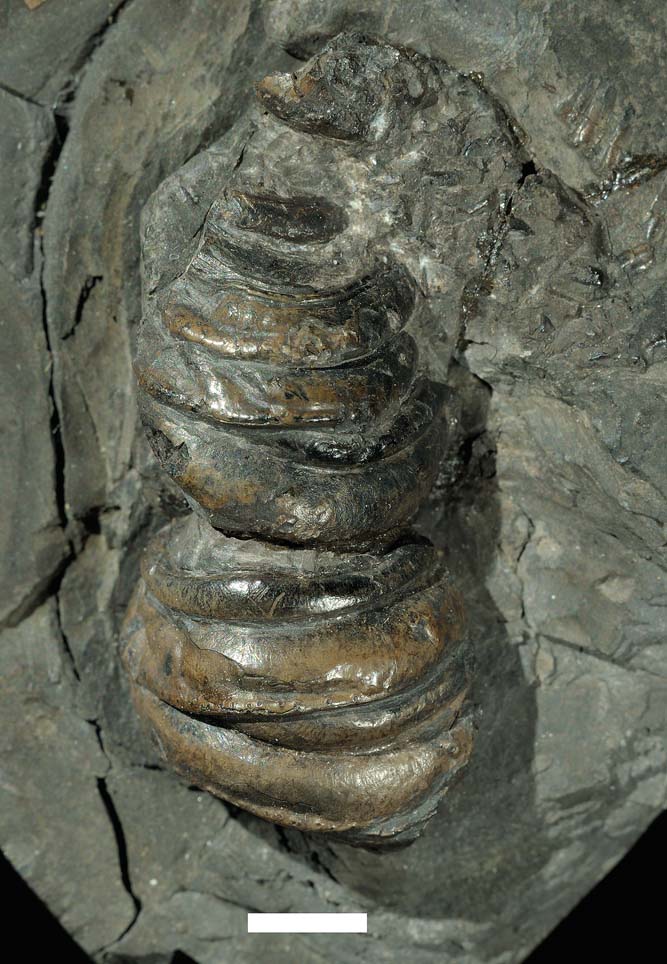
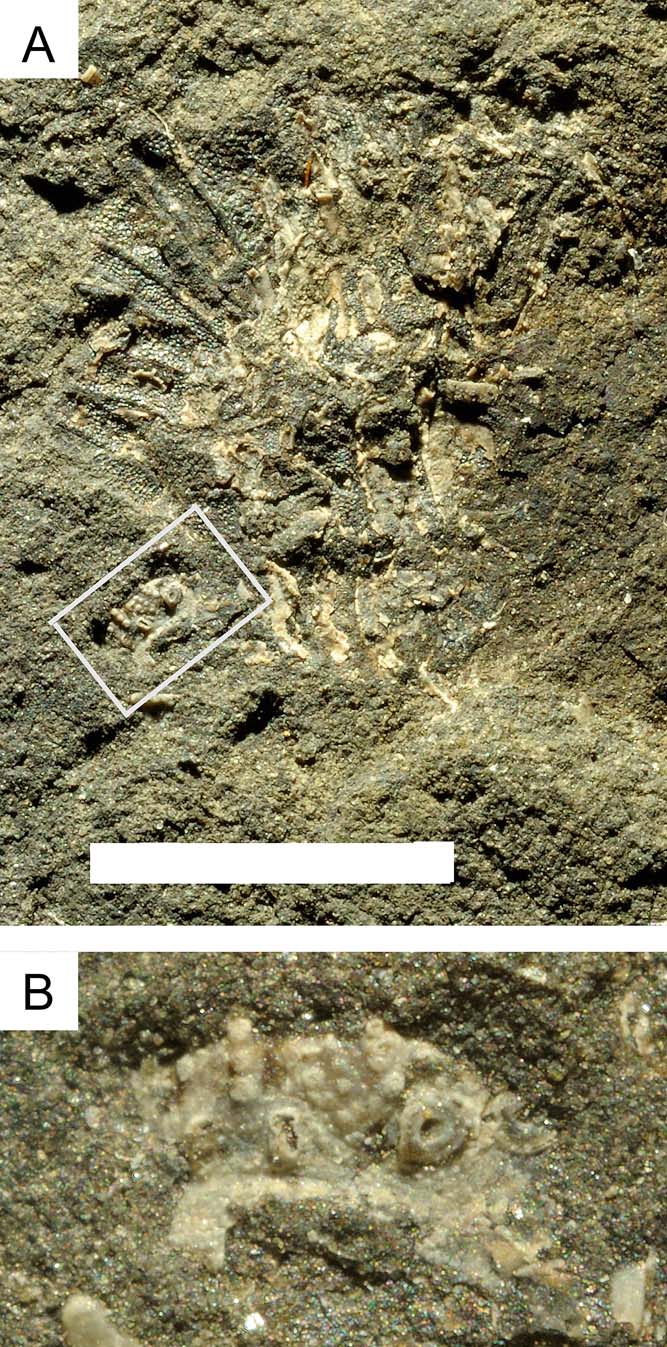
Pattonia couttsi Peach, Reference Peach1899 from the ‘Hosies Limestone' of East Kilbride, Lanarkshire was described as a ‘euphoberid myriapod'; however, from re-examination of the type specimen (NMS G.1887.25.1080), it appears to be a fish bromalite (cololite or coprolite) (see Fig. 2, compare with images and descriptions in Hunt et al. Reference Hunt, Milàn, Lucas and Spielmann2012). It is three-dimensional, phosphatic and the ‘segments' are irregular and of variable thickness. Peach (Reference Peach1899) described limbs that had been “broken off from the segments”, and these appear to be arthropod limbs (see Fig. 2, top right). Those and other fragments are most likely to be crustacean remains that just happen to be lying close to the bromalite. There are four Hosie Limestone horizons (Main, Mid, Second and Top) in the Lower Limestone Formation of Viséan (Brigantian) age (Clough et al. Reference Clough, Hinxman, Wilson, Crampton, Wright, Bailey, Anderson, Carruthers, Grabham, Flett, Lee, MacGregor and Dinham1925; Hall et al. Reference Hall, Browne and Forsyth1998); however, the specimen is preserved in a dark grey shale so probably came from a bed in between.
Pattonia couttsi Peach, Reference Peach1899. Holotype, NMS G. 1887.25.1080; East Kilbride, Lanarkshire. Originally described as a euphoberiid myriapod; however, it is a fish bromalite. Scale bar = 5 mm.

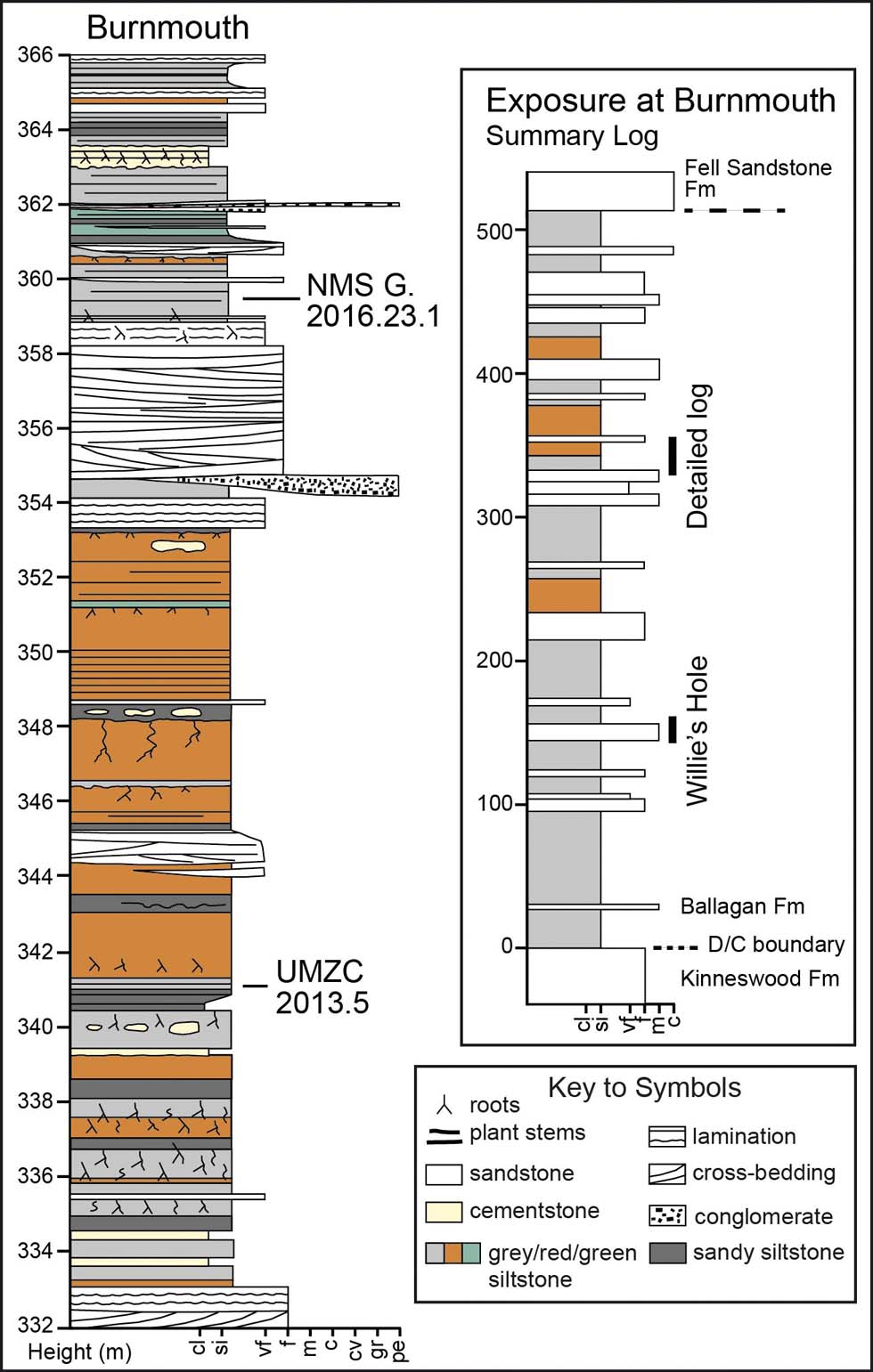
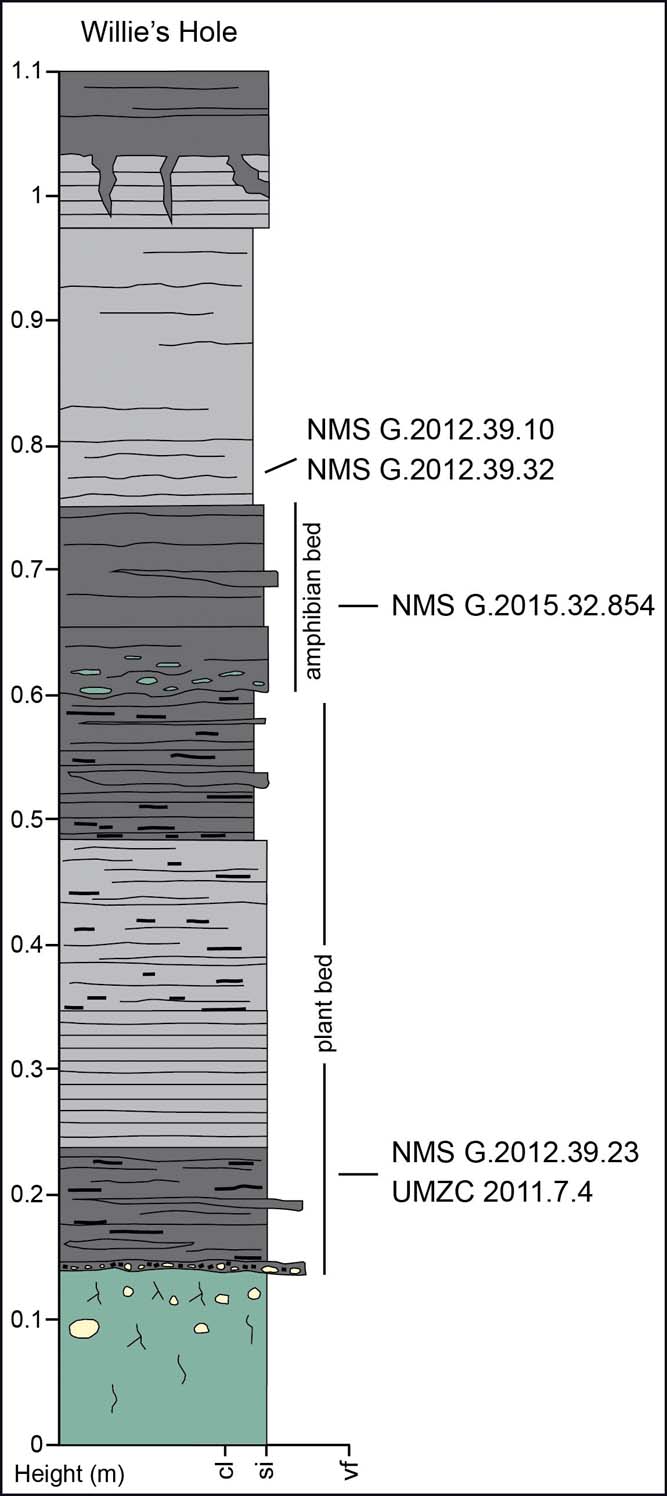
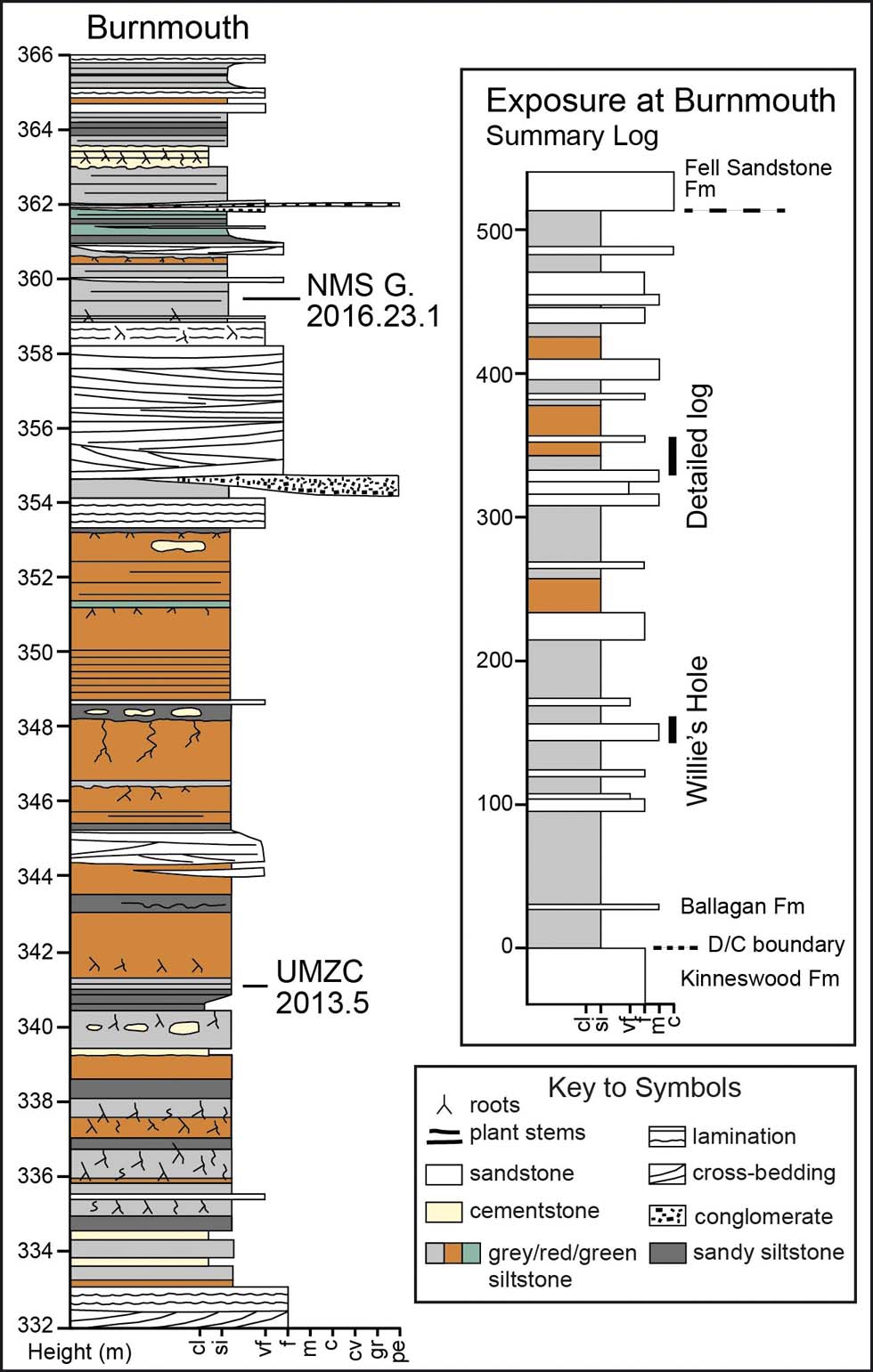
A new fauna of millipedes has been discovered in the Tournaisian (Courceyan) of the Ballagan Formation of the Scottish Borders. It was discovered by the late Stan Wood, who was primarily searching for tetrapod fossils. Seven specimens are known: five from Willie's Hole, River Whiteadder, Chirnside and two from Burnmouth on the east coast. Stratigraphic logs of Burnmouth and Willie's Hole showing the myriapod horizons can been seen in Figures 3 and 4.
Stratigraphic logs of the exposure of the Ballagan Formation at Burnmouth, showing the horizons from which diplopod specimens were collected. The stratigraphical position of the succession at Willie's Hole is inferred from a nearby borehole (Hutton Hall Barns, BGS Registered number NT85SE1: base proved at depth of 142.5 m) to be about 150 m above the base of the formation.
Detailed stratigraphic log of the section at Willie's Hole, River Whiteadder, Chirnside, showing the horizons from which diplopod specimens were collected. Section measured during an excavation organised by National Museums Scotland in the summer of 2015.

Wood found four specimens at Willie's Hole; a sketch log he produced and his notes indicated the horizons from which his specimens came. The fifth specimen from Willie's Hole was collected on a three-week excavation in the summer of 2015, organised by National Museums Scotland. A barrier was erected in the river bed and the area was drained and the water was pumped out to access the fossiliferous beds. The excavation yielded numerous vertebrate, arthropod and plant fossils which are currently under study. The lowest millipede horizon (a plant-rich grey mudstone) also yielded eumalacostracans, spinicaudatans, ostracods and a small scorpion, and this may correlate with the ‘Willie's Hole Shrimp Bed' logged by Cater et al. (Reference Cater, Briggs and Clarkson1989). At this locality they recorded Pseudotealliocaris, ostracods, scorpion and eurypterid remains. However, there are some differences in that we did not see any part of the section ‘bleed liquid hydrocarbons', the malacostracan remains we encountered were dark grey/brown, not ‘red-brown' and they recorded an ‘allochthonous coal' below the Shrimp Bed. Although there were abundant plant remains, the biggest concentration of plants was in a black shale above the millipede horizon at the top of the plant bed (at 0.5–0.6 m in Figure 4). The differences could possibly be explained by lateral variation and this was observed in the ‘amphibian bed' along a few metres in the excavation. The ‘red-brown' crustaceans could have been more weathered than the ones we found. One of the Burnmouth diplopods was found on a field-trip that formed part of the 7th International Conference on Fossil Insects, Arthropods and Amber, held in Edinburgh in 2016 (Ross Reference Ross2018). The specimens are held at National Museums Scotland (NMS) or University Museum of Zoology Cambridge (UMZC). Stan Wood gave his own numbers to the specimens he found (pre-fixed WOOD).
All the new diplopod specimens are different from Anthracodesmus macconochiei of the same age and formation, in that A. macconochiei has a distinct ornament of tessellated polygonal tubercles. It appears that six different species are present, but only one of them is complete enough to enable formal description. Most can be placed in the Infraclass Helminthomorpha, except for one which is incertae sedis. Although the helminthomorph fossils do not demonstrate the main character of males having one or two pair(s) of legs on the 7th or 8th segments modified into gonopods, their diplotergites are demarcated into prozonite and metazonite, which rules out other taxa. Although they are similar to other members of the extinct Superorder Archipolypoda, at least one does not possess paranota, which requires an emendation to the diagnosis of this group (see below).
An additional specimen from Willie's Hole (UMZC 2011.7.3, part & counterpart) was figured as a myriapod by Smithson et al. (Reference Smithson, Wood, Marshall and Clack2012, fig. 5C). However, re-examination has shown that it is a lycopod cone, the cone axis and scales being clearly visible.
AJR compiled the paper and undertook the primary study of the specimens, GDE and NC contributed to the descriptions and discussion, CEB produced the stratigraphy logs, VC and RB undertook preparation and conservation work, and BC took the photographs.
1. Systematic palaeontology
Class Diplopoda Blainville in Gervais, Reference Gervais1844
Subclass Chilognatha Latreille, Reference Latreille1802–03
Infraclass Helminthomorpha Pocock, Reference Pocock1887
Superorder Archipolypoda Scudder, Reference Scudder1882
Emended diagnosis. Modified from Wilson & Anderson (Reference Wilson and Anderson2004). Ocellarium with numerous ocelli in multiple rows; collum small; diplotergites with distinct division into prozonite and metazonite; two free sternites per diplotergite with pair of paramedian pores. Modified legs on trunk segment eight.
Remarks. The clear absence of paranota in Woodesmus sheari gen. et sp. nov. (see below) is unlike other Palaeozoic flat-backed millipedes. If the diagnosis of the Archipolypoda as given by Wilson & Anderson (Reference Wilson and Anderson2004) were followed, then this species would have to be excluded from the group. However, given that it possesses other archipolypodan characters, as well as some characters shared with members of the order Archidesmida, it seems prudent to remove the presence of paranota from the diagnosis of the Archipolypoda.
Order Archidesmida Wilson & Anderson, Reference Wilson and Anderson2004
Diagnosis. See Wilson & Anderson (Reference Wilson and Anderson2004).
Gen. & sp. indet. 1
(Fig. 5)
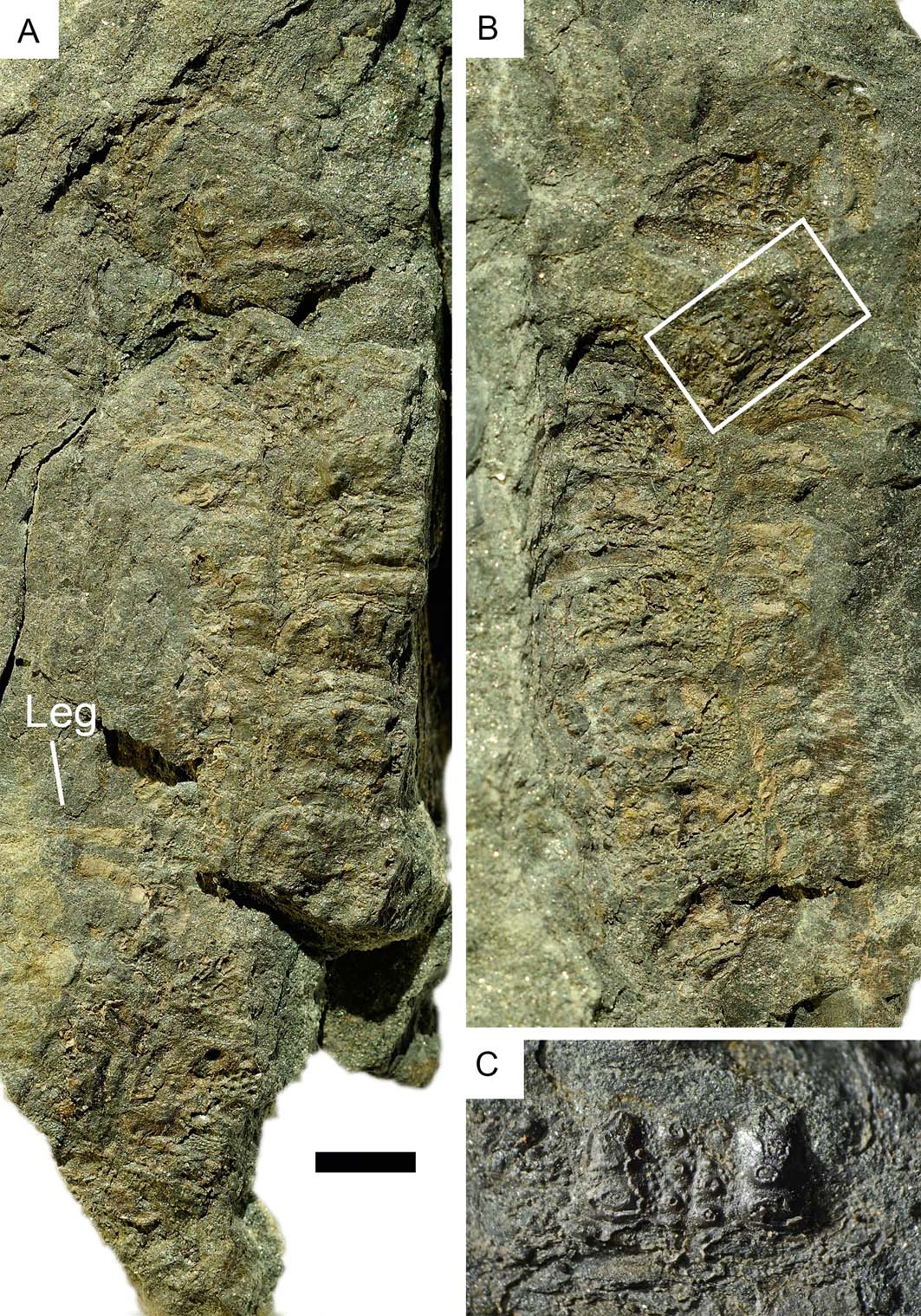
Archidesmida, gen. et sp. indet. 1, UMZC 2013.5 (Burnmouth; Wood Coll.): (A) part; (B) counterpart; (C) close-up of overturned tergite marked by box in (B). Scale bar = 5 mm.

Material. Specimen UMZC 2013.5 (WOOD 4267A, B) (part & counterpart) in a grey laminated micaceous siltstone. Burnmouth, Scottish Borders, Scotland. Collected by Stan Wood in September 2007.
Description. Dorso-ventrally flattened. Preserved length ∼70 mm (including disarticulated pleurotergites), preserved width 12 mm, estimated width 25 mm. At least seven incomplete pleurotergites preserved, maximum length 6 mm, divisible into prozonite and metazonite, with paranota. Five of the pleurotergites are articulated, though only the left part of each is visible, which is densely tuberculate plus finely tuberculate paranota. The ornament is more apparent in the counterpart (Fig. 5B) than the part (Fig. 5A). Two of the pleurotergites are disarticulated and one has been flipped over (Fig. 5C), displaying what appears to be the middle; which has a longitudinal median sulcus lined by small tubercles which are asymmetric, then with two elongate bosses with three or four large tubercles. However, the bosses with large tubercles are not entirely symmetrical, so there is the possibility that this is not the middle of the pleurotergite. The large and small tubercles are surrounded by very small tubercles. Part of one, possibly two, leg(s) are preserved, but without detail.
Remarks. The presence of tuberculate pleurotergites with a median sulcus and paranota enables placement within the Archidesmida. The specimen appears to have unique ornamentation, but it is not possible to view an entire pleurotergite; thus it has not been formally named.
Order incertae sedis
Family Woodesmidae Ross, Edgecombe & Clark fam. nov.
Diagnosis. Dorso-ventrally flattened. Tuberculate diplotergites with complete longitudinal median sulcus. Paranota absent.
Woodesmus Ross, Edgecombe & Clark gen. nov.
Etymology. After the late Stan Wood, collector of most of the specimens in this paper.
Diagnosis. Metazonite coarsely tuberculate with four large longitudinally ovate tubercles, two either side of the median sulcus and two near the lateral edges; most other tubercles smaller, rounded. Shallow transverse furrow dividing metazonite into two bands. Terminal tergite subtriangular.
Type species. Woodesmus sheari Ross, Edgecombe & Clark sp. nov.
Woodesmus sheari Ross, Edgecombe & Clark sp. nov.
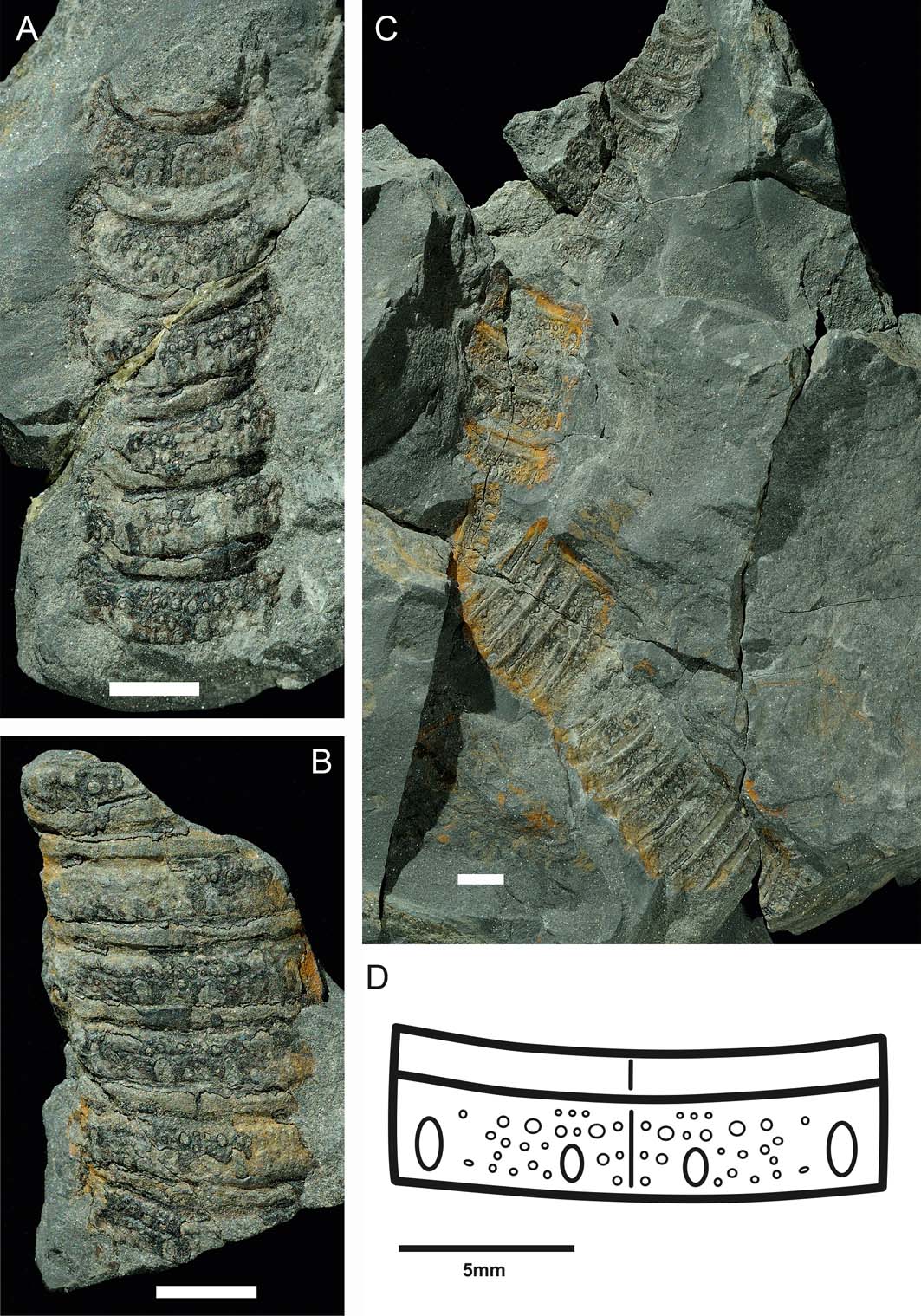
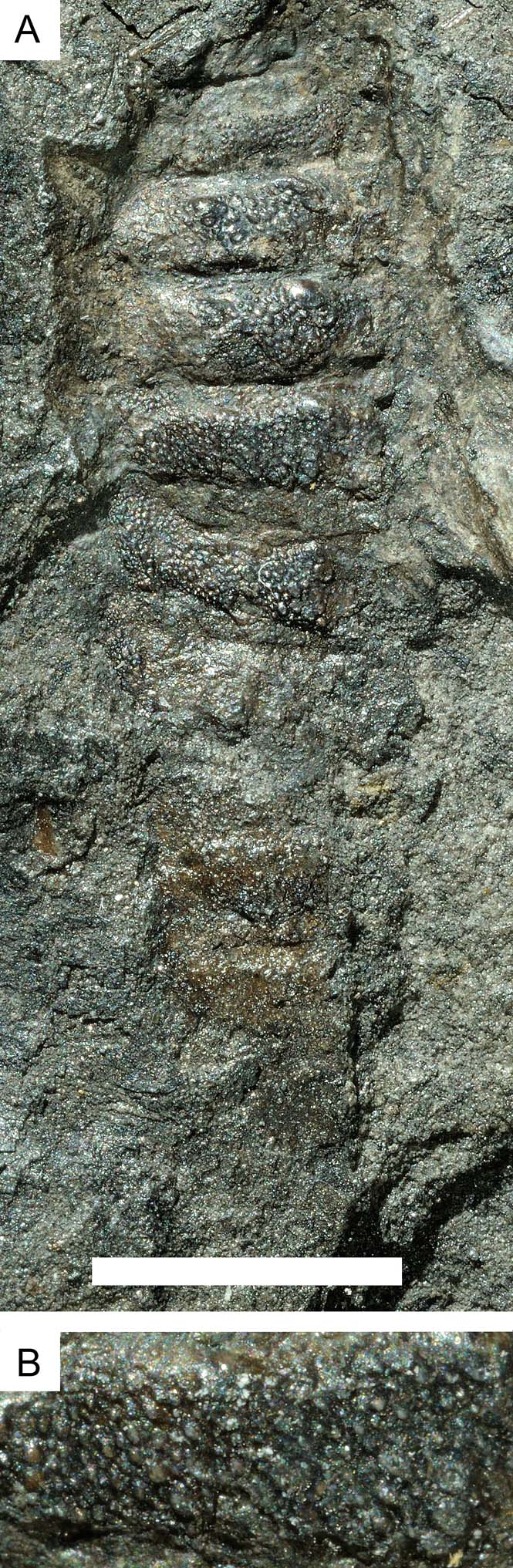
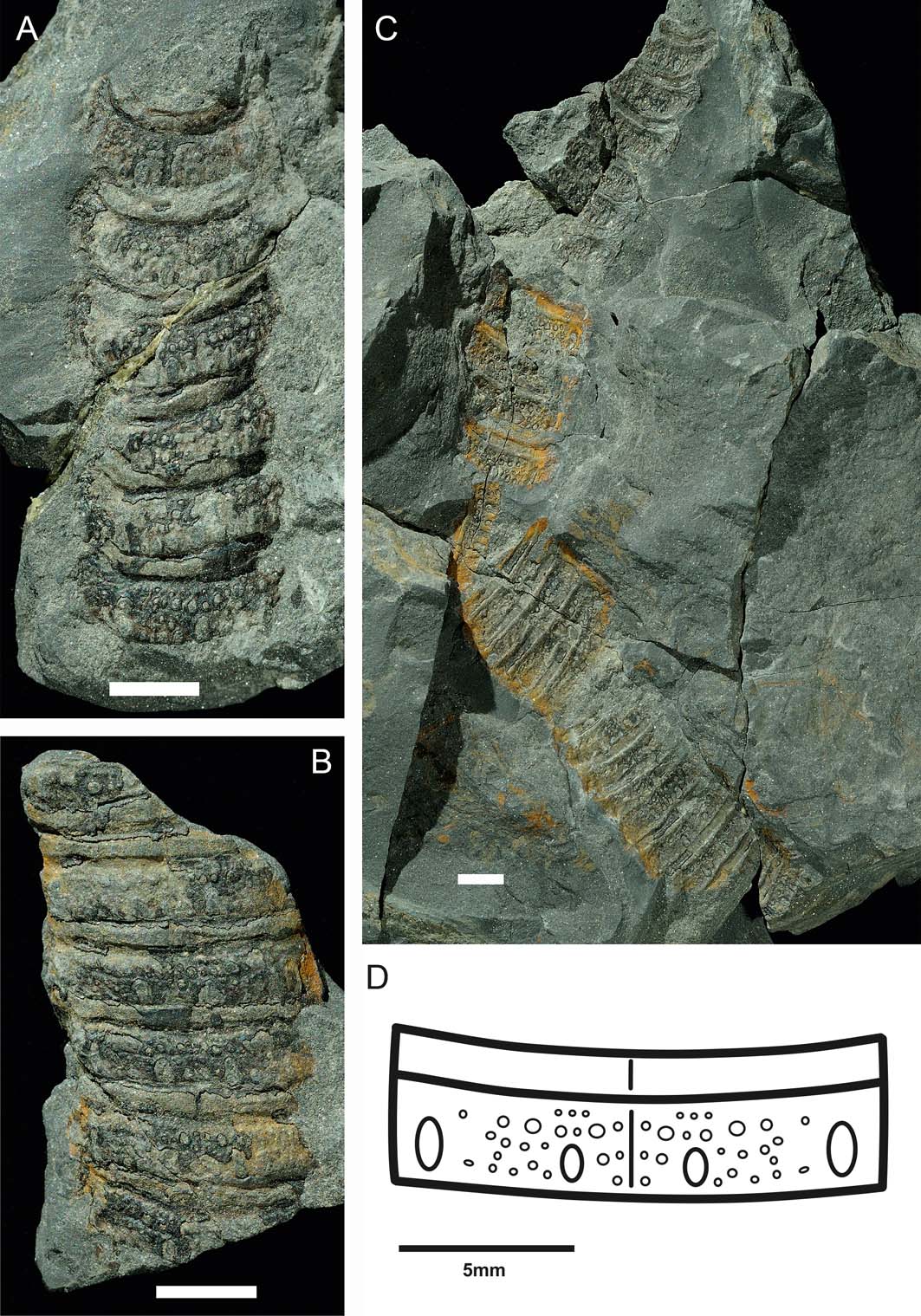
Woodesmidae, Woodesmus sheari Ross, Edgecombe & Clark gen. et sp. nov., holotype, NMS G. 2012.39.10 (Willie's Hole, Chirnside; Wood Coll.): (A) anterior piece of part; (B) posterior piece of part; (C) counterpart; (D) line drawing of one diplotergite, showing position of tubercles, based on (B). Scale bars = 5 mm.
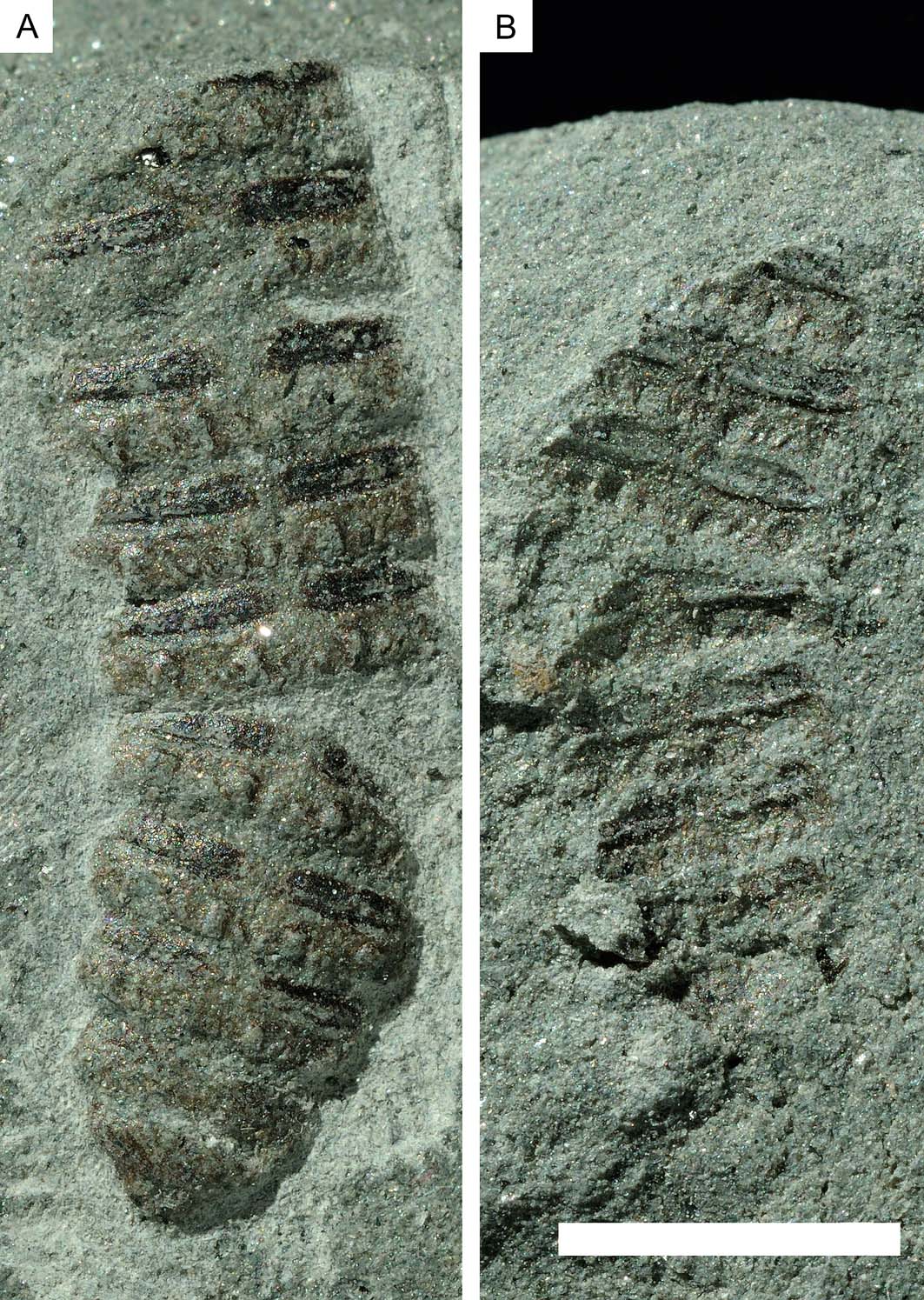
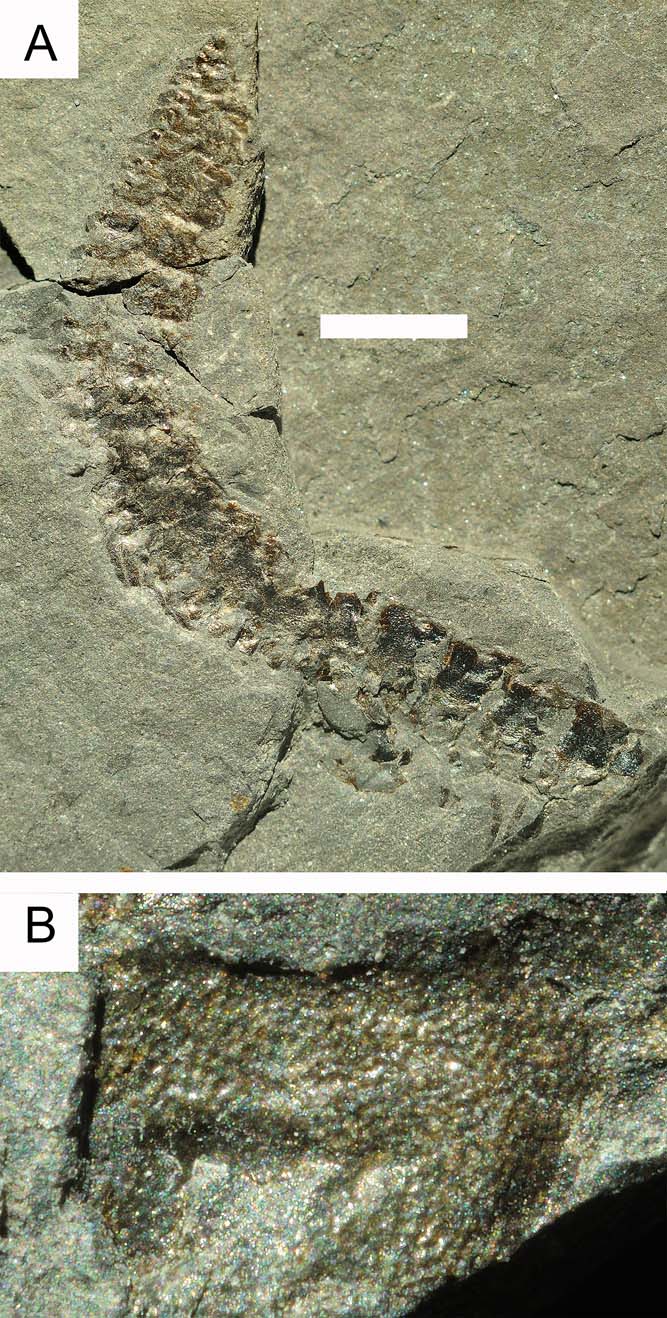
Woodesmidae, Woodesmus sheari Ross, Edgecombe & Clark gen. et sp. nov., paratype, NMS G.2016.23.1 (Burnmouth): (A) part; (B) counterpart. Scale bar = 5 mm.

2012 Myriapod. Smithson et al., p. 4534, fig. 5A.
Etymology. After William A. (Bill) Shear, eminent myriapod researcher, for his work on fossil millipedes.
Diagnosis. As for genus.
Holotype. NMS G. 2012.39.10 (WOOD G762A, B1–3) (part in three pieces & counterpart) in a dark grey silty mudstone. Willie's Hole, Whiteadder Water, Chirnside, Scottish Borders. Ballagan Formation (Tournaisian). Collected by Stan Wood.
Paratype. NMS G. 2016.23.1 (part & counterpart) in a blue-grey micaceous siltstone. Burnmouth, Scottish Borders. Ballagan Formation (Tournaisian). Collected by Alexey Bashkuev (part) and Wolfgang Zessin (counterpart) on the 7th International Conference on Fossil Insects, Arthropods and Amber excursion, 1 May 2016.
Description. Flat-backed millipede. Tergites divisible into smooth prozonite and tuberculate metazonite. Longitudinal median sulcus strongly impressed on prozonite and metazonite. Metazonite divided by shallow transverse sulcus into shorter anterior band and longer posterior band. Metazonite coarsely tuberculate with four large longitudinal tubercles near to posterior edge, two near median sulcus and two near lateral edge; tubercles on anterior part of metazonite (anterior to transverse furrow) round, arranged as irregular band(s) one or two deep (see Fig. 6B, D). Paranota absent. No legs preserved.
Holotype with body broken in middle (Fig. 6C). Preserved length (straightened) ∼110 mm, maximum width 16 mm. Twenty-three diplotergites preserved, maximum length 5 mm.
Paratype. Preserved length 17 mm, maximum width 5.5 mm. Nine trunk diplotergites preserved, maximum length 1.8 mm, plus terminal posterior tergite of length 2.5 mm, width 2.8 mm.
Remarks. The ornamentation, particularly the enlarged, longitudinally ovate tubercles on the metazonite, is unique. It is interesting that the anterior segments (Fig. 6A) are much more curved in the holotype than the posterior segments and they are not raised (more 3-D) than the posterior segments (Fig. 6B). This is probably due to taphonomic processes rather than to them being this way in life. The break in the middle, which does not show any internal structures, suggests the specimen is a moult. On the posterior diplotergites, more small tubercles may be present towards the lateral margins, but are but not visible on the specimen. The paratype is much smaller than the holotype and is therefore probably a juvenile. Although it is less well preserved due to the coarser matrix, it shares the same four large longitudinal tubercles.
The tuberculate tergites with a median sulcus are reminiscent of members of the Order Archidesmida (see comparison with Zanclodesmidae below), except for the absence of the paranota; thus, a new family is erected for archipolypodans that lack paranota. Presence or absence of paranota can be variable at fine taxonomic levels in some extant millipede clades (see, for example, Mesibov (Reference Mesibov2014) for variability within a single species in Polydesmida) but their presence has been consistently observed in the Archidesmida. Erecting a new order based only on the absence of paranota would be a step too far without a combination of other unique characters. Alternatively, the diagnosis of Archidesmida could be changed to remove the presence of paranota; however, it is not known if Woodesmus had modified anterior legs on trunk segment eight or if it had a small head, so the diagnosis of the Archidesmida is left unchanged and the family Woodesmidae is placed in order incertae sedis.
Woodesmus shares two distinctive apomorphic characters with the archidesmid family Zanclodesmidae, described based on two monotypic genera from the Upper Devonian of North America (Wilson et al. Reference Wilson, Daeschler and Desbiens2005). These are a complete median sulcus or furrow spanning the length of the prozonite and the metazonite, and the division of the metazonite lengthwise into two sections. In Zanclodesmidae, these are defined as two rows of raised bosses, whereas in Woodesmus, similarly proportioned anterior and posterior bands on the metazonite are delineated by a furrow. In the absence of sternites (which bear large pores in Archipolypoda), the superordinal assignment is made based on likely affinities to Zanclodesmidae and Archidesmidae, the latter also sharing a bilobate metazonite (Wilson et al. Reference Wilson, Daeschler and Desbiens2005). Woodesmus is excluded from Zanclodesmidae based on its undivided prozonite (this being bisected by a transverse furrow in zanclodesmids) and by the absence of paranota.
Order and family incertae sedis
Gen. & sp. indet. 2
(Fig. 8)
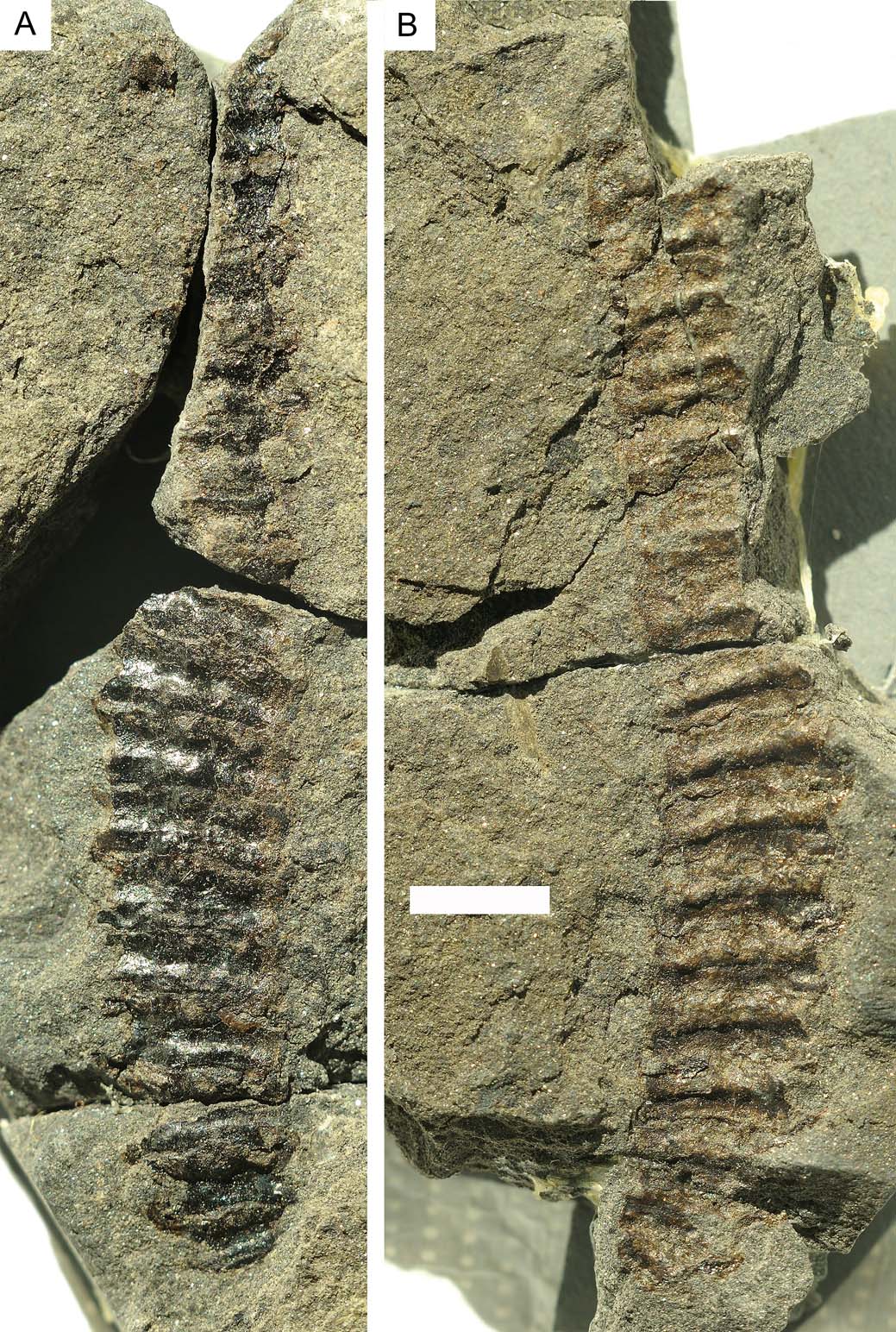
Archipolypoda, gen. et sp. indet. 2, NMS G. 2012.39.23 (Willie's Hole, Chirnside; Wood Coll.): (A) part; (B) counterpart. Scale bar = 5 mm.

Material. Specimen NMS G. 2012.39.23 (WOOD G786A, B) (part & counterpart) in a grey laminated micaceous siltstone. Willie's Hole, Whiteadder Water, Chirnside, Scottish Borders. Ballagan Formation (Tournaisian). Collected by Stan Wood in 2010.
Description. Dorso-ventrally flattened, body slightly curved. Length 45 mm preserved; width 7 mm preserved. Seventeen tergites, maximum length 3 mm, divided into prozonite and metazonite, with broad central longitudinal ridge and fine tuberculate ornament. Short paranota may be present. No legs preserved.
Remarks. The broad longitudinal ridge and fine ornament demonstrate that this specimen is different from the other specimens and belongs to a different taxon. It is preserved in a layer of silt so the preservation is poor, and it is uncertain whether it possesses paranota, so it is not classified or described further.
Gen. & sp. indet. 3
(Fig. 9)
Archipolypoda, gen. et sp. indet. 3, NMS G. 2015.32.854 (Willie's Hole, Chirnside; collected in 2015 on NMS-organised excavation): (A) part; (B) close-up of ornament on 4th tergite from top in (A). Scale bar = 5 mm.

Material. Specimen NMS G. 2015.32.854 in a dark grey sandy siltstone (Bennett et al. 2016) from within the ‘amphibian bed'. Willie's Hole, Whiteadder Water, Chirnside, Scottish Borders. Ballagan Formation (Tournaisian). Collected on an excavation organised by National Museums Scotland in 2015.
Description. Dorso-ventrally flattened. Length 17 mm preserved; width 5 mm preserved. Eight diplotergites, length 2 mm, divided into prozonite and metazonite, with dense tuberculate ornament (see Fig. 9B). Most tubercles are small, with up to three large tubercles visible per segment. No symmetry is observed, which implies that not all of the tergite is visible and their orientation (anterior or posterior end?) is difficult to ascertain. Not possible to determine if paranota are present or absent. No legs preserved.
Remarks. The dense ornament is different from the other specimens and thus it belongs to a different taxon. It is not possible to ascertain whether it has paranota or not as further preparation risks damaging the specimen. Its fragmentary nature prevents formal description and further classification.
?Superorder Juliformia Attems, Reference Attems1926
Order incertae sedis
Gen. & sp. indet. 4
(Fig. 10)
Juliformia, gen. et sp. indet. 4, NMS G. 2012.39.32a (Willie's Hole, Chirnside; Wood Coll.): (A) part; (B) close-up of ornamented tergite marked by box in (A). Scale bar = 5 mm.

Material. Specimen NMS G. 2012.39.32 (WOOD G763A, B) (part & counterpart) in a dark grey laminated micaceous siltstone with pyrite. Willie's Hole, Whiteadder Water, Chirnside. Ballagan Formation (Tournaisian). Collected by Stan Wood.
Description. Small incomplete body, curled up. Number of tergites hard to count, width approx. 3 mm, tergite length uncertain, divisible into prozonite and metazonite. Metazonite with fine, even tuberculate ornament, though coarser on one detached tergite (Fig. 10B). Paranota or pleurites absent. No legs preserved.
Remarks. The curled nature of the body indicates it would have been a cylindrical millipede, rather than a flat-backed one. The lack of pleurites indicates likely membership in the Juliformia rather than the Pleurojulida (see Wilson Reference Wilson2006; Wilson & Hannibal Reference Wilson and Hannibal2005). The detached tergite with coarser ornament may be from the anterior end of the animal. This specimen is hard to interpret however the fine even tuberculate ornament is very similar to that of a much larger cylindrical-bodied millipede from East Kirkton, West Lothian of Viséan age. The East Kirkton specimen (NMS G. 1992.21.1) was described and figured by Shear (Reference Shear1994, fig. 5), but not named.
Infraclass incertae sedis
Gen. & sp. indet. 5
Incertae sedis, gen. et sp. indet. 5, UMZC 2011.7.4a (Willie's Hole, Chirnside; Wood Coll.): (A) part; (B) counterpart, close-up of ornament on most posterior tergite. Scale bar = 5 mm.

2012. Myriapod. Smithson et al., p. 4534, fig. 5B.
Material. Specimen UMZC 2011.7.4a, b (WOOD G788A, B) (part & counterpart) in a dark grey mudstone with silt laminae. Willie's Hole, Whiteadder Water, Chirnside, Scottish Borders. Ballagan Formation (Tournaisian). Collected by Stan Wood in 2010.
Description. Dorso-ventrally flattened, body curved. Length ∼37 mm preserved; width 5 mm preserved. Eighteen tergites preserved with very fine tuberculate ornament (Fig. 11B). Several legs preserved, clearly two pairs per body segment.
Remarks. The presence of two pairs of legs per body segment demonstrates its diplopod status. The tergites are difficult to interpret and it is uncertain whether they are divisible into prozonite and metazonite, or whether paranota are present. The very fine tuberculate ornament certainly demonstrates that it is different from the other diplopods from the Tournaisian of the Scottish Borders; however, the lack of more characters precludes further classification and description.
2. Discussion
Until recently, very few terrestrial vertebrate fossils were known from the Tournaisian and this dearth had been given the name ‘Romer's Gap' after the vertebrate palaeontologist Alfred Sherwood Romer, who first noted it. Ward et al. (Reference Ward, Labandeira, Laurin and Berner2006) noticed that there was also a lack of terrestrial arthropods at this time (they incorrectly considered Anthracodesmus to be Viséan in age). They attributed the apparent absence to low atmospheric oxygen levels rather than to “a taphonomic artefact or period of undersampling.”
The new material from the Ballagan Formation of the Scottish Borders, although fragmentary in nature, clearly demonstrates a high diversity of millipedes living on land during the Tournaisian. Six different forms are present and five of them are based on only one specimen, which implies that further finds could belong to yet more different forms. This new material, along with an associated diverse terrestrial tetrapod fauna (Clack et al. Reference Clack, Bennett, Carpenter, Davies, Fraser, Kearsey, Marshall, Millward, Otoo, Reeves, Ross, Ruta, Smithson, Smithson and Walsh2016), supports Smithson et al. (Reference Smithson, Wood, Marshall and Clack2012)'s view that the gap was due to a lack of collecting, reflecting a paucity of exposures of terrestrial deposits of earliest Carboniferous age, rather than low oxygen levels at that time.
The only other place to have yielded a diverse tetrapod fauna of Tournaisian age is at Blue Beach, Horton Bluff, Nova Scotia, Canada (Anderson et al. Reference Anderson, Smithson, Mansky, Meyer and Clack2015). Diplopod trackways are known from Blue Beach and an intriguing segmented fossil from there has been described as a possible diplopod (Lerner et al. Reference Lerner, Mansky, Lucas, Lucas, DiMichele, Barrick, Schneider and Spielmann2013; Mansky & Lucas Reference Mansky, Lucas, Lucas, DiMichele, Barrick, Schneider and Spielmann2013); however, this interpretation is unconvincing. Neither ornament nor legs are present and the segments do not show a demarcation into prozonite and metazonite. The authors interpret ridges as the segment margins; however, the ridges are longer than the rest of the segment. They tentatively speculate that several large lateral extensions on one side are spines; but if so, these should occur on every segment, which does not appear to be the case. The Horton Bluff Formation contains a diverse trace fossil fauna (Mansky & Lucas Reference Mansky, Lucas, Lucas, DiMichele, Barrick, Schneider and Spielmann2013) and this seems a more likely explanation for the identity of this specimen.
Although the new material from the Scottish Borders clearly demonstrates a high diversity of diplopods during the earliest Carboniferous, the incomplete nature of the specimens does not add any information on the phylogeny of the group as summarised by Shear & Edgecombe (Reference Shear and Edgecombe2010). Unfortunately, the form of their heads and reproductive parts is not known and it is not possible to estimate how many body segments they had, nor their full length.
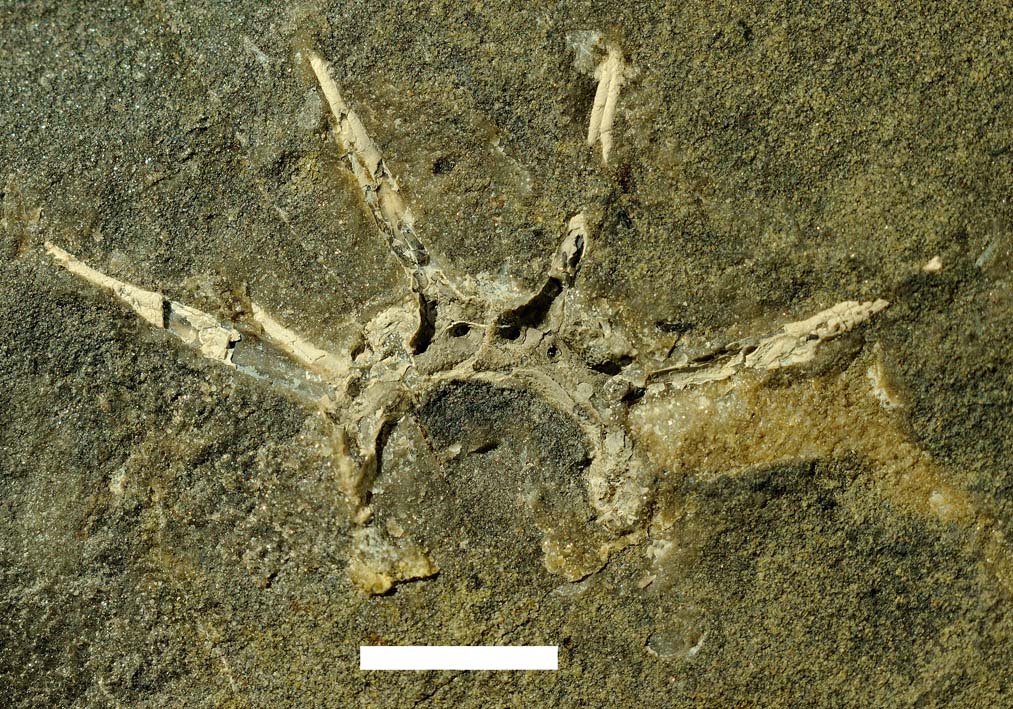
Millipedes are terrestrial vegetarian detritivores, including the giant Arthropleura (Rolfe & Ingham Reference Rolfe1967), and the ones described here would have lived in a changeable floodplain environment with seasonal wet and dry periods (Kearsey et al. Reference Kearsey, Bennett, Millward, Davies, Gowing, Kemp, Leng, Marshall and Browne2016). The tetrapods from Willie's Hole and Burnmouth were mainly found in sandy siltstones that were deposited during times of high rainfall leading to flooding (Bennett et al. 2016). In contrast, most of the millipedes are from slightly finer grained lithologies at other horizons and their articulated nature suggests they were probably deposited in less dynamic conditions. The proximity of the millipede specimens at Burnmouth to palaeosols or rooted horizons (Fig. 2b) supports only minimal post-mortem transportation. Given that tetrapods had only just crawled out onto land at that time (Smithson et al. Reference Smithson, Wood, Marshall and Clack2012), millipedes could have been a ready food source. It is interesting to note that none of the forms known from the Tournaisian display spines such as those possessed by the later order Euphoberiida (single family Euphoberiidae), which likely developed the spines as a defence against tetrapod predators. The earliest undoubted record of defensive spines in myriapods is a single metazonite with four spines mentioned by Shear (Reference Shear1994) from the late Viséan of East Kirkton (NMS G. 1998.61.1 part & counterpart; Fig. 12). The lateral and subdorsal position of the spines confirms the placement of this specimen within the Euphoberiida: Euphoberiidae, as per the diagnosis in Wilson & Anderson (Reference Wilson and Anderson2004).
Euphoberiida. Euphoberiidae metazonite with defensive spines, NMS G. 1998.61.1a (East Kirkton, Bathgate). Scale bar = 5 mm.

Another form of defence against predation was to grow to a huge size, as in the Arthropleurida, and although a couple of the new specimens are large by today's standards, they are not anywhere near the size attained by Arthropleura. The earliest evidence of gigantism in myriapods is indicated by large Diplichnites cuithensis trackways (widest 46 cm) from the east coast of Fife, attributed to Arthropleura and of Viséan age (Pearson Reference Pearson1992).
3. Acknowledgements
Many thanks go to Maggie Wood for supplying horizon data for Stan Wood's specimens, and to Alexey Bashkuev (Palaeontological Institute, Moscow) and Dr Wolfgang Zessin (Jasnitz, Germany) for finding the Woodesmus sheari paratype. This paper is a contribution to the TW:eed Project (TetrapodWorld: early evolution and diversification: www.tetrapods.org) funded by the Natural Environment Research Council (NERC) Consortium Grant ‘The Mid-Palaeozoic biotic crisis: setting the trajectory of tetrapod evolution', led by Professor Jenny Clack (University Museum of Zoology, Cambridge), including National Museums Scotland (NE/J020621/1) and Leicester University (NE/J020729/1).