Introduction
Despite the innovations in therapeutic interventions, a substantial proportion of individuals with schizophrenia have a poor long-term outcome (Swartz et al. Reference Swartz, Perkins, Stroup, Davis, Capuano, Rosenheck, Reimherr, McGee, Keefe, McEvoy, Hsiao and Lieberman2007). Functional deficits, which involve social, occupational and independent living activities, are often responsible for high costs of care and impairment of quality of life. Regardless of symptom remission, many individuals will, after a first psychotic episode, have trouble taking up their social and occupational roles again. Research suggests that there is significant heterogeneity in the recovery trajectory in schizophrenia (Carpenter & Strauss, Reference Carpenter and Strauss1991). Therefore, the prognostic value of pre-morbid, sociodemographic, clinical and cognitive variables present at intake are of major interest, both for those who experience a first-episode of schizophrenia (FES) and for clinicians.
Meta-analytic reviews suggest that there is a relatively consistent relationship between cognitive impairment and functional outcomes in schizophrenia, both in cross-sectional (Green, Reference Green1996; Green et al. Reference Green, Kern, Braff and Mintz2000) and longitudinal (Green et al. Reference Green, Kern and Heaton2004) studies. When functional capacity measures are used (testing what the person can do under optimal conditions), neuro-cognitive measures predict a considerable amount of the variance while the role of symptoms is marginal (Velligan et al. Reference Velligan, Mahurin, Diamond, Hazleton, Eckert and Miller1997). However, in some studies measures of real-world functioning (social and vocational performance in the community) have shown to be more related to clinical variables, such as negative symptoms (Bowie et al. Reference Bowie, Reichenberg, Patterson, Heaton and Harvey2006; Revheim et al. Reference Revheim, Schechter, Kim, Silipo, Allingham, Butler and Javitt2006; Lasalvia et al. Reference Lasalvia, Bonetto, Cristofalo, Tansella and Ruggeri2007), disorganized symptoms (Norman et al. Reference Norman, Malla, Cortese, Cheng, Diaz, McIntosh, McLean, Rickwood and Voruganti1999) and depressive symptoms (Bowie et al. Reference Bowie, Reichenberg, Patterson, Heaton and Harvey2006), than to cognitive functioning. Discrepant results on the influence of cognition on functional recovery may be due not only to methodological diversity, but also to a number of shortcomings of the studies in this field, such as small sample sizes, mixed samples with different diagnoses or at varying stages of illness, failure to control for confounding factors, such as pre-morbid functioning, and a lack of a reliable and valid primary outcome measure.
In spite of the importance attributed to the first years of the illness (Birchwood et al. Reference Birchwood, Todd and Jackson1998), only a few studies have been conducted prospectively with first-episode cases. Some studies have found that better cognitive functioning predicted functional outcomes for the first years of the disease (Robinson et al. Reference Robinson, Woerner, McMeniman, Mendelowitz and Bilder2004; Milev et al. Reference Milev, Ho, Arndt and Andreasen2005; Holthausen et al. Reference Holthausen, Wiersma, Cahn, Kahn, Dingemans, Schene and van den Bosch2007). Yet, other follow-up studies carried out on FES have reported a lack of association between cognitive variables and occupational outcome (Johnstone et al. Reference Johnstone, Macmillan, Frith, Benn and Crow1990; Verdoux et al. Reference Verdoux, Liraud, Assens, Abalan and van Os2002). Overall, the studies have explanatory purposes; they aimed to examine correlations of cognitive variables and specific functional outcomes. When found, these correlations explain a small to moderate amount of total variance (up to 30%). Thus, it remains to be seen whether these associations are relevant for predicting which cases will have a global functional recovery in FES. This issue is of primary concern for researchers and practitioners, as the development of new treatments largely depends on addressing the factors that influence good outcome.
In this article we attempt to determine whether cognitive variables help to predict which patients will achieve a global (i.e. occupational and social) functional recovery after controlling for other potential predictors of good outcome.
Method
Participants
The study participants were part of a cohort of consecutive admissions with a first-episode non-affective psychotic disorder from the Cantabria Intervention Programme of First-Episode Psychosis (PAFIP) from February 2001 to February 2005. The PAFIP is located at the University Hospital ‘Marqués de Valdecilla’, Santander, Spain. Inclusion criteria for the present study were as follows: age between 15 and 50 years; DSM-IV criteria for diagnosis of schizophrenia or schizophreniform disorder; never treated with antipsychotic medication; living in the catchment area; providing written informed consent. Exclusion criteria were a history of neurological disease, head injury, mental retardation (DSM-IV criteria) or drug dependence (DSM-IV criteria).
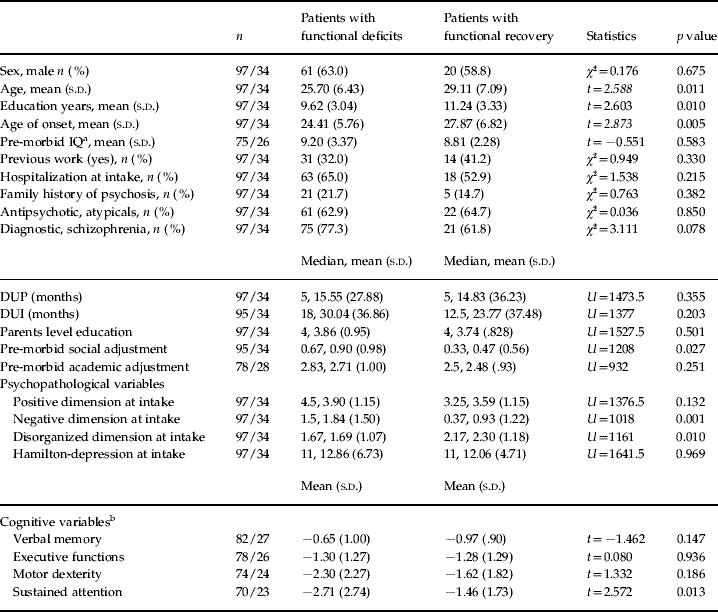
The original sample included 174 individuals with first-episode psychosis, of whom 141 participants had a confirmed diagnosis of schizophrenia or schizophreniform disorder, but 10 participants were excluded from analyses in this study due to missing functional outcome data at 1-year follow-up, leaving a final sample of 131 participants (93% retention rate) with a diagnosis of FES (n=96) or schizofreniform disorder (n=34). All diagnoses were confirmed 6 months after study entry using the Structured Clinical Interview for DSM-IV (First et al. Reference First, Spitzer, Gibbon and Williams1995) by a trained clinician. The majority of participants were male (62%). The mean age of the sample was 26 years and the mean education was 10 years. All patients were randomly assigned to haloperidol, olanzapine or risperidone (Crespo-Facorro et al. Reference Crespo-Facorro, Perez-Iglesias, Ramirez-Bonilla, Martinez-Garcia, Llorca and Vazquez-Barquero2006). A total of 83 participants (63%) were prescribed a second generation antipsychotic medication. Table 1 shows baseline demographic, clinical and cognitive characteristics of patients with functional recovery and with functional deficits after the first year of treatment. This study was approved by the Ethics Committee of the University Hospital ‘Marqués de Valdecilla’ and written informed consent was obtained from all participants or their legal representative.
Baseline demographic, clinical and cognitive characteristics

s.d., Standard deviation; DUP, duration of untreated psychosis; DUI, duration of untreated illness.
a Pre-morbid Intelligence Quotient (IQ) scores estimated from the Wechsler Adult Intelligence Scale-III Vocabulary subtest.
b Neuropsychological assessments were carried-out after clinical stabilization 10.58±3.98 weeks after antipsychotic treatment initiation.
Functional status
Functional status was determined at 1-year follow-up by collecting information from multiple sources. The patients and their relatives were assessed by a psychiatrist and a social worker independently. Information was gathered in order to know if the patient was in full or part-time work or at school as well as how each of the patients was performing at work or school compared with pre-morbid performance (i.e. better, worse or the same as before the onset of the illness). The comparison of pre-morbid level with current performance at school or work was based on a global impression of the raters, who were responsible for structured assessment of pre-morbid functioning and 1-year follow-up functional level. In addition, for rating social disability we used the global disability item from the Spanish version of Disability Assessment Schedule (DAS; Mañá et al. Reference Mañá, Ivorra and Girón1998). The DAS evaluates the ability of the subjects to carry out particular social roles normally expected of them in their environment. Ratings were based on the clinician's judgement of the information obtained from the patient, relatives, case notes and observation of the patient during the previous month. The global disability item has a score range of 0 (no disability) to 5 (gross disability); scores of 1 indicate a ‘minimal disability’, scores of 2 and above indicate obvious disability or worse (Mañá et al. Reference Mañá, Ivorra and Girón1998), with a consensus being reached between the psychiatrist and the social worker. Combining the above criteria, functional status was dichotomized as ‘functional recovery’ and ‘functional deficits’. Functional recovery indicated that the patient was currently in part-time or full-time work or study, with the same or better level of performance as before the psychotic episode and, at most, with a minimal social disability (scores of 0 or 1 in the DAS) (see Fig. 1). Patients not fulfilling these criteria were classified as patients with ‘functional deficits’.
Determining functional recovery at 1-year follow-up. DAS, Disability Assessment Schedule.

Pretreatment variables
The following measures were used to assess clinical status at study entry: the presence of positive and negative psychotic symptoms was assessed by the Scale for the Assessment of Positive Symptoms (SAPS; Andreasen, Reference Andreasen1983) and the Scale for the Assessment of Negative Symptoms (SANS; Andreasen, Reference Andreasen1981). In line with previous studies, we divided psychopathology into three dimensions (negative, positive and disorganized), which were calculated using sums of global scores from the SANS/SAPS (Grube et al. Reference Grube, Bilder and Goldman1998). The positive symptom dimension was the sum of global scores for hallucinations and delusions. The negative symptom dimension score was the sum of global scores for alogia, affective flattening, avolition–apathy and anhedonia–asociality. The disorganized symptom dimension comprised the global scores of positive formal thought disorder, disorganized/ bizarre behaviour and inappropriate affect. Depressive symptoms were assessed using the Hamilton Depression Scale (Miller et al. Reference Miller, Bishop, Norman and Maddever1985). All clinical measures were obtained at the first contact with the treating psychiatrist.
The Premorbid Adjustment Scale was used to evaluate pre-morbid functioning (Cannon-Spoor et al. Reference Cannon-Spoor, Potkin and Wyatt1982). In order to focus on early adjustment and given the high number of missing values for the adulthood period (because participants were already exhibiting psychotic features in that age period), we created composite scores for social and academic domains based only on the first three areas of development [i.e. childhood and (early and late) adolescence]. Reports from the patient and a key relative who knew the patient's pre-morbid development and behaviour were considered.
Age of onset of psychosis was defined as the age at which the emergence of the first continuous (present most of the time) psychotic symptom (hallucinations, delusions, bizarre behaviour, formal thought disorder or inappropriate affect) appeared.
Duration of untreated psychosis (DUP) was defined as the time from the first continuous psychotic symptom corresponding to a score of 4 or more on one of the SAPS items to initiation of an adequate antipsychotic drug treatment. DUP was determined after interviewing the patient and a close relative. Duration of untreated illness (DUI) was defined as the time from the first unspecific symptoms related to psychosis (for such a symptom to be considered, there should be no return to the previous stable level of functioning) to initiation of adequate antipsychotic drug treatment.
First-degree family history of psychotic illness (i.e. schizophrenia spectrum disorders or bipolar disorder with psychotic symptoms) was based on informants (patient and closer relative) reports. The informants were asked about each person in the pedigree regarding mental health, medication, psychotherapies, hospitalization and suicide.
Neuro-cognitive testing
In total, 109 participants (83.2% of those approached) consented to participate and completed the baseline neuro-cognitive assessment. To ensure no bias existed between those patients who completed the neuro-cognitive assessment and those who did not, we compared these two subgroups of patients in terms of positive symptoms (Z=−0.593, p=0.553), negative symptoms (Z=−1,871; p=0.061), disorganized symptoms (Z=−1.903, p=0.057), sex [χ2(1)=1.568, p=0.210], age [t(129)=−0.810, p=0.419], years of education [t(129)=0.942, p=0.348], age of onset [t(129)=−0.169, p=0.866], DUI (Z=−0.903, p=0.367) and DUP (Z=−1.384, p=0.166). The subgroups did not differ in any of the clinical and sociodemographic measures (all p>0.05); therefore, participants can be considered a representative sample of the patients treated in PAFIP. To maximize collaboration and avoid state effects of acute psychosis, the cognitive battery was applied following clinical stabilization of acute psychotic symptoms, with a mean of 10.58 [standard deviation (s.d.)=3.98] weeks after treatment initiation. Based on a previous exploratory factor analytic study, 30 cognitive subtest scores were grouped into eight cognitive dimensions (for a detailed description of the tests and factor analytic procedure, see González-Blanch et al. Reference González-Blanch, Crespo-Facorro, Alvarez-Jiménez, Rodríguez-Sanchez, Pelayo-Terán, Pérez-Iglesias and Vázquez-Barquero2007). Data were standardized to z scores (with an average of 0 and s.d.=1) using a healthy control group data. The mean of subtests z scores was used to compute factor scores. Based on previous literature (Green et al. Reference Green, Kern, Braff and Mintz2000) and on our previous research (Gonzalez-Blanch et al. Reference Gonzalez-Blanch, Crespo-Facorro, Alvarez-Jimenez, Rodriguez-Sanchez, Pelayo-Teran, Perez-Iglesias and Vazquez-Barquero2008), only four cognitive dimensions were examined as potential predictors of functional outcome: verbal learning and memory; executive functioning; motor dexterity; sustained attention. These dimensions comprised the following neuropsychological subtests.
Verbal learning and memory
Rey Auditory Verbal Learning Test (Spreen & Strauss, Reference Spreen and Strauss1998): immediate memory span, new learning, recall following short and long delay periods and recognition memory.
Speed processing and executive functioning
Trail Making Test, parts A and B (Lezak et al. Reference Lezak, Howieson and Loring2004); Cancellation test (Spreen & Strauss, Reference Spreen and Strauss1998); Digit Symbol-Coding and Digit Span-backward (Wechsler, Reference Wechsler1999).
Motor dexterity
Grooved Pegboard, dominant and non-dominant hand (Spreen & Strauss, Reference Spreen and Strauss1998).
Sustained attention
Continuous Performance Test Degraded-Stimulus hits and reaction time (Cegalis & Bowlin, Reference Cegalis and Bowlin1991); and Brief Test of Attention (Schretlen et al. Reference Schretlen, Bobholz and Brandt1996).
Statistical analyses
All data analyses were carried out with the Statistical Package for Social Sciences (SPSS version 15.0 for Windows; SPSS Inc., USA). To compare pretreatment and cognitive variables between patients with and those without functional recovery at 1-year follow-up, we used Student's t test and the χ2 test, as appropriate; and non-parametric Mann–Whitney U tests were used for variables with non-normal distribution.
Additionally, a logistic regression was carried out to examine a multivariate prediction model with functional outcome as a dependent variable. The variables entered into the logistic regression as predictors were those that were significant at a 10% level in the univariate analysis. We used the forward stepwise selection based on likelihood-ratio statistic. In forward stepwise the variables are entered to the model one by one and start with the model that cautions only the constant term b0 then the variable whose maximum log likelihood value is the largest after the constant term is selected to enter the model. New variables are added until the predictive utility of the model is not significantly improved with a probability for addition set at 0.1. Model χ2 and the Hosmer and Lemeshow goodness-of-fit test were used to determine the extent to which the regression model's estimates fit the data. A classification plot was depicted to summarize the proportion of cases that would be correctly categorized by the model. All statistical analyses were two-tailed and p<0.05 was used as a level of significance.
Results
At 1-year follow-up, 50 (38%) individuals were in part time or full time work; of these, 30 were in the same work as before the psychotic episode, 19 in a new normalized job and one in new sheltered work. Two women were housewives. There were 19 (15%) individuals attending school, of whom 10 were performing the same or better than before the psychotic episode. In the DAS global score, 59 (45%) individuals were rated as 0 (‘no dysfunction’) or 1 (‘minimal dysfunction’). By combining the above-mentioned data, 34 (26%) of the 131 individuals met the criteria for functional recovery at 1-year follow-up (see Fig. 1). This meant that they were active in attending any kind of work or study with the same or better level of performance as before the psychotic episode, and the global impression was that they had no or only minimal social disability. It is worth noting that 18 (30.5%) individuals of those 59 who were rated as having no social disability were not working or studying. This can be interpreted to mean that other reasons unrelated to the social dysfunction were responsible for these individuals not being occupationally active.
Table 1 depicts the differences between individuals who achieved functional recovery and those who did not for the selected baseline sociodemographic, clinical and cognitive variables. Individuals with functional recovery were significantly older, with an older age of onset of the illness, had more years of education and better pre-morbid social adjustment. Individuals with functional recovery had a lower level of negative and disorganized symptoms at study entry. The only significant difference in the cognitive functioning was in the sustained attention dimension.
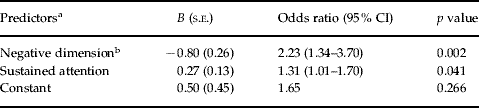
To further examine the predictors of functional recovery, a binary logistic regression was carried out. The variables entered into the logistic regression as predictors were those that were significant at the 10% level in the univariate analysis, namely, age of onset, years of education, diagnosis, pre-morbid social adjustment, negative dimension, disorganized dimension and sustained attention. Age was not included because of the strong correlations with the age of onset (r=0.93), which could lead to collinearity problems. The regression analysis was calculated by using data from 92 individuals for whom complete data were available on all seven predictors. This model was statistically significant [χ2(2)=18.89, p<0.001] and accounted for 28% of the variance (Nagelkerke R 2=0.28). The Hosmer and Lemeshow goodness-of-fit statistic suggested that the estimates of the model fitted the data to an acceptable level [χ2(8)=2.96, p=0.937]. Negative symptoms and sustained attention were significant predictors of functional status, with odds ratios of 2.23 and 1.31, respectively (Table 2). All other potential predictors examined were redundant in terms of separating the individuals with functional recovery from those with functional deficits. The decision to include age of onset instead of age in the prediction model was somewhat arbitrary, so we re-ran the analysis, including age instead of age of onset as a predictor; however, as expected, the final model remained unchanged.
Pretreatment predictors of functional recovery at 1-year follow-up by stepwise forward logistic regression (n=92)

s.e., Standard error; CI, confidence interval.
Model χ2(2)=18.89, p<0.001. R 2=0.28 (Nagelkerke).
a Variables entered in the analysis were age of onset, years of education, diagnosis (schizophrenia versus schizophreniform), pre-morbid social adjustment, negative dimension, disorganized dimension and sustained attention.
b Negative dimension scores were reversed (by multiplying by –1) so that lower scores stand for more negative symptoms. Thus, both predictors are interpreted in the same way: the higher the score, the better (i.e. fewer symptoms and better cognitive performance).
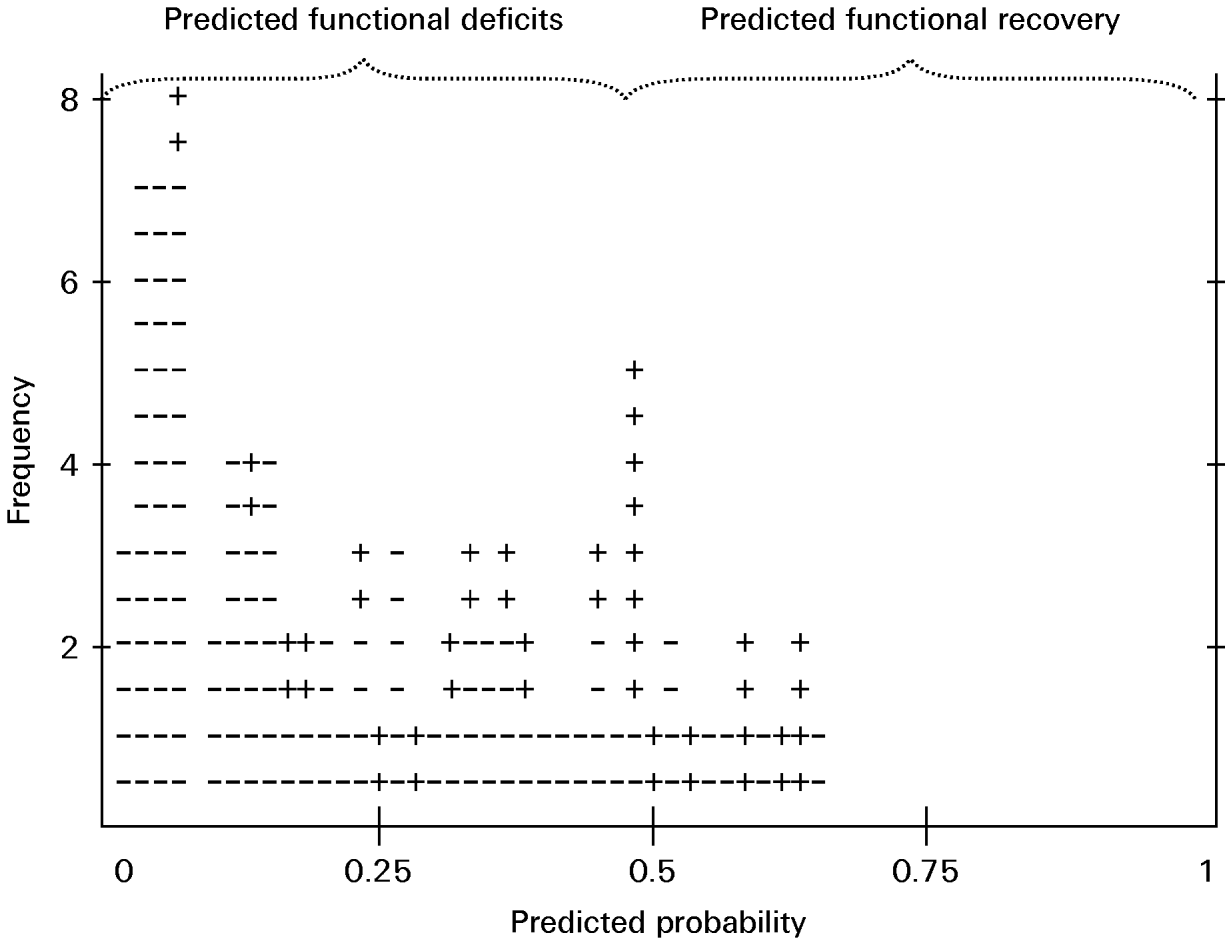
Overall, 75% of the patients were predicted correctly. As shown in Fig. 2, the model was good for the classification of patients with functional deficits, but was unacceptably inaccurate for the classification of patients with functional recovery. In fact, 63 out of 69 (91.3%) of those who had functional deficits were predicted correctly with this model, but only six out of 23 (26.1%) of those functionally recovered were predicted correctly.
Plot with observed groups and predicted probabilities. The x axis is the predicted probability from 0 to 1 of the dependent variable being classified as a patient with functional recovery. The y axis is the number of cases classified. Inside the plot are columns of observed cases (+, patients with functional recovery; –, patients with functional deficits), with 0.5 cases per symbol.

Discussion
The purpose of this longitudinal study was to examine the prognostic value of cognitive functioning for determining who will recover functionally after FES spectrum disorders. The functionally recovered group showed a milder deficit in the sustained attention dimension; this variable remained as a significant predictor after controlling for other potential prognostic factors. The resulting prediction model, which also included negative symptoms, explains a moderate amount of the variance of the global functional outcome. A close inspection of the model revealed that the prognostic value of this predictor is very limited if we considered the inaccuracy of the classification of patients with functional recovery.
The results support previous studies that indicate that negative symptoms and sustained attention are consistently correlated to functional outcome. Indeed, there is substantial evidence of a positive relationship between functional impairment and sustained attention deficits (Hofer et al. Reference Hofer, Baumgartner, Bodner, Edlinger, Hummer, Kemmler, Rettenbacher and Fleischhacker2005; Milev et al. Reference Milev, Ho, Arndt and Andreasen2005; Bowie et al. Reference Bowie, Leung, Reichenberg, McClure, Patterson, Heaton and Harvey2008) and negative symptoms (Dickerson et al. Reference Dickerson, Boronow, Ringel and Parente1999; Milev et al. Reference Milev, Ho, Arndt and Andreasen2005). However, the prospective association of baseline cognitive functioning and later functional outcome is attenuated for first-episode subjects (van Winkel et al. Reference van Winkel, Myin-Germeys, de Hert, Delespaul, Peuskens and van Os2007). Furthermore, cognitive variables account for small amount of variance of real-world functioning (Twamley et al. Reference Twamley, Doshi, Nayak, Palmer, Golshan, Heaton, Patterson and Jeste2002; Bowie et al. Reference Bowie, Reichenberg, Patterson, Heaton and Harvey2006; Keefe et al. Reference Keefe, Poe, Walker and Harvey2006). This may explain the lack of association of functional outcome with other cognitive variables examined (i.e. verbal memory, executive functions and motor dexterity). Green and colleagues (Green, Reference Green1996; Green et al. Reference Green, Kern, Braff and Mintz2000) have suggested that specific cognitive domains are related to particular types of outcome (such as social problem solving, psychosocial skills acquisition …); in consequence, the use of a global measure, which integrated social and vocational outcomes, may be concealing some possible associations. If our study had included more specific outcome measures, it is possible that the magnitude of correlations might have been greater and different predictors might have emerged. Nevertheless, beyond specific correlations, our data stress the limitations of cognitive variables, along with other commonly used predictors, to predict social and occupational recovery after a FES or schizophreniform disorder.
The fact that variables such as age of onset, DUP, education, family history of psychosis, pre-morbid adjustment or diagnosis (e.g. schizophrenia versus schizophreniform) were not identified as a significant predictor of outcome is in coincidence with the data from a recent systematic review of first-episode psychosis studies (Menezes et al. Reference Menezes, Arenovich and Zipursky2006). While this may be a consequence of our global measure, sampling selection and lack of power to detect small effects, it also suggests that other variables not related to cognitive, clinical and demographic factors may have a relevant role as determinants of functional outcome. Interestingly, the systematic review by Menezes and colleagues revealed that combination therapy (pharmacotherapy and psychosocial therapy) was the main predictor of good outcome in first-episode psychosis (Menezes et al. Reference Menezes, Arenovich and Zipursky2006). Our study controlled by randomization the type of antipsychotic drugs at baseline; the analysis revealed no differences between drug treatments. Unfortunately, in the present study we could not control for the effects of concomitant psychosocial interventions, among which family support (Zhang et al. Reference Zhang, Wang, Li and Phillips1994), cognitive behaviour therapy (Gumley et al. Reference Gumley, O'Grady, McNay, Reilly, Power and Norrie2003; Gleeson et al. Reference Gleeson, Cotton, Alvarez-Jimenez, Wade, Gee, Crisp, Pearce, Newman, Spiliotacopoulos, Castle and McGorry2009) and vocational therapies (Killackey et al. Reference Killackey, Jackson and McGorry2008) may have special importance in this population.
The rather limited prognostic value of baseline cognitive functioning might be interpreted to mean that cognitive deficits found in early schizophrenia are simply not strong enough to influence a global measure of functional recovery. A different pattern might emerge with chronic samples with more pronounced cognitive deficits. An alternative explanation to be considered is that other factors not included in this study, such as motivation, psychosocial interventions, social stigma, social support or financial needs, constitute a powerful main effect that may well be masking the contribution of cognitive variables to functional outcome.
This study has several limitations. First, we used a global measure of functional recovery as a dependent variable instead of separate measures of social and vocational recovery. These measures are to some degree independent of one another; in fact, 30% of those with no obvious social deficit did not meet the criteria for global recovery because they were not currently working or studying. While this strategy might be concealing some specific associations, a global measure of optimal performance in the real world, which integrates occupational and social factors, might be more obvious and meaningful for patients, relatives and clinicians than more specific or performance-based measures. Furthermore, the amount of variance explained by the prediction model of this dependent variable is similar or greater than what has been found in other studies that used more specific functional outcomes (Robinson et al. Reference Robinson, Woerner, McMeniman, Mendelowitz and Bilder2004; Milev et al. Reference Milev, Ho, Arndt and Andreasen2005; Holthausen et al. Reference Holthausen, Wiersma, Cahn, Kahn, Dingemans, Schene and van den Bosch2007). Second, in the current study we used a definition of functional recovery that did not include clinical remission. The inclusion of clinical remission as part of a recovery definition would artificially inflate the variance explained by the (clinical) predictors and the exclusion of clinical predictors would be obviating the overlapping relationship of cognitive variables and clinical symptoms. Interestingly, Gaite et al. (Reference Gaite, Vazquez-Barquero, Herran, Thornicroft, Becker, Sierra-Biddle, Ruggeri, Schene, Knapp and Vazquez-Bourgon2005) showed that on the Global Assessment of Functioning Scale, a global measure that incorporates symptom severity as well as psychological, social and occupational functioning, clinical factors appear to be the main determinants of the score. Thus, in order to elucidate the specific contribution of cognition to functional outcome, we believe that clinical recovery warrants a separate investigation. Third, we used a narrow definition of FES including only schizophrenia and schizophreniform disorder cases. It is worth noting that long-term studies suggest that populations with schizophrenia have different courses and outcomes from populations with other types of psychotic disorders (Harrow et al. Reference Harrow, Sands, Silverstein and Goldberg1997; Menezes et al. Reference Menezes, Arenovich and Zipursky2006), but it is questionable whether the schizophreniform disorder merits a diagnostic classification separate from schizophrenia (Zarate et al. Reference Zarate, Tohen and Land2000).
Overall, the results of this study emphasise that predicting who would do functionally well after a first episode of schizophrenia is much more difficult to do than to predict poor outcome (Fenton & McGlashan, Reference Fenton and McGlashan1987). On the other hand, the limitations found in the prediction of global functional recovery are important as they may be an indication of the need to address the role of other factors not commonly included in longitudinal studies of long-term outcomes in schizophrenia. Namely, future studies should attempt to understand the potential role of psychosocial interventions, social stigma, social support, financial needs, employment opportunities and a range of psychological factors such as motivation, health beliefs and personality in the functional recovery from FES.
Acknowledgements
The authors thank Dr Luis Gaite (Hospital Universitario Marqués de Valdecilla, Santander, Spain) for his helpful comments on an early draft of this manuscript. The present study was performed at the Hospital Universitario Marqués de Valdecilla (Santander, Spain), under the following grant support: Instituto de Salud Carlos III, FIS 00/3095 and G03/032, and SENY Fundació Research Grant 2005–0308007, Fundación Marqués de Valdecilla A/02/07. These institutions had no further role in study design, in the collection, analysis and interpretation of data, in the writing of the report and in the decision to submit the paper for publication.
Declaration of interest
None.