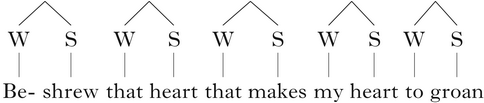
Among poetic metres regulating the properties of syllables, two types are traditionally distinguished, accentual (regulating stress or pitch accent placement, as in English) and quantitative (regulating weight, as in Sanskrit).Footnote 1 Metres are here assumed, along with perhaps most research in generative metrics, to be abstract trees of strong (S) and weak (W) nodes (see Blumenfeld Reference Blumenfeld2016 for an overview).Footnote 2 For example, (1) gives a line of English iambic pentameter (from Shakespeare's Sonnet 133), with its terminal layer of S and W nodes (cf. Hayes Reference Hayes and Newmeyer1988: 222, Hayes et al. Reference Hayes, Wilson and Shisko2012: 697). The concern of this article is not the generation of these structures (see e.g. Hanson & Kiparsky Reference Hanson and Kiparsky1996), but the principles of prominence-mapping (or correspondence; Blumenfeld Reference Blumenfeld2015) that regulate how S and W nodes are realised by linguistic material.
-
(1)

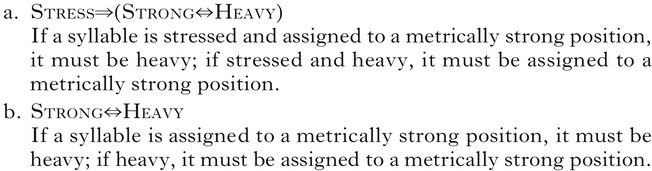
In an accentual metre, mapping relates metre to stress or phonological strength. For example, strong positions might be required to be stressed (notated Strong⇒Stress), or weak positions to be unstressed (Stress⇒Strong). When both conditions hold, these constraints can be combined into the biconditional Strong⇔Stress, as in (2a).Footnote 3
-
(2)
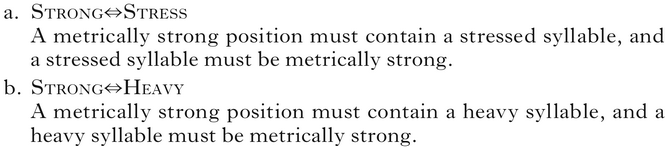
This is the simplest possible stress-mapping principle, though most accentual metres require more analytical nuance. For example, Hayes et al. (Reference Hayes, Wilson and Shisko2012: 697) estimate that only 12% of Shakespeare's lines adhere to Strong⇔Stress as rigidly as the examples in (1). Thus, Strong⇔Stress is mentioned here only as a kind of general schema to represent the metre–stress interface; see §1.2–§2.2 for some refinements that are necessary to analyse real metres. Similarly, in a quantitative metre, mapping relates metre to weight, most simply via Strong⇔Heavy, as in (2b).
Many metres exhibit either stress-mapping or weight-mapping, but not both. For example, Arabic, Sanskrit and Ancient Greek metres are said to be quantitative, while the English iambic pentameter is said to be accentual. To be sure, some constraints used to analyse the iambic pentameter refer to weight. For example, some poets permit a position to be filled by two syllables iff the first is light and they occupy the same word. This license, however, does not concern prominence-mapping, but rather position size (on this distinction, see Hanson & Kiparsky Reference Hanson and Kiparsky1996: 299). Furthermore, different metres within the same language might employ different types of mapping. Some English poets, for instance, employ quantitative metre (e.g. Sir Philip Sidney; see Hanson Reference Hanson2001).
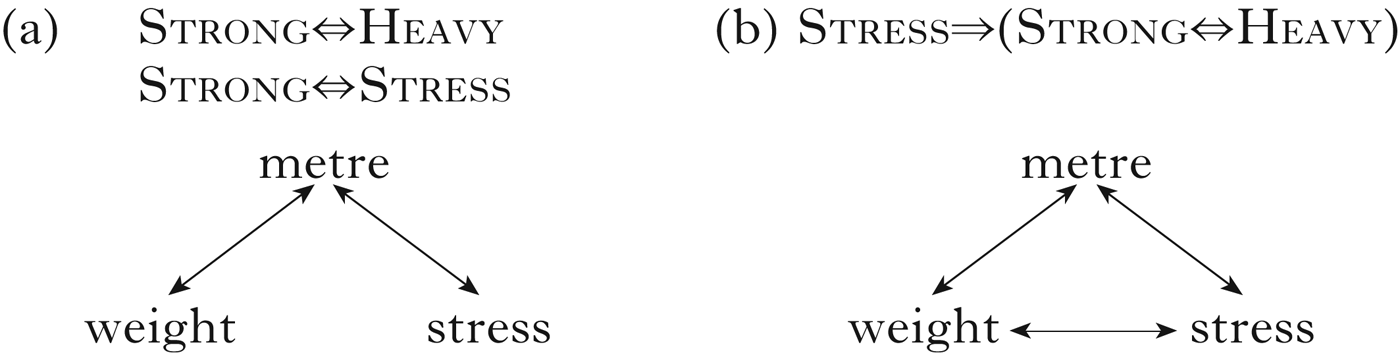
This article addresses hybrid accentual-quantitative metres, which feature both stress-mapping and weight-mapping. These metres fall into two classes, as schematised in Fig. 1.
Two types of hybrid accentual-quantitative metre. (a) independent mapping; (b) interactive mapping.

In the first, termed independent mapping, stress and weight interface separately with the same metre. For example, perhaps the best-known quantitative metre is the Latin hexameter. But this metre is not purely quantitative, as sometimes suggested: for most authors of the Augustan and later periods, including Virgil and Ovid (§1.1), the cadence of the line exhibits virtually strict stress-mapping alongside weight-mapping. In the Latin hexameter, then, as with Old Norse (§1.3), weight-mapping (Strong⇔Heavy) and stress-mapping (Strong⇔Stress) coexist. Crucially, both refer to the same underlying metre; the situation is not one of simultaneous metres. If a position is strong for weight, it must also be strong for stress, and vice versa. Previous proposals to the effect that stress and metre actively clash in parts of the line, implicating unnatural Strong⇔¬Stress or else disjunct metres, are argued in §1.1 to be premature.
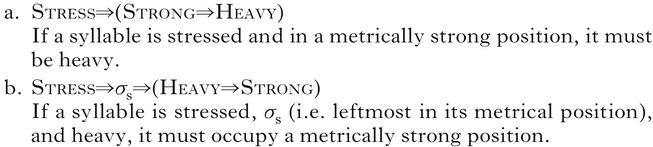
The second type of hybrid accentual-quantitative metre involves interactive mapping. These metres are also quantitative, but quantity is regulated more strictly for stressed than unstressed syllables. In other words, weight-mapping is modulated by stress level, as encoded here by constraints of the form Stress⇒(Strong⇔Heavy), as in (3). See §3 for truth tables and discussion of why other logically possible combinations of these predicates, such as weight-modulated stress-mapping, may be unattested.
-
(3)

Two genealogically unrelated cases of interactive mapping are examined in detail in this paper. First, weight-mapping in a medieval Tamil quantitative metre is shown in §2.1 to be nearly categorical for stressed syllables, but looser for unstressed syllables, though not ignored altogether. The second case comes from Kalevala Finnish (§2.2). As previously described, weight-mapping in the Kalevala applies only to primary-stressed syllables. This description is revised here, as it is demonstrated that secondary-stressed and unstressed syllables are also preferentially weight-mapped, albeit to lesser degrees, scaling with stress level. Yet a third genealogically unrelated case of interactive mapping is the Serbo-Croatian epic decasyllable, which is not analysed here (see Jakobson Reference Jakobson1933, Reference Jakobson and Jakobson1966, Hayes Reference Hayes and Newmeyer1988, Zec Reference Zec2009). Jakobson (Reference Jakobson and Jakobson1966: 418f) describes weight-mapping as applying more stringently for stressed than unstressed syllables, though it operates at least as a tendency for both. In short, in every documented case of interactive mapping, weight-mapping scales gradiently with stress level. This generalisation has not been previously recognised, nor has gradient stress modulation been previously formalised. Explanations for the typology of possible and impossible interfaces are proposed in §3, before a conclusion in §4.
1 Independent stress-mapping and weight-mapping
In a language with both stress and distinctive quantity, an individual metre can regulate both of these properties. This section examines two such cases in detail, the Latin hexameter (as employed by Virgil) and the Old Norse dróttkvætt. In §1.1, it is shown that the hexameter regulates stress, but only in the cadence. Against previous accounts of Latin, it is argued that there was probably no explicit tendency for stress to clash with the metre outside of the cadence, and therefore no need to invoke a counter-universal constraint of the type Strong⇒¬Stress. The Latin hexameter is then analysed in §1.2 using independent stress–metre and weight–metre interface constraints. For Latin, as for Old Norse in §1.3, stress-mapping and weight-mapping need not interact with each other, though both must answer to the same abstract metre, i.e. the arrangement of strong and weak positions.
1.1 The Latin hexameter: stress regulation
The Latin dactylic hexameter, like its Greek predecessor, follows the descriptive template in (4) (Duckworth Reference Duckworth1969, Halle Reference Halle, Bierwisch and Heidolph1970, Prince Reference Prince, Kiparsky and Youmans1989, Boldrini Reference Boldrini and Häuptli1999).
-
(4)

Each of the six metrical feet comprises two positions: first, the strong position (‘S’; also known as the princeps or thesis) must be filled by a heavy syllable (notated −). Second, the weak position (‘W’; also known as the biceps or arsis) can be filled by either a single heavy or a pair of lights (˘ ˘), except in the final foot, where W is a single syllable of any weight. A syllable is light iff it ends with a short vowel. The fifth weak position shows the heavy syllable in parentheses, because this option is rarely employed; in Virgil, it accounts for fewer than 1% of lines. Caesura usually falls within the third foot; in Virgil, ~85% of main caesurae fall immediately after the third strong position. The template is exemplified in (5) (in Latin forms, macrons indicate vowel length, and acute accents indicate primary stress).
-
(5)

Unlike Ancient Greek, Latin has salient word stress. While stress is often glossed over in introductions to the hexameter, the Latin hexameter is widely regarded to be sensitive to stress in addition to weight. In particular, in the final two feet (referred to here as the cadence), strong positions are nearly always stressed, and weak positions unstressed.Footnote 4 Elsewhere, stress alignment with the metre is looser, perhaps even actively avoided in the middle of the line (e.g. Sturtevant Reference Sturtevant1919: 383, Reference Sturtevant1923a, Knight Reference Knight1931, Reference Knight1950, Allen Reference Allen1973: 335ff, Ross Reference Ross2007: 143ff), though see below for an argument against active avoidance. The frequent clashes in the middle of the line are often regarded as setting up a tension that is resolved by the regular cadence.
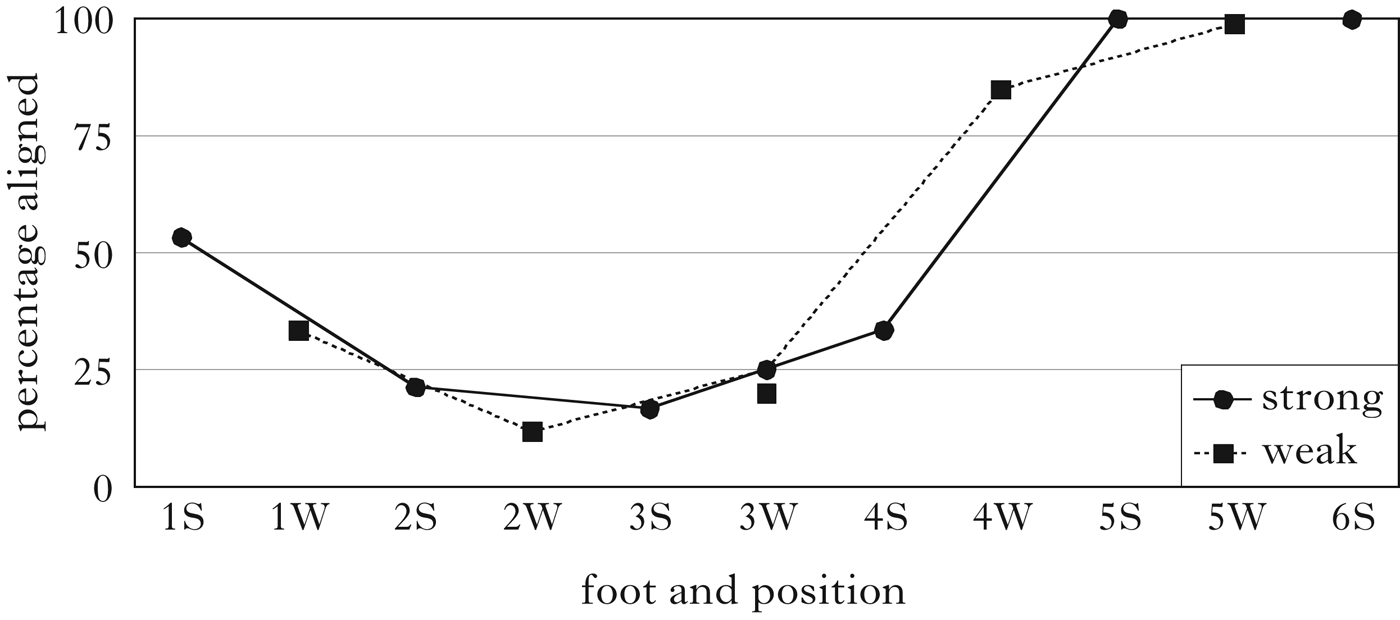
Figure 2 depicts the alignment of stress and metre across the Latin hexameter line. The corpus is the first six books of Virgil's Aeneid (c. 25 bce), with macrons following Pharr (Reference Pharr1964). All statistics for ‘Virgil’ below should be understood to refer only to this subcorpus of Virgil.Footnote 5 A Perl program was employed to annotate syllables for stress and metrical position.Footnote 6 Due to irrelevant complications such as irregular line or vowel length, and the variable phenomena mentioned in note 6, the program did not succeed in scanning every line. Lines that failed to scan were excluded, reducing the corpus by 13%. The final scanned corpus contains 4045 lines.
Percentage of alignment across the Latin hexameter line (except 6W; see text). Strong and weak positions are separated. For example, 4W is the weak position of the fourth foot.

Alignment in Fig. 2 is defined as follows. A strong position is aligned (also known as harmonic or homodyned; Sturtevant Reference Sturtevant1923a, Knight Reference Knight1950) iff it contains a stressed syllable, and a weak position is aligned iff it does not contain one. For simplicity, monosyllabic words, which are usually function words, were treated as neither stressed nor unstressed (Sturtevant Reference Sturtevant1923a makes the same exclusion). If a position contained nothing but one or more monosyllables, it was ignored (i.e. counted as neither aligned nor non-aligned). If a weak position included one monosyllable and one (part of a) non-monosyllable, it was evaluated according to the rule above, ignoring the monosyllable portion of the position. For example, the cadence of the Aeneid’s opening line (see (5)) is prī́mus ab ṓrīs. Because ab is ignored here for stress assignment, every position in this cadence is considered aligned.
One final caveat about this treatment of monosyllables is that it renders the alignment of the final weak position (6W) meaningless, as this position could only be stressed if filled by a monosyllable, and monosyllables are not counted here. Therefore, 6W is vacuously 100% aligned by the present metric, and excluded from Fig. 2. In reality, 6W is strictly aligned: Virgil fills it with a monosyllable only 1.4% of the time, and most, perhaps all, of those monosyllables are unstressed (e.g. 56% of them are est).
Though strong and weak positions are separated in Fig. 2, their alignment can be seen to follow nearly identical trajectories. In particular, alignment is middling at the opening, falling to a minimum in the second and third feet. It then rapidly ascends, reaching virtual categoricity in the cadence. It thus appears that stress is indeed metrically regulated, particularly given that the end of the line is cross-linguistically the locus of greatest strictness (Hayes Reference Hayes1983: 373, Dell & Halle Reference Dell and Halle2009, McPherson & Ryan to appear).
Nevertheless, the argument for stress-sensitivity only goes through if it can be shown that the distribution in Fig. 2 is the result of active preferences on the part of the poet, as opposed to being merely an automatic reflex of how stress is distributed in Latin words chosen to fit the template quantitatively. To this end, others (e.g. Sturtevant Reference Sturtevant1923a: 54, Reference Sturtevant1923b: 57, Allen Reference Allen1973: 337) have argued that the avoidance of hexameter-final monosyllables, which is without parallel in prose, can be explained by stress. If the final weak position were filled by a monosyllable, it would potentially itself receive stress, and the immediately preceding strong position would lack stress, unless it too were filled by a monosyllable. Similarly, words of the shape − − × (where × is a syllable of any weight) are arguably avoided as hexameter endings because the immediately preceding 5S position would lack stress, unless filled by a stressed monosyllable. In fact, Virgil almost always (=97% of the time) ends the line with a word of the shape − × or ˘ − ×, arguably because these are precisely the two shapes that guarantee a fully aligned cadence. In prose, by contrast, only 20% of sentences end with these two word shapes, judging from a sample of 2507 sentences by Caesar and Nepos. Even if we confine the prose sample to sentence-final words that would fit the end of the hexameter quantitatively, only 39% are − × or ˘ − ×. Thus Virgil's strong preference for these shapes is not motivated by the template in (5), but is simply explicable in terms of stress.
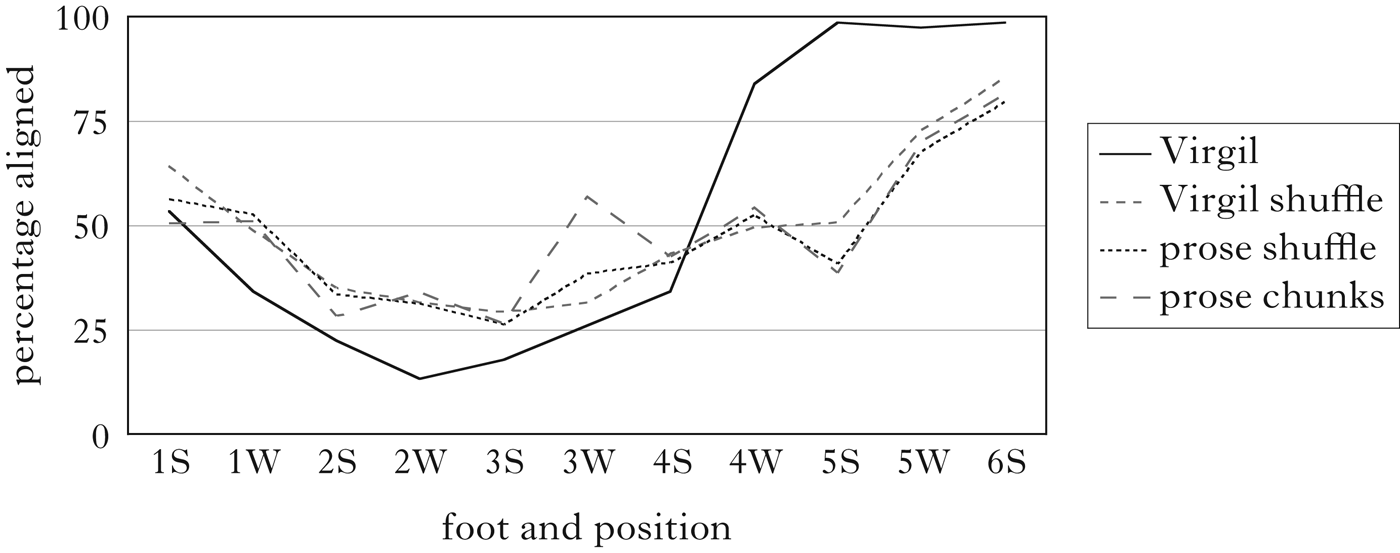
To demonstrate stress-sensitivity more generally, one can compute an expected distribution of stress under the null hypothesis that the metre ignores stress. In this case, three baselines were estimated, as shown in Fig. 3. Unlike Fig. 2, strong and weak positions are now collapsed into a single connected line for each corpus. The first baseline, entitled ‘Virgil shuffle’, constructs hexameter lines by concatenating words chosen at random from the entire Virgil corpus (cf. the ‘Rigged Veda’ of Gunkel & Ryan Reference Gunkel, Ryan, Jamison, Melchert and Vine2011: 66; also Janson Reference Janson1975 for a different permutation method for Latin). Constructed lines were retained only if they matched the hexameter template (after applying normal sandhi) and had a word break in the third foot to serve as caesura.Footnote 7 10,000 lines were constructed. The second constructor, ‘prose shuffle’, is identical to the previous one, except that it draws words from prose, namely the Caesar and Nepos corpus mentioned above. Finally, ‘prose chunks’ comprises all strings of any number of contiguous whole words from prose that scan as hexameters (on using prose phrases as a baseline to gauge metrical regulation, see Tarlinskaja & Teterina Reference Tarlinskaja and Teterina1974, Devine & Stephens Reference Devine and Stephens1976, Tarlinskaja Reference Tarlinskaja1976, Gasparov Reference Gasparov and Smith1980, Biggs Reference Biggs1996, Hall Reference Hall2006, Hayes & Moore-Cantwell Reference Hayes and Moore-Cantwell2011, Bross et al. Reference Bross, Gunkel and Ryan2014 and Blumenfeld Reference Blumenfeld2015).Footnote 8 Only 137 such accidental hexameters are found in 55,751 words of prose. Because ‘prose chunks’ are so few in number compared to the other methods, they exhibit greater variance in alignment. In particular, the bump at 3W for ‘prose chunks’ might not be meaningful, given the small sample size.
Alignment in the Latin hexameter, comparing real lines by Virgil to three baselines of expectation (Virgil: N = 4,045; Virgil shuffle: N = 10,000; prose shuffle: N = 10,000; prose chunks: N = 137).

From Fig. 3, it is once again clear that the strictness of the cadence (and, to a lesser extent, 4W) cannot be attributed to chance. This is most obvious for 5S, which is 99.5% aligned in the real corpus, vs. 39–51% in the baselines. Second, the constructed and real corpora exhibit an almost identical convexity in the precadence (here referring to the full line to the exclusion of the cadence), suggesting that the opening downtrend in Virgil is likely due to chance (on its offset from the baselines, see below).
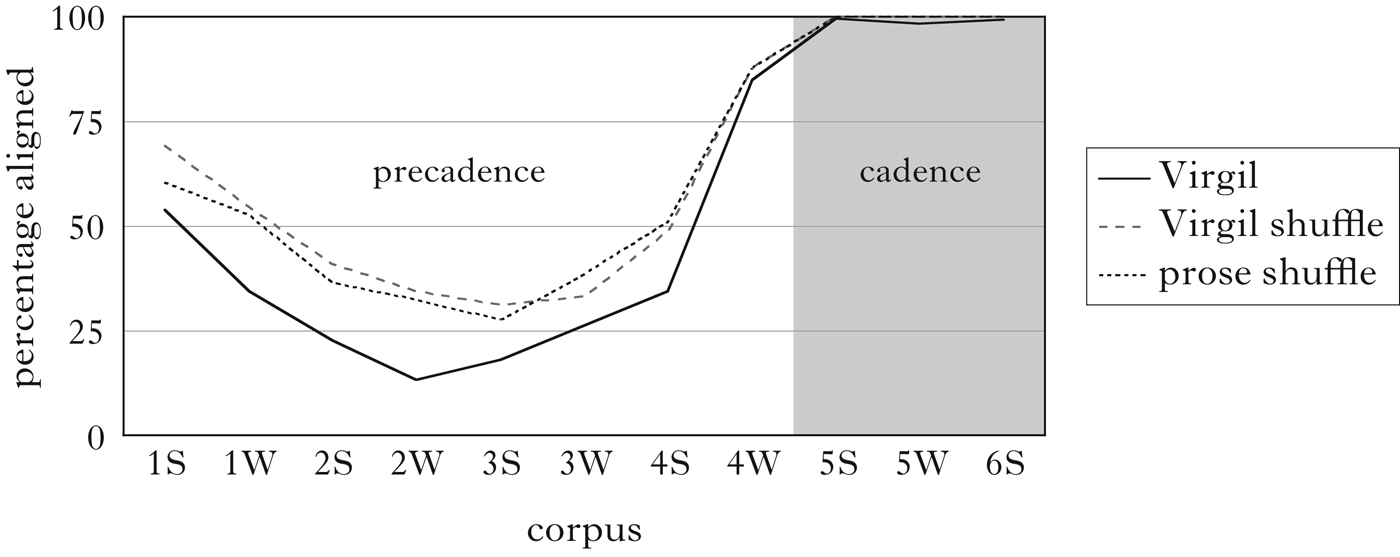
Beyond the cadence, 4W, immediately preceding the cadence, is strongly (85%) aligned. Nevertheless, the alignment of 4W can be shown to be an artefact of the alignment of the cadence. Figure 4 shows alignment in the two shuffled corpora when the constructor is modified to require perfect alignment in the cadence. ‘Prose chunks’ are now omitted, as only five exhibit strictly aligned cadences. With this new requirement, 4W emerges as strongly aligned in the constructed corpora, even though it was not directly regulated. This is because when 5S is required to be stressed, 4W could be stressed only if filled by a stressed monosyllable (not counted here, as discussed) or a light–light word, both uncommon.
Alignment in the Latin hexameter, showing that alignment in 4W is an artefact of alignment in the cadence. Shuffles are now required to align in the cadence, which is shaded.

To summarise thus far, the cadence virtually requires strict alignment of stress, while the high alignment of 4W can be attributed to chance, being a reflex of the strict cadence. Furthermore, the overall curvature of alignment in the precadence matches that of the baselines, indicating that it is likely also accidental. Nevertheless, one discrepancy remains: prior to 4W, the real corpus is consistently about 10% worse aligned than the baselines. At first glance, this might be taken as suggestive that Virgil actively (if weakly) avoids alignment in that part of the line, as some scholars maintain (e.g. Ross Reference Ross2007: 146).Footnote 9
However, there exists another possible explanation for the consistently lower rate of alignment in the precadence seen in Figs 3 and 4. The constructors above omitted consideration of a factor that plausibly influenced the poet, namely making good use of the available lexicon (fit in Hanson & Kiparsky Reference Hanson and Kiparsky1996: 294). Note that the cadence, requiring perfect alignment, accommodates only certain word shapes. For example, no word stressed on a light syllable (e.g. cánō) is permitted in the cadence, as such words necessarily induce non-alignment. Meanwhile, the vast majority of heavy-stressed words can be localised anywhere in the line, cadence or precadence.
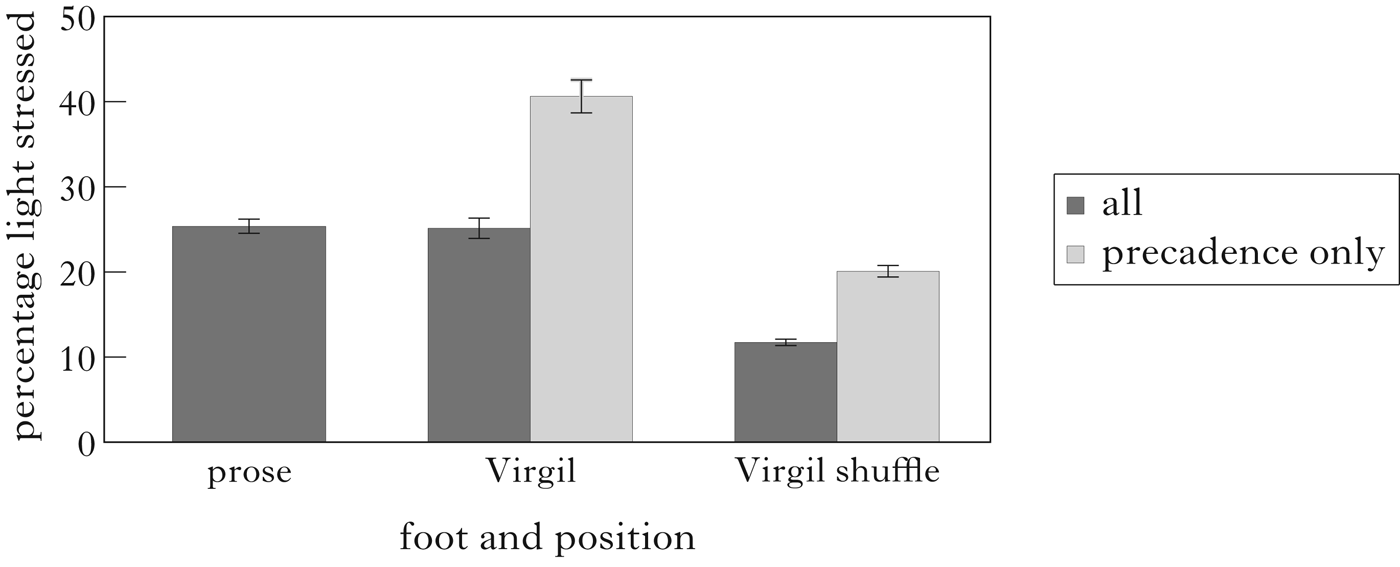
In the aggregate, Virgil employs light-stressed words at the same rate as prose. As Fig. 5 reveals, 25% of non-monosyllabic words in the Aeneid are light-stressed, approximately the same proportion as in prose. In this sense, Virgil is making good use of light-stressed words. However, because light-stressed words cannot occupy the cadence, this situation entails that they must be overrepresented in the precadence, where 41% of words are light-stressed, almost double the prose rate. Thus Virgil arguably overutilises light-stressed words in the precadence, not because he favours stress misalignment, but because he seeks to exploit the full range of Latin word shapes at approximately baseline (prose) rates, insofar as the metre permits.Footnote 10 In fact, he overutilises light-stressed words in the precadence just enough that the aggregate rate of usage in poetry matches that of prose, a fact that must be treated as coincidence by accounts proposing misalignment as an end in itself.
The constructors considered above failed to capture this effect, because they had no incentive to achieve a good fit with the lexicon. For instance, only 12% of words in the ‘Virgil shuffle’ corpus were light-stressed, half the rate found in prose (Fig. 5). Even though the constructor sampled randomly from Virgil, meaning that light-stressed words were initially sampled at Virgil's rate, candidate lines containing light-stressed words were less likely to survive scansion, resulting in their underrepresentation in the final shuffled corpus.
Proportion of words that are stressed on light as opposed to heavy syllables in three corpora. For the two poetry corpora, the overall rate is shown first (dark bar), followed by the rate in the precadence (light bar). The rate in cadences (zero) is not shown.

To conclude, this study corroborates the traditional view that the cadence (the final two feet) of Virgil's hexameter requires not just quantity, but also stress, to align with the metre. The high rate of alignment of the 4W position, immediately preceding the cadence, has been demonstrated to be an artefact of the regulation of the cadence. The remainder of the line either ignores or slightly avoids stress alignment. This section has argued for the former, on the grounds that the observed degree of misalignment is precisely that required to achieve an aggregate distribution fully representative of the (metrifiable) lexicon. Moreover, the present analysis obviates what would otherwise be a counteruniversal in metrics, namely a metrical system in which demonstrably strong positions actively select weak (i.e. unstressed) syllables. In short, we can tentatively conclude from these results that stress is regulated strictly in the cadence but ignored elsewhere, at least for the purposes of metrical mapping.
1.2 The Latin hexameter: analysis
Stress alignment can be enforced by the constraint Strong⇔Stress, as in (6). Because of the bidirectional implication, this constraint penalises both (a) a strong position that lacks stress and (b) stress in a weak position. In other words, it subsumes two constraints that in the formalism of Hanson & Kiparsky (Reference Hanson and Kiparsky1996) would be S⇒P (where S is ‘strong’ and P is ‘prominent’) and W⇒¬P, the latter equivalent to Stress⇒Strong.
-
(6)

As discussed in §1.1, Strong⇔Stress is only active in the cadence, and must therefore be indexed to this domain. Two approaches to defining this domain would work equally well for present purposes. The first assumes that the cadence is reified in metrical structure as a constituent directly dominating the final two metrical feet. (Identifying the cadence as a constituent does not imply that the precadence is also a constituent.) The second approach takes the domain to be the final (or strong) colon, a metrical constituent above the metron akin to the phonological phrase, if such a constituent exists (see e.g. Barnes Reference Barnes1986). The two domains potentially differ for lines such as (7a), whose cadence is -rántque per áurās, splitting a word, but whose final colon would perhaps be verrántque per áurās. In either case, strict alignment is observed. The colon could only potentially violate alignment if it extended back to 4S, as perhaps in (7b). However, such cases are uncommon (2.7% of lines), and could still be analysed as having secondary stress in 4S.
-
(7)

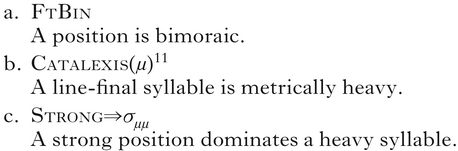
A metrical structure for the cadence (or strong colon) is given in (8). Every node is either metrically strong (head) or weak (non-head). Following Halle (Reference Halle, Bierwisch and Heidolph1970) and Prince (Reference Prince, Kiparsky and Youmans1989), the dactylic-spondaic metrical foot (metron) is taken to be left-headed, with the weak branch comprising either two light syllables or a single heavy. The final metron alone, however, cannot be a dactyl (− ˘ ˘). On one analysis (Prince Reference Prince, Kiparsky and Youmans1989: 57), this is because final light syllables undergo moraic catalexis, rendering them metrically heavy; − ˘ − would then violate FtBin in (9a) below. I assume that strength is right-oriented at and above the level of the metron, to accord with natural prosody and final strictness (Piera Reference Piera1980, Hayes Reference Hayes and Newmeyer1988, Golston & Riad Reference Golston and Riad2000, Hayes et al. Reference Hayes, Wilson and Shisko2012, Blumenfeld Reference Blumenfeld2015, Kiparsky Reference Kiparsky, Gunkel and Hacksteinto appear).
-
(8)
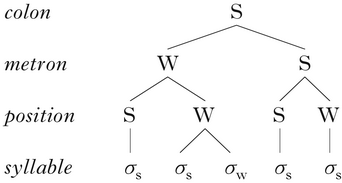
Given this structure, the constraints in (9) implement quantity in the cadence. First, FtBin – ‘foot’ here in the sense of moraic trochee, not metron – requires every position to be bimoraic, i.e. either a heavy syllable or a pair of lights (Prince Reference Prince, Kiparsky and Youmans1989, Prince & Smolensky Reference Prince and Smolensky1993). Second, Catalexis(m) requires a light syllable in final position to be parsed as heavy, which has the joint effect of allowing a single light to comprise that position and ruling out a dactyl there, which would be parsed as ˘ −, violating FtBin. Finally, Strong⇒sμμ requires that the strong position of a metron contain a bimoraic syllable, ruling out anapests (˘ ˘ −) and tetrabrachs (˘ ˘ ˘ ˘), while allowing dactyls (− ˘ ˘) and spondees (− −).
-
(9)
One final constraint warrants discussion here. The constraints discussed so far permit a cadence of the form −́ − −́ ×, with a spondee in the fifth foot. But Virgil almost always (over 99% of the time in the present corpus) implements the fifth foot with a dactyl. Weak⇒sμc a d e n c e in (10) therefore requires a weak position in the cadence to contain a light syllable. Together with FtBin, this ensures a dactyl. This constraint does not affect the final position, provided that it is dominated by FtBin and Catalexis(m). Moreover, because Virgil does occasionally permit spondees in the fifth foot, this constraint must be weighted, rather than strictly ranked (cf. Hayes et al. Reference Hayes, Wilson and Shisko2012).
-
(10)

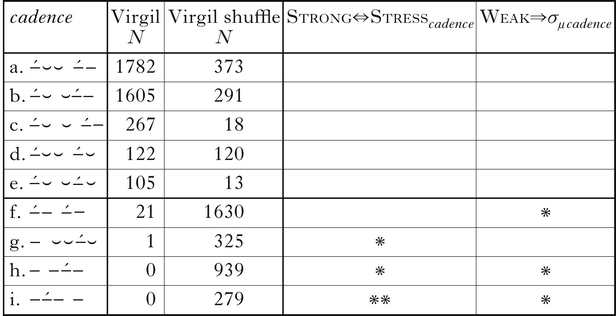
The two cadential constraints are illustrated in (11). Candidates (a)–(e) are the five most frequent cadences in Virgil.Footnote 12 None violates either constraint (their differing frequencies presumably reflect lexical resources, and perhaps other constraints not considered here). The remaining candidates violate one or both constraints, and are less frequent or unattested in Virgil. Counts from the ‘Virgil shuffle’ corpus (§1.1) are provided to reinforce that (f)–(i) would be expected to be frequent if these constraints were inactive.
-
(11)
1.3 Old Norse
The Old Norse dróttkvætt, the most widely attested skaldic metre, shares with the Latin hexameter some relevant features discussed in §1.1. Each dróttkvætt line comprises six positions, of which the final two compose the cadence (Sievers Reference Sievers1893, Kuhn Reference Kuhn1983, Árnason Reference Árnason1991, Gade Reference Gade1995). As in Latin, the cadence is trochaic in both stress and weight,Footnote 13 such that its first position must be stressed and heavy, while its second must be unstressed and light (though ‘final indifference’ may somewhat obscure the treatment of final weight).Footnote 14 Because primary stress is typically word-initial (Russom Reference Russom1998), the vast majority of lines end with heavy-initial disyllables, as in (12), though longer words with compound stress are also possible, e.g. (12c). The acute in the orthography indicates length, not stress.
-
(12)
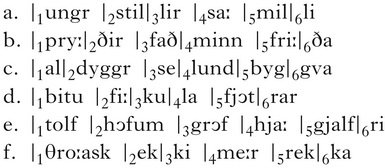
Each position usually accommodates a single syllable, as in (a)–(c), but resolution allows a position to be filled by two syllables, the first of which is light, a typologically frequent license (Hanson 1991, Hanson & Kiparsky Reference Hanson and Kiparsky1996: 296ff; cf. (16) in §2.1). Resolution is most frequently encountered in the first (d) or second (e) position of the line, and never in the cadence. Because long vowels normally scan as light in hiatus (i.e. immediately preceding another vowel), they too can participate in resolution, as in (f) (cf. Gade Reference Gade1995: 29).
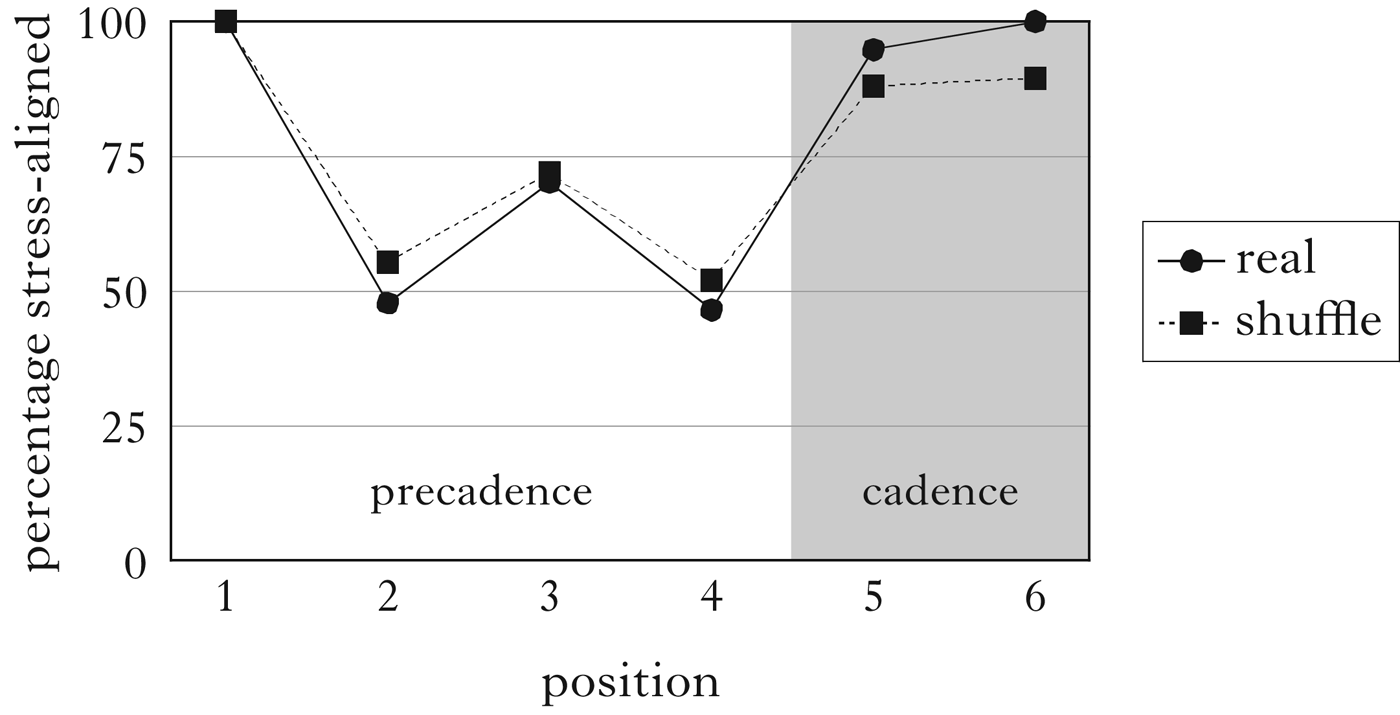
As with Latin (§1.2), Strong⇔Stress cadence is evidently active in Old Norse. In this metre, the cadence can be identified as the strong metrical foot, assuming, as before, that constituents above the foot are head-final (cf. Hayes et al. Reference Hayes, Wilson and Shisko2012: 697). If so, the index ‘cadence’ could be replaced by ‘foots’. If this constraint were inactive, we would expect to find more cadential monosyllables and polysyllables at the expense of disyllables. To be sure, line-final polysyllables do occur, as in (12c), but arguably fewer than would be expected if stress were ignored. for example, Fig. 6 compares the distribution of primary stress alignment in the real corpus (solid line) to that of a shuffled corpus (cf. §1.1) in which cadences were required to be heavy–light, but stress was ignored.Footnote 15 The real corpus consists of 11,252 lines downloaded from the Skaldic Project that an automated parser identified as dróttkvætt.Footnote 16 Stress is significantly better aligned in the real corpus (Fisher's exact test; odds ratio (OR)=4.7, p<0.0001). This model thus supports the insufficiency of weight-mapping alone.
Percentage of the time that a position is aligned for stress across positions of the dróttkvætt vs. a shuffled corpus in which only weight is regulated in the cadence.

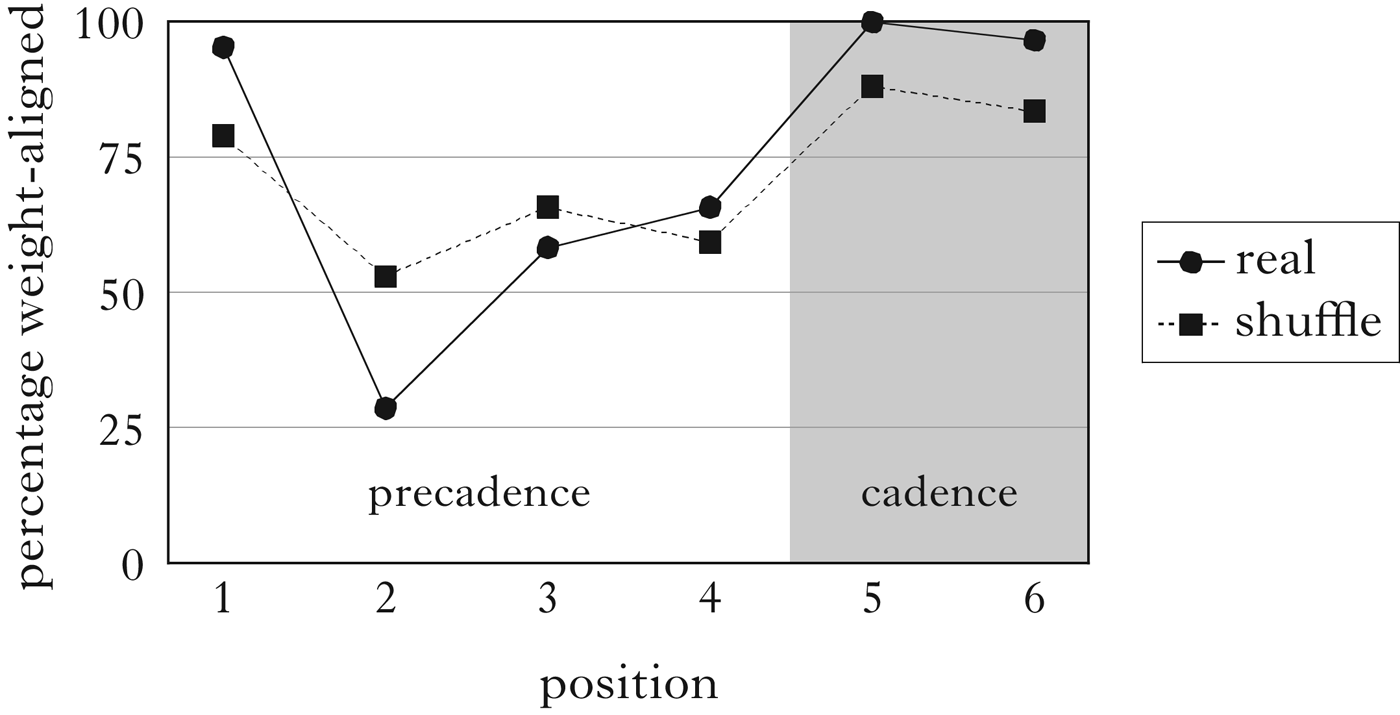
Weight-mapping in the cadence can be treated comparably, with Strong⇔Heavy c a d e n c e. Once again, this constraint is needed independently of stress-mapping. If only stress were regulated, we would expect to find light-initial disyllables in the cadence, as well as many more heavy-final disyllables. Figure 7 quantifies this expectation by testing a shuffled corpus in which only stress is regulated in the cadence. As expected, weight is significantly better aligned in the real corpus (OR=10.4, p<0.0001).
Percentage of the time that a position is aligned for weight across positions of the dróttkvætt vs. a shuffled corpus in which only stress is regulated in the cadence.

The remainder of the line, whose metrical analysis is more subtle and controversial (cf. e.g. Árnason Reference Árnason1991, Reference Árnason1998, Reference Árnason, Dewey and Frog2009, Gade Reference Gade1995; see note 15), is put aside here. It is possible that a fuller analysis would reveal that the metre has stress-modulated properties, like the metres analysed in §2. At least for the dróttkvætt cadence, however, stress-mapping and weight-mapping can be treated as independent constraints, both separately justified, just as they were for the Latin cadence.
2 Interactive stress-mapping and weight-mapping
In Latin and Old Norse, the metrical treatment of stress and weight required separate sets of mapping constraints. This section treats accentual-quantitative metres in which stress and weight interact, and must therefore be co-predicates of the same constraint, along with metre. I term such metres stress-modulated, in the sense that weight–metre mapping is regulated more strictly for syllables with greater stress. Two genealogically unrelated cases are described and analysed here, Tamil (§2.1) and Kalevala Finnish (§2.2).
2.1 Tamil
Tamil exhibits a wide variety of quantitative metres (Niklas Reference Niklas1988, Zvelebil Reference Zvelebil1989, Rajam Reference Rajam1992), of which the popular āciriyam (Hart & Heifetz Reference Hart and Heifetz1988, Parthasarathy Reference Parthasarathy1993) is considered here, more specifically the subtype of āciriyam schematised in (13). This metre is one of the most frequent in the medieval Tamil epic, the Rāmāyaṇa of Kambar, the corpus employed here (Hart & Heifetz Reference Hart and Heifetz1988; see the critical edition of Kambaṉ Reference Kambaṉ1956).
-
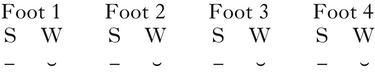
(13)
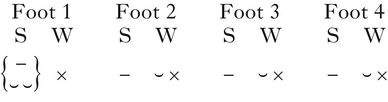
Each line comprises four feet. Non-initial feet have the form [−][˘ ×], akin to the Latin dactyl, except that the final syllable is indifferent to quantity. The first foot is exceptionally trochaic [−][×] or, with resolution, [˘ ˘][×]. Each foot in turn comprises two positions, labelled S and W here, by analogy with Latin (§1.1), though there is no basis for this labelling in the Tamil tradition. In traditional terms, the first position (acai) of each [−][˘ ×] metron is a nēr-acai and the second a nirai-acai, and the metron (cīr) as a whole a viḷam-cīr.
The first two quatrains of Kambar's epic are scanned in (14). A syllable is light iff it ends with a short vowel, including non-initial ai and au, indicated here with ˘. Final vowels usually scan as elided prevocalically, noted here with apostrophes. Resyllabification applies across words.
-
(14)
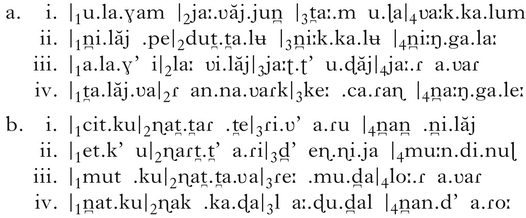
For present purposes, the first foot, being irregular, is put aside. The quantitative structure of the final three feet can be implemented by the constraints in (15).
-
(15)

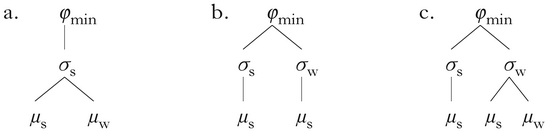
The first requires a metrical position to be a minimal foot (φm i n), i.e. a heavy syllable (sμμ), a pair of lights (sμsμ) or a resolved moraic trochee (sμsμμ), as depicted in (16).Footnote 17 φm i n is left-headed, and its leftmost (or only) branch is therefore labelled ss. ss refers here to the leftmost syllable of a metrical position, regardless of whether or not that syllable bears stress. The constraints in (15) therefore require a strong metrical position to be ssμμ (i.e. (16a)) and a weak metrical position to be ssμswμ(μ( (i.e. (16b, c)). A weak metrical position can contain a heavy syllable, but only in its weak branch, explaining the indifferent (×) positions as well as the impossibility of substituting − for ˘ ˘, as in Latin.
-
(16)
Nevertheless, exceptions to (15b) are fairly frequent. Line (14b.i), for instance, contains two exceptions, given in boldface in (17).
-
(17)

Previous work (e.g. Hart & Heifetz Reference Hart and Heifetz1988, Ryan Reference Ryan2011) acknowledges this exceptionality, but fails to note that such exceptions are almost entirely confined to unstressed syllables. Stress was likely uniformly initial in Old and Middle Tamil, the conservative Dravidian pattern (e.g. Zvelebil Reference Zvelebil1970, Hart & Heifetz Reference Hart and Heifetz1988, Krishnamurti Reference Krishnamurti2003; cf. also Christdas Reference Christdas1988, Beckman 1998, Keane Reference Keane2006 on Modern Tamil).Footnote 18
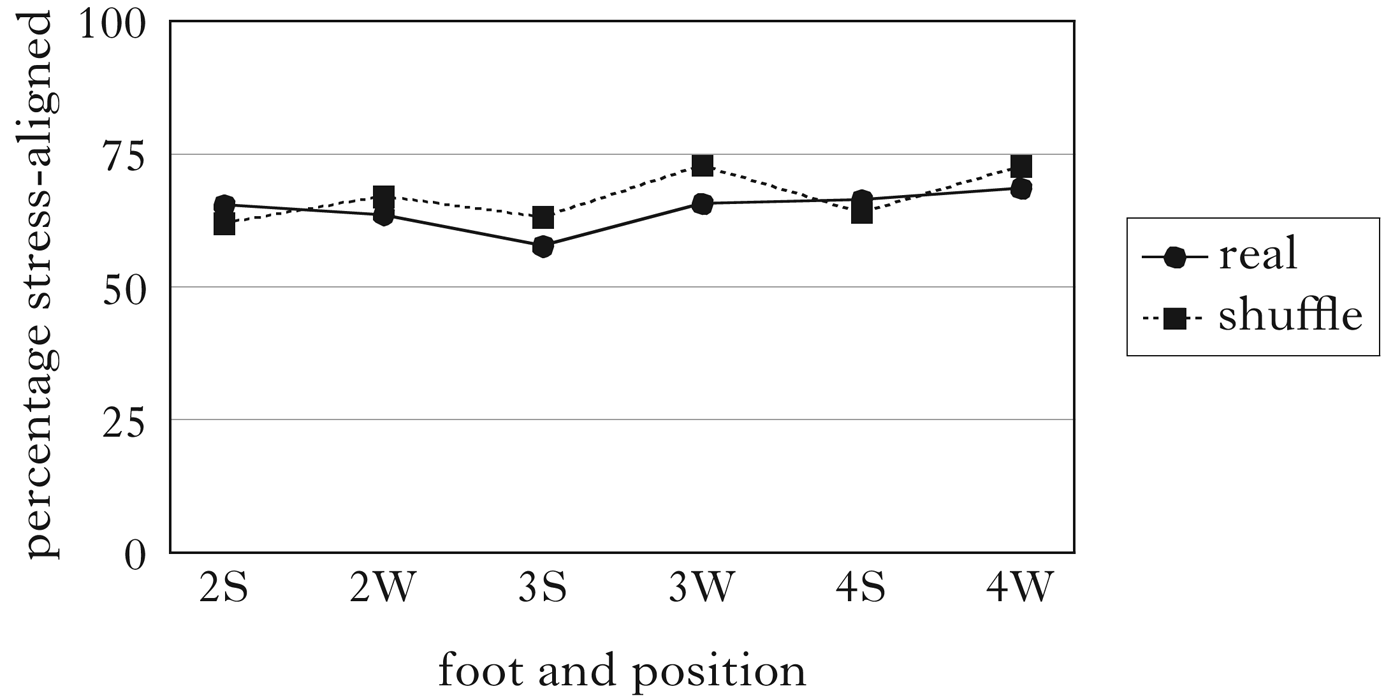
Before examining this effect of stress, however, it is important to be clear that the metre is not accentual in the traditional sense. That is, there is no explicit tendency for stress to coincide with strong positions or non-stress with weak positions, as there is in languages such as English, Latin and Old Norse. Figure 8 depicts the distribution of stress in the Tamil corpus, specifically the first 624 lines of Kambar's epic in the metre in (13). In this corpus, stress is aligned (i.e. stressed in S or unstressed in W) at consistently ~65% across positions. In the corpus as a whole, 67% of stressed syllables are heavy. Thus the distribution is exactly what one would expect if quantity is regulated, but stress ignored. To reinforce the argument, a shuffled corpus was constructed by concatenating words drawn at random from the real corpus (as in §1.1), keeping only lines that scanned as well-formed according to template (13), and ignoring stress. The distribution of stress in this shuffled corpus almost exactly matches that of the real corpus, supporting its non-regulation.
Percentage of stress alignment across the Tamil line, divided into feet (2 to 4) and position (S and W, excluding ×). Both the real distribution and a baseline of comparison are shown (real: N = 896; shuffle: N = 10,000).

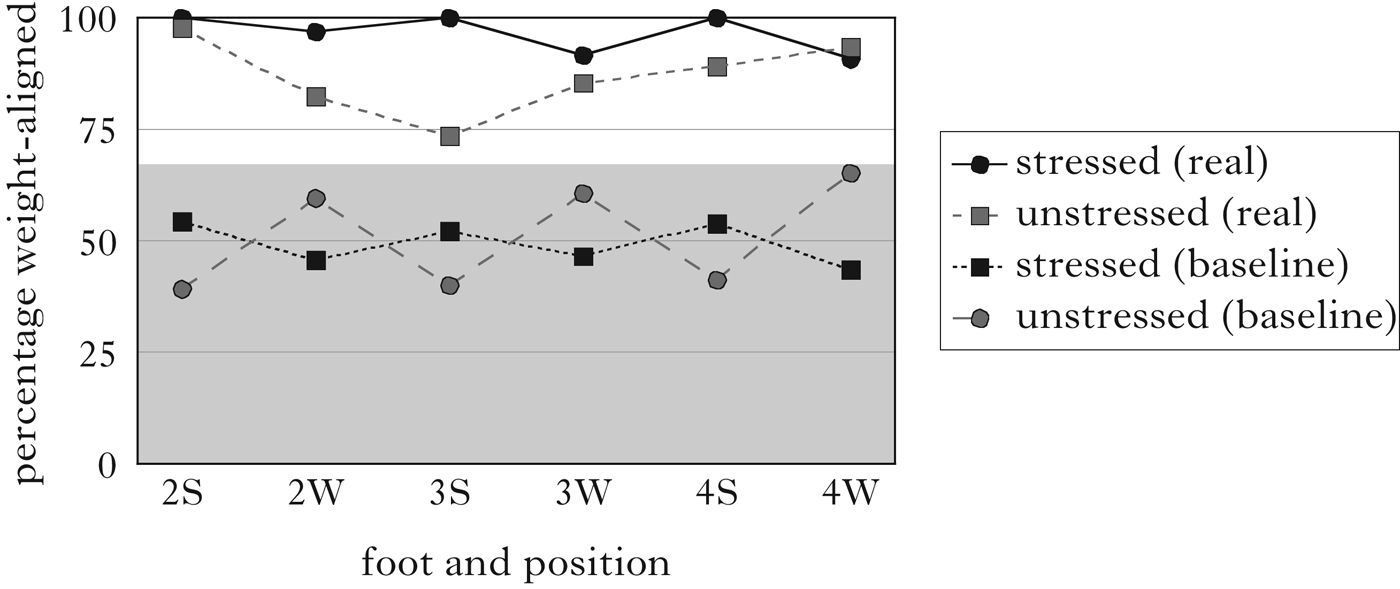
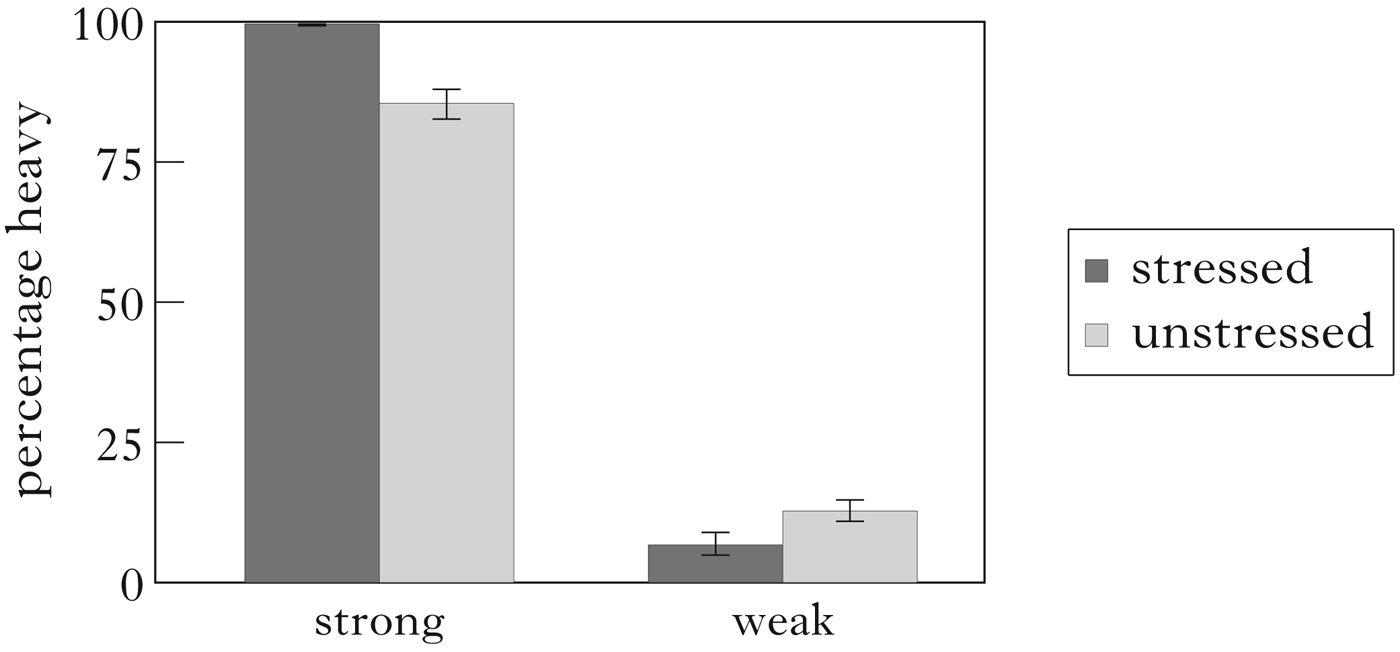
Although the metre does not regulate stress per se, it regulates weight more stringently for stressed than for unstressed syllables, as shown by Figs 9 and 10. The effect of stress is most salient in strong positions: in this corpus, no stressed syllable is light in a strong position, but 14% of unstressed syllables in strong positions are light (Fisher's exact test; OR=0, p<0.0001). In weak positions, stressed syllables are heavy 5% of the time, vs. 13% for unstressed syllables (OR=0.49, p<0.0001). Figure 9 shows the difference between stressed and unstressed syllables across positions of the line. It includes baseline rates (in the shaded region), based on a shuffled corpus controlling only for syllable count. Figure 10 shows the aggregate rate of heaviness in strong vs. weak positions as a function of stress.
Weight alignment across the Tamil line as a function of stress level. The upper two lines are the real corpus; the bottom two are constructed baselines based on shuffles.

Nearly categorical weight regulation for stressed syllables (dark bars) vs. less rigid regulation for unstressed syllables (light bars).

The basic weight-mapping constraint for Tamil was defined above as Strong⇔ssμμ (15b). This analysis can now be refined to accommodate the stress effect. Both stressed and unstressed syllables are regulated for weight, as the baselines in Fig. 9 make clear; they differ only in their degree of regulation. Thus Strong⇔ssμμ can be retained as a generic weight-mapping constraint that applies to all ss (i.e. metrical position-initial) syllables. Because there is no significant difference between strong and weak positions in the alignment of unstressed syllables (14% misaligned S vs. 13% misaligned W), Strong⇔ssμμ can remain bidirectional, equally penalising a heavy W and a light S. The constraint needs to be weighted, however, in order to account for the fact that weight-mapping in unstressed syllables is only a tendency.
Stress-modulated weight-mapping can be implemented by adding a stress condition to the weight-mapping constraint, as in (18). Because stress modulation is more severe for strong positions, separate constraints are invoked for strong and weak positions. Constraint (18b) specifies ss, in order to ensure that syllables in the right branches of weak positions are unregulated.
-
(18)
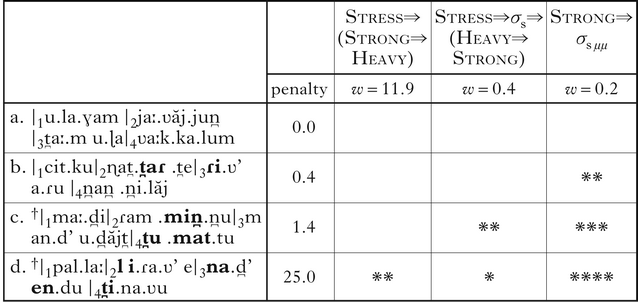
A weighted-constraint framework permits the modelling of both hard and soft constraints (for justification of such an approach to metrics, see especially Hayes et al. Reference Hayes, Wilson and Shisko2012; also Hayes & Moore-Cantwell Reference Hayes and Moore-Cantwell2011, Ryan Reference Ryan2011, McPherson & Ryan to appear). The most popular such framework for metrics has been maximum entropy Harmonic Grammar (MaxEnt HG; see Hayes & Wilson Reference Hayes and Wilson2008 for a general introduction). Constraints are assigned numerical weights corresponding to their strictness. Each candidate line receives a penalty score that is the sum of its weighted violations, which can then be translated into a probability. Learning software by Wilson & George (Reference Wilson and George2008) was used to train the weights of the three applicable mapping constraints on the Tamil corpus. (19) gives these weights and the penalties for four lines, two attested and two constructions (indicated by †).
-
(19)
2.2 Kalevala Finnish
Another example of a stress-modulated quantitative metre is provided by the Kalevala, a Karelian/Finnish epic of 22,795 lines, compiled and edited by Lönnrot (Reference Lönnrot1849). The metre is trochaic tetrameter, as in (20). Each position normally accommodates one syllable, such that lines are octosyllabic. This count can be increased by resolution, particularly in the first foot. Moreover, the surface form of the line might have fewer than eight syllables, due to the application of low-level phonological rules such as contraction and apocope, which Kiparsky (Reference Kiparsky and Gribble1968) analyses as applying subsequent to metrification. Aside from the metre per se, lines normally exhibit alliteration and avoidance of final monosyllables, the latter likely related to a more general tendency for longer words to occur later in the line (Sadeniemi Reference Sadeniemi1951, Kiparsky Reference Kiparsky and Gribble1968, Kaukonen Reference Kaukonen1979, Leino Reference Leino and Chesterman1986, Reference Leino, Siikala and Vakimo1994).
-
(20)
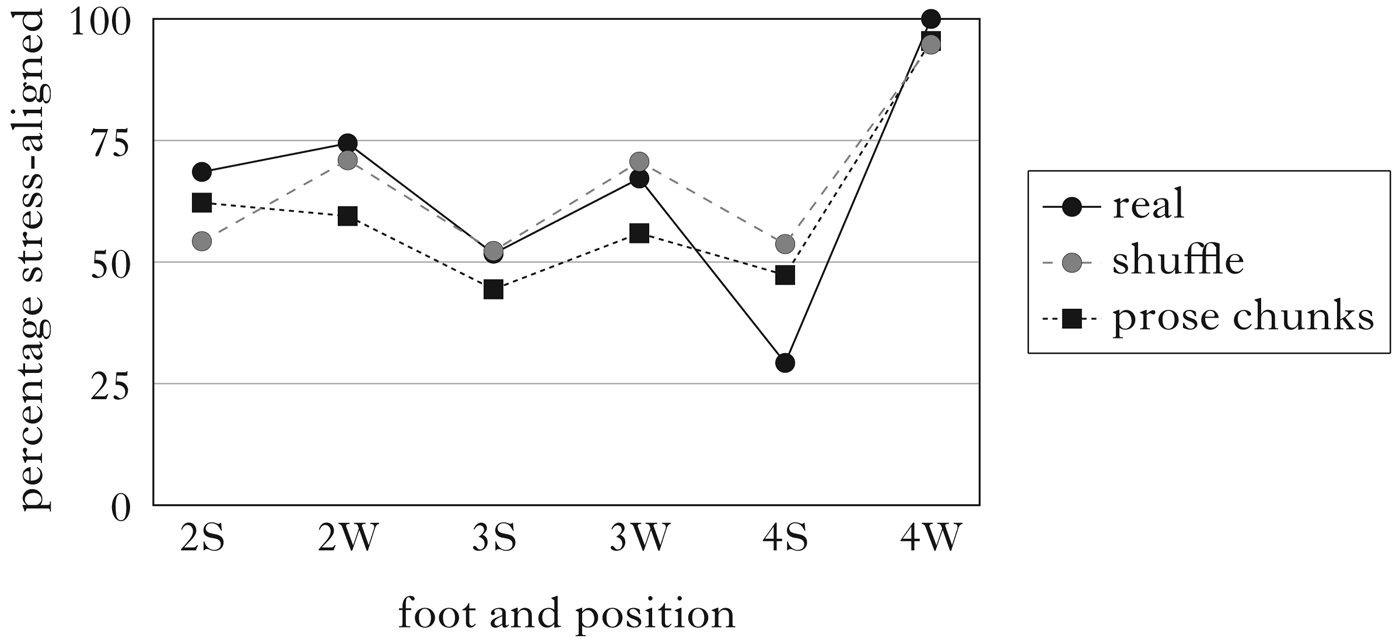
Like Tamil, the metre is not accentual in the traditional sense. Primary stressed syllables, which are uniformly word-initial, are neither preferred in strong positions nor avoided in weak ones. As Fig. 11 confirms, stress–metre alignment is middling throughout the line (except 4W), and never markedly higher than the baselines. 4W is well aligned across all of the corpora, because line-final monosyllables are infrequent. 4S is worse aligned than the baselines, because the real corpus shows a stronger tendency for longer words to be localised finally, pushing back word-initial stress to earlier positions. But this ‘end-weight’ tendency is unrelated to stress–metre alignment; as Fig. 11 shows, it has the opposite effect.
Stress alignment in the Kalevala. In strong positions, alignment is the percentage of syllables that is stressed; in weak positions, it is the percentage that is unstressed (real: N = 17,486; shuffle: N = 32,528; prose chunks: N = 8,289).

The Finnish corpora were derived as follows. The Kalevala corpus comprises 22,795 octosyllabic lines extracted from an online edition of the text. Duplicate lines were removed, as was any line exhibiting possible application of Kiparsky's (Reference Kiparsky and Gribble1968) post-metrification rules of contraction, apocope, vowel lengthening and gemination. Lines exhibiting possible application of any of these rules were easier to put aside than to correct (see Ryan Reference Ryan2011: 424f). These various exclusions reduced the size of the corpus by 23%, to 17,486 lines. The ‘shuffle’ corpus is a randomly permuted version of the real corpus, as in previous sections, with the same scansional criteria as for the real corpus. ‘Prose chunks’ comprise all octosyllabic phrases in the 1776 Finnish translation of the Bible. A phrase is taken to be as a sequence of one or more whole words standing between punctuation and summing to exactly eight syllables. 8,289 such phrases were extracted.
Weight-mapping in the Kalevala is stress-modulated. As traditionally described (Sadeniemi Reference Sadeniemi1951, Kiparsky Reference Kiparsky and Gribble1968), primary stressed syllables must be light (i.e. short vowel-final) in W and heavy in S. Other syllables are said to be unregulated, as are subminimal clitics such as ja ‘and’, presumably lacking stress. This mapping rule operates strongly only in the final three feet of the line. The first foot is virtually free; 35% of stressed syllables in it violate the rule. Exceptions are also encountered in the remainder of the line, but much less frequently (1.2% of stressed syllables in the second foot, 0.3% in the third and 0% in the fourth). Thus, oversimplifying only slightly, one can consider the first foot to be free and the later feet to be strict. As such, the first foot is excluded from the present analysis.
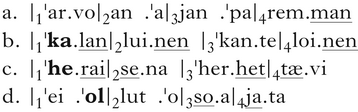
Four illustrative lines are scanned in (21). Exceptions to the metre are given in boldface, and unstressed syllables whose weight would conflict with the metre had they been stressed are underlined.Footnote 19
-
(21)
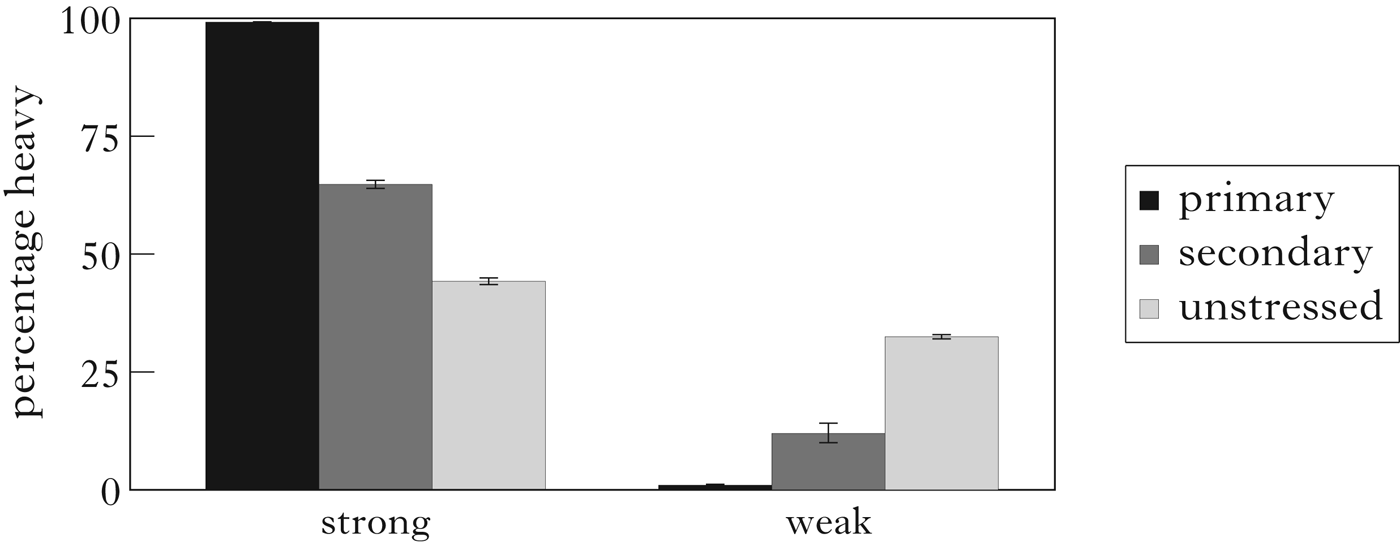
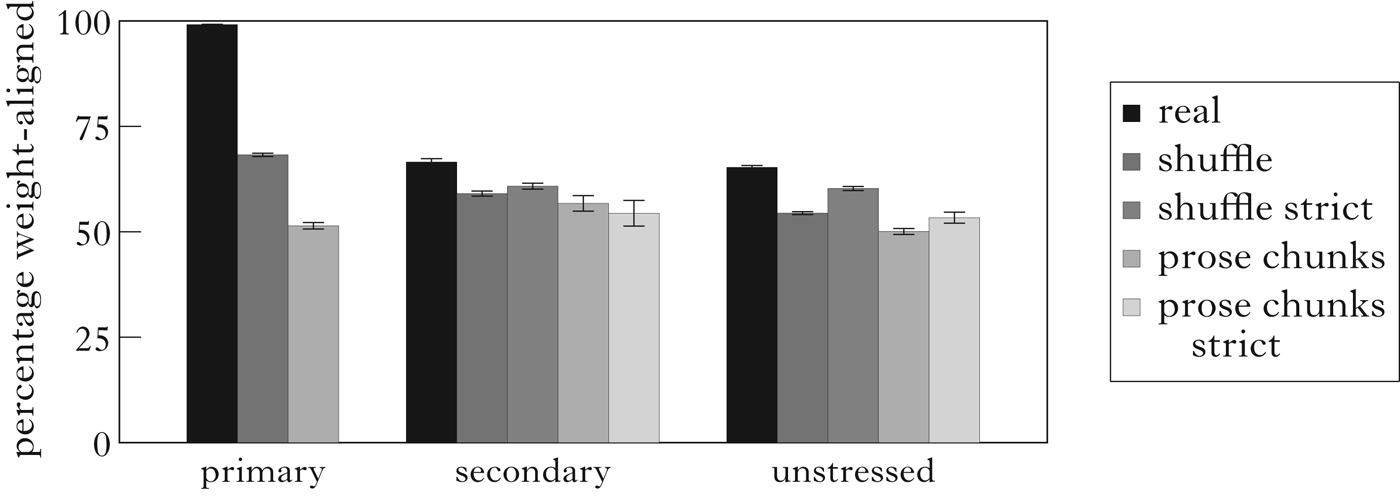
The aggregate effect of stress modulation in the final three feet is shown in Fig. 12. As with Latin in §1.1, to avoid concerns about whether monosyllables – usually function words – are stressed or not, they are ignored, and counted neither as stressed nor as unstressed. Primary stressed syllables are nearly categorically regulated for weight, being heavy 99.5% of the time in S and 1.0% of the time in W. This much is covered by the previous analyses, and can be implemented by the stress-modulated mapping constraint in (22), which has the same effect as the parameter settings in Hanson & Kiparsky (Reference Hanson and Kiparsky1996: 308).
-
(22)

Rate of heaviness in strong vs. weak positions as a function of stress level. The first foot is excluded, as are monosyllables.

Figure 12 also raises the possibility that weight-mapping occurs at above-chance levels for syllables lacking primary stress. This finding, if substantiated, would correspond to Tamil (§2.1), in which weight-mapping is nearly categorical for stressed syllables, and weaker, but not ignored, for unstressed syllables. We can now also distinguish between secondary and no stress. Secondary stress is assigned to every other non-final syllable following primary stress, unless it would land on a light followed by a non-final heavy, in which case two syllables were skipped (e.g. ˈtaittaˌjata, ˈkumottaˌvaisen; Hanson & Kiparsky Reference Hanson and Kiparsky1996: 301, Anttila Reference Anttila2010). As before, stress conditions are expressed in a stringency relation (cf. Prince Reference Prince1999, de Lacy Reference de Lacy2004). In §2.1, the conditions were ‘stressed’ and ‘all’, the former a subset of the latter. Given three stress levels, the nested conditions are (i) primary, (ii) primary and secondary and (iii) all, as reflected in constraints (22), (23a) and (23b) respectively.
-
(23)
The lines of the Kalevala were annotated for their violations of these three constraints and fed to the MaxEnt HG learning program used in §2.1. Their resulting weights were 2.82, 1.16 and 0.32 respectively, jibing impressionistically with the progressively dwindling contrasts in Fig. 12. Constraints (23a) and (b) were also subjected to likelihood-ratio tests (Hayes et al. Reference Hayes, Wilson and Shisko2012: 712). In both cases, the superset model including the constraint significantly outperformed the subset model excluding it (p<0.0001), justifying the three-constraint model over any one- or two-constraint alternative.
Another means of testing whether non-primary-stressed syllables are regulated is to compare their real alignment to that of the baselines described above. Figure 13 shows aggregate alignment per stress level in each corpus, based on the critical portion of the line, i.e. the third through seventh positions. As before, the first foot is excluded, as is the final position, which may be indifferent. Unsurprisingly, primary stress is best aligned in the real corpus. But this is also the case for secondary and no stress, as Fig. 13 shows. For every stress level, the real corpus (leftmost bar) is significantly better aligned than the comparanda. The comparanda are also given in ‘strict’ versions, in which primary stress is required to align. These versions are included to demonstrate that secondary and unstressed alignment are not merely automatic reflexes of primary stress alignment.
Weight alignment as a function of stress level in several corpora, including the real Kalevala (the black bar in each group) as well as four baselines of comparison (see text).

In sum, the Kalevala metre requires weight to align with the metre (heavy in S and light in W) nearly categorically for primary stressed syllables. A new finding here is that non-primary stressed syllables also tend to align significantly with the metre, albeit more flexibly, just as they did in Tamil (§2.1). In the Kalevala metre, stress modulation is gradient, such that primary stressed syllables are most strictly regulated, followed by secondary stressed and then unstressed syllables. This scale was proposed here to be implemented by mapping constraints that refer to stress levels in a stringency relationship.
3 Discussion
As established in §2, among possible three-way mappings of stress, weight and metre, only stress-modulated quantitative metres (schematically, Stress⇒(Strong⇔Heavy)) have been attested. This section considers other logically possible three-way mappings and possible causes for their absence from the typology.
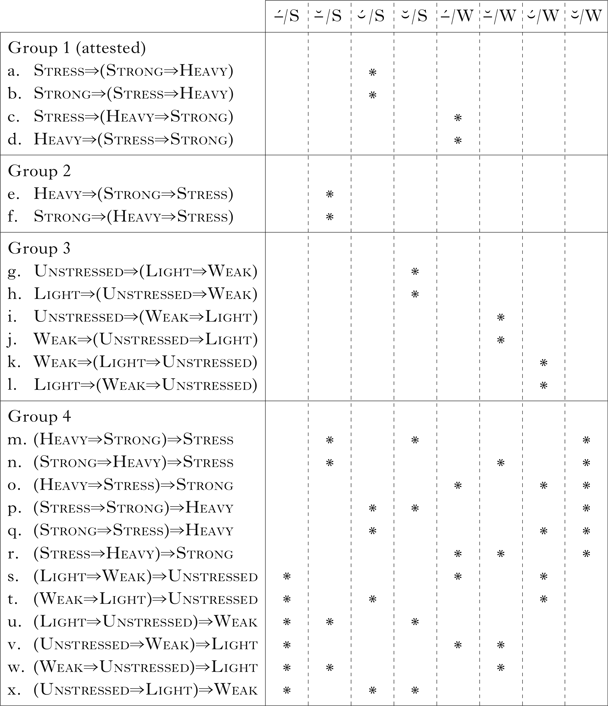
Before turning to three-way mappings, however, consider first the simpler case of a two-way mapping, say, between stress and weight. Both Stress-to-Weight (‘penalise a stressed light’) and Weight-to-Stress (‘penalise an unstressed heavy’) are conventionally recognised (e.g. Prince Reference Prince1990, Kager Reference Kager1999, Smith Reference Smith2002). These two constraints could also be formalised respectively as Stress⇒Heavy (or, equivalently, Light⇒Unstressed) and Heavy⇒Stress (or, equivalently, Unstressed⇒Light). (24) is a truth table (not a ranked tableau) showing the violations of all logically possible conditionals from stress ∈ {stressed, unstressed} to weight ∈ {heavy, light}, and vice versa. The columns are the four possible combinations of weight (− for heavy and ˘ for light) and stress (´ for stressed and ˘ for unstressed).
-
(24)
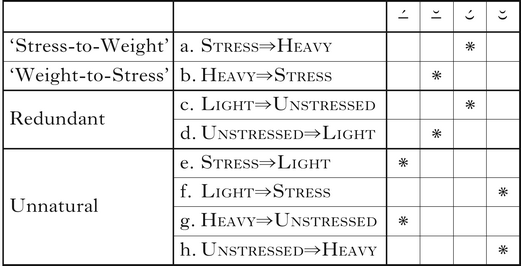
Constraints (e)–(h) in (24) are unnatural, as each maps a strong element onto a weak element, resulting in a markedness reversal. By hypothesis – termed scalar alignment in (25) – a legal mapping constraint can relate strong to strong and/or weak to weak, but not mix polarities. Although scales are treated as binary in this section, this principle extends straightforwardly to more complex scales if they are stringent, as they are throughout this article. In that case, ‘strong element’ can be read as ‘class of elements that is contiguous with the strong end of the scale’. For example, in Finnish, scalar alignment would be violated by both (more stringent) MainStress⇒Light and (less stringent) Stress⇒Light.Footnote 20
-
(25)
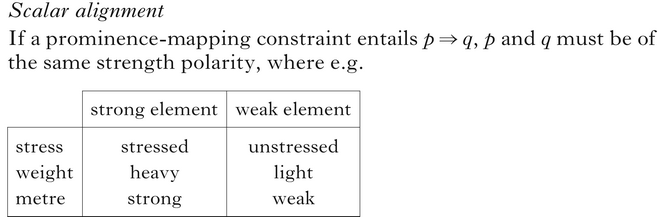
Table I shows the violation vectors of all 24 logically possible combinations of three terms in which each scale occurs once per constraint and polarities agree across terms. The horizontal axis comprises all eight combinations of stress, weight and metrical strength (S or W). Only unidirectional conditionals are shown. Biconditionals can be derived by combining constraints, in the sense of ranking them in the same place and pooling their violations (e.g. combining (a) and (c) yields Stress⇒(Strong⇔Heavy), which is violated whenever (a) or (c) is violated). Half of the constraints in groups 1–3 are redundant, since p⇒(q⇒r) is equivalent to q⇒(p⇒r).
Violation vectors of all logically possible unidirectional combinations of three strength predicates (without repetitions or polarity disagreements).

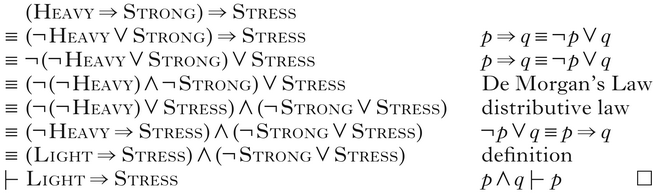
Of the constraints in Table I, only group 1 is attested, though given the small sample size, we should be cautious about imputing impossibility to gaps. Nevertheless, some possible rationales for the absence of groups 2–4 are advanced in the following paragraphs. First, group 4 comprises constraints of the form (p⇒q)⇒r, in which a conditional serves as an antecedent. Each of these constraints implies a markedness reversal. For example, (m) penalises ˘͜/W but not ˘́/W. The latter is more marked, since it adds stress to a weak position. Group 4 can be ruled out by scalar alignment, as defined in (25). Although the terms ostensibly agree in polarity within each constraint, the way in which they are connected entails p⇒q, in which p and q conflict in polarity. A proof is given in (26), in which ‘≡’ denotes logical equivalence and ‘⊢’ denotes entailment.
-
(26)
The remaining unattested groups – groups 2 and 3 – cannot be ruled out by scalar alignment. Group 3 contains constraints stated over weak terms. For example, (g), Unstressed⇒(Light⇒Weak), implements a metre in which strong positions must be heavy, but only unstressed syllables are evaluated. This is a type of stress-modulated quantitative metre, but evidently not a type that exists. In all known stress-modulated quantitative metres (as in §2), Stress (or MainStress) serves as the antecedent. Group 3 can therefore tentatively be ruled out by the no-weakness conjecture in (27). Prominence-mapping constraints apparently need only to refer to strong elements. Indeed, none of the constraints posited in this article invokes a weak element; only Stress, Heavy, Strong and (in one case) ss are invoked. For a two-way conditional, this is arbitrary; for instance, Light⇒Weak is equivalent to Strong⇒Heavy, so one can simply translate between all-weak and all-strong formulations. Similarly, W⇒¬P in Hanson & Kiparsky (Reference Hanson and Kiparsky1996) (‘a weak position must not be prominent’) could also be expressed in terms of strong elements (e.g. Stress⇒Strong). But for a three-way mapping of the type p⇒(q⇒r), such a translation is impossible. For example, Unstressed⇒(Light⇒Weak) is crucially weak; it cannot be restated as p⇒(q⇒r) in which p, q and r are all strong elements.
-
(27)

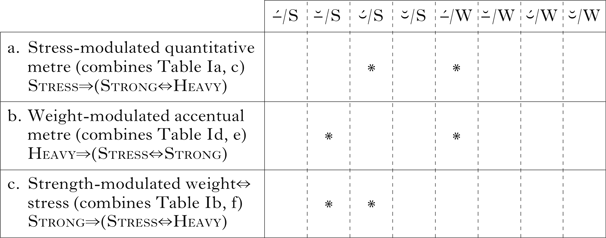
Finally, consider group 2 in Table I. This group permits the expression of two types of unattested modulations, namely (b) and (c) in Table II. The first, a weight-modulated accentual metre, requires heavy syllables to be stressed in strong positions and unstressed in weak positions. The second, stress-modulated weight⇔Stress, requires weight and stress to agree in strong positions.
Three logically possible types of modulation, of which only (a) is attested.

A few possible (not mutually exclusive) explanations for these gaps are considered here, though such a discussion is necessarily tentative, given the small size of the relevant typology (i.e. three cases of Table IIa). The first resides in the typology of privilege, where privilege refers to phonological elements that license other elements or processes by virtue of their salience or prominence. In surveys of privilege, stress is widely acknowledged to be such an antecedent, but weight is not (Beckman Reference Beckman2011). In this respect, stress-controlled weight-mapping may be more natural than weight-controlled stress-mapping, as stress is a more canonical realisation of privilege/prominence than weight. Moreover, in the case of (c), Strong⇒(Stress⇔Heavy), the embedded biconditional Stress⇔Heavy is not a possible metre, so it presumably cannot serve as the kernel of a modulated mapping for that reason.
A second potential justification for (a) as opposed to (b) and (c) concerns the origin and distribution of such metres. Hanson & Kiparsky (Reference Hanson and Kiparsky1996), following Sadeniemi (Reference Sadeniemi1949), note that quantity is only lexically distinctive in stressed (i.e. initial) syllables in (pre-)Kalevala Finnish; therefore, the stress antecedent in metre may reflect its role as a licensor in the general phonology. Something close to the same situation is found in early Tamil. In many Dravidian languages, and possibly Proto-Dravidian, distinctive quantity is confined to initial position, as is stress (Barnes Reference Barnes2002: 51ff). Middle Tamil represents a more complex situation, in which lexically distinctive quantity largely, though not entirely, correlates with initial position, which remained privileged in various ways (Beckman Reference Beckman2011). But under Sadeniemi's isomorphism hypothesis, this is exactly what one would expect for Tamil, given that it regulates initial syllables nearly strictly, and non-initial syllables intermediately. The degree to which this isomorphism holds typologically is left to future work. It is offered here merely as a plausible explanation for the selection of stress-modulated quantitative metres in languages such as Finnish and Tamil, but not, say, Arabic or Classical Latin.
In sum, this section has suggested four possible restrictions on the typology of three-way prominence mappings. First, constraints must abide by scalar alignment, which guarantees that they do not impose any markedness reversals. Second, mapping constraints seem never to crucially invoke weak elements or classes. For example, Unstressed is not known to serve as the antecedent of a stress-modulated quantitative metre. Thus a no-weakness condition has been hypothesised. Third, weight-modulated accentual metres may be unattested because such a modulation would violate hierarchies of privilege. Finally, a functional motivation for stress-modulated quantitative metres may reside in the prosodic isomorphism between metrics and the phonology of the language, in that both Finnish and Tamil are languages in which lexical distinctions in quantity were historically associated with accent.
4 Conclusion
While metrical prominence-mapping is often exclusively accentual or quantitative, some metres are sensitive to both of these dimensions. Typologically, these hybrid accentual-quantitative metres comprise two types, here termed independent mapping and interactive mapping. Independent mapping occurs when a metre requires both stress-mapping and weight-mapping constraints (schematically, Strong⇔Heavy and Strong⇔Stress), but no individual mapping constraint needs to invoke both stress and weight. It has been illustrated here with Latin (Virgil's hexameter; §1.1–§1.2) and Old Norse (the dróttkvaett; §1.3). In such a metre, all mapping constraints must answer to the same underlying metre; the situation is not one of simultaneous metres.
The second type of hybridity is interactive mapping, i.e. metres in which one or more individual mapping constraints must refer simultaneously to weight, stress and metre. Such metres are apparently universally stress-modulated quantitative metres (schematically, Stress⇒(Strong⇔Heavy)), in which weight is regulated more strictly for syllables with greater stress. Furthermore, this modulation is typically (perhaps universally) gradient, such that the higher the stress level, the stricter the weight-mapping. But syllables without stress appear never to be wholly ignored. This is true for Middle Tamil (§2.1) and Kalevala Finnish (§2.2), both analysed here, and also claimed for Serbo-Croatian by Jakobson (Reference Jakobson and Jakobson1966: 418f; cf. Zec Reference Zec2009). Stress-modulated quantitative metres constitute only a small subset of logically possible three-way prominence-mappings. Several possible motivations for this typology, both formal and functional, were discussed in §3, including scalar alignment, the no-weakness conjecture, phonological privilege and prosodic isomorphism between the metre and its associated language.