Introduction
The lack of emotional management tools can lead to a wide range of symptoms, including depressive symptoms and hopelessness, which are detrimental to mental health, when facing negative life events (Cha and Nock, Reference Cha and Nock2009; Salguero et al., Reference Salguero, Extremera, Cabello and Fernández-Berrocal2015). Older adults need emotional management resources to cope with change because the aging process involves multiple changes at different levels of the individual which affect adaptation (Chen et al., Reference Chen, Peng and Fang2016). These losses make coping a key variable in the successful adaptation and recovery of older adults. The effectiveness of interventions based on positive constructs has been demonstrated. These interventions, in addition to preventing disease, enhance various psychological constructs that are a source of well-being and strength (Hodzic et al., Reference Hodzic, Scharfen, Ripoll, Holling and Zenasni2018; Nelis et al., Reference Nelis, Quoidbach, Mikolajczak and Hansenne2009).
Emotional intelligence (EI) is a variable that has been found to be a strong predictor of negative mood and adaptive coping in recent literature (Luque-Reca et al., Reference Luque-Reca, Augusto-Landa and Pulido-Martos2016; Rey et al., Reference Rey, Extremera and Sánchez-Álvarez2017). EI has theoretically been conceptualized according to different approaches. On the one hand, mixed models consider EI to be a multidimensional construct that includes cognitive skills, personality traits, and affective and motivational dispositions. In this regard, trait EI refers to a constellation of emotion-based personality dispositions located at lower levels of personality hierarchies (Petrides et al., Reference Petrides, Pérez-González and Furnham2007). Essentially, this construct is concerned with people’s perceptions of their emotional abilities (Weaving et al., Reference Weaving, Orgeta, Orrell and Petrides2014). From this perspective, it has been observed that EI affects the perception of emotional and stressful situations. For example, individuals with high trait EI show greater self-efficacy in coping with stress and are more likely to view stressful situations as challenging rather than threatening (Mikolajczak and Luminet, Reference Mikolajczak and Luminet2008). Furthermore, Weaving et al. (Reference Weaving, Orgeta, Orrell and Petrides2014) found that lower trait EI was associated with higher levels of depression.
On the other hand, ability models define EI as a range of emotional and cognitive skills that unify these two dimensions. These skills consist of accurately perceiving, valuing, and expressing emotions, accessing and/or producing feelings that facilitate thought, understanding these emotions, and regulating them to foster emotional–intellectual growth. This definition corresponds to the EI model and is known as the hierarchical EI ability model (Mayer and Salovey, Reference Mayer, Salovey, Salovey and Sluyter1997; Salovey and Mayer, Reference Salovey and Mayer1990).
Using an integrative theoretical model, Joseph and Newman (Reference Joseph and Newman2010) suggest that both ability models and mixed models of EI can be measured with self-report and performance-based measures, and, accordingly, they distinguish between performance-based ability EI, self-reported ability EI, and self-reported mixed EI. Thus, ability models and trait models of EI are different and do not measure the same construct.
However, all the models and their respective measures have shown significant associations between emotional competencies and skills and relevant mental health outcomes, such as adaptive coping and negative mood. In fact, in an intervention with adults carried out by Kotsou et al. (Reference Kotsou, Nelis, Grégoire and Mikolajczak2011), where an integrative model developed through mixed self-reports was taken into account, the results showed that EI correlates negatively with trait anxiety, stress, depression, burnout, and negative affect in general. The authors propose that the reason for these results is that EI would moderate reactions to negative and stressful events (Kotsou et al., Reference Kotsou, Nelis, Grégoire and Mikolajczak2011). Therefore, individuals with high EI would appraise these events less negatively and use more efficient coping and regulation strategies.
The ability model has not been tested in interventions with older adults. However, many results indicate a strong relationship between EI evaluated with ability self-reports and relevant results associated with adaptation and mood in older adults, which are critical variables during aging (Delhom et al., Reference Delhom, Gutierrez, Mayordomo and Melendez2018; Kong et al., Reference Kong, Gong, Sajjad, Yang and Zhao2019; Lloyd et al., Reference Lloyd, Malek-Ahmadi, Barclay, Fernandez and Chartrand2012).
Therefore, EI is a protective factor against situations that generate negative moods (Mayer and Salovey, Reference Mayer, Salovey, Salovey and Sluyter1997). From the perspective of the ability model, the dimensions of clarity and repair have been negatively related to depressive affect and emotional discomfort, whereas attention has a positive relationship with them (Sánchez-Álvarez et al., Reference Sánchez-Álvarez, Extremera and Fernández-Berrocal2016). Thus, the dimension of attention to emotions, whether excessive or lacking, is not considered an indicator of adaptive EI (Sánchez-Álvarez et al., Reference Sánchez-Álvarez, Extremera and Fernández-Berrocal2015), with intermediate scores on attention indicating a good fit on this construct. Clarity and repair are considered highly explanatory of EI and beneficial for individuals in their relationships with their own emotions and those of others (Salovey et al., Reference Salovey, Bedell, Detweiler, Mayer and Snyder1999; Sánchez-Álvarez et al., 2015). In other words, people with an adaptive EI pattern obtain high scores on clarity and repair and moderate scores on attention. In addition, EI has been closely linked to coping during aging (Delhom et al., Reference Delhom, Gutierrez, Mayordomo and Melendez2018), to the extent that adaptive coping could be conceptualized as EI in action (Keefer et al., Reference Keefer, Parker, Saklofske, Parker, Saklofske and Stough2009). Coping consists of cognitive and behavioral efforts that constantly change and are developed to deal with specific external or internal situations that might overwhelm the individual’s resources (Lazarus and Folkman, Reference Lazarus and Folkman1984). The relationship between EI and mood has been shown to depend largely on the coping strategies that the person use to manage life experiences. EI has shown positive relationships with problem-focused coping and negative relationships with emotion-focused coping (Saklofske et al., Reference Saklofske, Austin, Galloway and Davidson2007). Zeidner et al. (Reference Zeidner, Matthews and Roberts2012) showed that people with higher scores on EI are able to cope with everyday stressors and damage more easily, taking action through more effective coping (Keefer et al., Reference Keefer, Parker, Saklofske, Parker, Saklofske and Stough2009). Thus, EI plays an important role in emotional self-control and the individual’s adaptive ability to cope with stressful situations by promoting the use of strategies that mitigate negative emotions and maintain positive ones (Zeidner et al., Reference Zeidner, Matthews and Shemesh2016).
Both EI in general and the relationship of each EI dimension with coping are decisive in preserving positive mood during aging (Delhom et al., Reference Delhom, Gutierrez, Mayordomo and Melendez2018). Older people with good reparation and clarity skills benefit from more adaptive strategies based on reflection and active coping. By contrast, people who focus too much attention on their emotions and do not understand them properly are not able to handle them effectively and tend to develop passive coping (Rey et al., Reference Rey, Extremera and Sánchez-Álvarez2017).
Considering the need for emotional management tools in older adults due to their impact on mental health, the development of EI skills could contribute to adaptive coping and reductions in negative mood. Characteristics of the EI construct itself (flexibility and change) support the possibility of intervening in older adults. Therefore, this study aims to implement an EI intervention to increase the clarity and repair of EI dimensions, centralize the emotional attention score, improve adaptive coping strategies, and reduce negative mood in older adults.
Methods
Participants
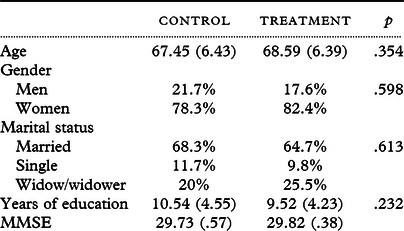
Participants included 111 older adults from Valencia (Spain). They were recruited through four senior centers. Participants were initially contacted by phone, and a face-to-face appointment was scheduled to determine whether they met the inclusion criteria. Inclusion criteria were: aged 65 or more, not being under institutional care, not having a cognitive impairment that interfered with their daily activities, evaluated with the Mini-Mental State Exam (MMSE; Folstein et al., Reference Folstein, Folstein and McHugh1975), and not receiving pharmacological or psychological therapy for depression or other psychiatric diseases. All the participants met the criteria and gave their written informed consent. Our study follows the principles of the Declaration of Helsinki. Initially, 60 were randomly assigned to a treatment group and 65 to a control group. In the treatment group, nine participants dropped out (due to not attending 20% of the sessions), and 51 participants finished the intervention; in the control group, five participants dropped out (did not perform the second evaluation), and 60 participants remained at the end. The participants did not receive an alternative intervention; instead, they became part of a waiting list to receive the intervention after the post-evaluation. Table 1 shows sociodemographic data and tests for homogeneity between the groups at pretreatment.
Sociodemographic data and inclusion/exclusion criteria of groups

Materials
MMSE (Folstein et al., Reference Folstein, Folstein and McHugh1975) is a screening test that quantitatively estimates the existence and severity of cognitive impairment. The maximum score is 30 points, which is obtained by adding together the scores on all the items. The cutoff score for dementia is usually set at 23 points.
Trait Meta-Mood Scale (Salovey et al., Reference Salovey, Mayer, Goldman, Turvey, Palfai and Pennebaker1995), the 24-item version, validated in elderly people by Delhom et al. (Reference Delhom, Gutierrez, Lucas-Molina and Meléndez2017), was administered. This self-report scale offers a measure of intrapersonal EI based on the theoretical model by Salovey and Mayer (Reference Salovey and Mayer1990). The scale contains three key dimensions: attention to feelings, emotional clarity, and repair and regulation of emotions, evaluated on a five-point Likert-type scale (1 = strongly disagree and 5 = strongly agree). Estimations of reliability using Cronbach’s alpha were: .72 for attention, .84 for clarity, and .86 for repair.
The Coping Strategies Questionnaire (CAE; Sandín and Chorot, Reference Sandín and Chorot2003) is a self-report measure of general coping consisting of 42 items with Likert-type response options ranging from never (0) to almost always (4). It is designed to assess seven basic coping styles: (1) problem-solving coping, (2) negative self-focused, (3) positive reappraisal, (4) overt emotional expression, (5) avoidance, (6) seeking social support, and (7) religious. The questionnaire was adapted to older adults. A confirmatory factor analysis was performed on these seven coping dimensions to test a two-factor solution composed of problem- and emotion-focused coping (Tomás et al., Reference Tomás, Sancho and Meléndez2013). The alpha values obtained in our study were .78 (problem-solving coping), .73 (negative self-focused coping), .78 (positive reappraisal), .73 (overt emotional expression), .70 (avoidance coping), .89 (social support seeking), and .84 (religious coping).
The Beck Hopelessness Scale (BHS; Beck et al., Reference Beck, Weissman, Lester and Trexler1974), adapted to a nonclinical Spanish elderly population (Satorres et al., Reference Satorres, Ros, Meléndez, Serrano, Latorre and Sales2018), is a 20-item self-report inventory designed to tap a general tendency toward pessimism and negative expectations. Based on the original cutoff scores, the participants were classified into four groups: no hopelessness at all (0–3), mild (4–8), moderate (9–14), and severe (15–20) hopelessness. The BHS reflects an individual’s negative expectations about the probability of attaining important goals. Cronbach’s alpha in this study was .84.
Centre for Epidemiologic Studies-Depression (CES-D; Radloff, Reference Radloff1977; Ros et al., Reference Ros, Latorre, Aguilar, Serrano, Navarro and Ricarte2011) is a short self-report scale designed to measure depressive symptomatology in the general population. It consists of 20 items that assess symptoms of depression during the week before the test. The CES-D is widely used in research with adults of all ages, and it has high reliability, internal consistency, and discriminant and construct validity. The internal consistency estimate for this study was .73.
Procedure
First, a pilot intervention was designed that was administered to two groups of 10 participants (n = 20) and served to make improvements in the intervention design. The recruitment process was sequential, so that the researchers came into contact with different senior centers in the city of Valencia (Spain). An appointment was made with the heads of each center to inform them about the study objectives and present the evaluation protocol. In the cases where the proposal was accepted, agreement was reached about the days that the investigator would administer the intervention. Control group participants completed the same measures at the same time as the intervention group, but they were not exposed to the intervention.
Intervention
The intervention was designed to favor EI development based on an ability model with three dimensions: attention, clarity, and emotional repair, in order to improve adaptive strategies and reduce negative mood.
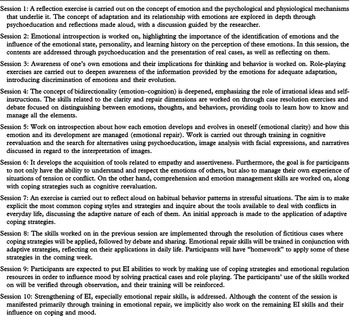
The intervention consisted of 10 group sessions, 1 per week, with a duration of 90 min each. In addition, there was an initial session for the pre-intervention evaluation and the presentation of the program and a final session for the final evaluation. The groups were composed of between 8 and 12 participants. In all cases, practical activities were designed, mostly as a group, to train the skills introduced. The content of the program sessions is presented in Table 2.
Description of the sessions

Analysis
Prior to the intervention, the sociodemographic characteristics of the groups were compared to verify their homogeneity, and t-tests were performed for independent samples on the qualitative dependent variables of age and years of education. Chi-square tests were performed on the variables of gender and marital status because these dependent variables are categorical. To analyze the effects of the intervention, a mixed analysis of variance was carried out for each dependent variable to study the interaction (group × time), as well as the simple effects of time and group. Bonferroni post hoc tests were used to analyze the significant interactions.
Results
EI
Regarding the dependent variable Attention, a mixed analysis of variance (2 times × 2 groups) was performed that showed a significant main effect of the time variable (F(1, 109) = 10.56, p = .002,
 $\eta _p^2$
= 0.088) and the significant main effect of the group variable (F(1, 109) = 7.41, p = .008,
 $\eta _p^2$
= 0.064). Finally, the time × group interaction was significant (F(1, 109) = 5.51, p = .021,
 $\eta _p^2$
= 0.048). Bonferroni post hoc tests to analyze this significant interaction showed that the difference between the groups at time 1 was not significant, but at time 2, the comparison of the groups showed a significant difference (p = .001). Moreover, the difference between the means at T1 and T2 was not significant in the control group, but the mean at T2 was significantly lower than the mean at T1 in the treatment group (p < .001), indicating that our treatment was effective in decreasing attention (see Table 3).
Means (and SD) for the emotional intelligence (EI)-dependent variables as a function of time (T1 = before treatment; T2 = after treatment) and group

The mixed analysis of variance for the dependent variable Clarity showed a significant main effect of time (F(1, 109) = 14.03, p < .001,
 $\eta _p^2$
= 0.114) and group (F(1, 109) = 4.19, p = .008,
 $\eta _p^2$
= 0.063), and the time × group interaction was significant (F(1, 109) = 11.15, p = .001,
 $\eta _p^2$
= 0.093). Bonferroni post hoc tests to analyze this significant interaction showed that the difference between groups was not significant at time 1, but at time 2, the comparison of the groups showed a significant difference (p < .001), with higher scores in the treatment group. Moreover, the difference between the means of T1 and T2 was not significant in the control group, but the T2 mean was significantly higher than the T1 mean in the treatment group (p < .001), indicating that our treatment was effective in increasing clarity (see Table 3).
Finally, a mixed analysis of variance was applied to the dependent variable Regulation, obtaining significant main effects for time (F(1, 109) = 11.69, p = .001,
 $\eta _p^2$
= 0.097) and group (F(1, 109) = 4.81, p < .030,
 $\eta _p^2$
= 0.042). The time × group interaction was significant (F(1, 109) = 23.63, p < .001,
 $\eta _p^2$
= 0.178). Bonferroni post hoc tests to analyze this significant interaction showed that the difference between groups was not significant in time 1, but in time 2, the comparison of the groups showed a significant difference (p < .001), with higher scores in the treatment group. In addition, the difference between the means of T1 and T2 was not significant in the control group, but the T2 mean was significantly higher than the T1 mean in the treatment group (p < .001), indicating that our treatment was effective in increasing repair (see Table 3).
Coping strategies
Regarding the dependent variable Problem-solving coping, a mixed analysis of variance (2 times × 2 groups) was performed and showed a significant main effect of time (F(1, 109) = 16.90, p < .001,
 $\eta _p^2$
= 0.134), but not group (F(1, 109) = .44, p = .504,
 $\eta _p^2$
= 0.004). The time × group interaction was significant (F(1, 109) = 15.11, p < .001,
 $\eta _p^2$
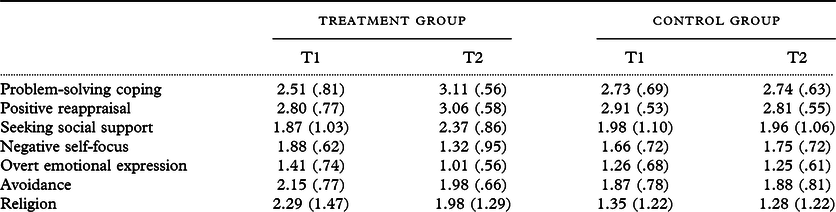
= 0.122). Bonferroni post hoc tests to analyze this significant interaction showed that the difference between groups was not significant in time 1, but in time 2, the comparison of the groups showed a significant difference (p = .002), with higher scores in the treatment group. Furthermore, the difference between the means in T1 and T2 was not significant in the control group, but the mean in T2 was significantly higher than the mean in T1 in the treatment group (p < .001), indicating that our treatment was effective in increasing problem-solving coping (see Table 4).
Means (and SD) for the coping strategies as dependent variables as a function of time (T1 = before treatment; T2 = after treatment) and group

The mixed analysis of variance for the dependent variable Positive reappraisal did not show a significant main effect of time (F(1, 109) = 9.15, p = .003,
 $\eta _p^2$
= 0.077) or group (F(1, 109) = .61, p = .439,
 $\eta _p^2$
= 0.006). However, the time × group interaction was significant (F(1, 109) = 19.15, p = .003,
 $\eta _p^2$
= 0.077). Bonferroni post hoc tests to analyze this significant interaction showed that the difference between groups was not significant in time 1, but in time 2, the comparison of the groups showed a significant difference (p = .045), with higher scores in the treatment group. In addition, the difference between the means for T1 and T2 was not significant in the control group, but the mean for T2 was significantly higher than the mean for T1 in the treatment group (p = .004), indicating that our treatment was effective in increasing positive reappraisal (see Table 4).
The mixed analysis of variance for the dependent variable Seeking social support showed a significant main effect of time (F(1, 109) = 8.07, p = .005,
 $\eta _p^2$
= 0.069), but not group (F(1, 109) = .74, p = .390,
 $\eta _p^2$
= 0.007). However, the time × group interaction was significant (F(1, 109) = 8.81, p = .004,
 $\eta _p^2$
= 0.075). Bonferroni post hoc tests to analyze this significant interaction showed that the difference between groups was not significant in time 1, but in time 2, the comparison of the groups showed a significant difference (p = .030), with higher scores in the treatment group. Moreover, the difference between the means for T1 and T2 in the control group was not significant, but the mean for T2 was significantly higher than the mean for T1 in the treatment group (p < .001), indicating that our treatment was effective in increasing seeking social support coping strategies (see Table 4).
Regarding the dependent variable negative self-focus, a mixed analysis of variance (2 times × 2 groups) was performed, showed a significant main effect of time (F(1, 109) = 8.77, p = .004,
 $\eta _p^2$
= 0.074), but not group (F(1, 109) = .68, p = .411,
 $\eta _p^2$
= 0.006). The time × group interaction was significant (F(1, 109) = 16.99, p < .001,
 $\eta _p^2$
= 0.135). Bonferroni post hoc tests to analyze this significant interaction showed that the difference between groups in time 1 was not significant, but in time 2, the comparison of the groups showed a significant difference (p = .009), with lower scores in the treatment group. Furthermore, the difference between the means for T1 and T2 was not significant in the control group, but the mean for T2 was significantly higher than the mean for T1 in the treatment group (p < .001), indicating that our treatment was effective in decreasing negative self-focus (see Table 4).
The mixed analysis of variance for the dependent variable Overt emotional expression showed a significant main effect of time (F(1, 109) = 11.42, p < .001,
 $\eta _p^2$
= 0.095), but not group (F(1, 109) = .18, p = .666,
 $\eta _p^2$
= 0.002). The time × group interaction was significant (F(1, 109) = 9.71, p = .002,
 $\eta _p^2$
= 0.082). Bonferroni post hoc tests to analyze this significant interaction showed that the difference between groups in time 1 was not significant, but in time 2, the comparison of the groups showed a significant difference (p = .031), with lower scores in the treatment group. In addition, the difference between the means for T1 and T2 in the control group was not significant, but the mean for T2 was significantly higher than the mean for T1 in the treatment group (p < .001), indicating that our treatment was effective in decreasing overt emotional expression (see Table 4).
Finally, the mixed analysis of variance for avoidance and religion did not obtain a significant time × group interaction.
Depressive mood
Regarding the dependent variable CES-D, a mixed analysis of variance (2 times × 2 groups) was performed, showed a significant main effect of time (F(1, 109) = 15.07, p < .001,
 $\eta _p^2$
= 0.122), but not group (F(1, 109) = 2.79, p = .079,
 $\eta _p^2$
= 0.025). However, the time × group interaction was significant (F(1, 109) = 33.49, p < .001,
 $\eta _p^2$
= 0.235). Bonferroni post hoc tests to analyze this significant interaction showed that the difference between groups in time 1 was not significant, but in time 2, the comparison of the groups showed a significant difference (p < .001), with lower scores in the treatment group. Moreover, the difference between the means for T1 (M = 17.65) and T2 (M = 18.96) was not significant in the control group, but the mean for T2 (M = 12.94) was significantly lower than the mean for T1 (M = 18.98) in the treatment group (p < .001), indicating that our treatment was effective in decreasing CES-D scores.
The mixed analysis of variance for the dependent variable BHS showed a significant main effect of time (F(1, 109) = 8.12, p = .005,
 $\eta _p^2$
= 0.069) and group (F(1, 109) = 8.41, p = .005,
 $\eta _p^2$
= 0.072), and the time × group interaction was significant (F(1, 109) = 22.02, p < .001,
 $\eta _p^2$
= 0.168). Bonferroni post hoc tests to analyze this significant interaction showed that the difference between groups in time 1 was not significant, but in time 2, the comparison of the groups showed a significant difference (p < .001), with lower scores in the treatment group. Furthermore, the difference between the means for T1 (M = 5.06) and T2 (M = 5.51) in the control group was not significant, but the mean for T2 (M = 2.88) was significantly lower than the mean for T1 (M = 4.73) in the treatment group (p < .001), indicating that our treatment was effective in decreasing CES-D scores.
Conclusion
The objective of this study was to verify the effectiveness of an EI-based intervention to improve EI and mood and develop coping strategies to enhance the adaptation of older adults. The three EI dimensions showed significant changes in the expected directions. Clarity and regulation scores increased, and attention scores decreased slightly, centralizing their scores; in contrast, no significant differences were observed in the control group. Negative mood was reduced and coping strategies based on problem-solving was increased, whereas the dimensions based on emotional coping declined, improving the adaptive capacity of the treatment group.
Previous research has suggested that it is desirable to improve the EI ability in aging. EI encourages adaptation to changes and the person’s self-efficacy in relation to his/her emotional functioning by increasing knowledge and understanding in this area. Therefore, the ability to develop adaptive EI skills would be a successful use of emotional strategies, contributing to reductions in maladaptive feelings and increasing the well-being and health of older adults (Delhom et al., Reference Delhom, Gutierrez, Lucas-Molina and Meléndez2017; Sánchez-Álvarez et al., Reference Sánchez-Álvarez, Extremera and Fernández-Berrocal2016). This approach to adaptive EI skills implies the correct use of emotional strategies linked to EI, as stated in the objectives of this study. The intervention allowed the treatment group to increase their scores on clarity, facilitating a deeper understanding of emotions and their causes and consequences (Pérez-Fuentes et al., Reference Pérez-Fuentes, Molero, Gázquez and Soler2014). In addition, their scores on emotional repair increased, which makes effective management of emotional states possible, integrating emotional information into the individual’s general functioning and taking control of it (Luque-Reca et al., Reference Luque-Reca, Augusto-Landa and Pulido-Martos2016; Zeidner et al., Reference Zeidner, Matthews and Shemesh2016). Finally, achieving intermediate levels of attention would facilitate an adaptive use of the information provided by the emotions without letting them stagnate. In this sense, the change in the attention dimension after the intervention showed a moderate effect size when comparing pre- and post-treatment measures. In this way, adaptive care is defined with moderate levels that allow us to attend to emotions to extract the information that they provide us, but without focusing exclusively on them as sources of information.
Schutte et al. (Reference Schutte, Malouff and Thorsteinsson2013), in a review paper on the current status and future directions of EI training, conclude that there is preliminary evidence suggesting that EI training can be effective in increasing the competencies comprising EI (Nelis et al., Reference Nelis, Kotsou, Quoidbach, Hansenne, Weytens, Dupuis and Mikolajczak2011). Furthermore, the results of several studies indicate that EI training may have the potential to improve mental health, physical health, and personal relationships, among others. These authors state that more research is needed to support this assessment of preliminary information about the effect of EI training (Schutte et al., Reference Schutte, Malouff and Thorsteinsson2013). In this regard, the present investigation contributes to the knowledge about EI training in older adults.
The intervention achieved increases in problem-focused coping (problem-solving, social support, and positive reappraisal) and a reduction in the scores on emotion-focused coping strategies (negative self-focus and overt emotional expression), which are considered maladaptive (Delhom et al., Reference Delhom, Gutierrez, Mayordomo and Melendez2018; Mayordomo et al., Reference Mayordomo, Viguer, Sales, Satorres and Meléndez2016). Problem-focused coping is a strategy that involves the individual in a deliberate goal-oriented effort to alter the situation (Lazarus and Folkman, Reference Lazarus and Folkman1984). The aim of emotion-focused coping is to reduce and manage the intensity of the negative and distressing emotions that a stressful situation has caused, rather than solving the problematic situation itself. The intervention facilitated the use of problem-oriented strategies. These types of strategies are adaptive in aging because older people are more likely to maintain their well-being in situations where environmental control requires adaptation (Ros et al., Reference Ros2016; Venkatesh and Fischer, Reference Venkatesh and Fischer2019). Results of other studies indicate that individuals with good EI skills appraise these events less negatively and use more efficient coping and regulation strategies (Kotsou et al., Reference Kotsou, Nelis, Grégoire and Mikolajczak2011).
Aging is a stage when many changes occur externally to the individual, and so there is no control over them. Therefore, the coping strategies that older adults use to resolve the stress situation could be essential keys to successful adaptation. These strategies, correctly applied, will help to reduce the negative psychological consequences, whereas incorrect application will strengthen their negative consequences. Linking EI to coping will involve emotional resources that are of great relevance in favoring adaptive emotional regulation in older adults.
Finally, there was a significant improvement in negative mood scores after the intervention, both on depressive symptoms and on hopelessness. This finding is highly relevant due to the importance of this symptomatology in older adults. This effect might have been due to the development of EI abilities, especially the clarity and repair dimensions, which are strongly linked to mood (Delhom et al., Reference Delhom, Gutierrez, Mayordomo and Melendez2018; Rey et al., Reference Rey, Extremera and Sánchez-Álvarez2017). These results coincide with the study by Kotsou et al. (Reference Kotsou, Nelis, Grégoire and Mikolajczak2011), who found that EI correlates negatively with depression and with negative affect in general, among others. In addition, the results obtained for coping strategies reinforce the idea proposed by these authors that these results could be explained by the fact that EI would moderate reactions to negative and stressful events (Kotsou et al., Reference Kotsou, Nelis, Grégoire and Mikolajczak2011). The advantages of emotional management represent an opportunity to enhance the adaptive value of emotional tools in this population (Cabello et al., Reference Cabello, Sorrel, Fernández-Pinto, Extremera and Fernández-Berrocal2016). The integration of hierarchical EI skills enables emotional regulation, which allows adaptive coping that reduces the duration of stressful experiences and the possibility of developing emotional problems. It also fosters the implementation of related tools that lead to feelings of well-being and satisfaction (Gómez-Romero et al., Reference Gómez-Romero, Limonero, Trallero, Montes-Hidalgo and Tomás-Sábado2018). In addition, EI linked to emotional repair is especially susceptible to being developed through strategies focusing on the regulation of the antecedent, such as positive reassessment or problem-solving. Thus, through the EI intervention, the cognitive patterns and response styles in stress situations are affected, improving understanding and management skills and reducing negative moods. Understanding the nature and causes of feelings and being competent in emotional regulation skills reduces the likelihood of collapse under pressure. Furthermore, EI facilitates the use of proactive measures to restore emotional balance (Fernández-Berrocal and Extremera, Reference Fernández-Berrocal and Extremera2006), and it is a positive predictor of feelings associated with well-being (Sánchez-Álvarez et al., Reference Sánchez-Álvarez, Extremera and Fernández-Berrocal2016; Zeidner et al., Reference Zeidner, Matthews and Shemesh2016) and a negative predictor of phenomena associated with mood disorders (Rubio et al., Reference Rubio, Dumitrache, García and Cordón-Pozo2018).
With the passing of time and greater experience, the emotional skills of older adults change, often showing improvements in using emotional management strategies (Scheibe and Zacher, Reference Scheibe, Zacher, Perrewé, Rosen and Halbesleben2013). Thus, these skills would be a potential intervention resource in promoting salutogenesis during aging. These findings reinforce the idea that older adults can benefit greatly from emotional education programs by developing new emotional skills and/or enhancing previously acquired skills.
As future lines of research, it would be advantageous to evaluate aspects such as psychological well-being or positive affect to find out whether the EI intervention not only decreases negative affect, but also increases positive affect, an aspect that has great relevance. Finally, it would be necessary to carry out follow-up studies of interventions, in order to verify their long-term effectiveness, and administer tasks or activities in the control group while the intervention is carried out, as well as taking into account a double-blind evaluation. It would also be interesting to introduce evaluation tests based on mixed models, in order to find out whether the intervention is effective in obtaining changes in the emotional competencies defined in these models.
In addition, we consider that it would be interesting to apply this intervention to a sample of caregivers, since research suggests that caregivers are more susceptible to increased depressive symptoms and higher stress level compared with non-caregivers (Weaving et al., Reference Weaving, Orgeta, Orrell and Petrides2014). In addition, women are twice as likely to suffer from depression as men. There is controversy about the marital status of caregivers in relation to depressive symptoms. However, it seems that and unmarried reported higher stress and more depressive symptoms due to decreased perceived family support (Sibalija et al., Reference Sibalija, Savundranayagam, Orange and Kloseck2020). In this regard, it is important to pay attention to mental health protective factors that help improve emotional coping skills in caregivers.
Conflict of interest
None.
Description of authors’ roles
Iraida Delhom was responsible for the assessment and data collection. Juan C. Meléndez and Encarnación Satorres were responsible for the statistical analyses performed. Finally, all authors contributed to the writing and revision of the manuscript.