In Russia, we use both carrots and sticks. When we’re done hitting them with the stick, we hit them with the carrot.
(A Russian joke)
Scholars have identified many ways that politicians use carrots, such as vote buying to mobilize voters, but have paid far less attention to how they use sticks, such as voter intimidation.Footnote 1 This lack of attention is unfortunate given the prevalence of the practice. From historical cases in imperial Germany, Latin America and the United States to contemporary cases in Nigeria, Bulgaria and Russia, scholars have documented a number of coercive mobilizational tactics, ranging from direct physical violence to more subtle forms of intimidation such as threats of job dismissal, pay cuts or denials of promotion.Footnote 2 The relative neglect of this topic is all the more regrettable given the obvious normative implications for electoral integrity and the many puzzles electoral intimidation raises for political scientists. Many questions remain underexplored. Under what conditions do politicians and employers use intimidation to encourage voters to go to the polls? Which voters are targeted with intimidation? When do politicians use vote buying rather than voter intimidation? To what extent must politicians monitor voters to ensure that they vote as directed?
We use data from the 2011–12 election cycle in Russia to shed new light on these questions. Given the myriad levers of influence that employers have over their employees, we expect that coercive mobilization will be most common in the workplace. Furthermore, we argue that intimidation will be more likely when vote buying is costly and when employers have greater leverage over employees. Finally, we argue that sufficiently severe and credible threats may mitigate the need for costly forms of active monitoring of voters. When threats are severe, the risks of non-compliance may be so great that voters will not want to risk punishment, even if they believe that there is only a low probability that their noncompliance will be detected.
We examine these arguments using list experiments that were placed on nationally representative surveys after the 2012 presidential election and a newly constructed database of crowd-sourced electoral violation reports collected by the Russian election observer organization, Golos. By using data from two independent, though imperfect, data sources we hope to increase our inferential leverage. Consistent with our arguments, we find that electoral intimidation is more common than vote buying in Russia. Moreover, our data clearly indicate that the primary locus for electoral intimidation in Russia is the workplace: 17 per cent of employed respondents experienced intimidation by their employers during the 2012 election campaign, but electoral intimidation was not statistically detectable among the non-employed population. In line with this finding, 83 per cent of all crowd-sourced violation reports about electoral intimidation occurred in the workplace. The dependence of employees on employers gives supervisors the opportunity to wield powerful negative inducements. Indeed, it is quite common for Russian employers to threaten workers with dismissal or cuts in salary and benefits if they do not vote or vote or certain way.
We also find that electoral intimidation is especially prevalent in settings where employer leverage over employees is highest. In Russia’s single-company towns (monogoroda), 44 per cent of employees report experiencing electoral intimidation. Because losing one’s job is a catastrophic outcome in a single-company town, threats of job dismissal carry extra weight in this setting.
Finally, using a list experiment that asked respondents about attempts to monitor their voting behavior, we discover that active monitoring efforts were more likely outside of single-company towns. In single-company towns, the threat of job dismissal may be so severe that it induces compliance on its own (especially in a setting such as Russia, where large portions of the public already believe that their ballot is not secret). But in more typical labor markets outside of single-company towns where alternative employment opportunities make threats of job dismissal less frightening, electoral intimidation is often supplemented with active monitoring efforts in order to induce compliance at the ballot box.
These results have several broader implications. For example, they indicate that employer pressure on voters is an important tool even in an election in which the outcome was not in doubt. But they also suggest some limits to the tactic. Employers may be deterred from intimidating workers when they are not able to make credible threats of punishment against employees or when monitoring costs are too high.
They also indicate that employers can be reliable vote brokers, particularly in settings where firm bosses hold considerable leverage over their employees. Whereas much of the literature on vote brokers has focused on low-level party and state officials, more attention should be paid to other types of elites who have the potential to mobilize voters. The strategies used by these elites to mobilize voters to the polls may differ from those used by the brokers more often studied in the literature.
The results also suggest one reason why politicians may be loath to conduct economic reforms that would create a more flexible labor market: doing so might increase economic efficiency, but it would weaken employers’ power over their workers on voting day and make it harder to mobilize voters with threats of dismissal or demotion.
Finally, like other scholars we find that vote buying may be less prevalent where the cost of buying a vote is high.Footnote 3 However this does not leave politicians at the mercy of voters in a middle-income country, like Russia. Instead, where company bosses have leverage over employees, they can turn to various forms of negative inducements to achieve their goals on election day.
VOTER INTIMIDATION IN THE LITERATURE
In recent years, political scientists have devoted increasing attention to the ways that politicians in non-democracies win elections without relying on programmatic appeals to voters. For example, over the past decade, scholars have developed sophisticated techniques for detecting ballot box fraud.Footnote 4 However, simply faking electoral results limits autocrats’ ability to gain legitimacy, gather information and coopt the opposition.Footnote 5 Moreover, ballot-box fraud is costly to organize and risks radicalizing the opposition. For these reasons, few electoral authoritarian regimes rely exclusively on ballot-box fraud to win elections; most still need to get voters to the polls.Footnote 6 An important question, then, is how autocrats mobilize those voters.
One method of mobilization is the exchange of selective inducements for political support. Of particular interest is the distinction between positive and negative inducements. The vast majority of the literature on non-programmatic appeals in elections is focused on the use of positive inducements – vote buying, patronage spending and club goods.Footnote 7
Less well studied is the use of negative inducements, such as threats, intimidation and coercion. By voter intimidation, we mean threats against voters, as well as directives to vote that are backed by implicit threats. Historical accounts from England,Footnote 8 the United States,Footnote 9 Spain,Footnote 10 France,Footnote 11 Latin AmericaFootnote 12 and GermanyFootnote 13 indicate that intimidation and coercion were common in nineteenth and early twentieth century elections. More contemporary accounts from sub-Saharan Africa,Footnote 14 the post-communist world,Footnote 15 Latin America,Footnote 16 the United StatesFootnote 17 and Southeast AsiaFootnote 18 indicate that the practice is still common.
While descriptions of the practice are common, explanations of voter intimidation, with some important exceptions, are not. Using survey data from Bulgaria, Mares, Muntean, and Petrova, argue that electoral intimidation is more common in regions where political, economic and/or ethnic resources are concentrated.Footnote 19 Robinson and Torvik also view repression as less costly than vote buying and offer a model in which swing voters are targeted with repression because incumbents would have to expend inordinate amounts of resources to buy their votes.Footnote 20
Others focus on extreme forms of voter intimidation, such as physical violence.Footnote 21 Using violence to influence voters, however, comes with major costs. Collier and Vicente, for instance, note that coercion is distasteful and puts off supporters.Footnote 22 They argue that politicians use voter repression only as a last resort when they find themselves in a severely disadvantaged electoral position. More generally, electoral violence is usually used to reduce, rather than increase, turnout. For these reasons, in this article we focus on less extreme forms of intimidation.Footnote 23
VOTER INTIMIDATION IN RUSSIA AND AROUND THE WORLD
In the aftermath of the March 2012 presidential elections in Russia, we commissioned a survey using a list experiment that attempted to gauge the prevalence of voter intimidation and vote buying. Survey list experiments have emerged as an innovative approach to elicit truthful answers to sensitive questions. The use of such experiments has been effective in measuring the extent of socially undesirable behaviors.Footnote 24
The list experiment works as follows. First, respondents are randomly assigned to one of two groups, treatment and control. Respondents in both groups are asked to count the number of items in an identical list that are correct. Key to the experiment is that a sensitive item is added to the list of items that members in the treatment group (but not the control group). The data are analyzed by comparing the average number of responses between the treatment and control groups (those who did and did not see the sensitive item); the difference between the two represents the level of the sensitive behavior within the population. Privacy is enhanced because respondents are asked only to count the number of items in the list that are ‘correct’, and not to identify which individual items on the list are ‘correct’.
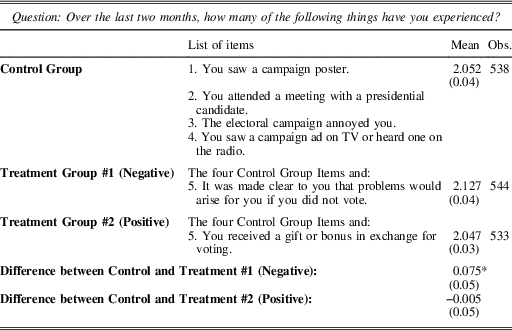
In our project, the list experiment was placed on a nationally representative omnibus survey of 1,600 Russian respondents.Footnote 25 The sample was divided equally into three parts: a control group that was presented with the four innocuous items, a treatment group that was presented with the four innocuous items in addition to a sensitive vote-buying item, and a treatment group that was presented with the four innocuous items in addition to a sensitive intimidation item.Footnote 26 The formulation of the question and results are presented in Table 1. The results indicate that approximately 7.5 per cent of all respondents reported that someone gave them the impression that there would be negative consequences for them if they did not turn out to vote. By contrast, the percentage of respondents that reported being part of a vote-buying transaction was not statistically distinguishable from 0.
List Experiment on Negative and Positive Inducements

Note: the first four lines present the question items for the control and the two treatment groups. Note that both of the treatment groups use the same four items from the control group (1–4) and add the fifth sensitive item (5) respectively for respondents randomly assigned to them. The column Mean gives the mean number of responses for each group, while the column Observations counts the number of respondents in each group. Standard errors given in parentheses and stars reflect p-values as calculated using one-sided t-tests. ***p<0.01, **p<0.05, *p<0.1
Thus in this election, vote buying was rare and about 8 per cent of voters experienced intimidation. As we show later, some types of voters, such as the employed and residents of single-company towns, experienced intimidation at far higher rates.Footnote 27
Observational data from observer organizations also indicate that electoral intimidation is common in Russia. The OSCE/ODIHR’s Election Observation Commission’s Final Report on the 2011 elections indicated that ‘observers received numerous credible allegations of attempts to unduly influence voters’ choices’, including threats by employers, poll workers and candidates.Footnote 28 The OSCE’s report on the 2007 elections reported similar violations.
Similar patterns can be gleaned from the Golos organization’s Karta Narusheniya (Violation Map). This much-publicized internet project, launched in fall 2011, was aimed at gathering crowd-sourced citizen reports of electoral subversion in Russian elections. To construct this database, Golos created a web-based platform that allowed citizens and activists to report electoral violations. The reports were then cleaned and categorized by the non-governmental organization and posted online. We gathered this raw data from their website and coded all 7,600 reported violations from the 2011 elections across several categories (discussed in more detail below).Footnote 29
Where possible, we use this data to demonstrate that real-world data are consistent with findings from the surveys. During the 2011 elections, there were 1,361 reports of voter intimidation.Footnote 30 Interestingly, there were less than half as many – 618 – reports of vote buying.
Yet coercion is clearly not the most common type of inducement in all settings. Bratton finds that reports of vote buying were three times as common as reports of electoral intimidation in the 2007 Nigerian elections.Footnote 31 In surveys carried out by the authors after the 2014 Indonesian parliamentary elections, 22 per cent reported that someone gave them a gift or reward before the election, while only 6 per cent reported that they were intimidated by someone. Mares and Petrova use list experiments to show that vote buying and intimidation were both used in the 2013 Bulgarian parliamentary elections.Footnote 32 Even in Russia many voters do not experience intimidation. The question thus arises: why is coercion applied against some voters and in some settings, but not in others? The next section presents a simple set of arguments to help answer this question.
ARGUMENT
First, consider a politician facing an election in a non-democracy who wants to mobilize voters as cheaply as possible. Non-democratic regimes often generate incentives for politicians to not just win a majority of votes, but to maximize turnout and votes.Footnote 33 A crushing victory at the polls can deter elite challengers to the incumbent and inhibit collective action from opposition movements. However, mobilizing voters is costly and politicians must trade off the costs of mobilization against the benefits of additional votes.
To maximize votes against the cost constraints, we consider three potential strategies that a politician can employ:
1) positive inducements, such as vote buying,
2) negative inducements, such as voter intimidation, and
3) normative appeals, such as appeals to civic duty, or partisan or programmatic goals.
Positive Inducements
Positive inducements entail the exchange of material benefits for support at the ballot box.Footnote 34 Vote buying often occurs in face-to-face transactions between agents of the ruler and the voter.Footnote 35 The payoff (UVB) to the ruler for using vote buying would be:
 $${\rm U}_{{{\rm VB}}} {\equals}{\rm U}\left( {\rm N} \right){\minus}{\rm N}{\asterisk}{\rm p}({\rm y}){\minus}{\rm C}_{{\rm M}} ,$$
where N equals the number of voters receiving benefits, p(y) is the equilibrium price of one vote, and CM denotes the costs of monitoring the voter to ensure that they actually vote. In line with the literature, we assume that the price of one vote increases with the wealth of the voter, which implies that it will be more costly to buy the votes of wealthier voters.Footnote 36
This strategy increases the likelihood of getting a vote, but it also entails costs. First, the politician must consider the size of the benefit needed to buy a vote, which is likely to increase with the wealth of the voter. In other words, it is cheaper to buy the votes of poorer citizens.Footnote 37 This may make vote buying in a middle-income country like Russia less attractive.
Secondly, positive inducements entail monitoring costs because vote-buying politicians run the risk that they will provide a benefit only to see the recipient not deliver the vote. Politicians often must expend resources to create monitoring systems to ensure that voters show up at the polls after receiving their benefit.Footnote 38 More active forms of monitoring turnout include co-opting electoral administrators to disclose vote choice or turnout, or compelling voters to inform party officials about how (or if) they voted. In some systems, the secret ballot may be violated by forcing voters to take non-standard ballots (absentee ballots or mobile ballot boxes) and directly overseeing the process of filling in ballots. In the twenty-first century, an oft-publicized strategy for violating the secret ballot is to require voters to take a photo of their ballot with their mobile phone before submitting it. These forms of active monitoring typically require some organization costs.
Monitoring costs may be reduced where agents of the ruler can rely on dense social ties, organizations or party networks to penetrate the social networks of voters and monitor vote choice.Footnote 39 In some settings, party activists and vote brokers can glean information about the vote choices of people in their social network without creating elaborate formal organizations. This monitoring strategy is likely cheaper than creating an organization to monitor voter behavior.
Negative Inducements
Rather than buying votes, rulers may try to intimidate voters. Employers and state officials are especially well placed to deploy negative inducements against voters. For employers, the physical costs associated with using negative inducements are often lower than for positive inducements.Footnote 40 Ordering employees to vote or issuing threats does not require politicians or their agents to provide a material benefit to the voter as does a positive inducement. In addition, there are economies of scale associated with intimidation that lower its cost vis-à-vis vote buying. For example, if implicit oral intimidation is all that is necessary, then voters can be gathered in a single place and addressed (that is, threatened) simultaneously. By contrast, vote buying generally requires transacting face to face with each voter to ensure they receive the good or service and acknowledge the exchange being offered.
In addition, negative inducements are attractive because they can impose significant costs on voters.Footnote 41 The type of negative inducements used can vary widely across settings. Some state officials can withhold welfare benefits from voters, while others can rely on intermediaries such as employers to hand down much stronger punishments, such as dismissing workers from their jobs. For this reason, employers are likely to be especially effective purveyors of negative inducements.Footnote 42 The implicit or explicit threat of job loss, salary reduction or demotion can make noncompliance potentially very costly. Relative to the typically small payments associated with vote buying, these forms of negative inducement can provide a far more consequential incentive. For this reason we argue that the workplace is likely to be a very common setting for voter intimidation.Footnote 43
In workplace settings, we assume that the utility that the autocrat gets from using voter intimidation is a function of the number of coerced voters, the effectiveness of coercive threats as suggested by the tightness of the labor market and the various costs of intimidation that the autocrat must incur in order to increase turnout.
More specifically, we assume that the utility of intimidation for the autocrat is:
 $${\rm U}_{{\rm I}} {\equals}{\rm U}({\rm N}){\minus}{\rm U}({\rm N}_{{{\rm E,}}} {\rm W}\_{\rm A}){\minus}{\rm C}_{{\rm I}} {\minus}{\rm C}_{{\rm M}} ,$$
where NE is the number of employees, W_A is the alternative wage available in the labor market, CI is the cost of intimidation, and CM is the cost of monitoring. An important assumption is that the benefits to employers of voter intimidation are decreasing in the size of an alternative wage (W_A) in another job. To motivate voters, threats of punishment must be sizable and credible, and both are influenced by the level of competition in the labor market. In slack labor markets where workers face few good alternative options, employers can levy more severe punishments. Moreover, threats of punishment in this setting are likely to be seen as credible because both the worker and the autocrats know the alternative wage available in the market. In tight labor markets, by contrast, where it is costly to find replacement workers, threats of punishment may ring hollow. Thus we expect voter intimidation to be less attractive in tight labor markets.
Politicians must also bear the costs of intimidating voters. Negative inducements may damage politicians’ reputations.Footnote 44 At the extreme, politicians can be held criminally liable for perpetrating violence against voters. Short of criminal prosecution, threats may evoke significant public anger, which can cost the politician votes.Footnote 45 Voters abhor violence, and it is likely to create significance public resonance.Footnote 46 Physical violence is thus especially costly. While threatening workers may not be popular, it is less abhorrent to voters than physical violence. Moreover, it may be difficult for the public to discover that an employer has intimated to his employees that they may face dismissal if the workforce does not turn out.
Negative intimidation also entails opportunity costs for vote mobilizers and their organizations. Vote mobilizers must divert time and effort to craft and transmit threats. In the workplace, for example, resources must be diverted from production in order to mobilize voters. This practice may undermine worker morale and further harm production.
Another potential cost associated with negative inducements is monitoring, CM. All else being equal, we assume that the costs of monitoring turnout via vote buying and vote intimidation are equal, but the details of these costs depend on the specific transaction and the size of the inducement. As with vote buying, rulers must ensure that voters turn out, and monitoring can occur via active forms (such as reporting to superiors on election day) or passive forms (such as relying on dense networks to convey information about participation).
The workplace is often a conducive place in which to monitor voters. In many sectors, employers have long-term relationships with employees and interact repeatedly with them in many contexts. Moreover, employers are often privy to the activities of their employees outside of the workplace. By relying on these types of dense social relations rather than formal structures such as parties or networks of party brokers, politicians can reduce the cost of monitoring by relying on employers in some settings.
Normative Appeals
Where the costs of voter intimidation and vote buying outweigh the benefits, the ruler can turn to normative appeals that involve neither material benefits nor threats of coercion. Rulers may appeal to voters’ sense of civic duty or partisanship, ideology or their identification with personal characteristics of the ruler, such as charisma, energy, etc. Normative appeals that encourage voters to go to the polls for non-material reasons are likely to be less effective in turning out votes, but are less costly than the transactional politics of positive and negative inducements. Where votes are expensive to purchase, labor markets are tight and monitoring costs are high, rulers may rely heavily on normative appeals to motivate voters to go to the polls. The autocrat’s utility for normative appeals is:
 $${\rm U}_{{{\rm NA}}} {\equals}{\rm U}\left( {\rm N} \right){\minus}{\rm C}_{{{\rm NA}}} ,$$
where CNA equals the cost of making a normative appeal, which is minimal. This strategy does not involve costs associated with buying, intimidating or monitoring individual voters. We assume that this strategy is cheap, but less likely to get voters to the polls.
Before an election, a ruler chooses a mobilization strategy. Given the goal of maximizing votes at low cost, s/he will choose the strategy that delivers the most votes at the lowest cost. Under this framework, we can derive the following hypotheses.
First, we expect vote buying to be less prominent when the marginal cost of buying a vote is higher. Thus, vote buying is likely to be relatively rare in a middle-income country like Russia.
Secondly, because coercion is more effective where brokers can make substantial and credible threats, voter intimidation is likely to be especially common in the workplace. Few potential brokers have as much leverage over voters as employers. Employers have many tools at their disposal that allow them to administer sizable threats and punishments. Bosses can threaten to withhold wages, deprive workers of bonuses or perks such as extra holiday time, or even fire employees. Building on previous work on voter mobilization in the workplace,Footnote 47 we argue that employed voters are particularly vulnerable to intimidation and coercion.
Thirdly, intimidation is more likely where employers have greater leverage over employees.Footnote 48 Where labor markets are slack, workers may find it difficult to find employment if they are fired. This increases their dependence on their employer, thereby strengthening the leverage that employers can bring to bear. In single-company towns, for instance, workers may find it difficult to find alternative employment if they are fired.
Fourthly, where employers have less leverage over employees, they may be compelled to employ more expensive forms of active monitoring. For some voters, the threats of punishment are so severe that they may comply even if they believe the probability is rather low that their ballot is not secret. Clearly, for voters who strongly believe that the ballot is not secret, monitoring is not necessary. But any dash of uncertainty about ballot secrecy may be enough to induce voters to the polls if the costs of non-compliance are high.Footnote 49 Voters do not want to risk a severe punishment. This may be the case in single-company towns, where the potential cost of losing one’s job is highly significant. In these cases, the employer can effectively reduce the alternative wage available to the worker so much that even a small probability of being caught shirking on election day can motivate a worker to turn up at the polls.
However, where the employer has less leverage, we might expect politicians to require voters to provide physical proof that they have voted as requested. Put differently, politicians and their agents should expend the costs of active monitoring only on those voters for whom the severity of the potential punishment is insufficient to influence voting behavior. In such settings, they must supplement intimidation with active monitoring efforts.
Workers outside of company towns are more likely to have alternative employment options if they are fired. For these workers, threats of punishment in the workplace have less potency. Therefore, we expect that when the labor market is tight, employers acting as vote mobilizers will need to make extra efforts to monitor voters in order to increase the effectiveness of intimidation.Footnote 50
EMPIRICAL EVIDENCE
In this section we probe the plausibility of our hypotheses using data from the 2011–12 election cycle in Russia. The main empirical evidence comes from questions we placed on the above-mentioned survey following the 2012 presidential election. As Table 1 shows, the list experiment evidence supports our first hypothesis: vote buying is less common than electoral intimidation in Russia. And, as noted above, the Karta Narusheniya data on crowd-sourced violation reports reveal a similar pattern; there are many reports of vote buying, but it is much less common than voter intimidation. Fifty-eight per cent of all ‘brokered’ violations involved intimidation, compared to 27 per cent that involved vote buying. Russia’s high level of income led us to predict that vote buying would be too costly for regime leaders to rely on as their sole strategy, and this seems to be supported by the evidence.
This finding is consistent with work showing that vote buying dies out in more developed countries.Footnote 51 It is also consistent with our own survey results from Indonesia, which has a GDP per capita one quarter that of Russia’s. In Indonesia, 25 per cent of respondents reported receiving something from a political party or vote broker during the 2014 parliamentary election campaign, while 6 per cent reported that someone threatened or intimidated them. And as noted, Bratton finds that vote buying is more common than coercion in Nigeria, which is also much poorer than Russia.Footnote 52
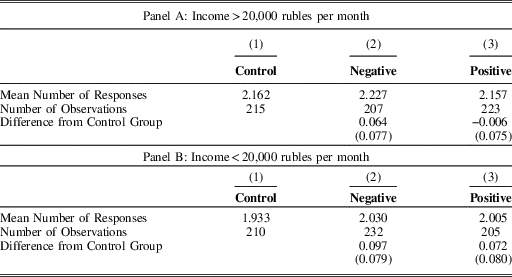
Hypothesis 1 also suggests that vote buying might be less common among poor voters. To examine this claim, we divide our survey sample into a high-income group (50 per cent of the sample with incomes greater than 20,000 rublesFootnote 53 per month) and a low-income group (50 per cent of the sample with incomes less than 20,000 rubles per month). We then compare the mean number of responses across the list experiment’s treatment and control groups within each of the two subsamples. The results, shown in Table 2, offer only weak support for this hypothesis. The difference in the average number of responses between the control group and the vote-buying treatment group is 0.07, which might suggest that 7 per cent of low-income voters experienced vote buying, but this result is not significant at the 0.1 level (p=0.19). In Appendix Figure 1, we bin the income variable into quartiles and graph the coefficients on each treatment, but do not find stronger evidence of a negative relationship between income and vote-buying experience.Footnote 54
Income and Prevalence of Negative/Positive Inducements

Note: standard errors given in parentheses. Stars reflect p-values as calculated using one-sided t-tests. Panels are subset by the total household income of the respondent. ***p<0.01, **p<0.05, *p<0.1
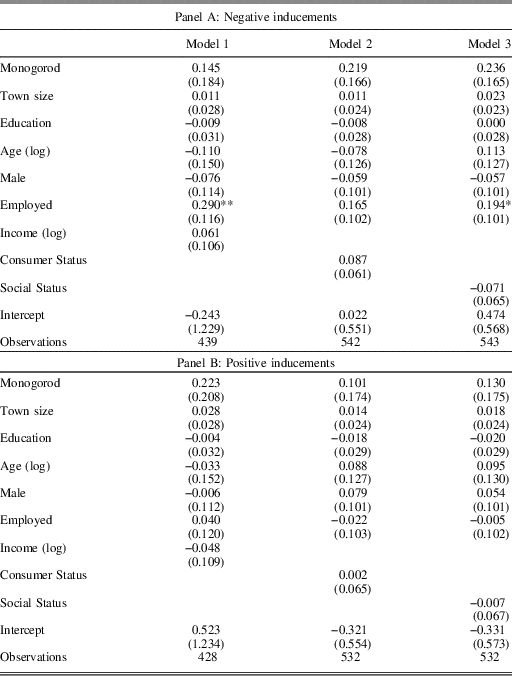
Of course, because income is a continuous variable, splitting the sample excludes useful information. Moreover, this method does not allow us to control for potential confounders. Thus we conduct multivariate analyses on our list experiment; the results are presented in Table 3.Footnote 55 The dependent variable is the number of affirmative responses a respondent gives to the negative/positive list experiment. The coefficients in the ‘Negative’ and ‘Positive’ columns show the difference in the marginal effect of a given covariate between the treatment group and the control group; each treatment group is defined as whether a respondent received an extra item on the list experiment to respond to, whether that item described having been positively or negatively mobilized.Footnote 56 For example, the coefficient on Log Income is −0.048 in the ‘Positive’ inducement models, which indicates that a one-unit increase in Log Income decreases the mean number of affirmative responses in the Positive treatment group by 0.048 units more than a one-unit increase in Log Income decreases the mean number of affirmative responses in the control group. This effect is negative, but the effect size is small and far from statistical significance. Thus there is not compelling evidence in support of Hypothesis 1.
Determinants of Negative and Positive Inducements

Note: the dependent variable is a count of the number of answers the respondent gave to the negative/positive list experiment. Standard OLS is used, making these models akin to interacting each covariate with a dummy variable for the treatment condition(s). The correlations between the covariates and the Control condition are included in the Appendix. ***p<0.01, **p<0.05, *p<0.1
These results contradict existing research, which finds that poor voters are more likely to be targeted with vote-buying offers.Footnote 57 One possible explanation for this surprising finding may have to do with economies of scale. If there are few voters poor enough to respond to vote-buying appeals, politicians may not invest in vote-buying technologies (for example, vote brokers, grassroots party organizations, monitoring capacities) at all. And if, as we discuss below, there are other cost-effective ways of mobilizing votes, then this may further reduce the incentive to invest in vote-buying technologies. Thus in relatively wealthy countries such as Russia, vote buying may be uncommon, even among the poor.
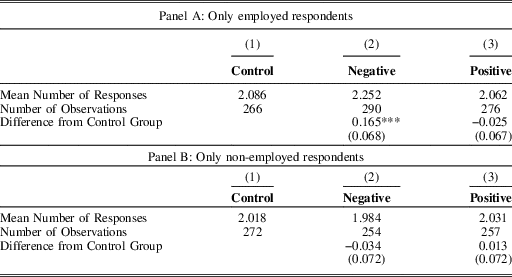
To explore Hypothesis 2, which suggests that voter intimidation should be more likely in the workplace, we divide our survey sample into employed and non-employed subsamples. Respondents are coded as employed if they answered yes to having a job.Footnote 58 The non-employed group includes individuals who are unemployed and looking for work, as well as the structurally unemployed (for example, pensioners, students, stay-at-home parents). We then compare the mean number of responses across the list experiment’s treatment and control groups in each subgroup (employed and non-employed). The results in Table 4 indicate that 17 per cent of employed respondents experienced intimidation before the elections. Non-employed respondents, by contrast, experienced almost no statistically detectable coercion. As Column 1 in Table 3 indicates, these results are confirmed by the multivariate analysis, which shows that employed respondents are significantly more likely to report intimidation than non-employed respondents. Vote buying was not detected among either employed or non-employed respondents.
Employment Status and the Prevalence of Negative/Positive Inducements

Note: panels are subset according to whether the respondent is employed at the time of the survey. Note that the ratio of employed to non-employed respondents is roughly one to one, because of the number of nonworking citizens in Russia, including students, pensioners and stay-at-home parents. Standard errors in parentheses and stars reflect p-values as calculated using one-sided t-tests. ***p<0.01, **p<0.05, *p<0.1
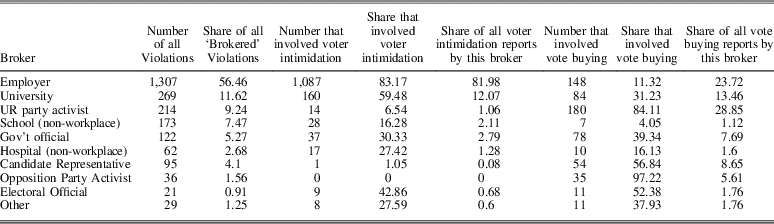
Data from the Karta Narusheniya violation reports paint a similar picture. In Table 5, we code and analyze the 2,328 ‘brokered’ violations in the dataset. These are violations in which an individual – often called a broker in the literature – targets individual voters or groups of voters and infringes on their electoral rights. Violations in our dataset that involve brokered mobilization include: voter intimidation, vote buying, attempts to violate the secret ballot and the organization of repeat voting schemes.Footnote 59
Brokered Electoral Violations from Karta Narusheniya Violation Reports, Russian 2011 Parliamentary Elections

Note: Employer is the only broker category to show a positive and statistically significant bivariate association with voter intimidation (using a chi-squared test). Gov’t Official, Candidate Representative, Opposition Agitator, Electoral Official, and UR Party Activist show a positive and statistically significant bivariate association with vote buying. Share columns may not sum to 100, because multiple brokers may be involved in a single violation report. The ‘Other’ category includes social organizations, priests, police officers, election observers and government employees (byudgetniki) aside from those in hospitals and schools.
As Table 5 shows, the workplace is by far the most common site of brokered violations in Russia: 56 per cent of all such violations occur at work. By contrast, party activists – the vote broker most frequently discussed in the literature on vote buying – are implicated in just over 10 per cent of violations (9.24 per cent by ruling party agitators and 1.56 by opposition party agitators). Even more starkly, the table shows that most reports of electoral intimidation occur in the workplace (83 per cent) and most employer-brokered violations (82 per cent) involved the use of intimidation. Hundreds of violation reports describe employers ordering or commanding their employees to engage in various mobilization activities. Such reports were especially prevalent in the government sector and in large, industrial enterprises.Footnote 60 Employers pressured their employees to turn out, to vote for United Russia, to hand over their passports (which could be used for organizing voting carousels), to vote at work, to obtain absentee ballots and hand them over to their employers, and to mobilize their friends and relatives.
We also coded the types of inducements that were reported in instances of voter intimidation. In over 50 per cent of the cases in which electoral intimidation was applied against employees, the enforcement mechanism was a direct order from a superior, such that fulfilling a political task temporarily became part of the employee’s job description. In these instances, a direct reference to a threat of dismissal was not mentioned, but since failure to fulfill one’s duties or failure to obey directives from superiors is grounds for dismissal in most workplaces, the threat may not need to be explicit. In 29 per cent of reports, employers overtly threatened dismissal if the request met with noncompliance. Reduction in wages or benefits was threatened in 9 per cent of cases. Less common threats included problems with housing or utilities, reductions in financing for the enterprise and problems finding another job. Threats of physical violence were extremely rare (reported in only 0.5 per cent of cases).
Electoral intimidation also occurred in other areas, though with less frequency. Many reports recounted intimidation against university students, where administrators have significant leverage. In primary schools, meanwhile, teachers put pressure on the parents of students, and in hospitals, pressure on patients was often reported. Interestingly, we see that party agitators rarely perpetrated electoral intimidation. This makes sense, since party agitators have far less leverage over voters than employers. Overall, the evidence suggests that most electoral intimidation in Russia is directed against employed voters by their employers.
Table 5 also reveals interesting patterns with respect to vote buying. For one thing, intimidation in the workplace is much more common than vote buying in the workplace. As our theory predicts, the former is more cost effective in a relatively wealthy country. Also consistent with our theory, brokers with little leverage over voters – for example, party activists – are much more likely to engage in vote buying than intimidation. Even though United Russia party activists figured in only 9 per cent of brokered violations, they were responsible for 29 per cent of all vote-buying reports.
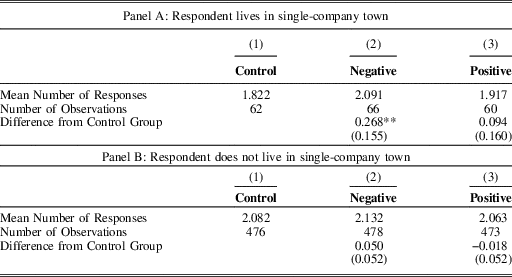
Moving to Hypothesis 3, which suggests that voter intimidation should be more likely where firm bosses have greater leverage over employees, we turn once again to our list experiment from the 2012 elections. We operationalize the leverage of employers with an indicator for whether the respondent lives in one of Russia’s 333 single-company towns, or monogorods. The economic geography of Soviet planning led to the creation of hundreds of settlements that are economically dependent on a single enterprise. In Russia, these monogorod are defined by the federal government as any municipality where a single enterprise or group of interlinked enterprises provide more than 50 per cent of the city’s industrial output. The Russian Government has identified 333 such towns in Russia.Footnote 61
Employer leverage is increased in such settings because losing one’s job at the main enterprise would have catastrophic consequences. When an employee spoils relations with the director of the main enterprise in a single-company town, s/he has fewer position openings that s/he can apply to after losing his/her job. This vulnerability is made all the more severe because many people in single-company towns are dependent on the firm not just for their livelihood, but also for social provisions such as housing, transportation, access to recreational facilities, pre-school and healthcare. In fact, this social dependence may make non-employed individuals in single-company towns more vulnerable to coercion than non-employed respondents elsewhere.Footnote 62 In addition, threats are made more credible in single-company towns because the labor market is usually slack.
Table 6 shows that coercion is much more likely in single-company towns. Our list experiment reveals that approximately 26 per cent of respondents in single-company towns experienced electoral intimidation, compared to only 5 per cent outside single-company towns (a statistically insignificant result).Footnote 63 Vote buying, by contrast, is no more likely in single-company towns.
Single-Company Towns and the Prevalence of Negative/Positive Inducements

Note: panels are subset according to whether the respondent is a resident of a single-company town, or monogorod, where a small number of large enterprises are responsible for the majority of employment and production output. Standard errors in parentheses and stars reflect p-values as calculated using one-sided t-tests. ***p<0.01, **p<0.05, *p<0.1
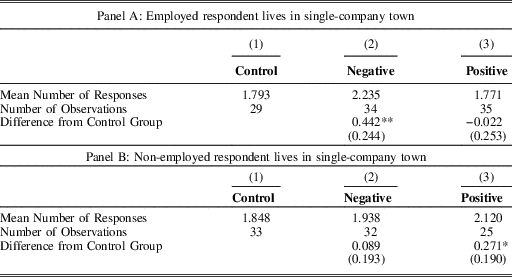
In Table 7, we further examine the mechanisms behind the high levels of electoral intimidation observed in single-company towns. Is it that employed individuals in single-company towns are more vulnerable to employer pressure, or are all individuals vulnerable and just as likely to report pressure in single-company towns? The subsetting in Table 7 indicates that electoral intimidation is much more likely among employed respondents: 44 per cent reported feeling intimidated.Footnote 64 Levels of coercion among the non-employed respondents in single-company towns are also higher than among non-employed respondents in the general population (9 per cent), but with so few observations and a modest effect size, this result does not approach conventional levels of statistical significance.
Single-company Towns, Employment and the Prevalence of Negative/Positive Inducements

Note: the sample used only includes residents of single-company towns, or monogorods, where a small number of large enterprises are responsible for the majority of employment and production output. Panels are subset according to whether a respondent is employed. Standard errors in parentheses and stars reflect p-values as calculated using one-sided t-tests. ***p<0.01, **p<0.05, *p<0.1
In our analysis of the list experiment on vote buying and voter intimidation reported earlier in Table 3, we see that the Monogorod variable is positive in the multivariate analysis but has a large standard error. This is understandable given that the ordinary least squares (OLS) estimator for the list experiment is highly inefficient and only 12 per cent of the sample lives in a monogorod. To address this problem we turn to different data from the 2011 parliamentary elections in Russia. After those elections, the Levada Center asked its respondents the following direct question: ‘Did you notice during the campaign any kind of pressure or coercion by your employer, trying to get you to participate in the elections and support a particular candidate?’ (8 per cent of employed voters answered ‘yes’). In Appendix Table 1, we show the results from a logit model that uses this question as the dependent variable. The coefficient on Single-Company Town is statistically significant and positive, controlling for several possible demographic confounders. Living in a single-company town increases the probability of an employee being pressured by roughly 8 per cent. Importantly, these models contain a control for the size of the town. Thus we have reason to believe that our findings on the prevalence of electoral intimidation in single-company towns is not due to the size of these cities. Of course, responses to this direct question may be affected by social desirability bias, but the fact that these multivariate results are consistent with our list experiment evidence is suggestive.
Finally, to address our last hypothesis about the relationship between employer leverage and monitoring we need a measure of active monitoring attempts. Our survey instrument contained a list experiment designed to measure how frequently voters had to inform someone about their voting behavior. During Russian elections, politicians and vote brokers have numerous tools to compel voters to report their voting behavior, from taking pictures of their ballot on their mobile phone to checking their name off lists outside polling stations. One turnout-monitoring scheme revealed in the Karta Narusheniya data entails giving voters a ticket with an identifier that can be redeemed for a prize handed out by poll workers.Footnote 65 By colluding with poll workers, intermediaries can then examine the redeemed tickets to determine who voted.
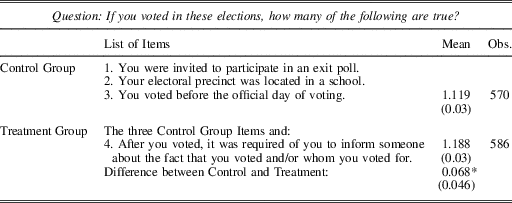
In order to capture these experiences more generally, we devised the following list experiment, presented in Table 8, that includes a sensitive item about vote monitoring. The results show that in the full sample nearly 7 per cent of respondents were required to inform someone of how they voted.
List Experiment on Reporting

Note: the first three lines present the question items for the control and the treatment group. Note that the treatment groups use the same three items from the control group (1–3) and adds a fourth sensitive item (4) for respondents randomly assigned to it. The column Mean gives the mean number of responses for each group while the column Observations counts the number of respondents in each group. Standard errors given in parentheses and stars reflect p-values as calculated using one-sided t-tests.
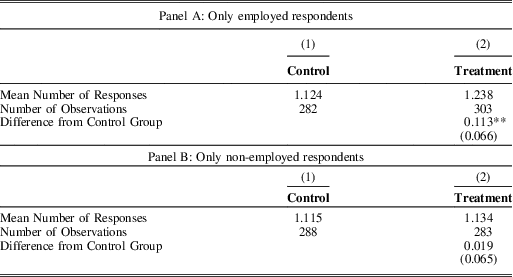
Next, as above, we subset the analysis according to the employment status of the respondent. The results are presented in Table 9 and indicate that reporting is slightly more likely among employed respondents. Employers have more tricks and tools at their disposal to carry out such monitoring. By far the most common monitoring technique in Russia is to require employees to take absentee ballots and vote either in the workplace or at a polling station designated by management.
Employment and the Prevalence of Monitoring

Note: panels are subset according to whether a respondent is employed. Standard errors in parentheses and stars reflect p-values as calculated using one-sided t-tests. ***p<0.01, **p<0.05, *p<0.1
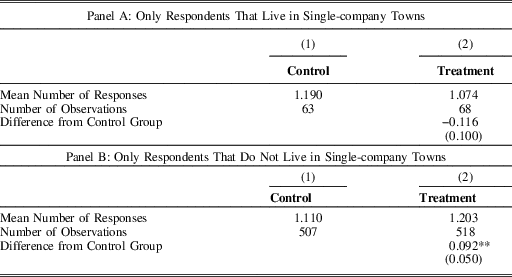
We use this list experiment to evaluate Hypothesis 4, which predicted that where the size and credibility of an inducement are insufficient to determine voter behavior on their own, politicians or their agents will be more likely to require physical proof that voters have voted as requested. As before, we argue that the size and credibility of inducements is higher in single-company towns, where employers have significant leverage over their employees. In Table 10, we divide the list experiment on monitoring into two subsamples, one in single-company towns and one outside single-company towns. The results indicate that active monitoring is more likely outside of single-company towns: 9 per cent of respondents outside of single-company towns reported that someone required them to report about how or whether they voted. There is not a statistically distinguishable difference within single-company towns.
Single-company Towns and the Prevalence of Monitoring

Note: the sample used only includes residents of single-company towns, or monogorods, where a small number of large enterprises are responsible for the majority of employment and production output. Panels are subset according to whether a respondent is employed. Standard errors in parentheses and stars reflect p-values as calculated using one-sided t-tests. ***p<0.01, **p<0.05, *p<0.1
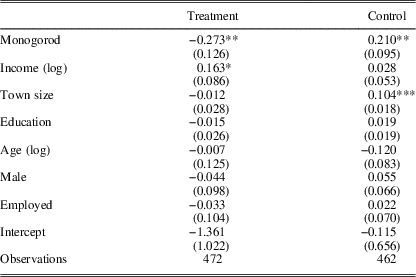
In Table 11, we apply multivariate OLS models on this list experiment and find results that are also consistent with Hypothesis 4: monitoring is less likely in single-company towns. This indicates that employer monitoring efforts may be less prevalent in single-company towns.
Determinants of Active Monitoring Efforts

Note: the dependent variable is a count of the number of answers the respondent gave to the monitoring list experiment. Standard OLS is used, making these models akin to interacting each covariate with a dummy variable for the treatment condition(s). ***p<0.01, **p<0.05, *p<0.1
Our argument and these findings should not be taken to suggest that electoral intimidation and active monitoring are substitutes. When subsetting the list experiment according to employment status outside of single-company towns, we still find that 13 per cent of employed individuals experienced electoral intimidation. Thus it is possible that many of those who experience active monitoring outside of single-company towns are also being intimidated. These findings are only suggestive, but they do indicate that because employer threats outside of single-company towns are less frightening to employees, electoral intimidation must be supplemented with active monitoring efforts in order to induce compliance. In single-company towns, by contrast, the threat of job dismissal is so severe that compliance is all but ensured and costly monitoring is not necessary. This makes voter intimidation more attractive for employers.
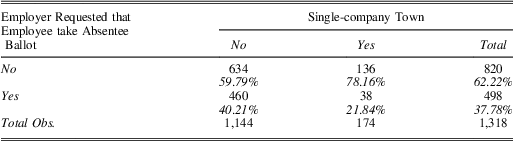
Furthermore, data from the Karta Narusheniya violation reports reveal a similar pattern of monitoring and residency in single-company towns. Table 12 shows that there is a negative and statistically significant association between violation reports from single-company towns and reports that employers asked their employees to take absentee ballots in order to vote in an irregular manner.
Monitoring, Employment and Single-company Towns

Note: Pearson chi-squared=21.68, p<0.001.
CONCLUSION
Voter intimidation and vote buying are common tactics that politicians use to subvert elections, but scholars tend to study one or the other: few studies explore the tradeoffs associated with using these two tactics. Intimidation, we have argued, is likely to be more common in settings where (1) vote buying is expensive, (2) significant negative inducements can be applied at low cost to politicians and (3) the severity of threats obviates the need for costly monitoring. To examine these simple arguments in a non-democratic setting, we used a combination of survey-based list experiments and crowd-sourced reports of electoral subversion from the 2011–12 Russian election cycle. Overall, we find that vote buying was far less common than voter intimidation. In a relatively wealthy country like Russia, buying votes is expensive, while voter intimidation can still be applied at relatively low cost. This is true, for example, in the workplace, where employers exercise significant leverage over voters. In Russia, most intimidation occurs in the workplace and most workplace-based electoral subversion consists of coercion. The practice is especially common in single-company towns where outside employment options are few. We also find that active forms of monitoring, such as required reporting, are more prevalent outside of company towns where employers have less leverage over their employees. It is possible that this form of monitoring is used to supplement intimidation when threats are insufficient to change behavior. This finding suggests another reason why threats might be attractive to politicians: if they are substantial enough, threats may obviate the need to engage in costly monitoring.
Although our data analysis has focused on Russia, our findings suggest some testable cross-national predictions. Vote buying is less common than intimidation in Russia, but this does not seem to be true in many less developed countries. In poor countries with large informal sectors, vote buying is cheaper and politicians lack access to the cost-effective channels of intimidation that operate through the workplace. This is likely to make vote buying an attractive strategy in many less developed countries. In turn, when vote buying – and other strategies – prove insufficient, leaders may resort to election violence.
These results suggest some areas for future research. For example, the extent to which ballot-box fraud acts as a substitute for (or complement to) selective inducements remains unclear. Most models analyze the decision to use ballot-box fraud as a binary one in which fraud is either employed or not employed. Future research could profit by considering the multiple tradeoffs between ballot-box fraud and the various strategies of selective inducements studied here.
Our research also leaves open some questions about the relationship between parties and employers. Our evidence indicates that employers can be reliable vote brokers, but employers likely have different interests and capabilities than the low-level party brokers studied in most of the literature. One area for future research is to think more about how reliance on employer-based vote brokers and party-based vote brokers shapes mobilization. For example, it would be helpful to know more about the conditions under which political elites use employers versus party officials as brokers. Are they complements or substitutes? Do employers and party brokers coordinate their strategies?
Finally, our study has focused on voter intimidation in a single hybrid regime. Contrary to the anecdote in the introduction, we find that during this election cycle Russian vote brokers rarely used carrots, but often turned to sticks. We hope that our analysis can illuminate thinking about this general phenomenon beyond Russia, but further research is needed to confirm that these results will apply to other settings and political contexts.