The harp seal Pagophylus groenlandicus (Erxleben, 1777) is the most usual species in the North Atlantic (Folkow et al., Reference Folkow, Nordøy and Arnoldus2004). This species consists of three populations with three independent breeding grounds, the north-west Atlantic, the Greenland Sea and the White Sea/Barents Sea population (Folkow et al., Reference Folkow, Nordøy and Arnoldus2004; Nordøy et al., Reference Nordøy, Folkow, Potelov, Prischemikhin and Blix2008). The north-west Atlantic population breeds in the Gulf of St Lawrence and off the coasts of Labrador and Newfoundland. The East Greenland population breeds near Jan Mayen Island, and the Barents Sea population breeds in the White Sea. After breeding, harp seals carry out important migratory journeys, always in waters of the North Atlantic and mainly around the Barents Sea (Kovacs, Reference Kovacs2008; Nordøy et al., Reference Nordøy, Folkow, Potelov, Prischemikhin and Blix2008).
Five other species of Arctic seals have been reported in Atlantic waters next to the Strait of Gibraltar (Avellá et al., Reference Avellá, Castells and Mayo1993; Bree, Reference Bree1997), but only the hooded seal Cystophora cristata (Erxleben, 1777) was previously reported inside the Mediterranean Sea (Bellido et al., Reference Bellido, Castillo, Martín, Mons, Farfán and Real2007). There are no prior reports of harp seal occurrence in the Mediterranean basin.
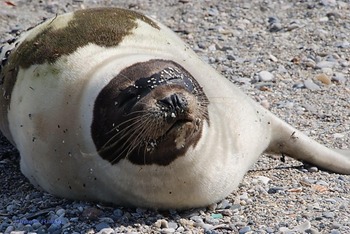
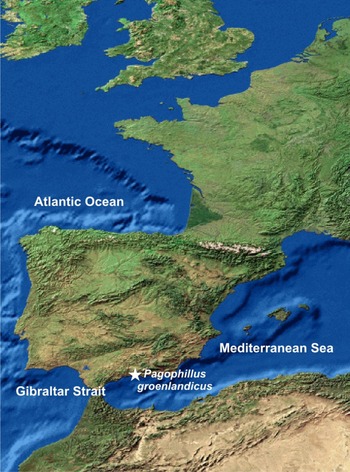
On 26 September 2008, one harp seal was found stranded (Figure 1) in Motril (36°41′N 3°29′W) Granada, Spain, inside the Mediterranean Sea (Figure 2). This specimen was a male with a total length of 170 cm and a weight of 61.5 kg. External anatomical characters and dental formula were used to determine the species of seal. The animal was very sick, extremely thin, with external injuries and presented three species of epibionts (Cirripedia: Lepas hilli Leach, 1818; Conchoderma virgatum, Spengler, 1790; Conchoderma auritum, Linnaeus 1767) (Figure 3) which may be a signal of a long period of weakness (Aznar et al., Reference Aznar, Perdiguero, Pérez del Olmo, Repullés, Agustí and Raga2005) with slow swimming. However, the epibiotic relation between species of genus Conchoderma and high migratory pelagic animals such as swordfish Xiphias gladius (Linnaeus, 1758), bluefin tuna Thunnus thynnus (Linnaeus, 1758) or whales is not unusual in the Mediterranean Sea (i.e. Báez et al., Reference Báez, De la Serna, Macias and Flores-Moya2003). Nevertheless, we did not find reports of similar cases in seals.
Harp seal stranded in Motril (southern Spain).

Location of the harp seal stranding in the Mediterranean Sea.

Epibiont organisms on the stranded harp seal.

The harp seal died on the beach while it was being treated by the emergency team. McAlpine & Walker (Reference Mcalpine and Walker1990) found a low rate of survival in extralimital strandings and sightings on the east coast of the USA, and suggested that this is common in specimens that leave their usual ranges of feeding and breeding and spend the summer in southern waters.
During the necropsy stones and sand were found in the stomach, as well as cephalopods and nematodes. The finding of stones in the stomach is not unusual in this species and it may be related to an aid in the physical breakdown of fish flesh and hard fish bones (Nordøy et al., Reference Nordøy1995). The presence of sand and stones in the stomach has been also confirmed in two specimens of hooded seal stranded on the Mediterranean Spanish coast (Mons et al., Reference Mons, Martín and Castillo1999; Bellido et al., Reference Bellido, Castillo, Martín, Mons, Farfán and Real2007).
Samples of skin, fat tissue, and muscle are kept in the Aula del Mar of Málaga (Spain) under the control of the Consejería de Medio Ambiente de la Junta de Andalucía (Andalusian Government), and the skull is housed in the Vertebrate Collection of the Estación Biológica de Doñana.
This sighting constitutes the southernmost known report for the harp seal worldwide, and could be put in the context of the unusual increase of extralimital records of harp seal reported by McAlpine et al. (Reference Mcalpine, Stevick and Murison1999) in the Gulf of Maine (north-west Atlantic) since the end of the past century. According to MacAlpine et al. (1999) ‘invasion years’ could be impelled by fish stock collapses which would force seals to travel south in search of food or by demographic explosions leading to greater numbers of extralimital animals. Indeed, Gjøsæter et al. (Reference Gjøsæter, Bogstad and Tjelmeland2009) reported a recent collapse of the capelin, Mallotus villosus Müller, 1776, stock in the Barents Sea, which is the principal prey of harp seals (Nordøy et al., Reference Nordøy, Folkow, Potelov, Prischemikhin and Blix2008).
ACKNOWLEDGEMENTS
Data from strandings have been lent by the Consejería de Medio Ambiente de la Junta de Andalucía (Andalusian Government) and the staff of the Vertebrate Collection of the Estación Biológica de Doñana (EBD). This study was partially funded by the project CGL2006-09567/BOS (Ministerio de Ciencia y Tecnología, Spain, and FEDER).